Lip Care Market Overview:
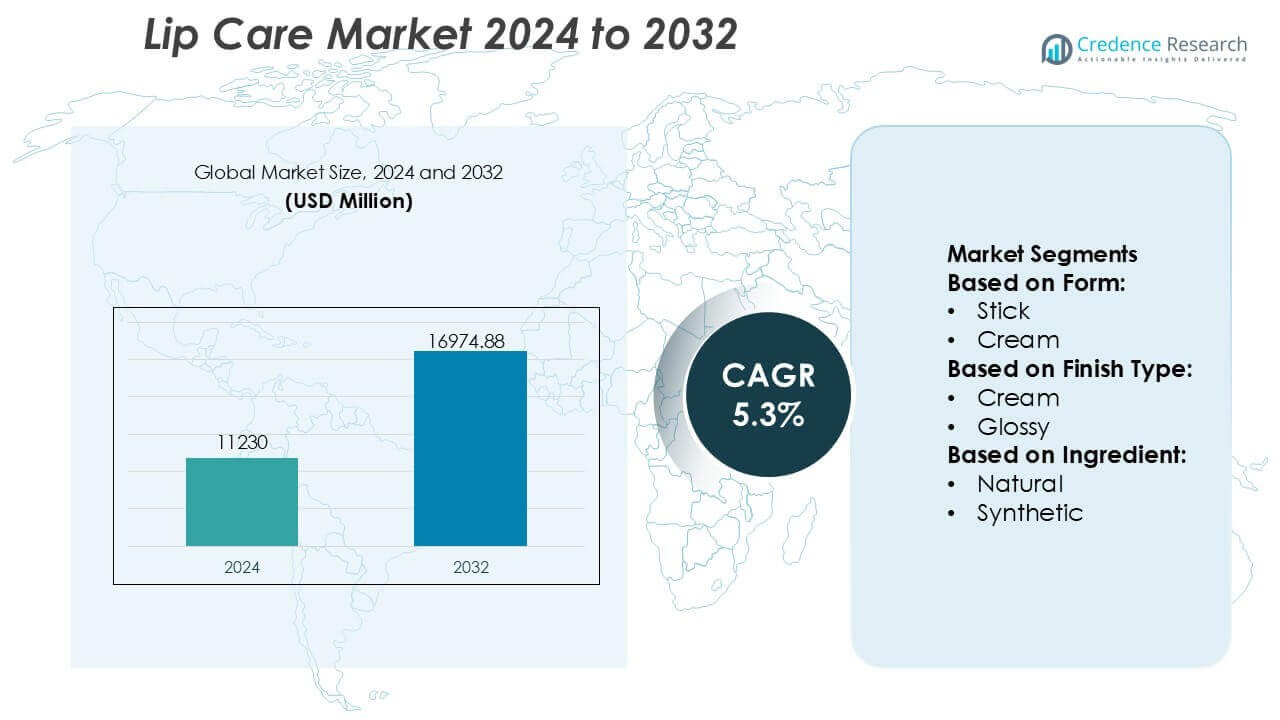
Lip Care Market size was valued USD 11230 million in 2024 and is anticipated to reach USD 16974.88 million by 2032, at a CAGR of 5.3% during the forecast period.
| REPORT ATTRIBUTE | DETAILS |
|---|---|
| Historical Period | 2020-2023 |
| Base Year | 2024 |
| Forecast Period | 2025-2032 |
| Lip Care Market Size 2024 | USD 11230 million |
| Lip Care Market, CAGR | 5.3% |
| Lip Care Market Size 2032 | USD 16974.88 million |
Lip Care Market Insights
- Market growth is primarily driven by rising demand for daily-use lip hydration products, increased awareness of SPF protection, and strong consumer preference for natural and dermatologically tested formulations, with stick-based products dominating at nearly 44% share due to ease of use.
- Key market trends include the rapid adoption of clean-label ingredients, multifunctional lip care products combining color and treatment benefits, and premium packaging supported by strong digital and omnichannel retail penetration.
- The competitive landscape remains moderately consolidated, with leading multinational brands leveraging R&D investments, global distribution networks, and brand loyalty to defend market share across mass and premium segments.
- Regionally, North America leads with an exact 36% market share, followed by Europe, while Asia-Pacific shows the fastest growth driven by expanding urban populations, rising disposable income, and increasing beauty awareness.
Lip Care Market Segmentation Analysis:
By Form
The lip care market by form is led by stick-based products, which hold an estimated around 46% market share, driven by ease of application, portability, and broad consumer familiarity. Lip sticks dominate daily-use and mass-market segments due to their solid format stability, precise application, and compatibility with moisturizing and SPF-infused formulations. Cream and liquid formats are gaining traction in premium and treatment-focused products, supported by higher emollient content and intensive hydration claims. Pencil formats benefit from precision-driven cosmetic use, while powders and niche forms remain limited to specialty applications and trend-driven launches.
- For instance, Unilever's advanced stick-based lip formulations, particularly within its Vaseline and Gluta-Hya ranges, utilize high-performance delivery systems to provide 24-hour sustained hydration.
By Finish Type
By finish type, natural finishes account for the largest share at approximately 34%, supported by growing demand for minimal-makeup aesthetics and everyday lip health products. Consumers increasingly prefer finishes that enhance natural lip tone while delivering hydration and repair benefits. Cream and glossy finishes follow, driven by their association with moisture retention and youthful appearance. Matte finishes remain relevant in cosmetic-focused lip care hybrids but face formulation challenges related to dryness. Shimmery and other finishes cater primarily to occasion-based usage, limiting their overall contribution despite steady demand in fashion-driven segments.
- For instance, Shiseido Company has developed proprietary film-forming technology within its lip formulations that utilizes optimized oil-gel networks to maintain surface flexibility while reducing transepidermal water loss, validated through instrumental hydration measurements exceeding 20 consecutive application hours and friction-reduction testing showing measurable improvement in lip surface smoothness after 7 days of controlled use, as documented in Shiseido’s published formulation research.
By Ingredient
Based on ingredients, natural formulations dominate with nearly 58% market share, reflecting strong consumer preference for clean-label, plant-based, and dermatologically gentle products. Rising awareness of ingredient safety, allergen avoidance, and sustainability has accelerated the adoption of oils, waxes, and botanical extracts in lip care. Natural ingredients also align well with repair, hydration, and sensitivity-focused claims. Synthetic ingredients continue to play a role in improving texture, shelf stability, and performance consistency, particularly in mass-market offerings, but their share is constrained by increasing regulatory scrutiny and evolving consumer perceptions.
Key Growth Drivers
Rising Demand for Daily-Use Personal Care Essentials
The lip care market benefits strongly from its transition from occasional cosmetic use to a daily personal care essential. Increased exposure to pollution, UV radiation, and extreme weather conditions has heightened awareness of lip protection and hydration. Consumers increasingly adopt lip balms and treatments as part of regular skincare routines rather than seasonal products. Growth in urban populations, longer outdoor exposure, and higher spending on preventive personal care support consistent demand. Additionally, the integration of functional benefits such as SPF protection, long-lasting moisture, and repair properties reinforces repeat purchases across diverse age groups.
- For instance, Johnson & Johnson Vision developed the Acuvue® Oasys Max 1-Day Multifocal for Astigmatism contact lens. This advanced product incorporates a precision-engineered silicone hydrogel platform and a quantified blue-light filtering system.
Premiumization and Ingredient-Led Product Differentiation
Premiumization is a major growth driver as consumers prioritize product safety, efficacy, and sensory experience. Lip care brands increasingly emphasize high-quality formulations featuring natural oils, plant butters, vitamins, and dermatologically tested ingredients. This shift aligns with broader clean beauty and wellness movements, encouraging consumers to trade up from basic products to specialized treatments. Anti-aging, tinted care, overnight repair, and therapeutic lip solutions expand average selling prices while enhancing brand loyalty. The growing influence of ingredient transparency and efficacy claims further strengthens consumer trust and purchasing intent.
- For instance, Beiersdorf has leveraged its proprietary Skin Research Center digital diagnostics and content platforms to translate laboratory science into consumer-facing education, supported by formulation technologies such as Eucerit® emulsifier systems developed from over 1,000 controlled formulation trials.
Expanding Influence of Beauty, Fashion, and Digital Media
The rapid expansion of digital platforms has significantly accelerated lip care consumption. Social media, influencer marketing, and beauty tutorials consistently promote new lip care formats, finishes, and application routines. Consumers increasingly view lip care as both functional and aesthetic, driving crossover demand between skincare and color cosmetics. Online retail channels enhance accessibility to niche and international brands, while targeted digital campaigns support faster product adoption. This visibility fuels impulse purchases, trial behavior, and brand experimentation, particularly among younger consumers and urban professionals.
Key Trends & Opportunities
Shift Toward Natural, Clean, and Sustainable Formulations
Sustainability and clean-label positioning represent a key opportunity in the lip care market. Consumers increasingly favor products formulated with natural, organic, and ethically sourced ingredients while avoiding parabens, petroleum-based compounds, and synthetic fragrances. Brands adopting recyclable packaging, cruelty-free certifications, and transparent sourcing practices gain competitive advantage. This trend supports innovation in plant-based waxes, biodegradable packaging, and minimalist formulations. As regulatory scrutiny and consumer awareness increase, sustainable lip care solutions are expected to drive long-term brand differentiation and premium growth opportunities.
- For instance, Avon has reduced its virgin plastic footprint by 23% since 2019 and decreased plastic in its Beauty+ packaging by 34.5% as of 2023. These sustainability efforts are supported by rigorous internal stability testing, where products like lip balms are subjected to accelerated aging at 40 °C for 12 weeks to ensure that texture, spreadability, and functional performance are maintained despite transitions to more sustainable packaging materials.
Growth of Multi-Functional and Hybrid Lip Care Products
Multi-functional products that combine hydration, sun protection, tint, and therapeutic benefits are gaining strong traction. Consumers prefer streamlined routines, encouraging demand for hybrid lip care solutions that address multiple needs in a single application. Products offering SPF, plumping effects, healing properties, or cosmetic finishes align with convenience-driven lifestyles. This trend opens opportunities for brands to innovate across texture, performance duration, and targeted treatments, supporting portfolio expansion and higher consumer engagement across mass and premium segments.
- For instance, L'Oréal S.A. has invested over 1 billion annually in research and innovation, employing more than 4,000 scientists and researchers to develop proprietary Beauty Tech platforms and next-generation testing systems that emulate human biology with numerical precision.
Key Challenges
Intense Competition and Product Commoditization
The lip care market faces intense competition due to low entry barriers and widespread product availability. Numerous global and regional brands offer similar formulations at comparable price points, increasing the risk of commoditization. Price sensitivity in mass-market segments further pressures margins, while frequent product launches shorten innovation cycles. Differentiating products through formulation, branding, and claims requires continuous investment, making it challenging for smaller players to sustain visibility and profitability in crowded retail and digital channels.
Regulatory Compliance and Ingredient Restrictions
Regulatory complexity presents a key challenge for lip care manufacturers. Products applied directly to the lips are subject to stricter safety, labeling, and ingredient regulations across regions. Evolving standards related to allergens, preservatives, UV filters, and natural claims increase formulation and compliance costs. Inconsistent global regulations complicate cross-border expansion and product standardization. Brands must continuously adapt formulations and documentation processes to maintain compliance, which can delay product launches and increase operational complexity.
Regional Analysis
North America
North America leads the lip care market with an estimated 34% market share, supported by high consumer awareness, strong purchasing power, and widespread adoption of daily skincare routines. Demand is driven by year-round usage linked to extreme seasonal weather conditions and high exposure to UV radiation. Consumers actively seek lip care products with SPF protection, long-lasting hydration, and dermatologically tested formulations. The region also benefits from rapid premiumization, with strong demand for natural, organic, and multifunctional lip care solutions. Well-developed retail infrastructure, strong e-commerce penetration, and effective digital marketing further reinforce market dominance.
Europe
Europe accounts for approximately 27% of the global lip care market, driven by strong regulatory standards, sustainability awareness, and a mature cosmetics industry. Consumers in the region prioritize ingredient transparency, eco-friendly packaging, and clean-label formulations, supporting demand for natural and organic lip care products. Cold climates in Northern and Central Europe contribute to consistent year-round usage. Premium and derma-cosmetic lip care products show strong traction, particularly in Western Europe. Established pharmacy chains, specialty beauty retailers, and growing online channels provide broad market access and support steady regional growth.
Asia-Pacific
Asia-Pacific holds around 25% market share and represents the fastest-growing region in the lip care market. Rising disposable incomes, expanding urban populations, and increasing beauty consciousness strongly support demand. Consumers actively adopt lip care as part of daily skincare and cosmetic routines, particularly among younger demographics. The popularity of tinted, glossy, and multifunctional lip care products is rising, driven by social media influence and beauty trends. Expanding e-commerce platforms, strong local brand presence, and growing penetration in emerging economies significantly enhance regional market expansion.
Latin America
Latin America represents an estimated 8% market share, supported by increasing personal care spending and growing awareness of lip protection in warm and high-UV climates. Demand is driven by moisturizing, SPF-based, and tinted lip care products suited to daily outdoor exposure. The region shows strong growth potential due to rising urbanization and expanding middle-income populations. While mass-market products dominate, premium and natural lip care segments are gradually gaining traction. Improving retail accessibility and increasing online beauty sales further support steady regional development.
Middle East & Africa
The Middle East & Africa region accounts for approximately 6% of the global lip care market. Demand is influenced by harsh climatic conditions, including high temperatures, low humidity, and strong sun exposure, which increase the need for protective and hydrating lip care products. Consumers show growing interest in SPF-infused and long-lasting formulations. Market growth is supported by rising beauty awareness, expanding retail infrastructure, and increasing penetration of international brands. However, affordability constraints and uneven distribution networks limit faster adoption across certain countries.
Lip Care Market Segmentations:
By Form:
- Stick
- Cream
By Finish Type:
- Cream
- Glossy
By Ingredient:
- Natural
- Synthetic
By Geography
- North America
- U.S.
- Canada
- Mexico
- Europe
- Germany
- France
- U.K.
- Italy
- Spain
- Rest of Europe
- Asia Pacific
- China
- Japan
- India
- South Korea
- South-east Asia
- Rest of Asia Pacific
- Latin America
- Brazil
- Argentina
- Rest of Latin America
- Middle East & Africa
- GCC Countries
- South Africa
- Rest of the Middle East and Africa
Competitive Landscape
The lip care market players such as Shiseido Company, Revlon, Johnson & Johnson Services, Inc., Beiersdorf, Avon, Procter & Gamble, L'Oréal S.A., Colgate-Palmolive Company. The lip care market is characterized by intense competition driven by continuous innovation, strong branding, and wide product availability across mass and premium segments. Companies focus on developing advanced formulations that deliver long-lasting hydration, protection from environmental stressors, and multifunctional benefits such as SPF, repair, and cosmetic finishes. Differentiation increasingly relies on ingredient quality, clean-label positioning, and sustainability initiatives, including recyclable packaging and ethically sourced materials. Digital engagement, influencer marketing, and direct-to-consumer channels play a crucial role in shaping brand visibility and accelerating product adoption. At the same time, efficient supply chains, regulatory compliance capabilities, and broad retail presence remain essential for maintaining competitiveness and defending market share in a highly crowded global marketplace.
Key Player Analysis
- Unilever
- Shiseido Company
- Revlon
- Johnson & Johnson Services, Inc.
- Beiersdorf
- Avon
- Procter & Gamble
- L'Oréal S.A.
- Colgate-Palmolive Company
- The Estée Lauder Companies
Recent Developments
- In October 2024, NIVEA India officially launched its multi-functional Caring Beauty Lip & Cheek tint in India around October 2024, offering 24-hour moisture, buildable color, and SPF 30 sun protection with key ingredients like Shea Butter, Vitamin E, and Almond Oil, available in shades like Pink, Rose, and Red for a natural look on lips and cheeks.
- In September 2024, L'Oréal, Abolis Biotechnologies, and Evonik formed a tri-party agreement to accelerate the development and large-scale manufacturing of next-generation bio-based ingredients for beauty and beyond. This collaboration is a key part of L'Oréal's sustainability strategy to reduce its environmental impact and meet global demand for responsible beauty products.
- In November 2023, Lion Corporation launched Dent Health Medicated Toothpaste DX in Japan a specialized toothpaste designed to combat periodontitis and cavities, the top causes of tooth loss, by protecting weakened gums and teeth with high concentrations of active ingredients.
Report Coverage
The research report offers an in-depth analysis based on Form, Finish Type, Ingredient and Geography. It details leading market players, providing an overview of their business, product offerings, investments, revenue streams, and key applications. Additionally, the report includes insights into the competitive environment, SWOT analysis, current market trends, as well as the primary drivers and constraints. Furthermore, it discusses various factors that have driven market expansion in recent years. The report also explores market dynamics, regulatory scenarios, and technological advancements that are shaping the industry. It assesses the impact of external factors and global economic changes on market growth. Lastly, it provides strategic recommendations for new entrants and established companies to navigate the complexities of the market.
Future Outlook
- Lip care products will increasingly integrate skincare-grade actives to deliver deeper hydration, barrier repair, and long-lasting protection.
- Demand for natural, clean-label, and dermatologically tested formulations will continue to strengthen across mass and premium segments.
- Multi-functional lip care products combining treatment, sun protection, and cosmetic appeal will gain wider consumer acceptance.
- Sustainable packaging and responsibly sourced ingredients will become central to product development and brand positioning.
- Digital-first marketing and social commerce will play a larger role in influencing product discovery and purchase decisions.
- Personalization and targeted lip care solutions addressing specific concerns will expand product portfolios.
- Growth in men’s grooming and gender-neutral personal care will create new demand opportunities.
- Innovation in textures, finishes, and application formats will support differentiation in crowded retail environments.
- Expansion of e-commerce and direct-to-consumer channels will improve market accessibility across regions.
- Regulatory compliance and ingredient transparency will increasingly shape formulation strategies and consumer trust.

Request a Free Sample
Fill in your details and we'll send you a free sample report.
- Sample data tables & charts
- Research methodology
Market Dynamics
Daily-Use Personal Care Integration
Lip care products have shifted from occasional cosmetic use to daily personal care essentials, driven by increased awareness of environmental stressors like pollution and UV exposure. This has led to higher adoption rates as consumers incorporate lip balms and treatments into regular skincare routines.
Premiumization and Ingredient Transparency
Consumers are increasingly seeking high-quality, natural, and dermatologically tested formulations, fueling demand for premium lip care products. Brands that emphasize clean-label ingredients, efficacy, and transparency are able to command higher prices and foster stronger brand loyalty.
Multi-Functional and Hybrid Product Innovation
The popularity of products that combine hydration, sun protection, tint, and therapeutic benefits is rising, as consumers prefer streamlined routines. This trend encourages brands to develop innovative hybrid solutions that address multiple needs in a single application.
Digital Influence and Omnichannel Retail
Social media, influencer marketing, and beauty tutorials have accelerated product discovery and trial, especially among younger consumers. The expansion of e-commerce and digital-first marketing strategies has broadened market access and increased impulse purchases.
Sustainability and Clean-Label Demand
Growing consumer preference for natural, ethically sourced ingredients and sustainable packaging is driving innovation in plant-based formulations and recyclable materials. Brands that prioritize sustainability gain a competitive edge and appeal to environmentally conscious consumers.
Need a Custom Version of This Report?
Tailor the scope, geography, or segments to your exact requirements.
- Custom geography or segment scope
- Direct access to our analyst team
Frequently Asked Questions
What is the current market size for the Lip Care Market, and what is its projected size in 2032?
At what Compound Annual Growth Rate is the Lip Care Market projected to grow between 2024 and 2032?
Which Lip Care Market segment held the largest share in 2024?
What are the primary factors fueling the growth of the Lip Care Market?
Who are the leading companies in the Lip Care Market?
Which region commanded the largest share of the Lip Care Market in 2024?
Table of Content
Chapter 1 Market Segmentation
- 1.1 Segmentation Framework
- 1.1.1 Product and Service Classification
- 1.1.2 Application and End-Use Classification
- 1.1.3 Technology and Solution Classification
- 1.1.4 Customer and Distribution Channel Classification
- 1.1.5 Geographic Segmentation
- 1.1.6 Market Segment Definitions and Boundaries
- 1.2 By Form
- 1.2.1 Stick
- 1.2.2 Cream
- 1.2.3 Liquid
- 1.2.4 Pencil
- 1.2.5 Powder
- 1.3 By Ingredient
- 1.3.1 Natural
- 1.3.2 Synthetic
- 1.3.3 Hybrid
- 1.4 By Finish Type
- 1.4.1 Natural
- 1.4.2 Cream
- 1.4.3 Glossy
- 1.4.4 Matte
- 1.4.5 Shimmery
Chapter 2 Introduction
- 2.1 Report Objectives and Scope
- 2.2 Product Definition and Industry Terminology
- 2.3 Market Inclusions and Exclusions
- 2.4 Research Process
- 2.4.1 Primary Research and Expert Interviews
- 2.4.2 Secondary Research and Source Review
- 2.4.3 Top-Down and Bottom-Up Estimation
- 2.4.4 Data Triangulation and Verification
- 2.5 Market Size Measurement Basis
- 2.5.1 2024: USD 11,230 million → 2032: USD 16,974.88 million
- 2.6 Historical and Forecast Reference Periods
- 2.6.1 Base Year: 2024
- 2.6.2 Forecast Period: 2024-2032
- 2.7 Research Assumptions and Limitations
Chapter 3 Executive Summary
- 3.1 Market Snapshot and Key Findings
- 3.2 Base-Year Market Size, 2024
- 3.3 Forecast Market Size, 2032
- 3.4 Revenue and Volume Growth Outlook
- 3.5 Key Demand and Supply Indicators
- 3.6 Leading Market Segments
- 3.7 Fastest-Growing Market Opportunities
- 3.8 Regional Performance Highlights
- 3.9 Technology and Industry Transformation
- 3.10 Competitive Landscape Summary
- 3.11 Analyst View and Strategic Implications
Chapter 4 Global Lip Care Market Trends and Developments
- 4.1 Historical Industry Development
- 4.2 Recent Market Trends and Developments
- 4.3 Demand and Customer Behavior Trends
- 4.4 Technology and Product Innovation
- 4.5 Artificial Intelligence, Automation and Digitalization
- 4.6 Local Manufacturing and Supply Chain Realignment
- 4.7 Industry Partnerships, Mergers and Acquisitions
- 4.8 Sustainability and Circular Economy Developments
- 4.9 Government and Private Sector Investment Trends
- 4.10 Emerging Business Models and Commercialization
- 4.11 Industry Developments and Announcements
Chapter 5 Global Lip Care Market Production, Supply and Demand Analysis
- 5.1 Demand Trend and Consumption Analysis
- 5.2 Demand Forecast, 2024-2032
- 5.3 Production and Output Trend
- 5.4 Production and Output Forecast, 2024-2032
- 5.5 Installed Capacity and Capacity Utilization
- 5.6 Company-Wise Production Plants and Statistics
- 5.6.1 Installed Production Capacity
- 5.6.2 Actual Production
- 5.6.3 Planned Capacity and Expansion Targets
- 5.7 Supply Chain Structure and Procurement Trends
- 5.8 Supply-Demand Gap and Bottlenecks
- 5.9 Import Dependence and Sourcing Structure
- 5.10 Contract Manufacturing and Outsourcing
- 5.11 Regional Supply and Demand Concentration
Chapter 6 Global Lip Care Market Pricing Analysis
- 6.1 Pricing Structure and Measurement
- 6.2 Historical Pricing Trends
- 6.3 Pricing Outlook, 2024-2032
- 6.4 Average Selling Price and Unit Economics
- 6.5 Pricing by Product and Market Segment
- 6.6 Geographic Pricing Differences
- 6.7 Key Input, Energy, Labor and Logistics Costs
- 6.8 Contract Pricing and Purchasing Models
- 6.9 Pricing Sensitivity and Competitive Positioning
- 6.10 Price, Margin and Profitability Implications
Chapter 7 Global Lip Care Market Dynamics
- 7.1 Market Growth Drivers
- 7.1.1 Demand-Side Drivers
- 7.1.2 Technology and Innovation Drivers
- 7.1.3 Infrastructure and Investment Drivers
- 7.1.4 Regulatory and Policy Drivers
- 7.2 Market Restraints
- 7.2.1 Cost and Affordability Constraints
- 7.2.2 Technology and Adoption Barriers
- 7.2.3 Supply Chain and Operational Constraints
- 7.3 Market Challenges
- 7.3.1 Competitive Pressure and Margin Erosion
- 7.3.2 Skills, Infrastructure and Implementation Gaps
- 7.4 Emerging Market Opportunities
- 7.5 Market Dynamics Impact and Time-Horizon Assessment
Chapter 8 Global Lip Care Value Chain Analysis
- 8.1 Industry Value Chain Overview
- 8.2 Upstream Suppliers and Critical Inputs
- 8.3 Technology and Component Providers
- 8.4 Manufacturing or Service Delivery
- 8.5 Distribution, Channel Partners and Integrators
- 8.6 Downstream Applications and End Users
- 8.7 Value Addition and Profit Pools
- 8.8 Vertical Integration and Outsourcing
- 8.9 Supplier Concentration and Risk
- 8.10 Supply Chain Localization and Resilience
Chapter 9 Global Lip Care Market Regulations and Policies
- 9.1 Relevant Laws, Standards and Compliance Frameworks
- 9.2 Product, Service, Safety and Quality Requirements
- 9.3 Government Policies, Incentives and Subsidies
- 9.4 Imports, Exports and Trade Barriers
- 9.5 Public Procurement and Local Content Requirements
- 9.6 Environmental and Sustainability Compliance
- 9.7 Upcoming Policy Changes and Market Implications
Chapter 10 Global Lip Care Market Hotspots and Opportunities
- 10.1 Market Opportunity Mapping and Growth Hotspots
- 10.2 High-Growth Applications and Customer Groups
- 10.3 Underserved Markets and White-Space Opportunities
- 10.4 Emerging Technology and Product Opportunities
- 10.5 New Capacity and Investment Hotspots
- 10.6 Market Entry and Expansion Opportunities
- 10.7 Distribution and Partnership Opportunities
- 10.8 Near-Term and Long-Term Commercial Potential
- 10.9 Opportunity Attractiveness and Execution Risks
Chapter 11 Global Lip Care Market Outlook, 2024-2032
- 11.1 Market Size and Analysis
- 11.1.1 Revenue (Market Measurement: 2024: USD 11,230 million → 2032: USD 16,974.88 million)
- 11.1.2 Market Volume and Quantity Sold
- 11.1.3 Historical Market Size
- 11.1.4 Base-Year Market Size, 2024
- 11.2 Market Forecast, 2024-2032
- 11.2.1 Revenue Forecast to 2032
- 11.2.2 Volume Forecast to 2032
- 11.2.3 CAGR and Year-on-Year Growth
- 11.2.4 Incremental Revenue Opportunity
- 11.3 Forecast Assumptions and Scenario Analysis
- 11.3.1 Base-Case Forecast
- 11.3.2 Optimistic and Conservative Scenarios
- 11.3.3 Technology, Pricing and Policy Sensitivities
- 11.4 Market Attractiveness and Growth Outlook
Chapter 12 Global Lip Care Market Segmentation and Outlook
- 12.1 Segmentation Summary and Market Shares, 2024
- 12.2 Largest and Fastest-Growing Segments
- 12.3 By Form - Market Size and Forecast, 2024-2032
- 12.3.1 Segment Definition and Scope
- 12.3.2 Historical Market Size
- 12.3.3 Revenue Forecast, 2024-2032
- 12.3.4 Volume Forecast, 2024-2032
- 12.3.5 Base-Year Market Share, 2024
- 12.3.6 Segment CAGR and Growth Drivers
- 12.3.7 Subsegment Market Size and Forecast
- 12.3.7.1 Stick
- 12.3.7.2 Cream
- 12.3.7.3 Liquid
- 12.3.7.4 Pencil
- 12.3.7.5 Powder
- 12.3.8 Subsegment Pricing and Adoption Trends
- 12.3.9 Leading Suppliers and Competition
- 12.3.10 Regional Demand and Opportunities
- 12.4 By Ingredient - Market Size and Forecast, 2024-2032
- 12.4.1 Segment Definition and Scope
- 12.4.2 Historical Market Size
- 12.4.3 Revenue Forecast, 2024-2032
- 12.4.4 Volume Forecast, 2024-2032
- 12.4.5 Base-Year Market Share, 2024
- 12.4.6 Segment CAGR and Growth Drivers
- 12.4.7 Subsegment Market Size and Forecast
- 12.4.7.1 Natural
- 12.4.7.2 Synthetic
- 12.4.7.3 Hybrid
- 12.4.8 Subsegment Pricing and Adoption Trends
- 12.4.9 Leading Suppliers and Competition
- 12.4.10 Regional Demand and Opportunities
- 12.5 By Finish Type - Market Size and Forecast, 2024-2032
- 12.5.1 Segment Definition and Scope
- 12.5.2 Historical Market Size
- 12.5.3 Revenue Forecast, 2024-2032
- 12.5.4 Volume Forecast, 2024-2032
- 12.5.5 Base-Year Market Share, 2024
- 12.5.6 Segment CAGR and Growth Drivers
- 12.5.7 Subsegment Market Size and Forecast
- 12.5.7.1 Natural
- 12.5.7.2 Cream
- 12.5.7.3 Glossy
- 12.5.7.4 Matte
- 12.5.7.5 Shimmery
- 12.5.8 Subsegment Pricing and Adoption Trends
- 12.5.9 Leading Suppliers and Competition
- 12.5.10 Regional Demand and Opportunities
- 12.6 Segment Growth Comparison
- 12.7 Segment Attractiveness and Priority Matrix
Chapter 13 Global Lip Care Geographic Market Outlook, 2024-2032
- 13.1 Regional Market Size and Share, 2024
- 13.2 Regional Market Forecast, 2024-2032
- 13.3 Regional Pricing, Production and Demand Differences
- 13.4 North America
- 13.4.1 United States
- 13.4.2 Canada
- 13.4.3 Mexico
- 13.5 Europe
- 13.5.1 Germany
- 13.5.2 France
- 13.5.3 Italy
- 13.5.4 United Kingdom
- 13.5.5 Spain
- 13.5.6 Poland
- 13.5.7 Russia
- 13.5.8 Netherlands
- 13.5.9 Belgium
- 13.5.10 Sweden
- 13.5.11 Denmark
- 13.5.12 Norway
- 13.5.13 Rest of Europe
- 13.6 Asia Pacific
- 13.6.1 China
- 13.6.2 India
- 13.6.3 Japan
- 13.6.4 South Korea
- 13.6.5 Thailand
- 13.6.6 Indonesia
- 13.6.7 Vietnam
- 13.6.8 Malaysia
- 13.6.9 Australia
- 13.6.10 Rest of Asia Pacific
- 13.7 Latin America
- 13.7.1 Brazil
- 13.7.2 Argentina
- 13.7.3 Colombia
- 13.7.4 Chile
- 13.7.5 Rest of Latin America
- 13.8 Middle East
- 13.8.1 Saudi Arabia
- 13.8.2 United Arab Emirates
- 13.8.3 Turkey
- 13.8.4 Israel
- 13.8.5 Iran
- 13.8.6 Rest of the Middle East
- 13.9 Africa
- 13.9.1 South Africa
- 13.9.2 Egypt
- 13.9.3 Nigeria
- 13.9.4 Morocco
- 13.9.5 Rest of Africa
- 13.10 Regional Investment, Policy and Supply Chain Differences
- 13.11 Regional Competitive Landscape
- 13.12 Geographic Growth Hotspots
Chapter 14 Global Lip Care Technology, Innovation and Sustainability Outlook
- 14.1 Technology Landscape and Maturity
- 14.2 Product, Process and Service Innovation
- 14.3 AI, Automation and Digital Tools in the Industry
- 14.4 Technology Adoption and Performance Benchmarking
- 14.5 Innovation Pipeline and R&D Investment
- 14.6 Patent and Intellectual Property Trends
- 14.7 Energy Efficiency and Resource Management
- 14.8 Sustainability, Recycling and Circularity
- 14.9 Technology Roadmap, 2024-2032
- 14.10 Risks of Obsolescence and Technology Substitution
Chapter 15 Global Lip Care Market Key Strategic Imperatives
- 15.1 Growth and Market Entry Priorities
- 15.2 High-Return Products and Segments
- 15.3 Pricing, Profitability and Cost Optimization
- 15.4 Technology Investment and Product Differentiation
- 15.5 Supply Chain Localization and Resilience
- 15.6 Distribution and Customer Acquisition
- 15.7 Partnership, Acquisition and Capacity Strategy
- 15.8 Regional Expansion Priorities
- 15.9 Short-, Medium- and Long-Term Actions
Chapter 16 Competition Outlook
- 16.1 Industry Competition Characteristics
- 16.2 Market Structure and Concentration
- 16.3 Market Share and Competitive Positioning, 2024
- 16.4 Company-Wise Revenue and Product Benchmarking
- 16.5 Production and Service Capacity Benchmarking
- 16.6 Technology, Pricing and Differentiation
- 16.7 Regional Footprint and Distribution Strength
- 16.8 Mergers, Acquisitions and Strategic Alliances
- 16.9 New Entrants and Competitive Threats
- 16.10 Porter's Five Forces and Industry Attractiveness
- 16.11 Competitive Outlook, 2024-2032
Chapter 17 Company Profiles
- 17.1 Company Coverage and Selection Criteria
- 17.2 Unilever
- 17.2.1 Business Description
- 17.2.2 Company Ownership and Geographic Presence
- 17.2.3 Product and Service Portfolio
- 17.2.4 Manufacturing and Operating Footprint
- 17.2.5 Production Capacity and Expansion Plans
- 17.2.6 Financial Performance and Investment
- 17.2.7 Market Share and Competitive Position
- 17.2.8 Technology and Innovation Capabilities
- 17.2.9 Strategic Alliances or Partnerships
- 17.2.10 Recent Developments
- 17.2.11 Growth Strategy and Outlook
- 17.3 Shiseido Company
- 17.4 Revlon
- 17.5 Johnson & Johnson Services, Inc.
- 17.6 Beiersdorf
- 17.7 Avon
- 17.8 Procter & Gamble
- 17.9 L'Oréal S.A.
- 17.10 Colgate-Palmolive Company
- 17.11 The Estée Lauder Companies
- 17.12 Other Relevant Market Participants
Note: Every listed company is profiled on the structure shown under the first company. The company list is preliminary and may change based on research findings, market developments, data availability and client requirements.
Chapter 18 Disclaimer
- 18.1 Research and Forecast Disclaimer
- 18.2 Data Source and Estimation Limitations
Note: The depth of individual sections depends on data availability for this market. Volume, capacity, trade and other unit-based metrics are included where applicable.