
| REPORT ATTRIBUTE | DETAILS |
|---|---|
| Historical Period | 2020-2023 |
| Base Year | 2024 |
| Forecast Period | 2025-2032 |
| Medical Device Contract Manufacturing Market Size 2023 | USD 79,181.52 million |
| Medical Device Contract Manufacturing Market, CAGR | 11.59% |
| Medical Device Contract Manufacturing Market Size 2032 | USD 1,90,413.87 million |
Market Overview
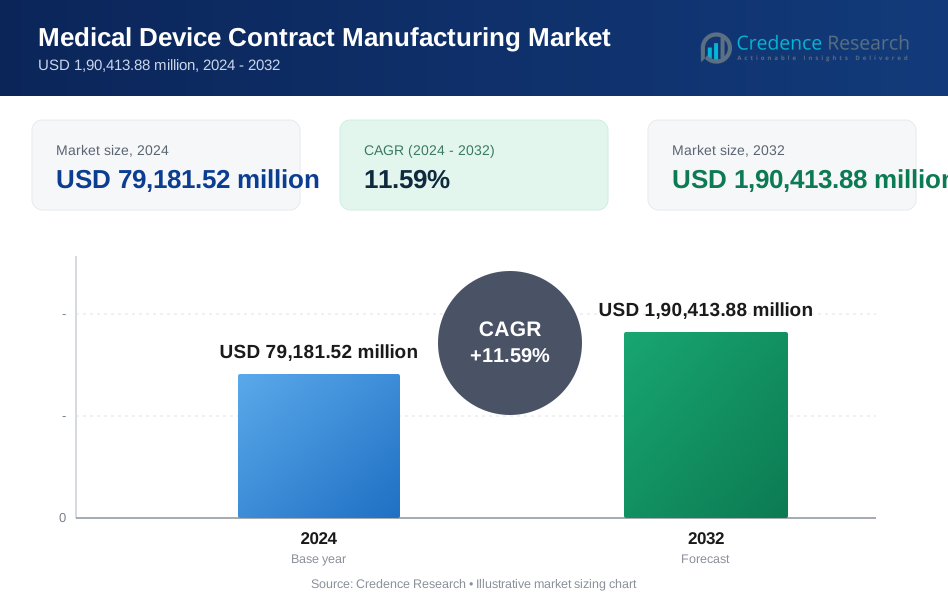
Global Medical Device Contract Manufacturing market size was valued at USD 79,181.52 million in 2024 and is anticipated to reach USD 1,90,413.87 million by 2032, at a CAGR of 11.59% during the forecast period (2024-2032).
The global medical device contract manufacturing market is experiencing robust growth, driven by increasing demand for cost-effective and high-quality medical devices, rising prevalence of chronic diseases, and the growing aging population worldwide. Technological advancements in medical devices, such as miniaturization and the integration of smart technologies, are encouraging OEMs to outsource production to specialized contract manufacturers. Additionally, stringent regulatory requirements and the need for compliance are prompting companies to partner with CMOs that offer expertise in navigating complex approval processes. Emerging markets in Asia-Pacific and Latin America present lucrative opportunities due to lower production costs and expanding healthcare infrastructure. Moreover, trends such as increased adoption of additive manufacturing, automation, and personalized medicine are reshaping the industry landscape. The emphasis on strategic partnerships, faster time-to-market, and scalability continues to drive OEMs toward flexible and innovative contract manufacturing solutions, ensuring sustainable growth and competitive advantage in an evolving global healthcare ecosystem.
The global medical device contract manufacturing market is shaped by distinct geographical dynamics, with North America, Europe, and Asia-Pacific being key regions driving growth. North America leads due to its well-established healthcare systems and stringent regulatory environment, while Europe benefits from a strong focus on innovation and compliance. Asia-Pacific, with its expanding healthcare infrastructure and cost-effective production, is rapidly gaining ground. Latin America and the Middle East & Africa represent emerging markets with increasing demand for medical devices. Key players in the market include Jabil Inc., Thermo Fisher Scientific Inc., Integer Holdings Corporation, Sanmina Corporation, and Celestica Inc., all of which are recognized for their expertise in providing comprehensive manufacturing solutions. These companies focus on expanding their global footprint through strategic partnerships, technological advancements, and regulatory compliance, offering end-to-end services that cater to the evolving needs of the medical device industry.
Market Insights
- The global medical device contract manufacturing market was valued at USD 79,181.52 million in 2024 and is expected to reach USD 1,90,413.87 million by 2032, growing at a CAGR of 11.59% during the forecast period (2024-2032).
- Increasing demand for cost-efficiency, innovation, and operational flexibility is driving the outsourcing of medical device manufacturing to specialized contract manufacturers.
- The integration of advanced manufacturing technologies such as 3D printing, robotics, and automation is transforming production capabilities, enabling faster and more customized device production.
- Key players in the market include Jabil Inc., Thermo Fisher Scientific, Integer Holdings, Sanmina, and Celestica, which are enhancing their market position through strategic partnerships and technological advancements.
- Stringent regulatory requirements and quality standards are challenges for manufacturers, demanding significant investments in compliance and risk management.
- Asia-Pacific is the fastest-growing region, driven by cost-effective production, a skilled workforce, and growing healthcare demands.
- North America and Europe continue to dominate, supported by established healthcare systems, technological innovation, and regulatory expertise
Report Scope
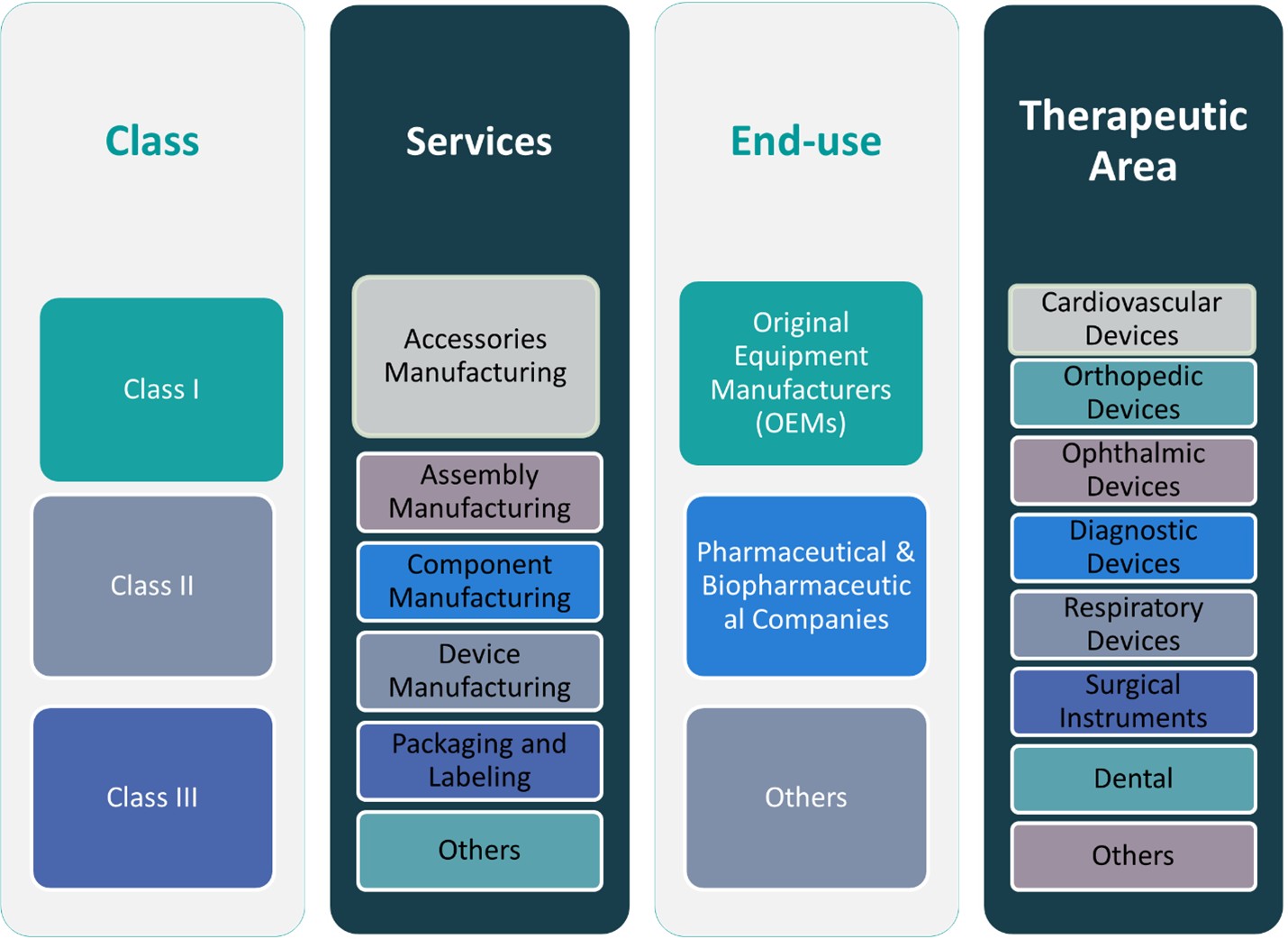
This report segments the Global Medical Device Contract Manufacturing market as follows:
Market Drivers
Rising Demand for Cost-Efficiency and Operational Flexibility
One of the primary drivers of the global medical device contract manufacturing (MDCM) market is the growing need for cost-effective production models. By leveraging the expertise and infrastructure of contract manufacturers, OEMs can focus on their core competencies, such as research, innovation, and marketing, while maintaining profitability. Additionally, outsourcing allows for scalability in production and rapid response to market demand fluctuations, providing greater operational flexibility and competitive advantage.
- For instance, OEMs in the healthcare sector are increasingly outsourcing manufacturing processes to third-party contract manufacturers to reduce overhead costs and streamline operations.
Regulatory Pressures and Compliance Expertise
The increasingly stringent regulatory landscape across global markets is another key factor propelling demand for contract manufacturing services. Navigating these complex regulatory requirements can be challenging and resource-intensive for OEMs. Contract manufacturers, especially those with ISO certifications and proven track records, offer valuable regulatory expertise, helping OEMs mitigate risk and accelerate market entry. Their ability to manage documentation, audits, and certifications not only ensures compliance but also strengthens product credibility and market acceptance.
- For instance, the U.S. FDA requires medical device contract manufacturers to comply with the Quality System Regulation (QSR), ensuring adherence to safety and efficacy standards.
Technological Advancements and Product Complexity
As medical technologies evolve, devices are becoming more sophisticated, integrating advanced functionalities such as robotics, AI, wearable sensors, and miniaturized components. These innovations require specialized manufacturing capabilities, which many OEMs lack in-house. Contract manufacturers equipped with cutting-edge technologies and expertise in precision engineering are well-positioned to meet these complex production requirements. Furthermore, the rise of additive manufacturing and automation has revolutionized prototyping and mass production processes, enabling faster turnaround times and greater customization. These technological capabilities make contract manufacturers essential partners in the development of next-generation medical devices.
Expanding Healthcare Infrastructure in Emerging Markets
The rapid development of healthcare infrastructure in emerging economies—particularly in Asia-Pacific, Latin America, and parts of the Middle East and Africa—is contributing significantly to the growth of the MDCM market. Governments in these regions are investing heavily in healthcare facilities, medical technology, and accessibility, creating a surge in demand for a wide range of medical devices. Contract manufacturers operating in or near these markets benefit from lower production costs, access to skilled labor, and proximity to growing customer bases. Moreover, strategic partnerships and joint ventures between global OEMs and regional contract manufacturers are fostering technology transfer, boosting local manufacturing capabilities, and enhancing global supply chain resilience.
Market Trends
Shift Toward Strategic Partnerships and Long-Term Collaborations
A prominent trend in the global medical device contract manufacturing (MDCM) market is the growing preference for strategic, long-term partnerships between OEMs and contract manufacturers. Rather than transactional, project-based engagements, OEMs are increasingly seeking integrated partnerships that span from early-stage development through full-scale manufacturing and post-market support. This shift enables deeper collaboration, better alignment of goals, and improved product outcomes. Contract manufacturers are evolving into comprehensive service providers, offering design assistance, regulatory guidance, and supply chain management, creating a more value-driven and collaborative ecosystem across the medical device industry.
- For instance, MedTech OEMs are increasingly collaborating with contract development and manufacturing organizations (CDMOs) to integrate design, regulatory guidance, and supply chain management into a single streamlined process.
Growing Focus on Sustainability and Environmental Compliance
Sustainability is becoming a critical consideration in the medical device manufacturing value chain. Contract manufacturers are responding to increasing pressure from regulators, consumers, and OEM partners to adopt environmentally responsible practices. Green manufacturing is no longer optional but a competitive differentiator, especially for companies aiming to strengthen ESG (Environmental, Social, and Governance) credentials. As a result, many contract manufacturers are incorporating sustainable design principles and eco-friendly production methods into their operations.
- For instance, medical device manufacturers are implementing green manufacturing practices to comply with global environmental standards such as RoHS and REACH.
Integration of Advanced Manufacturing Technologies
The incorporation of advanced manufacturing technologies, such as additive manufacturing (3D printing), robotics, automation, and precision machining, is transforming the MDCM landscape. These technologies enhance production efficiency, reduce lead times, and enable rapid prototyping and customization of complex medical devices. Contract manufacturers are investing in smart manufacturing solutions to meet the increasing demand for minimally invasive and patient-specific devices. The adoption of Industry 4.0 practices including data analytics, IoT-enabled machinery, and cloud-based monitoring also allows manufacturers to optimize workflows and ensure high product quality with real-time performance insights.
Rising Demand for Small-Batch and Personalized Devices
With the advancement of personalized medicine and the rise in patient-specific treatments, there is growing demand for small-batch and custom medical device manufacturing. Traditional high-volume manufacturing models are being complemented by flexible, low-volume production capabilities that can cater to niche markets and tailored therapies. Contract manufacturers are adapting to this trend by offering more agile production systems and modular manufacturing lines. This shift is particularly evident in areas such as orthopedics, dental devices, and wearable health technologies, where customization significantly enhances patient outcomes and satisfaction.
Market Challenges Analysis
Regulatory Complexity and Quality Assurance Pressures
One of the most significant challenges in the global medical device contract manufacturing (MDCM) market is navigating the complex and ever-evolving regulatory environment. Ensuring compliance across multiple jurisdictions requires robust quality management systems, thorough documentation, and continuous process validation. Any deviation or lapse can lead to delayed approvals, product recalls, or legal liabilities, which can damage reputations and result in financial losses. As regulatory requirements continue to evolve, especially with the introduction of new standards like the EU MDR, manufacturers must constantly invest in compliance infrastructure, skilled personnel, and audit readiness adding operational burden and increasing cost pressures.
- For instance, the U.S. FDA mandates compliance with the Quality System Regulation (QSR), requiring contract manufacturers to implement rigorous quality management systems.
Supply Chain Disruptions and Rising Input Costs
Global supply chain volatility presents another pressing challenge for contract manufacturers. The COVID-19 pandemic exposed significant vulnerabilities in sourcing raw materials, components, and medical-grade packaging materials, many of which are sourced from a limited number of suppliers or countries. Geopolitical tensions, logistical delays, and inflation have further exacerbated the unpredictability of supply chains, leading to increased lead times and rising input costs. For contract manufacturers operating on tight margins, managing these disruptions while maintaining quality and delivery timelines is increasingly difficult. In addition, fluctuations in currency exchange rates and rising labor costs, particularly in traditionally low-cost manufacturing hubs, have added to the financial strain. To remain competitive, manufacturers must explore strategies such as supplier diversification, nearshoring, and greater investment in supply chain risk management yet these strategies themselves require time and resources to implement effectively.
Market Opportunities
The global medical device contract manufacturing market presents substantial opportunities driven by the growing demand for innovative, high-quality, and cost-effective medical devices across developed and emerging economies. As healthcare systems worldwide focus on improving patient outcomes and reducing treatment costs, OEMs are increasingly outsourcing complex manufacturing processes to specialized contract manufacturers. This trend is particularly evident in high-growth areas such as minimally invasive devices, diagnostic equipment, and wearable health technologies. Contract manufacturers that offer end-to-end services from product design and prototyping to regulatory support and full-scale production are well-positioned to attract long-term partnerships with global OEMs seeking integrated, scalable, and efficient solutions.
Emerging markets, particularly in Asia-Pacific, Latin America, and the Middle East, offer untapped potential for contract manufacturing growth due to expanding healthcare infrastructure, rising disposable incomes, and increasing access to healthcare services. Additionally, the growing focus on personalized medicine and small-batch production creates opportunities for manufacturers with flexible capabilities and rapid turnaround processes. The adoption of advanced technologies, including 3D printing, automation, and smart manufacturing, further enhances competitiveness by enabling greater customization, faster development cycles, and higher product quality. As regulatory expectations become more harmonized globally, contract manufacturers with strong compliance expertise and international certifications will have a strategic advantage in accessing broader markets. Overall, the evolving landscape of global healthcare delivery, coupled with technological innovation and a shift toward outsourcing, sets a promising foundation for sustained growth in the medical device contract manufacturing sector.
Market Segmentation Analysis:
By Class:
The global medical device contract manufacturing market is segmented into three primary classes—Class I, Class II, and Class III—each with distinct regulatory requirements and manufacturing needs. Class I devices are the least complex and generally carry the lowest regulatory burden. These include products such as surgical instruments, bandages, and simple diagnostic devices. The demand for Class I medical devices is driven by their broad applicability across healthcare settings, with relatively straightforward manufacturing processes. In contrast, Class II devices, which include products like infusion pumps and diagnostic imaging devices, require more stringent controls and must undergo regulatory reviews. These devices often demand higher precision in design and manufacturing. Class III devices are the most complex and high-risk, including implantable devices and life-sustaining products like pacemakers. Due to their complexity, manufacturers need specialized knowledge and advanced technologies, making them a high-value segment for contract manufacturers. The increasing demand for high-quality and compliant devices in all three classes is driving steady growth in the contract manufacturing sector.
By Services:
The global medical device contract manufacturing market is further segmented by services, offering a broad range of specialized manufacturing capabilities. Accessories Manufacturing involves the production of peripheral components that complement primary medical devices, such as battery packs and connectors, which are crucial for device functionality. Assembly Manufacturing focuses on the final assembly of medical devices, ensuring that components are integrated to meet operational standards and regulatory requirements. Component Manufacturing plays a vital role in producing essential parts, such as sensors and connectors, which are integral to the overall performance of medical devices. Device Manufacturing encompasses the full production process for medical devices, from prototyping to large-scale manufacturing, ensuring that end products meet both technical and regulatory specifications. Packaging and Labelling are critical for ensuring product safety and compliance, involving the proper sealing and clear labeling of devices, while also ensuring protection during distribution. Other specialized services cater to unique manufacturing needs across niche medical device segments. Each of these services plays a critical role in supporting the broader healthcare ecosystem by ensuring high-quality, reliable products.
Segments:
Based on Class:
- Class I
- Class II
- Class III
Based on Services:
- Accessories Manufacturing
- Assembly Manufacturing
- Component Manufacturing
- Device Manufacturing
- Packaging and Labelling
- Others
Based on End- Use:
- Original Equipment Manufacturers (OEMs)
- Pharmaceutical & Biopharmaceutical Companies
- Others
Based on Therapeutic Area:
- Cardiovascular Devices
- Orthopedic Devices
- Ophthalmic Devices
- Diagnostic Devices
- Respiratory Devices
- Surgical Instruments
- Dental
- Others
Based on the Geography:
- North America
- U.S.
- Canada
- Mexico
- Europe
- UK
- France
- Germany
- Italy
- Spain
- Russia
- Belgium
- Netherlands
- Austria
- Sweden
- Poland
- Denmark
- Switzerland
- Rest of Europe
- Asia Pacific
- China
- Japan
- South Korea
- India
- Australia
- Thailand
- Indonesia
- Vietnam
- Malaysia
- Philippines
- Taiwan
- Rest of Asia Pacific
- Latin America
- Brazil
- Argentina
- Peru
- Chile
- Colombia
- Rest of Latin America
- Middle East
- UAE
- KSA
- Israel
- Turkey
- Iran
- Rest of Middle East
- Africa
- Egypt
- Nigeria
- Algeria
- Morocco
- Rest of Africa
Regional Analysis
North America
North America holds the largest market share, accounting for approximately 40% of the global market. The region benefits from a well-established healthcare infrastructure, significant investments in medical research, and the presence of leading Original Equipment Manufacturers (OEMs). Additionally, stringent regulatory standards in the U.S. and Canada ensure high product quality, which drives demand for specialized contract manufacturing services. The growing trend of outsourcing production to reduce costs while maintaining quality is further boosting market growth in North America.
Europe
In Europe, the medical device contract manufacturing market holds a substantial share of about 35%. The region is characterized by robust healthcare systems, increasing demand for advanced medical technologies, and a strong regulatory framework. Countries like Germany, the UK, and France are leading in terms of market share within Europe. The region’s aging population and the rising incidence of chronic diseases have contributed to the growing demand for medical devices, leading to a heightened need for reliable contract manufacturers. European companies are also focusing on sustainability, regulatory compliance, and innovation in the medical device manufacturing sector, which aligns with the broader global market trends.
Asia-Pacific
The Asia-Pacific (APAC) region is one of the fastest-growing markets, with a market share of approximately 25%. Emerging economies, particularly in China, India, and Southeast Asia, are becoming key players in the global medical device contract manufacturing landscape. The rapid expansion of healthcare infrastructure, lower production costs, and access to a skilled labor force make APAC an attractive destination for outsourcing medical device manufacturing. Additionally, the region's growing middle class and increasing healthcare expenditures are driving demand for affordable, high-quality medical devices. As a result, APAC is expected to see significant market growth during the forecast period.
Latin America and the Middle East & Africa (MEA),
In Latin America and the Middle East & Africa (MEA), the medical device contract manufacturing market holds a smaller yet promising share of about 10%. The Latin American market, especially in Brazil and Mexico, is experiencing growth due to improvements in healthcare access and rising demand for medical technologies. Meanwhile, the MEA region is benefiting from increasing investments in healthcare infrastructure and the establishment of new healthcare facilities. The growth in these regions, although slower compared to North America and Europe, presents untapped opportunities for contract manufacturers looking to expand into emerging markets with evolving medical needs.
Key Player Analysis
- Jabil Inc.
- Thermo Fisher Scientific Inc.
- Integer Holdings Corporation
- Sanmina Corporation
- Celestica Inc.
Competitive Analysis
The competitive landscape of the global medical device contract manufacturing market is highly dynamic, with several key players leading through technological innovation, strategic partnerships, and global expansion. Major companies such as Jabil Inc., Thermo Fisher Scientific Inc., Integer Holdings Corporation, Sanmina Corporation, and Celestica Inc. dominate the market by offering end-to-end contract manufacturing services, including design, prototyping, production, packaging, and regulatory support. These companies leverage their global manufacturing footprints and strong R&D capabilities to meet the evolving demands of OEMs for high-quality, cost-effective, and scalable medical devices. Competition is further intensified by a growing focus on advanced technologies like additive manufacturing, automation, and smart production systems, which enhance precision and reduce time-to-market. To strengthen their market presence, key players are actively investing in expanding their production facilities, especially in emerging regions such as Asia-Pacific. Moreover, partnerships with medical technology firms and healthcare providers are enabling these manufacturers to offer more integrated and value-added solutions.
Recent Developments
- In February 2025, Jabil completed the acquisition of Pii, a contract development and manufacturing organization (CDMO) specializing in aseptic filling, lyophilization, and oral solid dose manufacturing.
- In November 2024, Integer completed the sale of its non-medical Electrochem business for $50 million, making it a pure-play medical technology company and allowing it to redeploy capital into high-growth medtech markets.
- In October 2024, At CPHI Milan 2024, Thermo Fisher launched its Accelerator Drug Development platform, a 360° CDMO and CRO offering. This service provides customizable manufacturing, clinical research, and supply chain solutions for small molecules, biologics, and cell and gene therapies, covering the full drug development lifecycle.
Market Concentration & Characteristics
The global medical device contract manufacturing market demonstrates a moderately concentrated structure, with several key players commanding a substantial portion of the industry due to their broad service capabilities, technological advancements, and global reach. These companies typically offer full-service solutions, including design, engineering, prototyping, regulatory support, and large-scale production, which positions them as preferred partners for major medical device OEMs. The market is marked by high entry barriers, primarily driven by stringent regulatory standards, significant capital requirements, and the need for technical expertise. Additionally, the industry places a strong emphasis on precision, quality assurance, and compliance with international healthcare regulations. While large firms dominate, there is increasing room for smaller, specialized manufacturers to serve niche segments, particularly in emerging markets. Long-term contracts, innovation-driven partnerships, and a growing demand for outsourcing continue to shape the market's competitive landscape, making flexibility, compliance, and advanced manufacturing capabilities critical to sustained success.
Report Coverage
The research report offers an in-depth analysis based on Class, Services, End-Use, Therapeutic Area and Geography. It details leading market players, providing an overview of their business, product offerings, investments, revenue streams, and key applications. Additionally, the report includes insights into the competitive environment, SWOT analysis, current market trends, as well as the primary drivers and constraints. Furthermore, it discusses various factors that have driven market expansion in recent years. The report also explores market dynamics, regulatory scenarios, and technological advancements that are shaping the industry. It assesses the impact of external factors and global economic changes on market growth. Lastly, it provides strategic recommendations for new entrants and established companies to navigate the complexities of the market.
Future Outlook
- Demand for contract manufacturing in medical devices will continue to rise as OEMs increasingly focus on cost efficiency and core competencies.
- Advancements in automation, robotics, and digital manufacturing will enhance production speed and precision.
- The integration of AI and data analytics will improve quality control and process optimization across manufacturing stages.
- Manufacturers will expand capabilities to support the rising demand for minimally invasive and wearable medical devices.
- Regulatory compliance will remain a priority, driving investment in quality systems and global certifications.
- Asia-Pacific will emerge as a leading hub for medical device contract manufacturing due to lower production costs and skilled labor.
- Sustainability and environmentally friendly production practices will become more prominent in manufacturing operations.
- The market will see greater consolidation as large players acquire smaller firms to expand service offerings and global reach.
- Customization and rapid prototyping will become key differentiators as demand grows for patient-specific solutions.
- Long-term strategic partnerships between OEMs and contract manufacturers will strengthen to ensure supply chain resilience and innovation.
Request a Free Sample
Fill in your details and we'll send you a free sample report.
- Sample data tables & charts
- Research methodology
Need a Custom Version of This Report?
Tailor the scope, geography, or segments to your exact requirements.
- Custom geography or segment scope
- Direct access to our analyst team
Frequently Asked Questions
What is the current size of the Global Medical Device Contract Manufacturing?
What factors are driving the growth of the Global Medical Device Contract Manufacturing?
What are the key segments within the Global Medical Device Contract Manufacturing?
What are some challenges faced by the Global Medical Device Contract Manufacturing?
Who are the major players in the Global Medical Device Contract Manufacturing?
Table of Content
Chapter 1. Report Introduction
- 1.1 Report Description & Purpose
- 1.1.1 Report Title & Market Definition
- 1.1.2 Unique Selling Propositions (USP) & Key Differentiators
- 1.1.3 Value Proposition for Stakeholders
- 1.2 Research Objectives
- 1.2.1 Market Sizing Objectives (Volume & Revenue)
- 1.2.2 Segmentation Objectives
- 1.2.3 Competitive Intelligence Objectives
- 1.2.4 Forecast & Scenario Objectives
- 1.3 Report Scope
- 1.3.1 Medical Device Contract Manufacturing Scope – Types & Subtypes Covered
- 1.3.2 Geographic Scope – Regions & Countries Covered
- 1.3.3 Historical Period, Base Year & Forecast Period (2024; forecast to 2032)
- 1.3.4 Inclusions & Exclusions
- 1.4 HS Code & Classification Framework
- 1.5 Currency, Units & Pricing Basis
- 1.6 Target Stakeholders
- 1.7 Limitations & Assumptions
Chapter 2. Executive Summary
- 2.1 Global Medical Device Contract Manufacturing Market Snapshot
- 2.1.1 Market Size – Historical (2024) & Forecast (2024-2032) (2024: USD 79,181.52 million → 2032: USD 1,90,413.88 million)
- 2.1.2 Volume & Revenue – Global Totals
- 2.1.3 Key Market Highlights – Top Five Facts
- 2.2 Medical Device Contract Manufacturing Market Segmentation Snapshot
- 2.2.1 Market Split by Region – 2024 vs. 2032
- 2.3 Competitive Snapshot
- 2.3.1 Top 10 Players by Revenue Share – 2024
- 2.3.2 Top 10 Players by Volume Share – 2024
- 2.3.3 Recent Strategic Developments (18-Month Summary)
- 2.4 Key Investment Highlights & Strategic Conclusions
Chapter 3. Medical Device Contract Manufacturing Market Dynamics & Industry Analysis
- 3.1 Market Overview & Context
- 3.1.1 Medical Device Contract Manufacturing Market Position in the Broader Automotive Value Chain
- 3.1.2 OEM vs. Replacement Market Dynamics
- 3.1.3 Market Maturity & Development Stage by Region
- 3.2 Medical Device Contract Manufacturing Market Drivers
- 3.3 Medical Device Contract Manufacturing Market Restraints & Challenges
- 3.4 Medical Device Contract Manufacturing Market Opportunities
- 3.5 Porter's Five Forces Analysis
- 3.5.1 Threat of New Entrants
- 3.5.2 Bargaining Power of Suppliers
- 3.5.3 Bargaining Power of Buyers
- 3.5.4 Threat of Substitutes
- 3.5.5 Competitive Rivalry – Intensity Assessment
- 3.6 Medical Device Contract Manufacturing Value Chain Analysis
- 3.6.1 Upstream – Raw Material/Input Suppliers
- 3.6.1.1 Raw Material/Input 1
- 3.6.1.2 Raw Material/Input 2
- 3.6.1.3 Raw Material/Input 3
- 3.6.2 Midstream – Production/Manufacturing/Service Delivery
- 3.6.2.1 Production/Process Overview
- 3.6.2.2 Key Facility Locations & Capacity by Manufacturer
- 3.6.3 Downstream – Distribution & End Consumer
- 3.6.3.1 Primary Channel – B2B/OEM
- 3.6.3.2 Secondary Channels – Dealer, Retail, Online, Direct
- 3.6.4 Value Chain Profitability Analysis
- 3.6.1 Upstream – Raw Material/Input Suppliers
- 3.7 PESTEL Analysis
- 3.7.1 Political Factors
- 3.7.2 Economic Factors
- 3.7.3 Social Factors
- 3.7.4 Technological Factors
- 3.7.5 Environmental Factors
- 3.7.6 Legal Factors
- 3.8 Medical Device Contract Manufacturing Supply Chain Analysis
- 3.8.1 Raw Material/Input Supply Risk Assessment
- 3.8.2 Manufacturing Concentration Risk (Geographic Exposure)
- 3.8.3 Trade Disruption Impact Analysis
- 3.9 Regulatory & Policy Landscape
Note: The regulatory and policy landscape section covers regulations based on their applicability to the market, Medical Device Contract Manufacturing category, geography, and scope of the study. Only regulatory frameworks with a material impact on operations, compliance, trade, sustainability, or market access are analyzed in detail.
Chapter 4. Key Investment Pockets & Opportunity Analysis
- 4.1 Medical Device Contract Manufacturing Market Attractiveness Analysis
- 4.1.1 By Region – Investment Attractiveness Matrix (Volume × CAGR)
- 4.2 Absolute Revenue Growth Opportunity
- 4.2.1 By Region – Absolute USD Growth Through 2032
- 4.3 Incremental Volume Opportunity
- 4.3.1 By Region – Incremental Volume Through 2032
- 4.3.2 Segment – Incremental Volume
- 4.4 Emerging Submarket Opportunity Deep Dive (Subject to Applicability)
- 4.5 Emerging Market Opportunity Scorecards
- 4.5.1 United States
- 4.5.2 Europe
- 4.5.3 Asia
- 4.5.4 Middle East & Africa
Note: Emerging Market Opportunity Scorecards will be included based on relevance and strategic importance. Regions listed are indicative and may vary depending on data availability and market dynamics.
Chapter 5. Medical Device Contract Manufacturing Import-Export Analysis & Trade Flows
- 5.1 Global Trade Overview
- 5.1.1 Global Export Value by Country (2024)
- 5.1.2 Global Export Volume by Country (2024)
- 5.1.3 Global Import Value by Country (2024)
- 5.1.4 Global Import Volume by Country (2024)
- 5.1.5 Net Trade Balance by Country (2024)
- 5.2 Export Analysis – Segment
- 5.2.1 Type 1 (HS Code)
- 5.2.2 Type 2 (HS Code)
- 5.2.3 Type 3 (HS Code)
- 5.2.4 Type 4 (HS Code)
- 5.2.5 Type 5 (HS Code)
- 5.3 Import Analysis – Segment
- 5.3.1 Type 1 (HS Code)
- 5.3.2 Type 2 (HS Code)
- 5.3.3 Type 3 (HS Code)
- 5.3.4 Type 4 (HS Code)
- 5.3.5 Type 5 (HS Code)
- 5.4 Average Unit Trade Prices
- 5.4.1 Average Export Price – Segment & Country
- 5.4.2 Average Import Price – Segment & Source Country
- 5.4.3 Price Trends (2024)
- 5.5 Key Trade Route Analysis
- 5.5.1 Trade Route 1
- 5.5.2 Trade Route 2
- 5.5.3 Trade Route 3
- 5.5.4 Trade Route 4
- 5.5.5 Trade Route 5
- 5.6 Trade Policy Impact Assessment
- 5.6.1 US Anti-Dumping & Section 301 Tariffs
- 5.6.2 EU Customs Union Impact
- 5.6.3 Major Free Trade Agreements
- 5.6.4 USMCA Rules of Origin
Note: Trade policy analysis will be included only where relevant to the Medical Device Contract Manufacturing market.
Chapter 6. Competitive Landscape & Company Benchmarking
- 6.1 Medical Device Contract Manufacturing Market Concentration & Structure
- 6.1.1 Herfindahl-Hirschman Index (HHI) – vs. 2024
- 6.1.2 Tier 1, Tier 2 & Tier 3 Market Structure
- 6.1.3 Global, Regional & Local Player Dynamics
- 6.2 Medical Device Contract Manufacturing Market Share Analysis – 2024
- 6.2.1 Global Revenue Share by Company
- 6.2.2 Global Volume Share by Company
- 6.2.3 Regional Revenue Share
- 6.2.4 Market Share Evolution ( vs. 2024)
- 6.2.5 OEM Segment Share by Company
- 6.2.6 Replacement Segment Share by Company
- 6.3 Production/Delivery Capacity & Facility Analysis
- 6.3.1 Global Installed Capacity
- 6.3.2 Capacity Utilization Rates
- 6.3.3 Production/Output Volume
- 6.3.4 Facility Locations & Capacity Map
- 6.3.5 Planned Capacity Additions
- 6.4 Medical Device Contract Manufacturing Competitive Benchmarking Matrix
- 6.4.1 Revenue, Volume, CAGR & Profitability Comparison
- 6.4.2 Channel Revenue Mix
- 6.4.3 Geographic Revenue Exposure
- 6.4.4 R&D Intensity
- 6.4.5 Sustainability Maturity
- 6.5 Strategic Developments in Medical Device Contract Manufacturing (Last 24 Months)
- 6.5.1 Mergers, Acquisitions & Divestments
- 6.5.2 New Medical Device Contract Manufacturing Launches
- 6.5.3 Facility Expansions
- 6.5.4 Strategic Alliances, Joint Ventures & Partnerships
- 6.5.5 Distribution Expansion & Market Entry
- 6.5.6 Sustainability & ESG Initiatives
- 6.6 Competitive Strategy Mapping
- 6.6.1 Leader, Challenger, Follower & Niche Classification
- 6.6.2 Pricing Strategy Comparison
- 6.6.3 Channel Strategy Matrix
Note: Strategic developments are included based on their materiality and the availability of reliable information.
Chapter 7. Global Medical Device Contract Manufacturing Market – By Distribution Channel
- 7.1 Segment Overview
- 7.1.1 Volume & Revenue Split by Channel (2024 & 2032)
- 7.1.2 Channel Mix Evolution (2024-2032)
Chapter 8. Regional Market Analysis – Global Overview
- 8.1 Global Regional Overview
- 8.1.1 Regional Volume Share
- 8.1.2 Regional Revenue Share
- 8.1.3 Regional Volume by Region
- 8.1.4 Regional Revenue by Region
- 8.1.5 Regional Forecast Through 2032
- 8.2 Cross-Regional Segment Analysis
- 8.2.1 By Distribution Channel
- 8.2.2 By Brand/Price Tier
Chapter 9. North America Medical Device Contract Manufacturing Market
- 9.1 United States
- 9.2 Canada
- 9.3 Mexico
Chapter 10. Europe Medical Device Contract Manufacturing Market
- 10.1 Germany
- 10.2 France
- 10.3 Italy
- 10.4 United Kingdom
- 10.5 Spain
- 10.6 Poland
- 10.7 Russia
- 10.8 Netherlands
- 10.9 Belgium
- 10.10 Sweden
- 10.11 Denmark
- 10.12 Norway
- 10.13 Rest of Europe
Chapter 11. Asia Pacific Medical Device Contract Manufacturing Market
- 11.1 China
- 11.2 India
- 11.3 Japan
- 11.4 South Korea
- 11.5 Thailand
- 11.6 Indonesia
- 11.7 Vietnam
- 11.8 Malaysia
- 11.9 Australia
- 11.10 Rest of Asia Pacific
Chapter 12. Latin America Medical Device Contract Manufacturing Market
- 12.1 Brazil
- 12.2 Argentina
- 12.3 Colombia
- 12.4 Chile
- 12.5 Rest of Latin America
Chapter 13. Middle East Medical Device Contract Manufacturing Market
- 13.1 Saudi Arabia
- 13.2 United Arab Emirates
- 13.3 Turkey
- 13.4 Israel
- 13.5 Iran
- 13.6 Rest of the Middle East
Chapter 14. Africa Medical Device Contract Manufacturing Market
- 14.1 South Africa
- 14.2 Egypt
- 14.3 Nigeria
- 14.4 Morocco
- 14.5 Rest of Africa
Chapter 15. Medical Device Contract Manufacturing Company Profiles
- 15.1 [Company 01]
- 15.1.1 Company Overview
- 15.1.2 Key Management Personnel
- 15.1.3 Products & Services Portfolio
- 15.1.4 Financial Performance
- 15.1.5 Key Market Focus & Geographic Presence
- 15.1.6 Recent Developments & Strategic Initiatives
Note: The company profile list is preliminary and may change based on research findings, market developments, data availability, and client requirements.
Chapter 16. Appendices
- Appendix A – List of Abbreviations & Acronyms
- Appendix B – Industry Classification Code Reference – Full Series
- Appendix C – Production & Capacity Data Tables
- Appendix D – End-Use & Demand Base Tables
- Appendix E – Consumption & Replacement Rate Assumptions
- Appendix F – ASP Reference Tables
- Appendix G – Manufacturing & Facility Database
- Appendix H – Import-Export Data Tables
- Appendix I – Regulatory Summary Tables
- Appendix J – Primary Research Participant List (Anonymized)
- Appendix K – Primary Research Questionnaire Framework
- Appendix L – Data Sources & Bibliography
- Appendix M – Market Size Divergence & Source Comparison
Chapter 17. Research Methodology
- 17.1 Research Framework & Philosophy
- 17.2 Secondary Research – Sources, Hierarchy & Data Extraction
- 17.3 Data Modeling – Bottom-Up & Top-Down Market Sizing
- 17.4 Primary Research – Stakeholder Framework, LOI & Sample Sizes
- 17.5 Forecast Methodology – Regression, Scenario & Sensitivity Analysis
- 17.6 Quality Control – Four-Layer Validation Framework
- 17.7 Limitations & Standard Assumptions
- 17.8 Disclaimer
