
Market Overview:
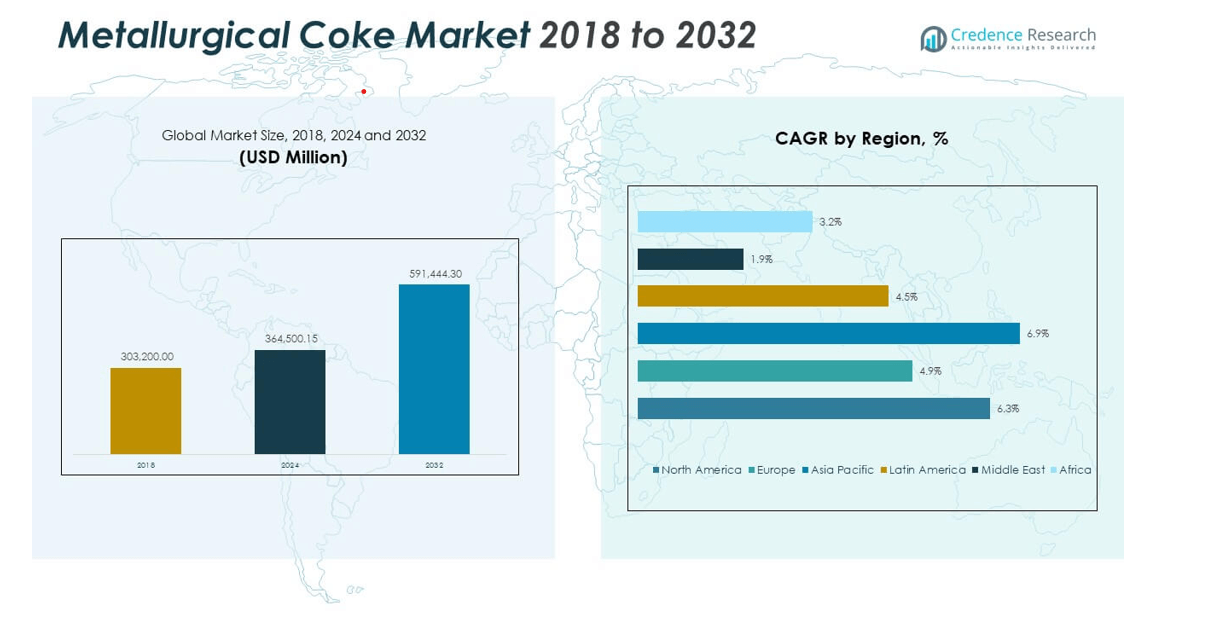
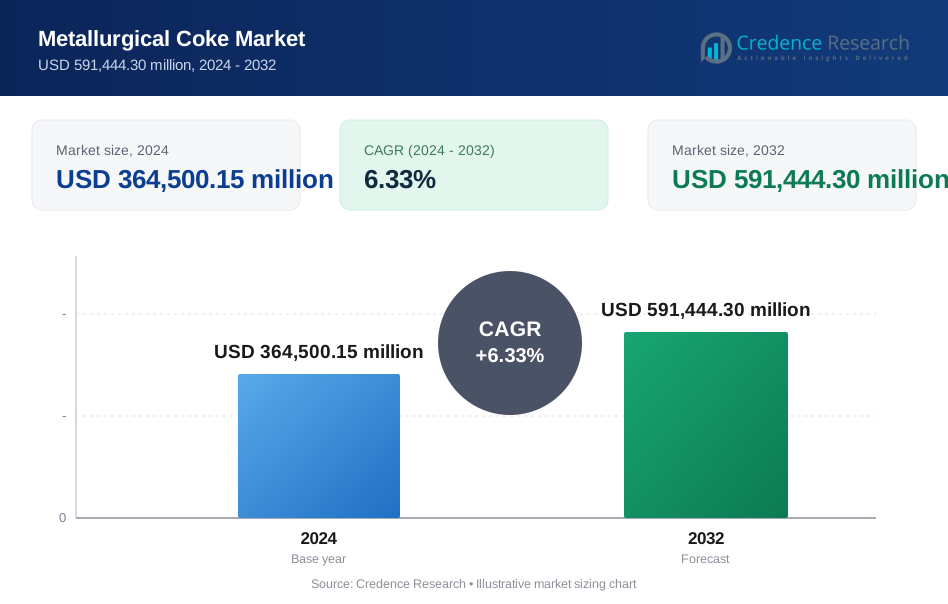
The Metallurgical Coke Market size was valued at USD 303,200.00 million in 2018 to USD 364,500.15 million in 2024 and is anticipated to reach USD 591,444.30 million by 2032, at a CAGR of 6.33% during the forecast period.
| REPORT ATTRIBUTE | DETAILS |
|---|---|
| Historical Period | 2020-2023 |
| Base Year | 2024 |
| Forecast Period | 2025-2032 |
| Metallurgical Coke Market Size 2024 | USD 364,500.15 million |
| Metallurgical Coke Market, CAGR | 6.33% |
| Metallurgical Coke Market Size 2032 | USD 591,444.30 million |
Market growth is primarily driven by expanding steel production in developing economies and continuous investments in construction, automotive, and heavy machinery sectors. The push toward energy-efficient technologies in steelmaking encourages the use of high-quality, low-ash coke. Technological improvements in coke oven operations and emission control systems enhance production efficiency and environmental compliance. Growing demand for premium metallurgical coke also aligns with sustainability goals and modernization initiatives within major steel plants.
Asia Pacific leads the global metallurgical coke market due to its large-scale steel production and strong domestic coal resources. China, India, and Japan dominate consumption owing to industrial expansion and government-backed infrastructure programs. Europe maintains steady growth through modernization and adoption of energy-efficient furnaces, while North America benefits from advanced coke production technologies. Emerging markets in Latin America and Africa witness rising demand fueled by steel capacity expansion and mining projects. The Middle East focuses on diversifying its industrial base with modest growth potential.
Market Insights:
- The Metallurgical Coke Market was valued at USD 303,200.00 million in 2018, reached USD 364,500.15 million in 2024, and is projected to attain USD 591,444.30 million by 2032, growing at a CAGR of 6.33%.
- Asia Pacific leads with a 63% share due to large-scale steel production in China, India, and Japan, supported by abundant coal resources and high infrastructure investment.
- North America holds a 17% share, driven by advanced coke-making technologies and demand from automotive and construction industries, while Europe follows with 14%, supported by modernization and energy-efficient furnaces.
- Asia Pacific remains the fastest-growing region, expanding at 6.9% CAGR, driven by industrialization, infrastructure projects, and capacity expansion in emerging economies.
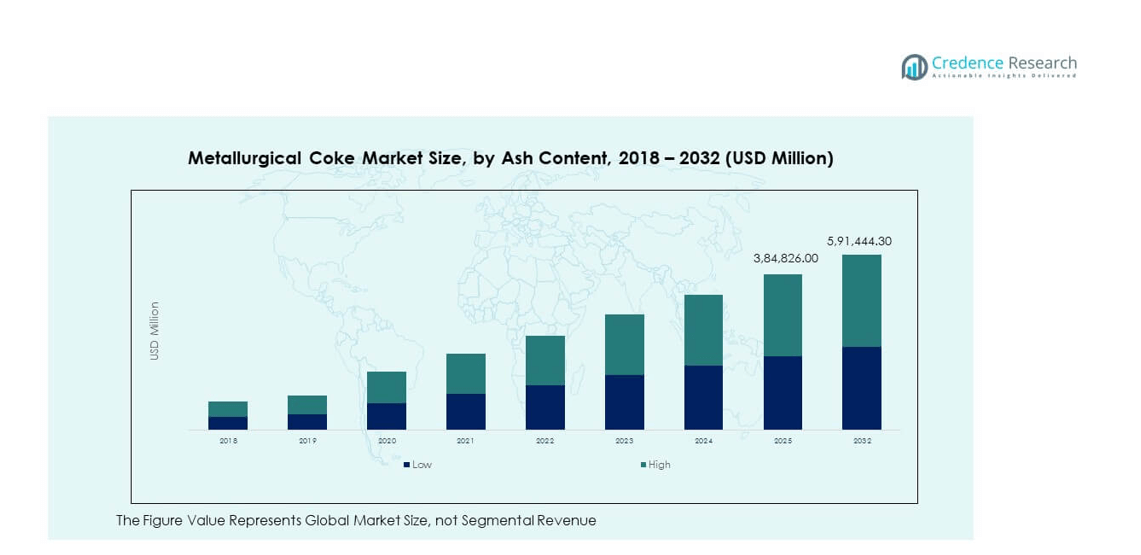
- By ash content, low-ash metallurgical coke accounts for 60% of total production due to superior carbon purity and efficiency, while high-ash grades represent 40%, serving cost-sensitive industrial applications.
Market Drivers
Rising Steel Production and Infrastructure Expansion Worldwide
The surge in global steel production is a major driver for the Metallurgical Coke Market. Rapid urbanization, industrialization, and infrastructure projects in developing economies increase steel consumption across sectors. High-strength steel remains vital for construction, automotive, and machinery applications, raising demand for metallurgical coke as a fuel and reducing agent. Governments are investing in large-scale transportation, housing, and energy infrastructure. These projects boost blast furnace operations globally. Leading steel-producing countries expand capacity to meet rising domestic and export needs. Growing investment in industrial corridors and manufacturing zones reinforces this upward trend.
- For instance, ArcelorMittal began a €53 million modernization of Blast Furnace No. 1 at its Fos-sur-Mer plant in France in June 2025, involving more than 300 employees and focusing on extending the furnace’s service life and supporting efficient steel production for infrastructure projects, with the renovation expected to be completed in the first half of 2026
Technological Advancements in Coke Oven and Byproduct Recovery Systems
Technological progress in coke oven design and byproduct recovery systems supports production efficiency and environmental compliance. Modern coke plants adopt heat recovery and emission control systems to reduce energy loss and pollution. Automation enhances operational safety and process control, ensuring consistent coke quality. It enables producers to achieve higher yield with lower fuel consumption. Companies invest in upgrading legacy facilities with advanced carbonization technology. The integration of digital monitoring improves plant reliability and energy optimization. This shift toward cleaner and smarter production strengthens the competitiveness of the Metallurgical Coke Market globally.
Growing Demand from the Automotive and Heavy Machinery Sectors
Automotive and machinery industries increasingly rely on high-quality steel, driving the need for metallurgical coke. Automakers demand strong, durable materials for chassis, engine parts, and safety structures. The rising shift toward electric vehicles further supports steel usage for lightweight frames. Heavy machinery manufacturers also depend on steel for equipment strength and wear resistance. Expanding production in these industries raises demand for blast furnace coke. Strategic partnerships between steelmakers and automotive OEMs sustain steady coke consumption. The Metallurgical Coke Market benefits from the interlinked growth of these downstream sectors.
Favorable Government Policies and Industrial Investments in Emerging Economies
Governments in developing regions promote industrial expansion and steel self-sufficiency through supportive policies. Incentives for domestic steel production and raw material availability encourage investment in coke manufacturing. Tax benefits, infrastructure development, and foreign direct investments strengthen supply chains. It enables regional producers to meet local and export needs efficiently. Energy-efficient furnace technology and cleaner production initiatives align with environmental standards. International collaborations for sustainable industrial growth further boost capacity expansion. These policy measures create long-term growth opportunities for the Metallurgical Coke Market in emerging economies.
- For instance, Hyundai Steel and Kia announced in March 2025 a plan to build a new electric arc furnace flat steel mill in Louisiana, USA, with an annual capacity of 2.7 million metric tonnes to primarily supply Hyundai’s auto plants, backed by a $5.8 billion investment and substantial support from U.S. government and state incentives to strengthen sustainable supply chains for steel.
Market Trends
Adoption of Energy-Efficient and Low-Emission Production Technologies
Energy-efficient and low-emission technologies are transforming coke production processes. Modern coke plants incorporate waste heat recovery and flue gas treatment systems. These systems minimize carbon footprint while improving energy utilization. Automation and AI-based control systems enhance operational performance and reduce downtime. It allows producers to comply with stricter emission norms globally. Companies are shifting toward integrated steel-coke plants for better resource optimization. The Metallurgical Coke Market reflects a growing preference for sustainable manufacturing models supported by government and industry initiatives.
- For instance, Tata Steel is building a 3.2 million tons per year electric arc furnace at Port Talbot, UK, which is set to reduce direct CO₂ emissions by approximately 90% compared to current levels, and is further enhancing system efficiency through advanced waste heat recovery and green hydrogen pilot projects at its Indian and Dutch facilities.
Increasing Use of Secondary Raw Materials and Recycling Practices
Recycling and circular economy initiatives are shaping industry operations. Coke producers are integrating coal tar, pitch, and recovered carbon sources into production cycles. These efforts lower dependency on premium coking coal imports. Waste recycling enhances cost efficiency and supports environmental targets. It improves overall material utilization in steelmaking. The adoption of closed-loop systems strengthens sustainability credentials. The Metallurgical Coke Market benefits from innovation in resource recovery and reuse practices across multiple industrial facilities.
Shift Toward Integrated Steel Plants and Consolidated Production Facilities
The global steel industry is witnessing consolidation to optimize costs and efficiency. Integrated steel plants produce coke, iron, and steel within a single ecosystem. This approach reduces logistics costs and supply disruptions. Centralized production facilities improve quality control and output consistency. It also enables better energy sharing across processes. Leading producers expand integrated operations to secure stable coke supply. The Metallurgical Coke Market is increasingly influenced by vertical integration strategies among top steel manufacturers.
- For instance, Baosteel Zhanjiang Iron & Steel started a new Energiron direct reduction plant in 2024, now the largest hydrogen-enabled reactor in China, which produces 1 million metric tons of direct reduced iron annually with metallization rates up to 96% and hybrid operation using hydrogen, natural gas, and coke oven gas.
Rising Focus on Automation, Digital Monitoring, and Predictive Maintenance
Automation and digital transformation are redefining plant management systems. Smart sensors and AI platforms monitor temperature, pressure, and carbonization in real time. Predictive maintenance tools minimize unplanned shutdowns and operational risks. It enhances overall productivity and reduces equipment wear. Cloud-based analytics improve decision-making for process optimization. Companies deploy integrated data systems for seamless coordination across units. The Metallurgical Coke Market reflects this trend toward digital industrial transformation for improved reliability and sustainability.
Market Challenges Analysis
Volatility in Coking Coal Prices and Limited Raw Material Availability
Fluctuating coking coal prices remain a major challenge for the Metallurgical Coke Market. Raw material costs significantly affect overall production expenses and profit margins. Limited high-quality coal reserves in several regions create supply constraints. It forces reliance on imports from Australia, Russia, or the U.S., exposing producers to global market fluctuations. Trade restrictions and logistics disruptions further add to cost instability. Producers face pressure to secure long-term contracts to manage volatility. Price unpredictability affects both large integrated players and small coke producers equally, reducing market stability.
Stringent Environmental Regulations and Rising Sustainability Pressures
Environmental compliance continues to challenge coke manufacturers globally. Stringent emission norms and carbon reduction mandates increase operating costs. Installation of desulfurization units, filtration systems, and carbon capture technologies requires heavy capital investment. It impacts profitability for small and medium-sized producers. Regulators demand continuous monitoring of particulate matter and sulfur emissions. Public scrutiny around air pollution from coke ovens intensifies the need for green technologies. Companies are adapting to these changes through modernization, but regulatory pressure continues to restrict growth potential.
Market Opportunities
Expansion of Green Steel Initiatives and Sustainable Coke Substitutes
The shift toward green steel production opens new opportunities for metallurgical coke manufacturers. Producers are developing low-carbon coke variants to support sustainable steelmaking. Hydrogen-based and bio-coke alternatives are gaining industrial attention. It enables steelmakers to balance efficiency with environmental goals. Government-funded R&D projects focus on improving coke substitutes’ performance. This transition supports long-term demand stability while aligning with emission targets. The Metallurgical Coke Market benefits from partnerships advancing cleaner steel production technologies.
Rising Investments in Emerging Markets and Capacity Modernization
Emerging markets in Asia, Latin America, and Africa are investing heavily in steel capacity expansion. New blast furnace projects and industrial corridors generate consistent demand for metallurgical coke. It encourages modernization of existing coke plants with advanced automation and emission control systems. International collaborations improve technology access and operational expertise. Localized production reduces dependency on imports and strengthens supply resilience. These developments create a strong foundation for sustained market growth in the coming years.
Market Segmentation Analysis:
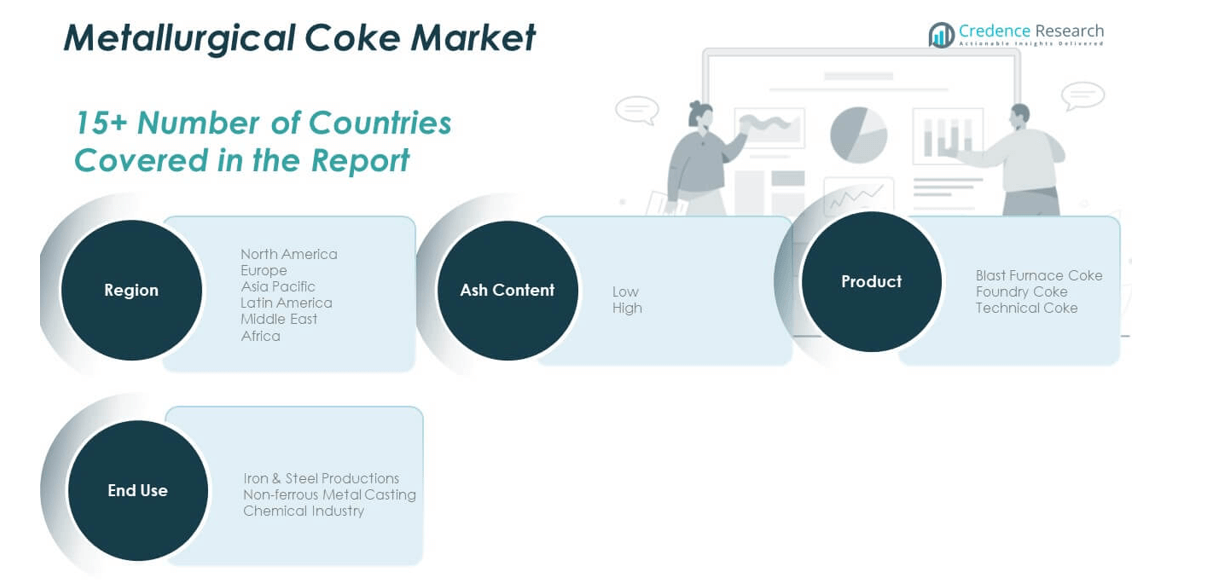
The Metallurgical Coke Market is segmented by ash content, product type, and end use.
By ash content, low ash metallurgical coke holds a major share due to its higher carbon content, lower impurities, and better energy efficiency in blast furnace operations. It supports superior metal yield and reduces emissions during smelting. High ash metallurgical coke finds use in specific industrial processes where cost efficiency outweighs purity requirements. Its availability from blended or lower-grade coal sources provides an economical option for regional producers.
- For instance, Nippon Steel achieved a co-firing hydrogen ratio of 43% in a test blast furnace, demonstrating a 43% reduction in CO₂ emissions versus conventional coke processes, as announced in December 2024 during pilot trials at its Kimitsu Works.
By product, blast furnace coke dominates due to its essential role in large-scale steel manufacturing. It provides structural strength within furnaces and maintains consistent heat generation. Foundry coke serves smaller furnaces and non-ferrous applications requiring uniform carbon content and controlled reactivity. Technical coke caters to specialized industries including chemical synthesis and metallurgical research, emphasizing high-quality carbon and stable performance. It supports diversified industrial demand and niche applications.
By end use, iron and steel production remains the leading segment, driven by infrastructure growth and automotive manufacturing. Non-ferrous metal casting uses coke for thermal stability and impurity removal in alloys such as copper and aluminum. The chemical industry applies coke in processes including calcium carbide and ferroalloy synthesis. It enables consistent carbon reduction in multiple applications and sustains industrial operations requiring reliable thermal performance. This broad functional scope ensures steady demand across industrial sectors.
- For instance, in 2025, POSCO International partnered with Energy Fuels Inc. to supply neodymium-praseodymium (NdPr) oxide for alloy and permanent magnet production, with qualification samples processed to meet POSCO’s exacting purity and performance specifications, powering over 30,000 EVs once in full-scale production.
Segmentation:
By Ash Content
- Low Ash Metallurgical Coke
- High Ash Metallurgical Coke
By Product
- Blast Furnace Coke
- Foundry Coke
- Technical Coke
By End Use
- Iron & Steel Production
- Non-Ferrous Metal Casting
- Chemical Industry
By Region
- North America
- U.S.
- Canada
- Mexico
- Europe
- Germany
- France
- U.K.
- Italy
- Spain
- Rest of Europe
- Asia Pacific
- China
- Japan
- India
- South Korea
- South-east Asia
- Rest of Asia Pacific
- Latin America
- Brazil
- Argentina
- Rest of Latin America
- Middle East & Africa
- GCC Countries
- South Africa
- Rest of the Middle East and Africa
Regional Analysis:
North America
The North America Metallurgical Coke Market size was valued at USD 52,908.40 million in 2018 to USD 61,999.29 million in 2024 and is anticipated to reach USD 100,310.02 million by 2032, at a CAGR of 6.3% during the forecast period. North America accounts for 17% of the global market share, driven by strong steel demand from automotive and construction industries. The U.S. leads regional production supported by integrated steel mills and advanced coke-making technologies. Canada and Mexico contribute through expanding infrastructure projects and energy-intensive manufacturing sectors. It benefits from steady domestic coal supply and modernization of coke oven plants. Stringent environmental regulations drive innovation in low-emission technologies. Rising investments in green steel initiatives and recycling infrastructure reinforce long-term regional growth.
Europe
The Europe Metallurgical Coke Market size was valued at USD 45,025.20 million in 2018 to USD 50,400.40 million in 2024 and is anticipated to reach USD 73,488.53 million by 2032, at a CAGR of 4.9% during the forecast period. Europe holds 14% of the global market share, supported by modernization of aging steel plants and adoption of energy-efficient technologies. Germany, France, and Italy remain major coke consumers in automotive and industrial manufacturing. It witnesses gradual shifts toward hydrogen-based steelmaking, impacting traditional coke demand. Eastern Europe continues to expand coke exports, balancing supply across the continent. Environmental norms drive decarbonization strategies and cleaner production methods. Investments in circular economy projects sustain the regional coke ecosystem.
Asia Pacific
The Asia Pacific Metallurgical Coke Market size was valued at USD 185,649.36 million in 2018 to USD 227,136.74 million in 2024 and is anticipated to reach USD 384,202.69 million by 2032, at a CAGR of 6.9% during the forecast period. Asia Pacific commands 63% of the global market share, led by China, India, and Japan. China dominates global coke production with large-scale blast furnaces and abundant coking coal reserves. India’s rising steel capacity and infrastructure projects accelerate coke demand. Japan focuses on energy-efficient steelmaking with high-grade coke consumption. It benefits from rapid industrialization and supportive government investments. Southeast Asia emerges as a new production hub with foreign investment inflows. The region remains the key global supply center for metallurgical coke exports.
Latin America
The Latin America Metallurgical Coke Market size was valued at USD 10,672.64 million in 2018 to USD 12,608.06 million in 2024 and is anticipated to reach USD 17,784.72 million by 2032, at a CAGR of 4.5% during the forecast period. Latin America accounts for 3% of the global market share, primarily driven by Brazil’s expanding steel production. Brazil leads coke demand with its growing automotive and infrastructure sectors. Argentina and Chile focus on industrial growth supported by mining and metal fabrication. It benefits from access to coal reserves and trade ties with Asian markets. Regional producers are investing in plant upgrades and efficiency improvements. Demand for metallurgical coke continues to rise with regional industrialization.
Middle East
The Middle East Metallurgical Coke Market size was valued at USD 4,396.40 million in 2018 to USD 4,408.08 million in 2024 and is anticipated to reach USD 5,089.67 million by 2032, at a CAGR of 1.9% during the forecast period. The region contributes 1% of the global market share, supported by growing industrial diversification and metal production. GCC countries invest in steelmaking projects to reduce import dependency. It benefits from energy availability and logistical advantages for export. Israel and Turkey witness industrial expansion with rising steel consumption. Limited domestic coal resources constrain large-scale coke manufacturing. Focus on sustainable industrial strategies encourages joint ventures with Asian suppliers. Regional production remains modest but strategically important for localized demand.
Africa
The Africa Metallurgical Coke Market size was valued at USD 4,548.00 million in 2018 to USD 7,947.58 million in 2024 and is anticipated to reach USD 10,568.67 million by 2032, at a CAGR of 3.2% during the forecast period. Africa holds 2% of the global market share, driven by steel capacity expansion in South Africa and Egypt. Infrastructure development and mining activities boost regional consumption. Nigeria and Kenya explore domestic coke manufacturing to reduce imports. It benefits from resource-rich reserves and growing industrial corridors. Governments are encouraging foreign investments to strengthen steel value chains. Ongoing energy and logistics challenges hinder faster growth, yet rising industrialization supports steady demand. The region offers long-term potential for coke production growth.
Key Player Analysis:
- ArcelorMittal
- BlueScope Steel
- CHINA SHENHUA
- ECL (Ennore Coke Limited)
- GNCL (Gujarat NRE Coke Limited)
- Hickman Williams & Company
- Jastrzębska Spółka Węglowa (JSW)
- Mechel
- Nippon Steel Corporation
- SunCoke Energy Inc.
Competitive Analysis:
The Metallurgical Coke Market is highly consolidated, with leading producers controlling significant global capacity. ArcelorMittal, Nippon Steel Corporation, and China Shenhua dominate production through vertically integrated operations and advanced coke oven technologies. SunCoke Energy Inc. focuses on cleaner production methods using heat recovery systems to meet environmental standards. Jastrzębska Spółka Węglowa (JSW) maintains a strong position in Europe through consistent supply and investment in modernization. BlueScope Steel and Mechel strengthen regional networks with strategic expansions and partnerships. It reflects competition centered on product quality, operational efficiency, and emission control technology. Companies emphasize sustainability, digital automation, and reliable raw material sourcing to gain a competitive edge. Continuous innovation and capacity optimization define market leadership and profitability across regions.
Recent Developments:
- In October 2025, ArcelorMittal launched Helioroof®, an innovative low-carbon, all-in-one insulated steel roof integrating solar cells. This product is designed to significantly reduce carbon emissions while combining insulation and solar power generation in one efficient steel roofing solution, aligning with sustainability goals.
- In October 2025, Jastrzębska Spółka Węglowa (JSW) adopted a merger plan to absorb its subsidiary JSW Nowe Projekty S.A. in a simplified procedure that consolidates assets and streamlines operations under JSW S.A., marking a significant corporate restructuring.
Report Coverage:
The research report offers an in-depth analysis based on Ash Content, Product and End Use. It details leading market players, providing an overview of their business, product offerings, investments, revenue streams, and key applications. Additionally, the report includes insights into the competitive environment, SWOT analysis, current market trends, as well as the primary drivers and constraints. Furthermore, it discusses various factors that have driven market expansion in recent years. The report also explores market dynamics, regulatory scenarios, and technological advancements that are shaping the industry. It assesses the impact of external factors and global economic changes on market growth. Lastly, it provides strategic recommendations for new entrants and established companies to navigate the complexities of the market.
Future Outlook:
- The Metallurgical Coke Market will experience sustained demand growth driven by global steel production expansion.
- Rising infrastructure development in developing economies will continue to reinforce consumption across industrial sectors.
- Advanced coke oven technologies and emission control systems will gain wider adoption to meet regulatory goals.
- The shift toward low-ash, high-carbon coke will improve furnace efficiency and energy utilization.
- Increasing automation and digital monitoring will enhance operational safety and productivity across coke plants.
- Green steel initiatives will stimulate innovation in low-carbon coke and hydrogen-based reduction methods.
- Strategic collaborations between steelmakers and coke producers will strengthen integrated supply networks.
- Capacity modernization projects in Asia and Latin America will expand production capabilities and export potential.
- Environmental compliance and raw material optimization will guide long-term investment strategies.
- The market will remain competitive, with companies focusing on technology-driven efficiency and regional diversification.
Request a Free Sample
Fill in your details and we'll send you a free sample report.
- Sample data tables & charts
- Research methodology
Need a Custom Version of This Report?
Tailor the scope, geography, or segments to your exact requirements.
- Custom geography or segment scope
- Direct access to our analyst team
Frequently Asked Questions
What is the current market size for the Metallurgical Coke Market, and what is its projected size in 2032?
At what Compound Annual Growth Rate is the Metallurgical Coke Market projected to grow between 2024 and 2032?
What is the major growth driving factors for global Metallurgical Coke market?
Which Metallurgical Coke Market segment held the largest share in 2024?
What are the primary factors fueling the growth of the Metallurgical Coke Market?
Who are the leading companies in the Metallurgical Coke Market?
Table of Content
Chapter 1. Report Introduction
- 1.1 Report Description & Purpose
- 1.1.1 Report Title & Market Definition
- 1.1.2 Unique Selling Propositions (USP) & Key Differentiators
- 1.1.3 Value Proposition for Stakeholders
- 1.2 Research Objectives
- 1.2.1 Market Sizing Objectives (Volume & Revenue) (Volume Where Applicable)
- 1.2.2 Segmentation Objectives
- 1.2.3 Competitive Intelligence Objectives
- 1.2.4 Forecast & Scenario Objectives
- 1.3 Report Scope
- 1.3.1 Metallurgical Coke Scope – Segments & Subsegments Covered
- 1.3.2 Geographic Scope – Regions & Countries Covered
- 1.3.3 Historical Period, Base Year & Forecast Period (2024; forecast to 2032)
- 1.3.4 Inclusions & Exclusions
- 1.4 Industry Classification & Applicable Codes
- 1.5 Currency, Measurement Units & Valuation Basis
- 1.6 Target Stakeholders
- 1.7 Limitations & Assumptions
Chapter 2. Executive Summary
- 2.1 Global Metallurgical Coke Market Snapshot
- 2.1.1 Market Size – Historical (2024) & Forecast (2024-2032) (2024: USD 364,500.15 million → 2032: USD 591,444.30 million)
- 2.1.2 Volume & Revenue – Global Totals (Volume Where Applicable)
- 2.1.3 Key Market Highlights – Top Five Facts
- 2.2 Metallurgical Coke Market Segmentation Snapshot
- 2.2.1 Market Split by Region – 2024 vs. 2032
- 2.3 Competitive Snapshot
- 2.3.1 Top 10 Players by Revenue Share – 2024
- 2.3.2 Top 10 Players by Volume Share – 2024 (Volume Where Applicable)
- 2.3.3 Recent Strategic Developments (18-Month Summary)
- 2.4 Key Investment Highlights & Strategic Conclusions
Chapter 3. Metallurgical Coke Market Dynamics & Industry Analysis
- 3.1 Market Overview & Context
- 3.1.1 Metallurgical Coke Market Position in the Broader Industry Value Chain
- 3.1.2 Demand Structure & Purchasing Dynamics
- 3.1.3 Market Maturity & Development Stage by Region
- 3.2 Metallurgical Coke Market Drivers
- 3.3 Metallurgical Coke Market Restraints & Challenges
- 3.4 Metallurgical Coke Market Opportunities
- 3.5 Porter's Five Forces Analysis
- 3.5.1 Threat of New Entrants
- 3.5.2 Bargaining Power of Suppliers
- 3.5.3 Bargaining Power of Buyers
- 3.5.4 Threat of Substitutes
- 3.5.5 Competitive Rivalry – Intensity Assessment
- 3.6 Metallurgical Coke Value Chain Analysis
- 3.6.1 Upstream – Key Inputs, Resources & Suppliers
- 3.6.1.1 Key Input/Resource 1
- 3.6.1.2 Key Input/Resource 2
- 3.6.1.3 Key Input/Resource 3
- 3.6.2 Midstream – Core Operations & Value Creation
- 3.6.2.1 Operating Model & Process Overview
- 3.6.2.2 Key Operating Locations & Capabilities by Company
- 3.6.3 Downstream – Market Channels & End Users
- 3.6.3.1 Direct Sales & Customer Engagement Channels
- 3.6.3.2 Indirect Sales, Intermediaries & Partner Channels
- 3.6.4 Value Chain Profitability Analysis
- 3.6.1 Upstream – Key Inputs, Resources & Suppliers
- 3.7 PESTEL Analysis
- 3.7.1 Political Factors
- 3.7.2 Economic Factors
- 3.7.3 Social Factors
- 3.7.4 Technological Factors
- 3.7.5 Environmental Factors
- 3.7.6 Legal Factors
- 3.8 Metallurgical Coke Supply Chain Analysis
- 3.8.1 Critical Input & Resource Availability Risk Assessment
- 3.8.2 Supplier & Operational Concentration Risk (Geographic Exposure)
- 3.8.3 Supply & Service Disruption Impact Analysis
- 3.9 Regulatory & Policy Landscape
Note: The regulatory and policy landscape section covers regulations based on their applicability to the market, Metallurgical Coke category, geography, and scope of the study. Only regulatory frameworks with a material impact on operations, compliance, trade, sustainability, or market access are analyzed in detail.
Chapter 4. Key Investment Pockets & Opportunity Analysis
- 4.1 Metallurgical Coke Market Attractiveness Analysis
- 4.1.1 By Region – Investment Attractiveness Matrix (Market Size × CAGR)
- 4.2 Absolute Revenue Growth Opportunity
- 4.2.1 By Region – Absolute Revenue Growth Through 2032
- 4.3 Incremental Demand Opportunity
- 4.3.1 By Region – Incremental Demand Through 2032
- 4.3.2 Segment – Incremental Demand
- 4.4 Emerging Submarket Opportunity Deep Dive (Subject to Applicability)
- 4.5 Priority Market Opportunity Scorecards
- 4.5.1 United States
- 4.5.2 Europe
- 4.5.3 Asia
- 4.5.4 Middle East & Africa
Note: Priority market opportunity scorecards reflect the geographic scope and strategic relevance of the study. Listed markets are indicative and may be adapted to the industry.
Chapter 5. Metallurgical Coke Cross-Border Trade & Market Access Analysis
- 5.1 International Trade & Cross-Border Activity Overview
- 5.1.1 Global Export Value by Country (2024)
- 5.1.2 Global Export Volume by Country (2024) (Volume Where Applicable)
- 5.1.3 Global Import Value by Country (2024)
- 5.1.4 Global Import Volume by Country (2024) (Volume Where Applicable)
- 5.1.5 Net Trade Balance by Country (2024)
- 5.2 Export Analysis – Segment
- 5.2.1 Category 1 (Applicable Classification Code)
- 5.2.2 Category 2 (Applicable Classification Code)
- 5.2.3 Category 3 (Applicable Classification Code)
- 5.2.4 Category 4 (Applicable Classification Code)
- 5.2.5 Category 5 (Applicable Classification Code)
- 5.3 Import Analysis – Segment
- 5.3.1 Category 1 (Applicable Classification Code)
- 5.3.2 Category 2 (Applicable Classification Code)
- 5.3.3 Category 3 (Applicable Classification Code)
- 5.3.4 Category 4 (Applicable Classification Code)
- 5.3.5 Category 5 (Applicable Classification Code)
- 5.4 Cross-Border Pricing & Transaction Benchmarks
- 5.4.1 Export Pricing – Segment & Country
- 5.4.2 Import Pricing – Segment & Source Country
- 5.4.3 Price Trends (2024)
- 5.5 Key Cross-Border Trade & Delivery Routes
- 5.5.1 Cross-Border Trade/Delivery Route 1
- 5.5.2 Cross-Border Trade/Delivery Route 2
- 5.5.3 Cross-Border Trade/Delivery Route 3
- 5.5.4 Cross-Border Trade/Delivery Route 4
- 5.5.5 Cross-Border Trade/Delivery Route 5
- 5.6 Trade Policy & Market Access Impact Assessment
- 5.6.1 Tariff & Non-Tariff Barriers
- 5.6.2 Regional Trade & Economic Integration Frameworks
- 5.6.3 Bilateral & Multilateral Trade Agreements
- 5.6.4 Cross-Border Operating, Licensing & Localization Requirements
Note: This chapter applies where cross-border trade or delivery is relevant to Metallurgical Coke. Goods, services, and digital offerings are assessed using applicable classifications and transaction measures. Import-export volumes, trade balances, and route analyses are included only where meaningful to the market.
Chapter 6. Competitive Landscape & Company Benchmarking
- 6.1 Metallurgical Coke Market Concentration & Structure
- 6.1.1 Herfindahl-Hirschman Index (HHI) – vs. 2024
- 6.1.2 Leading, Mid-Sized & Emerging Player Structure
- 6.1.3 Global, Regional & Local Player Dynamics
- 6.2 Metallurgical Coke Market Share Analysis – 2024
- 6.2.1 Global Revenue Share by Company
- 6.2.2 Global Volume Share by Company (Volume Where Applicable)
- 6.2.3 Regional Revenue Share
- 6.2.4 Market Share Evolution ( vs. 2024)
- 6.2.5 Company Market Share by Key Segment
- 6.2.6 Company Market Share by Customer Group
- 6.3 Operating Scale, Capacity & Infrastructure Analysis
- 6.3.1 Global Operating Scale & Supply Capacity
- 6.3.2 Resource Utilization & Operating Efficiency
- 6.3.3 Output, Service Delivery & Activity Metrics
- 6.3.4 Operating Footprint & Infrastructure Map
- 6.3.5 Planned Operational & Capacity Expansion
- 6.4 Metallurgical Coke Competitive Benchmarking Matrix
- 6.4.1 Revenue, Growth, Profitability & Operating Metric Comparison
- 6.4.2 Channel Revenue Mix
- 6.4.3 Geographic Revenue Exposure
- 6.4.4 R&D Intensity
- 6.4.5 Sustainability Maturity
- 6.5 Strategic Developments in Metallurgical Coke (Last 24 Months)
- 6.5.1 Mergers, Acquisitions & Divestments
- 6.5.2 New Products, Services & Solutions in Metallurgical Coke
- 6.5.3 Operational & Infrastructure Expansions
- 6.5.4 Strategic Alliances, Joint Ventures & Partnerships
- 6.5.5 Distribution Expansion & Market Entry
- 6.5.6 Sustainability & ESG Initiatives
- 6.6 Competitive Strategy Mapping
- 6.6.1 Leader, Challenger, Follower & Niche Classification
- 6.6.2 Pricing Strategy Comparison
- 6.6.3 Channel Strategy Matrix
Note: Strategic developments are included based on their materiality and the availability of reliable information.
Chapter 7. Global Metallurgical Coke Market – By Sales & Delivery Channel
- 7.1 Segment Overview
- 7.1.1 Volume & Revenue Split by Channel (2024 & 2032) (Volume Where Applicable)
- 7.1.2 Channel Mix Evolution (2024-2032)
Chapter 8. Regional Market Analysis – Global Overview
- 8.1 Global Regional Overview
- 8.1.1 Regional Volume Share (Volume Where Applicable)
- 8.1.2 Regional Revenue Share
- 8.1.3 Regional Volume by Region (Volume Where Applicable)
- 8.1.4 Regional Revenue by Region
- 8.1.5 Regional Forecast Through 2032
- 8.2 Cross-Regional Segment Analysis
- 8.2.1 By Sales & Delivery Channel
- 8.2.2 By Competitive Positioning & Price Tier
Chapter 9. North America Metallurgical Coke Market
- 9.1 United States
- 9.2 Canada
- 9.3 Mexico
Chapter 10. Europe Metallurgical Coke Market
- 10.1 Germany
- 10.2 France
- 10.3 Italy
- 10.4 United Kingdom
- 10.5 Spain
- 10.6 Poland
- 10.7 Russia
- 10.8 Netherlands
- 10.9 Belgium
- 10.10 Sweden
- 10.11 Denmark
- 10.12 Norway
- 10.13 Rest of Europe
Chapter 11. Asia Pacific Metallurgical Coke Market
- 11.1 China
- 11.2 India
- 11.3 Japan
- 11.4 South Korea
- 11.5 Thailand
- 11.6 Indonesia
- 11.7 Vietnam
- 11.8 Malaysia
- 11.9 Australia
- 11.10 Rest of Asia Pacific
Chapter 12. Latin America Metallurgical Coke Market
- 12.1 Brazil
- 12.2 Argentina
- 12.3 Colombia
- 12.4 Chile
- 12.5 Rest of Latin America
Chapter 13. Middle East Metallurgical Coke Market
- 13.1 Saudi Arabia
- 13.2 United Arab Emirates
- 13.3 Turkey
- 13.4 Israel
- 13.5 Iran
- 13.6 Rest of the Middle East
Chapter 14. Africa Metallurgical Coke Market
- 14.1 South Africa
- 14.2 Egypt
- 14.3 Nigeria
- 14.4 Morocco
- 14.5 Rest of Africa
Chapter 15. Metallurgical Coke Company Profiles
- 15.1 [Company 01]
- 15.1.1 Company Overview
- 15.1.2 Key Management Personnel
- 15.1.3 Products & Services Portfolio
- 15.1.4 Financial Performance
- 15.1.5 Key Market Focus & Geographic Presence
- 15.1.6 Recent Developments & Strategic Initiatives
Note: The company profile list is preliminary and may change based on research findings, market developments, data availability, and client requirements.
Chapter 16. Appendices
- Appendix A – List of Abbreviations & Acronyms
- Appendix B – Industry Classification Code Reference – Full Series
- Appendix C – Supply, Output & Operating Capacity Data Tables
- Appendix D – End-Use & Demand Base Tables
- Appendix E – Demand, Adoption & Usage Assumptions
- Appendix F – Pricing & Revenue Metric Reference Tables
- Appendix G – Company Operations & Infrastructure Database
- Appendix H – Cross-Border Trade & Activity Data Tables (Where Applicable)
- Appendix I – Regulatory Summary Tables
- Appendix J – Primary Research Participant List (Anonymized)
- Appendix K – Primary Research Questionnaire Framework
- Appendix L – Data Sources & Bibliography
- Appendix M – Market Size Divergence & Source Comparison
Chapter 17. Research Methodology
- 17.1 Research Framework & Philosophy
- 17.2 Secondary Research – Sources, Hierarchy & Data Extraction
- 17.3 Data Modeling – Bottom-Up & Top-Down Market Sizing
- 17.4 Primary Research – Stakeholder Framework, LOI & Sample Sizes
- 17.5 Forecast Methodology – Regression, Scenario & Sensitivity Analysis
- 17.6 Quality Control – Four-Layer Validation Framework
- 17.7 Limitations & Standard Assumptions
- 17.8 Disclaimer
