
Market Overview:
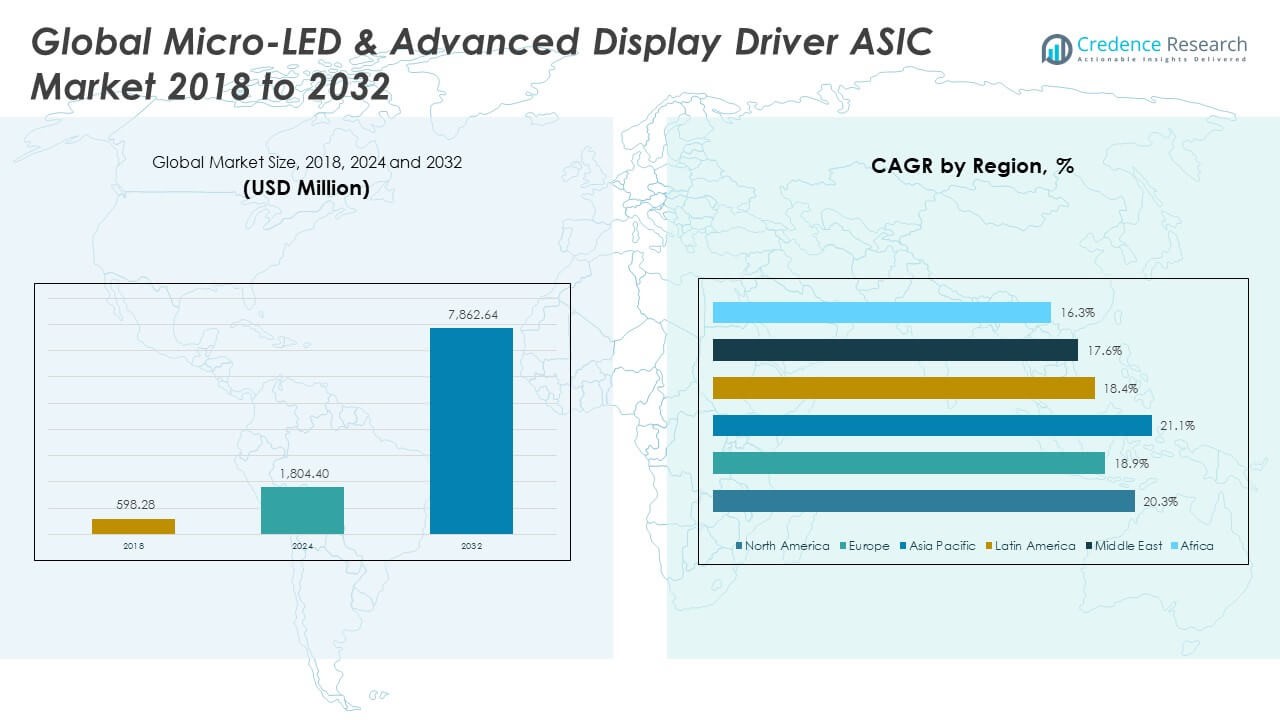
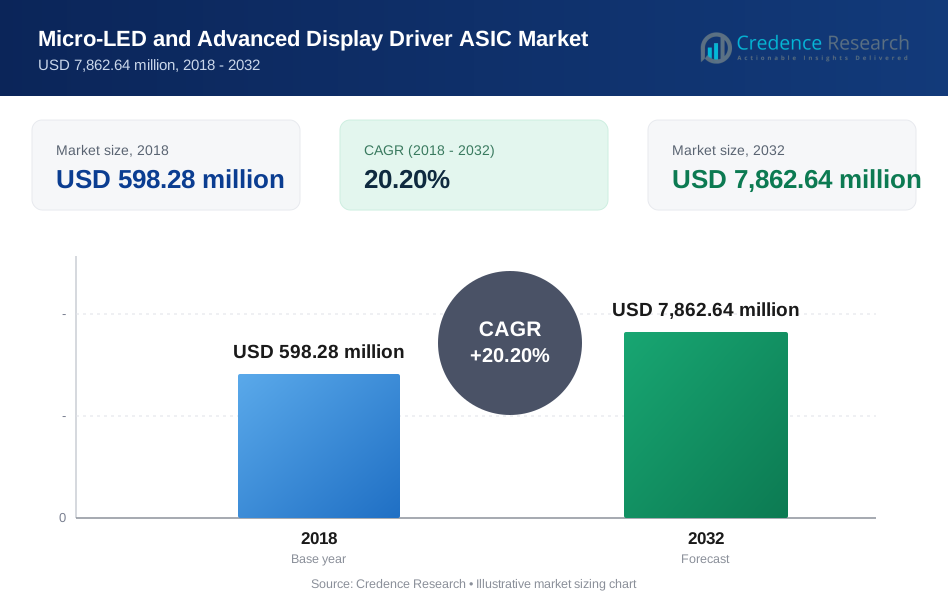
The Global Micro-LED & Advanced Display Driver ASIC Market was valued at USD 598.28 million in 2018 to USD 1,804.40 million in 2024 and is projected to reach USD 7,862.64 million by 2032, growing at a CAGR of 20.20% during the forecast period.
| REPORT ATTRIBUTE | DETAILS |
|---|---|
| Historical Period | 2020-2024 |
| Base Year | 2024 |
| Forecast Period | 2025-2032 |
| Micro-LED & Advanced Display Driver ASIC Market Size 2024 | USD 1,804.40Million |
| Micro-LED & Advanced Display Driver ASIC Market, CAGR | 20.20% |
| Micro-LED & Advanced Display Driver ASIC Market Size 2032 | USD 7,862.64 Million |
Key drivers of market growth include the rapid technological advancements in micro-LED display technology, which offer better contrast ratios, thinner panels, and lower power consumption. The growing use of micro-LEDs in high-end televisions, smartphones, wearables, and automotive displays has increased the need for advanced display driver ASICs to support these innovations. As consumers demand improved display quality and energy efficiency, the need for specialized display drivers that can handle micro-LED configurations becomes more critical, stimulating significant investments in the ASIC market.
Regionally, North America and Asia-Pacific are the dominant players in this market. North America benefits from a strong presence of semiconductor companies and continuous advancements in display technologies. The U.S., in particular, is witnessing considerable investments in micro-LED development from key industry players. Meanwhile, Asia-Pacific, especially China and South Korea, has become a rapidly emerging market due to its booming electronics sector and government support for technological innovation. Europe is also witnessing increased adoption of micro-LED technology in automotive displays and wearables, contributing to its growing market share.
Market Insights:
- The Global Micro-LED & Advanced Display Driver ASIC Market was valued at USD 598.28 million in 2018 and is projected to reach USD 7,862.64 million by 2032, growing at a CAGR of 20.20% during the forecast period. The market is driven by growing demand for high-quality, energy-efficient displays across industries such as consumer electronics, automotive, and digital signage.
- Technological advancements in micro-LED are driving growth, offering superior brightness, contrast, and energy efficiency, particularly in high-end displays for smartphones, wearables, and televisions.
- The integration of micro-LED technology in automotive displays, including heads-up displays and in-cabin entertainment systems, is contributing significantly to market expansion.
- High production costs of micro-LED technology, including complex manufacturing processes, remain a key restraint, limiting its widespread adoption, especially in cost-sensitive markets.
- The complexity of designing advanced display driver ASICs to support micro-LED displays poses a challenge, impacting development timelines and increasing R&D expenses.
- North America and Asia Pacific dominate the market, with North America benefiting from a strong presence of semiconductor companies and Asia Pacific experiencing rapid growth due to booming electronics sectors and government support.
- Europe is adopting micro-LED in automotive displays, while Latin America is seeing steady growth in consumer electronics and digital signage, presenting emerging opportunities in these regions.
Market Drivers:
Increased Demand for High-Quality, Energy-Efficient Displays
One of the primary drivers of the Global Micro-LED & Advanced Display Driver ASIC Market is the increasing demand for high-quality, energy-efficient displays. Micro-LED technology offers improved brightness, contrast, and color saturation, making it ideal for applications such as televisions, smart devices, and automotive displays. This shift towards micro-LED displays is pushing manufacturers to develop advanced display driver ASICs that can handle the intricate demands of micro-LED technology, such as pixel-level brightness control and precise color calibration.
Growing Adoption in Consumer Electronics and High-Tech Devices
The growing adoption of micro-LED displays in consumer electronics and other high-tech devices is also a significant factor in the market's expansion. With consumers increasingly prioritizing advanced display technology for their electronic devices, the demand for displays that provide better picture quality and energy efficiency is rising. Micro-LED’s potential to offer these features makes it a preferred choice, and as its implementation in smart TVs, smartphones, and wearables increases, it directly boosts the need for display driver ASICs.
- For example, VueReal, utilizing its proprietary MicroSolid Printing™ platform, has reported yield rates above 99.97%in micro-LED die transfer for high-density displays. The company’s reference design kits enable commercial partners to develop products with pixel sizes as small as 5μm, allowing for pixel densities exceeding 5,000ppi in consumer electronics such as AR glasses and next-gen smartwatches.
Rising Demand for Higher-Resolution Displays
Another key market driver is the push for higher-resolution displays across various industries. With the growing trend of ultra-high-definition and 4K displays, advanced display driver ASICs are needed to support the greater number of pixels required for these displays. Micro-LEDs, which are inherently more efficient in achieving higher resolutions than traditional LED or OLED technologies, are being integrated into these high-end displays. Consequently, the demand for ASICs capable of handling the advanced processing requirements for such displays has surged.
- For example, Micro-LED driver ASICs are now designed to support 8K and even 16K resolutiondisplays, requiring parallel data processing and high-bandwidth (multi-gigabit per second) transmission interfaces.
Micro-LED Adoption in Automotive Displays
The increasing use of micro-LED technology in automotive displays also plays a crucial role in driving the market. As automotive manufacturers focus on integrating cutting-edge displays into vehicles, such as heads-up displays, in-cabin entertainment systems, and advanced instrument clusters, the need for advanced display driver ASICs that can handle these high-performance micro-LED systems is growing. This trend is expected to continue as the automotive sector adopts more high-tech features in vehicles.
Market Trends:
Miniaturization and Compact Design
One significant trend in the Global Micro-LED & Advanced Display Driver ASIC Market is the growing focus on miniaturization and compact design. As devices become increasingly smaller and more portable, the need for compact and power-efficient display drivers has intensified. Micro-LEDs, with their small pixel sizes, fit well within this trend, and manufacturers are focusing on designing ASICs that are not only powerful but also space-efficient to meet the needs of portable devices such as wearables and handheld electronics.
Flexible and Bendable Displays
A rising trend in the market is the shift towards flexible and bendable displays. As the demand for foldable smartphones and other flexible devices increases, micro-LED technology is emerging as an ideal solution due to its inherent flexibility and durability. This trend is prompting semiconductor companies to develop advanced display driver ASICs capable of functioning effectively in these flexible applications, creating a new segment within the micro-LED and display driver market.
- For example, AUO Corporationshowcased a portable 3-inch foldable Micro-LED display at SID Display Week 2024, representing one of the largest and most advanced flexible Micro-LEDs brought to market.
Focus on Sustainability and Energy Efficiency
The rise in demand for sustainable and eco-friendly technologies is also influencing the Global Micro-LED & Advanced Display Driver ASIC Market. Micro-LEDs consume less power than traditional LED and OLED displays, making them an attractive choice for consumers and industries focused on reducing energy consumption. Display driver ASIC manufacturers are increasingly prioritizing the design of energy-efficient, environmentally friendly components to meet the growing demand for sustainable products across various markets, including consumer electronics and automotive.
Integration of Artificial Intelligence (AI) in Displays
Another key trend shaping the market is the integration of artificial intelligence (AI) into display technologies. AI-powered display driver ASICs are becoming more common, as these chips help optimize display performance by adjusting brightness, color accuracy, and power consumption based on real-time environmental factors. As AI technology continues to evolve, it is expected to play a larger role in enhancing micro-LED displays, further driving the demand for advanced display driver ASICs.
- For example, Hyperlume’s use of Micro-LEDs for optical communication has achieved “orders of magnitude” lower power use for data transfer compared to traditional interconnects, with sub-pJ/bit energy efficiency and multi-terabit/mm² density metrics, made possible by direct CMOS-compatible integration of the Micro-LED optical engine with ASIC packaging.
Market Challenges Analysis:
High Production Costs
The primary challenge facing the Global Micro-LED & Advanced Display Driver ASIC Market is the high cost of production associated with micro-LED technology. While micro-LED displays offer numerous benefits, such as higher resolution and greater energy efficiency, they are costly to manufacture compared to traditional LED or OLED displays. The complexity of micro-LED assembly and the need for advanced manufacturing techniques contribute to the higher costs, which can hinder widespread adoption, particularly in cost-sensitive markets.
Technological Complexity in ASIC Design
Another challenge is the technological complexity involved in developing advanced display driver ASICs for micro-LEDs. As micro-LED displays require precise control over each pixel, the ASICs used in these displays must be capable of handling intricate tasks such as real-time brightness adjustment and color accuracy. Designing ASICs that meet these stringent requirements while maintaining efficiency and reliability poses a significant technical hurdle for manufacturers. This complexity often results in longer development cycles and higher research and development costs.
Market Opportunities:
Opportunities in the Automotive Sector
The Global Micro-LED & Advanced Display Driver ASIC Market presents significant opportunities in the automotive sector. As automotive manufacturers increasingly incorporate micro-LED displays into vehicle dashboards, infotainment systems, and heads-up displays, there is a growing demand for advanced display driver ASICs capable of supporting these high-performance systems. The automotive industry's shift towards incorporating cutting-edge display technologies presents a lucrative market for micro-LED driver ASICs.
Expansion in Wearable Devices
The expansion of micro-LED technology into wearable devices also presents a promising opportunity. With the growing consumer demand for wearables such as smartwatches and fitness trackers, micro-LED displays are gaining traction due to their compact design and energy efficiency. Display driver ASICs that can support these applications, enabling smaller, more efficient devices with high-quality displays, represent a key opportunity for manufacturers in the market.
Market Segmentation Analysis:
The Global Micro-LED & Advanced Display Driver ASIC Market is experiencing significant growth, driven by technological advancements in display technologies and increasing demand across various applications.
By display technology, with micro-LED leading due to its superior brightness, color accuracy, and energy efficiency. Mini-LED follows closely, offering enhanced contrast ratios and being adopted in high-end televisions and monitors. OLED/AMOLED displays remain popular for their flexibility and rich color representation, especially in smartphones and wearable devices. LCD technology continues to dominate in mass-market applications due to its cost-effectiveness and widespread use in various consumer electronics.
- For example, according to Apple’s Pro Display XDR technical specifications, the 32-inch display utilizes a 576-zone, full-array Mini-LED backlight system, achieves 1,600 nits peak brightness (full screen) for HDR content, 1,000,000:1 contrast ratio, and 10-bit color depth.
By application segments show diverse growth patterns. Smartphones and tablets represent the largest portion of the market, as consumers demand better display quality and power efficiency. Televisions and monitors are also expanding rapidly, driven by the adoption of ultra-high-definition and micro-LED displays for premium products. The wearables segment is gaining momentum, fueled by increasing demand for smartwatches and fitness trackers with advanced display features. Automotive displays are another fast-growing segment, with micro-LED technology being integrated into dashboard displays, heads-up displays, and in-vehicle entertainment systems. Digital signage, particularly in retail and outdoor advertising, is increasingly incorporating micro-LEDs due to their durability and brightness. Industrial and medical displays are adopting advanced display technologies for better image clarity and reliability, especially in critical applications like medical imaging and control panels.
- For example, BMW Vision Neue Klasse concept (2025) describes a next-generation curved display “designed from the ground up specifically for Micro-LED technology,” featuring high contrast, crystal-clear graphics, and superior sunlight legibility.
Segmentation:
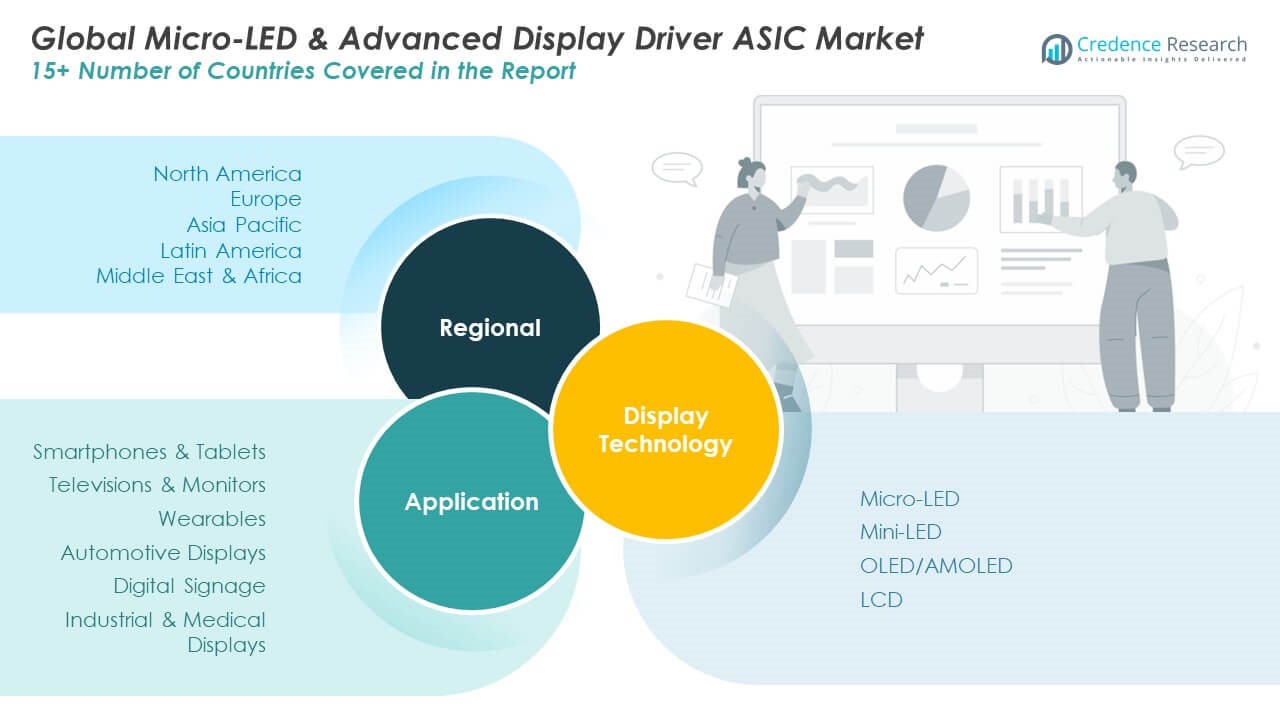
By Display Technology Segments:
- Micro-LED
- Mini-LED
- OLED/AMOLED
- LCD
By Application Segments:
- Smartphones & Tablets
- Televisions & Monitors
- Wearables
- Automotive Displays
- Digital Signage
- Industrial & Medical Displays
By Region Segments:
- North America
- U.S.
- Canada
- Mexico
- Europe
- Germany
- France
- U.K.
- Italy
- Spain
- Rest of Europe
- Asia Pacific
- China
- Japan
- India
- South Korea
- South-east Asia
- Rest of Asia Pacific
- Latin America
- Brazil
- Argentina
- Rest of Latin America
- Middle East & Africa
- GCC Countries
- South Africa
- Rest of the Middle East and Africa
Regional Analysis:
North America
The North America Global Micro-LED & Advanced Display Driver ASIC Market size was valued at USD 171.91 million in 2018 to USD 510.29 million in 2024 and is projected to reach USD 2,233.03 million by 2032, growing at a CAGR of 20.3% during the forecast period. The region is witnessing significant advancements in micro-LED technology, primarily driven by the presence of key players and robust demand for high-performance displays in consumer electronics and automotive sectors. North America dominates the market with a substantial market share of approximately 28%, due to the widespread adoption of micro-LED displays in devices such as televisions, smart devices, and high-tech automotive displays. The growth is also fueled by investments from major companies focused on developing advanced display driver ASICs to support the growing adoption of micro-LED technology.
Europe
The Europe Global Micro-LED & Advanced Display Driver ASIC Market size was valued at USD 118.10 million in 2018 to USD 337.73 million in 2024 and is projected to reach USD 1,345.87 million by 2032, growing at a CAGR of 18.9% during the forecast period. Europe’s market growth is driven by the increasing demand for micro-LED displays in automotive applications, particularly for in-cabin displays, infotainment systems, and heads-up displays. The region holds a market share of around 17%, with countries such as Germany and the United Kingdom leading the charge. Europe is also heavily investing in sustainability and energy-efficient display technologies, further accelerating the need for advanced display driver ASICs. As the European market emphasizes technological innovation and energy efficiency, it has become a significant player in the Global Micro-LED & Advanced Display Driver ASIC Market.
Asia Pacific
The Asia Pacific Global Micro-LED & Advanced Display Driver ASIC Market size was valued at USD 255.67 million in 2018 to USD 800.21 million in 2024 and is projected to reach USD 3,704.21 million by 2032, growing at a CAGR of 21.1% during the forecast period. The region is poised to experience the highest growth due to the rapid adoption of micro-LED displays in consumer electronics, especially in countries like China, Japan, and South Korea. Asia Pacific’s dominance, with a market share of approximately 40%, is attributed to the booming electronics manufacturing sector, with a large number of companies focusing on the development and deployment of micro-LED technology. The demand for micro-LED in televisions, smartphones, and wearables, coupled with government support for high-tech innovations, drives the need for display driver ASICs in the region.
Latin America
The Latin America Global Micro-LED & Advanced Display Driver ASIC Market size was valued at USD 28.26 million in 2018 to USD 84.16 million in 2024 and is projected to reach USD 324.59 million by 2032, growing at a CAGR of 18.4% during the forecast period. While the Latin American market is smaller compared to other regions, it is witnessing steady growth driven by increased interest in micro-LED technology for consumer electronics, particularly televisions and digital signage. Latin America holds a market share of approximately 5%, with the growing middle-class population and rising disposable income contributing to the demand for high-definition displays. Additionally, Latin American countries are increasingly adopting smart city initiatives, further driving the need for advanced display solutions in public and commercial spaces.
Middle East
The Middle East Global Micro-LED & Advanced Display Driver ASIC Market size was valued at USD 16.29 million in 2018 to USD 44.79 million in 2024 and is projected to reach USD 163.73 million by 2032, growing at a CAGR of 17.6% during the forecast period. The Middle East market is growing at a moderate pace due to its increasing adoption of high-end display technologies in sectors such as retail, automotive, and entertainment. The region holds a market share of approximately 3%, with countries like the UAE and Saudi Arabia investing heavily in smart city projects that incorporate advanced display technologies such as micro-LEDs in public infrastructure and digital signage. The region is also focusing on enhancing consumer electronics offerings with premium display solutions.
Africa
The Africa Global Micro-LED & Advanced Display Driver ASIC Market size was valued at USD 8.05 million in 2018 to USD 27.21 million in 2024 and is projected to reach USD 91.21 million by 2032, growing at a CAGR of 16.3% during the forecast period. The African market for micro-LED and advanced display driver ASICs is in its early stages but is expected to grow steadily, driven by rising adoption of consumer electronics and increasing infrastructure development. Africa holds a market share of approximately 2%, with a focus on urbanization and smart city projects, creating demand for energy-efficient and high-performance display technologies. As more emphasis is placed on consumer electronics, particularly smartphones and TVs, Africa is poised to experience steady growth in the micro-LED display market.
Key Player Analysis:
- Texas Instruments (TI)
- STMicroelectronics
- Samsung
- Novatek Microelectronics
- SiliconCore
- BOE HC SemiTek
- Jocoj
- TOPCO
- Finemad Electronics
- Focuslight
Competitive Analysis:
The competitive landscape of the Global Micro-LED & Advanced Display Driver ASIC Market is characterized by the presence of several key players such as Texas Instruments, Analog Devices, and Broadcom, among others. These companies focus on developing high-performance, energy-efficient ASIC solutions tailored for micro-LED displays. Competition is intense as players aim to differentiate their products through innovation in design and technology, offering improved display quality, enhanced power efficiency, and smaller form factors. Strategic partnerships and mergers and acquisitions are commonly observed as companies seek to enhance their technological capabilities and expand their market reach. The need for cost-effective solutions, alongside the rise in demand for premium displays in consumer electronics, automotive, and other industries, intensifies the competitive dynamics. Companies that can provide scalable, reliable, and energy-efficient solutions are well-positioned to lead the market in the long term.
Recent Developments:
- In May 2025, Samsung Electronics announced a strategic partnership with BAFTA, becoming BAFTA’s first Official Screen Partner. Coinciding with the reveal of its highly-anticipated 2025 lineup of TVs, projectors, and soundbars, this partnership aligns Samsung with leading names in the creative arts and underscores its leadership in advanced display innovation.
Market Concentration & Characteristics:
The Global Micro-LED & Advanced Display Driver ASIC Market is moderately concentrated, with a few dominant players controlling a significant portion of the market share. Large semiconductor companies such as Texas Instruments and Broadcom lead the market, owing to their extensive research and development capabilities and established customer bases. The market is characterized by rapid technological advancements, with players continuously focusing on optimizing power efficiency and enhancing display quality. As micro-LED technology continues to mature, companies are increasingly investing in product innovation to meet the rising demand for high-definition, energy-efficient displays across consumer electronics, automotive, and other sectors. The market also sees growing competition from smaller players that offer specialized solutions targeting specific industry needs.
Report Coverage:
The research report offers an in-depth analysis based on Display Technology and Application. It details leading market players, providing an overview of their business, product offerings, investments, revenue streams, and key applications. Additionally, the report includes insights into the competitive environment, SWOT analysis, current market trends, as well as the primary drivers and constraints. Furthermore, it discusses various factors that have driven market expansion in recent years. The report also explores market dynamics, regulatory scenarios, and technological advancements that are shaping the industry. It assesses the impact of external factors and global economic changes on market growth. Lastly, it provides strategic recommendations for new entrants and established companies to navigate the complexities of the market.
Future Outlook:
- The Global Micro-LED & Advanced Display Driver ASIC Market will continue its strong growth, during the forecast period.
- Technological advancements will drive innovations in display quality, including better contrast ratios, thinner panels, and reduced power consumption.
- The growing demand for micro-LEDs in high-end consumer electronics, such as televisions and smartphones, will increase the need for specialized display driver ASICs.
- Adoption of micro-LEDs in automotive applications will significantly boost market demand for display driver solutions.
- As energy efficiency becomes a key consumer preference, the need for energy-efficient advanced display driver ASICs will rise.
- The shift towards flexible, foldable, and bendable displays will create new opportunities for ASIC manufacturers.
- AI-driven display technologies will become more integrated, driving demand for advanced display driver ASICs with AI capabilities.
- North America and Asia-Pacific will continue to lead the market, with substantial investments from key semiconductor companies.
- The European market will grow due to the rising adoption of micro-LED technology in automotive and wearable devices.
- Smaller players with specialized solutions will also gain traction in niche markets, increasing competition and innovation.
Request a Free Sample
Fill in your details and we'll send you a free sample report.
- Sample data tables & charts
- Research methodology
Need a Custom Version of This Report?
Tailor the scope, geography, or segments to your exact requirements.
- Custom geography or segment scope
- Direct access to our analyst team
Frequently Asked Questions
What is the current size of the Global Micro-LED & Advanced Display Driver ASIC Market?
What factors are driving the growth of the Global Micro-LED & Advanced Display Driver ASIC Market?
What are the key segments within the Global Micro-LED & Advanced Display Driver ASIC Market?
What are some challenges faced by the Global Micro-LED & Advanced Display Driver ASIC Market?
Who are the major players in the Global Micro-LED & Advanced Display Driver ASIC Market?
Table of Content
Chapter 1. Report Introduction
- 1.1 Report Description & Purpose
- 1.1.1 Report Title & Market Definition
- 1.1.2 Unique Selling Propositions (USP) & Key Differentiators
- 1.1.3 Value Proposition for Stakeholders
- 1.2 Research Objectives
- 1.2.1 Market Sizing Objectives (Volume & Revenue) (Volume Where Applicable)
- 1.2.2 Segmentation Objectives
- 1.2.3 Competitive Intelligence Objectives
- 1.2.4 Forecast & Scenario Objectives
- 1.3 Report Scope
- 1.3.1 Micro-LED and Advanced Display Driver ASIC Scope – Segments & Subsegments Covered
- 1.3.2 Geographic Scope – Regions & Countries Covered
- 1.3.3 Historical Period, Base Year & Forecast Period (2018; forecast to 2032)
- 1.3.4 Inclusions & Exclusions
- 1.4 Industry Classification & Applicable Codes
- 1.5 Currency, Measurement Units & Valuation Basis
- 1.6 Target Stakeholders
- 1.7 Limitations & Assumptions
Chapter 2. Executive Summary
- 2.1 Global Micro-LED and Advanced Display Driver ASIC Market Snapshot
- 2.1.1 Market Size – Historical (2018) & Forecast (2018-2032) (2018: USD 598.28 million → 2032: USD 7,862.64 million)
- 2.1.2 Volume & Revenue – Global Totals (Volume Where Applicable)
- 2.1.3 Key Market Highlights – Top Five Facts
- 2.2 Micro-LED and Advanced Display Driver ASIC Market Segmentation Snapshot
- 2.2.1 Market Split by Region – 2018 vs. 2032
- 2.3 Competitive Snapshot
- 2.3.1 Top 10 Players by Revenue Share – 2018
- 2.3.2 Top 10 Players by Volume Share – 2018 (Volume Where Applicable)
- 2.3.3 Recent Strategic Developments (18-Month Summary)
- 2.4 Key Investment Highlights & Strategic Conclusions
Chapter 3. Micro-LED and Advanced Display Driver ASIC Market Dynamics & Industry Analysis
- 3.1 Market Overview & Context
- 3.1.1 Micro-LED and Advanced Display Driver ASIC Market Position in the Broader Industry Value Chain
- 3.1.2 Demand Structure & Purchasing Dynamics
- 3.1.3 Market Maturity & Development Stage by Region
- 3.2 Micro-LED and Advanced Display Driver ASIC Market Drivers
- 3.3 Micro-LED and Advanced Display Driver ASIC Market Restraints & Challenges
- 3.4 Micro-LED and Advanced Display Driver ASIC Market Opportunities
- 3.5 Porter's Five Forces Analysis
- 3.5.1 Threat of New Entrants
- 3.5.2 Bargaining Power of Suppliers
- 3.5.3 Bargaining Power of Buyers
- 3.5.4 Threat of Substitutes
- 3.5.5 Competitive Rivalry – Intensity Assessment
- 3.6 Micro-LED and Advanced Display Driver ASIC Value Chain Analysis
- 3.6.1 Upstream – Key Inputs, Resources & Suppliers
- 3.6.1.1 Key Input/Resource 1
- 3.6.1.2 Key Input/Resource 2
- 3.6.1.3 Key Input/Resource 3
- 3.6.2 Midstream – Core Operations & Value Creation
- 3.6.2.1 Operating Model & Process Overview
- 3.6.2.2 Key Operating Locations & Capabilities by Company
- 3.6.3 Downstream – Market Channels & End Users
- 3.6.3.1 Direct Sales & Customer Engagement Channels
- 3.6.3.2 Indirect Sales, Intermediaries & Partner Channels
- 3.6.4 Value Chain Profitability Analysis
- 3.6.1 Upstream – Key Inputs, Resources & Suppliers
- 3.7 PESTEL Analysis
- 3.7.1 Political Factors
- 3.7.2 Economic Factors
- 3.7.3 Social Factors
- 3.7.4 Technological Factors
- 3.7.5 Environmental Factors
- 3.7.6 Legal Factors
- 3.8 Micro-LED and Advanced Display Driver ASIC Supply Chain Analysis
- 3.8.1 Critical Input & Resource Availability Risk Assessment
- 3.8.2 Supplier & Operational Concentration Risk (Geographic Exposure)
- 3.8.3 Supply & Service Disruption Impact Analysis
- 3.9 Regulatory & Policy Landscape
Note: The regulatory and policy landscape section covers regulations based on their applicability to the market, Micro-LED and Advanced Display Driver ASIC category, geography, and scope of the study. Only regulatory frameworks with a material impact on operations, compliance, trade, sustainability, or market access are analyzed in detail.
Chapter 4. Key Investment Pockets & Opportunity Analysis
- 4.1 Micro-LED and Advanced Display Driver ASIC Market Attractiveness Analysis
- 4.1.1 By Region – Investment Attractiveness Matrix (Market Size × CAGR)
- 4.2 Absolute Revenue Growth Opportunity
- 4.2.1 By Region – Absolute Revenue Growth Through 2032
- 4.3 Incremental Demand Opportunity
- 4.3.1 By Region – Incremental Demand Through 2032
- 4.3.2 Segment – Incremental Demand
- 4.4 Emerging Submarket Opportunity Deep Dive (Subject to Applicability)
- 4.5 Priority Market Opportunity Scorecards
- 4.5.1 United States
- 4.5.2 Europe
- 4.5.3 Asia
- 4.5.4 Middle East & Africa
Note: Priority market opportunity scorecards reflect the geographic scope and strategic relevance of the study. Listed markets are indicative and may be adapted to the industry.
Chapter 5. Micro-LED and Advanced Display Driver ASIC Cross-Border Trade & Market Access Analysis
- 5.1 International Trade & Cross-Border Activity Overview
- 5.1.1 Global Export Value by Country (2018)
- 5.1.2 Global Export Volume by Country (2018) (Volume Where Applicable)
- 5.1.3 Global Import Value by Country (2018)
- 5.1.4 Global Import Volume by Country (2018) (Volume Where Applicable)
- 5.1.5 Net Trade Balance by Country (2018)
- 5.2 Export Analysis – Segment
- 5.2.1 Category 1 (Applicable Classification Code)
- 5.2.2 Category 2 (Applicable Classification Code)
- 5.2.3 Category 3 (Applicable Classification Code)
- 5.2.4 Category 4 (Applicable Classification Code)
- 5.2.5 Category 5 (Applicable Classification Code)
- 5.3 Import Analysis – Segment
- 5.3.1 Category 1 (Applicable Classification Code)
- 5.3.2 Category 2 (Applicable Classification Code)
- 5.3.3 Category 3 (Applicable Classification Code)
- 5.3.4 Category 4 (Applicable Classification Code)
- 5.3.5 Category 5 (Applicable Classification Code)
- 5.4 Cross-Border Pricing & Transaction Benchmarks
- 5.4.1 Export Pricing – Segment & Country
- 5.4.2 Import Pricing – Segment & Source Country
- 5.4.3 Price Trends (2018)
- 5.5 Key Cross-Border Trade & Delivery Routes
- 5.5.1 Cross-Border Trade/Delivery Route 1
- 5.5.2 Cross-Border Trade/Delivery Route 2
- 5.5.3 Cross-Border Trade/Delivery Route 3
- 5.5.4 Cross-Border Trade/Delivery Route 4
- 5.5.5 Cross-Border Trade/Delivery Route 5
- 5.6 Trade Policy & Market Access Impact Assessment
- 5.6.1 Tariff & Non-Tariff Barriers
- 5.6.2 Regional Trade & Economic Integration Frameworks
- 5.6.3 Bilateral & Multilateral Trade Agreements
- 5.6.4 Cross-Border Operating, Licensing & Localization Requirements
Note: This chapter applies where cross-border trade or delivery is relevant to Micro-LED and Advanced Display Driver ASIC. Goods, services, and digital offerings are assessed using applicable classifications and transaction measures. Import-export volumes, trade balances, and route analyses are included only where meaningful to the market.
Chapter 6. Competitive Landscape & Company Benchmarking
- 6.1 Micro-LED and Advanced Display Driver ASIC Market Concentration & Structure
- 6.1.1 Herfindahl-Hirschman Index (HHI) – the historical period vs. 2018
- 6.1.2 Leading, Mid-Sized & Emerging Player Structure
- 6.1.3 Global, Regional & Local Player Dynamics
- 6.2 Micro-LED and Advanced Display Driver ASIC Market Share Analysis – 2018
- 6.2.1 Global Revenue Share by Company
- 6.2.2 Global Volume Share by Company (Volume Where Applicable)
- 6.2.3 Regional Revenue Share
- 6.2.4 Market Share Evolution (the historical period vs. 2018)
- 6.2.5 Company Market Share by Key Segment
- 6.2.6 Company Market Share by Customer Group
- 6.3 Operating Scale, Capacity & Infrastructure Analysis
- 6.3.1 Global Operating Scale & Supply Capacity
- 6.3.2 Resource Utilization & Operating Efficiency
- 6.3.3 Output, Service Delivery & Activity Metrics
- 6.3.4 Operating Footprint & Infrastructure Map
- 6.3.5 Planned Operational & Capacity Expansion
- 6.4 Micro-LED and Advanced Display Driver ASIC Competitive Benchmarking Matrix
- 6.4.1 Revenue, Growth, Profitability & Operating Metric Comparison
- 6.4.2 Channel Revenue Mix
- 6.4.3 Geographic Revenue Exposure
- 6.4.4 R&D Intensity
- 6.4.5 Sustainability Maturity
- 6.5 Strategic Developments in Micro-LED and Advanced Display Driver ASIC (Last 24 Months)
- 6.5.1 Mergers, Acquisitions & Divestments
- 6.5.2 New Products, Services & Solutions in Micro-LED and Advanced Display Driver ASIC
- 6.5.3 Operational & Infrastructure Expansions
- 6.5.4 Strategic Alliances, Joint Ventures & Partnerships
- 6.5.5 Distribution Expansion & Market Entry
- 6.5.6 Sustainability & ESG Initiatives
- 6.6 Competitive Strategy Mapping
- 6.6.1 Leader, Challenger, Follower & Niche Classification
- 6.6.2 Pricing Strategy Comparison
- 6.6.3 Channel Strategy Matrix
Note: Strategic developments are included based on their materiality and the availability of reliable information.
Chapter 7. Global Micro-LED and Advanced Display Driver ASIC Market – By Sales & Delivery Channel
- 7.1 Segment Overview
- 7.1.1 Volume & Revenue Split by Channel (2018 & 2032) (Volume Where Applicable)
- 7.1.2 Channel Mix Evolution (2018-2032)
Chapter 8. Regional Market Analysis – Global Overview
- 8.1 Global Regional Overview
- 8.1.1 Regional Volume Share (Volume Where Applicable)
- 8.1.2 Regional Revenue Share
- 8.1.3 Regional Volume by Region (Volume Where Applicable)
- 8.1.4 Regional Revenue by Region
- 8.1.5 Regional Forecast Through 2032
- 8.2 Cross-Regional Segment Analysis
- 8.2.1 By Sales & Delivery Channel
- 8.2.2 By Competitive Positioning & Price Tier
Chapter 9. North America Micro-LED and Advanced Display Driver ASIC Market
- 9.1 United States
- 9.2 Canada
- 9.3 Mexico
Chapter 10. Europe Micro-LED and Advanced Display Driver ASIC Market
- 10.1 Germany
- 10.2 France
- 10.3 Italy
- 10.4 United Kingdom
- 10.5 Spain
- 10.6 Poland
- 10.7 Russia
- 10.8 Netherlands
- 10.9 Belgium
- 10.10 Sweden
- 10.11 Denmark
- 10.12 Norway
- 10.13 Rest of Europe
Chapter 11. Asia Pacific Micro-LED and Advanced Display Driver ASIC Market
- 11.1 China
- 11.2 India
- 11.3 Japan
- 11.4 South Korea
- 11.5 Thailand
- 11.6 Indonesia
- 11.7 Vietnam
- 11.8 Malaysia
- 11.9 Australia
- 11.10 Rest of Asia Pacific
Chapter 12. Latin America Micro-LED and Advanced Display Driver ASIC Market
- 12.1 Brazil
- 12.2 Argentina
- 12.3 Colombia
- 12.4 Chile
- 12.5 Rest of Latin America
Chapter 13. Middle East Micro-LED and Advanced Display Driver ASIC Market
- 13.1 Saudi Arabia
- 13.2 United Arab Emirates
- 13.3 Turkey
- 13.4 Israel
- 13.5 Iran
- 13.6 Rest of the Middle East
Chapter 14. Africa Micro-LED and Advanced Display Driver ASIC Market
- 14.1 South Africa
- 14.2 Egypt
- 14.3 Nigeria
- 14.4 Morocco
- 14.5 Rest of Africa
Chapter 15. Micro-LED and Advanced Display Driver ASIC Company Profiles
- 15.1 [Company 01]
- 15.1.1 Company Overview
- 15.1.2 Key Management Personnel
- 15.1.3 Products & Services Portfolio
- 15.1.4 Financial Performance
- 15.1.5 Key Market Focus & Geographic Presence
- 15.1.6 Recent Developments & Strategic Initiatives
Note: The company profile list is preliminary and may change based on research findings, market developments, data availability, and client requirements.
Chapter 16. Appendices
- Appendix A – List of Abbreviations & Acronyms
- Appendix B – Industry Classification Code Reference – Full Series
- Appendix C – Supply, Output & Operating Capacity Data Tables
- Appendix D – End-Use & Demand Base Tables
- Appendix E – Demand, Adoption & Usage Assumptions
- Appendix F – Pricing & Revenue Metric Reference Tables
- Appendix G – Company Operations & Infrastructure Database
- Appendix H – Cross-Border Trade & Activity Data Tables (Where Applicable)
- Appendix I – Regulatory Summary Tables
- Appendix J – Primary Research Participant List (Anonymized)
- Appendix K – Primary Research Questionnaire Framework
- Appendix L – Data Sources & Bibliography
- Appendix M – Market Size Divergence & Source Comparison
Chapter 17. Research Methodology
- 17.1 Research Framework & Philosophy
- 17.2 Secondary Research – Sources, Hierarchy & Data Extraction
- 17.3 Data Modeling – Bottom-Up & Top-Down Market Sizing
- 17.4 Primary Research – Stakeholder Framework, LOI & Sample Sizes
- 17.5 Forecast Methodology – Regression, Scenario & Sensitivity Analysis
- 17.6 Quality Control – Four-Layer Validation Framework
- 17.7 Limitations & Standard Assumptions
- 17.8 Disclaimer
