Market Overview
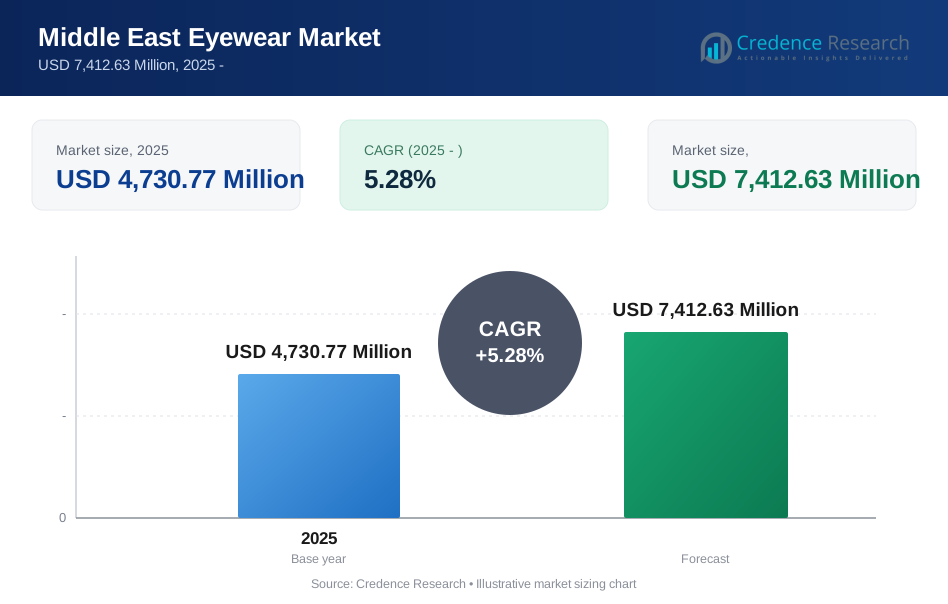
The Middle East Eyewear Market is projected to grow from USD 4,730.77 Million in 2025 to an estimated USD 7,412.63 Million by 2032, with a CAGR of 5.28% from 2025 to 2032. Demand continues to rise as vision correction needs increase, fashion-led eyewear spending expands and organized optical retail strengthens across key urban markets.
Rising screen exposure, growing diagnosis of refractive errors and increasing consumer interest in premium branded frames and lenses drive market expansion. Within the region, Gulf markets led by Saudi Arabia and the UAE represent the strongest revenue concentration because of higher disposable income, dense retail networks and stronger adoption of branded optical products.
| REPORT ATTRIBUTE | DETAILS |
|---|---|
| Historical Period: | 2020-2024 |
| Base Year | 2025 |
| Forecast Period | 2025-2032 |
| Middle East Eyewear Market Market Size 2025 | USD 4,730.77 Million |
| Middle East Eyewear Market CAGR | 5.28% |
| Middle East Eyewear Market Market Size 2032 | USD 7,412.63 Million |
Market Insights
- Saudi Arabia holds the largest share in the Middle East eyewear market, supported by its large consumer base, expanding optical retail infrastructure, and rising spending on both prescription eyewear and sunglasses
- Prescription (RX) Glasses dominated product demand in 2025 with an estimated 46.2% share because corrective eyewear remains essential across broad age groups.
- EssilorLuxottica, Zeiss Group, Safilo Group, CooperVision Limited and De Rigo Vision S.p.A. rank among the most visible competitive participants shaping branded and clinical eyewear demand.
- Brick & Mortar remained the leading distribution route in 2025 as consumers continued to prefer in-store eye testing, fitting accuracy and immediate product consultation.
- Key market trend centers on premiumization, with blue-light lenses, polarized sunglasses, digital fitting tools and fashion-led collections gaining traction across urban consumers.

Market Segmentation Analysis
By product - Prescription eyewear anchors market demand
On the basis of product, the market is classified into Contact Lenses, Prescription (RX) Glasses and Sunglasses. Prescription (RX) Glasses held the largest market share of 46.2% in 2025. This segment leads because refractive errors remain widespread and consumers increasingly seek lightweight lenses, anti-reflective coatings and branded frames through organized optical chains. Demand also benefits from repeat replacement cycles and growing awareness of routine eye examinations. Key companies operating in this segment include EssilorLuxottica, Zeiss Group and Aynai Optical.
By price range - Value and mid-market purchases support volume leadership
On the basis of price range, the market is classified into Upto USD 150, USD 151-300 and Above USD 300. Upto USD 150 accounted for the largest share at 48.5% in 2025. This segment benefits from broad accessibility, stronger demand from price-sensitive households and high unit turnover in basic prescription frames and entry-level sunglasses. Expanding private-label assortments and promotions by optical retailers also support growth. Key companies active across this segment include Lapaire, Titan Company Limited and Zarka Al Yamama Lens Factory.
By gender - Male consumers maintain larger purchase base
On the basis of gender, the market is classified into Male and Female. Male held the largest market share of 52.4% in 2025. The segment remains ahead because of higher adoption of functional prescription eyewear, sunglasses for outdoor driving and work-related usage across large urban populations. Sports and polarized categories also support stronger male purchasing frequency in several Gulf markets. Key companies serving this segment include Safilo Group, JINS Inc. and De Rigo Vision S.p.A.
By distribution channel - Store-led optical retail sustains leadership
On the basis of distribution channel, the market is classified into E-Commerce and Brick & Mortar. Brick & Mortar held the largest share of 71.3% in 2025. Consumers continue to prefer physical stores for eye testing, frame trials, lens customization and after-sales adjustment services, especially for prescription products. Retail chains and independent opticians also benefit from trusted optometrist relationships and faster conversion of walk-in traffic. Key companies participating in this channel include Fielmann AG, EssilorLuxottica and Aynai Optical.
Key Growth Drivers
Rising vision correction needs expand core eyewear demand
Growing incidence of myopia, hyperopia, astigmatism, and age-related vision decline continues to support steady demand for prescription eyewear across the Middle East, as urban lifestyles, longer years in education, and heavy screen exposure increase visual stress among school-age children, working professionals, and older adults, making routine eye examinations, corrective lenses, and frame replacement a recurring healthcare and lifestyle need rather than a one-time purchase.
Demand growth is especially visible in major cities, where organized optical chains, hospital-linked eye care networks, and broader access to refraction and diagnostic services are helping more consumers move into formal vision correction pathways, while fashion consciousness and premium brand availability also encourage faster replacement cycles for eyewear products.
The underlying scale is substantial, with WHO EMRO estimating around 40.5 million visually impaired people in the region and identifying uncorrected refractive errors as 43 percent of visual impairment causes, while MAGRABi Retail Group says its footprint now exceeds 290 stores across the Middle East, showing how major retailers are expanding to meet sustained prescription eyewear demand.
Premium fashion positioning lifts average selling prices
Eyewear increasingly functions as both a medical necessity and a visible fashion accessory across the Middle East, which is raising consumer willingness to trade up from basic vision correction products to branded sunglasses, designer frames, and premium coated lenses that reflect personal style as much as optical need.
This pattern is especially strong in Saudi Arabia, the UAE, and other urban Gulf markets, where brand affinity, image consciousness, and preference for curated retail experiences are encouraging retailers to widen assortments across luxury, premium, and accessible branded tiers in both prescription and non-prescription categories. International groups are responding by expanding franchise, wholesale, and shop-in-shop models that blend fashion authority with optical expertise, helping the category move beyond simple replacement purchases toward premium lifestyle positioning.
The commercial logic is clear, as Chalhoub Group reported that GCC personal luxury retail sales reached USD 12.8 billion with the UAE accounting for 56 percent of that market, while EssilorLuxottica and Chalhoub have partnered to open mono-brand and multi-brand eyewear stores for labels such as Ray-Ban, Persol, Oliver Peoples, and David Clulow across the GCC.
Retail modernization and digital tools improve conversion Market growth also benefits from structural improvement in retail delivery. Optical chains, specialty stores and omnichannel platforms now provide digital eye testing workflows, virtual try-on tools, electronic prescriptions and lens customization interfaces that simplify purchase decisions. These capabilities reduce friction for first-time users and improve replacement cycle conversion for existing customers. In-store service still matters, but digital discovery and appointment booking increasingly influence footfall and final purchase. E-commerce is expanding faster in contact lenses and sunglasses, while stores remain essential for prescription dispensing. Better retail execution also helps brands penetrate secondary cities through franchising and curated assortments. As consumers receive clearer product information on lens materials, UV protection, blue-light filtering and frame fit, overall basket value improves and attachment rates for premium lens add-ons continue to rise.
Key Trends & Opportunities
Trend:
Premium lenses and lifestyle eyewear gain traction Consumers across the Middle East are moving beyond basic corrective products and choosing eyewear that combines visual performance with design appeal. Demand is increasing for anti-glare coatings, blue-light filtering, photochromic lenses, polarized sunglasses and thinner high-index materials. This trend is strongest in affluent urban markets where shoppers often own multiple pairs for work, driving and fashion use. Brand storytelling and influencer-led merchandising are reinforcing demand for premium frames and curated seasonal collections.
Omnichannel retail reshapes eyewear purchase journeys Purchase behavior is becoming more hybrid as consumers research online, compare prices digitally and complete fittings in stores. E-commerce is increasingly relevant for replenishment categories such as contact lenses and for non-corrective sunglasses, while prescription eyewear still depends on in-person verification and fitting. Retailers are integrating appointment booking, digital catalogs, virtual try-on and click-and-collect services to shorten sales cycles. Social commerce and mobile-led browsing also influence younger buyers who prioritize style, convenience and promotional transparency. As organized optical chains improve customer relationship management and follow-up reminders, repeat purchases and lens upgrades become easier to monetize. This omnichannel shift will keep accelerating as internet penetration and digital payment usage expand across Gulf and wider regional markets.
Opportunity:
Secondary cities and value segments remain underpenetrated Significant expansion opportunity remains outside top metropolitan clusters. Many consumers in secondary cities still rely on fragmented independent optical stores with narrower product ranges and less advanced diagnostic support. Companies that build affordable assortments, localized retail formats and efficient supply chains can capture unmet demand for basic prescription glasses and low-to-mid priced sunglasses. Value-led products are particularly important for families, migrant populations and younger consumers entering the corrective eyewear category for the first time. Partnerships with clinics, pharmacies and hospital networks can further improve reach. As screening access expands, these underserved locations are likely to generate meaningful volume growth across both replacement eyewear and first-time purchases.
Specialized segments can unlock higher-margin growth Firms also have room to build differentiated positions in specialized subcategories. Children’s eyewear, sports eyewear, workplace safety eyewear and daily disposable contact lenses offer targeted growth potential because each segment carries distinct fit, comfort and performance requirements. Aging populations create demand for progressive lenses and reading solutions, while outdoor lifestyles support UV-protective and polarized products. Brands that tailor assortments by climate, occupation and fashion preference can improve conversion and loyalty. Clinical collaboration with eye care professionals can support premium lens adoption and patient trust. This creates attractive room for companies to balance mass-market volume with margin-rich niches across both retail and institutional optical channels.
Key Challenges
Challenge:
Price sensitivity limits premium conversion Despite rising interest in branded and advanced eyewear, price sensitivity remains a major constraint across several consumer groups. Many buyers still prioritize affordability over coatings, premium lens materials or luxury frame labels, especially in replacement purchases. This limits trade-up potential and intensifies discounting pressure in entry and mid-tier categories. Imported products also face currency and logistics effects that can widen retail price gaps.
Fragmented retail and counterfeit risks affect trust Market structure remains mixed, with organized chains competing against numerous independent outlets that vary widely in service quality, product authenticity and diagnostic capability. Counterfeit sunglasses and unverified online sellers can weaken consumer trust and distort pricing benchmarks. Inconsistent fitting standards and limited after-sales service also affect customer satisfaction, particularly for prescription products that require precise measurement and lens customization.
Regional Analysis
Saudi Arabia – 28.4%
Saudi Arabia holds the largest share in the Middle East eyewear market, supported by its large consumer base, expanding optical retail infrastructure, and rising spending on both prescription eyewear and sunglasses. Demand is reinforced by increasing awareness of eye health, growing fashion orientation among younger consumers, and the steady expansion of online eyewear channels. Saudi Arabia’s eyewear market was valued at about USD 1.38 billion in 2025, which supports its position as the leading country market in the region.
Turkey – 23.6%
Turkey represents the second-largest share due to its broad population base, established optical retail network, and strong prescription eyewear demand. The market also benefits from tourism-linked retail activity and increasing consumer interest in branded sunglasses and fashion frames. Grand View Research indicates Turkey generated about USD 809.8 million in 2024, while Euromonitor notes continued value growth in 2025, making Turkey one of the most significant eyewear markets connected to the wider Middle East commercial landscape.
UAE – 16.8%
The UAE accounts for a high share relative to its population because of premiumization, luxury retail concentration, and strong demand for branded sunglasses and designer frames, particularly in Dubai and Abu Dhabi. The country’s market is supported by high disposable incomes, fashion-conscious consumers, tourism spending, and rapid adoption of omnichannel retail. Research coverage on UAE luxury and online eyewear retail points to a sizeable premium segment, while Grand View also highlights the broader Middle East market’s shift toward omnichannel and lifestyle-led eyewear demand.
Iran – 12.1%
Iran captures a meaningful share due to its large population and steady underlying need for vision correction products. Its contribution is supported more by volume-driven prescription demand than by premium fashion eyewear. Although public market data is less transparent than for Saudi Arabia, Turkey, or the UAE, Iran’s demographic scale and essential optical demand justify a double-digit regional share within the Middle East split. This allocation is an inference based on the regional market size, the relative scale of disclosed country markets, and the fact that prescription eyewear remains the largest product category globally.
Israel – 7.9%
Israel holds a moderate share, supported by high urbanization, good eye-care access, and strong uptake of contact lenses and premium optical products. Available market data shows Israel’s contact lens segment alone reached USD 110.05 million in 2022, indicating a relatively developed eye-care retail base for its size. This supports a mid-single- to high-single-digit share in the broader Middle East eyewear market.
Rest of Middle East – 11.2%
The rest of the Middle East, including Kuwait, Qatar, Oman, Bahrain, Jordan, and other smaller markets, collectively contributes a notable share. These countries benefit from rising optical retail penetration, higher awareness of UV protection, growing fashion consumption, and expanding mall-based and online distribution. However, their combined share remains below Saudi Arabia and Turkey because of smaller populations and more limited market depth outside leading urban centers.
Market Segmentations
- Product
- Contact Lenses
- Prescription (RX) Glasses
- Sunglasses
- Price Range
- Up to USD 150
- USD 151-300
- Above USD 300
- Gender
- Male
- Female
- Distribution Channel
- E-Commerce
- Brick & Mortar
Competitive Landscape
The Middle East Eyewear Market remains moderately fragmented, with global eyewear groups competing alongside regional optical specialists and local manufacturers. Companies focus on innovation through lightweight materials, advanced coatings, blue-light filtering and digital fitting tools. Product strategies center on balancing premium branded portfolios with accessible value lines to capture broad consumer demand. Distribution remains a key competitive lever, with players expanding through optical chains, franchise models, department store counters, e-commerce platforms and partnerships with clinics and eye care professionals. Regional relevance also matters, as firms tailor assortments to climate, fashion preferences and price sensitivity across Gulf and wider Middle Eastern markets. Competitive intensity is rising as international brands strengthen direct retail presence and local players improve service quality, private-label offerings and turnaround times for prescription lenses. Brand visibility, after-sales support and trusted optometry services continue to shape market share outcomes.
Key Player Analysis
- Aynai Optical
- Zeiss Group
- Safilo Group
- Zarka Al Yamama Lens Factory
- CooperVision Limited
- De Rigo Vision S.p.A.
- Fielmann AG
- JINS Inc.
- Titan Company Limited
- EssilorLuxottica
- Lapaire
Recent Developments
- In January 2026, Lenskart Middle East unveiled a pilot campaign for its Glint eyewear range that used generative AI, which Campaign Middle East described as a significant step in the brand’s regional marketing approach. The move stands out as an innovation-led development because it tied a consumer eyewear line to AI-driven creative execution in the Middle East operation rather than treating AI as only a back-end retail tool.
- In February 2025, TOKAI OPTICAL established TOKAI OPTICAL MEA (FZC) in the Sharjah Airport International Free Zone in the UAE and began eyeglass lens production following an opening ceremony held on January 31. TOKAI said the new factory was created to expand its presence and sales in the Middle East and Africa and to introduce its high-quality lens products to a region where the population needing vision correction is rising, making this a meaningful production and market-entry launch for the regional eyewear business.
- In February 2025, 100% Eyewear became a new partner of UAE Team ADQ for the cycling season. The announcement framed the partnership around the brand’s expertise in sports eyewear and its combination of innovation and performance, making it a relevant collaboration for the Middle East eyewear market because it links product visibility to a high-profile UAE-based sports platform.
Request a Free Sample
Fill in your details and we'll send you a free sample report.
- Sample data tables & charts
- Research methodology
Need a Custom Version of This Report?
Tailor the scope, geography, or segments to your exact requirements.
- Custom geography or segment scope
- Direct access to our analyst team
Frequently Asked Questions
What is the current size of the Middle East Eyewear Market?
What is driving growth in the Middle East Eyewear Market?
What are the main trends in the Middle East Eyewear Market?
Who are the top players in the Middle East Eyewear Market?
Table of Content
Chapter 1 Market Segmentation
- 1.1 Segmentation Framework
- 1.1.1 Product and Service Classification
- 1.1.2 Application and End-Use Classification
- 1.1.3 Technology and Solution Classification
- 1.1.4 Customer and Distribution Channel Classification
- 1.1.5 Geographic Segmentation
- 1.1.6 Market Segment Definitions and Boundaries
Chapter 2 Introduction
- 2.1 Report Objectives and Scope
- 2.2 Product Definition and Industry Terminology
- 2.3 Market Inclusions and Exclusions
- 2.4 Research Process
- 2.4.1 Primary Research and Expert Interviews
- 2.4.2 Secondary Research and Source Review
- 2.4.3 Top-Down and Bottom-Up Estimation
- 2.4.4 Data Triangulation and Verification
- 2.5 Market Size Measurement Basis
- 2.5.1 2025: USD 4,730.77 Million → 2032: USD 7,412.63 Million
- 2.6 Historical and Forecast Reference Periods
- 2.6.1 Base Year: 2025
- 2.6.2 Forecast Period: 2025-2032
- 2.7 Research Assumptions and Limitations
Chapter 3 Executive Summary
- 3.1 Market Snapshot and Key Findings
- 3.2 Base-Year Market Size, 2025
- 3.3 Forecast Market Size, 2032
- 3.4 Revenue and Volume Growth Outlook
- 3.5 Key Demand and Supply Indicators
- 3.6 Leading Market Segments
- 3.7 Fastest-Growing Market Opportunities
- 3.8 Regional Performance Highlights
- 3.9 Technology and Industry Transformation
- 3.10 Competitive Landscape Summary
- 3.11 Analyst View and Strategic Implications
Chapter 4 Middle East Eyewear Market Trends and Developments
- 4.1 Historical Industry Development
- 4.2 Recent Market Trends and Developments
- 4.3 Demand and Customer Behavior Trends
- 4.4 Technology and Product Innovation
- 4.5 Artificial Intelligence, Automation and Digitalization
- 4.6 Local Manufacturing and Supply Chain Realignment
- 4.7 Industry Partnerships, Mergers and Acquisitions
- 4.8 Sustainability and Circular Economy Developments
- 4.9 Government and Private Sector Investment Trends
- 4.10 Emerging Business Models and Commercialization
- 4.11 Industry Developments and Announcements
Chapter 5 Middle East Eyewear Market Production, Supply and Demand Analysis
- 5.1 Demand Trend and Consumption Analysis
- 5.2 Demand Forecast, 2025-2032
- 5.3 Production and Output Trend
- 5.4 Production and Output Forecast, 2025-2032
- 5.5 Installed Capacity and Capacity Utilization
- 5.6 Company-Wise Production Plants and Statistics
- 5.6.1 Installed Production Capacity
- 5.6.2 Actual Production
- 5.6.3 Planned Capacity and Expansion Targets
- 5.7 Supply Chain Structure and Procurement Trends
- 5.8 Supply-Demand Gap and Bottlenecks
- 5.9 Import Dependence and Sourcing Structure
- 5.10 Contract Manufacturing and Outsourcing
- 5.11 Regional Supply and Demand Concentration
Chapter 6 Middle East Eyewear Market Pricing Analysis
- 6.1 Pricing Structure and Measurement
- 6.2 Historical Pricing Trends
- 6.3 Pricing Outlook, 2025-2032
- 6.4 Average Selling Price and Unit Economics
- 6.5 Pricing by Product and Market Segment
- 6.6 Geographic Pricing Differences
- 6.7 Key Input, Energy, Labor and Logistics Costs
- 6.8 Contract Pricing and Purchasing Models
- 6.9 Pricing Sensitivity and Competitive Positioning
- 6.10 Price, Margin and Profitability Implications
Chapter 7 Middle East Eyewear Market Dynamics
- 7.1 Market Growth Drivers
- 7.1.1 Demand-Side Drivers
- 7.1.2 Technology and Innovation Drivers
- 7.1.3 Infrastructure and Investment Drivers
- 7.1.4 Regulatory and Policy Drivers
- 7.2 Market Restraints
- 7.2.1 Cost and Affordability Constraints
- 7.2.2 Technology and Adoption Barriers
- 7.2.3 Supply Chain and Operational Constraints
- 7.3 Market Challenges
- 7.3.1 Competitive Pressure and Margin Erosion
- 7.3.2 Skills, Infrastructure and Implementation Gaps
- 7.4 Emerging Market Opportunities
- 7.5 Market Dynamics Impact and Time-Horizon Assessment
Chapter 8 Middle East Eyewear Value Chain Analysis
- 8.1 Industry Value Chain Overview
- 8.2 Upstream Suppliers and Critical Inputs
- 8.3 Technology and Component Providers
- 8.4 Manufacturing or Service Delivery
- 8.5 Distribution, Channel Partners and Integrators
- 8.6 Downstream Applications and End Users
- 8.7 Value Addition and Profit Pools
- 8.8 Vertical Integration and Outsourcing
- 8.9 Supplier Concentration and Risk
- 8.10 Supply Chain Localization and Resilience
Chapter 9 Middle East Eyewear Market Regulations and Policies
- 9.1 Relevant Laws, Standards and Compliance Frameworks
- 9.2 Product, Service, Safety and Quality Requirements
- 9.3 Government Policies, Incentives and Subsidies
- 9.4 Imports, Exports and Trade Barriers
- 9.5 Public Procurement and Local Content Requirements
- 9.6 Environmental and Sustainability Compliance
- 9.7 Upcoming Policy Changes and Market Implications
Chapter 10 Middle East Eyewear Market Hotspots and Opportunities
- 10.1 Market Opportunity Mapping and Growth Hotspots
- 10.2 High-Growth Applications and Customer Groups
- 10.3 Underserved Markets and White-Space Opportunities
- 10.4 Emerging Technology and Product Opportunities
- 10.5 New Capacity and Investment Hotspots
- 10.6 Market Entry and Expansion Opportunities
- 10.7 Distribution and Partnership Opportunities
- 10.8 Near-Term and Long-Term Commercial Potential
- 10.9 Opportunity Attractiveness and Execution Risks
Chapter 11 Middle East Eyewear Market Outlook, 2025-2032
- 11.1 Market Size and Analysis
- 11.1.1 Revenue (Market Measurement: 2025: USD 4,730.77 Million → 2032: USD 7,412.63 Million)
- 11.1.2 Market Volume and Quantity Sold
- 11.1.3 Historical Market Size
- 11.1.4 Base-Year Market Size, 2025
- 11.2 Market Forecast, 2025-2032
- 11.2.1 Revenue Forecast to 2032
- 11.2.2 Volume Forecast to 2032
- 11.2.3 CAGR and Year-on-Year Growth
- 11.2.4 Incremental Revenue Opportunity
- 11.3 Forecast Assumptions and Scenario Analysis
- 11.3.1 Base-Case Forecast
- 11.3.2 Optimistic and Conservative Scenarios
- 11.3.3 Technology, Pricing and Policy Sensitivities
- 11.4 Market Attractiveness and Growth Outlook
Chapter 12 Middle East Eyewear Market Segmentation and Outlook
- 12.1 Segmentation Summary and Market Shares, 2025
- 12.2 Largest and Fastest-Growing Segments
- 12.3 Segment Growth Comparison
- 12.4 Segment Attractiveness and Priority Matrix
Chapter 13 Middle East Eyewear Geographic Market Outlook, 2025-2032
- 13.1 Regional Market Size and Country-Level Shares, 2025
- 13.2 Country Market Size Comparison, 2025
- 13.3 Country Market Forecasts, 2025-2032
- 13.4 Subregional Industrial and Demand Clusters
- 13.5 Intra-Regional Pricing and Cost Differences
- 13.6 Cross-Border Trade and Supply Networks
- 13.7 Regional Supply and Demand Balances
- 13.8 Country Opportunity Comparison and Prioritization
Note: Every listed country is covered on the structure shown under the first country.
Chapter 14 Middle East Eyewear Technology, Innovation and Sustainability Outlook
- 14.1 Technology Landscape and Maturity
- 14.2 Product, Process and Service Innovation
- 14.3 AI, Automation and Digital Tools in the Industry
- 14.4 Technology Adoption and Performance Benchmarking
- 14.5 Innovation Pipeline and R&D Investment
- 14.6 Patent and Intellectual Property Trends
- 14.7 Energy Efficiency and Resource Management
- 14.8 Sustainability, Recycling and Circularity
- 14.9 Technology Roadmap, 2025-2032
- 14.10 Risks of Obsolescence and Technology Substitution
Chapter 15 Middle East Eyewear Market Key Strategic Imperatives
- 15.1 Growth and Market Entry Priorities
- 15.2 High-Return Products and Segments
- 15.3 Pricing, Profitability and Cost Optimization
- 15.4 Technology Investment and Product Differentiation
- 15.5 Supply Chain Localization and Resilience
- 15.6 Distribution and Customer Acquisition
- 15.7 Partnership, Acquisition and Capacity Strategy
- 15.8 Regional Expansion Priorities
- 15.9 Short-, Medium- and Long-Term Actions
Chapter 16 Competition Outlook
- 16.1 Industry Competition Characteristics
- 16.2 Market Structure and Concentration
- 16.3 Market Share and Competitive Positioning, 2025
- 16.4 Company-Wise Revenue and Product Benchmarking
- 16.5 Production and Service Capacity Benchmarking
- 16.6 Technology, Pricing and Differentiation
- 16.7 Regional Footprint and Distribution Strength
- 16.8 Mergers, Acquisitions and Strategic Alliances
- 16.9 New Entrants and Competitive Threats
- 16.10 Porter's Five Forces and Industry Attractiveness
- 16.11 Competitive Outlook, 2025-2032
Chapter 17 Company Profiles
- 17.1 Company Coverage and Selection Criteria
- 17.2 Leading Market Participants – Standard Profile Structure
- 17.2.1 Business Description
- 17.2.2 Company Ownership and Geographic Presence
- 17.2.3 Product and Service Portfolio
- 17.2.4 Manufacturing and Operating Footprint
- 17.2.5 Production Capacity and Expansion Plans
- 17.2.6 Financial Performance and Investment
- 17.2.7 Market Share and Competitive Position
- 17.2.8 Technology and Innovation Capabilities
- 17.2.9 Strategic Alliances or Partnerships
- 17.2.10 Recent Developments
- 17.2.11 Growth Strategy and Outlook
- 17.3 Other Relevant Market Participants
Note: Every listed company is profiled on the structure shown under the first company. The company list is preliminary and may change based on research findings, market developments, data availability and client requirements.
Chapter 18 Disclaimer
- 18.1 Research and Forecast Disclaimer
- 18.2 Data Source and Estimation Limitations
Note: The depth of individual sections depends on data availability for this market. Volume, capacity, trade and other unit-based metrics are included where applicable.