
Motorcycle Suspension System Market Overview:
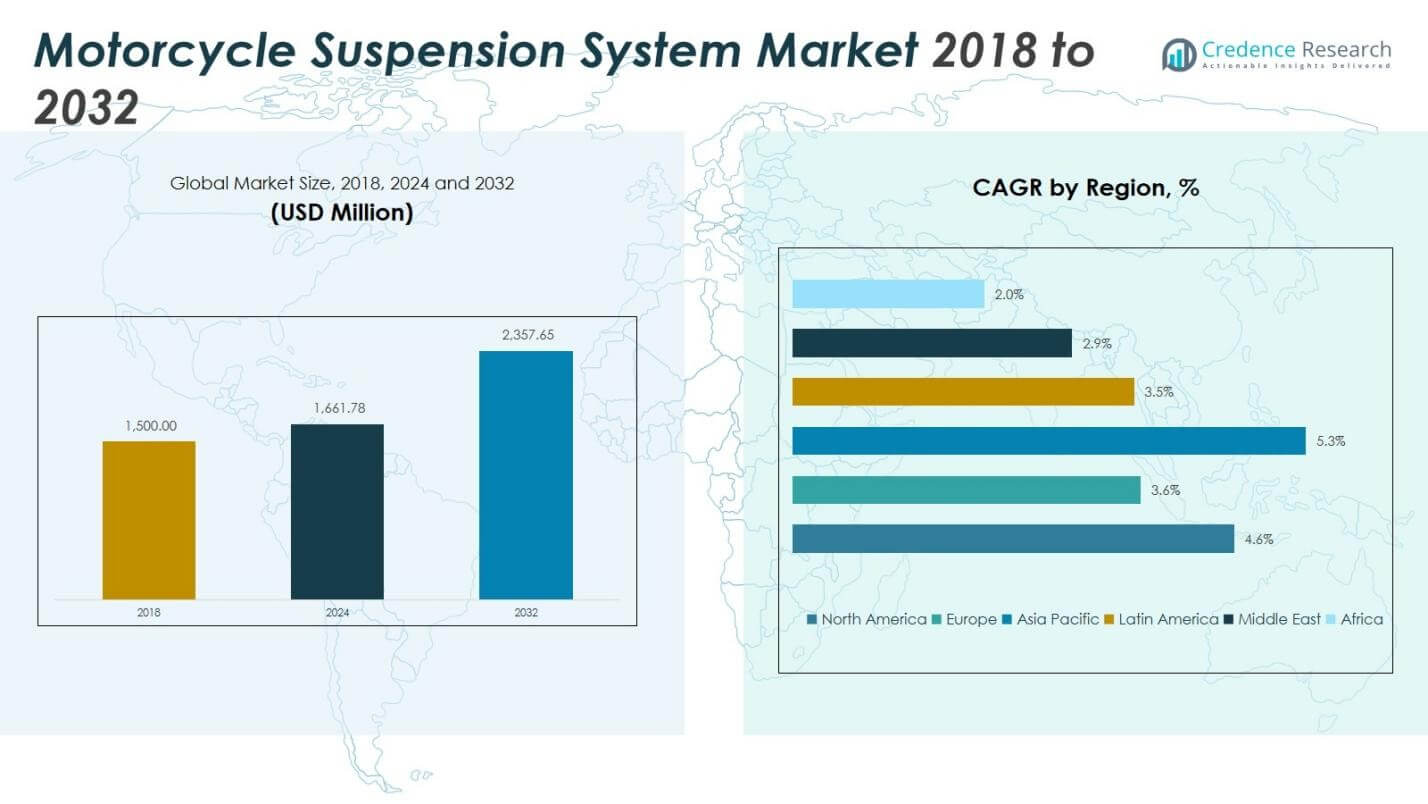
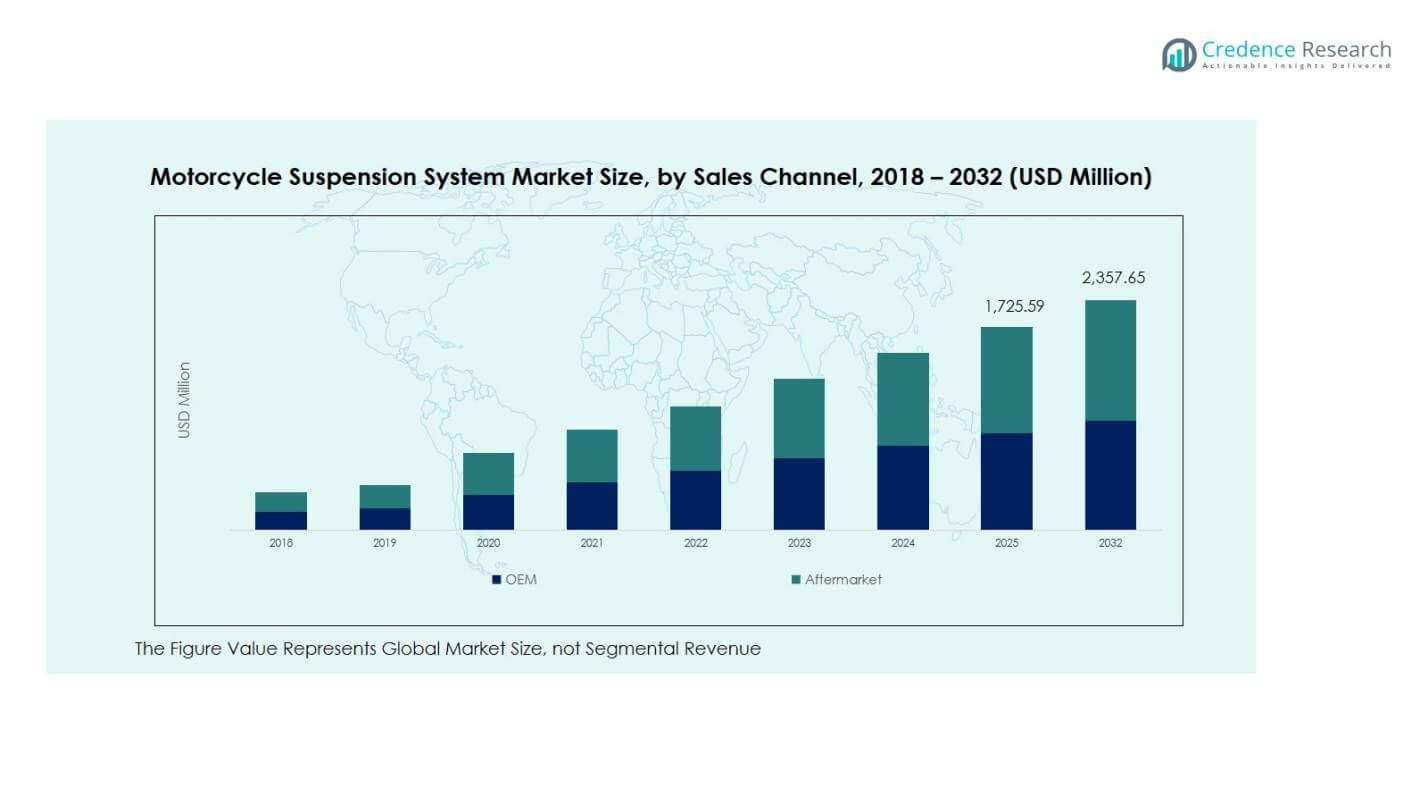
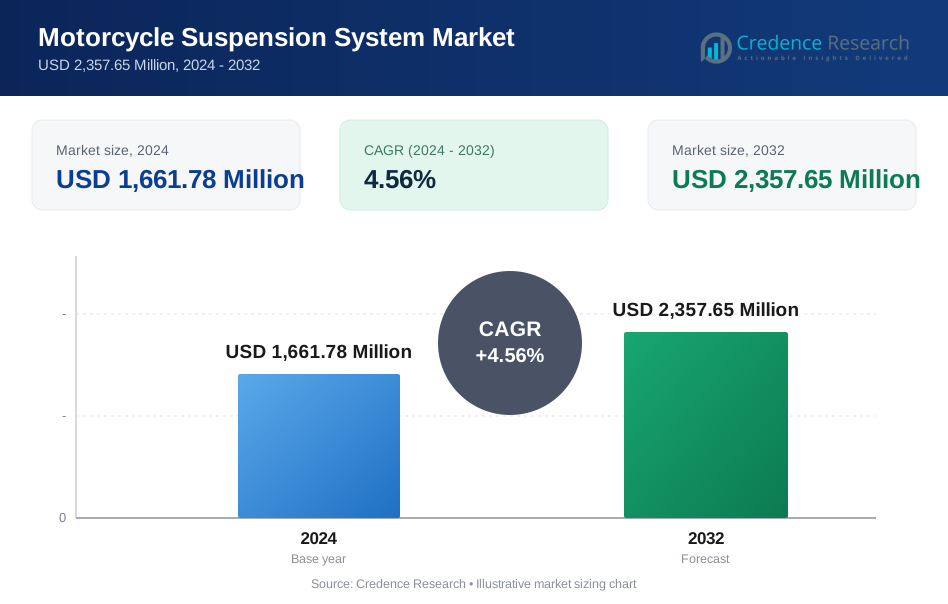
Motorcycle Suspension System Market size was valued at USD 1,500.00 Million in 2018, increased to USD 1,661.78 Million in 2024, and is anticipated to reach USD 2,357.65 Million by 2032, at a CAGR of 4.56% during the forecast period.
| REPORT ATTRIBUTE | DETAILS |
|---|---|
| Historical Period | 2020-2023 |
| Base Year | 2024 |
| Forecast Period | 2025-2032 |
| Motorcycle Suspension System Market Size 2024 | USD 1,661.78 million |
| Motorcycle Suspension System Market, CAGR | 4.56% |
| Motorcycle Suspension System Market Size 2032 | USD 2,357.65 million |
Market Insights
- The market is driven by rising motorcycle production, urban mobility demand, and growing consumer focus on ride comfort, stability, and safety, with strong adoption across commuter, sports, and touring motorcycles.
- Market trends include increasing integration of mono-shock and semi-active suspension systems, technological upgrades in damping performance, and expanding aftermarket customization and suspension replacement demand across performance and premium motorcycles.
- Leading players such as KYB Corporation, Showa Corporation, ZF Friedrichshafen AG (Sachs), WP Suspension, and Marzocchi Moto strengthen their position through product innovation, OEM partnerships, and expansion into high-growth two-wheeler markets, while cost-sensitive regions restrain adoption of advanced electronic systems.
- Asia Pacific leads the market with 44.61% regional share in 2024, followed by North America with 24.66% and Europe with 19.45%, while the Front Suspension–Telescopic Fork segment dominates with 62.4% share.
Motorcycle Suspension System Market Segmentation Analysis:
By Product Type
The Motorcycle Suspension System Market by product type is led by the Front Suspension segment, where Telescopic Fork systems account for 62.4% market share in 2024, making them the dominant sub-segment. Their leadership is driven by widespread adoption in commuter, touring, and entry-level motorcycles, owing to their structural simplicity, cost efficiency, and proven ride stability across diverse road conditions. The Rear Suspension segment, including Dual and Mono Shocks, continues to gain traction in performance and premium motorcycles, supported by rising consumer demand for comfort, enhanced traction, and improved handling in urban and long-distance riding environments.
- For instance, Yamaha employs upright telescopic front forks in its Saluto RX 110cc commuter bike for reliable performance and minimal machining needs.
By Technology
The Motorcycle Suspension System Market by technology is dominated by the Passive Suspension segment, which holds 78.6% market share in 2024 due to its low maintenance requirements, affordability, and suitability for mass-market commuter and utility motorcycles. Manufacturers prefer passive systems for their mechanical reliability and durability in emerging-market road environments. The Active and Semi-Active Suspension segment is expanding steadily in premium motorcycles, sports bikes, and adventure touring models, supported by increasing integration of electronic damping control, growing rider preference for performance-oriented handling, and OEM investments in intelligent suspension technologies to enhance safety, stability, and adaptive ride comfort.
- For instance, KTM's 1290 Super Adventure S features WP SAT semi-active technology with 48mm upside-down front forks and electronically regulated rear preload, adapting dynamically to road conditions via stroke sensors.
By Motorcycle Type
The Motorcycle Suspension System Market by motorcycle type is led by the Standard Motorcycle segment, which represents 34.2% market share in 2024, making it the dominant sub-segment. Growth is driven by high production volumes in commuter-class motorcycles, strong demand in Asia Pacific and Latin America, and the need for durable suspension systems suited for daily mobility and mixed-terrain commuting. The Sports and Cruiser segments contribute significantly to advanced suspension adoption, particularly mono-shock and semi-active systems, supported by rising consumer interest in performance riding, recreational touring, and premium motorcycle upgrades across developed and emerging economies.
Key Growth Drivers
Rising Motorcycle Production and Urban Mobility Demand
The Motorcycle Suspension System Market grows significantly as global motorcycle production expands, particularly in Asia Pacific, Latin America, and Africa, where two-wheelers remain a primary mode of mobility. Rapid urbanization, population growth, and increasing fuel-efficiency preferences strengthen demand for commuter and mid-segment motorcycles that rely on reliable and durable suspension systems. OEM investments in vehicle comfort and ride stability further accelerate adoption, while evolving consumer expectations around handling, safety, and fatigue reduction reinforce the role of advanced suspension solutions across both mass-market and performance-oriented motorcycles worldwide.
- For instance, KYB supplies 2-in-1 telescopic front forks and rear mono-shocks as OEM parts across Asia, Europe, and North America, emphasizing low-maintenance durability for commuter bikes.
Technological Advancements and Integration of Performance-Enhancing Systems
Market growth is driven by continuous innovation in suspension technology, including the integration of mono-shock systems, lightweight materials, enhanced damping control, and electronically assisted active or semi-active suspension units in premium motorcycles. These innovations improve ride comfort, vehicle stability, cornering performance, and shock absorption efficiency, making them highly attractive in sports, adventure, and touring motorcycles. Rising participation in motorsports, increasing customization trends, and growing consumer awareness of performance components encourage OEMs and aftermarket suppliers to invest in R&D, thereby expanding the technological scope of motorcycle suspension systems.
- For instance, Yamaha pioneered the Monocross single-shock rear suspension in 1972 on its YZ250 and YZ360 motocross bikes, designed by Lucien Tilkens to enhance performance in competitions.
Increasing Consumer Preference for Comfort and Safety in Daily Commuting
The growing importance of rider comfort, ergonomic stability, and vibration reduction in daily commuting environments significantly supports demand for advanced suspension components. Consumers increasingly prioritize smoother ride quality over uneven roads, potholes, and mixed terrains, especially in emerging markets with developing road infrastructure. Regulatory emphasis on road safety and vehicle durability complements this shift, encouraging manufacturers to enhance suspension reliability and structural integrity. The expanding market for electric motorcycles and scooters further reinforces demand for optimized suspension setups tailored for lightweight frames and urban commuting conditions.
Key Trends & Opportunities
Adoption of Electronic and Semi-Active Suspension in Premium and Performance Motorcycles
A major trend shaping the Motorcycle Suspension System Market is the rising adoption of electronic, semi-active, and adaptive damping suspension technologies in premium, adventure, and high-performance motorcycles. These systems automatically adjust stiffness and damping in real time based on terrain, riding speed, and load conditions, delivering superior ride comfort and handling precision. Opportunities emerge as global OEMs integrate sensor-based control units, connected riding features, and predictive suspension behavior. The trend also supports aftermarket upgrades, encouraging enthusiasts to retrofit high-end suspension solutions, thereby expanding revenue opportunities for component manufacturers and technology suppliers.
- For instance, Kawasaki's Ninja H2 SX SE employs KECS with Skyhook technology from Showa, using stroke sensors and solenoid valves to adjust damping every 10 milliseconds based on vertical acceleration and pitch.
Growing Aftermarket Customization and Suspension Upgrade Culture
The rapid expansion of aftermarket motorcycle customization creates strong opportunities for suspension system manufacturers, particularly in performance tuning, sports motorcycles, off-road bikes, and touring segments. Riders increasingly upgrade factory-installed suspension units to enhance shock absorption, cornering grip, ride height control, and load-carrying stability. The trend is reinforced by the rising popularity of motorcycle touring, adventure sports, and long-distance leisure riding. Independent garages, performance workshops, and online component platforms further accelerate aftermarket penetration, enabling suppliers to introduce specialized mono-shock units, adjustable suspension kits, and premium tuning solutions across multiple motorcycle categories.
- For instance, Öhlins provides STX 46 monotube shock absorbers as major upgrades for adventure bikes like Royal Enfield Himalayan RE 907, featuring a 46 mm piston for reliable performance across environments.
Key Challenges
High Cost of Advanced Suspension Systems and Limited Adoption in Price-Sensitive Markets
A key challenge for the Motorcycle Suspension System Market is the high manufacturing and integration cost of advanced suspension technologies, particularly electronic and semi-active systems. Price-sensitive markets prioritize affordability over technological sophistication, which restricts widespread OEM adoption in commuter and entry-level motorcycles. The cost burden also limits aftermarket penetration for premium components, especially in regions with low disposable income. Manufacturers must balance cost optimization with performance delivery, while ensuring durability and reliability in harsh road and climate conditions, which further increases engineering complexity and production expenses.
Supply Chain Constraints and Dependence on Specialized Materials and Components
The market faces challenges related to supply chain fluctuations, raw material price volatility, and dependence on specialized mechanical and electronic components such as precision springs, dampers, actuators, and lightweight alloys. Disruptions in global logistics networks, geopolitical uncertainties, and manufacturing concentration in select regions increase risk exposure for OEMs and component suppliers. Ensuring consistent product quality, regulatory compliance, and timely delivery adds operational pressure. Additionally, the need for advanced testing, calibration, and safety validation extends production cycles, making scalability and cost control critical challenges for industry participants.
Regional Analysis
North America
North America remains a strong contributor to the Motorcycle Suspension System Market, with revenue increasing from USD 376.50 million in 2018 to USD 409.78 million in 2024, representing a 24.66% market share in 2024, and projected to reach USD 580.22 million by 2032 at a CAGR of 4.6%. Growth is driven by rising demand for premium motorcycles, expanding recreational touring activities, and the adoption of advanced mono-shock and semi-active suspension technologies. Strong OEM presence, motorcycle customization trends, and consumer preference for comfort and performance further strengthen market expansion across urban mobility and leisure-riding segments.
Europe
Europe shows steady advancement in the Motorcycle Suspension System Market, rising from USD 307.20 million in 2018 to USD 323.34 million in 2024, accounting for a 19.45% market share in 2024, and projected to reach USD 425.68 million by 2032 with a CAGR of 3.6%. Growth is influenced by strong motorcycle culture in Germany, Italy, Spain, and France, along with increasing demand for performance-oriented and touring motorcycles. The market benefits from technological leadership, lightweight suspension innovations, and OEM integration of electronically adjustable and semi-active damping systems tailored for safety, handling precision, and long-distance riding comfort.
Asia Pacific
Asia Pacific dominates the Motorcycle Suspension System Market, expanding from USD 652.50 million in 2018 to USD 740.90 million in 2024, representing the largest regional share at 44.61% in 2024, and expected to reach USD 1,113.52 million by 2032 at a CAGR of 5.3%. High two-wheeler production volumes in China, India, Indonesia, and Vietnam, coupled with rapid urban mobility adoption, drive large-scale demand for durable commuter-class suspension systems. Increasing motorcycle electrification, infrastructure expansion, and rising consumer preference for comfort and ride stability further support adoption of mono-shock and enhanced damping technologies across economy and mid-segment motorcycles.
Latin America
Latin America demonstrates moderate but consistent growth in the Motorcycle Suspension System Market, increasing from USD 88.35 million in 2018 to USD 96.87 million in 2024, with a 2024 market share of 5.83%, and projected to reach USD 126.77 million by 2032 at a CAGR of 3.5%. Demand is fueled by strong motorcycle dependence for urban transportation in Brazil, Argentina, and Colombia, along with rising aftermarket suspension upgrades for durability and road-shock absorption. Expansion of commuter and delivery-segment motorcycles, coupled with OEM focus on comfort and structural reliability, reinforces market development across budget and mid-range vehicle categories.
Middle East
The Middle East Motorcycle Suspension System Market shows gradual expansion, rising from USD 46.50 million in 2018 to USD 47.52 million in 2024, representing 2.86% market share in 2024, and forecast to reach USD 59.19 million by 2032 at a CAGR of 2.9%. Market growth is supported by increasing adoption of high-performance and leisure motorcycles in GCC countries and premium touring demand in urban mobility clusters. Rising consumer interest in desert-touring and adventure motorcycles drives adoption of robust mono-shock and reinforced suspension systems, while OEM networks and aftermarket customization strengthen long-term upgrade opportunities.
Africa
Africa records steady development in the Motorcycle Suspension System Market, increasing from USD 28.95 million in 2018 to USD 43.38 million in 2024, accounting for 2.61% market share in 2024, and projected to reach USD 52.27 million by 2032 at a CAGR of 2.0%. Growth is primarily driven by widespread motorcycle adoption for rural and urban mobility in East and West African markets. Demand centers on durable, low-maintenance suspension systems suited for rough road environments, commercial commuting, and delivery transport fleets, while gradual aftermarket expansion and affordability-focused OEM strategies support incremental market penetration across economy motorcycle segments.
Motorcycle Suspension System Market Segmentations:
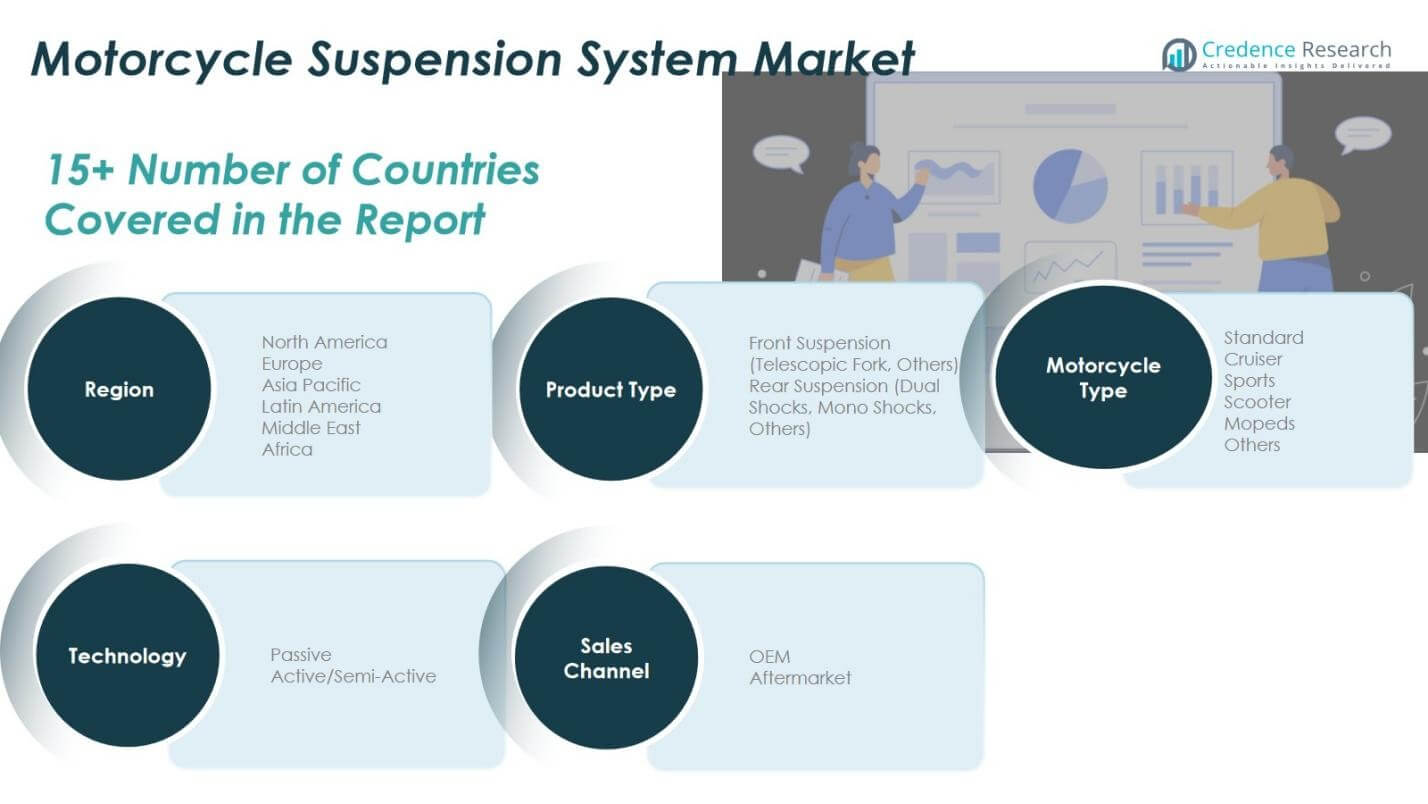
By Product Type
- Front Suspension
- Telescopic Fork
- Others
- Rear Suspension
- Dual Shocks
- Mono Shocks
- Others
By Technology
- Passive
- Active / Semi-Active
By Motorcycle Type
- Standard
- Cruiser
- Sports
- Scooter
- Mopeds
- Others
By Sales Channel
- OEM
- Aftermarket
By Geography
- North America
- U.S.
- Canada
- Mexico
- Europe
- Germany
- France
- U.K.
- Italy
- Spain
- Rest of Europe
- Asia Pacific
- China
- Japan
- India
- South Korea
- South-east Asia
- Rest of Asia Pacific
- Latin America
- Brazil
- Argentina
- Rest of Latin America
- Middle East & Africa
- GCC Countries
- South Africa
- Rest of the Middle East and Africa
Competitive Landscape
Competitive landscape analysis in the Motorcycle Suspension System Market is shaped by the strong presence of leading players including KYB Corporation, Showa Corporation, ZF Friedrichshafen AG (Sachs), WP Suspension (KTM Group), Marzocchi Moto, BITUBO S.r.l., Nitron Racing Shocks, YSS Suspension, Progressive Suspension, Gabriel India Limited, and Racetech Suspension. The market is characterized by continuous innovation in damping technologies, lightweight materials, and electronically assisted suspension systems to enhance ride comfort, handling precision, and safety performance. OEM partnerships, motorsport engineering expertise, and product differentiation through mono-shock, dual-shock, and semi-active suspension platforms strengthen competitive positioning. Players increasingly focus on expanding presence in emerging two-wheeler markets, strengthening aftermarket distribution networks, and delivering performance-oriented upgrade kits to capture customization demand. Strategic investments in R&D, premium motorcycle segments, and technology integration including adaptive control systems and modular suspension architectures are key factors shaping market leadership and long-term growth competitiveness across global motorcycle manufacturing ecosystems.
Key Player Analysis
- KYB Corporation
- Showa Corporation
- ZF Friedrichshafen AG (Sachs)
- WP Suspension (KTM Group)
- Marzocchi Moto (VRM Group)
- BITUBO S.r.l.
- Nitron Racing Shocks
- YSS Suspension
- Racetech Suspension
- Progressive Suspension
- Gabriel India Limited
- TechnoFlex Suspension
- J.Juan Suspension Components
Recent Developments
- In January 2025, Brembo completed the acquisition of Öhlins Racing AB, integrating premium suspension technology to strengthen its performance and innovation capabilities in the motorcycle suspension segment.
- In February 2025, Endurance Technologies Limited secured new orders from TVS, Hero MotoCorp, and Suzuki for inverted front forks, rear mono shocks, and suspension components.
- In February 2025, Gabriel India Limited signed a Technical Assistance Agreement with TracTive Suspension BV to manufacture and distribute advanced electronically adjustable suspension systems in India.
Report Coverage
The research report offers an in-depth analysis based on Product Type, Technology, Motorcycle Type, Sales Channel and Geography. It details leading market players, providing an overview of their business, product offerings, investments, revenue streams, and key applications. Additionally, the report includes insights into the competitive environment, SWOT analysis, current market trends, as well as the primary drivers and constraints. Furthermore, it discusses various factors that have driven market expansion in recent years. The report also explores market dynamics, regulatory scenarios, and technological advancements that are shaping the industry. It assesses the impact of external factors and global economic changes on market growth. Lastly, it provides strategic recommendations for new entrants and established companies to navigate the complexities of the market.
Future Outlook
- The market will experience steady growth as motorcycle production expands across emerging economies and urban mobility adoption increases.
- Manufacturers will focus on improving ride comfort, stability, and safety through enhanced damping and structural suspension designs.
- Active and semi-active electronic suspension systems will gain wider adoption in premium and performance motorcycles.
- The aftermarket segment will grow as riders increasingly upgrade stock suspension components for durability and performance.
- Lightweight materials and modular suspension architectures will support fuel efficiency and design flexibility in new motorcycle platforms.
- Electric motorcycles and scooters will drive demand for optimized suspension systems tailored for lightweight frames and urban commuting use.
- OEMs will strengthen collaboration with technology suppliers to integrate intelligent control and adaptive suspension features.
- Adventure, touring, and sports motorcycle categories will stimulate demand for advanced mono-shock and high-performance suspension solutions.
- Regulatory emphasis on vehicle safety and quality standards will encourage manufacturers to enhance suspension reliability and testing.
- Global players will expand their presence in Asia Pacific, Latin America, and Africa to capitalize on growing two-wheeler penetration.
Request a Free Sample
Fill in your details and we'll send you a free sample report.
- Sample data tables & charts
- Research methodology
Need a Custom Version of This Report?
Tailor the scope, geography, or segments to your exact requirements.
- Custom geography or segment scope
- Direct access to our analyst team
Frequently Asked Questions
What is the current market size for the Motorcycle Suspension System Market, and what is its projected size in 2032?
At what Compound Annual Growth Rate is the Motorcycle Suspension System Market projected to grow between 2024 and 2032?
Which Motorcycle Suspension System Market segment held the largest share in 2024?
What are the primary factors fueling the growth of the Motorcycle Suspension System Market?
Which region commanded the largest share of the Motorcycle Suspension System Market in 2024?
Table of Content
Chapter 1. Report Introduction
- 1.1 Report Description & Purpose
- 1.1.1 Report Title & Market Definition
- 1.1.2 Unique Selling Propositions (USP) & Key Differentiators
- 1.1.3 Value Proposition for Stakeholders
- 1.2 Research Objectives
- 1.2.1 Market Sizing Objectives (Volume & Revenue)
- 1.2.2 Segmentation Objectives
- 1.2.3 Competitive Intelligence Objectives
- 1.2.4 Forecast & Scenario Objectives
- 1.3 Report Scope
- 1.3.1 Motorcycle Suspension System Scope – Types & Subtypes Covered
- 1.3.2 Geographic Scope – Regions & Countries Covered
- 1.3.3 Historical Period, Base Year & Forecast Period (2024; forecast to 2032)
- 1.3.4 Inclusions & Exclusions
- 1.4 HS Code & Classification Framework
- 1.5 Currency, Units & Pricing Basis
- 1.6 Target Stakeholders
- 1.7 Limitations & Assumptions
Chapter 2. Executive Summary
- 2.1 Global Motorcycle Suspension System Market Snapshot
- 2.1.1 Market Size – Historical (2024) & Forecast (2024-2032) (2024: USD 1,661.78 Million → 2032: USD 2,357.65 Million)
- 2.1.2 Volume & Revenue – Global Totals
- 2.1.3 Key Market Highlights – Top Five Facts
- 2.2 Motorcycle Suspension System Market Segmentation Snapshot
- 2.2.1 Market Split by Region – 2024 vs. 2032
- 2.3 Competitive Snapshot
- 2.3.1 Top 10 Players by Revenue Share – 2024
- 2.3.2 Top 10 Players by Volume Share – 2024
- 2.3.3 Recent Strategic Developments (18-Month Summary)
- 2.4 Key Investment Highlights & Strategic Conclusions
Chapter 3. Motorcycle Suspension System Market Dynamics & Industry Analysis
- 3.1 Market Overview & Context
- 3.1.1 Motorcycle Suspension System Market Position in the Broader Automotive Value Chain
- 3.1.2 OEM vs. Replacement Market Dynamics
- 3.1.3 Market Maturity & Development Stage by Region
- 3.2 Motorcycle Suspension System Market Drivers
- 3.3 Motorcycle Suspension System Market Restraints & Challenges
- 3.4 Motorcycle Suspension System Market Opportunities
- 3.5 Porter's Five Forces Analysis
- 3.5.1 Threat of New Entrants
- 3.5.2 Bargaining Power of Suppliers
- 3.5.3 Bargaining Power of Buyers
- 3.5.4 Threat of Substitutes
- 3.5.5 Competitive Rivalry – Intensity Assessment
- 3.6 Motorcycle Suspension System Value Chain Analysis
- 3.6.1 Upstream – Raw Material/Input Suppliers
- 3.6.1.1 Raw Material/Input 1
- 3.6.1.2 Raw Material/Input 2
- 3.6.1.3 Raw Material/Input 3
- 3.6.2 Midstream – Production/Manufacturing/Service Delivery
- 3.6.2.1 Production/Process Overview
- 3.6.2.2 Key Facility Locations & Capacity by Manufacturer
- 3.6.3 Downstream – Distribution & End Consumer
- 3.6.3.1 Primary Channel – B2B/OEM
- 3.6.3.2 Secondary Channels – Dealer, Retail, Online, Direct
- 3.6.4 Value Chain Profitability Analysis
- 3.6.1 Upstream – Raw Material/Input Suppliers
- 3.7 PESTEL Analysis
- 3.7.1 Political Factors
- 3.7.2 Economic Factors
- 3.7.3 Social Factors
- 3.7.4 Technological Factors
- 3.7.5 Environmental Factors
- 3.7.6 Legal Factors
- 3.8 Motorcycle Suspension System Supply Chain Analysis
- 3.8.1 Raw Material/Input Supply Risk Assessment
- 3.8.2 Manufacturing Concentration Risk (Geographic Exposure)
- 3.8.3 Trade Disruption Impact Analysis
- 3.9 Regulatory & Policy Landscape
Note: The regulatory and policy landscape section covers regulations based on their applicability to the market, Motorcycle Suspension System category, geography, and scope of the study. Only regulatory frameworks with a material impact on operations, compliance, trade, sustainability, or market access are analyzed in detail.
Chapter 4. Key Investment Pockets & Opportunity Analysis
- 4.1 Motorcycle Suspension System Market Attractiveness Analysis
- 4.1.1 By Region – Investment Attractiveness Matrix (Volume × CAGR)
- 4.2 Absolute Revenue Growth Opportunity
- 4.2.1 By Region – Absolute USD Growth Through 2032
- 4.3 Incremental Volume Opportunity
- 4.3.1 By Region – Incremental Volume Through 2032
- 4.3.2 Segment – Incremental Volume
- 4.4 Emerging Submarket Opportunity Deep Dive (Subject to Applicability)
- 4.5 Emerging Market Opportunity Scorecards
- 4.5.1 United States
- 4.5.2 Europe
- 4.5.3 Asia
- 4.5.4 Middle East & Africa
Note: Emerging Market Opportunity Scorecards will be included based on relevance and strategic importance. Regions listed are indicative and may vary depending on data availability and market dynamics.
Chapter 5. Motorcycle Suspension System Import-Export Analysis & Trade Flows
- 5.1 Global Trade Overview
- 5.1.1 Global Export Value by Country (2024)
- 5.1.2 Global Export Volume by Country (2024)
- 5.1.3 Global Import Value by Country (2024)
- 5.1.4 Global Import Volume by Country (2024)
- 5.1.5 Net Trade Balance by Country (2024)
- 5.2 Export Analysis – Segment
- 5.2.1 Type 1 (HS Code)
- 5.2.2 Type 2 (HS Code)
- 5.2.3 Type 3 (HS Code)
- 5.2.4 Type 4 (HS Code)
- 5.2.5 Type 5 (HS Code)
- 5.3 Import Analysis – Segment
- 5.3.1 Type 1 (HS Code)
- 5.3.2 Type 2 (HS Code)
- 5.3.3 Type 3 (HS Code)
- 5.3.4 Type 4 (HS Code)
- 5.3.5 Type 5 (HS Code)
- 5.4 Average Unit Trade Prices
- 5.4.1 Average Export Price – Segment & Country
- 5.4.2 Average Import Price – Segment & Source Country
- 5.4.3 Price Trends (2024)
- 5.5 Key Trade Route Analysis
- 5.5.1 Trade Route 1
- 5.5.2 Trade Route 2
- 5.5.3 Trade Route 3
- 5.5.4 Trade Route 4
- 5.5.5 Trade Route 5
- 5.6 Trade Policy Impact Assessment
- 5.6.1 US Anti-Dumping & Section 301 Tariffs
- 5.6.2 EU Customs Union Impact
- 5.6.3 Major Free Trade Agreements
- 5.6.4 USMCA Rules of Origin
Note: Trade policy analysis will be included only where relevant to the Motorcycle Suspension System market.
Chapter 6. Competitive Landscape & Company Benchmarking
- 6.1 Motorcycle Suspension System Market Concentration & Structure
- 6.1.1 Herfindahl-Hirschman Index (HHI) – vs. 2024
- 6.1.2 Tier 1, Tier 2 & Tier 3 Market Structure
- 6.1.3 Global, Regional & Local Player Dynamics
- 6.2 Motorcycle Suspension System Market Share Analysis – 2024
- 6.2.1 Global Revenue Share by Company
- 6.2.2 Global Volume Share by Company
- 6.2.3 Regional Revenue Share
- 6.2.4 Market Share Evolution ( vs. 2024)
- 6.2.5 OEM Segment Share by Company
- 6.2.6 Replacement Segment Share by Company
- 6.3 Production/Delivery Capacity & Facility Analysis
- 6.3.1 Global Installed Capacity
- 6.3.2 Capacity Utilization Rates
- 6.3.3 Production/Output Volume
- 6.3.4 Facility Locations & Capacity Map
- 6.3.5 Planned Capacity Additions
- 6.4 Motorcycle Suspension System Competitive Benchmarking Matrix
- 6.4.1 Revenue, Volume, CAGR & Profitability Comparison
- 6.4.2 Channel Revenue Mix
- 6.4.3 Geographic Revenue Exposure
- 6.4.4 R&D Intensity
- 6.4.5 Sustainability Maturity
- 6.5 Strategic Developments in Motorcycle Suspension System (Last 24 Months)
- 6.5.1 Mergers, Acquisitions & Divestments
- 6.5.2 New Motorcycle Suspension System Launches
- 6.5.3 Facility Expansions
- 6.5.4 Strategic Alliances, Joint Ventures & Partnerships
- 6.5.5 Distribution Expansion & Market Entry
- 6.5.6 Sustainability & ESG Initiatives
- 6.6 Competitive Strategy Mapping
- 6.6.1 Leader, Challenger, Follower & Niche Classification
- 6.6.2 Pricing Strategy Comparison
- 6.6.3 Channel Strategy Matrix
Note: Strategic developments are included based on their materiality and the availability of reliable information.
Chapter 7. Global Motorcycle Suspension System Market – By Distribution Channel
- 7.1 Segment Overview
- 7.1.1 Volume & Revenue Split by Channel (2024 & 2032)
- 7.1.2 Channel Mix Evolution (2024-2032)
Chapter 8. Regional Market Analysis – Global Overview
- 8.1 Global Regional Overview
- 8.1.1 Regional Volume Share
- 8.1.2 Regional Revenue Share
- 8.1.3 Regional Volume by Region
- 8.1.4 Regional Revenue by Region
- 8.1.5 Regional Forecast Through 2032
- 8.2 Cross-Regional Segment Analysis
- 8.2.1 By Distribution Channel
- 8.2.2 By Brand/Price Tier
Chapter 9. North America Motorcycle Suspension System Market
- 9.1 United States
- 9.2 Canada
- 9.3 Mexico
Chapter 10. Europe Motorcycle Suspension System Market
- 10.1 Germany
- 10.2 France
- 10.3 Italy
- 10.4 United Kingdom
- 10.5 Spain
- 10.6 Poland
- 10.7 Russia
- 10.8 Netherlands
- 10.9 Belgium
- 10.10 Sweden
- 10.11 Denmark
- 10.12 Norway
- 10.13 Rest of Europe
Chapter 11. Asia Pacific Motorcycle Suspension System Market
- 11.1 China
- 11.2 India
- 11.3 Japan
- 11.4 South Korea
- 11.5 Thailand
- 11.6 Indonesia
- 11.7 Vietnam
- 11.8 Malaysia
- 11.9 Australia
- 11.10 Rest of Asia Pacific
Chapter 12. Latin America Motorcycle Suspension System Market
- 12.1 Brazil
- 12.2 Argentina
- 12.3 Colombia
- 12.4 Chile
- 12.5 Rest of Latin America
Chapter 13. Middle East Motorcycle Suspension System Market
- 13.1 Saudi Arabia
- 13.2 United Arab Emirates
- 13.3 Turkey
- 13.4 Israel
- 13.5 Iran
- 13.6 Rest of the Middle East
Chapter 14. Africa Motorcycle Suspension System Market
- 14.1 South Africa
- 14.2 Egypt
- 14.3 Nigeria
- 14.4 Morocco
- 14.5 Rest of Africa
Chapter 15. Motorcycle Suspension System Company Profiles
- 15.1 [Company 01]
- 15.1.1 Company Overview
- 15.1.2 Key Management Personnel
- 15.1.3 Products & Services Portfolio
- 15.1.4 Financial Performance
- 15.1.5 Key Market Focus & Geographic Presence
- 15.1.6 Recent Developments & Strategic Initiatives
Note: The company profile list is preliminary and may change based on research findings, market developments, data availability, and client requirements.
Chapter 16. Appendices
- Appendix A – List of Abbreviations & Acronyms
- Appendix B – Industry Classification Code Reference – Full Series
- Appendix C – Production & Capacity Data Tables
- Appendix D – End-Use & Demand Base Tables
- Appendix E – Consumption & Replacement Rate Assumptions
- Appendix F – ASP Reference Tables
- Appendix G – Manufacturing & Facility Database
- Appendix H – Import-Export Data Tables
- Appendix I – Regulatory Summary Tables
- Appendix J – Primary Research Participant List (Anonymized)
- Appendix K – Primary Research Questionnaire Framework
- Appendix L – Data Sources & Bibliography
- Appendix M – Market Size Divergence & Source Comparison
Chapter 17. Research Methodology
- 17.1 Research Framework & Philosophy
- 17.2 Secondary Research – Sources, Hierarchy & Data Extraction
- 17.3 Data Modeling – Bottom-Up & Top-Down Market Sizing
- 17.4 Primary Research – Stakeholder Framework, LOI & Sample Sizes
- 17.5 Forecast Methodology – Regression, Scenario & Sensitivity Analysis
- 17.6 Quality Control – Four-Layer Validation Framework
- 17.7 Limitations & Standard Assumptions
- 17.8 Disclaimer
