
Electric Vehicle Test Equipment Market Overview:
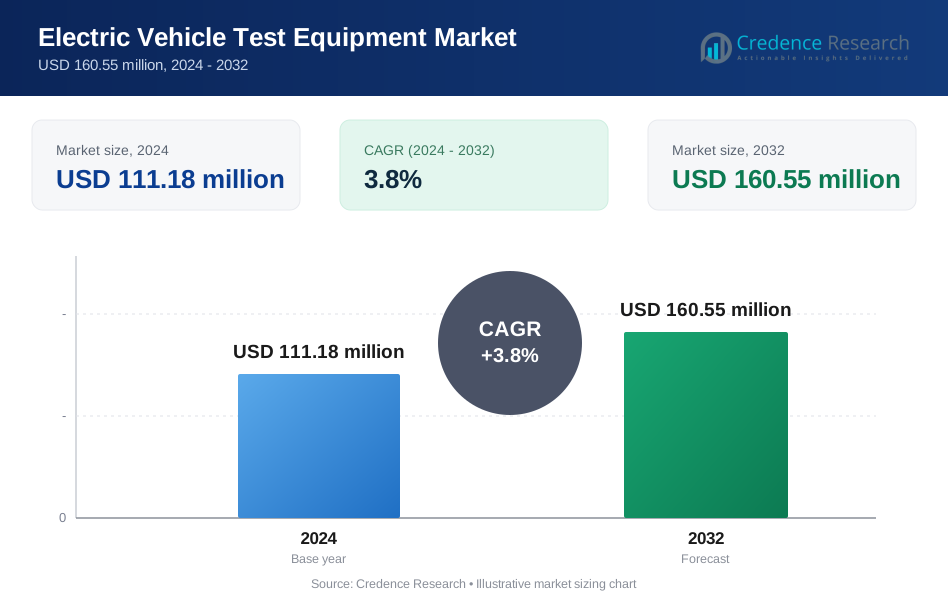
The Electric Vehicle Test Equipment market was valued at USD 111.18 million in 2024 and is anticipated to reach USD 160.55 million by 2032, growing at a CAGR of 3.8% during the forecast period.
| REPORT ATTRIBUTE | DETAILS |
|---|---|
| Historical Period | 2020-2024 |
| Base Year | 2025 |
| Forecast Period | 2026-2032 |
| Electric Vehicle Test Equipment Market Size 2024 | USD 111.18 million |
| Electric Vehicle Test Equipment Market, CAGR | 3.8% |
| Electric Vehicle Test Equipment Market Size 2032 | USD 160.55 million |
Electric Vehicle Test Equipment Market Insights
- Market growth is driven by rising EV production, safety regulations, and technology complexity, with passenger electric vehicles leading the vehicle type segment at a 55% share due to higher testing intensity.
- Market trends highlight strong demand for R&D and validation testing, which dominates the application segment with a 46% share as OEMs focus on battery safety and performance optimization.
- Competitive analysis shows emphasis on automation, software-driven testing, and digital validation, while high capital costs and rapid technology change remain key market restraints.
- Regional analysis indicates Asia Pacific leads with a 39% share, followed by Europe at 28% and North America at 25%, reflecting manufacturing scale, regulatory rigor, and R&D investment levels.
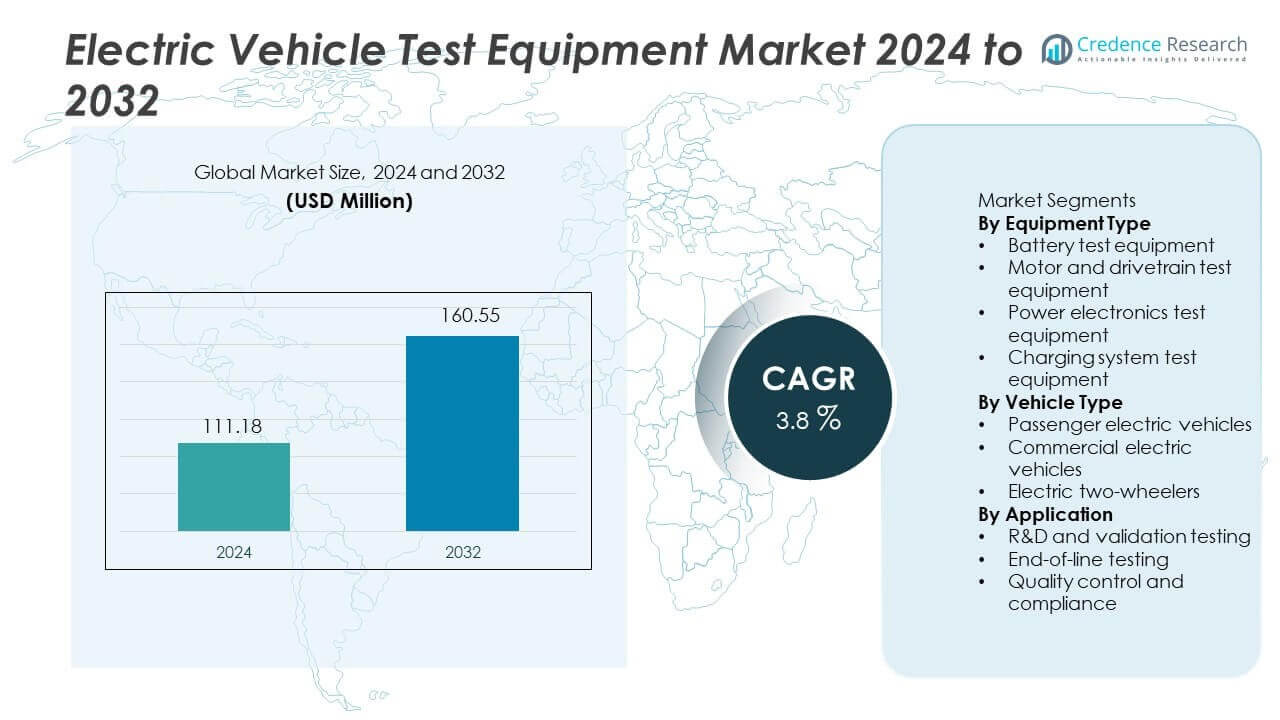
Electric Vehicle Test Equipment Market Segmentation Analysis:
By Equipment Type
By equipment type, battery test equipment dominates the electric vehicle test equipment market with a 38% share. Battery testing remains critical due to safety, performance, and lifecycle requirements. OEMs and suppliers rely on battery test systems for thermal behavior, charge–discharge cycles, and durability validation. Growing battery capacity and chemistry diversity increase testing complexity. Motor and drivetrain test equipment holds a 27% share, driven by efficiency and torque validation needs. Power electronics test equipment accounts for 21%, supported by inverter and converter testing. Charging system test equipment holds a 14% share. Battery test equipment leads due to strict safety regulations and high testing intensity.
- For instance, AVL List GmbH offers battery test systems supporting pack voltages up to 1,500 V and current loads of 1,200 A.
By Vehicle Type
By vehicle type, passenger electric vehicles lead the electric vehicle test equipment market with a 55% share. High passenger EV production volumes require extensive testing across batteries, motors, and electronics. Frequent model updates increase validation cycles. Regulatory compliance testing further supports demand. Commercial electric vehicles account for a 28% share, driven by buses, trucks, and fleet electrification programs that require durability and load testing. Electric two-wheelers hold a 17% share, supported by rapid adoption in Asia Pacific. Passenger EV dominance reflects higher unit complexity, wider testing scope, and stronger regulatory oversight.
- For instance, National Instruments enables passenger EV validation using PXI systems with over 20 synchronized measurement channels per rack.
By Application
By application, R&D and validation testing dominates with a 46% share in the electric vehicle test equipment market. Continuous innovation in batteries and powertrains increases demand for advanced validation tools. OEMs prioritize early-stage testing to reduce recall and safety risks. End-of-line testing holds a 34% share, driven by mass production quality checks and functional verification. Quality control and compliance account for a 20% share, supported by certification and regulatory audits. R&D and validation testing leads due to rising technology complexity, safety requirements, and accelerated EV development cycles.
Key Growth Drivers
Rising Electric Vehicle Production and Model Complexity
Electric vehicle production growth drives demand for electric vehicle test equipment. OEMs launch multiple EV models across segments. Each platform requires extensive testing for batteries, motors, and electronics. Higher power density increases testing needs. Safety and durability validation gain importance. Shorter development cycles increase testing frequency. Advanced architectures raise system complexity. Manufacturers invest in comprehensive test solutions. Passenger and commercial EV expansion sustains equipment demand. Production scale directly supports market growth.
- For instance, Vector Informatik enables model-based validation using CAN, LIN, FlexRay, and Automotive Ethernet with data rates up to 100 Mbps.
Stringent Safety and Regulatory Compliance Requirements
Regulatory standards strongly influence the electric vehicle test equipment market. Governments mandate strict battery and electrical safety testing. Compliance testing ensures vehicle approval and market entry. Thermal runaway prevention increases battery testing demand. Power electronics certification becomes essential. OEMs adopt standardized testing protocols. Failure risks increase validation intensity. Regulatory audits require documented testing processes. Compliance needs drive continuous equipment upgrades. Safety-focused regulation remains a key growth driver.
- For instance, Horiba Ltd. provides battery abuse and thermal testing chambers operating from −40°C to 180°C for regulatory validation.
Continuous Advancements in Battery and Powertrain Technologies
Technology innovation increases testing complexity and demand. New battery chemistries require specialized validation tools. Higher voltage systems increase electrical stress testing. Motor efficiency targets require precision testing. Power electronics integration adds testing layers. OEMs invest in advanced simulation and validation. Technology shifts shorten product life cycles. Early-stage testing reduces development risks. Innovation-driven testing supports sustained market growth.
Key Trends & Opportunities
Growth in R&D and Validation Testing Investments
R&D testing investment continues to rise. OEMs prioritize early validation to reduce recalls. Advanced test benches support rapid prototyping. Simulation-based testing improves efficiency. Automated systems enhance accuracy. Software-driven platforms gain adoption. R&D spending supports premium test solutions. Start-ups and suppliers increase in-house testing. This trend creates long-term equipment demand. Validation-focused growth offers strong market opportunities.
- For instance, Chroma ATE supplies battery test systems supporting 2,000 V and 1,000 A for cell-to-pack validation.
Integration of Automation and Digital Testing Solutions
Automation trends reshape testing operations. Digital twins improve test accuracy. Data analytics enhance performance insights. Automated test systems reduce cycle time. Remote monitoring improves efficiency. Smart testing supports predictive maintenance. Integration with manufacturing systems improves workflows. Digital solutions add value beyond hardware. This trend opens opportunities for advanced test platforms.
- For instance, DEWESoft offers synchronized data capture at sampling rates up to 200 kS/s per channel for automated validation.
Key Challenges
High Capital Cost of Advanced Test Equipment
Test equipment requires significant upfront investment. Advanced systems involve high development costs. Smaller manufacturers face budget constraints. Long payback periods limit adoption. Custom solutions increase expenses. Maintenance and calibration add cost. Capital intensity slows market penetration. Cost sensitivity impacts purchasing decisions. High equipment pricing remains a major challenge.
Rapid Technology Evolution and Compatibility Issues
Fast technology changes create compatibility challenges. Equipment may become obsolete quickly. Multiple standards complicate test design. Software updates require continuous adaptation. Hardware flexibility becomes critical. OEM requirements vary widely. Integration issues increase complexity. Training needs rise with advanced systems. Managing rapid evolution challenges market stability.
Regional Analysis
North America
North America holds a 25% share of the electric vehicle test equipment market, supported by strong R&D activity and regulatory compliance needs. The United States leads regional demand through extensive validation of batteries, power electronics, and drivetrains. OEMs and Tier-1 suppliers invest in advanced test benches to support new EV launches. Safety standards increase battery and high-voltage testing intensity. End-of-line testing expands with domestic EV production. Collaboration between automakers and test equipment providers accelerates adoption. The region benefits from advanced engineering expertise, high automation levels, and steady investment in validation infrastructure.
Europe
Europe accounts for a 28% share of the electric vehicle test equipment market, driven by strict emission and safety regulations. Germany, France, and Nordic countries lead testing demand due to strong EV manufacturing bases. OEMs emphasize compliance testing, durability validation, and certification processes. Battery safety and powertrain efficiency testing remain priorities. Public funding supports R&D facilities and innovation centers. Standardized testing protocols increase equipment utilization. Supplier ecosystems remain well developed. Europe maintains consistent demand due to regulatory rigor, advanced manufacturing practices, and continuous EV model introductions.
Asia Pacific
Asia Pacific dominates the electric vehicle test equipment market with a 39% share, driven by large-scale EV production. China leads demand through extensive battery and drivetrain testing across passenger vehicles, buses, and two-wheelers. High production volumes increase end-of-line testing needs. Rapid technology iteration raises validation frequency. Japan and South Korea contribute through advanced power electronics and battery testing. India adds growth through expanding EV manufacturing. Cost-efficient production supports equipment deployment. The region benefits from scale, integrated supply chains, and strong government support for EV development.
Rest of the World
The Rest of the World holds an 8% share of the electric vehicle test equipment market, reflecting early adoption stages. Latin America shows growth through electric bus programs and pilot manufacturing projects. The Middle East invests in EV testing aligned with energy transition goals. Australia supports testing for imported EV models and charging compliance. Limited local manufacturing restricts large-scale demand. Most equipment is imported. Regulatory frameworks continue to evolve. Gradual EV adoption supports long-term testing needs. Growth depends on regional EV policies and manufacturing expansion.
Electric Vehicle Test Equipment Market Segmentations:
By Equipment Type
- Battery test equipment
- Motor and drivetrain test equipment
- Power electronics test equipment
- Charging system test equipment
By Vehicle Type
- Passenger electric vehicles
- Commercial electric vehicles
- Electric two-wheelers
By Application
- R&D and validation testing
- End-of-line testing
- Quality control and compliance
By Geography
- North America
- U.S.
- Canada
- Mexico
- Europe
- Germany
- France
- U.K.
- Italy
- Spain
- Rest of Europe
- Asia Pacific
- China
- Japan
- India
- South Korea
- South-east Asia
- Rest of Asia Pacific
- Latin America
- Brazil
- Argentina
- Rest of Latin America
- Middle East & Africa
- GCC Countries
- South Africa
- Rest of the Middle East and Africa
Competitive Landscape
Competitive landscape analysis in the electric vehicle test equipment market highlights AVL List GmbH, Horiba Ltd., Keysight Technologies, National Instruments, and Chroma ATE as leading participants. Competition centers on accuracy, automation, and software-driven testing solutions. Key players invest in advanced battery, power electronics, and drivetrain test platforms to support evolving EV architectures. OEM demand for faster validation cycles drives innovation in simulation, digital twins, and data analytics. Long-term relationships with automakers and Tier-1 suppliers strengthen market positions. Customization capability and compliance expertise provide differentiation. High entry barriers favor established brands with proven reliability. Overall, competition emphasizes technology depth, system integration, and the ability to support rapid EV development cycles.
Key Player Analysis
- AVL List GmbH
- Horiba Ltd.
- Keysight Technologies
- National Instruments
- Chroma ATE
- Rohde & Schwarz
- DEWESoft
- IPETRONIK
- Vector Informatik
- Bosch
Recent Developments
- In November 2024, AVL List GmbH was selected by PowerCo to develop a battery cell test factory supporting large-scale EV cell validation.
- In June 2024, Horiba Ltd. expanded its STARS Battery software with enhanced automation and lifecycle testing for EV battery systems.
- In May 2024, National Instruments introduced new hardware-software integrations to improve EV powertrain and electronics testing efficiency.
Report Coverage
The research report offers an in-depth analysis based on Equipment Type, Vehicle Type, Application and Geography. It details leading market players, providing an overview of their business, product offerings, investments, revenue streams, and key applications. Additionally, the report includes insights into the competitive environment, SWOT analysis, current market trends, as well as the primary drivers and constraints. Furthermore, it discusses various factors that have driven market expansion in recent years. The report also explores market dynamics, regulatory scenarios, and technological advancements that are shaping the industry. It assesses the impact of external factors and global economic changes on market growth. Lastly, it provides strategic recommendations for new entrants and established companies to navigate the complexities of the market.
Future Outlook
- Electric vehicle production growth will sustain steady demand for test equipment.
- Battery safety and performance testing will remain the primary focus area.
- R&D and validation testing will continue dominating application demand.
- Automation and digital testing adoption will increase across facilities.
- Software-driven test platforms will gain wider acceptance.
- High-voltage system testing will expand with advanced EV architectures.
- OEMs will seek faster validation to shorten development cycles.
- Integration of simulation and real-world testing will increase.
- Asia Pacific will remain the leading region for testing demand.
- Compliance and certification requirements will support long-term market stability.
Request a Free Sample
Fill in your details and we'll send you a free sample report.
- Sample data tables & charts
- Research methodology
Need a Custom Version of This Report?
Tailor the scope, geography, or segments to your exact requirements.
- Custom geography or segment scope
- Direct access to our analyst team
Frequently Asked Questions
What is the current market size for the Electric Vehicle Test Equipment market, and what is its projected size in 2032?
At what Compound Annual Growth Rate is the Electric Vehicle Test Equipment market projected to grow between 2024 and 2032?
Which Electric Vehicle Test Equipment market segment held the largest share in 2024?
What are the primary factors fueling the growth of the Electric Vehicle Test Equipment market?
Who are the leading companies in the Electric Vehicle Test Equipment market?
Which region commanded the largest share of the Electric Vehicle Test Equipment market in 2024?
Table of Content
Chapter 1. Report Introduction
- 1.1 Report Description & Purpose
- 1.1.1 Report Title & Market Definition
- 1.1.2 Unique Selling Propositions (USP) & Key Differentiators
- 1.1.3 Value Proposition for Stakeholders
- 1.2 Research Objectives
- 1.2.1 Market Sizing Objectives (Volume & Revenue)
- 1.2.2 Segmentation Objectives
- 1.2.3 Competitive Intelligence Objectives
- 1.2.4 Forecast & Scenario Objectives
- 1.3 Report Scope
- 1.3.1 Electric Vehicle Test Equipment Scope – Types & Subtypes Covered
- 1.3.2 Geographic Scope – Regions & Countries Covered
- 1.3.3 Historical Period, Base Year & Forecast Period (2024; forecast to 2032)
- 1.3.4 Inclusions & Exclusions
- 1.4 HS Code & Classification Framework
- 1.5 Currency, Units & Pricing Basis
- 1.6 Target Stakeholders
- 1.7 Limitations & Assumptions
Chapter 2. Executive Summary
- 2.1 Global Electric Vehicle Test Equipment Market Snapshot
- 2.1.1 Market Size – Historical (2024) & Forecast (2024-2032) (2024: USD 111.18 million → 2032: USD 160.55 million)
- 2.1.2 Volume & Revenue – Global Totals
- 2.1.3 Key Market Highlights – Top Five Facts
- 2.2 Electric Vehicle Test Equipment Market Segmentation Snapshot
- 2.2.1 Market Split by Region – 2024 vs. 2032
- 2.3 Competitive Snapshot
- 2.3.1 Top 10 Players by Revenue Share – 2024
- 2.3.2 Top 10 Players by Volume Share – 2024
- 2.3.3 Recent Strategic Developments (18-Month Summary)
- 2.4 Key Investment Highlights & Strategic Conclusions
Chapter 3. Electric Vehicle Test Equipment Market Dynamics & Industry Analysis
- 3.1 Market Overview & Context
- 3.1.1 Electric Vehicle Test Equipment Market Position in the Broader Automotive Value Chain
- 3.1.2 OEM vs. Replacement Market Dynamics
- 3.1.3 Market Maturity & Development Stage by Region
- 3.2 Electric Vehicle Test Equipment Market Drivers
- 3.3 Electric Vehicle Test Equipment Market Restraints & Challenges
- 3.4 Electric Vehicle Test Equipment Market Opportunities
- 3.5 Porter's Five Forces Analysis
- 3.5.1 Threat of New Entrants
- 3.5.2 Bargaining Power of Suppliers
- 3.5.3 Bargaining Power of Buyers
- 3.5.4 Threat of Substitutes
- 3.5.5 Competitive Rivalry – Intensity Assessment
- 3.6 Electric Vehicle Test Equipment Value Chain Analysis
- 3.6.1 Upstream – Raw Material/Input Suppliers
- 3.6.1.1 Raw Material/Input 1
- 3.6.1.2 Raw Material/Input 2
- 3.6.1.3 Raw Material/Input 3
- 3.6.2 Midstream – Production/Manufacturing/Service Delivery
- 3.6.2.1 Production/Process Overview
- 3.6.2.2 Key Facility Locations & Capacity by Manufacturer
- 3.6.3 Downstream – Distribution & End Consumer
- 3.6.3.1 Primary Channel – B2B/OEM
- 3.6.3.2 Secondary Channels – Dealer, Retail, Online, Direct
- 3.6.4 Value Chain Profitability Analysis
- 3.6.1 Upstream – Raw Material/Input Suppliers
- 3.7 PESTEL Analysis
- 3.7.1 Political Factors
- 3.7.2 Economic Factors
- 3.7.3 Social Factors
- 3.7.4 Technological Factors
- 3.7.5 Environmental Factors
- 3.7.6 Legal Factors
- 3.8 Electric Vehicle Test Equipment Supply Chain Analysis
- 3.8.1 Raw Material/Input Supply Risk Assessment
- 3.8.2 Manufacturing Concentration Risk (Geographic Exposure)
- 3.8.3 Trade Disruption Impact Analysis
- 3.9 Regulatory & Policy Landscape
Note: The regulatory and policy landscape section covers regulations based on their applicability to the market, Electric Vehicle Test Equipment category, geography, and scope of the study. Only regulatory frameworks with a material impact on operations, compliance, trade, sustainability, or market access are analyzed in detail.
Chapter 4. Key Investment Pockets & Opportunity Analysis
- 4.1 Electric Vehicle Test Equipment Market Attractiveness Analysis
- 4.1.1 By Region – Investment Attractiveness Matrix (Volume × CAGR)
- 4.2 Absolute Revenue Growth Opportunity
- 4.2.1 By Region – Absolute USD Growth Through 2032
- 4.3 Incremental Volume Opportunity
- 4.3.1 By Region – Incremental Volume Through 2032
- 4.3.2 Segment – Incremental Volume
- 4.4 Emerging Submarket Opportunity Deep Dive (Subject to Applicability)
- 4.5 Emerging Market Opportunity Scorecards
- 4.5.1 United States
- 4.5.2 Europe
- 4.5.3 Asia
- 4.5.4 Middle East & Africa
Note: Emerging Market Opportunity Scorecards will be included based on relevance and strategic importance. Regions listed are indicative and may vary depending on data availability and market dynamics.
Chapter 5. Electric Vehicle Test Equipment Import-Export Analysis & Trade Flows
- 5.1 Global Trade Overview
- 5.1.1 Global Export Value by Country (2024)
- 5.1.2 Global Export Volume by Country (2024)
- 5.1.3 Global Import Value by Country (2024)
- 5.1.4 Global Import Volume by Country (2024)
- 5.1.5 Net Trade Balance by Country (2024)
- 5.2 Export Analysis – Segment
- 5.2.1 Type 1 (HS Code)
- 5.2.2 Type 2 (HS Code)
- 5.2.3 Type 3 (HS Code)
- 5.2.4 Type 4 (HS Code)
- 5.2.5 Type 5 (HS Code)
- 5.3 Import Analysis – Segment
- 5.3.1 Type 1 (HS Code)
- 5.3.2 Type 2 (HS Code)
- 5.3.3 Type 3 (HS Code)
- 5.3.4 Type 4 (HS Code)
- 5.3.5 Type 5 (HS Code)
- 5.4 Average Unit Trade Prices
- 5.4.1 Average Export Price – Segment & Country
- 5.4.2 Average Import Price – Segment & Source Country
- 5.4.3 Price Trends (2024)
- 5.5 Key Trade Route Analysis
- 5.5.1 Trade Route 1
- 5.5.2 Trade Route 2
- 5.5.3 Trade Route 3
- 5.5.4 Trade Route 4
- 5.5.5 Trade Route 5
- 5.6 Trade Policy Impact Assessment
- 5.6.1 US Anti-Dumping & Section 301 Tariffs
- 5.6.2 EU Customs Union Impact
- 5.6.3 Major Free Trade Agreements
- 5.6.4 USMCA Rules of Origin
Note: Trade policy analysis will be included only where relevant to the Electric Vehicle Test Equipment market.
Chapter 6. Competitive Landscape & Company Benchmarking
- 6.1 Electric Vehicle Test Equipment Market Concentration & Structure
- 6.1.1 Herfindahl-Hirschman Index (HHI) – vs. 2024
- 6.1.2 Tier 1, Tier 2 & Tier 3 Market Structure
- 6.1.3 Global, Regional & Local Player Dynamics
- 6.2 Electric Vehicle Test Equipment Market Share Analysis – 2024
- 6.2.1 Global Revenue Share by Company
- 6.2.2 Global Volume Share by Company
- 6.2.3 Regional Revenue Share
- 6.2.4 Market Share Evolution ( vs. 2024)
- 6.2.5 OEM Segment Share by Company
- 6.2.6 Replacement Segment Share by Company
- 6.3 Production/Delivery Capacity & Facility Analysis
- 6.3.1 Global Installed Capacity
- 6.3.2 Capacity Utilization Rates
- 6.3.3 Production/Output Volume
- 6.3.4 Facility Locations & Capacity Map
- 6.3.5 Planned Capacity Additions
- 6.4 Electric Vehicle Test Equipment Competitive Benchmarking Matrix
- 6.4.1 Revenue, Volume, CAGR & Profitability Comparison
- 6.4.2 Channel Revenue Mix
- 6.4.3 Geographic Revenue Exposure
- 6.4.4 R&D Intensity
- 6.4.5 Sustainability Maturity
- 6.5 Strategic Developments in Electric Vehicle Test Equipment (Last 24 Months)
- 6.5.1 Mergers, Acquisitions & Divestments
- 6.5.2 New Electric Vehicle Test Equipment Launches
- 6.5.3 Facility Expansions
- 6.5.4 Strategic Alliances, Joint Ventures & Partnerships
- 6.5.5 Distribution Expansion & Market Entry
- 6.5.6 Sustainability & ESG Initiatives
- 6.6 Competitive Strategy Mapping
- 6.6.1 Leader, Challenger, Follower & Niche Classification
- 6.6.2 Pricing Strategy Comparison
- 6.6.3 Channel Strategy Matrix
Note: Strategic developments are included based on their materiality and the availability of reliable information.
Chapter 7. Global Electric Vehicle Test Equipment Market – By Distribution Channel
- 7.1 Segment Overview
- 7.1.1 Volume & Revenue Split by Channel (2024 & 2032)
- 7.1.2 Channel Mix Evolution (2024-2032)
Chapter 8. Regional Market Analysis – Global Overview
- 8.1 Global Regional Overview
- 8.1.1 Regional Volume Share
- 8.1.2 Regional Revenue Share
- 8.1.3 Regional Volume by Region
- 8.1.4 Regional Revenue by Region
- 8.1.5 Regional Forecast Through 2032
- 8.2 Cross-Regional Segment Analysis
- 8.2.1 By Distribution Channel
- 8.2.2 By Brand/Price Tier
Chapter 9. North America Electric Vehicle Test Equipment Market
- 9.1 United States
- 9.2 Canada
- 9.3 Mexico
Chapter 10. Europe Electric Vehicle Test Equipment Market
- 10.1 Germany
- 10.2 France
- 10.3 Italy
- 10.4 United Kingdom
- 10.5 Spain
- 10.6 Poland
- 10.7 Russia
- 10.8 Netherlands
- 10.9 Belgium
- 10.10 Sweden
- 10.11 Denmark
- 10.12 Norway
- 10.13 Rest of Europe
Chapter 11. Asia Pacific Electric Vehicle Test Equipment Market
- 11.1 China
- 11.2 India
- 11.3 Japan
- 11.4 South Korea
- 11.5 Thailand
- 11.6 Indonesia
- 11.7 Vietnam
- 11.8 Malaysia
- 11.9 Australia
- 11.10 Rest of Asia Pacific
Chapter 12. Latin America Electric Vehicle Test Equipment Market
- 12.1 Brazil
- 12.2 Argentina
- 12.3 Colombia
- 12.4 Chile
- 12.5 Rest of Latin America
Chapter 13. Middle East Electric Vehicle Test Equipment Market
- 13.1 Saudi Arabia
- 13.2 United Arab Emirates
- 13.3 Turkey
- 13.4 Israel
- 13.5 Iran
- 13.6 Rest of the Middle East
Chapter 14. Africa Electric Vehicle Test Equipment Market
- 14.1 South Africa
- 14.2 Egypt
- 14.3 Nigeria
- 14.4 Morocco
- 14.5 Rest of Africa
Chapter 15. Electric Vehicle Test Equipment Company Profiles
- 15.1 [Company 01]
- 15.1.1 Company Overview
- 15.1.2 Key Management Personnel
- 15.1.3 Products & Services Portfolio
- 15.1.4 Financial Performance
- 15.1.5 Key Market Focus & Geographic Presence
- 15.1.6 Recent Developments & Strategic Initiatives
Note: The company profile list is preliminary and may change based on research findings, market developments, data availability, and client requirements.
Chapter 16. Appendices
- Appendix A – List of Abbreviations & Acronyms
- Appendix B – Industry Classification Code Reference – Full Series
- Appendix C – Production & Capacity Data Tables
- Appendix D – End-Use & Demand Base Tables
- Appendix E – Consumption & Replacement Rate Assumptions
- Appendix F – ASP Reference Tables
- Appendix G – Manufacturing & Facility Database
- Appendix H – Import-Export Data Tables
- Appendix I – Regulatory Summary Tables
- Appendix J – Primary Research Participant List (Anonymized)
- Appendix K – Primary Research Questionnaire Framework
- Appendix L – Data Sources & Bibliography
- Appendix M – Market Size Divergence & Source Comparison
Chapter 17. Research Methodology
- 17.1 Research Framework & Philosophy
- 17.2 Secondary Research – Sources, Hierarchy & Data Extraction
- 17.3 Data Modeling – Bottom-Up & Top-Down Market Sizing
- 17.4 Primary Research – Stakeholder Framework, LOI & Sample Sizes
- 17.5 Forecast Methodology – Regression, Scenario & Sensitivity Analysis
- 17.6 Quality Control – Four-Layer Validation Framework
- 17.7 Limitations & Standard Assumptions
- 17.8 Disclaimer
