
Automotive Active Health Monitoring System Market Overview:
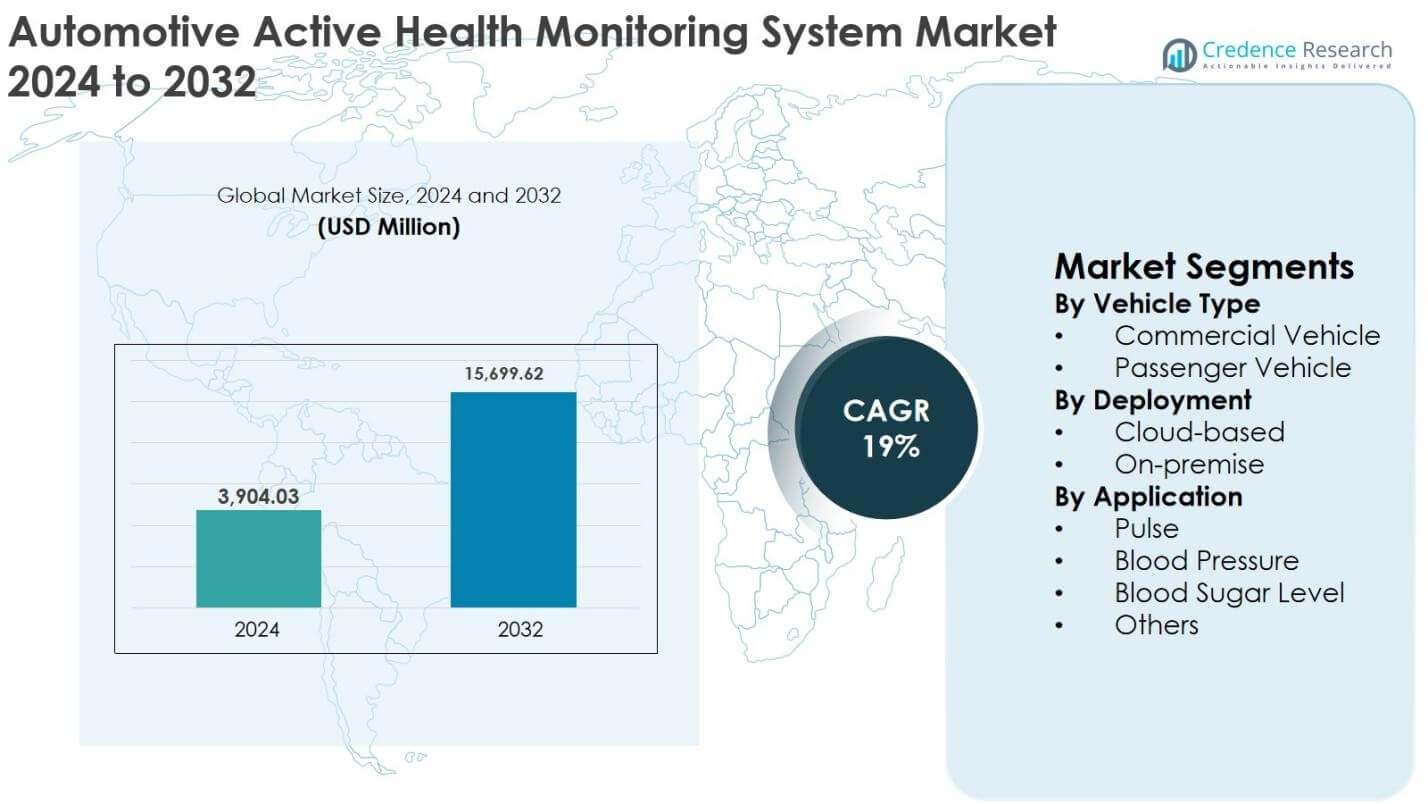
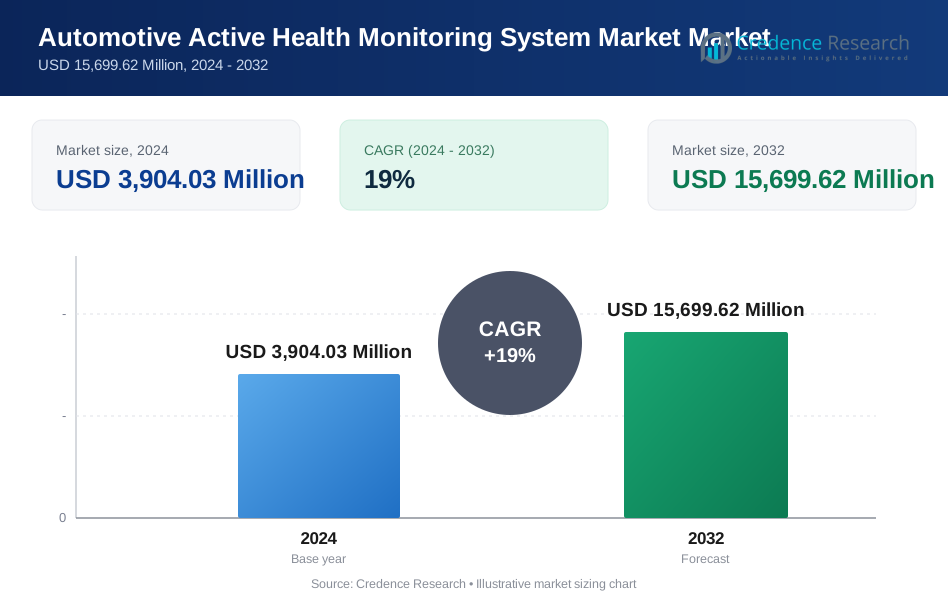
Automotive Active Health Monitoring System market size was valued USD 3,904.03 Million in 2024 and is anticipated to reach USD 15,699.62 Million by 2032, at a CAGR of 19% during the forecast period.
| REPORT ATTRIBUTE | DETAILS |
|---|---|
| Historical Period | 2020-2024 |
| Base Year | 2025 |
| Forecast Period | 2026-2032 |
| Automotive Active Health Monitoring System Market Size 2024 | USD 3,904.03 million |
| Automotive Active Health Monitoring System Market, CAGR | 19% |
| Automotive Active Health Monitoring System Market Size 2032 | USD 15,699.62 million |
Automotive Active Health Monitoring System Market Insights
- Market Overview focuses on growing integration of biometric sensing, fatigue detection, and stress-monitoring features in connected and premium vehicles, with Passenger Vehicle emerging as the dominant segment with 64.3% share in 2024.
- Markets Driver includes increasing emphasis on road safety, rising consumer awareness of in-cabin wellness, advancements in AI-enabled biosensors, and strong OEM–health-tech collaborations accelerating technology adoption.
- Competetitive analysis highlights leading players such as Faurecia, TATA Elxsi, Robert Bosch GmbH, Continental AG, and FLEX Ltd. investing in smart-cockpit integration, modular sensor platforms, and cloud-based physiological analytics to strengthen market presence.
- Regional Analysis shows North America leading with 32.6% share in 2024, followed by Asia-Pacific at 28.9% and Europe at 27.8%, while Latin America and Middle East & Africa record emerging growth supported by gradual adoption of connected mobility technologies.
Automotive Active Health Monitoring System Market Segmentation Analysis:
By Vehicle Type
The Automotive Active Health Monitoring System market by vehicle type is segmented into Commercial Vehicle and Passenger Vehicle. The Passenger Vehicle segment emerged as the dominant sub-segment in 2024, accounting for 64.3% market share, driven by the rising integration of wellness and driver-safety systems in mid- and premium-segment cars, growing consumer awareness of in-cabin health technologies, and the increasing adoption of connected and ADAS-enabled vehicles. Automakers are focusing on preventive safety features such as fatigue detection, stress monitoring, and biometric-based alerts, which further strengthen uptake in passenger vehicles, while commercial fleets are gradually adopting these systems to enhance driver productivity and safety compliance.
- For instance, Mercedes-Benz introduced its Energizing Seat Kinetics and Energizing Comfort Control systems in models like the E-Class and S-Class, which adjust seat micro-movements, lighting, and climate settings to reduce driver fatigue and stress.
By Deployment
The Automotive Active Health Monitoring System market by deployment includes Cloud-based and On-premise solutions. The Cloud-based segment held the dominant share of 57.6% in 2024, supported by the increasing integration of telematics, real-time analytics, and remote diagnostics in connected mobility ecosystems. Cloud platforms enable continuous biometric data monitoring, predictive alerts, and over-the-air feature updates, making them highly suitable for fleet operators and OEM wellness platforms. Additionally, the scalability, lower infrastructure cost, and enhanced interoperability with vehicle health records and AI-driven insights are accelerating adoption, whereas on-premise deployment remains relevant in premium vehicles requiring localized data control and privacy-centric architectures.
- For instance, General Motors’ OnStar platform leverages cloud connectivity to support remote diagnostics and proactive alerts for vehicle and driver-related conditions across millions of connected vehicles in North America.
By Application
The Automotive Active Health Monitoring System market by application is categorized into Pulse, Blood Pressure, Blood Sugar Level, and Others. The Pulse monitoring segment dominated the market in 2024 with 39.8% market share, owing to its widespread integration in steering wheels, seat sensors, and wearable-linked vehicle interfaces. Pulse tracking enables early detection of fatigue, stress, drowsiness, and cardiovascular anomalies, thereby improving driver safety and wellness intervention capabilities. Growing advancements in biosensing materials, photoplethysmography-based systems, and AI-enabled physiological analytics further strengthen its adoption, while applications such as Blood Pressure and Blood Sugar Level monitoring are gaining traction as OEMs expand toward comprehensive in-cabin health ecosystems.
Key Growth Drivers
Integration of Health Monitoring with Advanced Safety and ADAS Ecosystems
The integration of active health monitoring with advanced driver assistance systems (ADAS) and in-cabin safety technologies acts as a major growth driver in the Automotive Active Health Monitoring System market. Automakers are increasingly embedding biometric sensing modules, fatigue detection systems, and stress-level monitoring into steering wheels, seats, and dashboards to prevent accidents caused by drowsiness or medical emergencies. This convergence of wellness analytics with vehicle safety enhances real-time driver alertness, supports predictive intervention, and aligns with the industry’s shift toward human-centric vehicle intelligence. Growing regulatory emphasis on road safety, rising accident rates linked to fatigue conditions, and the increasing prioritization of preventive monitoring in premium and connected vehicles are further accelerating adoption. Moreover, OEM partnerships with health-tech providers and data-analytics companies enable feature-rich vehicle wellness ecosystems, strengthening the strategic value proposition of health-enabled mobility platforms.
- For instance, Volvo integrates Driver Alert Control and in-cabin cameras in its newer platforms to track driver attentiveness and trigger warnings or safe-stop interventions when signs of distraction or fatigue are detected.
Rising Consumer Awareness of In-Cabin Wellness and Personalized Driving Experience
Increasing consumer focus on health, wellness, and preventive monitoring inside vehicles is significantly fueling market growth. Modern drivers seek comfort, safety, and physiological awareness as part of the overall mobility experience, especially as long-distance commuting and urban congestion contribute to stress and fatigue. Active health monitoring systems support personalized driving environments by tracking parameters such as pulse rate, respiration, and cardiovascular indicators, enhancing both safety and wellbeing. The growing penetration of smart, connected, and luxury vehicles, along with the rising adoption of wearable-integrated biometric solutions, strengthens consumer acceptance of in-cabin wellness features. Automakers are positioning health monitoring as a premium differentiation factor, offering proactive alerts, adaptive comfort settings, and health-linked driving assistance. This consumer-driven preference for intelligent, wellness-oriented mobility strongly reinforces system deployment across passenger and fleet vehicles.
- For instance, Hyundai and Kia’s “Driver Attention Warning” and “Smart Sense” technologies monitor driver behavior and issue alerts or suggest breaks on models like the Hyundai Tucson and Kia Sportage, aligning safety with driver wellbeing.
Advancements in Biosensors, AI Analytics, and Connected Vehicle Infrastructure
Rapid technological advancements in biosensing materials, embedded sensors, AI-driven physiological analytics, and cloud-based data processing are accelerating the evolution of Automotive Active Health Monitoring Systems. Next-generation sensors integrated into seats, steering wheels, or cabin surfaces enable non-intrusive monitoring of multiple health parameters with improved accuracy and responsiveness. AI algorithms support real-time anomaly detection, personalized biometric profiling, and predictive health alerts, enhancing system reliability and usability. Additionally, connected vehicle architectures and telematics platforms enable continuous remote monitoring, OTA feature upgrades, and integration with digital health ecosystems. These innovations reduce latency, improve interoperability, and expand application scope beyond safety toward preventive healthcare and wellness analytics. The technological convergence between automotive electronics, digital health, and IoT ecosystems is therefore creating new opportunities for scalable and intelligent in-vehicle health solutions.
Key Trends & Opportunities
Expansion Toward Comprehensive In-Cabin Health Ecosystems and Data-Driven Services
A key industry trend is the transition from single-parameter monitoring to comprehensive in-cabin health ecosystems that integrate multiple biometric indicators and behavioral analytics. OEMs are increasingly developing platforms that combine heart-rate tracking, stress detection, posture monitoring, respiration sensing, and emotional-state assessment to deliver holistic wellness insights. This expansion creates opportunities for value-added, data-driven services such as personalized health reports, driver coaching, subscription-based wellness features, and integration with telehealth platforms. Collaboration between automotive manufacturers, health-tech firms, AI analytics providers, and insurance companies is further enabling ecosystem-based offerings. As vehicles evolve into connected digital environments, health monitoring is emerging as a core pillar of personalized mobility services and long-term customer engagement.
- For instance, Toyota has showcased research on “Driver Status Monitoring” that uses camera-based behavioral analytics and biometric cues to assess drowsiness and emotional state, feeding into adaptive alerts and assistance features.
Growing Adoption in Electric, Autonomous, and Fleet Mobility Applications
The increasing penetration of electric vehicles, autonomous driving technologies, and shared mobility platforms is creating strong growth opportunities for active health monitoring solutions. EVs and autonomous vehicles emphasize comfort, passenger wellbeing, and intelligent cabin experiences, making biometric monitoring a natural extension of smart interiors. Fleet and commercial mobility operators are also adopting health monitoring to enhance driver safety, reduce downtime, and support compliance with occupational health standards. In autonomous and semi-autonomous environments, continuous biometric tracking helps assess driver readiness, support takeover alerts, and ensure safe human–machine interaction. These emerging mobility ecosystems provide a scalable pathway for the widespread deployment of advanced, real-time in-vehicle health intelligence.
- For instance, General Motors’ Super Cruise uses a driver-facing infrared camera to track head and eye position, ensuring the driver remains ready to take over while hands-free driving is active in models like the Cadillac Escalade and Chevrolet Silverado.
Key Challenges
Data Privacy, Cybersecurity, and Ethical Concerns in Biometric Monitoring
One of the major challenges in the Automotive Active Health Monitoring System market is the growing complexity of data privacy, cybersecurity, and ethical governance surrounding biometric and health-related information. These systems collect sensitive physiological data that require strict protection, secure storage, and transparent consent frameworks. Concerns related to potential misuse of health data, cross-border regulatory variations, insurance-linked risk profiling, and user trust remain significant barriers to large-scale adoption. Automakers must ensure compliance with global data protection standards, implement strong encryption architectures, and design privacy-by-default systems. Balancing technological innovation with ethical responsibility and user confidence remains a critical strategic requirement for market expansion.
High System Cost, Integration Complexity, and Limited Standardization
High implementation costs, sensor calibration requirements, and integration challenges across diverse vehicle platforms present key market constraints. Advanced biosensing hardware, AI analytics modules, and connectivity infrastructures increase overall vehicle cost, limiting deployment in budget and mid-segment models. Additionally, the absence of uniform performance standards, varying OEM architectures, and interoperability limitations with healthcare systems create technical and operational complexity. Manufacturers must invest in scalable designs, modular sensor platforms, and cost-optimized components to improve accessibility. Overcoming these barriers is essential to achieving widespread commercialization and enabling mass-market penetration of automotive health monitoring technologies.
Regional Analysis
North America
North America held the largest share of the Automotive Active Health Monitoring System market in 2024, accounting for 32.6% of the global market, driven by strong adoption of connected and premium vehicles, early integration of ADAS and biometric safety technologies, and active collaboration between automotive OEMs and health-tech companies. The presence of leading technology innovators and regulatory emphasis on driver safety support wider deployment of fatigue, stress, and vital-sign monitoring solutions. Rising consumer awareness of in-cabin wellness, expanding EV and autonomous vehicle programs, and increasing fleet adoption further reinforce the region’s leadership position during the forecast period.
Europe
Europe captured 27.8% market share in 2024, supported by stringent road-safety standards, growing regulatory focus on driver well-being, and rapid integration of human-centric safety technologies in premium and luxury vehicles. The region’s strong automotive manufacturing base, high penetration of connected mobility platforms, and technological innovation in sensor electronics and AI-driven analytics are contributing to market expansion. Increasing consumer demand for health-assisted driving, emphasis on fatigue and stress detection features, and ongoing initiatives for smart cockpit development are strengthening adoption across Germany, the U.K., France, and Nordic countries, particularly within EV and intelligent mobility ecosystems.
Asia-Pacific
Asia-Pacific accounted for 28.9% market share in 2024 and represents the fastest-growing region, driven by rising vehicle production, expanding urban mobility, and increasing consumer awareness of safety and wellness features in countries such as China, Japan, South Korea, and India. The rapid growth of connected vehicles, strong investments in smart cockpit electronics, and increasing integration of biometric and driver-monitoring systems in mid-segment passenger cars are accelerating adoption. Regional OEM–technology partnerships, expanding EV ecosystems, and government initiatives promoting road safety and digital mobility infrastructures further enhance market uptake across both passenger and commercial vehicle segments.
Latin America
Latin America held a moderate share of 6.4% in 2024, with growth primarily driven by gradual adoption of connected vehicle technologies, increasing awareness of driver fatigue and health-related safety risks, and rising penetration of advanced comfort and safety features in urban mobility fleets. Countries such as Brazil and Mexico are witnessing growing demand for smart in-cabin monitoring and telematics-enabled systems, particularly in commercial and fleet applications. However, high system costs and limited technology standardization remain barriers to large-scale deployment, although expanding OEM investments and improving vehicle digitization are expected to support steady market growth.
Middle East & Africa
The Middle East & Africa region accounted for 4.3% market share in 2024, with adoption supported by rising deployment of premium and luxury vehicles, increasing investments in smart mobility infrastructure, and growing awareness of wellness-oriented vehicle technologies in Gulf countries. Fleet operators and commercial transport sectors are gradually integrating fatigue and health-monitoring solutions to enhance safety and operational efficiency. While market penetration remains limited due to cost sensitivity and slower technology transition in several African economies, ongoing smart-city initiatives, expanding connected vehicle ecosystems, and premium automotive demand are expected to create incremental growth opportunities in the coming years.
Automotive Active Health Monitoring System Market Segmentations:
By Vehicle Type
- Commercial Vehicle
- Passenger Vehicle
By Deployment
- Cloud-based
- On-premise
By Application
- Pulse
- Blood Pressure
- Blood Sugar Level
- Others
By Geography
- North America
- U.S.
- Canada
- Mexico
- Europe
- Germany
- France
- U.K.
- Italy
- Spain
- Rest of Europe
- Asia Pacific
- China
- Japan
- India
- South Korea
- South-east Asia
- Rest of Asia Pacific
- Latin America
- Brazil
- Argentina
- Rest of Latin America
- Middle East & Africa
- GCC Countries
- South Africa
- Rest of the Middle East and Africa
Competitive Landscape
Competitive landscape in the Automotive Active Health Monitoring System market is characterized by the presence of leading automotive technology providers, sensor manufacturers, and mobility electronics companies focusing on advanced in-cabin wellness and driver-safety solutions. Key players include Faurecia, TATA Elxsi, Plessey Semiconductors, Acellent Technologies, Hoana Medical Inc., FLEX Ltd., Continental AG, Robert Bosch GmbH, Gentherm, and Harman International, among others. These companies are investing in biosensing technologies, AI-driven physiological analytics, and smart-cockpit integration to enhance real-time monitoring of pulse rate, fatigue, stress levels, and cardiovascular indicators. Strategic initiatives such as OEM partnerships, collaboration with health-tech firms, and development of cloud-enabled health data platforms are strengthening product portfolios. Market participants are also prioritizing modular sensor architectures, non-intrusive monitoring solutions, and interoperability with connected vehicle ecosystems to support large-scale adoption. Increasing competition is driving innovation in embedded seat sensors, steering-wheel biometrics, camera-based behavior analysis, and predictive wellness features across premium and mid-segment vehicles.
Key Player Analysis
- FLEX LTD.
- Hoana Medical, Inc.
- TATA Elxsi
- LORD Micro Strain Sensing Systems
- Plessey Semiconductors
- Faurecia
- Acellent Technologies
- Micro Strain Sensing Systems
- Continental AG
- Robert Bosch GmbH
Recent Developments
- In June 2025, BMW Group announced advancements in in-car health risk detection systems aiming to detect driver health risks and changes proactively, enhancing automotive active health monitoring functionality in future vehicles.
- In June 2025, trinamiX presented its Invisible Biometric Sensing Display at InCabin 2025 in Detroit, a new biometric imaging technology for monitoring vital signs of vehicle occupants to improve safety and comfort within automotive health monitoring frameworks
Report Coverage
The research report offers an in-depth analysis based on Vehicle Type, Deployment, Application and Geography. It details leading market players, providing an overview of their business, product offerings, investments, revenue streams, and key applications. Additionally, the report includes insights into the competitive environment, SWOT analysis, current market trends, as well as the primary drivers and constraints. Furthermore, it discusses various factors that have driven market expansion in recent years. The report also explores market dynamics, regulatory scenarios, and technological advancements that are shaping the industry. It assesses the impact of external factors and global economic changes on market growth. Lastly, it provides strategic recommendations for new entrants and established companies to navigate the complexities of the market.
Future Outlook
- The market will expand rapidly as automakers integrate advanced biometric and wellness monitoring features into next-generation smart cockpits.
- Adoption will increase across passenger and premium vehicles as consumers prioritize safety, fatigue detection, and preventive health awareness while driving.
- AI-enabled analytics will enhance real-time physiological monitoring accuracy and support predictive wellness and driver-alert capabilities.
- Cloud-connected platforms will strengthen remote diagnostics, data analytics, and health-linked mobility services across OEM ecosystems.
- Integration with wearable devices and mobile health applications will create personalized and continuous in-vehicle wellness experiences.
- Adoption in electric, autonomous, and shared mobility fleets will accelerate due to safety compliance and driver-readiness monitoring requirements.
- Modular and non-intrusive sensor architectures will reduce integration cost and support wider deployment in mid-segment vehicles.
- Partnerships between automotive manufacturers, health-tech firms, and AI providers will drive innovation and ecosystem-based service models.
- Regulatory focus on road safety and driver health monitoring will encourage broader technology standardization and market acceptance.
- Emerging markets will witness increasing uptake as connected mobility infrastructure and smart-vehicle penetration continue to strengthen.
Request a Free Sample
Fill in your details and we'll send you a free sample report.
- Sample data tables & charts
- Research methodology
Need a Custom Version of This Report?
Tailor the scope, geography, or segments to your exact requirements.
- Custom geography or segment scope
- Direct access to our analyst team
Frequently Asked Questions
What is the current market size for the Automotive Active Health Monitoring System Market, and what is its projected size in 2032?
At what Compound Annual Growth Rate is the Automotive Active Health Monitoring System Market projected to grow between 2024 and 2032?
Which Automotive Active Health Monitoring System Market segment held the largest share in 2024?
What are the primary factors fueling the growth of the Automotive Active Health Monitoring System Market?
Who are the leading companies in the Automotive Active Health Monitoring System Market?
Which region commanded the largest share of the Automotive Active Health Monitoring System Market in 2024?
Table of Content
Chapter 1. Report Introduction
- 1.1 Report Description & Purpose
- 1.1.1 Report Title & Market Definition
- 1.1.2 Unique Selling Propositions (USP) & Key Differentiators
- 1.1.3 Value Proposition for Stakeholders
- 1.2 Research Objectives
- 1.2.1 Market Sizing Objectives (Volume & Revenue)
- 1.2.2 Segmentation Objectives
- 1.2.3 Competitive Intelligence Objectives
- 1.2.4 Forecast & Scenario Objectives
- 1.3 Report Scope
- 1.3.1 Automotive Active Health Monitoring System Market Scope – Types & Subtypes Covered
- 1.3.2 Geographic Scope – Regions & Countries Covered
- 1.3.3 Historical Period, Base Year & Forecast Period (2024; forecast to 2032)
- 1.3.4 Inclusions & Exclusions
- 1.4 HS Code & Classification Framework
- 1.5 Currency, Units & Pricing Basis
- 1.6 Target Stakeholders
- 1.7 Limitations & Assumptions
Chapter 2. Executive Summary
- 2.1 Global Automotive Active Health Monitoring System Market Market Snapshot
- 2.1.1 Market Size – Historical (2024) & Forecast (2024-2032) (2024: USD 3,904.03 Million → 2032: USD 15,699.62 Million)
- 2.1.2 Volume & Revenue – Global Totals
- 2.1.3 Key Market Highlights – Top Five Facts
- 2.2 Automotive Active Health Monitoring System Market Market Segmentation Snapshot
- 2.2.1 Market Split by Region – 2024 vs. 2032
- 2.3 Competitive Snapshot
- 2.3.1 Top 10 Players by Revenue Share – 2024
- 2.3.2 Top 10 Players by Volume Share – 2024
- 2.3.3 Recent Strategic Developments (18-Month Summary)
- 2.4 Key Investment Highlights & Strategic Conclusions
Chapter 3. Automotive Active Health Monitoring System Market Market Dynamics & Industry Analysis
- 3.1 Market Overview & Context
- 3.1.1 Automotive Active Health Monitoring System Market Market Position in the Broader Automotive Value Chain
- 3.1.2 OEM vs. Replacement Market Dynamics
- 3.1.3 Market Maturity & Development Stage by Region
- 3.2 Automotive Active Health Monitoring System Market Market Drivers
- 3.3 Automotive Active Health Monitoring System Market Market Restraints & Challenges
- 3.4 Automotive Active Health Monitoring System Market Market Opportunities
- 3.5 Porter's Five Forces Analysis
- 3.5.1 Threat of New Entrants
- 3.5.2 Bargaining Power of Suppliers
- 3.5.3 Bargaining Power of Buyers
- 3.5.4 Threat of Substitutes
- 3.5.5 Competitive Rivalry – Intensity Assessment
- 3.6 Automotive Active Health Monitoring System Market Value Chain Analysis
- 3.6.1 Upstream – Raw Material/Input Suppliers
- 3.6.1.1 Raw Material/Input 1
- 3.6.1.2 Raw Material/Input 2
- 3.6.1.3 Raw Material/Input 3
- 3.6.2 Midstream – Production/Manufacturing/Service Delivery
- 3.6.2.1 Production/Process Overview
- 3.6.2.2 Key Facility Locations & Capacity by Manufacturer
- 3.6.3 Downstream – Distribution & End Consumer
- 3.6.3.1 Primary Channel – B2B/OEM
- 3.6.3.2 Secondary Channels – Dealer, Retail, Online, Direct
- 3.6.4 Value Chain Profitability Analysis
- 3.6.1 Upstream – Raw Material/Input Suppliers
- 3.7 PESTEL Analysis
- 3.7.1 Political Factors
- 3.7.2 Economic Factors
- 3.7.3 Social Factors
- 3.7.4 Technological Factors
- 3.7.5 Environmental Factors
- 3.7.6 Legal Factors
- 3.8 Automotive Active Health Monitoring System Market Supply Chain Analysis
- 3.8.1 Raw Material/Input Supply Risk Assessment
- 3.8.2 Manufacturing Concentration Risk (Geographic Exposure)
- 3.8.3 Trade Disruption Impact Analysis
- 3.9 Regulatory & Policy Landscape
Note: The regulatory and policy landscape section covers regulations based on their applicability to the market, Automotive Active Health Monitoring System Market category, geography, and scope of the study. Only regulatory frameworks with a material impact on operations, compliance, trade, sustainability, or market access are analyzed in detail.
Chapter 4. Key Investment Pockets & Opportunity Analysis
- 4.1 Automotive Active Health Monitoring System Market Market Attractiveness Analysis
- 4.1.1 By Region – Investment Attractiveness Matrix (Volume × CAGR)
- 4.2 Absolute Revenue Growth Opportunity
- 4.2.1 By Region – Absolute USD Growth Through 2032
- 4.3 Incremental Volume Opportunity
- 4.3.1 By Region – Incremental Volume Through 2032
- 4.3.2 Segment – Incremental Volume
- 4.4 Emerging Submarket Opportunity Deep Dive (Subject to Applicability)
- 4.5 Emerging Market Opportunity Scorecards
- 4.5.1 United States
- 4.5.2 Europe
- 4.5.3 Asia
- 4.5.4 Middle East & Africa
Note: Emerging Market Opportunity Scorecards will be included based on relevance and strategic importance. Regions listed are indicative and may vary depending on data availability and market dynamics.
Chapter 5. Automotive Active Health Monitoring System Market Import-Export Analysis & Trade Flows
- 5.1 Global Trade Overview
- 5.1.1 Global Export Value by Country (2024)
- 5.1.2 Global Export Volume by Country (2024)
- 5.1.3 Global Import Value by Country (2024)
- 5.1.4 Global Import Volume by Country (2024)
- 5.1.5 Net Trade Balance by Country (2024)
- 5.2 Export Analysis – Segment
- 5.2.1 Type 1 (HS Code)
- 5.2.2 Type 2 (HS Code)
- 5.2.3 Type 3 (HS Code)
- 5.2.4 Type 4 (HS Code)
- 5.2.5 Type 5 (HS Code)
- 5.3 Import Analysis – Segment
- 5.3.1 Type 1 (HS Code)
- 5.3.2 Type 2 (HS Code)
- 5.3.3 Type 3 (HS Code)
- 5.3.4 Type 4 (HS Code)
- 5.3.5 Type 5 (HS Code)
- 5.4 Average Unit Trade Prices
- 5.4.1 Average Export Price – Segment & Country
- 5.4.2 Average Import Price – Segment & Source Country
- 5.4.3 Price Trends (2024)
- 5.5 Key Trade Route Analysis
- 5.5.1 Trade Route 1
- 5.5.2 Trade Route 2
- 5.5.3 Trade Route 3
- 5.5.4 Trade Route 4
- 5.5.5 Trade Route 5
- 5.6 Trade Policy Impact Assessment
- 5.6.1 US Anti-Dumping & Section 301 Tariffs
- 5.6.2 EU Customs Union Impact
- 5.6.3 Major Free Trade Agreements
- 5.6.4 USMCA Rules of Origin
Note: Trade policy analysis will be included only where relevant to the Automotive Active Health Monitoring System Market market.
Chapter 6. Competitive Landscape & Company Benchmarking
- 6.1 Automotive Active Health Monitoring System Market Market Concentration & Structure
- 6.1.1 Herfindahl-Hirschman Index (HHI) – vs. 2024
- 6.1.2 Tier 1, Tier 2 & Tier 3 Market Structure
- 6.1.3 Global, Regional & Local Player Dynamics
- 6.2 Automotive Active Health Monitoring System Market Market Share Analysis – 2024
- 6.2.1 Global Revenue Share by Company
- 6.2.2 Global Volume Share by Company
- 6.2.3 Regional Revenue Share
- 6.2.4 Market Share Evolution ( vs. 2024)
- 6.2.5 OEM Segment Share by Company
- 6.2.6 Replacement Segment Share by Company
- 6.3 Production/Delivery Capacity & Facility Analysis
- 6.3.1 Global Installed Capacity
- 6.3.2 Capacity Utilization Rates
- 6.3.3 Production/Output Volume
- 6.3.4 Facility Locations & Capacity Map
- 6.3.5 Planned Capacity Additions
- 6.4 Automotive Active Health Monitoring System Market Competitive Benchmarking Matrix
- 6.4.1 Revenue, Volume, CAGR & Profitability Comparison
- 6.4.2 Channel Revenue Mix
- 6.4.3 Geographic Revenue Exposure
- 6.4.4 R&D Intensity
- 6.4.5 Sustainability Maturity
- 6.5 Strategic Developments in Automotive Active Health Monitoring System Market (Last 24 Months)
- 6.5.1 Mergers, Acquisitions & Divestments
- 6.5.2 New Automotive Active Health Monitoring System Market Launches
- 6.5.3 Facility Expansions
- 6.5.4 Strategic Alliances, Joint Ventures & Partnerships
- 6.5.5 Distribution Expansion & Market Entry
- 6.5.6 Sustainability & ESG Initiatives
- 6.6 Competitive Strategy Mapping
- 6.6.1 Leader, Challenger, Follower & Niche Classification
- 6.6.2 Pricing Strategy Comparison
- 6.6.3 Channel Strategy Matrix
Note: Strategic developments are included based on their materiality and the availability of reliable information.
Chapter 7. Global Automotive Active Health Monitoring System Market Market – By Distribution Channel
- 7.1 Segment Overview
- 7.1.1 Volume & Revenue Split by Channel (2024 & 2032)
- 7.1.2 Channel Mix Evolution (2024-2032)
Chapter 8. Regional Market Analysis – Global Overview
- 8.1 Global Regional Overview
- 8.1.1 Regional Volume Share
- 8.1.2 Regional Revenue Share
- 8.1.3 Regional Volume by Region
- 8.1.4 Regional Revenue by Region
- 8.1.5 Regional Forecast Through 2032
- 8.2 Cross-Regional Segment Analysis
- 8.2.1 By Distribution Channel
- 8.2.2 By Brand/Price Tier
Chapter 9. North America Automotive Active Health Monitoring System Market Market
- 9.1 United States
- 9.2 Canada
- 9.3 Mexico
Chapter 10. Europe Automotive Active Health Monitoring System Market Market
- 10.1 Germany
- 10.2 France
- 10.3 Italy
- 10.4 United Kingdom
- 10.5 Spain
- 10.6 Poland
- 10.7 Russia
- 10.8 Netherlands
- 10.9 Belgium
- 10.10 Sweden
- 10.11 Denmark
- 10.12 Norway
- 10.13 Rest of Europe
Chapter 11. Asia Pacific Automotive Active Health Monitoring System Market Market
- 11.1 China
- 11.2 India
- 11.3 Japan
- 11.4 South Korea
- 11.5 Thailand
- 11.6 Indonesia
- 11.7 Vietnam
- 11.8 Malaysia
- 11.9 Australia
- 11.10 Rest of Asia Pacific
Chapter 12. Latin America Automotive Active Health Monitoring System Market Market
- 12.1 Brazil
- 12.2 Argentina
- 12.3 Colombia
- 12.4 Chile
- 12.5 Rest of Latin America
Chapter 13. Middle East Automotive Active Health Monitoring System Market Market
- 13.1 Saudi Arabia
- 13.2 United Arab Emirates
- 13.3 Turkey
- 13.4 Israel
- 13.5 Iran
- 13.6 Rest of the Middle East
Chapter 14. Africa Automotive Active Health Monitoring System Market Market
- 14.1 South Africa
- 14.2 Egypt
- 14.3 Nigeria
- 14.4 Morocco
- 14.5 Rest of Africa
Chapter 15. Automotive Active Health Monitoring System Market Company Profiles
- 15.1 [Company 01]
- 15.1.1 Company Overview
- 15.1.2 Key Management Personnel
- 15.1.3 Products & Services Portfolio
- 15.1.4 Financial Performance
- 15.1.5 Key Market Focus & Geographic Presence
- 15.1.6 Recent Developments & Strategic Initiatives
Note: The company profile list is preliminary and may change based on research findings, market developments, data availability, and client requirements.
Chapter 16. Appendices
- Appendix A – List of Abbreviations & Acronyms
- Appendix B – Industry Classification Code Reference – Full Series
- Appendix C – Production & Capacity Data Tables
- Appendix D – End-Use & Demand Base Tables
- Appendix E – Consumption & Replacement Rate Assumptions
- Appendix F – ASP Reference Tables
- Appendix G – Manufacturing & Facility Database
- Appendix H – Import-Export Data Tables
- Appendix I – Regulatory Summary Tables
- Appendix J – Primary Research Participant List (Anonymized)
- Appendix K – Primary Research Questionnaire Framework
- Appendix L – Data Sources & Bibliography
- Appendix M – Market Size Divergence & Source Comparison
Chapter 17. Research Methodology
- 17.1 Research Framework & Philosophy
- 17.2 Secondary Research – Sources, Hierarchy & Data Extraction
- 17.3 Data Modeling – Bottom-Up & Top-Down Market Sizing
- 17.4 Primary Research – Stakeholder Framework, LOI & Sample Sizes
- 17.5 Forecast Methodology – Regression, Scenario & Sensitivity Analysis
- 17.6 Quality Control – Four-Layer Validation Framework
- 17.7 Limitations & Standard Assumptions
- 17.8 Disclaimer
