
| REPORT ATTRIBUTE | DETAILS |
|---|---|
| Historical Period | 2020-2023 |
| Base Year | 2024 |
| Forecast Period | 2025-2032 |
| Multi Touch Screen Market Size 2024 | USD 16,448.66 Million |
| Multi Touch Screen Market CAGR | 11.47% |
| Multi Touch Screen Market Size 2032 | USD 39,075.12 Million |
Market Overview
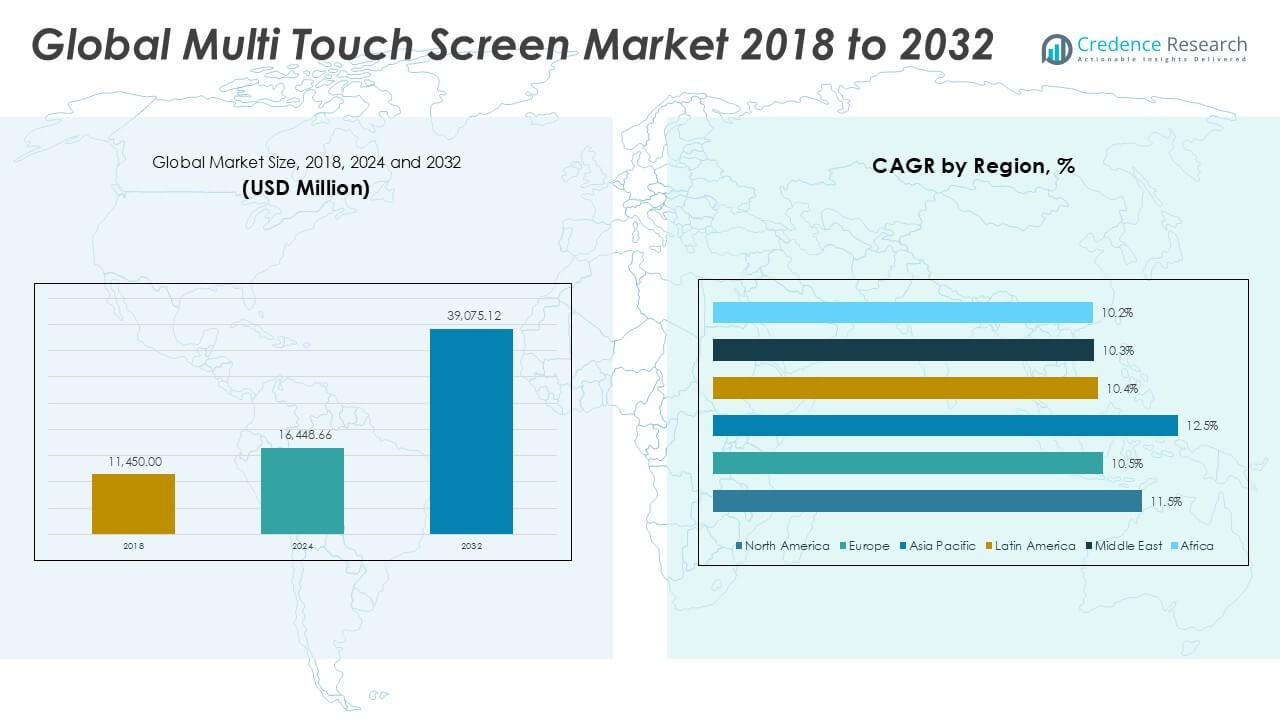
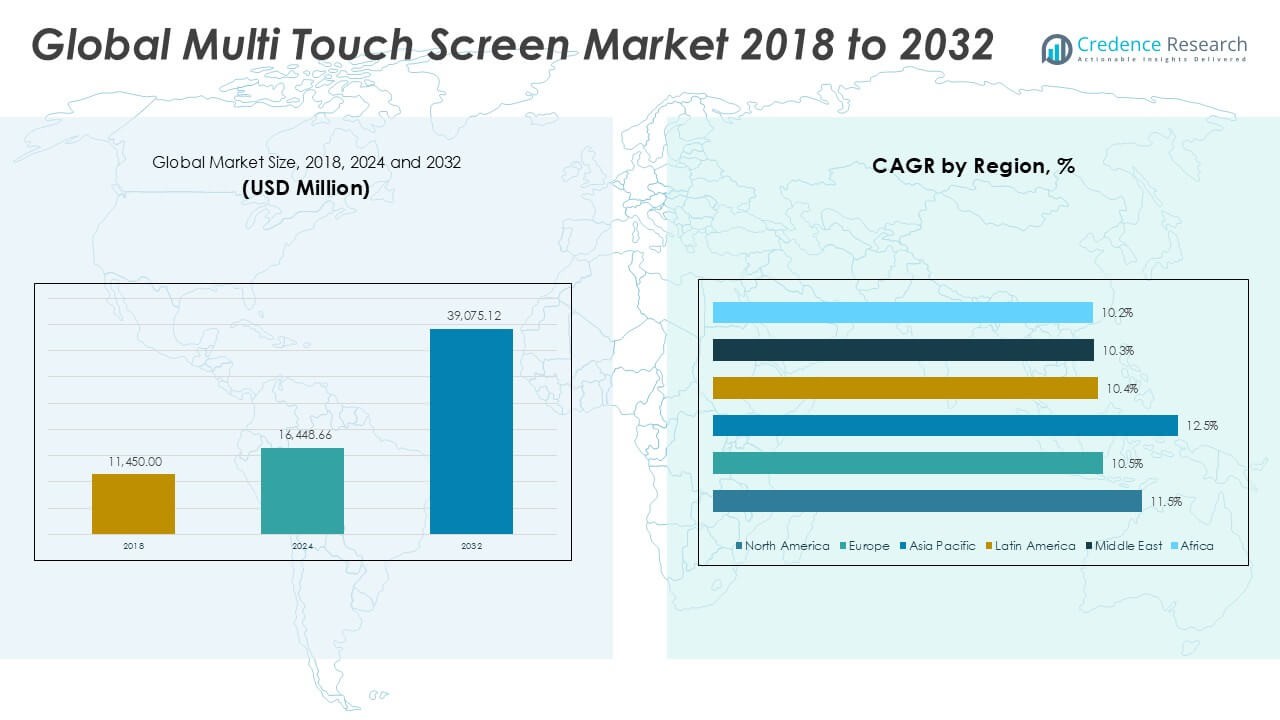
The Global Multi Touch Screen Market is projected to grow from USD 16,448.66 million in 2024 to an estimated USD 39,075.12 million by 2032, with a compound annual growth rate (CAGR) of 11.47% from 2025 to 2032.
The market is primarily driven by the growing adoption of multi-touch screens in the consumer electronics sector and increasing demand for intuitive human-machine interfaces. Trends such as the proliferation of touch-enabled devices, expanding use of interactive displays in education and retail, and the shift towards smart homes and connected cars are fueling market progress. Additionally, technological advancements, including the development of thinner, more durable, and energy-efficient screens, are enhancing user experiences and supporting the widespread adoption of multi-touch solutions across industries.
Geographically, Asia Pacific dominates the Global Multi Touch Screen Market due to the presence of major electronic manufacturers and high consumer demand in countries like China, Japan, and South Korea. North America and Europe also contribute significantly, driven by technological innovation and strong adoption in automotive and industrial sectors. Key players operating in the market include 3M, Apple Inc., Fujitsu Ltd., LG Display Co., Ltd., Samsung Electronics Co., Ltd., Sharp Corporation, Microsoft Corporation, and Panasonic Corporation, all of whom are actively advancing multi-touch technologies to capture growing market opportunities.
Market Insights
- The Global Multi Touch Screen Market is projected to nearly double from USD 16,448.66 million in 2024 to USD 39,075.12 million by 2032, driven by a CAGR of 11.47%.
- Rising consumer demand for interactive devices in smartphones, tablets, and automotive displays fuels strong market growth globally.
- Technological advancements producing thinner, more durable, and energy-efficient touchscreens enhance adoption across various industries.
- High production costs and technical limitations, including sensitivity to environmental factors, restrict wider market penetration.
- Asia Pacific leads the market with major electronics manufacturers and growing consumer demand, holding the largest regional market share.
- North America and Europe maintain significant shares through innovation and adoption in automotive, industrial, and consumer sectors.
- Emerging regions like Latin America and the Middle East offer growth opportunities with increasing investments in smart infrastructure and digital transformation.
Market Drivers
Rising Demand for Consumer Electronics with Advanced Touchscreen Capabilities
The Global Multi Touch Screen Market is experiencing strong growth due to the increasing demand for smartphones, tablets, and laptops equipped with multi-touch functionality. Consumers prefer devices with fast, accurate, and seamless touch responses, which is pushing manufacturers to innovate and upgrade touch technologies. It is benefiting from the widespread use of these devices in both personal and professional environments. The need for portable, user-friendly gadgets is driving further investment in touchscreen development. Companies are focusing on producing high-resolution, durable screens that meet the growing expectations of tech-savvy users. The adoption of touchscreens in wearables and smart home devices is also contributing to the market’s expansion.
- For instance, according to IDC, global smartphone shipments reached 1,170,000,000 units in 2023, with nearly all new models featuring multi-touch screen technology to meet consumer demand for advanced interactive displays.
Growing Integration of Multi Touch Screens in Automotive Applications
The integration of multi-touch screens in vehicle dashboards and infotainment systems is significantly driving the Global Multi Touch Screen Market. Consumers expect advanced, easy-to-use interfaces in modern vehicles, which is increasing the installation of touch-enabled controls. It is gaining attention from automotive manufacturers who are replacing traditional buttons with sleek touchscreen panels. The demand for connected cars with sophisticated navigation, entertainment, and climate control systems is supporting this trend. Multi-touch screens provide a safer, more intuitive way for drivers to interact with in-car technology. The automotive sector is becoming a key growth avenue for this market.
- For instance, over 29,000,000 new vehicles produced globally in 2023 were equipped with multi-touch infotainment displays, reflecting the rapid adoption of this technology in the automotive industry.
Expanding Use of Multi Touch Screens in Retail, Healthcare, and Education
The Global Multi Touch Screen Market is supported by the expanding adoption of interactive displays in retail, healthcare, and education. In retail, touchscreens are widely used in self-service kiosks and digital signage, improving customer engagement and streamlining operations. It is gaining popularity in healthcare where interactive screens facilitate patient management and information display. In educational institutions, the increasing use of interactive whiteboards and tablets is enhancing learning experiences. The need for efficient, user-friendly communication tools is pushing the use of multi-touch screens across these sectors. Businesses and organizations are investing in touch-enabled solutions to improve service delivery and user interaction.
Continuous Technological Advancements and Product Innovations
Technological advancements are playing a critical role in driving the Global Multi Touch Screen Market. Companies are introducing thinner, more energy-efficient, and highly responsive screens that offer superior touch accuracy. It is moving towards the development of flexible and foldable displays that create new design possibilities. Manufacturers are focusing on improving touch sensitivity, screen durability, and optical clarity. Innovations such as pressure-sensitive touch and multi-user capability are expanding the applications of these screens. The market is benefitting from the growing investment in research and development to meet changing consumer preferences and industry requirements. These innovations are strengthening the competitiveness of key players in the market.
Market Trends
Increasing Shift Toward Touch-Based Interfaces Across Industries
The Global Multi Touch Screen Market is witnessing a growing shift toward touch-based interfaces across various industries. Companies in retail, healthcare, automotive, and education are adopting interactive touchscreen solutions to improve user experiences. It is transforming how businesses engage with customers and streamline operations. Interactive kiosks, digital signage, and in-car infotainment systems are becoming standard features. The demand for fast, intuitive, and responsive interfaces is leading to the replacement of traditional input methods. Businesses are focusing on touchscreens to deliver seamless, real-time interaction that meets modern consumer expectations.
- For instance, according to the GSMA's Annual State of Mobile Internet Connectivity Report 2023, over 4,300,000,000 people globally now possess a smartphone, fueling the widespread adoption of touch-based interfaces in both consumer and professional environments
Rising Adoption of Flexible and Foldable Touchscreen Displays
Flexible and foldable touchscreen displays are gaining traction and reshaping the product landscape in the Global Multi Touch Screen Market. Manufacturers are introducing innovative products that allow devices to fold or bend without compromising display quality. It is opening new possibilities in smartphone, tablet, and wearable designs. The market is seeing strong consumer interest in compact, versatile devices that offer larger screen experiences. Companies are investing in new materials and production techniques to support this trend. The development of foldable touchscreens is creating competitive opportunities for key players.
- For instance, global shipments of foldable phones reached 15,900,000 units in 2023, reflecting the rapid growth and consumer acceptance of flexible touchscreen technology in the mobile device market
Growth of Multi-Touch Technology in Smart Home Devices
The increasing popularity of smart home devices is creating new growth avenues for the Global Multi Touch Screen Market. Consumers are integrating multi-touch screens into smart appliances, security systems, and home automation panels. It is driving the demand for intuitive, easy-to-use control interfaces within residential settings. Smart thermostats, lighting systems, and connected home hubs are now adopting multi-touch screens for improved functionality. The convenience of managing multiple systems through a single interactive display is supporting the widespread use of these technologies. Smart home trends are strengthening the role of multi-touch solutions in everyday life.
Rising Demand for Durable and Energy-Efficient Touchscreen Solutions
Durability and energy efficiency have become important trends in the Global Multi Touch Screen Market. Manufacturers are focusing on developing scratch-resistant, water-resistant, and long-lasting screens that can perform under various conditions. It is responding to growing consumer preferences for devices with extended lifespans and minimal maintenance needs. The demand for energy-efficient screens is increasing across portable devices where battery life is critical. Companies are working to reduce power consumption while maintaining high touch sensitivity and display brightness. These features are becoming key differentiators for manufacturers competing in the global market.
Market Challenges
High Production Costs and Complex Manufacturing Processes Restraining Market Growth
The Global Multi Touch Screen Market faces significant challenges due to high production costs and complex manufacturing processes. Producing multi-touch screens with advanced features, such as high sensitivity and flexibility, requires expensive raw materials and precision engineering. It increases the overall cost of devices, making them less accessible to price-sensitive consumers. Manufacturers must invest heavily in specialized equipment and quality control to ensure product reliability. The need for continuous technological upgrades also puts pressure on production timelines and costs. These challenges are limiting the ability of some manufacturers to compete effectively on price.
- For instance, according to a 2024 report by Display Supply Chain Consultants (DSCC), the average production cost for a foldable multi-touch smartphone display was $130 per unit in 2023, compared to $45 per unit for a conventional rigid multi-touch display, highlighting the significant cost gap that manufacturers face when adopting advanced touchscreen technologies.
Technical Limitations and Performance Issues Impacting User Experience
Technical limitations and performance issues remain key challenges in the Global Multi Touch Screen Market. Multi-touch screens can experience reduced responsiveness, screen lag, and limited accuracy when used in certain environments or with specific materials. It affects the user experience and may reduce consumer satisfaction with the technology. Environmental factors like humidity, dust, and extreme temperatures can further compromise performance. Durability concerns, particularly in foldable and flexible screens, require manufacturers to address issues such as cracking and wear over time. These technical barriers are slowing adoption in industries where reliability and precision are critical.
Market Opportunities
Expanding Application in Emerging Sectors Creating New Growth Avenues
The Global Multi Touch Screen Market holds strong opportunities through its expanding applications in sectors such as healthcare, education, and retail. Touch-based diagnostic equipment, interactive learning platforms, and self-service kiosks are gaining preference in these industries. It is well-positioned to benefit from the rising demand for interactive and user-friendly solutions that improve efficiency and customer engagement. Healthcare providers are adopting touchscreens to streamline patient management and improve operational workflows. Educational institutions are integrating multi-touch displays to support collaborative learning environments. Retailers are focusing on touchscreen kiosks to offer faster and more personalized customer experiences, creating new revenue streams for manufacturers.
Growing Demand for Smart Cities and IoT-Enabled Devices Supporting Market Expansion
Smart city projects and the increasing adoption of IoT-enabled devices present significant opportunities for the Global Multi Touch Screen Market. Urban planners and technology providers are implementing interactive displays for public information systems, transportation hubs, and smart home controls. It is expected to gain from the rising need for connected and intelligent user interfaces that support real-time communication. Smart homes are incorporating multi-touch panels to control lighting, security, and entertainment systems, driving further adoption. Manufacturers can leverage these trends to develop customized solutions that meet the specific requirements of smart infrastructure. This growing integration into connected environments is set to open new market segments and long-term growth prospects.
Market Segmentation Analysis
By Product
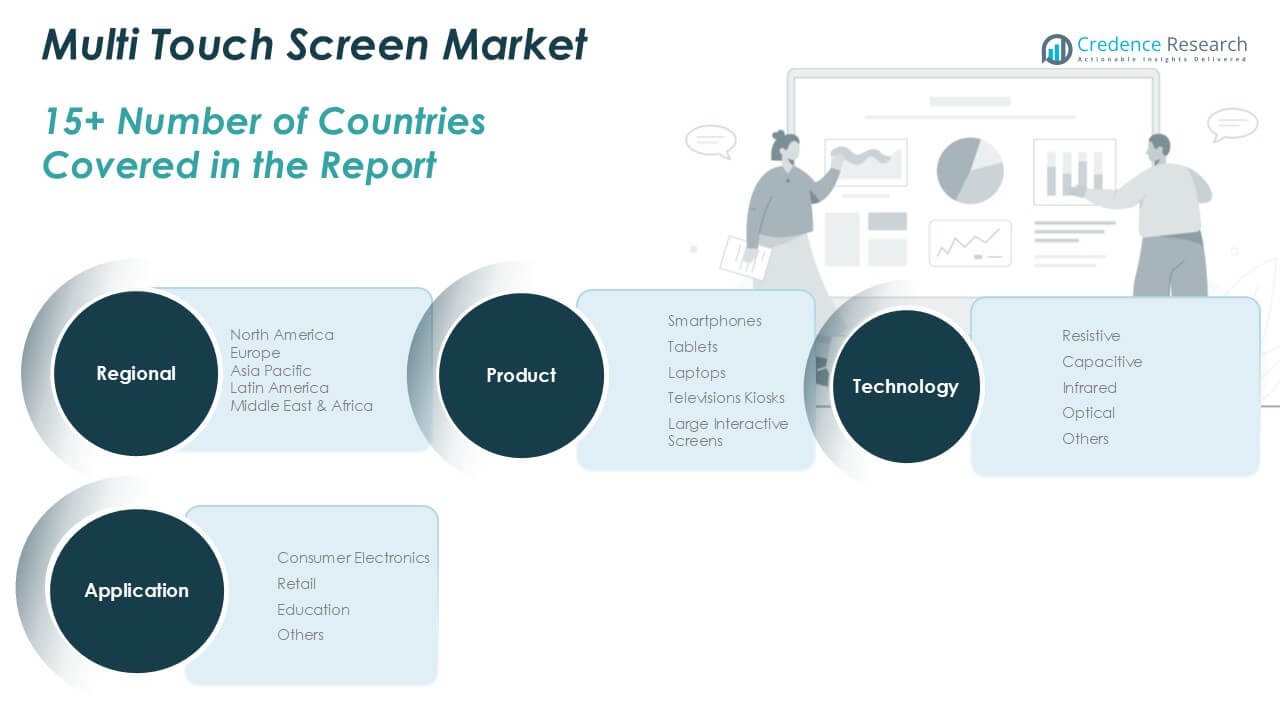
The Global Multi Touch Screen Market is segmented by product into smartphones, tablets, laptops, televisions kiosks, and large interactive screens. Smartphones hold a significant revenue share due to their widespread consumer adoption and frequent technology upgrades. Tablets and laptops also contribute strongly to market growth, driven by demand for portable and multi-functional devices. It is expanding with the increasing use of televisions kiosks and large interactive screens across retail, education, and public spaces, where touch-based interfaces improve customer interaction and service efficiency. The growing trend of interactive displays in shopping centers, airports, and classrooms is further boosting demand in these product categories.
- For instance, global tablet shipments reached 135,300,000 units in 2023, with the majority featuring multi-touch screen technology to meet user expectations for intuitive and responsive interfaces.
By Technology
The Global Multi Touch Screen Market is segmented by technology into resistive, capacitive, infrared, optical, and others. Capacitive technology holds a major share due to its high sensitivity, durability, and fast response, making it popular in smartphones and tablets. Resistive screens remain relevant in applications requiring pressure-based input and cost efficiency. It is also growing in segments using infrared and optical technologies, which support large screens and multi-user applications with reliable performance. Infrared and optical touchscreens are preferred in public displays and industrial environments where precision and long-term reliability are essential.
- For instance, over 1,020,000,000 capacitive touch panels were shipped globally in 2023, maintaining their dominance as the preferred technology for smartphones, tablets, and other consumer electronics.
By Application
The Global Multi Touch Screen Market is segmented by application into consumer electronics, retail, education, and others. Consumer electronics dominate the market due to the high penetration of smartphones, tablets, and laptops with multi-touch capabilities. It is seeing steady growth in retail applications where interactive kiosks and digital signage improve customer service and operational speed. The education sector is adopting multi-touch screens to enhance collaborative learning and digital classroom experiences. Other applications, including healthcare and industrial use, are expanding due to the demand for efficient, touch-based control systems in professional settings.
Segments
Based on Product
- Smartphones
- Tablets
- Laptops
- Televisions Kiosks
- Large Interactive Screens
Based on Technology
- Resistive
- Capacitive
- Infrared
- Optical
- Others
Based on Application
- Consumer Electronics
- Retail
- Education
- Others
Based on Region
- North America
- U.S.
- Canada
- Mexico
- Europe
- UK
- France
- Germany
- Italy
- Spain
- Russia
- Belgium
- Netherlands
- Austria
- Sweden
- Poland
- Denmark
- Switzerland
- Rest of Europe
- Asia Pacific
- China
- Japan
- South Korea
- India
- Australia
- Thailand
- Indonesia
- Vietnam
- Malaysia
- Philippines
- Taiwan
- Rest of Asia Pacific
- Latin America
- Brazil
- Argentina
- Peru
- Chile
- Colombia
- Rest of Latin America
- Middle East
- UAE
- KSA
- Israel
- Turkey
- Iran
- Rest of Middle East
- Africa
- Egypt
- Nigeria
- Algeria
- Morocco
- Rest of Africa
Regional Analysis
North America Multi Touch Screen Market
The Multi Touch Screen Market in North America is projected to grow from USD 5,612.70 million in 2024 to USD 13,404.91 million by 2032, registering a CAGR of 11.5% during the forecast period. North America holds approximately 34.12% of the global market share in 2024. It is driven by the rapid adoption of advanced consumer electronics and strong demand in the automotive and healthcare sectors. The United States leads the region with a significant share, supported by technological innovation and high consumer spending on smart devices. Canada is also contributing to the market with increasing use of multi-touch screens in educational institutions and public services. The presence of key players and a highly developed infrastructure further supports market growth in this region.
Europe Multi Touch Screen Market
The Europe Multi Touch Screen Market is expected to increase from USD 3,861.70 million in 2024 to USD 8,548.57 million by 2032, growing at a CAGR of 10.5%. Europe accounts for 23.45% of the global market share in 2024. It is expanding due to strong demand in automotive applications, particularly in Germany and France, where multi-touch screens are becoming standard in vehicle dashboards. The retail and education sectors across the UK, Italy, and Spain are also contributing to regional growth through rising adoption of interactive displays. The push towards smart infrastructure and digital transformation across industries supports steady market development in Europe.
Asia Pacific Multi Touch Screen Market
The Asia Pacific Multi Touch Screen Market is projected to grow from USD 5,030.75 million in 2024 to USD 12,891.62 million by 2032, achieving a CAGR of 12.5%. Asia Pacific holds the largest share, accounting for 30.59% of the global market in 2024. It is rapidly advancing due to high demand for smartphones, tablets, and smart home devices in China, Japan, South Korea, and India. The region benefits from the presence of leading manufacturers and a strong supply chain network. Growing investment in smart cities and digital classrooms is further fueling market expansion. Increasing consumer spending and rapid urbanization strengthen Asia Pacific's market position.
Latin America Multi Touch Screen Market
The Multi Touch Screen Market in Latin America is expected to grow from USD 832.14 million in 2024 to USD 1,819.73 million by 2032, registering a CAGR of 10.4%. Latin America contributes approximately 5.06% of the global market share in 2024. It is supported by the growing adoption of multi-touch kiosks and interactive retail displays in countries such as Brazil and Mexico. Demand is rising in the education sector, where digital learning solutions are becoming more prevalent. Increasing investments in smart infrastructure are creating new opportunities for multi-touch technology in public and commercial spaces. The region shows potential for steady growth with improving technology penetration.
Middle East Multi Touch Screen Market
The Middle East Multi Touch Screen Market is forecasted to grow from USD 569.02 million in 2024 to USD 1,234.52 million by 2032, with a CAGR of 10.3%. The region holds 3.46% of the global market share in 2024. It is gaining momentum due to expanding applications in smart buildings, airports, and transportation hubs across the UAE, Saudi Arabia, and Qatar. Multi-touch screens are increasingly used in luxury retail and public services, supporting regional market growth. The rising focus on digital transformation and smart city initiatives is further accelerating demand. Key projects in hospitality and education sectors continue to support the adoption of advanced touchscreen solutions.
Africa Multi Touch Screen Market
The Africa Multi Touch Screen Market is projected to increase from USD 542.36 million in 2024 to USD 1,175.77 million by 2032, growing at a CAGR of 10.2%. Africa accounts for 3.30% of the global market share in 2024. It is growing steadily with increasing investments in education and public service automation. The adoption of interactive kiosks and multi-touch displays in retail and transportation is improving user engagement and service delivery. Countries like South Africa and Nigeria are leading in technology uptake. Efforts to modernize infrastructure and expand access to smart devices support the region’s gradual market development. The rising availability of affordable touchscreen products is contributing to wider market acceptance.
Key players
- 3M Company
- Apple Inc.
- Corning Incorporated
- Fujitsu Limited
- HP Inc.
- Immersion Corporation
- Infineon Technologies AG
- Japan Display Inc. (Sony Corporation)
- LG Electronics Inc.
- Microsoft Corporation
- Samsung Electronics Co. Ltd.
- Panasonic Corporation
- Sharp Corporation
Competitive Analysis
The Global Multi Touch Screen Market is highly competitive, with key players focusing on product innovation, technological advancement, and strategic partnerships to strengthen their market position. It is driven by leading companies like 3M Company, Apple Inc., Samsung Electronics Co. Ltd., and LG Electronics Inc., which offer advanced multi-touch solutions across various industries. These players invest in research and development to improve product durability, sensitivity, and energy efficiency. Companies such as Microsoft Corporation and HP Inc. continue to expand their product portfolios to meet the growing demand for touch-enabled devices. Strategic collaborations and acquisitions are helping key participants enter new markets and enhance their global reach. The competition pushes manufacturers to offer customized solutions and maintain high-quality standards to retain market share.
Recent Developments
- In 2024, Apple introduced the Apple Vision Pro, a spatial computer utilizing a spatial computing interface driven by eye, hand, and voice input. The device leverages Apple's existing expertise and features ultra-high-resolution micro-OLED displays.
Market Concentration and Characteristics
The Global Multi Touch Screen Market is moderately concentrated, with several leading companies controlling a significant share. It is characterized by rapid technological advancements, high product differentiation, and strong competition among key players. Companies continuously invest in innovation to develop thinner, more responsive, and energy-efficient touchscreens. The market demands consistent product upgrades to meet changing consumer preferences and industry standards. It features a mix of global technology giants and specialized manufacturers focusing on specific product categories or regional markets. The increasing application of multi-touch screens across sectors such as automotive, healthcare, education, and retail continues to shape market dynamics.
Report Coverage
The research report offers an in-depth analysis based on Product, Technology, Application and Region. It details leading market players, providing an overview of their business, product offerings, investments, revenue streams, and key applications. Additionally, the report includes insights into the competitive environment, SWOT analysis, current market trends, as well as the primary drivers and constraints. Furthermore, it discusses various factors that have driven market expansion in recent years. The report also explores market dynamics, regulatory scenarios, and technological advancements that are shaping the industry. It assesses the impact of external factors and global economic changes on market growth. Lastly, it provides strategic recommendations for new entrants and established companies to navigate the complexities of the market.
Future Outlook
- The Global Multi Touch Screen Market will continue its robust growth driven by rising demand for interactive consumer electronics and smart devices worldwide.
- Advancements in flexible and foldable touchscreen technology will open new opportunities for innovative product designs across smartphones and wearables.
- The integration of multi-touch screens in automotive dashboards and infotainment systems will expand, enhancing user experience and vehicle connectivity.
- Increasing adoption of smart home devices featuring multi-touch interfaces will drive significant market penetration in residential sectors.
- Retail and hospitality industries will leverage interactive kiosks and digital signage extensively to improve customer engagement and operational efficiency.
- Education and healthcare sectors will adopt multi-touch technologies to facilitate collaborative learning and patient management solutions.
- Emerging markets in Asia Pacific, Latin America, and Africa will witness accelerated growth due to rising consumer spending and infrastructure development.
- Energy-efficient and durable touchscreen solutions will gain prominence, catering to the demand for sustainable and long-lasting devices.
- Industry players will invest heavily in research and development to enhance touch sensitivity, screen resolution, and multi-user functionality.
- Strategic collaborations and mergers among key manufacturers will intensify, aiming to expand product portfolios and global market reach.

Request a Free Sample
Fill in your details and we'll send you a free sample report.
- Sample data tables & charts
- Research methodology
Market Dynamics
Proliferation of Touch-Enabled Consumer Electronics
The widespread adoption of smartphones, tablets, and laptops with multi-touch capabilities is fueling market growth as consumers demand faster, more intuitive, and seamless device interactions. Manufacturers are responding with frequent technology upgrades and high-resolution, durable screens.
Integration in Automotive Infotainment and Control Systems
Automotive manufacturers are increasingly incorporating multi-touch screens into vehicle dashboards and infotainment systems, replacing traditional controls with sleek, interactive panels. This trend is driven by consumer expectations for advanced, user-friendly interfaces and the rise of connected cars.
Expansion of Interactive Displays in Retail, Education, and Healthcare
Retailers, educational institutions, and healthcare providers are deploying multi-touch kiosks, digital signage, and interactive whiteboards to enhance customer engagement, streamline operations, and improve learning and patient management experiences.
Technological Advancements in Touchscreen Durability and Efficiency
Continuous innovation has led to the development of thinner, more energy-efficient, and highly responsive multi-touch screens, including flexible and foldable displays. These advancements are expanding the range of applications and improving user satisfaction across industries.
Growth in Smart Home and IoT-Enabled Devices
The increasing integration of multi-touch screens in smart home appliances, security systems, and home automation panels is driving demand for intuitive control interfaces, supporting the market's expansion into residential and IoT applications.
Need a Custom Version of This Report?
Tailor the scope, geography, or segments to your exact requirements.
- Custom geography or segment scope
- Direct access to our analyst team
Frequently Asked Questions
What was the market size of the Global Multi Touch Screen Market in 2023, and what is the forecast for 2032?
What are the main drivers of growth in the Global Multi Touch Screen Market?
Which industries are adopting multi-touch screen technology most rapidly?
Which regions dominate the Global Multi Touch Screen Market?
Who are the key players in the Global Multi Touch Screen Market?
Table of Content
Chapter 1 Market Segmentation
- 1.1 Segmentation Framework
- 1.1.1 Product and Service Classification
- 1.1.2 Application and End-Use Classification
- 1.1.3 Technology and Solution Classification
- 1.1.4 Customer and Distribution Channel Classification
- 1.1.5 Geographic Segmentation
- 1.1.6 Market Segment Definitions and Boundaries
- 1.2 By Product
- 1.2.1 Smartphones
- 1.2.2 Tablets
- 1.2.3 Laptops
- 1.2.4 Televisions Kiosks
- 1.2.5 Large Interactive Screens
- 1.3 By Technology
- 1.3.1 Resistive
- 1.3.2 Capacitive
- 1.3.3 Infrared
- 1.3.4 Optical
- 1.3.5 Others
- 1.4 By Application
- 1.4.1 Consumer Electronics
- 1.4.2 Retail
- 1.4.3 Education
- 1.4.4 Others
Chapter 2 Introduction
- 2.1 Report Objectives and Scope
- 2.2 Product Definition and Industry Terminology
- 2.3 Market Inclusions and Exclusions
- 2.4 Research Process
- 2.4.1 Primary Research and Expert Interviews
- 2.4.2 Secondary Research and Source Review
- 2.4.3 Top-Down and Bottom-Up Estimation
- 2.4.4 Data Triangulation and Verification
- 2.5 Market Size Measurement Basis
- 2.5.1 2024: USD 16,448.66 million → 2032: USD 39,075.12 million
- 2.6 Historical and Forecast Reference Periods
- 2.6.1 Base Year: 2024
- 2.6.2 Forecast Period: 2024-2032
- 2.7 Research Assumptions and Limitations
Chapter 3 Executive Summary
- 3.1 Market Snapshot and Key Findings
- 3.2 Base-Year Market Size, 2024
- 3.3 Forecast Market Size, 2032
- 3.4 Revenue and Volume Growth Outlook
- 3.5 Key Demand and Supply Indicators
- 3.6 Leading Market Segments
- 3.7 Fastest-Growing Market Opportunities
- 3.8 Regional Performance Highlights
- 3.9 Technology and Industry Transformation
- 3.10 Competitive Landscape Summary
- 3.11 Analyst View and Strategic Implications
Chapter 4 Global Multi Touch Screen Market Trends and Developments
- 4.1 Historical Industry Development
- 4.2 Recent Market Trends and Developments
- 4.3 Demand and Customer Behavior Trends
- 4.4 Technology and Product Innovation
- 4.5 Artificial Intelligence, Automation and Digitalization
- 4.6 Local Manufacturing and Supply Chain Realignment
- 4.7 Industry Partnerships, Mergers and Acquisitions
- 4.8 Sustainability and Circular Economy Developments
- 4.9 Government and Private Sector Investment Trends
- 4.10 Emerging Business Models and Commercialization
- 4.11 Industry Developments and Announcements
Chapter 5 Global Multi Touch Screen Market Production, Supply and Demand Analysis
- 5.1 Demand Trend and Consumption Analysis
- 5.2 Demand Forecast, 2024-2032
- 5.3 Production and Output Trend
- 5.4 Production and Output Forecast, 2024-2032
- 5.5 Installed Capacity and Capacity Utilization
- 5.6 Company-Wise Production Plants and Statistics
- 5.6.1 Installed Production Capacity
- 5.6.2 Actual Production
- 5.6.3 Planned Capacity and Expansion Targets
- 5.7 Supply Chain Structure and Procurement Trends
- 5.8 Supply-Demand Gap and Bottlenecks
- 5.9 Import Dependence and Sourcing Structure
- 5.10 Contract Manufacturing and Outsourcing
- 5.11 Regional Supply and Demand Concentration
Chapter 6 Global Multi Touch Screen Market Pricing Analysis
- 6.1 Pricing Structure and Measurement
- 6.2 Historical Pricing Trends
- 6.3 Pricing Outlook, 2024-2032
- 6.4 Average Selling Price and Unit Economics
- 6.5 Pricing by Product and Market Segment
- 6.6 Geographic Pricing Differences
- 6.7 Key Input, Energy, Labor and Logistics Costs
- 6.8 Contract Pricing and Purchasing Models
- 6.9 Pricing Sensitivity and Competitive Positioning
- 6.10 Price, Margin and Profitability Implications
Chapter 7 Global Multi Touch Screen Market Dynamics
- 7.1 Market Growth Drivers
- 7.1.1 Demand-Side Drivers
- 7.1.2 Technology and Innovation Drivers
- 7.1.3 Infrastructure and Investment Drivers
- 7.1.4 Regulatory and Policy Drivers
- 7.2 Market Restraints
- 7.2.1 Cost and Affordability Constraints
- 7.2.2 Technology and Adoption Barriers
- 7.2.3 Supply Chain and Operational Constraints
- 7.3 Market Challenges
- 7.3.1 Competitive Pressure and Margin Erosion
- 7.3.2 Skills, Infrastructure and Implementation Gaps
- 7.4 Emerging Market Opportunities
- 7.5 Market Dynamics Impact and Time-Horizon Assessment
Chapter 8 Global Multi Touch Screen Value Chain Analysis
- 8.1 Industry Value Chain Overview
- 8.2 Upstream Suppliers and Critical Inputs
- 8.3 Technology and Component Providers
- 8.4 Manufacturing or Service Delivery
- 8.5 Distribution, Channel Partners and Integrators
- 8.6 Downstream Applications and End Users
- 8.7 Value Addition and Profit Pools
- 8.8 Vertical Integration and Outsourcing
- 8.9 Supplier Concentration and Risk
- 8.10 Supply Chain Localization and Resilience
Chapter 9 Global Multi Touch Screen Market Regulations and Policies
- 9.1 Relevant Laws, Standards and Compliance Frameworks
- 9.2 Product, Service, Safety and Quality Requirements
- 9.3 Government Policies, Incentives and Subsidies
- 9.4 Imports, Exports and Trade Barriers
- 9.5 Public Procurement and Local Content Requirements
- 9.6 Environmental and Sustainability Compliance
- 9.7 Data Protection, AI and Cybersecurity Compliance
- 9.8 Upcoming Policy Changes and Market Implications
Chapter 10 Global Multi Touch Screen Market Hotspots and Opportunities
- 10.1 Market Opportunity Mapping and Growth Hotspots
- 10.2 High-Growth Applications and Customer Groups
- 10.3 Underserved Markets and White-Space Opportunities
- 10.4 Emerging Technology and Product Opportunities
- 10.5 New Capacity and Investment Hotspots
- 10.6 Market Entry and Expansion Opportunities
- 10.7 Distribution and Partnership Opportunities
- 10.8 Near-Term and Long-Term Commercial Potential
- 10.9 Opportunity Attractiveness and Execution Risks
Chapter 11 Global Multi Touch Screen Market Outlook, 2024-2032
- 11.1 Market Size and Analysis
- 11.1.1 Revenue (Market Measurement: 2024: USD 16,448.66 million → 2032: USD 39,075.12 million)
- 11.1.2 Market Volume and Quantity Sold
- 11.1.3 Historical Market Size
- 11.1.4 Base-Year Market Size, 2024
- 11.2 Market Forecast, 2024-2032
- 11.2.1 Revenue Forecast to 2032
- 11.2.2 Volume Forecast to 2032
- 11.2.3 CAGR and Year-on-Year Growth
- 11.2.4 Incremental Revenue Opportunity
- 11.3 Forecast Assumptions and Scenario Analysis
- 11.3.1 Base-Case Forecast
- 11.3.2 Optimistic and Conservative Scenarios
- 11.3.3 Technology, Pricing and Policy Sensitivities
- 11.4 Market Attractiveness and Growth Outlook
Chapter 12 Global Multi Touch Screen Market Segmentation and Outlook
- 12.1 Segmentation Summary and Market Shares, 2024
- 12.2 Largest and Fastest-Growing Segments
- 12.3 By Product - Market Size and Forecast, 2024-2032
- 12.3.1 Segment Definition and Scope
- 12.3.2 Historical Market Size
- 12.3.3 Revenue Forecast, 2024-2032
- 12.3.4 Volume Forecast, 2024-2032
- 12.3.5 Base-Year Market Share, 2024
- 12.3.6 Segment CAGR and Growth Drivers
- 12.3.7 Subsegment Market Size and Forecast
- 12.3.7.1 Smartphones
- 12.3.7.2 Tablets
- 12.3.7.3 Laptops
- 12.3.7.4 Televisions Kiosks
- 12.3.7.5 Large Interactive Screens
- 12.3.8 Subsegment Pricing and Adoption Trends
- 12.3.9 Leading Suppliers and Competition
- 12.3.10 Regional Demand and Opportunities
- 12.4 By Technology - Market Size and Forecast, 2024-2032
- 12.4.1 Segment Definition and Scope
- 12.4.2 Historical Market Size
- 12.4.3 Revenue Forecast, 2024-2032
- 12.4.4 Volume Forecast, 2024-2032
- 12.4.5 Base-Year Market Share, 2024
- 12.4.6 Segment CAGR and Growth Drivers
- 12.4.7 Subsegment Market Size and Forecast
- 12.4.7.1 Resistive
- 12.4.7.2 Capacitive
- 12.4.7.3 Infrared
- 12.4.7.4 Optical
- 12.4.7.5 Others
- 12.4.8 Subsegment Pricing and Adoption Trends
- 12.4.9 Leading Suppliers and Competition
- 12.4.10 Regional Demand and Opportunities
- 12.5 By Application - Market Size and Forecast, 2024-2032
- 12.5.1 Segment Definition and Scope
- 12.5.2 Historical Market Size
- 12.5.3 Revenue Forecast, 2024-2032
- 12.5.4 Volume Forecast, 2024-2032
- 12.5.5 Base-Year Market Share, 2024
- 12.5.6 Segment CAGR and Growth Drivers
- 12.5.7 Subsegment Market Size and Forecast
- 12.5.7.1 Consumer Electronics
- 12.5.7.2 Retail
- 12.5.7.3 Education
- 12.5.7.4 Others
- 12.5.8 Subsegment Pricing and Adoption Trends
- 12.5.9 Leading Suppliers and Competition
- 12.5.10 Regional Demand and Opportunities
- 12.6 Segment Growth Comparison
- 12.7 Segment Attractiveness and Priority Matrix
Chapter 13 Global Multi Touch Screen End-Use and Application Market Outlook
- 13.1 End-Use Industry and Customer Demand Structure
- 13.2 Leading Applications and Customer Groups
- 13.3 End-Use Market Size, Share and Forecast
- 13.4 Major End-Use Industry Deep Dives
- 13.4.1 Customer Requirements and Use Cases
- 13.4.2 Demand and Replacement Cycles
- 13.4.3 Technical and Regulatory Considerations
- 13.4.4 Purchasing and Procurement Models
- 13.4.5 Leading Vendors and Distribution Channels
- 13.4.6 Forecast and Commercial Opportunities
- 13.5 Emerging Applications and Cross-Segment Demand
- 13.6 End-Use Industry Investment Priorities
Chapter 14 Global Multi Touch Screen Geographic Market Outlook, 2024-2032
- 14.1 Regional Market Size and Share, 2024
- 14.2 Regional Market Forecast, 2024-2032
- 14.3 Regional Pricing, Production and Demand Differences
- 14.4 North America
- 14.4.1 United States
- 14.4.2 Canada
- 14.4.3 Mexico
- 14.5 Europe
- 14.5.1 Germany
- 14.5.2 France
- 14.5.3 Italy
- 14.5.4 United Kingdom
- 14.5.5 Spain
- 14.5.6 Poland
- 14.5.7 Russia
- 14.5.8 Netherlands
- 14.5.9 Belgium
- 14.5.10 Sweden
- 14.5.11 Denmark
- 14.5.12 Norway
- 14.5.13 Rest of Europe
- 14.6 Asia Pacific
- 14.6.1 China
- 14.6.2 India
- 14.6.3 Japan
- 14.6.4 South Korea
- 14.6.5 Thailand
- 14.6.6 Indonesia
- 14.6.7 Vietnam
- 14.6.8 Malaysia
- 14.6.9 Australia
- 14.6.10 Rest of Asia Pacific
- 14.7 Latin America
- 14.7.1 Brazil
- 14.7.2 Argentina
- 14.7.3 Colombia
- 14.7.4 Chile
- 14.7.5 Rest of Latin America
- 14.8 Middle East
- 14.8.1 Saudi Arabia
- 14.8.2 United Arab Emirates
- 14.8.3 Turkey
- 14.8.4 Israel
- 14.8.5 Iran
- 14.8.6 Rest of the Middle East
- 14.9 Africa
- 14.9.1 South Africa
- 14.9.2 Egypt
- 14.9.3 Nigeria
- 14.9.4 Morocco
- 14.9.5 Rest of Africa
- 14.10 Regional Investment, Policy and Supply Chain Differences
- 14.11 Regional Competitive Landscape
- 14.12 Geographic Growth Hotspots
Chapter 15 Global Multi Touch Screen Technology, Innovation and Sustainability Outlook
- 15.1 Technology Landscape and Maturity
- 15.2 Product, Process and Service Innovation
- 15.3 AI, Automation and Digital Tools in the Industry
- 15.4 Technology Adoption and Performance Benchmarking
- 15.5 Innovation Pipeline and R&D Investment
- 15.6 Patent and Intellectual Property Trends
- 15.7 Energy Efficiency and Resource Management
- 15.8 Sustainability, Recycling and Circularity
- 15.9 Technology Roadmap, 2024-2032
- 15.10 Risks of Obsolescence and Technology Substitution
Chapter 16 Global Multi Touch Screen Market Key Strategic Imperatives
- 16.1 Growth and Market Entry Priorities
- 16.2 High-Return Products and Segments
- 16.3 Pricing, Profitability and Cost Optimization
- 16.4 Technology Investment and Product Differentiation
- 16.5 Supply Chain Localization and Resilience
- 16.6 Distribution and Customer Acquisition
- 16.7 Partnership, Acquisition and Capacity Strategy
- 16.8 Regional Expansion Priorities
- 16.9 Short-, Medium- and Long-Term Actions
Chapter 17 Competition Outlook
- 17.1 Industry Competition Characteristics
- 17.2 Market Structure and Concentration
- 17.3 Market Share and Competitive Positioning, 2024
- 17.4 Company-Wise Revenue and Product Benchmarking
- 17.5 Production and Service Capacity Benchmarking
- 17.6 Technology, Pricing and Differentiation
- 17.7 Regional Footprint and Distribution Strength
- 17.8 Mergers, Acquisitions and Strategic Alliances
- 17.9 New Entrants and Competitive Threats
- 17.10 Porter's Five Forces and Industry Attractiveness
- 17.11 Competitive Outlook, 2024-2032
Chapter 18 Company Profiles
- 18.1 Company Coverage and Selection Criteria
- 18.2 3M Company
- 18.2.1 Business Description
- 18.2.2 Company Ownership and Geographic Presence
- 18.2.3 Product and Service Portfolio
- 18.2.4 Manufacturing and Operating Footprint
- 18.2.5 Production Capacity and Expansion Plans
- 18.2.6 Financial Performance and Investment
- 18.2.7 Market Share and Competitive Position
- 18.2.8 Technology and Innovation Capabilities
- 18.2.9 Strategic Alliances or Partnerships
- 18.2.10 Recent Developments
- 18.2.11 Growth Strategy and Outlook
- 18.3 Apple Inc.
- 18.4 Samsung Electronics Co. Ltd.
- 18.5 LG Electronics Inc.
- 18.6 Microsoft Corporation
- 18.7 Panasonic Corporation
- 18.8 Sharp Corporation
- 18.9 Fujitsu Limited
- 18.10 HP Inc.
- 18.11 Corning Incorporated
- 18.12 Other Relevant Market Participants
Note: Every listed company is profiled on the structure shown under the first company. The company list is preliminary and may change based on research findings, market developments, data availability and client requirements.
Chapter 19 Disclaimer
- 19.1 Research and Forecast Disclaimer
- 19.2 Data Source and Estimation Limitations
Note: The depth of individual sections depends on data availability for this market. Volume, capacity, trade and other unit-based metrics are included where applicable.

