North America Checkpoint Inhibitor Refractory Cancer Market Overview:
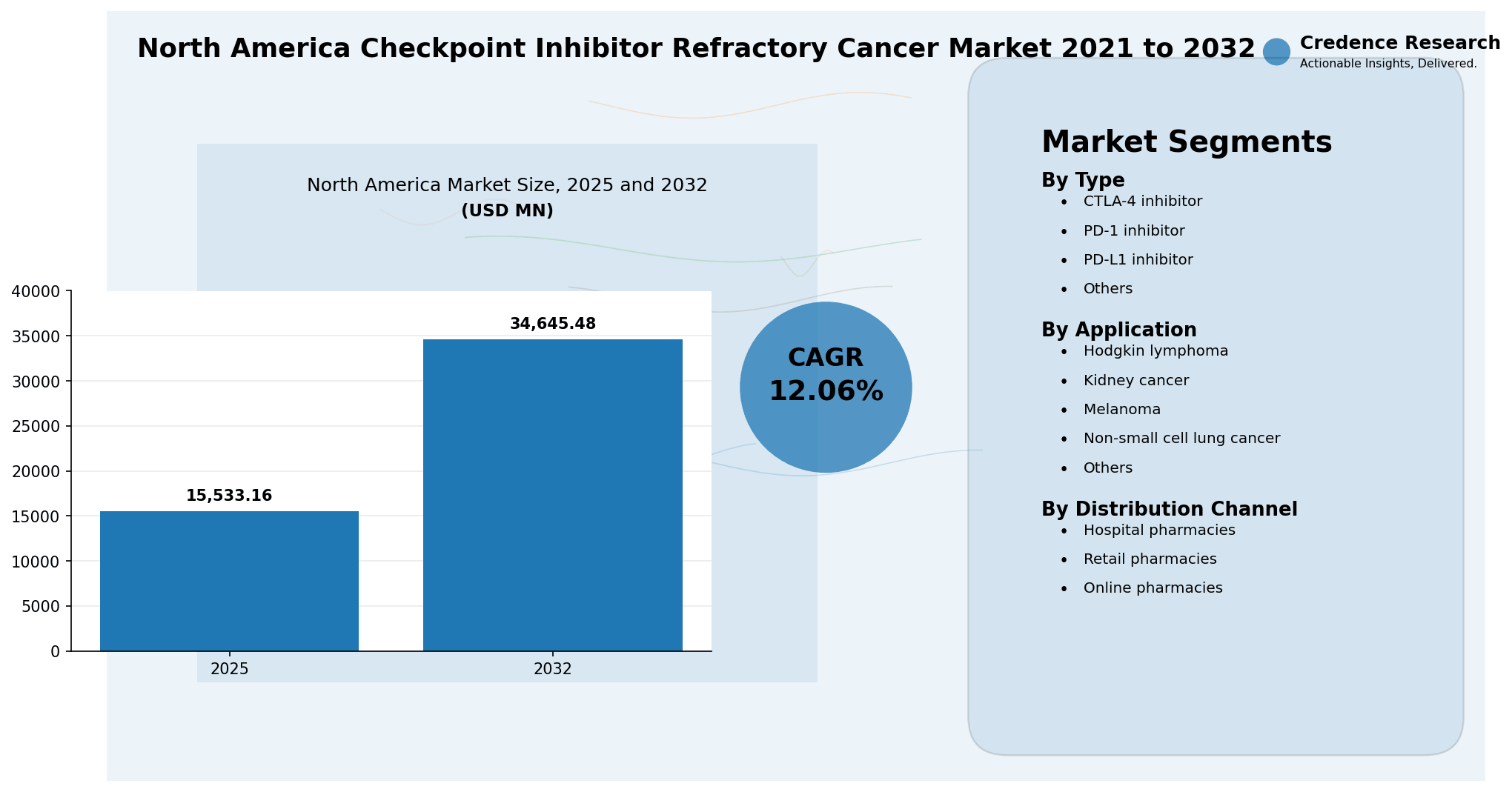
The North America Checkpoint Inhibitor Refractory Cancer Market size was valued at USD 7,532.84 MN in 2021 and reached USD 15,533.16 MN in 2025. It is anticipated to reach USD 34,645.48 MN by 2032, growing at a CAGR of 12.06% during the forecast period.
| REPORT ATTRIBUTE |
DETAILS |
| Historical Period |
2021-2024 |
| Base Year |
2025 |
| Forecast Period |
2025-2032 |
| North America Checkpoint Inhibitor Refractory Cancer Market Size 2025 |
USD 15,533.16 million |
| North America Checkpoint Inhibitor Refractory Cancer Market, CAGR |
12.06% |
| North America Checkpoint Inhibitor Refractory Cancer Market Size 2032 |
USD 34,645.48 million |
North America Checkpoint Inhibitor Refractory Cancer Market Insights
- Market growth is supported by rising use of immune checkpoint inhibitors, resistance after immunotherapy exposure, expansion of combination regimens, biomarker-led patient selection and demand for next-line oncology options.
- PD-1 Inhibitor holds a strong position because PD-1 therapies remain central to immuno-oncology treatment across Melanoma, Non-Small Cell Lung Cancer, Kidney Cancer, Hodgkin Lymphoma and other cancers.
- Non-Small Cell Lung Cancer remains a major application area because many patients receive immunotherapy-based regimens and require next-line strategies after checkpoint inhibitor resistance.
- Hospital Pharmacies remain the leading distribution channel because refractory cancer therapies require specialist prescribing, infusion support, reimbursement coordination and clinical monitoring.
Segment Insights
By type
By type, PD-1 Inhibitor held the strongest position in 2025 because PD-1-based therapy is widely used across major tumor types and remains central to immuno-oncology practice. PD-1 therapies are used alone and in combination with CTLA-4 inhibitors, chemotherapy, targeted agents and immune-modulating therapies. PD-L1 Inhibitor also holds a strong position because it supports treatment strategies across lung cancer, bladder cancer and other solid tumors where ligand blockade remains clinically relevant. CTLA-4 Inhibitor demand is supported by combination regimens, especially where immune priming and dual-checkpoint blockade are used. Others include emerging immune-modulating approaches, cellular therapies and post-checkpoint strategies designed for patients with primary or acquired resistance.
Access crucial information at unmatched prices!
Request your sample report today & start making informed decisions powered by Credence Research Inc.!
Download Sample
By application
By application, Non-Small Cell Lung Cancer held a strong position in 2025 because immunotherapy is widely used in advanced disease, first-line combinations and maintenance strategies. Many patients eventually experience progression, creating demand for post-checkpoint therapeutic options and combination approaches. Melanoma remains a key application because checkpoint inhibitors are central to metastatic and adjuvant treatment, but refractory disease continues to create a major unmet need. Kidney Cancer supports steady demand due to immune-oncology combinations and post-PD-1/PD-L1 treatment pathways. Hodgkin Lymphoma is also important because PD-1 blockade has strong clinical relevance in relapsed or refractory disease. Others include tumor types where immunotherapy resistance is becoming a growing treatment challenge.
By distribution channel
By distribution channel, Hospital Pharmacies held the strongest position in 2025 because many checkpoint inhibitor and refractory cancer therapies require infusion administration, specialist supervision and coordinated oncology care. Hospital-based dispensing supports immune-related adverse event management, regimen scheduling, cold-chain handling and payer documentation. Retail Pharmacies remain relevant for oral oncology drugs, supportive care therapies and targeted agents used after immunotherapy exposure. Online Pharmacies are gaining gradual traction through specialty medication fulfillment, refill management and patient support programs. However, high-value oncology therapies still require strong clinical oversight and reimbursement coordination. Distribution channel growth will favor integrated specialty pharmacy models connected to oncology providers and payers.
Key market drivers
Rising checkpoint inhibitor exposure and acquired resistance
Rising checkpoint inhibitor exposure and acquired resistance represent a major growth driver for the North America Checkpoint Inhibitor Refractory Cancer Market. Wider use of PD-1, PD-L1 and CTLA-4 therapies across Melanoma, Non-Small Cell Lung Cancer, Kidney Cancer, Hodgkin Lymphoma and other tumor types is increasing the number of patients who need subsequent treatment after disease progression. Primary resistance limits response in some patients, while acquired resistance can emerge after initial benefit. This creates demand for next-line immunotherapy combinations, immune-restoration strategies, targeted agents and novel mechanisms that can overcome resistance.
FDA approved belzutifan for advanced renal cell carcinoma after prior PD-1 or PD-L1 inhibitor therapy and VEGF-TKI exposure, confirming a defined treatment pathway for patients progressing after checkpoint-based therapy.
Expansion of combination immunotherapy strategies
Expansion of combination immunotherapy strategies supports market growth as companies and clinicians seek stronger responses in difficult-to-treat and refractory cancer settings. Dual-checkpoint blockade, PD-1/CTLA-4 combinations, immune agonists, targeted therapy combinations and chemotherapy-immunotherapy regimens are being evaluated to improve durability and overcome resistance. This trend supports demand for CTLA-4 Inhibitor, PD-1 Inhibitor, PD-L1 Inhibitor and other immune-modulating products.
FDA approved nivolumab with ipilimumab for unresectable or metastatic MSI-H or dMMR colorectal cancer in April 2025, while Bristol Myers Squibb stated the approval followed Breakthrough Therapy Designation and Priority Review, showing continued regulatory support for dual-checkpoint regimens.
Unmet need in refractory NSCLC and melanoma
Unmet need in refractory NSCLC and melanoma continues to strengthen market demand because these cancers have broad checkpoint inhibitor use and meaningful post-progression treatment gaps. Non-Small Cell Lung Cancer patients often receive immunotherapy-based first-line regimens, but progression creates demand for second-line and later-line approaches. Melanoma patients may require additional options after PD-1 exposure, CTLA-4 exposure or combination immunotherapy.
ImmunityBio reported Phase 2 QUILT-3.055 findings in 2025 showing ANKTIVA activity in checkpoint inhibitor-resistant advanced NSCLC and later reported in 2026 that ANKTIVA plus checkpoint inhibitor therapy demonstrated statistically significant immune restoration across two NSCLC trials involving 151 patients.
Shift toward specialty oncology distribution
Shift toward specialty oncology distribution supports market growth as refractory cancer treatment becomes more complex, expensive and clinically monitored. Hospital Pharmacies remain central for infused immunotherapies, dual-checkpoint combinations and therapies requiring toxicity management. Retail Pharmacies and Online Pharmacies are gaining relevance where oral targeted therapies or supportive care medicines are used after checkpoint exposure. Specialty pharmacy models also help coordinate prior authorization, patient assistance, adherence support and temperature-controlled delivery. This driver will remain important as oncology care becomes more personalized and treatment sequencing becomes more complex. Distribution success will depend on payer access, clinical education and provider-linked fulfillment networks.
Key Trends and Opportunities
Immune-restoration approaches gain attention
Immune-restoration approaches are becoming a major opportunity as drug developers look beyond conventional checkpoint blockade. Patients with checkpoint inhibitor resistance may need therapies that restore immune function, reverse immune exhaustion or enhance immune-cell activity. These approaches include cytokine-based therapies, innate immune activators, cellular therapies and combination regimens with existing checkpoint inhibitors. The opportunity is strongest in Non-Small Cell Lung Cancer, Melanoma and Kidney Cancer, where checkpoint inhibitor exposure is common. Companies that show clear clinical benefit after checkpoint progression can capture high-value market opportunities. Biomarker-defined patient selection will be important for adoption.
Subcutaneous checkpoint inhibitor formats expand access
Subcutaneous checkpoint inhibitor formats are expanding access by reducing infusion time and improving clinic workflow. These formats can help oncology centers manage patient volume, chair capacity and administration burden. They also support more convenient care delivery when used across established checkpoint inhibitor indications. FDA approved Merck’s Keytruda QLEX in September 2025 across most adult solid tumor indications for Keytruda, and Merck stated it can be administered by a health care provider in as little as one minute. This trend can strengthen checkpoint inhibitor utilization while supporting treatment continuity across complex oncology pathways.
Biomarker-guided refractory cancer management rises
Biomarker-guided refractory cancer management is rising as clinicians use PD-L1 expression, tumor mutational burden, mismatch repair status, genomic alterations and immune microenvironment markers to guide treatment selection. Biomarkers help identify patients who may benefit from dual-checkpoint blockade, targeted therapy, antibody-drug conjugates or immune-modulating approaches. This trend improves clinical decision-making in Non-Small Cell Lung Cancer, Kidney Cancer, Melanoma and other difficult-to-treat cancers. Diagnostic testing also supports payer confidence by linking treatment choice to measurable patient characteristics. Companies that pair therapies with validated diagnostics and real-world evidence will be better positioned. Biomarker-led treatment will remain central through 2032.
Key Market Challenges
Resistance biology and response variability
Resistance biology and response variability remain key challenges for the North America Checkpoint Inhibitor Refractory Cancer Market. Patients can fail checkpoint inhibitors through tumor-intrinsic resistance, immune exclusion, antigen presentation loss, T-cell exhaustion, microbiome effects and immunosuppressive tumor microenvironments. These mechanisms vary by cancer type, treatment history and patient biology. Response variability makes clinical development more difficult because trial populations can be heterogeneous. It also creates uncertainty for physicians selecting next-line therapy. Stronger biomarker strategies and better resistance mapping will be needed to improve outcomes.
High treatment cost and reimbursement scrutiny
High treatment cost and reimbursement scrutiny can limit market access. Checkpoint inhibitors, dual-immunotherapy regimens, targeted agents, cellular therapies and emerging immune-modulating drugs often carry high prices. Payers assess clinical benefit, survival improvement, biomarker definition and treatment duration before providing broad coverage. Prior authorization and documentation requirements can delay access for patients with advanced disease. Providers must also manage financial toxicity and patient support needs. Manufacturers that show durable benefit in refractory populations and provide strong health economic evidence will be better positioned.
Immune-related adverse event management
Immune-related adverse event management creates clinical and operational challenges. Checkpoint inhibitors and combination regimens can cause pneumonitis, colitis, hepatitis, endocrinopathies, nephritis, dermatologic toxicities and other immune-mediated reactions. Risk can rise when therapies are combined or used in heavily pretreated patients. Hospitals and oncology centers require trained teams, monitoring protocols and supportive care pathways. Toxicity concerns can affect treatment selection, dose timing and patient adherence. Companies must support clinician education and risk management to improve adoption.
Regional Analysis
United States
The United States leads the North America Checkpoint Inhibitor Refractory Cancer Market due to its large treated oncology population, broad immunotherapy use, strong cancer center network and rapid adoption of premium oncology therapies. The country has high demand across Non-Small Cell Lung Cancer, Melanoma, Kidney Cancer and Hodgkin Lymphoma because checkpoint inhibitors are already embedded in multiple treatment guidelines. Hospital Pharmacies remain the primary distribution channel due to infusion administration and clinical monitoring needs. Pharmaceutical companies prioritize the U.S. for launches, label expansions, trials and patient support programs. The United States is expected to remain the primary revenue contributor through 2032.
Canada
Canada represents a steady market supported by public cancer care systems, academic oncology centers, specialty pharmacy networks and adoption of immunotherapy across key tumor types. Demand is strongest for PD-1 Inhibitor and PD-L1 Inhibitor regimens used across lung cancer, melanoma, kidney cancer and lymphoma. Market access depends on health technology assessment, provincial reimbursement and clinical guideline adoption. Hospital Pharmacies play a central role in drug distribution and toxicity monitoring. Growth will depend on approval timelines, funding decisions, biomarker testing access and treatment sequencing policies.
Mexico
Mexico offers a smaller but gradually expanding market within North America. Demand is supported by improving oncology care access, private hospital networks and growing availability of immuno-oncology therapies. Hospital Pharmacies remain central because checkpoint inhibitor and refractory cancer treatments require specialist administration and payer coordination. Retail Pharmacies and Online Pharmacies support selected oral therapies and supportive care medicines. Affordability and reimbursement constraints remain important barriers, especially for high-cost combination regimens. Growth will depend on private health care expansion, access to diagnostics and availability of oncology specialists.
Report Attribute Details
| Report Attribute |
Details |
| Historical Period |
2021–2024 |
| Base Year |
2025 |
| Forecast Period |
2025–2032 |
| Market Size in 2021 |
USD 7,532.84 MN |
| Market Size in 2025 |
USD 15,533.16 MN |
| Market Size in 2032 |
USD 34,645.48 MN |
| CAGR |
12.06% |
| Segments Covered |
Type, Application, Distribution Channel and Geography |
| Key Companies Covered |
Bristol-Myers Squibb Company, Merck & Co., Inc., Regeneron Pharmaceuticals, Inc., Exelixis, Inc., AstraZeneca plc, GSK plc, F. Hoffmann-La Roche Ltd, Eisai Co., Ltd., ImmunityBio and ENB Therapeutics, Inc |
North America Checkpoint Inhibitor Refractory Cancer Market Segmentations
By Type
- CTLA-4 Inhibitor
- PD-1 Inhibitor
- PD-L1 Inhibitor
- Others
By Application
- Hodgkin Lymphoma
- Kidney Cancer
- Melanoma
- Non-Small Cell Lung Cancer
- Others
By Distribution Channel
- Hospital Pharmacies
- Retail Pharmacies
- Online Pharmacies
Key Players
- Bristol-Myers Squibb Company
- Merck & Co., Inc.
- Regeneron Pharmaceuticals, Inc.
- Exelixis, Inc.
- AstraZeneca plc
- GSK plc
- F. Hoffmann-La Roche Ltd
- Eisai Co., Ltd.
- ImmunityBio
- ENB Therapeutics, Inc
Shape Your Report to Specific Countries or Regions & Enjoy 30% Off!
Recent Developments
- In March 2026, FDA approved nivolumab with doxorubicin, vinblastine and dacarbazine for previously untreated Stage III or IV classical Hodgkin Lymphoma and granted traditional approval to nivolumab for relapsed or refractory classical Hodgkin Lymphoma indications in adults.
- In September 2025, FDA approved Merck’s Keytruda QLEX, a subcutaneous pembrolizumab formulation, across most adult solid tumor indications for Keytruda.
- In September 2025, ImmunityBio reported Phase 2 QUILT-3.055 findings for ANKTIVA in checkpoint inhibitor-resistant advanced Non-Small Cell Lung Cancer.
- In April 2025, FDA approved Bristol Myers Squibb’s nivolumab with ipilimumab for unresectable or metastatic MSI-H or dMMR colorectal cancer.
Report Coverage
The research report offers an in-depth analysis based on type, application, distribution channel and geography. It details leading market players, providing an overview of their business positioning, immuno-oncology portfolios, pipeline relevance, commercialization strategies and strategic role in the North America Checkpoint Inhibitor Refractory Cancer Market. The report includes insights into the competitive environment, market trends, growth drivers, restraints and opportunities. It also examines checkpoint inhibitor exposure, acquired resistance, combination immunotherapy, immune-restoration strategies, biomarker-guided treatment and specialty oncology distribution as major factors shaping market development. The report assesses the impact of resistance biology, reimbursement scrutiny, immune-related adverse events and treatment sequencing complexity on market growth. It provides strategic recommendations for pharmaceutical companies, hospital systems, specialty pharmacies, payers, distributors, investors and new entrants seeking to navigate North America’s refractory immuno-oncology market.
Future Outlook
- Demand for checkpoint inhibitor refractory cancer therapies will continue to rise as PD-1, PD-L1 and CTLA-4 therapies expand across cancer treatment pathways.
- PD-1 Inhibitor will remain a major type segment because PD-1 therapies are central to immuno-oncology use across multiple tumor types.
- PD-L1 Inhibitor will remain important in lung cancer, bladder cancer and selected solid tumor settings.
- CTLA-4 Inhibitor will gain value through dual-checkpoint and combination regimens where deeper immune activation is required.
- Non-Small Cell Lung Cancer will remain a leading application due to broad checkpoint inhibitor use and significant post-progression treatment needs.
- Melanoma and Kidney Cancer will continue to support high-value demand because immunotherapy sequencing is well established in these cancers.
- Hospital Pharmacies will remain the leading distribution channel due to infusion requirements, toxicity monitoring and reimbursement coordination.
- Retail Pharmacies and Online Pharmacies will gain relevance where oral targeted agents and supportive care drugs are used after checkpoint therapy.
- Biomarker-guided treatment selection will become more important as companies seek better response prediction in refractory settings.
- Competition will increase as leading companies compete on survival benefit, immune-restoration mechanisms, combination strategies, safety profiles, dosing convenience and payer access.



