Market Overview
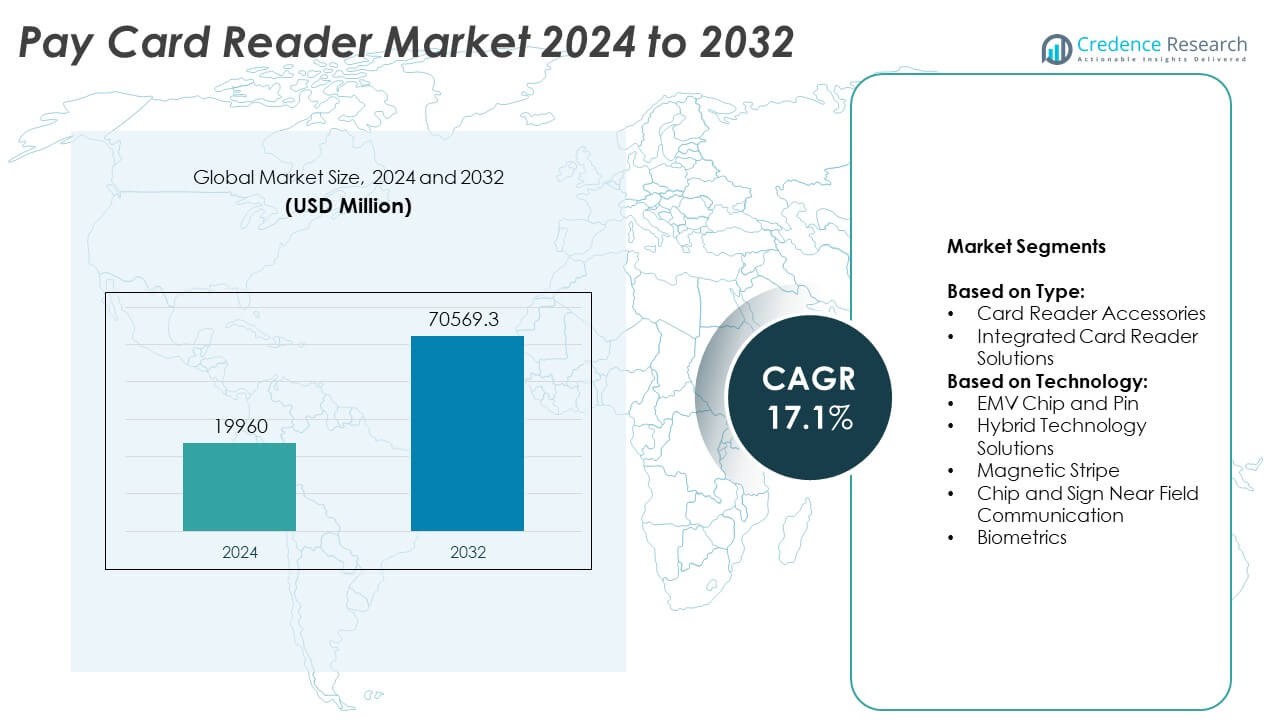
The Pay Card Reader Market size was valued at USD 19,960 million in 2024 and is anticipated to reach USD 70,569.3 million by 2032, at a CAGR of 17.1% during the forecast period.
| REPORT ATTRIBUTE |
DETAILS |
| Historical Period |
2020-2024 |
| Base Year |
2024 |
| Forecast Period |
2025-2032 |
| Pay Card Reader Market Size 2024 |
USD 19,960 Million |
| Pay Card Reader Market, CAGR |
17.1% |
| Pay Card Reader Market Size 2032 |
USD 70,569.3 Million |
The Pay Card Reader market grows on the strength of rising demand for contactless payments, mobile wallet integration, and increased digital transactions across retail and service sectors. Businesses seek secure, fast, and user-friendly payment methods that reduce reliance on cash and support mobility. Trends show a shift toward integrated POS systems, app-based readers, and wireless devices that combine payment acceptance with inventory and analytics tools. Biometric authentication and AI-driven fraud detection further enhance product appeal.
The Pay Card Reader market exhibits strong adoption across North America, Europe, and Asia Pacific, driven by digital infrastructure, regulatory mandates, and rising demand for mobile payment solutions. North America leads with widespread use of contactless and EMV-compliant systems, while Europe emphasizes secure, multi-currency readers. Asia Pacific shows rapid growth supported by financial inclusion efforts and mobile-first transactions. Latin America and the Middle East & Africa are gradually expanding with fintech-driven solutions in urban and semi-urban regions. Key players operating in this space include Square Inc., PayPal Inc., Intuit Inc., and First Data Corporation, each offering differentiated solutions tailored to regional needs.
Access crucial information at unmatched prices!
Request your sample report today & start making informed decisions powered by Credence Research Inc.!
Download Sample
Market Insights
- The Pay Card Reader market was valued at USD 19,960 million in 2024 and is expected to reach USD 70,569.3 million by 2032, growing at a CAGR of 17.1% during the forecast period.
- Increasing demand for contactless payments, mobile wallet integration, and digitization among small businesses continues to fuel market expansion.
- Biometric-enabled card readers, hybrid technology integration, and app-based wireless devices are shaping future product development and consumer preferences.
- Key players compete on platform integration, software-driven ecosystems, and secure multi-payment capabilities tailored to both SMEs and large enterprises.
- Market growth faces restraints such as inconsistent internet infrastructure, power supply limitations, and regulatory compliance costs in developing regions.
- North America leads the market with high adoption of digital POS systems, while Europe follows with strong demand for secure, multi-currency card readers; Asia Pacific shows high growth potential driven by financial inclusion programs.
- The market continues to evolve with a focus on mobile-first experiences, real-time analytics, offline functionality, and expansion into underbanked regions through fintech collaboration.
Market Drivers
Expansion of Contactless Payments and Mobile Wallet Integration
The widespread adoption of contactless payments continues to drive demand for modern card reader systems. Consumers and businesses prefer fast, secure, and hygienic payment methods that reduce reliance on physical cash. Integration with mobile wallets such as Apple Pay, Google Pay, and Samsung Pay strengthens the shift toward tap-and-go transactions. Financial institutions and merchants upgrade infrastructure to meet rising contactless transaction volumes. The Pay Card Reader market benefits from this momentum by offering NFC-enabled devices compatible with smartphones and smartwatches. It supports enhanced transaction speeds while maintaining regulatory compliance and security standards.
- For instance, SumUp sold over 1.5 million mobile card readers in Europe and Latin America, supporting small business adoption through app-based payments and real-time reporting tools.
Growth of Small and Medium Enterprises Across Emerging Markets
Small and medium-sized enterprises (SMEs) contribute significantly to the growth of electronic payment infrastructure. These businesses seek compact, affordable, and easy-to-use point-of-sale solutions to meet rising consumer expectations. Portable card readers with Bluetooth or USB interfaces offer flexibility in retail, hospitality, and field service sectors. Companies such as Square and SumUp provide tailored devices with integrated software and analytics tools. The Pay Card Reader market aligns with SME digitization trends, meeting the demand for mobile-first and app-driven solutions. It enables micro-merchants and startups to accept payments seamlessly across diverse business settings.
- For instance, Ingenico holds around 25% of the payment terminal installed base in the U.S., reflecting strong presence of contactless-capable devices in retail environments
Government Mandates and Financial Inclusion Initiatives
Governments implement policies to reduce cash dependency and promote digital financial services. Regulatory frameworks in regions such as India, Brazil, and Southeast Asia encourage deployment of card-based payment infrastructure among underserved populations. Subsidies, tax incentives, and mandatory electronic payment acceptance further support this transition. The Pay Card Reader market responds with scalable, low-cost devices suitable for rural banking agents and last-mile merchants. It plays a key role in expanding access to digital payment networks and increasing transaction transparency across national economies.
Technological Advancements in Security and Multi-Functionality
Innovation in card reader technology continues to enhance functionality and reduce fraud risks. Biometric authentication, end-to-end encryption, and dynamic PIN verification ensure high security during transactions. Card readers now support multiple payment modes including EMV chip, magnetic stripe, QR code, and NFC in a single device. Companies such as Verifone and Ingenico invest in AI-driven firmware to detect anomalies and prevent breaches. The Pay Card Reader market evolves to support faster firmware updates, cloud integration, and hardware durability. It strengthens market adoption by addressing both merchant and consumer security expectations.
Market Trends
Rising Adoption of Integrated Point-of-Sale (POS) Ecosystems
Businesses increasingly prefer all-in-one POS systems that consolidate payments, inventory management, and analytics into a single interface. Integrated card readers offer streamlined operations for merchants seeking efficiency and scalability. Cloud-based POS platforms support real-time transaction data and remote management capabilities. Companies such as Clover and Toast embed card readers directly into their systems, reducing the need for external hardware. The Pay Card Reader market reflects this trend by focusing on compatibility with retail management software and mobile POS solutions. It supports seamless integration with backend platforms across industries.
- For instance, PayNearby facilitated an impressive 33% increase in UPI transactions at semi‑urban and rural retail outlets in 2024, indicating expanding digital acceptance. The data is based on PayNearby’s analysis of over 10,00,000 small retailers offering financial and digital services across rural and semi-urban India.
Transition Toward Wireless and App-Based Card Reader Devices
Demand is rising for portable, wireless card readers that offer ease of mobility and lower installation costs. Bluetooth and Wi-Fi-enabled devices eliminate the need for fixed infrastructure, supporting merchants in dynamic environments such as delivery, outdoor sales, and food trucks. App-based card readers pair with smartphones or tablets, allowing users to accept payments without bulky hardware. Square, PayPal Zettle, and SumUp lead this shift by offering sleek, user-friendly readers that operate across mobile operating systems. The Pay Card Reader market follows this transition by developing compact, battery-efficient devices compatible with multiple devices and applications.
- For instance, Square introduced its Square Handheld device, a compact, 11‑ounce POS unit featuring an all-day battery and integrated barcode scanner that fits into a pocket—enabling sales anywhere in a store or restaurant
Emphasis on Biometric and AI-Powered Authentication Technologies
Security remains a priority for card reader manufacturers and end users. Trends show growing implementation of biometric verification, including fingerprint scanning and facial recognition, within payment authentication processes. AI algorithms support fraud detection by analyzing behavioral patterns and transaction anomalies in real time. Leading providers incorporate secure elements and machine learning modules to combat spoofing and data breaches. The Pay Card Reader market adapts by embedding these features in its high-end devices. It promotes user confidence and meets the evolving standards of secure digital commerce.
Expansion of QR Code and Token-Based Contactless Payments
QR code scanning and tokenization methods gain traction across developing and developed regions. Merchants embrace these formats due to ease of setup, low cost, and wide customer acceptance. Contactless cards and digital wallets increasingly support tokenized credentials for secure, one-time-use transactions. Companies like Alipay and PhonePe standardize QR code interfaces for interoperability across merchant platforms. The Pay Card Reader market incorporates QR scanning modules and NFC upgrades in response to this shift. It helps businesses support frictionless checkout experiences while minimizing risk exposure.
Market Challenges Analysis
High Dependency on Stable Network Connectivity and Power Infrastructure
Pay card readers rely heavily on consistent internet connectivity and reliable power supply to operate efficiently. In regions with limited network infrastructure or frequent outages, merchants face transaction delays and payment failures. This disrupts business operations and lowers customer trust in digital payment modes. Offline functionality remains limited in many low-cost models, restricting adoption in rural or underserved areas. Companies must invest in devices with offline data caching, battery backup, and dual-SIM capabilities to mitigate this barrier. The Pay Card Reader market experiences adoption constraints where technological readiness remains uneven across geographies.
Security Compliance and Regulatory Complexity Across Jurisdictions
Data privacy and payment security regulations differ significantly across countries and regions. Card reader manufacturers must adhere to stringent compliance standards such as PCI DSS, EMVCo, and GDPR. Ensuring device-level encryption, secure firmware updates, and cross-border certification requires significant investment. Smaller vendors struggle to maintain compliance in multi-region deployments due to rising costs and technical challenges. The Pay Card Reader market faces operational friction when integrating with financial networks governed by disparate regulatory bodies. It must evolve with scalable security frameworks to meet dynamic compliance landscapes.
Market Opportunities
Untapped Growth Potential in Emerging Economies and Micro-Merchant Segments
Emerging economies present a strong opportunity for expanding digital payment infrastructure. Governments and financial institutions promote card-based transactions through subsidy programs and fintech partnerships. Micro-merchants and informal retailers increasingly adopt mobile card readers to accept payments from a wider customer base. Low-cost, app-enabled devices tailored for local languages and currencies support penetration in remote and semi-urban areas. The Pay Card Reader market can scale its presence by aligning with national financial inclusion initiatives and localized distribution networks. It offers access to large, previously unbanked populations seeking convenient and secure transaction options.
Advancements in Value-Added Services and Data Analytics Integration
Merchants seek tools that extend beyond payment acceptance to include features like invoicing, customer management, and sales reporting. Integrating value-added services into card reader platforms creates differentiation and increases customer retention. Real-time data analytics supports inventory tracking, purchase trends, and business performance insights. Companies like Square and Clover embed these tools into their card reader ecosystems, offering subscription-based revenue models. The Pay Card Reader market benefits from bundling financial software with hardware solutions. It enables service providers to address broader business needs while capturing recurring revenue streams.
Market Segmentation Analysis:
By Type:
The market includes Card Reader Accessories and Integrated Card Reader Solutions. Integrated card reader solutions lead adoption due to their seamless hardware-software interface, compact design, and simplified installation process. These systems appeal to retailers and service providers seeking streamlined transactions, customer management, and inventory control. Manufacturers integrate multi-functionality into a single device, reducing the need for separate peripheral equipment. Card reader accessories, such as PIN pads, printer attachments, and stands, support extended functionality but remain dependent on core reader systems. The Pay Card Reader market reflects greater traction for integrated solutions among SMEs and mobility-focused businesses.
- For instance, Clover has deployed over 800,000 merchant devices worldwide, highlighting the substantial reach and adoption of integrated POS solutions across industries.
By Technology:
The EMV Chip and Pin segment holds a dominant share, driven by global mandates to reduce card-present fraud. These readers support dynamic authentication and meet international compliance standards, making them a preferred option in banking and retail. Hybrid Technology Solutions, which combine EMV, NFC, and magnetic stripe capabilities, address the need for flexible payment acceptance across diverse markets. This segment sees strong demand among merchants operating in regions with mixed payment infrastructure maturity. Magnetic Stripe readers remain in use due to legacy systems, particularly in North America and Latin America, but face gradual phase-out due to security vulnerabilities.Chip and Sign Near Field Communication (NFC) readers gain adoption in contactless environments such as quick-service restaurants, transit, and event ticketing. Their low-friction user experience supports faster transaction flow and reduced checkout times. Biometric card readers represent an emerging segment with growing relevance in sectors requiring high security, such as healthcare, government, and financial services. These devices use fingerprint or facial recognition to enhance identity verification and reduce PIN-related fraud. The Pay Card Reader market sees opportunities across segments driven by regulatory needs, user convenience, and demand for secure multi-modal authentication technologies.
- For instance, Toast strengthens its presence in quick-service restaurants by serving approximately 120,000 U.S. restaurants, underlying the widespread adoption of mobile and handheld POS solutions like the Toast Go 2 handheld unit.
Segments:
Based on Type:
- Card Reader Accessories
- Integrated Card Reader Solutions
Based on Technology:
- EMV Chip and Pin
- Hybrid Technology Solutions
- Magnetic Stripe
- Chip and Sign Near Field Communication
- Biometrics
Based on the Geography:
- North America
- Europe
- UK
- France
- Germany
- Italy
- Spain
- Russia
- Belgium
- Netherlands
- Austria
- Sweden
- Poland
- Denmark
- Switzerland
- Rest of Europe
- Asia Pacific
- China
- Japan
- South Korea
- India
- Australia
- Thailand
- Indonesia
- Vietnam
- Malaysia
- Philippines
- Taiwan
- Rest of Asia Pacific
- Latin America
- Brazil
- Argentina
- Peru
- Chile
- Colombia
- Rest of Latin America
- Middle East
- UAE
- KSA
- Israel
- Turkey
- Iran
- Rest of Middle East
- Africa
- Egypt
- Nigeria
- Algeria
- Morocco
- Rest of Africa
Regional Analysis
North America
North America holds the largest share of the Pay Card Reader market, accounting for 34.2% of the global revenue. The region benefits from a highly digitized retail environment and widespread adoption of EMV-compliant and contactless card reader technologies. Regulatory mandates such as PCI DSS and EMV liability shifts have accelerated POS infrastructure upgrades across the United States and Canada. Major players such as Square, Verifone, and Clover drive growth by providing compact, wireless card readers suited to both large enterprises and small merchants. The strong penetration of mobile wallets and support for digital-first transactions fuel further expansion. The region also witnesses a shift toward integrated payment ecosystems that combine hardware, software, and analytics in a unified solution.
Europe
Europe ranks second with a market share of 28.7%, driven by stringent financial regulations, high card penetration, and advanced contactless infrastructure. Countries such as the United Kingdom, Germany, France, and the Netherlands lead in adopting secure card reader technologies, including biometric verification and hybrid systems. The region’s high adoption of NFC-enabled cards and mobile payment applications supports continued investment in smart POS systems. Vendors in Europe focus on offering modular card readers with enhanced security and multi-currency support to cater to cross-border transactions. SMEs and fintech startups accelerate regional growth by adopting cost-effective mobile reader solutions integrated with customer management tools. The Pay Card Reader market in Europe emphasizes compliance, security, and cross-platform compatibility.
Asia Pacific
Asia Pacific holds a market share of 21.5%, characterized by rapid digital transformation and rising adoption of mobile payments in countries such as China, India, Japan, and South Korea. Government-backed initiatives supporting financial inclusion and reduced cash dependency boost the installation of low-cost, app-based card readers. Chinese providers like Alipay and UnionPay and Indian fintechs such as PhonePe and Paytm push QR-based contactless payment ecosystems that coexist with EMV-enabled card readers. The market shows strong potential for hybrid and biometric solutions in urban centers and dense retail environments. Growing e-commerce transactions and digital wallet integration strengthen demand across merchant categories. The Pay Card Reader market in Asia Pacific is dynamic, cost-sensitive, and increasingly mobile-first.
Latin America
Latin America contributes 9.3% of the global market, with growth driven by expanding mobile payment adoption in Brazil, Mexico, and Argentina. Regulatory efforts to formalize micro-merchant transactions support the distribution of app-connected card readers and wireless POS terminals. Local startups and fintech firms deliver tailored payment solutions compatible with regional banking standards. The need for lightweight and portable card readers supports usage across informal retail, street vendors, and delivery segments. Despite infrastructure limitations in rural zones, urban deployment remains robust. The Pay Card Reader market in Latin America is expanding due to government policies encouraging digital financial inclusion and improved merchant accessibility.
Middle East & Africa
The Middle East & Africa holds the smallest market share at 6.3%, reflecting early-stage adoption and limited digital infrastructure across several countries. However, rising smartphone penetration and policy-driven financial digitization offer promising growth potential. Gulf Cooperation Council (GCC) countries invest in smart city initiatives and digital retail ecosystems, creating demand for advanced card reader systems. South Africa and Kenya show traction in mobile-based POS devices supported by fintech collaborations. The Pay Card Reader market in the region gradually expands as secure, scalable, and low-cost technologies reach underserved merchant networks and improve transaction transparency.
Shape Your Report to Specific Countries or Regions & Enjoy 30% Off!
Key Player Analysis
- Mahindra Comviva (India)
- PayPal Inc. (US)
- CPI Card Group Inc. (US)
- Gemalto NV (Netherlands)
- First Data Corporation (US)
- Infineon Technologies AG (Germany)
- Payanywhere LLC (US)
- Square Inc. (US)
- Intuit Inc. (US)
Competitive Analysis
Square Inc., PayPal Inc., Intuit Inc., Payanywhere LLC, First Data Corporation, CPI Card Group Inc., Infineon Technologies AG, Gemalto NV, Mahindra Comviva Leading players in the Pay Card Reader market compete by leveraging product innovation, platform integration, and targeted customer strategies. Square focuses on delivering an all-in-one POS ecosystem that integrates payments, inventory, and analytics, making it attractive to small businesses seeking ease of use and low upfront costs. PayPal capitalizes on its vast global user base and wallet infrastructure, positioning its card readers as extensions of its digital ecosystem for both online and offline transactions. Intuit builds competitive strength through its QuickBooks integration, offering card readers that seamlessly link with accounting and financial tools to simplify operations for small enterprises. First Data and CPI Card Group maintain strongholds in traditional retail and banking channels, emphasizing reliability and wide-scale deployment. Infineon Technologies and Gemalto play crucial roles in hardware-level security by providing chipsets and modules that enable EMV, NFC, and biometric authentication features. Mahindra Comviva competes by catering to emerging markets with regionally tailored mobile payment solutions that support financial inclusion and micro-merchant adoption. Competitive intensity remains high as firms enhance device compatibility, prioritize mobile-first experiences, and address rising demand for contactless, secure, and data-enabled transactions. Players differentiate themselves through ecosystem depth, technical reliability, and geographic focus.
Recent Developments
- In May 2025, Square launched the Square Handheld, a sleek, phone-like POS device priced at $399. It combines a built-in card reader, barcode scanner, 16 MP camera, inventory management, and tap-to-pay functionality. This notable innovation targets seamless mobility and enhanced checkout experiences for merchants.
- In 2025, Square announced plans to integrate Bitcoin payments via the Lightning Network, targeting 2026 for rollout, with early trials at the 2025 Bitcoin Conference.
- In April 2024, according to Shopify, 72% of consumers rely on in-store shopping. Therefore, they have introduced the POS Terminal Countertop Kit which aims at streamlined checkout experiences, and POS GO which offers flexibility on the sales floor.
- In May 2024, NMI launched the ID TECH VP3350 mobile card reader. This device connects directly to smartphones and tablets, enabling quick, seamless, and cost-effective mobile payment acceptance. Small and medium-sized businesses were previously limited to cash transactions but now accept credit cards with this user-friendly device.
- In January 2024, ACS, a prominent player in smart card technology worldwide revealed two innovative products the ACR40U Standard Contact Smart Card Reader and the ACR40U Premium Contact Smart Card Reader. These gadgets are designed to provide security and ease of use across various applications, ranging from financial services to secure identification.
Market Concentration & Characteristics
The Pay Card Reader market demonstrates moderate to high concentration, with a mix of global technology firms and regional fintech providers shaping competitive dynamics. Leading players hold significant market share through integrated hardware-software ecosystems, strong brand recognition, and wide merchant adoption. The market favors companies with end-to-end payment capabilities, mobile-first platforms, and secure EMV and NFC-enabled technologies. It shows characteristics of rapid innovation cycles, where device compactness, multi-functionality, and app integration play critical roles in product differentiation. Demand is largely driven by the shift toward contactless payments, growing mobile commerce, and digital financial inclusion initiatives in developing regions. The Pay Card Reader market operates within strict regulatory frameworks, requiring consistent compliance with security standards such as PCI DSS and EMVCo. It attracts both large-scale enterprises and micro-merchants, reflecting a wide user base with varying infrastructure needs. Barriers to entry remain moderate due to hardware development costs, certification requirements, and platform compatibility demands, which reinforce the position of established vendors.
Report Coverage
The research report offers an in-depth analysis based on Type, Technology and Geography. It details leading market players, providing an overview of their business, product offerings, investments, revenue streams, and key applications. Additionally, the report includes insights into the competitive environment, SWOT analysis, current market trends, as well as the primary drivers and constraints. Furthermore, it discusses various factors that have driven market expansion in recent years. The report also explores market dynamics, regulatory scenarios, and technological advancements that are shaping the industry. It assesses the impact of external factors and global economic changes on market growth. Lastly, it provides strategic recommendations for new entrants and established companies to navigate the complexities of the market.
Future Outlook
- The market will continue to grow with increased demand for contactless and mobile-based payment solutions.
- Integrated POS systems with card reader functionality will see higher adoption across small and medium businesses.
- Biometric-enabled card readers will gain traction due to rising concerns over transaction security.
- Cloud-based and app-driven reader solutions will expand, supporting remote updates and analytics.
- Emerging markets will drive growth through financial inclusion initiatives and digital infrastructure expansion.
- Players will focus on developing multi-functional devices compatible with various payment modes.
- Regulatory compliance and data security standards will shape product design and certification processes.
- Strategic partnerships between fintech firms and banks will enhance distribution and service offerings.
- Offline-capable card readers will become essential in regions with limited connectivity.
- Demand for compact, wireless, and user-friendly card readers will continue to influence product innovation.



