
| REPORT ATTRIBUTE | DETAILS |
|---|---|
| Historical Period | 2019-2022 |
| Base Year | 2023 |
| Forecast Period | 2024-2032 |
| Phosphate Conversion Coatings Market Size 2024 | USD 1878.6 million |
| Phosphate Conversion Coatings Market, CAGR | 4.5% |
| Phosphate Conversion Coatings Market Size 2032 | USD 2671.55 million |
Market Overview:
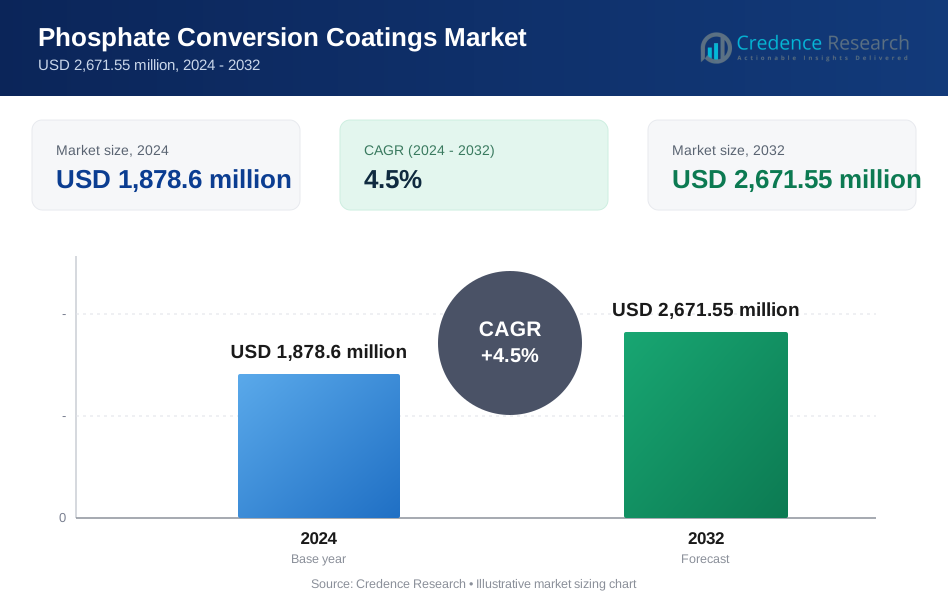
The Phosphate Conversion Coatings Market is projected to grow from USD 1878.6 million in 2024 to an estimated USD 2671.55 million by 2032, with a compound annual growth rate (CAGR) of 4.5% from 2024 to 2032.
Several factors are driving the phosphate conversion coatings market, including the increasing adoption of phosphate coatings for their ability to enhance the durability and performance of metal surfaces. These coatings provide excellent corrosion resistance and adhesion properties, making them ideal for use in harsh environments. The rising demand for energy-efficient and sustainable solutions in industries also supports the growth of phosphate conversion coatings. Additionally, the technological advancements in coating formulations, which are focused on improving environmental sustainability, are expected to further propel market expansion.
Regionally, the phosphate conversion coatings market is experiencing strong growth in North America, Europe, and the Asia Pacific. North America holds a significant share of the market due to the established automotive and aerospace industries, which utilize phosphate coatings extensively. Europe is also witnessing notable growth driven by stringent environmental regulations that promote the use of eco-friendly and energy-efficient coatings. The Asia Pacific region, particularly China and India, is anticipated to exhibit the highest growth rates due to rapid industrialization, expanding manufacturing sectors, and increasing infrastructure development.
Market Drivers:
Increasing Demand for Corrosion Protection:
One of the primary drivers of the phosphate conversion coatings market is the rising demand for corrosion-resistant solutions across various industries. For instance, BASF provides excellent protection against rust and corrosion, especially in industries like automotive, aerospace, and construction. Phosphate coatings provide excellent protection against rust and corrosion, especially in industries like automotive, aerospace, and construction. The ability of these coatings to protect metal surfaces in harsh environments contributes significantly to their adoption. As industrialization accelerates, the need for durable and long-lasting materials becomes more critical, further boosting the market for phosphate conversion coatings.
Growth in Automotive and Aerospace Sectors:
The automotive and aerospace sectors are major consumers of phosphate conversion coatings, driving market growth. For instance, PPG Industries applies these coatings to components such as chassis, engine parts, and suspension systems to enhance durability and performance. In automotive manufacturing, these coatings are applied to components such as chassis, engine parts, and suspension systems to enhance durability and performance. In aerospace, the demand for phosphate coatings is driven by their effectiveness in preventing corrosion in critical components exposed to extreme conditions. As both sectors continue to expand globally, the market for phosphate conversion coatings is expected to see consistent demand.
Technological Advancements in Coating Solutions:
Technological innovations in phosphate conversion coatings are another key factor supporting market growth. For instance, AkzoNobel has introduced advances in formulation and application techniques, making these coatings more efficient, durable, and environmentally friendly. Advances in formulation and application techniques are making these coatings more efficient, durable, and environmentally friendly. Manufacturers are now focusing on reducing the environmental impact of phosphate coatings by developing low-phosphorus and chromium-free alternatives. These innovations not only enhance the performance of the coatings but also meet the increasing regulatory requirements related to environmental sustainability, thus fueling market growth.
Regulatory Pressure and Environmental Concerns:
Increasing environmental regulations are driving the demand for eco-friendly coating solutions. For instance, the Environmental Protection Agency (EPA) recognizes phosphate conversion coatings as a more sustainable alternative to traditional methods by reducing the need for harmful chemicals like chromium. Phosphate conversion coatings offer a more sustainable alternative to traditional methods by reducing the need for harmful chemicals like chromium. As governments worldwide impose stricter regulations on industrial processes and products, businesses are turning to phosphate coatings to ensure compliance. This regulatory push towards more environmentally responsible coatings further accelerates market growth.
Market Trends:
Shift Toward Eco-Friendly Coatings:
A significant trend in the phosphate conversion coatings market is the increasing shift toward eco-friendly and sustainable coating solutions. As industries face mounting pressure to reduce their environmental impact, the demand for phosphate coatings that are free from harmful chemicals like chromium and low in phosphates is rising. For instance, companies like Henkel and Chemetall are developing alternative formulations that not only help manufacturers comply with stricter environmental regulations but also contribute to greener, more sustainable production processes. These alternative formulations not only help manufacturers comply with stricter environmental regulations but also contribute to greener, more sustainable production processes. This trend is pushing companies to innovate and adopt environmentally friendly solutions while maintaining the performance standards of traditional coatings.
Growing Adoption in the Automotive Industry:
The automotive industry continues to be a major driver of phosphate conversion coatings, with an increasing focus on light weighting, durability, and fuel efficiency. Phosphate coatings are applied to various components such as body parts, suspension systems, and exhaust systems to improve corrosion resistance and reduce maintenance costs. For instance, major automotive manufacturers like Ford and General Motors are exploring phosphate coatings to enhance the longevity and sustainability of EV components. With the rising demand for electric vehicles (EVs), the automotive industry is also exploring phosphate coatings to enhance the longevity and sustainability of EV components. This growing adoption of advanced coatings is expected to drive the market forward, as manufacturers seek reliable and durable solutions to meet evolving consumer demands.
Technological Advancements in Coating Processes:
Technological innovations in coating application methods are another key trend shaping the phosphate conversion coatings market. Automation and the development of advanced equipment are helping to improve the efficiency, consistency, and quality of coatings. For instance, companies like Nordson and Gema have developed innovations in spray technologies, such as electrostatic spraying and powder coatings, that have enhanced the application process, reducing waste and improving the final product’s performance. Additionally, innovations in spray technologies, such as electrostatic spraying and powder coatings, have enhanced the application process, reducing waste and improving the final product’s performance. These technological advancements are enabling manufacturers to offer more precise and cost-effective coating solutions to their clients.
Expansion in Emerging Markets:
The phosphate conversion coatings market is experiencing significant growth in emerging economies, particularly in Asia-Pacific. Rapid industrialization, increased manufacturing activities, and growing infrastructure projects in countries like China, India, and Southeast Asia are driving the demand for these coatings. For instance, market players like Nippon Paint and Kansai Paint are capitalizing on the growing need for robust corrosion protection in these regions. As the need for robust corrosion protection intensifies in these regions, the market for phosphate conversion coatings is poised for substantial expansion, presenting lucrative opportunities for global players to capitalize on this trend.
Market Challenges Analysis:
Environmental and Regulatory Challenges:
One of the key challenges facing the phosphate conversion coatings market is the growing pressure to comply with stringent environmental regulations. As governments worldwide impose stricter environmental standards to limit the use of hazardous chemicals, particularly in the coating industry, manufacturers are required to reformulate their products. While alternatives to traditional phosphate coatings, such as low-phosphorus or chromium-free solutions, are available, these formulations often come with higher costs and may not always provide the same performance levels as conventional coatings. This regulatory pressure demands ongoing investment in research and development to create compliant, high-performance alternatives.
Raw Material Price Fluctuations:
Another significant challenge in the phosphate conversion coatings market is the volatility in raw material prices. The primary components of phosphate coatings—phosphoric acid and other chemical agents—are subject to price fluctuations, which can affect overall production costs. These fluctuations are often driven by geopolitical factors, supply chain disruptions, and changes in global demand. Manufacturers are under constant pressure to maintain profit margins while coping with rising raw material costs, which can hinder market growth, particularly for smaller players with limited resources.
Performance Variability and Quality Control:
The variability in the performance and quality of phosphate coatings can present challenges for manufacturers. Achieving consistent coating thickness, adhesion, and corrosion resistance is critical, especially for high-performance applications in industries such as aerospace and automotive. Differences in environmental conditions, application methods, and the base metal being coated can affect the final quality of the coating. As a result, manufacturers must implement rigorous quality control measures and invest in advanced coating technologies to ensure that the coatings meet industry standards and customer expectations.
Competitive Pressure and Market Fragmentation:
The phosphate conversion coatings market is highly competitive, with numerous players offering similar products. This market fragmentation presents challenges for companies seeking to differentiate themselves. Smaller manufacturers may struggle to compete with larger companies that benefit from economies of scale and more extensive distribution networks. To stay competitive, businesses must focus on continuous innovation, product differentiation, and expanding their customer base through strategic partnerships and collaborations.
Market Segmentation Analysis:
By Product Type
The phosphate conversion coatings market is primarily segmented by product type into zinc phosphate, iron phosphate, manganese phosphate, and others. Zinc phosphate coatings dominate the market due to their excellent corrosion resistance, adhesion properties, and cost-effectiveness, making them widely used in automotive, aerospace, and industrial applications. Iron phosphate coatings are gaining traction due to their environmental benefits and ability to improve the surface properties of metals. Manganese phosphate coatings, though less common, are used in high-performance applications where enhanced wear resistance and lubrication properties are required.
By Substrate
In terms of substrate, the phosphate conversion coatings market is segmented into metals such as steel, aluminum, and others. Steel remains the dominant substrate for phosphate coatings due to its extensive use in industries like automotive and construction. Aluminum is also a significant substrate, particularly in the aerospace industry, where corrosion protection and weight reduction are crucial. Other substrates, including copper and brass, are gaining traction in specific applications where their unique properties are needed.
By End-Use Industry
The end-use industries for phosphate conversion coatings include automotive, aerospace, construction, and others. The automotive industry is the largest consumer of phosphate coatings, where they are applied to components for corrosion protection and enhanced durability. Aerospace also represents a key market segment, requiring phosphate coatings for the protection of critical metal parts exposed to extreme conditions. The construction industry is increasingly adopting phosphate coatings for infrastructure projects requiring long-lasting corrosion resistance.
Segmentations:
By Product Type:
- Iron Phosphate Conversion Coating
- Zinc Phosphate Conversion Coating
- Manganese Phosphate Conversion Coating
By Substrate:
- Steel
- Cast Iron
- Others (Magnesium, Aluminium, Titanium)
By End-use Industry:
- Food & Beverages
- Consumer Appliances
- Automotive
- Others (Chemical/ Petrochemical, Healthcare, Aerospace, etc.)
By Region:
- North America
- U.S.
- Canada
- Mexico
- Europe
- UK
- France
- Germany
- Italy
- Spain
- Russia
- Belgium
- Netherlands
- Austria
- Sweden
- Poland
- Denmark
- Switzerland
- Rest of Europe
- Asia Pacific
- China
- Japan
- South Korea
- India
- Australia
- Thailand
- Indonesia
- Vietnam
- Malaysia
- Philippines
- Taiwan
- Rest of Asia Pacific
- Latin America
- Brazil
- Argentina
- Peru
- Chile
- Colombia
- Rest of Latin America
- Middle East
- UAE
- KSA
- Israel
- Turkey
- Iran
- Rest of Middle East
- Africa
- Egypt
- Nigeria
- Algeria
- Morocco
- Rest of Africa
Regional Analysis:
North America
North America holds the largest share of the phosphate conversion coatings market, accounting for approximately 32% of the global market. This dominance is attributed to the established automotive and aerospace industries in the United States and Canada, which are major consumers of phosphate coatings. The region’s advanced manufacturing infrastructure, combined with stringent regulatory standards focused on environmental sustainability, supports the continued growth of the market in this region.
Europe
Europe follows closely with a market share of about 28%. The region’s focus on eco-friendly and sustainable solutions drives significant demand for phosphate coatings, particularly in automotive and aerospace applications. Strong regulatory frameworks in countries such as Germany, France, and the UK promote the adoption of low-phosphorus and chromium-free alternatives, contributing to the growing market share in this region.
Asia-Pacific
Asia-Pacific represents the fastest-growing region, capturing around 22% of the global market. The rapid industrialization, expanding manufacturing base, and infrastructure development in countries like China, India, and Japan contribute to the increasing adoption of phosphate conversion coatings. The automotive, construction, and manufacturing industries in these countries rely heavily on corrosion-resistant solutions, which further boost the market share in this region.
Latin America
Latin America holds a smaller share of the phosphate conversion coatings market, estimated at 10%. Key markets in Brazil and Mexico are the primary contributors to this share, driven by the automotive and industrial sectors. Although growth is moderate, there is an increasing demand for corrosion protection solutions as the region modernizes its infrastructure and manufacturing capabilities.
Middle East & Africa
The Middle East & Africa region holds the smallest market share, accounting for approximately 8%. However, the market is steadily expanding, driven by industrial activities in oil and gas, construction, and infrastructure development, particularly in countries like Saudi Arabia, the UAE, and South Africa. Despite being a smaller market, the need for corrosion protection in harsh environments offers growth opportunities in this region.
Key Player Analysis:
- Henkel AG & Co. KGaA
- PPG Industries
- The Sherwin-Williams Company
- Axalta Coating Systems LLC
- Kansai Paint Co.
- Chemetall GmbH
- Nihon Parkerizing Co., Ltd.
- Keystone Corporation
- Freiborne Industries Inc.
- Hubbard-Hall Inc.
Competitive Analysis:
The phosphate conversion coatings market is highly competitive, with several established players dominating the landscape. Key companies in the market include PPG Industries, Henkel AG & Co. KGaA, Chemetall, and Molybdnum Inc., among others. These companies focus on product innovation, technological advancements, and expanding their product portfolios to maintain a competitive edge. Strategic collaborations, mergers, and acquisitions are common strategies among market leaders to strengthen their presence across regions. For instance, partnerships with automotive, aerospace, and construction industries allow these companies to tailor their coatings to specific application needs, such as improved corrosion resistance and environmental sustainability. Additionally, with the growing emphasis on eco-friendly solutions, companies are investing in research and development to develop low-phosphorus and chromium-free alternatives. The market is also characterized by the presence of regional players focusing on localized solutions, which adds complexity to competition and pricing strategies.
Recent Developments:
- In October 2024, PPG announced plans to present new sustainably advantaged solutions for automotive manufacturing, including advancements in their coating technologies.
- In June 2024, Henkel Adhesive Technologies introduced Bonderite M-NT 41044, a revolutionary cleaner and coater technology that combines cleaning and coating in a single step, reducing process steps by half while saving energy and water.
- In August 2023, Nihon Parkerizing introduced a new generation of phosphate conversion coatings with enhanced adhesion properties.
Market Concentration & Characteristics:
The phosphate conversion coatings market is moderately concentrated, with a few major players holding a significant share of the market, including global leaders such as PPG Industries, Henkel AG & Co. KGaA, and Chemetall. These companies leverage their established product portfolios, technological expertise, and global reach to maintain a competitive advantage. However, the market also includes a number of regional players, offering specialized and localized solutions tailored to specific industry needs. The presence of both large multinational corporations and smaller, niche players creates a dynamic competitive environment. Key characteristics of the market include a focus on innovation, particularly in developing eco-friendly and high-performance coating formulations. Additionally, manufacturers are under increasing pressure to comply with environmental regulations, driving the development of chromium-free and low-phosphorus alternatives. Overall, the market exhibits a balance between consolidation through large players and competition from emerging regional manufacturers offering differentiated solutions.
Report Coverage:
The research report offers an in-depth analysis based on Product Type, Substrate and End-Use Industry. It details leading market players, providing an overview of their business, product offerings, investments, revenue streams, and key applications. Additionally, the report includes insights into the competitive environment, SWOT analysis, current market trends, as well as the primary drivers and constraints. Furthermore, it discusses various factors that have driven market expansion in recent years. The report also explores market dynamics, regulatory scenarios, and technological advancements that are shaping the industry. It assesses the impact of external factors and global economic changes on market growth. Lastly, it provides strategic recommendations for new entrants and established companies to navigate the complexities of the market.
Future Outlook:
- The phosphate conversion coatings market will continue to grow due to increasing demand for corrosion-resistant coatings across industries such as automotive, aerospace, and construction.
- Eco-friendly and sustainable coating solutions will become a major driver, with growing adoption of low-phosphorus and chromium-free alternatives.
- Technological advancements in coating formulations and application methods will improve efficiency, performance, and reduce environmental impact.
- The rising emphasis on industrial automation and modernization in manufacturing processes will drive the demand for high-performance coatings.
- The expanding automotive sector, particularly with the growth of electric vehicles, will require enhanced corrosion protection, boosting the market for phosphate coatings.
- Emerging economies, particularly in Asia-Pacific, will contribute significantly to market expansion, driven by rapid industrialization and infrastructure development.
- Stringent environmental regulations in regions like Europe and North America will accelerate the shift toward more sustainable and compliant coating solutions.
- Continued investment in research and development will foster innovations in coating technology, such as advanced corrosion resistance and better adhesion properties.
- The growing focus on lightweighting and durability in industries like aerospace will increase the adoption of phosphate coatings for critical components.
- Market consolidation may occur through mergers and acquisitions, with large players seeking to expand their regional presence and capabilities to meet evolving customer needs.
Request a Free Sample
Fill in your details and we'll send you a free sample report.
- Sample data tables & charts
- Research methodology
Need a Custom Version of This Report?
Tailor the scope, geography, or segments to your exact requirements.
- Custom geography or segment scope
- Direct access to our analyst team
Frequently Asked Questions
What is the projected growth of the phosphate conversion coatings market?
What factors are driving the growth of the phosphate conversion coatings market?
Why is North America a major market for phosphate conversion coatings?
How do technological advancements impact the phosphate conversion coatings market?
Table of Content
Chapter 1. Report Introduction
- 1.1 Report Description & Purpose
- 1.1.1 Report Title & Market Definition
- 1.1.2 Unique Selling Propositions (USP) & Key Differentiators
- 1.1.3 Value Proposition for Stakeholders
- 1.2 Research Objectives
- 1.2.1 Market Sizing Objectives (Volume & Revenue)
- 1.2.2 Segmentation Objectives
- 1.2.3 Competitive Intelligence Objectives
- 1.2.4 Forecast & Scenario Objectives
- 1.3 Report Scope
- 1.3.1 Phosphate Conversion Coatings Scope – Types & Subtypes Covered
- 1.3.2 Geographic Scope – Regions & Countries Covered
- 1.3.3 Historical Period, Base Year & Forecast Period (2024; forecast to 2032)
- 1.3.4 Inclusions & Exclusions
- 1.4 HS Code & Classification Framework
- 1.5 Currency, Units & Pricing Basis
- 1.6 Target Stakeholders
- 1.7 Limitations & Assumptions
Chapter 2. Executive Summary
- 2.1 Global Phosphate Conversion Coatings Market Snapshot
- 2.1.1 Market Size – Historical (2024) & Forecast (2024-2032) (2024: USD 1,878.6 million → 2032: USD 2,671.55 million)
- 2.1.2 Volume & Revenue – Global Totals
- 2.1.3 Key Market Highlights – Top Five Facts
- 2.2 Phosphate Conversion Coatings Market Segmentation Snapshot
- 2.2.1 Market Split by Region – 2024 vs. 2032
- 2.3 Competitive Snapshot
- 2.3.1 Top 10 Players by Revenue Share – 2024
- 2.3.2 Top 10 Players by Volume Share – 2024
- 2.3.3 Recent Strategic Developments (18-Month Summary)
- 2.4 Key Investment Highlights & Strategic Conclusions
Chapter 3. Phosphate Conversion Coatings Market Dynamics & Industry Analysis
- 3.1 Market Overview & Context
- 3.1.1 Phosphate Conversion Coatings Market Position in the Broader Automotive Value Chain
- 3.1.2 OEM vs. Replacement Market Dynamics
- 3.1.3 Market Maturity & Development Stage by Region
- 3.2 Phosphate Conversion Coatings Market Drivers
- 3.3 Phosphate Conversion Coatings Market Restraints & Challenges
- 3.4 Phosphate Conversion Coatings Market Opportunities
- 3.5 Porter's Five Forces Analysis
- 3.5.1 Threat of New Entrants
- 3.5.2 Bargaining Power of Suppliers
- 3.5.3 Bargaining Power of Buyers
- 3.5.4 Threat of Substitutes
- 3.5.5 Competitive Rivalry – Intensity Assessment
- 3.6 Phosphate Conversion Coatings Value Chain Analysis
- 3.6.1 Upstream – Raw Material/Input Suppliers
- 3.6.1.1 Raw Material/Input 1
- 3.6.1.2 Raw Material/Input 2
- 3.6.1.3 Raw Material/Input 3
- 3.6.2 Midstream – Production/Manufacturing/Service Delivery
- 3.6.2.1 Production/Process Overview
- 3.6.2.2 Key Facility Locations & Capacity by Manufacturer
- 3.6.3 Downstream – Distribution & End Consumer
- 3.6.3.1 Primary Channel – B2B/OEM
- 3.6.3.2 Secondary Channels – Dealer, Retail, Online, Direct
- 3.6.4 Value Chain Profitability Analysis
- 3.6.1 Upstream – Raw Material/Input Suppliers
- 3.7 PESTEL Analysis
- 3.7.1 Political Factors
- 3.7.2 Economic Factors
- 3.7.3 Social Factors
- 3.7.4 Technological Factors
- 3.7.5 Environmental Factors
- 3.7.6 Legal Factors
- 3.8 Phosphate Conversion Coatings Supply Chain Analysis
- 3.8.1 Raw Material/Input Supply Risk Assessment
- 3.8.2 Manufacturing Concentration Risk (Geographic Exposure)
- 3.8.3 Trade Disruption Impact Analysis
- 3.9 Regulatory & Policy Landscape
Note: The regulatory and policy landscape section covers regulations based on their applicability to the market, Phosphate Conversion Coatings category, geography, and scope of the study. Only regulatory frameworks with a material impact on operations, compliance, trade, sustainability, or market access are analyzed in detail.
Chapter 4. Key Investment Pockets & Opportunity Analysis
- 4.1 Phosphate Conversion Coatings Market Attractiveness Analysis
- 4.1.1 By Region – Investment Attractiveness Matrix (Volume × CAGR)
- 4.2 Absolute Revenue Growth Opportunity
- 4.2.1 By Region – Absolute USD Growth Through 2032
- 4.3 Incremental Volume Opportunity
- 4.3.1 By Region – Incremental Volume Through 2032
- 4.3.2 Segment – Incremental Volume
- 4.4 Emerging Submarket Opportunity Deep Dive (Subject to Applicability)
- 4.5 Emerging Market Opportunity Scorecards
- 4.5.1 United States
- 4.5.2 Europe
- 4.5.3 Asia
- 4.5.4 Middle East & Africa
Note: Emerging Market Opportunity Scorecards will be included based on relevance and strategic importance. Regions listed are indicative and may vary depending on data availability and market dynamics.
Chapter 5. Phosphate Conversion Coatings Import-Export Analysis & Trade Flows
- 5.1 Global Trade Overview
- 5.1.1 Global Export Value by Country (2024)
- 5.1.2 Global Export Volume by Country (2024)
- 5.1.3 Global Import Value by Country (2024)
- 5.1.4 Global Import Volume by Country (2024)
- 5.1.5 Net Trade Balance by Country (2024)
- 5.2 Export Analysis – Segment
- 5.2.1 Type 1 (HS Code)
- 5.2.2 Type 2 (HS Code)
- 5.2.3 Type 3 (HS Code)
- 5.2.4 Type 4 (HS Code)
- 5.2.5 Type 5 (HS Code)
- 5.3 Import Analysis – Segment
- 5.3.1 Type 1 (HS Code)
- 5.3.2 Type 2 (HS Code)
- 5.3.3 Type 3 (HS Code)
- 5.3.4 Type 4 (HS Code)
- 5.3.5 Type 5 (HS Code)
- 5.4 Average Unit Trade Prices
- 5.4.1 Average Export Price – Segment & Country
- 5.4.2 Average Import Price – Segment & Source Country
- 5.4.3 Price Trends (2024)
- 5.5 Key Trade Route Analysis
- 5.5.1 Trade Route 1
- 5.5.2 Trade Route 2
- 5.5.3 Trade Route 3
- 5.5.4 Trade Route 4
- 5.5.5 Trade Route 5
- 5.6 Trade Policy Impact Assessment
- 5.6.1 US Anti-Dumping & Section 301 Tariffs
- 5.6.2 EU Customs Union Impact
- 5.6.3 Major Free Trade Agreements
- 5.6.4 USMCA Rules of Origin
Note: Trade policy analysis will be included only where relevant to the Phosphate Conversion Coatings market.
Chapter 6. Competitive Landscape & Company Benchmarking
- 6.1 Phosphate Conversion Coatings Market Concentration & Structure
- 6.1.1 Herfindahl-Hirschman Index (HHI) – vs. 2024
- 6.1.2 Tier 1, Tier 2 & Tier 3 Market Structure
- 6.1.3 Global, Regional & Local Player Dynamics
- 6.2 Phosphate Conversion Coatings Market Share Analysis – 2024
- 6.2.1 Global Revenue Share by Company
- 6.2.2 Global Volume Share by Company
- 6.2.3 Regional Revenue Share
- 6.2.4 Market Share Evolution ( vs. 2024)
- 6.2.5 OEM Segment Share by Company
- 6.2.6 Replacement Segment Share by Company
- 6.3 Production/Delivery Capacity & Facility Analysis
- 6.3.1 Global Installed Capacity
- 6.3.2 Capacity Utilization Rates
- 6.3.3 Production/Output Volume
- 6.3.4 Facility Locations & Capacity Map
- 6.3.5 Planned Capacity Additions
- 6.4 Phosphate Conversion Coatings Competitive Benchmarking Matrix
- 6.4.1 Revenue, Volume, CAGR & Profitability Comparison
- 6.4.2 Channel Revenue Mix
- 6.4.3 Geographic Revenue Exposure
- 6.4.4 R&D Intensity
- 6.4.5 Sustainability Maturity
- 6.5 Strategic Developments in Phosphate Conversion Coatings (Last 24 Months)
- 6.5.1 Mergers, Acquisitions & Divestments
- 6.5.2 New Phosphate Conversion Coatings Launches
- 6.5.3 Facility Expansions
- 6.5.4 Strategic Alliances, Joint Ventures & Partnerships
- 6.5.5 Distribution Expansion & Market Entry
- 6.5.6 Sustainability & ESG Initiatives
- 6.6 Competitive Strategy Mapping
- 6.6.1 Leader, Challenger, Follower & Niche Classification
- 6.6.2 Pricing Strategy Comparison
- 6.6.3 Channel Strategy Matrix
Note: Strategic developments are included based on their materiality and the availability of reliable information.
Chapter 7. Global Phosphate Conversion Coatings Market – By Distribution Channel
- 7.1 Segment Overview
- 7.1.1 Volume & Revenue Split by Channel (2024 & 2032)
- 7.1.2 Channel Mix Evolution (2024-2032)
Chapter 8. Regional Market Analysis – Global Overview
- 8.1 Global Regional Overview
- 8.1.1 Regional Volume Share
- 8.1.2 Regional Revenue Share
- 8.1.3 Regional Volume by Region
- 8.1.4 Regional Revenue by Region
- 8.1.5 Regional Forecast Through 2032
- 8.2 Cross-Regional Segment Analysis
- 8.2.1 By Distribution Channel
- 8.2.2 By Brand/Price Tier
Chapter 9. North America Phosphate Conversion Coatings Market
- 9.1 United States
- 9.2 Canada
- 9.3 Mexico
Chapter 10. Europe Phosphate Conversion Coatings Market
- 10.1 Germany
- 10.2 France
- 10.3 Italy
- 10.4 United Kingdom
- 10.5 Spain
- 10.6 Poland
- 10.7 Russia
- 10.8 Netherlands
- 10.9 Belgium
- 10.10 Sweden
- 10.11 Denmark
- 10.12 Norway
- 10.13 Rest of Europe
Chapter 11. Asia Pacific Phosphate Conversion Coatings Market
- 11.1 China
- 11.2 India
- 11.3 Japan
- 11.4 South Korea
- 11.5 Thailand
- 11.6 Indonesia
- 11.7 Vietnam
- 11.8 Malaysia
- 11.9 Australia
- 11.10 Rest of Asia Pacific
Chapter 12. Latin America Phosphate Conversion Coatings Market
- 12.1 Brazil
- 12.2 Argentina
- 12.3 Colombia
- 12.4 Chile
- 12.5 Rest of Latin America
Chapter 13. Middle East Phosphate Conversion Coatings Market
- 13.1 Saudi Arabia
- 13.2 United Arab Emirates
- 13.3 Turkey
- 13.4 Israel
- 13.5 Iran
- 13.6 Rest of the Middle East
Chapter 14. Africa Phosphate Conversion Coatings Market
- 14.1 South Africa
- 14.2 Egypt
- 14.3 Nigeria
- 14.4 Morocco
- 14.5 Rest of Africa
Chapter 15. Phosphate Conversion Coatings Company Profiles
- 15.1 [Company 01]
- 15.1.1 Company Overview
- 15.1.2 Key Management Personnel
- 15.1.3 Products & Services Portfolio
- 15.1.4 Financial Performance
- 15.1.5 Key Market Focus & Geographic Presence
- 15.1.6 Recent Developments & Strategic Initiatives
Note: The company profile list is preliminary and may change based on research findings, market developments, data availability, and client requirements.
Chapter 16. Appendices
- Appendix A – List of Abbreviations & Acronyms
- Appendix B – Industry Classification Code Reference – Full Series
- Appendix C – Production & Capacity Data Tables
- Appendix D – End-Use & Demand Base Tables
- Appendix E – Consumption & Replacement Rate Assumptions
- Appendix F – ASP Reference Tables
- Appendix G – Manufacturing & Facility Database
- Appendix H – Import-Export Data Tables
- Appendix I – Regulatory Summary Tables
- Appendix J – Primary Research Participant List (Anonymized)
- Appendix K – Primary Research Questionnaire Framework
- Appendix L – Data Sources & Bibliography
- Appendix M – Market Size Divergence & Source Comparison
Chapter 17. Research Methodology
- 17.1 Research Framework & Philosophy
- 17.2 Secondary Research – Sources, Hierarchy & Data Extraction
- 17.3 Data Modeling – Bottom-Up & Top-Down Market Sizing
- 17.4 Primary Research – Stakeholder Framework, LOI & Sample Sizes
- 17.5 Forecast Methodology – Regression, Scenario & Sensitivity Analysis
- 17.6 Quality Control – Four-Layer Validation Framework
- 17.7 Limitations & Standard Assumptions
- 17.8 Disclaimer
