Market Overview
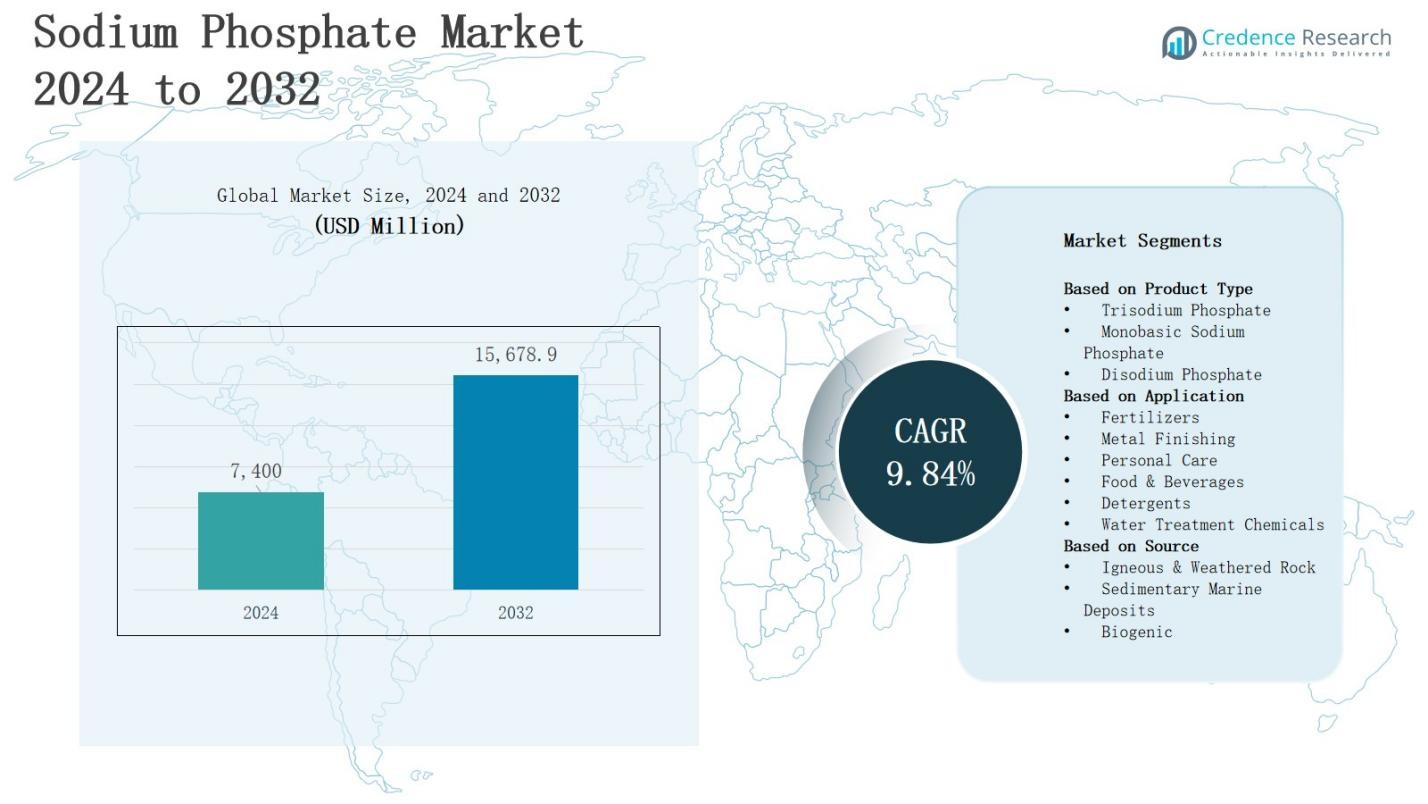
The Sodium Phosphate Market is projected to grow from USD 7,400 million in 2024 to USD 15,678.9 million by 2032, registering a strong CAGR of 9.84% during the forecast period.
| REPORT ATTRIBUTE | DETAILS |
|---|---|
| Historical Period | 2020-2024 |
| Base Year | 2024 |
| Forecast Period | 2025-2032 |
| Sodium Phosphate Market Size 2024 | USD 7,400 Million |
| Sodium Phosphate Market, CAGR | 9.84% |
| Sodium Phosphate Market Size 2032 | USD 15,678.9 Million |
The sodium phosphate market is driven by rising demand in food and beverage industries as a preservative and emulsifier, coupled with its extensive use in pharmaceuticals for laxatives and electrolyte solutions. Growing applications in water treatment and fertilizers further support market expansion. Increasing awareness of health and wellness is boosting demand for phosphate-based supplements, while advancements in processing technologies enhance product quality and efficiency. Trends include the development of eco-friendly phosphate production methods, rising adoption in nutraceutical formulations, and expanding use in industrial cleaning solutions, positioning sodium phosphate as a versatile and essential chemical across multiple sectors.
The sodium phosphate market demonstrates diverse geographical growth, with Asia Pacific leading at 34% share, followed by North America at 28% and Europe at 23%, while Latin America accounts for 8% and the Middle East & Africa holds 7%. Strong demand arises from food, pharmaceutical, agricultural, and water treatment applications across these regions. Key players include S.A. OCP, PJSC PhosAgro AG, EuroChem, Innophos Holdings, Inc., The Mosaic Company, Potash Corporation of Saskatchewan Inc., Agrium Inc., Saudi Arabian Mining Company, and Israel Chemicals Ltd., driving innovation and competitiveness.
Market Insights
- The sodium phosphate market is projected to grow from USD 7,400 million in 2024 to USD 15,678.9 million by 2032, registering a CAGR of 9.84%.
- Rising demand in food and beverage industries for preservatives, stabilizers, and emulsifiers continues to drive market growth.
- Expanding pharmaceutical use in oral solutions, laxatives, and electrolyte replacements strengthens adoption across healthcare applications.
- Growing reliance on fertilizers and water treatment chemicals enhances demand from agriculture and industrial sectors.
- Technological advancements enable high-purity, eco-friendly phosphate production, boosting industrial cleaning and detergent applications.
- Regulatory scrutiny and raw material price volatility remain key challenges, impacting cost efficiency and compliance.
- Asia Pacific leads with 34% share, followed by North America at 28%, Europe at 23%, Latin America at 8%, and Middle East & Africa at 7%.
Market Drivers
Rising Demand from Food and Beverage Industry
The sodium phosphate market benefits strongly from its critical role as a food additive, stabilizer, and emulsifier across bakery, dairy, and meat products. It enhances texture, improves moisture retention, and extends shelf life, making it essential for processed foods. Consumers increasingly favor packaged and convenience foods, driving consistent use of sodium phosphate. It supports pH regulation and food fortification, aligning with evolving consumer expectations for quality, safety, and nutritional value.
- For instance, in bakery applications, sodium phosphate reacts with sodium bicarbonate to produce carbon dioxide, which helps build volume and improve texture in cakes, cookies, and refrigerated yeast dough. In processed cheeses, it acts as an emulsifier to maintain the mixture of oil and water, enhancing texture and viscosity.
Expanding Applications in Pharmaceuticals
The sodium phosphate market gains momentum through rising pharmaceutical demand, where it serves in oral solutions, laxatives, and electrolyte replacements. It addresses increasing cases of constipation, kidney-related conditions, and bowel cleansing needs before medical procedures. Growing emphasis on effective treatment formulations supports its adoption. It contributes to stabilizing medications and enhancing therapeutic effectiveness. Expanding healthcare infrastructure and greater accessibility to advanced drugs strengthen the importance of sodium phosphate across pharmaceutical applications.
- For instance, Innophos Inc., a leading U.S.-based manufacturer, produces sodium phosphate compounds used in bowel cleansing agents like Fleet Phospho-soda, widely prescribed for colonoscopy preparation.
Growth in Agricultural and Water Treatment Sectors
The sodium phosphate market experiences strong demand in agriculture, where it enhances fertilizers and supports soil conditioning. Farmers adopt it to improve crop yield and productivity amid rising food security concerns. It also finds significant use in water treatment plants for corrosion control and scale inhibition. Increasing urbanization and industrialization drive higher freshwater demand, requiring effective treatment solutions. It strengthens its relevance across critical sectors with expanding industrial and agricultural adoption.
Technological Advancements and Industrial Applications
The sodium phosphate market expands further due to continuous innovation in production processes and industrial applications. Advanced processing ensures high purity, greater solubility, and consistent performance across end-use industries. It supports growth in cleaning agents, detergents, and textile processing. Increasing focus on eco-friendly formulations encourages sustainable production practices. Expanding industrial usage coupled with continuous research strengthens sodium phosphate’s role as a versatile chemical. It secures a strong position across diverse global markets.
Market Trends
Increasing Use in Functional Foods and Nutraceuticals
The sodium phosphate market is witnessing rising integration into functional foods and nutraceutical products, driven by growing consumer interest in health and wellness. It supports dietary supplements by aiding mineral balance and improving bone health. Food manufacturers incorporate it in fortified beverages and nutritional bars to meet demand for convenient nutrition. It helps regulate acidity levels, ensuring product stability. Strong consumer preference for preventive healthcare and nutrient-rich diets sustains steady adoption in this sector.
- For instance, Innophos produces specialty sodium phosphate ingredients used in processed cheese to improve texture and melt quality.
Sustainability and Eco-Friendly Production Practices
The sodium phosphate market is shaped by growing emphasis on sustainable production processes and environmentally responsible sourcing. Manufacturers are investing in energy-efficient technologies that minimize waste and carbon emissions. It aligns with stricter environmental regulations, prompting industries to adopt cleaner methods. Demand for eco-friendly chemicals encourages innovation in phosphate processing. Consumers and governments increasingly support green products, positioning sodium phosphate as a sustainable alternative in various end-use industries that prioritize long-term environmental responsibility.
- For instance, Mosaic Company, a major phosphate producer, has developed a joint venture with Ma’aden in Saudi Arabia that incorporates eco-friendly phosphate fertilizer production facilities, emphasizing resource efficiency and environmental compliance.
Rising Adoption in Water Treatment and Industrial Cleaning
The sodium phosphate market benefits from increasing demand in water treatment, where it prevents corrosion, scale deposits, and contamination. Industries with high water usage adopt it to ensure efficient operations and regulatory compliance. It plays a crucial role in detergents and cleaning agents by enhancing cleaning effectiveness. Rapid industrial growth and urbanization increase demand for reliable treatment chemicals. Rising focus on sanitation, hygiene, and safe water access continues to boost market expansion.
Technological Innovations in Product Development
The sodium phosphate market is witnessing strong innovation in manufacturing and formulation technologies. Producers focus on creating high-purity grades with improved solubility and stability for advanced applications. It supports growth in pharmaceuticals, processed foods, and specialty industrial uses. Investments in R&D encourage development of customized phosphate solutions tailored to specific industry needs. Growing competition drives continuous product enhancements. Strong demand for multifunctional performance positions sodium phosphate as a vital ingredient across diverse industries.
Market Challenges Analysis
Regulatory Restrictions and Health Concerns
The sodium phosphate market faces challenges due to increasing regulatory scrutiny and health-related concerns. Excessive consumption of phosphate additives in foods is linked with risks of kidney disease, cardiovascular issues, and bone health complications. Governments and health organizations impose stricter guidelines on permissible usage levels, creating compliance challenges for manufacturers. It must adapt to evolving safety standards while maintaining functionality in applications. Rising consumer awareness of food labeling and clean-label preferences further limits growth opportunities.
Volatility in Raw Material Supply and Price Fluctuations
The sodium phosphate market encounters significant obstacles from raw material availability and cost instability. Global phosphate rock reserves face depletion concerns, which impact long-term supply security. It experiences price volatility due to fluctuating mining costs, trade restrictions, and geopolitical tensions in major producing countries. Manufacturers face pressure to optimize production efficiency while maintaining affordability. Rising demand across multiple industries amplifies competition for limited resources, creating supply chain uncertainties and affecting consistent market growth.
Market Opportunities
Expansion in Functional Foods, Nutraceuticals, and Pharmaceuticals
The sodium phosphate market presents strong opportunities through rising demand in functional foods, nutraceuticals, and pharmaceutical products. Consumers increasingly prefer fortified foods and dietary supplements that enhance energy, bone strength, and overall wellness. It offers essential benefits in pH regulation, mineral balance, and stability in formulations, making it vital for product innovation. Pharmaceutical applications, including electrolyte solutions and bowel cleansing agents, continue to expand with growing healthcare needs. Rising awareness of preventive healthcare creates sustained avenues for growth.
Adoption in Water Treatment, Agriculture, and Industrial Applications
The sodium phosphate market offers opportunities in water treatment, agriculture, and diverse industrial sectors. Rapid urbanization and rising industrialization heighten demand for effective water treatment solutions, where it prevents corrosion and scale formation. Farmers increasingly adopt phosphate-based fertilizers to address food security challenges. Industrial applications in cleaning agents, detergents, and textiles open new growth streams. Technological advancements in eco-friendly production enhance its acceptance across industries. Expanding global infrastructure development further supports its widespread integration and long-term potential.
Market Segmentation Analysis:
By Product Type
The sodium phosphate market is segmented into trisodium phosphate, monobasic sodium phosphate, and disodium phosphate. Trisodium phosphate holds significant demand due to its wide use in cleaning agents, detergents, and water treatment. Monobasic sodium phosphate finds applications in pharmaceuticals and food products for pH adjustment and buffering. Disodium phosphate is preferred in food processing for texture enhancement and stabilization. It continues to witness balanced adoption across sectors driven by its functional versatility and cost-effectiveness.
- For instance, Kraft Heinz uses disodium phosphate in their processed cheese products to enhance texture and maintain moisture.
By Application
The sodium phosphate market covers fertilizers, metal finishing, personal care, food and beverages, detergents, and water treatment chemicals. Fertilizers represent a major segment, supporting soil enrichment and agricultural productivity. Food and beverages account for strong demand, with sodium phosphate used as an additive, emulsifier, and preservative. Water treatment and detergents also contribute significantly to market share. It secures growth potential across personal care and industrial applications where functional additives are essential for performance and safety.
- For instance, Rishi Chemical Works manufactures food-grade sodium phosphate used as an emulsifier in processed meats and leavening agent in baked goods, supplying global food companies with high-purity additives from their India-based plants.
By Source
The sodium phosphate market draws raw materials from igneous and weathered rock, sedimentary marine deposits, and biogenic sources. Sedimentary marine deposits dominate supply due to abundant reserves and cost-efficient extraction processes. Igneous and weathered rock provide reliable alternatives, particularly in regions with rich mineral availability. Biogenic sources, though limited, are gaining interest for sustainable and eco-friendly production. It strengthens supply security and supports evolving environmental regulations by diversifying sourcing channels across multiple geographies.
Segments:
Based on Product Type
- Trisodium Phosphate
- Monobasic Sodium Phosphate
- Disodium Phosphate
Based on Application
- Fertilizers
- Metal Finishing
- Personal Care
- Food & Beverages
- Detergents
- Water Treatment Chemicals
Based on Source
- Igneous & Weathered Rock
- Sedimentary Marine Deposits
- Biogenic
Based on the Geography:
- North America
- U.S.
- Canada
- Mexico
- Europe
- Germany
- France
- U.K.
- Italy
- Spain
- Rest of Europe
- Asia Pacific
- China
- Japan
- India
- South Korea
- South-east Asia
- Rest of Asia Pacific
- Latin America
- Brazil
- Argentina
- Rest of Latin America
- Middle East & Africa
- GCC Countries
- South Africa
- Rest of the Middle East and Africa
Regional Analysis
North America
The sodium phosphate market in North America holds a 28% share, supported by strong demand from food and beverage, pharmaceutical, and water treatment industries. Widespread use of sodium phosphate in packaged foods aligns with consumer preferences for convenience and shelf stability. Pharmaceutical adoption remains high due to its role in laxatives and medical-grade electrolyte solutions. It benefits from advanced healthcare infrastructure and regulatory standards that promote quality formulations. Industrial cleaning and water treatment applications further strengthen growth momentum across the United States and Canada.
Europe
Europe accounts for 23% of the sodium phosphate market, driven by growing demand in food processing, agriculture, and industrial cleaning. Food and beverage manufacturers adopt it for stabilization and pH control, meeting stringent regulatory requirements. Agricultural applications remain critical due to rising pressure on sustainable farming practices. The pharmaceutical industry incorporates sodium phosphate in formulations for patient care across major economies. It supports industrial water treatment solutions, reflecting the region’s strict environmental regulations and efficiency standards.
Asia Pacific
Asia Pacific dominates the sodium phosphate market with a 34% share, fueled by expanding food processing, agriculture, and industrial sectors. Rising population and growing middle-class income levels drive demand for packaged foods and fortified products. Agricultural use in fertilizers is expanding to meet food security goals across China, India, and Southeast Asia. Pharmaceutical adoption is rising with greater healthcare access and infrastructure investments. It experiences steady demand from water treatment and detergents as urbanization and industrialization accelerate.
Latin America
Latin America represents 8% of the sodium phosphate market, supported by agriculture, food processing, and water treatment applications. Fertilizer demand is expanding due to reliance on phosphate-based inputs for crop productivity. Food and beverage industries adopt it for shelf-life extension and quality enhancement. Pharmaceutical and personal care applications are gaining traction with improving healthcare services. It finds adoption in industrial cleaning and municipal water treatment, supported by regional development initiatives across Brazil, Mexico, and Argentina.
Middle East & Africa
The sodium phosphate market in the Middle East & Africa holds a 7% share, driven by growing demand for water treatment solutions and agricultural inputs. Rising urbanization increases the need for municipal and industrial water management, where sodium phosphate serves a vital role. Fertilizer demand is strengthening in agricultural economies across Africa. Food and beverage industries are expanding with growing consumer markets. It benefits from infrastructure development and government focus on sustainable industrial solutions.
Key Player Analysis
- Israel Chemicals Ltd.
- Innophos Holdings, Inc.
- Saudi Arabian Mining Company
- Agrium Inc.
- The Mosaic Company
- EuroChem
- PJSC PhosAgro AG
- Potash Corporation of Saskatchewan Inc.
- A. OCP
Competitive Analysis
The sodium phosphate market is characterized by intense competition, with global and regional players focusing on product quality, innovation, and supply chain strength to maintain market position. Leading companies such as S.A. OCP, PJSC PhosAgro AG, EuroChem, Innophos Holdings, Inc., The Mosaic Company, Potash Corporation of Saskatchewan Inc., Agrium Inc., Saudi Arabian Mining Company, and Israel Chemicals Ltd. dominate through extensive production capacities and diversified portfolios. It relies on vertical integration strategies, ensuring efficient raw material sourcing and cost management to secure long-term competitiveness. Companies invest in research and development to produce high-purity grades for specialized applications in food, pharmaceuticals, and water treatment. Expansion into emerging economies and partnerships with regional distributors support market penetration. Strong emphasis on sustainability and eco-friendly production methods also defines competitive positioning, with firms aligning operations to meet global environmental regulations. It remains influenced by pricing strategies, regulatory compliance, and innovation-driven differentiation, shaping the growth potential for leading players worldwide.
Recent Developments
- In July 2024, American Regent, Inc. launched Sodium Phosphates Injection, USP, FDA-approved and AP-rated, to treat hypophosphatemia in patients unable to take oral supplements.
- in June 2023, CJ Food & Nutrition Tech (CJ FNT) from Korea introduced TasteNrich HYBIND, a new substitute for conventional phosphates.
- In July 2024, American Regent, Inc.launched Sodium Phosphates Injection, USP, which earned FDA approval and an “AP” rating. This injectable phosphorus source (3 mM P/mL) supports IV fluids to prevent or correct hypophosphatemia in patients who cannot take oral supplements
- In June 2025, Innophosunveiled VersaCal® Bright, a clean-label phosphate-based solution designed to deliver the whiteness and brightness of titanium dioxide, enriched with essential nutrients. This innovation caters to the growing demand for natural, functional additives.
Market Concentration & Characteristics
The sodium phosphate market exhibits a moderately consolidated structure, with a mix of global leaders and regional players competing through product quality, distribution networks, and application diversity. Large companies such as S.A. OCP, PJSC PhosAgro AG, EuroChem, The Mosaic Company, and Israel Chemicals Ltd. maintain strong market positions by leveraging extensive raw material reserves, advanced processing technologies, and integrated supply chains. It shows high concentration in regions with abundant phosphate rock deposits, ensuring competitive advantage for resource-rich producers. The market is characterized by consistent demand from food and beverages, pharmaceuticals, agriculture, and water treatment sectors, making it resilient to cyclical fluctuations. Companies focus on sustainable production methods and regulatory compliance, reflecting industry shifts toward eco-friendly solutions. Innovation in high-purity grades and application-specific formulations strengthens competitiveness. It continues to balance between established multinationals and emerging regional suppliers, shaping a dynamic competitive environment across global markets.
Report Coverage
The research report offers an in-depth analysis based on Product Type, Application, Source and Geography. It details leading market players, providing an overview of their business, product offerings, investments, revenue streams, and key applications. Additionally, the report includes insights into the competitive environment, SWOT analysis, current market trends, as well as the primary drivers and constraints. Furthermore, it discusses various factors that have driven market expansion in recent years. The report also explores market dynamics, regulatory scenarios, and technological advancements that are shaping the industry. It assesses the impact of external factors and global economic changes on market growth. Lastly, it provides strategic recommendations for new entrants and established companies to navigate the complexities of the market.
Future Outlook
- Demand for sodium phosphate will grow in food and beverage applications due to rising consumption of packaged and convenience products.
- Pharmaceutical usage will expand with increasing adoption in electrolyte solutions, laxatives, and bowel cleansing formulations.
- Agricultural demand will rise as phosphate-based fertilizers remain essential for improving crop productivity.
- Water treatment applications will strengthen due to rising urbanization and industrialization across emerging economies.
- Technological advancements will enhance production efficiency and improve product purity.
- Eco-friendly and sustainable phosphate production methods will gain stronger industry focus.
- Industrial applications in detergents, cleaning agents, and textiles will continue to expand.
- Regulatory frameworks will shape product development, pushing compliance with stricter food safety and environmental standards.
- Geographical growth will remain strong in Asia Pacific, supported by food security and healthcare expansion.
- Competitive intensity will increase as global leaders and regional players diversify their product portfolios.

Request a Free Sample
Fill in your details and we'll send you a free sample report.
- Sample data tables & charts
- Research methodology
Market Dynamics
Expanding Food & Beverage Applications
Sodium phosphate is widely used as a preservative, stabilizer, and emulsifier in bakery, dairy, and processed meat products, supporting the growing demand for packaged and convenience foods. Its ability to enhance texture, moisture retention, and shelf life makes it indispensable for food manufacturers.
Rising Pharmaceutical Utilization
The pharmaceutical sector increasingly relies on sodium phosphate for oral solutions, laxatives, and electrolyte replacements, driven by the need for effective bowel cleansing agents and treatments for kidney-related conditions. Expanding healthcare infrastructure and demand for advanced formulations further boost adoption.
Growth in Agriculture and Water Treatment
Sodium phosphate is essential in fertilizers for improving crop yield and soil conditioning, addressing food security concerns. Its use in water treatment for corrosion control and scale inhibition is rising due to urbanization and industrialization, increasing the need for effective water management solutions.
Technological Advancements and Eco-Friendly Production
Innovations in processing technologies are enabling the production of high-purity, eco-friendly sodium phosphate, which meets stricter environmental regulations and consumer demand for sustainable products. This supports its expanding use in industrial cleaning, detergents, and specialty applications.
Increasing Demand in Functional Foods and Nutraceuticals
Consumer interest in health and wellness is driving the incorporation of sodium phosphate in dietary supplements, fortified foods, and nutraceuticals, where it aids mineral balance and product stability. This trend is supported by the shift toward preventive healthcare and nutrient-rich diets.
Need a Custom Version of This Report?
Tailor the scope, geography, or segments to your exact requirements.
- Custom geography or segment scope
- Direct access to our analyst team
Frequently Asked Questions
What is the current market size for Sodium phosphate market, and what is its projected size in 2032?
At what Compound Annual Growth Rate is the Sodium phosphate market projected to grow between 2025 and 2032?
Which Sodium phosphate market segment held the largest share in 2024?
What are the primary factors fueling the growth of the Sodium phosphate market?
Who are the leading companies in the Sodium phosphate market?
Which region commanded the largest share of the Sodium phosphate market in 2024?
Table of Content
Chapter 1 Market Segmentation
- 1.1 Segmentation Framework
- 1.1.1 Product and Service Classification
- 1.1.2 Application and End-Use Classification
- 1.1.3 Technology and Solution Classification
- 1.1.4 Customer and Distribution Channel Classification
- 1.1.5 Geographic Segmentation
- 1.1.6 Market Segment Definitions and Boundaries
- 1.2 By Source
- 1.2.1 Igneous & Weathered Rock
- 1.2.2 Sedimentary Marine Deposits
- 1.2.3 Biogenic
- 1.3 By Application
- 1.3.1 Fertilizers
- 1.3.2 Metal Finishing
- 1.3.3 Personal Care
- 1.3.4 Food & Beverages
- 1.3.5 Detergents
- 1.3.6 Water Treatment Chemicals
- 1.4 By Product Type
- 1.4.1 Trisodium Phosphate
- 1.4.2 Monobasic Sodium Phosphate
- 1.4.3 Disodium Phosphate
Chapter 2 Introduction
- 2.1 Report Objectives and Scope
- 2.2 Product Definition and Industry Terminology
- 2.3 Market Inclusions and Exclusions
- 2.4 Research Process
- 2.4.1 Primary Research and Expert Interviews
- 2.4.2 Secondary Research and Source Review
- 2.4.3 Top-Down and Bottom-Up Estimation
- 2.4.4 Data Triangulation and Verification
- 2.5 Market Size Measurement Basis
- 2.5.1 2024: USD 7,400 million → 2032: USD 15,678.9 million
- 2.6 Historical and Forecast Reference Periods
- 2.6.1 Base Year: 2024
- 2.6.2 Forecast Period: 2024-2032
- 2.7 Research Assumptions and Limitations
Chapter 3 Executive Summary
- 3.1 Market Snapshot and Key Findings
- 3.2 Base-Year Market Size, 2024
- 3.3 Forecast Market Size, 2032
- 3.4 Revenue and Volume Growth Outlook
- 3.5 Key Demand and Supply Indicators
- 3.6 Leading Market Segments
- 3.7 Fastest-Growing Market Opportunities
- 3.8 Regional Performance Highlights
- 3.9 Technology and Industry Transformation
- 3.10 Competitive Landscape Summary
- 3.11 Analyst View and Strategic Implications
Chapter 4 Global Sodium Phosphate Market Trends and Developments
- 4.1 Historical Industry Development
- 4.2 Recent Market Trends and Developments
- 4.3 Demand and Customer Behavior Trends
- 4.4 Technology and Product Innovation
- 4.5 Artificial Intelligence, Automation and Digitalization
- 4.6 Local Manufacturing and Supply Chain Realignment
- 4.7 Industry Partnerships, Mergers and Acquisitions
- 4.8 Sustainability and Circular Economy Developments
- 4.9 Government and Private Sector Investment Trends
- 4.10 Emerging Business Models and Commercialization
- 4.11 Industry Developments and Announcements
Chapter 5 Global Sodium Phosphate Market Production, Supply and Demand Analysis
- 5.1 Demand Trend and Consumption Analysis
- 5.2 Demand Forecast, 2024-2032
- 5.3 Production and Output Trend
- 5.4 Production and Output Forecast, 2024-2032
- 5.5 Installed Capacity and Capacity Utilization
- 5.6 Company-Wise Production Plants and Statistics
- 5.6.1 Installed Production Capacity
- 5.6.2 Actual Production
- 5.6.3 Planned Capacity and Expansion Targets
- 5.7 Supply Chain Structure and Procurement Trends
- 5.8 Supply-Demand Gap and Bottlenecks
- 5.9 Import Dependence and Sourcing Structure
- 5.10 Contract Manufacturing and Outsourcing
- 5.11 Regional Supply and Demand Concentration
Chapter 6 Global Sodium Phosphate Market Pricing Analysis
- 6.1 Pricing Structure and Measurement
- 6.2 Historical Pricing Trends
- 6.3 Pricing Outlook, 2024-2032
- 6.4 Average Selling Price and Unit Economics
- 6.5 Pricing by Product and Market Segment
- 6.6 Geographic Pricing Differences
- 6.7 Key Input, Energy, Labor and Logistics Costs
- 6.8 Contract Pricing and Purchasing Models
- 6.9 Pricing Sensitivity and Competitive Positioning
- 6.10 Price, Margin and Profitability Implications
Chapter 7 Global Sodium Phosphate Market Dynamics
- 7.1 Market Growth Drivers
- 7.1.1 Demand-Side Drivers
- 7.1.2 Technology and Innovation Drivers
- 7.1.3 Infrastructure and Investment Drivers
- 7.1.4 Regulatory and Policy Drivers
- 7.2 Market Restraints
- 7.2.1 Cost and Affordability Constraints
- 7.2.2 Technology and Adoption Barriers
- 7.2.3 Supply Chain and Operational Constraints
- 7.3 Market Challenges
- 7.3.1 Competitive Pressure and Margin Erosion
- 7.3.2 Skills, Infrastructure and Implementation Gaps
- 7.4 Emerging Market Opportunities
- 7.5 Market Dynamics Impact and Time-Horizon Assessment
Chapter 8 Global Sodium Phosphate Value Chain Analysis
- 8.1 Industry Value Chain Overview
- 8.2 Upstream Suppliers and Critical Inputs
- 8.3 Technology and Component Providers
- 8.4 Manufacturing or Service Delivery
- 8.5 Distribution, Channel Partners and Integrators
- 8.6 Downstream Applications and End Users
- 8.7 Value Addition and Profit Pools
- 8.8 Vertical Integration and Outsourcing
- 8.9 Supplier Concentration and Risk
- 8.10 Supply Chain Localization and Resilience
Chapter 9 Global Sodium Phosphate Market Regulations and Policies
- 9.1 Relevant Laws, Standards and Compliance Frameworks
- 9.2 Product, Service, Safety and Quality Requirements
- 9.3 Government Policies, Incentives and Subsidies
- 9.4 Imports, Exports and Trade Barriers
- 9.5 Public Procurement and Local Content Requirements
- 9.6 Environmental and Sustainability Compliance
- 9.7 Upcoming Policy Changes and Market Implications
Chapter 10 Global Sodium Phosphate Market Hotspots and Opportunities
- 10.1 Market Opportunity Mapping and Growth Hotspots
- 10.2 High-Growth Applications and Customer Groups
- 10.3 Underserved Markets and White-Space Opportunities
- 10.4 Emerging Technology and Product Opportunities
- 10.5 New Capacity and Investment Hotspots
- 10.6 Market Entry and Expansion Opportunities
- 10.7 Distribution and Partnership Opportunities
- 10.8 Near-Term and Long-Term Commercial Potential
- 10.9 Opportunity Attractiveness and Execution Risks
Chapter 11 Global Sodium Phosphate Market Outlook, 2024-2032
- 11.1 Market Size and Analysis
- 11.1.1 Revenue (Market Measurement: 2024: USD 7,400 million → 2032: USD 15,678.9 million)
- 11.1.2 Market Volume and Quantity Sold
- 11.1.3 Historical Market Size
- 11.1.4 Base-Year Market Size, 2024
- 11.2 Market Forecast, 2024-2032
- 11.2.1 Revenue Forecast to 2032
- 11.2.2 Volume Forecast to 2032
- 11.2.3 CAGR and Year-on-Year Growth
- 11.2.4 Incremental Revenue Opportunity
- 11.3 Forecast Assumptions and Scenario Analysis
- 11.3.1 Base-Case Forecast
- 11.3.2 Optimistic and Conservative Scenarios
- 11.3.3 Technology, Pricing and Policy Sensitivities
- 11.4 Market Attractiveness and Growth Outlook
Chapter 12 Global Sodium Phosphate Market Segmentation and Outlook
- 12.1 Segmentation Summary and Market Shares, 2024
- 12.2 Largest and Fastest-Growing Segments
- 12.3 By Source - Market Size and Forecast, 2024-2032
- 12.3.1 Segment Definition and Scope
- 12.3.2 Historical Market Size
- 12.3.3 Revenue Forecast, 2024-2032
- 12.3.4 Volume Forecast, 2024-2032
- 12.3.5 Base-Year Market Share, 2024
- 12.3.6 Segment CAGR and Growth Drivers
- 12.3.7 Subsegment Market Size and Forecast
- 12.3.7.1 Igneous & Weathered Rock
- 12.3.7.2 Sedimentary Marine Deposits
- 12.3.7.3 Biogenic
- 12.3.8 Subsegment Pricing and Adoption Trends
- 12.3.9 Leading Suppliers and Competition
- 12.3.10 Regional Demand and Opportunities
- 12.4 By Application - Market Size and Forecast, 2024-2032
- 12.4.1 Segment Definition and Scope
- 12.4.2 Historical Market Size
- 12.4.3 Revenue Forecast, 2024-2032
- 12.4.4 Volume Forecast, 2024-2032
- 12.4.5 Base-Year Market Share, 2024
- 12.4.6 Segment CAGR and Growth Drivers
- 12.4.7 Subsegment Market Size and Forecast
- 12.4.7.1 Fertilizers
- 12.4.7.2 Metal Finishing
- 12.4.7.3 Personal Care
- 12.4.7.4 Food & Beverages
- 12.4.7.5 Detergents
- 12.4.7.6 Water Treatment Chemicals
- 12.4.8 Subsegment Pricing and Adoption Trends
- 12.4.9 Leading Suppliers and Competition
- 12.4.10 Regional Demand and Opportunities
- 12.5 By Product Type - Market Size and Forecast, 2024-2032
- 12.5.1 Segment Definition and Scope
- 12.5.2 Historical Market Size
- 12.5.3 Revenue Forecast, 2024-2032
- 12.5.4 Volume Forecast, 2024-2032
- 12.5.5 Base-Year Market Share, 2024
- 12.5.6 Segment CAGR and Growth Drivers
- 12.5.7 Subsegment Market Size and Forecast
- 12.5.7.1 Trisodium Phosphate
- 12.5.7.2 Monobasic Sodium Phosphate
- 12.5.7.3 Disodium Phosphate
- 12.5.8 Subsegment Pricing and Adoption Trends
- 12.5.9 Leading Suppliers and Competition
- 12.5.10 Regional Demand and Opportunities
- 12.6 Segment Growth Comparison
- 12.7 Segment Attractiveness and Priority Matrix
Chapter 13 Global Sodium Phosphate End-Use and Application Market Outlook
- 13.1 End-Use Industry and Customer Demand Structure
- 13.2 Leading Applications and Customer Groups
- 13.3 End-Use Market Size, Share and Forecast
- 13.4 Major End-Use Industry Deep Dives
- 13.4.1 Customer Requirements and Use Cases
- 13.4.2 Demand and Replacement Cycles
- 13.4.3 Technical and Regulatory Considerations
- 13.4.4 Purchasing and Procurement Models
- 13.4.5 Leading Vendors and Distribution Channels
- 13.4.6 Forecast and Commercial Opportunities
- 13.5 Emerging Applications and Cross-Segment Demand
- 13.6 End-Use Industry Investment Priorities
Chapter 14 Global Sodium Phosphate Geographic Market Outlook, 2024-2032
- 14.1 Regional Market Size and Share, 2024
- 14.2 Regional Market Forecast, 2024-2032
- 14.3 Regional Pricing, Production and Demand Differences
- 14.4 North America
- 14.4.1 United States
- 14.4.2 Canada
- 14.4.3 Mexico
- 14.5 Europe
- 14.5.1 Germany
- 14.5.2 France
- 14.5.3 Italy
- 14.5.4 United Kingdom
- 14.5.5 Spain
- 14.5.6 Poland
- 14.5.7 Russia
- 14.5.8 Netherlands
- 14.5.9 Belgium
- 14.5.10 Sweden
- 14.5.11 Denmark
- 14.5.12 Norway
- 14.5.13 Rest of Europe
- 14.6 Asia Pacific
- 14.6.1 China
- 14.6.2 India
- 14.6.3 Japan
- 14.6.4 South Korea
- 14.6.5 Thailand
- 14.6.6 Indonesia
- 14.6.7 Vietnam
- 14.6.8 Malaysia
- 14.6.9 Australia
- 14.6.10 Rest of Asia Pacific
- 14.7 Latin America
- 14.7.1 Brazil
- 14.7.2 Argentina
- 14.7.3 Colombia
- 14.7.4 Chile
- 14.7.5 Rest of Latin America
- 14.8 Middle East
- 14.8.1 Saudi Arabia
- 14.8.2 United Arab Emirates
- 14.8.3 Turkey
- 14.8.4 Israel
- 14.8.5 Iran
- 14.8.6 Rest of the Middle East
- 14.9 Africa
- 14.9.1 South Africa
- 14.9.2 Egypt
- 14.9.3 Nigeria
- 14.9.4 Morocco
- 14.9.5 Rest of Africa
- 14.10 Regional Investment, Policy and Supply Chain Differences
- 14.11 Regional Competitive Landscape
- 14.12 Geographic Growth Hotspots
Chapter 15 Global Sodium Phosphate Technology, Innovation and Sustainability Outlook
- 15.1 Technology Landscape and Maturity
- 15.2 Product, Process and Service Innovation
- 15.3 AI, Automation and Digital Tools in the Industry
- 15.4 Technology Adoption and Performance Benchmarking
- 15.5 Innovation Pipeline and R&D Investment
- 15.6 Patent and Intellectual Property Trends
- 15.7 Energy Efficiency and Resource Management
- 15.8 Sustainability, Recycling and Circularity
- 15.9 Technology Roadmap, 2024-2032
- 15.10 Risks of Obsolescence and Technology Substitution
Chapter 16 Global Sodium Phosphate Market Key Strategic Imperatives
- 16.1 Growth and Market Entry Priorities
- 16.2 High-Return Products and Segments
- 16.3 Pricing, Profitability and Cost Optimization
- 16.4 Technology Investment and Product Differentiation
- 16.5 Supply Chain Localization and Resilience
- 16.6 Distribution and Customer Acquisition
- 16.7 Partnership, Acquisition and Capacity Strategy
- 16.8 Regional Expansion Priorities
- 16.9 Short-, Medium- and Long-Term Actions
Chapter 17 Competition Outlook
- 17.1 Industry Competition Characteristics
- 17.2 Market Structure and Concentration
- 17.3 Market Share and Competitive Positioning, 2024
- 17.4 Company-Wise Revenue and Product Benchmarking
- 17.5 Production and Service Capacity Benchmarking
- 17.6 Technology, Pricing and Differentiation
- 17.7 Regional Footprint and Distribution Strength
- 17.8 Mergers, Acquisitions and Strategic Alliances
- 17.9 New Entrants and Competitive Threats
- 17.10 Porter's Five Forces and Industry Attractiveness
- 17.11 Competitive Outlook, 2024-2032
Chapter 18 Company Profiles
- 18.1 Company Coverage and Selection Criteria
- 18.2 Israel Chemicals Ltd.
- 18.2.1 Business Description
- 18.2.2 Company Ownership and Geographic Presence
- 18.2.3 Product and Service Portfolio
- 18.2.4 Manufacturing and Operating Footprint
- 18.2.5 Production Capacity and Expansion Plans
- 18.2.6 Financial Performance and Investment
- 18.2.7 Market Share and Competitive Position
- 18.2.8 Technology and Innovation Capabilities
- 18.2.9 Strategic Alliances or Partnerships
- 18.2.10 Recent Developments
- 18.2.11 Growth Strategy and Outlook
- 18.3 Innophos Holdings, Inc.
- 18.4 Saudi Arabian Mining Company
- 18.5 Agrium Inc.
- 18.6 The Mosaic Company
- 18.7 EuroChem
- 18.8 PJSC PhosAgro AG
- 18.9 Potash Corporation of Saskatchewan Inc.
- 18.10 S.A. OCP
- 18.11 Other Relevant Market Participants
Note: Every listed company is profiled on the structure shown under the first company. The company list is preliminary and may change based on research findings, market developments, data availability and client requirements.
Chapter 19 Disclaimer
- 19.1 Research and Forecast Disclaimer
- 19.2 Data Source and Estimation Limitations
Note: The depth of individual sections depends on data availability for this market. Volume, capacity, trade and other unit-based metrics are included where applicable.