
Market Overview
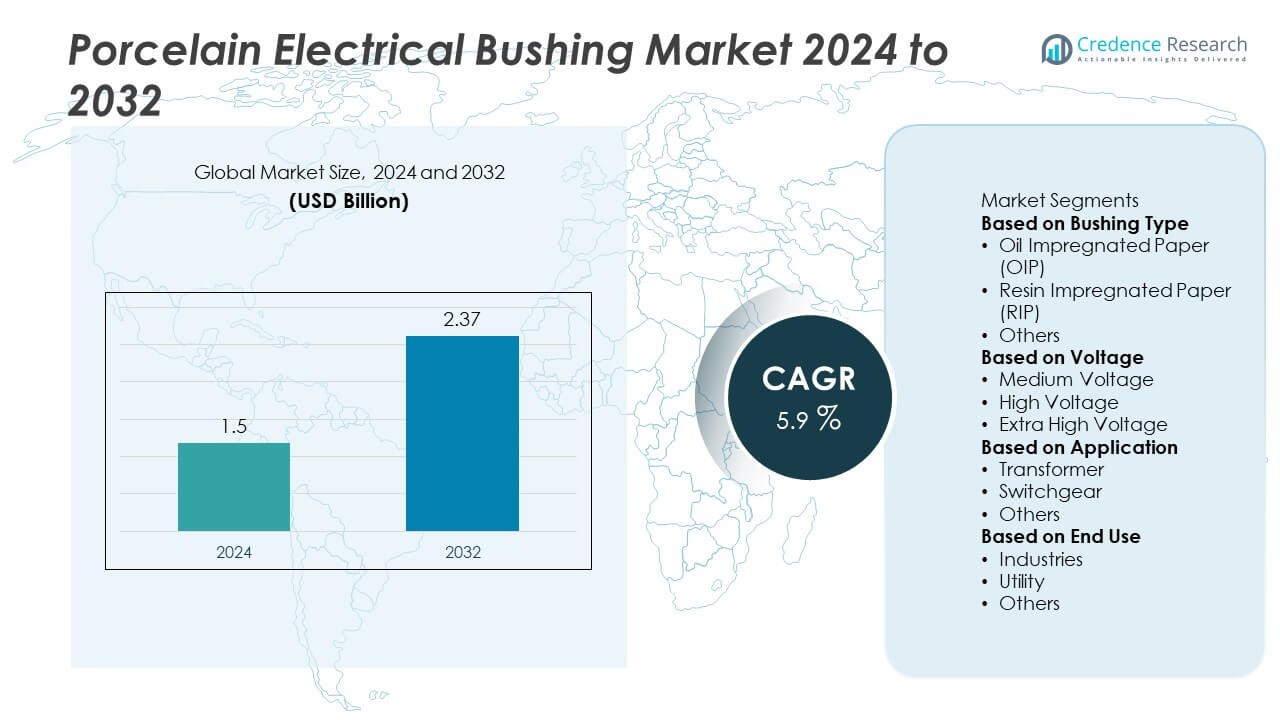
The Porcelain Electrical Bushing Market was valued at USD 1.5 billion in 2024 and is projected to reach USD 2.37 billion by 2032, growing at a CAGR of 5.9% during the forecast period.
| REPORT ATTRIBUTE | DETAILS |
|---|---|
| Historical Period | 2020-2023 |
| Base Year | 2024 |
| Forecast Period | 2025-2032 |
| Porcelain Electrical Bushing MarketSize 2024 | USD 1.5 Billion |
| Porcelain Electrical Bushing Market, CAGR | 5.9% |
| Porcelain Electrical Bushing Market Size 2032 | USD 2.37 Billion |
The Porcelain Electrical Bushing market is led by top players including Hitachi Energy, Barberi Rubinetterie Industriali, Hubbell, Jiangxi Johnson Electric, GIPRO, CG Power and Industrial Solutions, Elliot Industries, ABB, Eaton, and General Electric. These companies strengthen their presence through advanced product designs, strategic partnerships with utilities, and investments in high-voltage and extra-high-voltage applications. Asia-Pacific led the market with 38% share in 2024, driven by large-scale electrification and ultra-high-voltage projects, while Europe held 27% share, supported by stringent safety standards and grid modernization. North America accounted for 23%, propelled by replacement of aging infrastructure and renewable energy integration.
 Market Insights
- The Porcelain Electrical Bushing market was valued at USD 1.5 billion in 2024 and is projected to reach USD 2.37 billion by 2032, growing at a CAGR of 5.9% during the forecast period.
- Oil Impregnated Paper (OIP) bushings dominated with 56% share in 2024, supported by their reliability and wide adoption in high-voltage transformers, while transformers accounted for 58% share among applications, reflecting their central role in power infrastructure.
- A key trend is the rising adoption of hybrid insulation designs and extra-high-voltage bushings, driven by renewable integration and long-distance transmission projects, creating new opportunities for manufacturers.
- Leading companies such as Hitachi Energy, ABB, Eaton, General Electric, Hubbell, CG Power and Industrial Solutions, Barberi Rubinetterie Industriali, Elliot Industries, Jiangxi Johnson Electric, and GIPRO focus on technology improvements, sustainability, and global expansion to maintain competitiveness.
- Asia-Pacific led with 38% share in 2024, followed by Europe at 27% and North America at 23%, while Latin America held 7% and Middle East & Africa accounted for 5%, reflecting balanced global demand.
Market Segmentation Analysis:
By Bushing Type
Oil Impregnated Paper (OIP) bushings dominated the porcelain electrical bushing market in 2024, holding 56% share. Their leadership is driven by long-standing reliability, cost-effectiveness, and suitability for high-voltage transformers and switchgear. Utilities prefer OIP bushings due to proven dielectric performance and wide availability across transmission networks. Resin Impregnated Paper (RIP) bushings followed with 31% share, supported by increasing demand for environmentally friendly, low-maintenance alternatives. The remaining 13% share came from other types, including hybrid and advanced insulation bushings designed for specialized applications where compact design and reduced fire risk are required.
- For instance, ABB manufactures OIP bushings for power transformers rated up to 800 kV with current carrying capacity exceeding 4,000 A, ensuring stable dielectric performance and long service life in high-voltage grids.
By Voltage
High voltage bushings led the market in 2024 with 49% share, reflecting their widespread use in transmission networks and power transformers. Demand is fueled by the global expansion of grid infrastructure, renewable energy integration, and replacement of aging high-voltage assets. Medium voltage bushings accounted for 36% share, primarily driven by industrial and distribution grid applications. Extra high voltage (EHV) bushings represented 15% share, with adoption supported by ultra-high-voltage projects in Asia-Pacific and Europe. The dominance of high voltage bushings highlights their critical role in supporting reliable long-distance electricity transmission.
- For instance, Hitachi Energy offers various series of bushings for applications in transmission substations and large power transformers, including some designed for voltages up to 550 kV with partial discharge levels below 5 pC.
By Application
Transformers remained the largest application segment in 2024, securing 58% share of the porcelain electrical bushing market. Their dominance is linked to continuous demand for transmission and distribution transformers in expanding grid networks. Switchgear followed with 29% share, driven by urban infrastructure development, industrial applications, and integration of renewable energy systems. Other applications, including circuit breakers and specialized high-voltage equipment, contributed 13% share. The dominance of transformers reflects the central role of bushings in ensuring insulation and current flow reliability, particularly in large-scale utility and industrial operations.
Key Growth Drivers
Expansion of Transmission and Distribution Networks
The global expansion of transmission and distribution networks is a major growth driver for the porcelain electrical bushing market. With rising electricity demand, particularly in developing regions, utilities are investing in grid upgrades and new installations. Porcelain bushings are essential for transformers and switchgear in high-voltage and extra-high-voltage applications, ensuring safe current transfer. Their proven durability and cost-effectiveness make them the preferred choice for large-scale projects. Growing electrification in Asia-Pacific, Africa, and the Middle East continues to support stable demand for these components.
- For instance, CG Power and Industrial Solutions manufactures Oil Impregnated Paper (OIP) condenser bushings up to 800 kV, which are used in India's transmission projects to support grid expansion.
Integration of Renewable Energy Projects
The integration of renewable energy sources, such as wind and solar, requires reliable grid infrastructure, boosting demand for porcelain bushings. High-voltage transformers and switchgear play a central role in connecting renewable generation to national grids. Porcelain bushings provide robust insulation and performance in harsh outdoor environments, making them vital for renewable installations. Increasing investments in offshore wind and utility-scale solar projects worldwide drive adoption. This trend reinforces the critical role of porcelain bushings in enabling energy transition while maintaining grid reliability.
- For instance, Hitachi Energy delivered dry-type resin-impregnated synthetic (RIS) or composite bushings for offshore wind substations in Europe, rated up to 420 kV, ensuring reliable insulation under high humidity and marine exposure.
Replacement of Aging Power Infrastructure
Aging grid infrastructure in developed regions is fueling demand for replacement of old equipment, including electrical bushings. Many transmission transformers and switchgear installed decades ago are nearing end-of-life, requiring refurbishment or replacement. Porcelain bushings, with their high mechanical strength and established reliability, remain the preferred choice for retrofit projects. Utilities in North America and Europe are investing heavily in modernizing infrastructure to meet higher load requirements and safety standards. This replacement cycle is expected to be a consistent growth driver over the forecast period.
Key Trends & Opportunities
Shift Toward Hybrid Insulation Designs
A key trend is the growing shift toward hybrid insulation bushings that combine porcelain with resin-based or polymeric insulation. These designs improve fire resistance, reduce maintenance, and enhance operational safety. While OIP bushings continue to dominate, hybrid systems are increasingly preferred in urban and industrial environments with stringent safety standards. Manufacturers are capitalizing on this opportunity by developing advanced hybrid solutions that balance performance, cost, and environmental compliance. The gradual adoption of hybrid technologies represents a significant opportunity for innovation in the market.
- For instance, GIPRO produces custom epoxy resin bushings rated up to 40.5 kV with very low partial discharge levels, offering robust, gas-tight insulation for medium-voltage switchgear.
Growth of Extra High Voltage Applications
The demand for extra-high-voltage (EHV) bushings is rising as countries expand their long-distance transmission capabilities. Projects in Asia-Pacific and Europe, including UHVDC (ultra-high-voltage direct current) networks, drive this trend. Porcelain bushings in the EHV range provide reliable insulation and mechanical performance under extreme conditions. This segment offers opportunities for manufacturers to capture niche, high-value contracts. With growing energy interconnections and renewable integration, demand for EHV bushings is expected to remain strong, reinforcing the importance of advanced porcelain bushing designs.
- For instance, ABB supplied condenser bushings for the Changji–Guquan UHVDC project in China, which transmit electricity at 1,100 kV DC. The bushings use Resin Impregnated Paper (RIP) technology and were designed to withstand extreme operating conditions, ensuring reliable operation in ultra-high-voltage transmission lines.
Key Challenges
Competition from Polymer and Composite Bushings
The porcelain electrical bushing market faces strong competition from polymer and composite bushings, which offer lightweight designs, reduced risk of explosion, and lower maintenance. These alternatives are gaining traction in modern grids where space constraints and safety concerns are critical. While porcelain maintains dominance in high-voltage applications, rising adoption of composites poses a long-term challenge. Manufacturers must differentiate through cost-effectiveness, durability, and performance to maintain market share against these emerging substitutes.
High Installation and Maintenance Costs
Porcelain bushings require specialized handling, installation, and periodic maintenance, adding to overall infrastructure costs. Their heavy weight increases transportation and installation complexity compared to lighter polymeric alternatives. Utilities in cost-sensitive regions may prefer low-maintenance or lighter options despite porcelain’s proven reliability. Additionally, potential risks of oil leakage in OIP bushings add to service costs. These challenges create barriers to adoption in some markets, pressuring manufacturers to optimize cost structures and improve product efficiency to remain competitive.
Regional Analysis
North America
North America held 23% share of the porcelain electrical bushing market in 2024, driven by replacement demand in aging power infrastructure and expansion of renewable integration projects. The U.S. leads with significant investments in upgrading high-voltage transmission networks, while Canada contributes through modernization of hydroelectric facilities. Mexico’s growth is linked to rising industrial demand and cross-border energy projects. Regional utilities prioritize bushings with proven reliability and safety standards, supporting steady demand. Replacement cycles, coupled with renewable grid connections, continue to reinforce North America as a consistent growth market during the forecast period.
Europe
Europe accounted for 27% share of the market in 2024, supported by stringent regulatory standards and advanced power grid modernization programs. Germany, France, and the U.K. lead demand, focusing on sustainable, high-voltage projects and renewable integration. Eastern European nations contribute growth through investments in transmission and distribution infrastructure. The region emphasizes environmentally compliant technologies, favoring resin-impregnated designs alongside traditional porcelain solutions. With strong investments in offshore wind projects and cross-border transmission links, Europe continues to rely on porcelain bushings for long-term durability and safety in grid and industrial applications.
Asia-Pacific
Asia-Pacific dominated the porcelain electrical bushing market in 2024 with 38% share, reflecting large-scale expansion of power generation and transmission capacity. China remains the leading consumer due to extensive investments in ultra-high-voltage projects, while India is accelerating adoption through rapid electrification and renewable integration. Japan and South Korea add demand through advanced industrial and urban infrastructure. Cost-effective manufacturing capabilities and high infrastructure spending across the region reinforce dominance. Asia-Pacific’s leadership is expected to continue, driven by grid expansion, electrification of rural areas, and large-scale renewable projects requiring high-voltage porcelain bushings.
Latin America
Latin America represented 7% share of the porcelain electrical bushing market in 2024, led by Brazil and Mexico. Regional demand is fueled by expanding transmission and distribution projects, industrialization, and growth in renewable energy installations. Brazil’s hydroelectric sector plays a major role in sustaining porcelain bushing adoption, while Mexico supports demand through rising manufacturing and automotive industries. Economic challenges and cost pressures, however, limit broader adoption across smaller economies. Despite these constraints, steady investment in energy infrastructure and grid reliability ensures gradual growth, making Latin America an emerging but stable market segment.
Middle East & Africa
The Middle East & Africa accounted for 5% share of the porcelain electrical bushing market in 2024, supported by large-scale infrastructure and energy projects. Saudi Arabia and the UAE lead demand with high-voltage transmission projects tied to urban development and renewable integration. South Africa drives adoption through ongoing investments in utilities and industrial power systems. Limited local manufacturing leads to reliance on imports, creating opportunities for global suppliers. With growing demand for durable, high-performance bushings in harsh environments, the region is expected to see gradual but steady growth over the forecast period.
Market Segmentations:
By Bushing Type
- Oil Impregnated Paper (OIP)
- Resin Impregnated Paper (RIP)
- Others
By Voltage
- Medium Voltage
- High Voltage
- Extra High Voltage
By Application
- Transformer
- Switchgear
- Others
By End Use
- Industries
- Utility
- Others
By Geography
- North America
- U.S.
- Canada
- Mexico
- Europe
- Germany
- France
- U.K.
- Italy
- Spain
- Rest of Europe
- Asia Pacific
- China
- Japan
- India
- South Korea
- South-east Asia
- Rest of Asia Pacific
- Latin America
- Brazil
- Argentina
- Rest of Latin America
- Middle East & Africa
- GCC Countries
- South Africa
- Rest of the Middle East and Africa
Competitive Landscape
The competitive landscape of the Porcelain Electrical Bushing market is shaped by leading players such as Hitachi Energy, Barberi Rubinetterie Industriali, Hubbell, Jiangxi Johnson Electric, GIPRO, CG Power and Industrial Solutions, Elliot Industries, ABB, Eaton, and General Electric. These companies focus on developing advanced porcelain bushing technologies that meet the demands of high-voltage, medium-voltage, and extra-high-voltage applications. Strategies include expanding manufacturing capacities, investing in R&D for improved insulation and reliability, and forming partnerships with utilities and transformer manufacturers. Sustainability and compliance with international safety standards are central to their innovation agendas. Regional players emphasize cost-effective solutions to compete in price-sensitive markets, while global companies leverage strong distribution networks and technical expertise to maintain dominance. With rising grid expansion, renewable integration, and modernization projects, competition remains intense, pushing manufacturers to differentiate through durability, performance, and long-term lifecycle value.
Key Player Analysis
- Hitachi Energy
- Barberi Rubinetterie Industriali
- Hubbell
- Jiangxi Johnson Electric
- GIPRO
- CG Power and Industrial Solutions
- Elliot Industries
- ABB
- Eaton
- General Electric
Recent Developments
- In July 2025, Eaton updated its liquid-immersed distribution transformer manual, listing LV/HV porcelain bushings and options such as arcing horns for HV porcelain bushings.
- In 2025, Hitachi Energy published guidance on “future-ready” bushings for next-gen switchgear, highlighting compliance with modern insulation systems and test standards.
- In 2025, Hubbell (Electro Composites brand) introduced SDC LV all-epoxy bushings, expanding its solid-bushing line for utility gear.
- In December 2024, Elliott Industries was acquired by Power Grid Components; Elliott continues producing apparatus bushings/insulators for pad-mount and substation equipment.
Report Coverage
The research report offers an in-depth analysis based on Bushing Type, Voltage, Application, End Use and Geography. It details leading market players, providing an overview of their business, product offerings, investments, revenue streams, and key applications. Additionally, the report includes insights into the competitive environment, SWOT analysis, current market trends, as well as the primary drivers and constraints. Furthermore, it discusses various factors that have driven market expansion in recent years. The report also explores market dynamics, regulatory scenarios, and technological advancements that are shaping the industry. It assesses the impact of external factors and global economic changes on market growth. Lastly, it provides strategic recommendations for new entrants and established companies to navigate the complexities of the market.
Future Outlook
- Demand for porcelain electrical bushings will rise with expansion of transmission and distribution networks.
- Renewable energy integration will increase adoption in high-voltage transformers and switchgear.
- Replacement of aging power infrastructure will remain a key driver in developed regions.
- Hybrid insulation designs combining porcelain with resin systems will gain wider acceptance.
- Extra-high-voltage bushings will see growth as long-distance transmission projects expand.
- Asia-Pacific will maintain leadership due to large-scale electrification and infrastructure projects.
- Europe will sustain demand through stringent safety standards and grid modernization initiatives.
- North America will focus on replacing outdated bushings and integrating renewable capacity.
- Manufacturers will invest in advanced designs to enhance durability and reduce maintenance needs.
- Competition from polymer and composite alternatives will drive differentiation through reliability and lifecycle performance.

Request a Free Sample
Fill in your details and we'll send you a free sample report.
- Sample data tables & charts
- Research methodology
Market Dynamics
Expansion of Transmission and Distribution Networks
Utilities worldwide are investing in new grid infrastructure and upgrades to meet rising electricity demand, especially in developing regions. Porcelain bushings are essential components for transformers and switchgear in these projects, supporting safe and reliable current transfer in high-voltage and extra-high-voltage applications.
Integration of Renewable Energy Projects
The increasing adoption of wind and solar power requires robust grid connections, driving demand for porcelain bushings in high-voltage transformers and switchgear. Their durability and insulation performance make them vital for connecting renewable generation to national grids, especially in harsh outdoor environments.
Replacement of Aging Power Infrastructure
Developed regions are facing a replacement cycle for aging transmission transformers and switchgear, many of which require new porcelain bushings. Utilities are modernizing infrastructure to meet higher load requirements and safety standards, ensuring steady demand for reliable, long-life bushing solutions.
Growth of Extra High Voltage Applications
The expansion of long-distance and ultra-high-voltage transmission projects, particularly in Asia-Pacific and Europe, is increasing demand for extra-high-voltage porcelain bushings. These applications require advanced insulation and mechanical performance, creating opportunities for manufacturers to supply high-value, specialized products.
Shift Toward Hybrid Insulation Designs
There is a growing trend toward hybrid bushings that combine porcelain with resin-based or polymeric insulation, improving fire resistance and reducing maintenance. This shift is driven by stricter safety standards and the need for enhanced operational safety in urban and industrial environments.
Need a Custom Version of This Report?
Tailor the scope, geography, or segments to your exact requirements.
- Custom geography or segment scope
- Direct access to our analyst team
Frequently Asked Questions
What is the current market size for Porcelain Electrical Bushing market, and what is its projected size in 2032?
At what Compound Annual Growth Rate is the Porcelain Electrical Bushing market projected to grow between 2025 and 2032?
Which Porcelain Electrical Bushing market segment held the largest share in 2024?
What are the primary factors fueling the growth of the Porcelain Electrical Bushing market?
Who are the leading companies in the Porcelain Electrical Bushing market?
Which region commanded the largest share of the Porcelain Electrical Bushing market in 2024?
Table of Content
Chapter 1 Market Segmentation
- 1.1 Segmentation Framework
- 1.1.1 Product and Service Classification
- 1.1.2 Application and End-Use Classification
- 1.1.3 Technology and Solution Classification
- 1.1.4 Customer and Distribution Channel Classification
- 1.1.5 Geographic Segmentation
- 1.1.6 Market Segment Definitions and Boundaries
- 1.2 By End Use
- 1.2.1 Industries
- 1.2.2 Utility
- 1.2.3 Others
- 1.3 By Voltage
- 1.3.1 Medium Voltage
- 1.3.2 High Voltage
- 1.3.3 Extra High Voltage
- 1.4 By Application
- 1.4.1 Transformer
- 1.4.2 Switchgear
- 1.4.3 Others
- 1.5 By Bushing Type
- 1.5.1 Oil Impregnated Paper (OIP)
- 1.5.2 Resin Impregnated Paper (RIP)
- 1.5.3 Others
Chapter 2 Introduction
- 2.1 Report Objectives and Scope
- 2.2 Product Definition and Industry Terminology
- 2.3 Market Inclusions and Exclusions
- 2.4 Research Process
- 2.4.1 Primary Research and Expert Interviews
- 2.4.2 Secondary Research and Source Review
- 2.4.3 Top-Down and Bottom-Up Estimation
- 2.4.4 Data Triangulation and Verification
- 2.5 Market Size Measurement Basis
- 2.5.1 2024: USD 1.5 billion → 2032: USD 2.37 billion
- 2.6 Historical and Forecast Reference Periods
- 2.6.1 Base Year: 2024
- 2.6.2 Forecast Period: 2024-2032
- 2.7 Research Assumptions and Limitations
Chapter 3 Executive Summary
- 3.1 Market Snapshot and Key Findings
- 3.2 Base-Year Market Size, 2024
- 3.3 Forecast Market Size, 2032
- 3.4 Revenue and Volume Growth Outlook
- 3.5 Key Demand and Supply Indicators
- 3.6 Leading Market Segments
- 3.7 Fastest-Growing Market Opportunities
- 3.8 Regional Performance Highlights
- 3.9 Technology and Industry Transformation
- 3.10 Competitive Landscape Summary
- 3.11 Analyst View and Strategic Implications
Chapter 4 Global Porcelain Electrical Bushing Market Trends and Developments
- 4.1 Historical Industry Development
- 4.2 Recent Market Trends and Developments
- 4.3 Demand and Customer Behavior Trends
- 4.4 Technology and Product Innovation
- 4.5 Artificial Intelligence, Automation and Digitalization
- 4.6 Local Manufacturing and Supply Chain Realignment
- 4.7 Industry Partnerships, Mergers and Acquisitions
- 4.8 Sustainability and Circular Economy Developments
- 4.9 Government and Private Sector Investment Trends
- 4.10 Emerging Business Models and Commercialization
- 4.11 Industry Developments and Announcements
Chapter 5 Global Porcelain Electrical Bushing Market Production, Supply and Demand Analysis
- 5.1 Demand Trend and Consumption Analysis
- 5.2 Demand Forecast, 2024-2032
- 5.3 Production and Output Trend
- 5.4 Production and Output Forecast, 2024-2032
- 5.5 Installed Capacity and Capacity Utilization
- 5.6 Company-Wise Production Plants and Statistics
- 5.6.1 Installed Production Capacity
- 5.6.2 Actual Production
- 5.6.3 Planned Capacity and Expansion Targets
- 5.7 Supply Chain Structure and Procurement Trends
- 5.8 Supply-Demand Gap and Bottlenecks
- 5.9 Import Dependence and Sourcing Structure
- 5.10 Contract Manufacturing and Outsourcing
- 5.11 Regional Supply and Demand Concentration
Chapter 6 Global Porcelain Electrical Bushing Market Pricing Analysis
- 6.1 Pricing Structure and Measurement
- 6.2 Historical Pricing Trends
- 6.3 Pricing Outlook, 2024-2032
- 6.4 Average Selling Price and Unit Economics
- 6.5 Pricing by Product and Market Segment
- 6.6 Geographic Pricing Differences
- 6.7 Key Input, Energy, Labor and Logistics Costs
- 6.8 Contract Pricing and Purchasing Models
- 6.9 Pricing Sensitivity and Competitive Positioning
- 6.10 Price, Margin and Profitability Implications
Chapter 7 Global Porcelain Electrical Bushing Market Dynamics
- 7.1 Market Growth Drivers
- 7.1.1 Demand-Side Drivers
- 7.1.2 Technology and Innovation Drivers
- 7.1.3 Infrastructure and Investment Drivers
- 7.1.4 Regulatory and Policy Drivers
- 7.2 Market Restraints
- 7.2.1 Cost and Affordability Constraints
- 7.2.2 Technology and Adoption Barriers
- 7.2.3 Supply Chain and Operational Constraints
- 7.3 Market Challenges
- 7.3.1 Competitive Pressure and Margin Erosion
- 7.3.2 Skills, Infrastructure and Implementation Gaps
- 7.4 Emerging Market Opportunities
- 7.5 Market Dynamics Impact and Time-Horizon Assessment
Chapter 8 Global Porcelain Electrical Bushing Value Chain Analysis
- 8.1 Industry Value Chain Overview
- 8.2 Upstream Suppliers and Critical Inputs
- 8.3 Technology and Component Providers
- 8.4 Manufacturing or Service Delivery
- 8.5 Distribution, Channel Partners and Integrators
- 8.6 Downstream Applications and End Users
- 8.7 Value Addition and Profit Pools
- 8.8 Vertical Integration and Outsourcing
- 8.9 Supplier Concentration and Risk
- 8.10 Supply Chain Localization and Resilience
Chapter 9 Global Porcelain Electrical Bushing Market Regulations and Policies
- 9.1 Relevant Laws, Standards and Compliance Frameworks
- 9.2 Product, Service, Safety and Quality Requirements
- 9.3 Government Policies, Incentives and Subsidies
- 9.4 Imports, Exports and Trade Barriers
- 9.5 Public Procurement and Local Content Requirements
- 9.6 Environmental and Sustainability Compliance
- 9.7 Upcoming Policy Changes and Market Implications
Chapter 10 Global Porcelain Electrical Bushing Market Hotspots and Opportunities
- 10.1 Market Opportunity Mapping and Growth Hotspots
- 10.2 High-Growth Applications and Customer Groups
- 10.3 Underserved Markets and White-Space Opportunities
- 10.4 Emerging Technology and Product Opportunities
- 10.5 New Capacity and Investment Hotspots
- 10.6 Market Entry and Expansion Opportunities
- 10.7 Distribution and Partnership Opportunities
- 10.8 Near-Term and Long-Term Commercial Potential
- 10.9 Opportunity Attractiveness and Execution Risks
Chapter 11 Global Porcelain Electrical Bushing Market Outlook, 2024-2032
- 11.1 Market Size and Analysis
- 11.1.1 Revenue (Market Measurement: 2024: USD 1.5 billion → 2032: USD 2.37 billion)
- 11.1.2 Market Volume and Quantity Sold
- 11.1.3 Historical Market Size
- 11.1.4 Base-Year Market Size, 2024
- 11.2 Market Forecast, 2024-2032
- 11.2.1 Revenue Forecast to 2032
- 11.2.2 Volume Forecast to 2032
- 11.2.3 CAGR and Year-on-Year Growth
- 11.2.4 Incremental Revenue Opportunity
- 11.3 Forecast Assumptions and Scenario Analysis
- 11.3.1 Base-Case Forecast
- 11.3.2 Optimistic and Conservative Scenarios
- 11.3.3 Technology, Pricing and Policy Sensitivities
- 11.4 Market Attractiveness and Growth Outlook
Chapter 12 Global Porcelain Electrical Bushing Market Segmentation and Outlook
- 12.1 Segmentation Summary and Market Shares, 2024
- 12.2 Largest and Fastest-Growing Segments
- 12.3 By End Use - Market Size and Forecast, 2024-2032
- 12.3.1 Segment Definition and Scope
- 12.3.2 Historical Market Size
- 12.3.3 Revenue Forecast, 2024-2032
- 12.3.4 Volume Forecast, 2024-2032
- 12.3.5 Base-Year Market Share, 2024
- 12.3.6 Segment CAGR and Growth Drivers
- 12.3.7 Subsegment Market Size and Forecast
- 12.3.7.1 Industries
- 12.3.7.2 Utility
- 12.3.7.3 Others
- 12.3.8 Subsegment Pricing and Adoption Trends
- 12.3.9 Leading Suppliers and Competition
- 12.3.10 Regional Demand and Opportunities
- 12.4 By Voltage - Market Size and Forecast, 2024-2032
- 12.4.1 Segment Definition and Scope
- 12.4.2 Historical Market Size
- 12.4.3 Revenue Forecast, 2024-2032
- 12.4.4 Volume Forecast, 2024-2032
- 12.4.5 Base-Year Market Share, 2024
- 12.4.6 Segment CAGR and Growth Drivers
- 12.4.7 Subsegment Market Size and Forecast
- 12.4.7.1 Medium Voltage
- 12.4.7.2 High Voltage
- 12.4.7.3 Extra High Voltage
- 12.4.8 Subsegment Pricing and Adoption Trends
- 12.4.9 Leading Suppliers and Competition
- 12.4.10 Regional Demand and Opportunities
- 12.5 By Application - Market Size and Forecast, 2024-2032
- 12.5.1 Segment Definition and Scope
- 12.5.2 Historical Market Size
- 12.5.3 Revenue Forecast, 2024-2032
- 12.5.4 Volume Forecast, 2024-2032
- 12.5.5 Base-Year Market Share, 2024
- 12.5.6 Segment CAGR and Growth Drivers
- 12.5.7 Subsegment Market Size and Forecast
- 12.5.7.1 Transformer
- 12.5.7.2 Switchgear
- 12.5.7.3 Others
- 12.5.8 Subsegment Pricing and Adoption Trends
- 12.5.9 Leading Suppliers and Competition
- 12.5.10 Regional Demand and Opportunities
- 12.6 By Bushing Type - Market Size and Forecast, 2024-2032
- 12.6.1 Segment Definition and Scope
- 12.6.2 Historical Market Size
- 12.6.3 Revenue Forecast, 2024-2032
- 12.6.4 Volume Forecast, 2024-2032
- 12.6.5 Base-Year Market Share, 2024
- 12.6.6 Segment CAGR and Growth Drivers
- 12.6.7 Subsegment Market Size and Forecast
- 12.6.7.1 Oil Impregnated Paper (OIP)
- 12.6.7.2 Resin Impregnated Paper (RIP)
- 12.6.7.3 Others
- 12.6.8 Subsegment Pricing and Adoption Trends
- 12.6.9 Leading Suppliers and Competition
- 12.6.10 Regional Demand and Opportunities
- 12.7 Segment Growth Comparison
- 12.8 Segment Attractiveness and Priority Matrix
Chapter 13 Global Porcelain Electrical Bushing End-Use and Application Market Outlook
- 13.1 End-Use Industry and Customer Demand Structure
- 13.2 Leading Applications and Customer Groups
- 13.3 End-Use Market Size, Share and Forecast
- 13.4 Major End-Use Industry Deep Dives
- 13.4.1 Customer Requirements and Use Cases
- 13.4.2 Demand and Replacement Cycles
- 13.4.3 Technical and Regulatory Considerations
- 13.4.4 Purchasing and Procurement Models
- 13.4.5 Leading Vendors and Distribution Channels
- 13.4.6 Forecast and Commercial Opportunities
- 13.5 Emerging Applications and Cross-Segment Demand
- 13.6 End-Use Industry Investment Priorities
Chapter 14 Global Porcelain Electrical Bushing Geographic Market Outlook, 2024-2032
- 14.1 Regional Market Size and Share, 2024
- 14.2 Regional Market Forecast, 2024-2032
- 14.3 Regional Pricing, Production and Demand Differences
- 14.4 North America
- 14.4.1 United States
- 14.4.2 Canada
- 14.4.3 Mexico
- 14.5 Europe
- 14.5.1 Germany
- 14.5.2 France
- 14.5.3 Italy
- 14.5.4 United Kingdom
- 14.5.5 Spain
- 14.5.6 Poland
- 14.5.7 Russia
- 14.5.8 Netherlands
- 14.5.9 Belgium
- 14.5.10 Sweden
- 14.5.11 Denmark
- 14.5.12 Norway
- 14.5.13 Rest of Europe
- 14.6 Asia Pacific
- 14.6.1 China
- 14.6.2 India
- 14.6.3 Japan
- 14.6.4 South Korea
- 14.6.5 Thailand
- 14.6.6 Indonesia
- 14.6.7 Vietnam
- 14.6.8 Malaysia
- 14.6.9 Australia
- 14.6.10 Rest of Asia Pacific
- 14.7 Latin America
- 14.7.1 Brazil
- 14.7.2 Argentina
- 14.7.3 Colombia
- 14.7.4 Chile
- 14.7.5 Rest of Latin America
- 14.8 Middle East
- 14.8.1 Saudi Arabia
- 14.8.2 United Arab Emirates
- 14.8.3 Turkey
- 14.8.4 Israel
- 14.8.5 Iran
- 14.8.6 Rest of the Middle East
- 14.9 Africa
- 14.9.1 South Africa
- 14.9.2 Egypt
- 14.9.3 Nigeria
- 14.9.4 Morocco
- 14.9.5 Rest of Africa
- 14.10 Regional Investment, Policy and Supply Chain Differences
- 14.11 Regional Competitive Landscape
- 14.12 Geographic Growth Hotspots
Chapter 15 Global Porcelain Electrical Bushing Technology, Innovation and Sustainability Outlook
- 15.1 Technology Landscape and Maturity
- 15.2 Product, Process and Service Innovation
- 15.3 AI, Automation and Digital Tools in the Industry
- 15.4 Technology Adoption and Performance Benchmarking
- 15.5 Innovation Pipeline and R&D Investment
- 15.6 Patent and Intellectual Property Trends
- 15.7 Energy Efficiency and Resource Management
- 15.8 Sustainability, Recycling and Circularity
- 15.9 Technology Roadmap, 2024-2032
- 15.10 Risks of Obsolescence and Technology Substitution
Chapter 16 Global Porcelain Electrical Bushing Market Key Strategic Imperatives
- 16.1 Growth and Market Entry Priorities
- 16.2 High-Return Products and Segments
- 16.3 Pricing, Profitability and Cost Optimization
- 16.4 Technology Investment and Product Differentiation
- 16.5 Supply Chain Localization and Resilience
- 16.6 Distribution and Customer Acquisition
- 16.7 Partnership, Acquisition and Capacity Strategy
- 16.8 Regional Expansion Priorities
- 16.9 Short-, Medium- and Long-Term Actions
Chapter 17 Competition Outlook
- 17.1 Industry Competition Characteristics
- 17.2 Market Structure and Concentration
- 17.3 Market Share and Competitive Positioning, 2024
- 17.4 Company-Wise Revenue and Product Benchmarking
- 17.5 Production and Service Capacity Benchmarking
- 17.6 Technology, Pricing and Differentiation
- 17.7 Regional Footprint and Distribution Strength
- 17.8 Mergers, Acquisitions and Strategic Alliances
- 17.9 New Entrants and Competitive Threats
- 17.10 Porter's Five Forces and Industry Attractiveness
- 17.11 Competitive Outlook, 2024-2032
Chapter 18 Company Profiles
- 18.1 Company Coverage and Selection Criteria
- 18.2 Hitachi Energy
- 18.2.1 Business Description
- 18.2.2 Company Ownership and Geographic Presence
- 18.2.3 Product and Service Portfolio
- 18.2.4 Manufacturing and Operating Footprint
- 18.2.5 Production Capacity and Expansion Plans
- 18.2.6 Financial Performance and Investment
- 18.2.7 Market Share and Competitive Position
- 18.2.8 Technology and Innovation Capabilities
- 18.2.9 Strategic Alliances or Partnerships
- 18.2.10 Recent Developments
- 18.2.11 Growth Strategy and Outlook
- 18.3 Barberi Rubinetterie Industriali
- 18.4 Hubbell
- 18.5 Jiangxi Johnson Electric
- 18.6 GIPRO
- 18.7 CG Power and Industrial Solutions
- 18.8 Elliot Industries
- 18.9 ABB
- 18.10 Eaton
- 18.11 General Electric
- 18.12 Other Relevant Market Participants
Note: Every listed company is profiled on the structure shown under the first company. The company list is preliminary and may change based on research findings, market developments, data availability and client requirements.
Chapter 19 Disclaimer
- 19.1 Research and Forecast Disclaimer
- 19.2 Data Source and Estimation Limitations
Note: The depth of individual sections depends on data availability for this market. Volume, capacity, trade and other unit-based metrics are included where applicable.

