
Market Overview
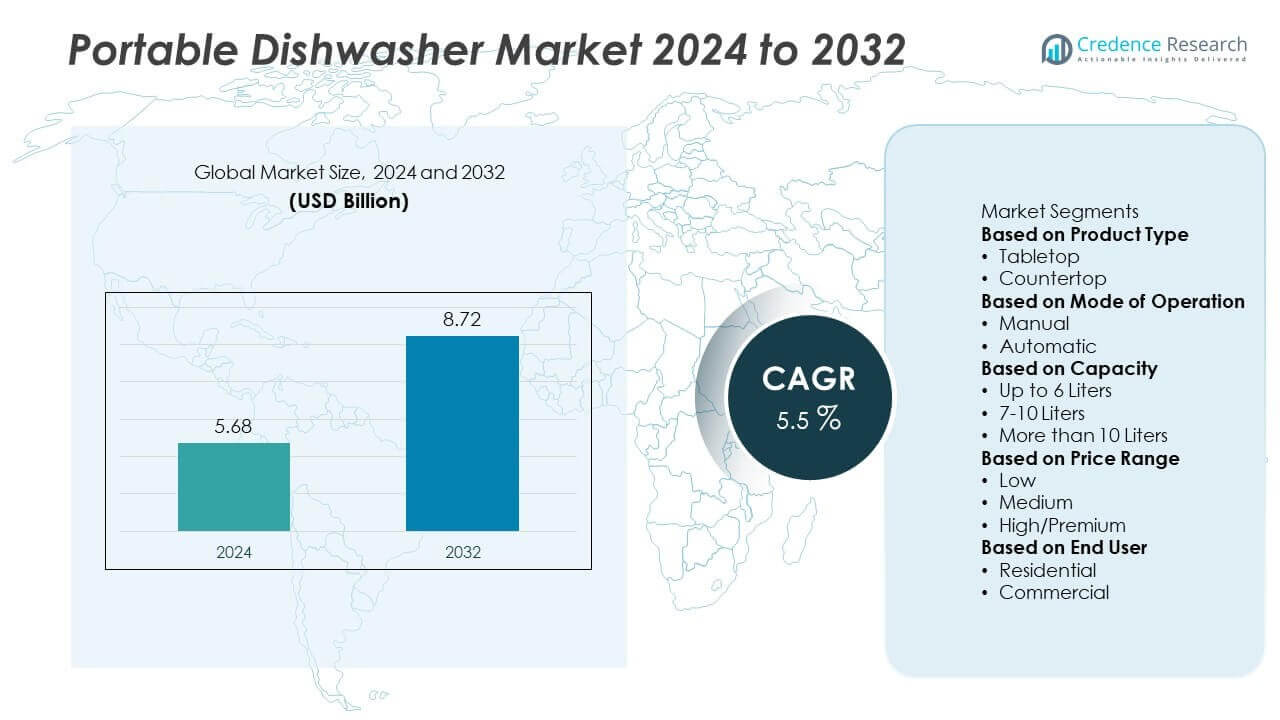
The Portable Dishwasher Market was valued at USD 5.68 billion in 2024. It is projected to reach USD 8.72 billion by 2032, growing at a CAGR of 5.5% during the forecast period.
| REPORT ATTRIBUTE | DETAILS |
|---|---|
| Historical Period | 2020-2023 |
| Base Year | 2024 |
| Forecast Period | 2025-2032 |
| Portable Dishwasher Market Size 2024 | USD 5.68 Billion |
| Portable Dishwasher Market, CAGR | 5.5% |
| Portable Dishwasher Market Size 2032 | USD 8.72 Billion |
The portable dishwasher market is driven by top players including Champion Industries, Haier Inc., KitchenAid, IFB Appliances, Electrolux AB, Danby, GE Appliances, Baumatic Ltd., Fisher & Paykel Appliances Ltd., and Fagor Industrial. These companies lead through innovation in compact, automated, and energy-efficient models while expanding their presence via online retail and regional distribution networks. North America emerged as the leading region in 2024 with over 35% share, supported by high consumer awareness and strong adoption of smart appliances. Europe followed with 30% share, driven by eco-regulations and demand for sustainable products, while Asia-Pacific accounted for 25% share, positioning itself as the fastest-growing market due to rising urbanization and expanding middle-class households.
 Market Insights
- The portable dishwasher market was valued at USD 5.68 billion in 2024 and is projected to reach USD 8.72 billion by 2032, growing at a CAGR of 5.5% during 2024–2032.
- Growing demand for convenience, compact designs, and automation drives adoption, with automatic models capturing nearly 65% share and tabletop dishwashers leading product type with over 55% share.
- Smart features such as IoT connectivity, energy-saving cycles, and eco-friendly designs are shaping market trends, with mid-capacity units (7–10 liters segment) holding 50% share due to suitability for family households.
- The competitive landscape is moderately consolidated with key players including Haier Inc., KitchenAid, IFB Appliances, Electrolux AB, GE Appliances, and Danby focusing on innovation, online retail expansion, and sustainability-focused designs.
- North America held over 35% share in 2024, followed by Europe at 30% and Asia-Pacific at 25%, with Asia-Pacific emerging as the fastest-growing regional market.
Market Segmentation Analysis:
By Product Type
The tabletop segment dominated the portable dishwasher market in 2024, accounting for over 55% share. Its leadership is driven by compact size, affordability, and suitability for small households and apartments where kitchen space is limited. Rising adoption among urban consumers and renters boosts demand, as tabletop units require minimal installation. Countertop models hold a smaller but growing share, supported by improved aesthetics and advanced features like energy-saving modes. However, tabletop dishwashers remain preferred due to ease of placement, lower water consumption, and strong distribution through online retail platforms.
- For instance, Danby’s DDW631SDB model, a six-place-setting tabletop dishwasher, operates at 54 dB and consumes approximately 11.7 liters of water per normal wash cycle, making it highly efficient for small households.
By Mode of Operation
Automatic portable dishwashers led the market in 2024 with nearly 65% share, reflecting consumers’ preference for convenience and efficiency. Growth is driven by rising demand for smart appliances that offer preset wash cycles, energy optimization, and water-saving technologies. Urban households increasingly adopt automatic models to save time, particularly in regions with higher disposable incomes. Manual units maintain presence in cost-sensitive markets, but lack of advanced features limits growth. Automatic dishwashers dominate due to integration of IoT-enabled controls, expanding their appeal across tech-savvy and working-class consumers.
- For instance, the Haier HDC1804TW portable countertop dishwasher features three wash cycles, a 47 dBA quiet package, and is suitable for smaller urban kitchens with limited space.
By Capacity
The 7–10 liters segment accounted for the largest share in 2024, holding around 50% of the market. This capacity range balances affordability with sufficient load size for medium households, making it the most practical choice. Rising urban population density and the need for efficient water usage drive segment dominance. Up to 6-liter models appeal to single users and compact apartments but capture a smaller share. Larger units above 10 liters are growing in premium households. However, mid-capacity dishwashers remain dominant due to strong demand among families seeking efficient yet space-saving solutions.
Key Growth Drivers
Rising Urbanization and Space Constraints
Urban households with limited kitchen space are driving demand for portable dishwashers. Compact units, especially tabletop models, fit well in small apartments where traditional built-in dishwashers are impractical. Rising rental housing and nuclear family structures add to adoption, as consumers seek flexible appliances that require minimal installation. Growing middle-class incomes in emerging markets also expand affordability, strengthening overall market penetration.
- For instance, the IFB Neptune VX dishwasher has a 12-place setting capacity and consumes 9 liters of water per cycle, which is efficient for daily use. This model has a width of approximately 59.6 cm.
Increasing Preference for Convenience and Automation
Consumers increasingly prioritize time-saving and hassle-free solutions in daily chores. Automatic portable dishwashers, with preset wash cycles, energy-saving features, and water optimization, address these needs effectively. The rise of dual-income households further supports this trend, as busy lifestyles encourage adoption of smart kitchen appliances. Manufacturers are introducing IoT-enabled and voice-controlled models, enhancing convenience and attracting tech-savvy buyers. This demand for automation is a strong growth engine.
- For instance, the KitchenAid KDTM604KPS model offers 44 dBA ultra-quiet operation along with a ProWash cycle that uses sensors to automatically adjust wash time and water temperature based on soil levels.
Rising Focus on Water and Energy Efficiency
Environmental concerns and rising utility costs are pushing consumers toward eco-friendly dishwashers. Modern portable dishwashers use less water compared to manual washing, appealing to households conscious about sustainability. Regulatory standards promoting energy-efficient appliances also boost adoption across developed regions. Manufacturers are innovating with low-water-use models and energy-saving modes, making these units more appealing. The focus on reducing environmental footprints ensures consistent growth momentum in this segment.
Key Trends & Opportunities
Adoption of Smart and Connected Appliances
Integration of IoT, AI, and smartphone connectivity is transforming the portable dishwasher market. Consumers can now control and monitor wash cycles remotely, while predictive maintenance and customized settings enhance user experience. Smart features not only improve convenience but also align with broader smart home adoption, creating new revenue opportunities for manufacturers.
- For instance, Haier has introduced several Wi-Fi–enabled dishwashers under its high-end Casarte brand, which can be controlled via a smartphone app to monitor the cycle status and start a wash remotely. Some of its full-size models, such as the double-drawer dishwasher, offer features like voice commands and real-time process display, while other Haier smart dishwashers can use sensors to automatically determine the appropriate water usage for a given load.
Growth in Online Retail and E-Commerce Distribution
Online platforms are emerging as a major sales channel for portable dishwashers. E-commerce offers consumers access to a wider variety of models, transparent pricing, and promotional discounts. Rising digital adoption in developing economies enhances market reach, creating strong opportunities for brands to expand customer bases beyond traditional retail.
- For instance, Electrolux AB distributes its ESF6010BW portable dishwasher across multiple e-commerce platforms, with an eight-place-setting capacity and water use rated at 8.8 liters per standard eco wash cycle, demonstrating strong traction through online sales channels.
Key Challenges
High Initial Cost and Limited Awareness
Despite growing demand, portable dishwashers remain relatively expensive compared to traditional manual washing. In cost-sensitive regions, this price barrier restricts penetration. Additionally, limited consumer awareness about product benefits slows adoption, particularly in developing economies where dishwashing remains labor-intensive.
Durability and Maintenance Concerns Many consumers perceive portable dishwashers as less durable than built-in models. Issues related to water leakage, limited load capacity, and frequent maintenance discourage adoption. These concerns create hesitation among first-time buyers and reduce repeat purchases, restraining faster market growth.
Regional Analysis
North America
North America held over 35% share of the portable dishwasher market in 2024, driven by high consumer adoption of compact and automated kitchen appliances. Strong demand stems from rising urban housing, nuclear families, and preference for convenience-focused solutions. The U.S. dominates the region, supported by advanced distribution networks and strong presence of leading appliance brands. Growing integration of IoT-enabled and energy-efficient models also fuels adoption. Canada contributes steadily, with increasing disposable incomes and sustainability-focused consumers driving sales. The region benefits from higher awareness of water and energy conservation, boosting market growth across residential households.
Europe
Europe accounted for around 30% share of the market in 2024, supported by advanced appliance penetration and environmental regulations. Countries such as Germany, the U.K., and France drive growth through strong awareness of water-saving and energy-efficient products. Compact housing across major cities enhances adoption of tabletop and mid-capacity dishwashers. EU policies promoting eco-friendly appliances create strong incentives for households to switch from manual washing. Additionally, rising online retail distribution provides greater accessibility to diverse product ranges. Europe remains a mature market where sustainability-driven innovations and automated models play a key role in maintaining steady demand.
Asia-Pacific
Asia-Pacific captured over 25% share in 2024 and represents the fastest-growing market for portable dishwashers. Rising urbanization, expanding middle-class incomes, and growing adoption of modern kitchen appliances drive strong demand. China leads the region with significant sales of affordable tabletop units, while Japan and South Korea showcase high adoption of smart and compact models. India is emerging as a promising market with increasing awareness of water-saving appliances. E-commerce growth further boosts accessibility, while regional manufacturers introduce budget-friendly options to attract first-time buyers. Asia-Pacific’s expansion is fueled by both affordability and consumer preference for convenient lifestyle solutions.
Latin America
Latin America held about 6% share of the market in 2024, with Brazil and Mexico serving as primary growth hubs. Increasing urban population and a shift toward modern appliances are driving demand, especially in middle-income households. Limited awareness and affordability challenges restrain faster penetration, but rising exposure through online retail and global brands is improving adoption. Demand for compact and low-capacity dishwashers is growing in metropolitan areas where space constraints prevail. Manufacturers are targeting cost-sensitive consumers with energy-efficient and budget-friendly options, helping the region build a steady but smaller role in the global market.
Middle East & Africa
The Middle East & Africa region accounted for around 4% share of the portable dishwasher market in 2024. Growth is led by the Gulf countries, where rising disposable incomes and preference for modern lifestyle appliances fuel adoption. Compact dishwashers are increasingly popular among younger households and urban residents. Africa remains a developing market with lower penetration due to affordability concerns and limited product awareness. However, expanding retail infrastructure and rising internet access are opening new opportunities. Energy- and water-saving models are gaining traction, particularly in areas facing resource constraints, supporting long-term market potential in the region.
Market Segmentations:
By Product Type
- Tabletop
- Countertop
By Mode of Operation
- Manual
- Automatic
By Capacity
- Up to 6 Liters
- 7-10 Liters
- More than 10 Liters
By Price Range
- Low
- Medium
- High/Premium
By End User
- Residential
- Commercial
By Geography
- North America
- U.S.
- Canada
- Mexico
- Europe
- UK
- France
- Germany
- Italy
- Spain
- Russia
- Belgium
- Netherlands
- Austria
- Sweden
- Poland
- Denmark
- Switzerland
- Rest of Europe
- Asia Pacific
- China
- Japan
- South Korea
- India
- Australia
- Thailand
- Indonesia
- Vietnam
- Malaysia
- Philippines
- Taiwan
- Rest of Asia Pacific
- Latin America
- Brazil
- Argentina
- Peru
- Chile
- Colombia
- Rest of Latin America
- Middle East
- UAE
- KSA
- Israel
- Turkey
- Iran
- Rest of Middle East
- Africa
- Egypt
- Nigeria
- Algeria
- Morocco
- Rest of Africa
Competitive Landscape
The competitive landscape of the portable dishwasher market is shaped by leading players such as Champion Industries, Haier Inc., KitchenAid, IFB Appliances, Electrolux AB, Danby, GE Appliances, Baumatic Ltd., Fisher & Paykel Appliances Ltd., and Fagor Industrial. These companies compete through product innovation, smart technology integration, and expansion into new regional markets. Many focus on developing compact, energy-efficient, and water-saving models to attract eco-conscious consumers. Strategic partnerships with online retailers and investments in e-commerce platforms are further strengthening their market presence. Global brands dominate in North America and Europe, while regional manufacturers are capturing growth in Asia-Pacific and Latin America with affordable product lines. Continuous innovation in design, automation, and IoT-enabled features is a major differentiator, as brands aim to expand consumer bases across both premium and cost-sensitive markets. The market remains moderately consolidated, with competition intensifying as manufacturers prioritize sustainability and user convenience.
Key Player Analysis
- Champion Industries
- Haier Inc.
- KitchenAid
- IFB Appliances
- Electrolux AB
- Danby
- GE Appliances
- Baumatic Ltd.
- Fisher & Paykel Appliances Ltd.
- Fagor Industrial
Recent Developments
- In May 2025, Electrolux Professional reported a top repairability rating for its NeoBlue Touch undercounter unit, reflecting efficiency features relevant to compact installations.
- In September 2024, KitchenAid announced its 360° Max Jets third-rack dishwasher platform, a tech update that spread across its lineup and informed compact offerings.
- In 2024, GE Appliances showcased its portfolio at KBIS 2024, including the 24-inch GPT225 portable dishwasher with sanitize cycle.
- In 2024, Champion Industries published guidance on selecting commercial dishwashers, noting space and mobility factors that align with portable needs.
Report Coverage
The research report offers an in-depth analysis based on Product Type, Mode of Operation, Capacity, Price Range, End User and Geography. It details leading market players, providing an overview of their business, product offerings, investments, revenue streams, and key applications. Additionally, the report includes insights into the competitive environment, SWOT analysis, current market trends, as well as the primary drivers and constraints. Furthermore, it discusses various factors that have driven market expansion in recent years. The report also explores market dynamics, regulatory scenarios, and technological advancements that are shaping the industry. It assesses the impact of external factors and global economic changes on market growth. Lastly, it provides strategic recommendations for new entrants and established companies to navigate the complexities of the market.
Future Outlook
- The market will expand steadily with rising adoption of compact household appliances.
- Automatic models will continue to dominate due to convenience and time-saving features.
- Smart and IoT-enabled dishwashers will gain higher demand among tech-savvy consumers.
- Energy- and water-efficient designs will remain central to product innovation.
- Tabletop dishwashers will sustain leadership as urban housing drives compact solutions.
- Online retail channels will strengthen distribution and improve global consumer access.
- Asia-Pacific will record the fastest growth, supported by urbanization and rising incomes.
- Europe will sustain demand driven by strict eco-regulations and sustainability awareness.
- Partnerships between manufacturers and e-commerce platforms will enhance market reach.
- Competition will intensify as global brands and regional players introduce affordable models.

Request a Free Sample
Fill in your details and we'll send you a free sample report.
- Sample data tables & charts
- Research methodology
Need a Custom Version of This Report?
Tailor the scope, geography, or segments to your exact requirements.
- Custom geography or segment scope
- Direct access to our analyst team
Frequently Asked Questions
What is the current market size for Portable Dishwasher market, and what is its projected size in 2032?
At what Compound Annual Growth Rate is the Portable Dishwasher market projected to grow between 2025 and 2032?
Which Portable Dishwasher market segment held the largest share in 2024?
What are the primary factors fueling the growth of the Portable Dishwasher market?
Who are the leading companies in the Portable Dishwasher market?
Which region commanded the largest share of the Portable Dishwasher market in 2024?
Table of Content
Chapter 1. Report Introduction
- 1.1 Report Description & Purpose
- 1.1.1 Report Title & Market Definition
- 1.1.2 Unique Selling Propositions (USP) & Key Differentiators
- 1.1.3 Value Proposition for Stakeholders
- 1.2 Research Objectives
- 1.2.1 Market Sizing Objectives (Volume & Revenue) (Volume Where Applicable)
- 1.2.2 Segmentation Objectives
- 1.2.3 Competitive Intelligence Objectives
- 1.2.4 Forecast & Scenario Objectives
- 1.3 Report Scope
- 1.3.1 Portable Dishwasher Scope – Segments & Subsegments Covered
- 1.3.2 Geographic Scope – Regions & Countries Covered
- 1.3.3 Historical Period, Base Year & Forecast Period (2024; forecast to 2032)
- 1.3.4 Inclusions & Exclusions
- 1.4 Industry Classification & Applicable Codes
- 1.5 Currency, Measurement Units & Valuation Basis
- 1.6 Target Stakeholders
- 1.7 Limitations & Assumptions
Chapter 2. Executive Summary
- 2.1 Global Portable Dishwasher Market Snapshot
- 2.1.1 Market Size – Historical (2024) & Forecast (2024-2032) (2024: USD 5.68 billion → 2032: USD 8.72 billion)
- 2.1.2 Volume & Revenue – Global Totals (Volume Where Applicable)
- 2.1.3 Key Market Highlights – Top Five Facts
- 2.2 Portable Dishwasher Market Segmentation Snapshot
- 2.2.1 Market Split by Region – 2024 vs. 2032
- 2.3 Competitive Snapshot
- 2.3.1 Top 10 Players by Revenue Share – 2024
- 2.3.2 Top 10 Players by Volume Share – 2024 (Volume Where Applicable)
- 2.3.3 Recent Strategic Developments (18-Month Summary)
- 2.4 Key Investment Highlights & Strategic Conclusions
Chapter 3. Portable Dishwasher Market Dynamics & Industry Analysis
- 3.1 Market Overview & Context
- 3.1.1 Portable Dishwasher Market Position in the Broader Industry Value Chain
- 3.1.2 Demand Structure & Purchasing Dynamics
- 3.1.3 Market Maturity & Development Stage by Region
- 3.2 Portable Dishwasher Market Drivers
- 3.3 Portable Dishwasher Market Restraints & Challenges
- 3.4 Portable Dishwasher Market Opportunities
- 3.5 Porter's Five Forces Analysis
- 3.5.1 Threat of New Entrants
- 3.5.2 Bargaining Power of Suppliers
- 3.5.3 Bargaining Power of Buyers
- 3.5.4 Threat of Substitutes
- 3.5.5 Competitive Rivalry – Intensity Assessment
- 3.6 Portable Dishwasher Value Chain Analysis
- 3.6.1 Upstream – Key Inputs, Resources & Suppliers
- 3.6.1.1 Key Input/Resource 1
- 3.6.1.2 Key Input/Resource 2
- 3.6.1.3 Key Input/Resource 3
- 3.6.2 Midstream – Core Operations & Value Creation
- 3.6.2.1 Operating Model & Process Overview
- 3.6.2.2 Key Operating Locations & Capabilities by Company
- 3.6.3 Downstream – Market Channels & End Users
- 3.6.3.1 Direct Sales & Customer Engagement Channels
- 3.6.3.2 Indirect Sales, Intermediaries & Partner Channels
- 3.6.4 Value Chain Profitability Analysis
- 3.6.1 Upstream – Key Inputs, Resources & Suppliers
- 3.7 PESTEL Analysis
- 3.7.1 Political Factors
- 3.7.2 Economic Factors
- 3.7.3 Social Factors
- 3.7.4 Technological Factors
- 3.7.5 Environmental Factors
- 3.7.6 Legal Factors
- 3.8 Portable Dishwasher Supply Chain Analysis
- 3.8.1 Critical Input & Resource Availability Risk Assessment
- 3.8.2 Supplier & Operational Concentration Risk (Geographic Exposure)
- 3.8.3 Supply & Service Disruption Impact Analysis
- 3.9 Regulatory & Policy Landscape
Note: The regulatory and policy landscape section covers regulations based on their applicability to the market, Portable Dishwasher category, geography, and scope of the study. Only regulatory frameworks with a material impact on operations, compliance, trade, sustainability, or market access are analyzed in detail.
Chapter 4. Key Investment Pockets & Opportunity Analysis
- 4.1 Portable Dishwasher Market Attractiveness Analysis
- 4.1.1 By Region – Investment Attractiveness Matrix (Market Size × CAGR)
- 4.2 Absolute Revenue Growth Opportunity
- 4.2.1 By Region – Absolute Revenue Growth Through 2032
- 4.3 Incremental Demand Opportunity
- 4.3.1 By Region – Incremental Demand Through 2032
- 4.3.2 Segment – Incremental Demand
- 4.4 Emerging Submarket Opportunity Deep Dive (Subject to Applicability)
- 4.5 Priority Market Opportunity Scorecards
- 4.5.1 United States
- 4.5.2 Europe
- 4.5.3 Asia
- 4.5.4 Middle East & Africa
Note: Priority market opportunity scorecards reflect the geographic scope and strategic relevance of the study. Listed markets are indicative and may be adapted to the industry.
Chapter 5. Portable Dishwasher Cross-Border Trade & Market Access Analysis
- 5.1 International Trade & Cross-Border Activity Overview
- 5.1.1 Global Export Value by Country (2024)
- 5.1.2 Global Export Volume by Country (2024) (Volume Where Applicable)
- 5.1.3 Global Import Value by Country (2024)
- 5.1.4 Global Import Volume by Country (2024) (Volume Where Applicable)
- 5.1.5 Net Trade Balance by Country (2024)
- 5.2 Export Analysis – Segment
- 5.2.1 Category 1 (Applicable Classification Code)
- 5.2.2 Category 2 (Applicable Classification Code)
- 5.2.3 Category 3 (Applicable Classification Code)
- 5.2.4 Category 4 (Applicable Classification Code)
- 5.2.5 Category 5 (Applicable Classification Code)
- 5.3 Import Analysis – Segment
- 5.3.1 Category 1 (Applicable Classification Code)
- 5.3.2 Category 2 (Applicable Classification Code)
- 5.3.3 Category 3 (Applicable Classification Code)
- 5.3.4 Category 4 (Applicable Classification Code)
- 5.3.5 Category 5 (Applicable Classification Code)
- 5.4 Cross-Border Pricing & Transaction Benchmarks
- 5.4.1 Export Pricing – Segment & Country
- 5.4.2 Import Pricing – Segment & Source Country
- 5.4.3 Price Trends (2024)
- 5.5 Key Cross-Border Trade & Delivery Routes
- 5.5.1 Cross-Border Trade/Delivery Route 1
- 5.5.2 Cross-Border Trade/Delivery Route 2
- 5.5.3 Cross-Border Trade/Delivery Route 3
- 5.5.4 Cross-Border Trade/Delivery Route 4
- 5.5.5 Cross-Border Trade/Delivery Route 5
- 5.6 Trade Policy & Market Access Impact Assessment
- 5.6.1 Tariff & Non-Tariff Barriers
- 5.6.2 Regional Trade & Economic Integration Frameworks
- 5.6.3 Bilateral & Multilateral Trade Agreements
- 5.6.4 Cross-Border Operating, Licensing & Localization Requirements
Note: This chapter applies where cross-border trade or delivery is relevant to Portable Dishwasher. Goods, services, and digital offerings are assessed using applicable classifications and transaction measures. Import-export volumes, trade balances, and route analyses are included only where meaningful to the market.
Chapter 6. Competitive Landscape & Company Benchmarking
- 6.1 Portable Dishwasher Market Concentration & Structure
- 6.1.1 Herfindahl-Hirschman Index (HHI) – the historical period vs. 2024
- 6.1.2 Leading, Mid-Sized & Emerging Player Structure
- 6.1.3 Global, Regional & Local Player Dynamics
- 6.2 Portable Dishwasher Market Share Analysis – 2024
- 6.2.1 Global Revenue Share by Company
- 6.2.2 Global Volume Share by Company (Volume Where Applicable)
- 6.2.3 Regional Revenue Share
- 6.2.4 Market Share Evolution (the historical period vs. 2024)
- 6.2.5 Company Market Share by Key Segment
- 6.2.6 Company Market Share by Customer Group
- 6.3 Operating Scale, Capacity & Infrastructure Analysis
- 6.3.1 Global Operating Scale & Supply Capacity
- 6.3.2 Resource Utilization & Operating Efficiency
- 6.3.3 Output, Service Delivery & Activity Metrics
- 6.3.4 Operating Footprint & Infrastructure Map
- 6.3.5 Planned Operational & Capacity Expansion
- 6.4 Portable Dishwasher Competitive Benchmarking Matrix
- 6.4.1 Revenue, Growth, Profitability & Operating Metric Comparison
- 6.4.2 Channel Revenue Mix
- 6.4.3 Geographic Revenue Exposure
- 6.4.4 R&D Intensity
- 6.4.5 Sustainability Maturity
- 6.5 Strategic Developments in Portable Dishwasher (Last 24 Months)
- 6.5.1 Mergers, Acquisitions & Divestments
- 6.5.2 New Products, Services & Solutions in Portable Dishwasher
- 6.5.3 Operational & Infrastructure Expansions
- 6.5.4 Strategic Alliances, Joint Ventures & Partnerships
- 6.5.5 Distribution Expansion & Market Entry
- 6.5.6 Sustainability & ESG Initiatives
- 6.6 Competitive Strategy Mapping
- 6.6.1 Leader, Challenger, Follower & Niche Classification
- 6.6.2 Pricing Strategy Comparison
- 6.6.3 Channel Strategy Matrix
Note: Strategic developments are included based on their materiality and the availability of reliable information.
Chapter 7. Global Portable Dishwasher Market – By Sales & Delivery Channel
- 7.1 Segment Overview
- 7.1.1 Volume & Revenue Split by Channel (2024 & 2032) (Volume Where Applicable)
- 7.1.2 Channel Mix Evolution (2024-2032)
Chapter 8. Regional Market Analysis – Global Overview
- 8.1 Global Regional Overview
- 8.1.1 Regional Volume Share (Volume Where Applicable)
- 8.1.2 Regional Revenue Share
- 8.1.3 Regional Volume by Region (Volume Where Applicable)
- 8.1.4 Regional Revenue by Region
- 8.1.5 Regional Forecast Through 2032
- 8.2 Cross-Regional Segment Analysis
- 8.2.1 By Sales & Delivery Channel
- 8.2.2 By Competitive Positioning & Price Tier
Chapter 9. North America Portable Dishwasher Market
- 9.1 United States
- 9.2 Canada
- 9.3 Mexico
Chapter 10. Europe Portable Dishwasher Market
- 10.1 Germany
- 10.2 France
- 10.3 Italy
- 10.4 United Kingdom
- 10.5 Spain
- 10.6 Poland
- 10.7 Russia
- 10.8 Netherlands
- 10.9 Belgium
- 10.10 Sweden
- 10.11 Denmark
- 10.12 Norway
- 10.13 Rest of Europe
Chapter 11. Asia Pacific Portable Dishwasher Market
- 11.1 China
- 11.2 India
- 11.3 Japan
- 11.4 South Korea
- 11.5 Thailand
- 11.6 Indonesia
- 11.7 Vietnam
- 11.8 Malaysia
- 11.9 Australia
- 11.10 Rest of Asia Pacific
Chapter 12. Latin America Portable Dishwasher Market
- 12.1 Brazil
- 12.2 Argentina
- 12.3 Colombia
- 12.4 Chile
- 12.5 Rest of Latin America
Chapter 13. Middle East Portable Dishwasher Market
- 13.1 Saudi Arabia
- 13.2 United Arab Emirates
- 13.3 Turkey
- 13.4 Israel
- 13.5 Iran
- 13.6 Rest of the Middle East
Chapter 14. Africa Portable Dishwasher Market
- 14.1 South Africa
- 14.2 Egypt
- 14.3 Nigeria
- 14.4 Morocco
- 14.5 Rest of Africa
Chapter 15. Portable Dishwasher Company Profiles
- 15.1 [Company 01]
- 15.1.1 Company Overview
- 15.1.2 Key Management Personnel
- 15.1.3 Products & Services Portfolio
- 15.1.4 Financial Performance
- 15.1.5 Key Market Focus & Geographic Presence
- 15.1.6 Recent Developments & Strategic Initiatives
Note: The company profile list is preliminary and may change based on research findings, market developments, data availability, and client requirements.
Chapter 16. Appendices
- Appendix A – List of Abbreviations & Acronyms
- Appendix B – Industry Classification Code Reference – Full Series
- Appendix C – Supply, Output & Operating Capacity Data Tables
- Appendix D – End-Use & Demand Base Tables
- Appendix E – Demand, Adoption & Usage Assumptions
- Appendix F – Pricing & Revenue Metric Reference Tables
- Appendix G – Company Operations & Infrastructure Database
- Appendix H – Cross-Border Trade & Activity Data Tables (Where Applicable)
- Appendix I – Regulatory Summary Tables
- Appendix J – Primary Research Participant List (Anonymized)
- Appendix K – Primary Research Questionnaire Framework
- Appendix L – Data Sources & Bibliography
- Appendix M – Market Size Divergence & Source Comparison
Chapter 17. Research Methodology
- 17.1 Research Framework & Philosophy
- 17.2 Secondary Research – Sources, Hierarchy & Data Extraction
- 17.3 Data Modeling – Bottom-Up & Top-Down Market Sizing
- 17.4 Primary Research – Stakeholder Framework, LOI & Sample Sizes
- 17.5 Forecast Methodology – Regression, Scenario & Sensitivity Analysis
- 17.6 Quality Control – Four-Layer Validation Framework
- 17.7 Limitations & Standard Assumptions
- 17.8 Disclaimer
