
Protein Shot Market Overview:
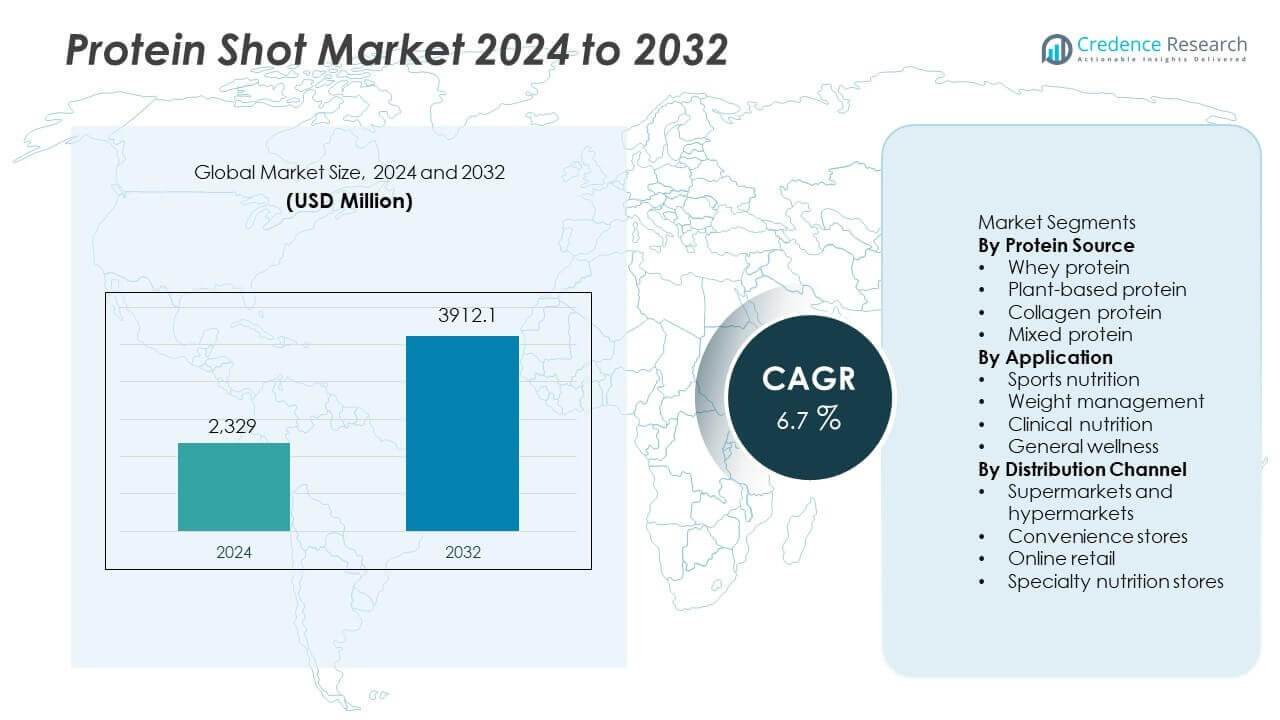
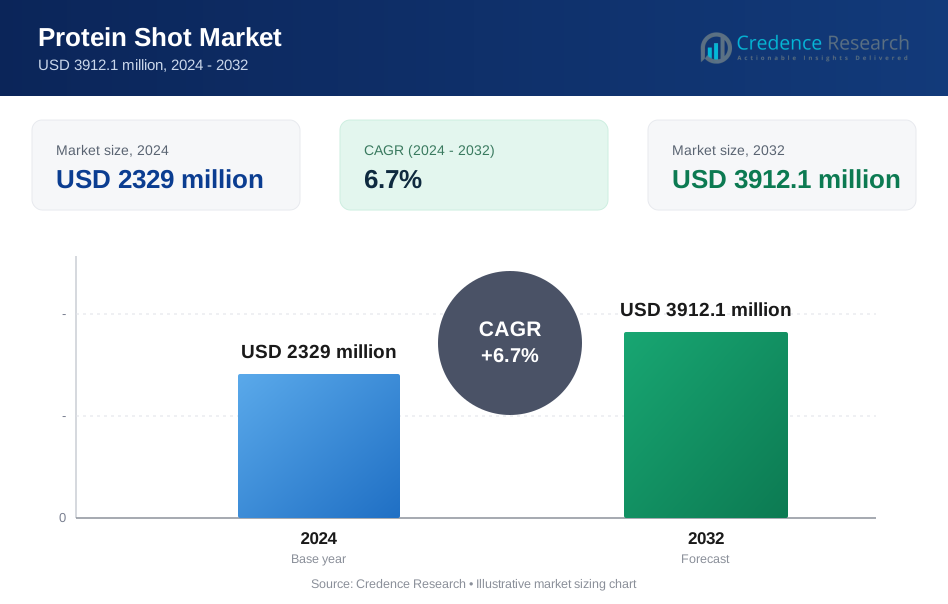
The protein shot market was valued at USD 2329 million in 2024 and is projected to reach USD 3912.1 million by 2032, growing at a CAGR of 6.7% during the forecast period.
| REPORT ATTRIBUTE | DETAILS |
|---|---|
| Historical Period | 2020-2023 |
| Base Year | 2024 |
| Forecast Period | 2025-2032 |
| Protein Shot Market Size 2024 | USD 2329 million |
| Protein Shot Market, CAGR | 6.7% |
| Protein Shot Market Size 2032 | USD 3912.1 million |
Protein Shot Market Insights
- Market growth is driven by rising demand for convenient protein intake, sports nutrition usage, and preventive health focus, with whey protein leading the protein source segment at a market share of 42.7%.
- Key trends include expansion of plant-based and functional protein shots, while sports nutrition dominates applications with a market share of 46.3% due to active lifestyle adoption.
- Competitive activity remains strong as major brands invest in taste improvement, compact packaging, and online distribution, while regulatory compliance and formulation challenges act as restraints.
- North America leads regional performance with a market share of 35.6%, followed by Europe at 27.9% and Asia Pacific at 24.3%, driven by fitness culture, wellness awareness, and urbanization.
Protein Shot Market Segmentation Analysis:
By Protein Source
By protein source, whey protein dominates the protein shot market with a market share of 42.7%. Strong consumer trust in whey for muscle recovery and fast absorption supports this leadership. Athletes and fitness-focused consumers prefer whey-based shots for post-workout convenience. High bioavailability and complete amino acid profiles strengthen demand. Manufacturers favor whey due to formulation stability and taste compatibility. Plant-based protein follows, driven by vegan and lactose-intolerant consumers, while collagen protein gains traction for beauty and joint health positioning. Mixed protein shots address balanced nutrition needs. Whey remains dominant due to proven performance benefits, wide availability, and strong brand adoption.
- For instance, Glanbia plc formulates whey shots delivering 20 grams of protein with all nine essential amino acids per serving.'
By Application
By application, sports nutrition holds the largest share at 46.3% of the protein shot market. Active lifestyles, gym participation, and endurance training drive demand for compact protein formats. Protein shots offer quick intake without heavy volume, appealing to athletes and busy professionals. Brands market sports-focused claims around strength, recovery, and stamina. Weight management applications follow, supported by appetite control positioning. General wellness adoption rises among older consumers, while clinical nutrition remains niche. Sports nutrition leads due to high consumption frequency, performance-driven purchasing behavior, and strong influence of fitness trends across urban populations.
- For instance, PepsiCo, Inc. expanded its sports nutrition portfolio by launching high-protein beverages and recovery products through its Gatorade and Muscle Milk brands specifically designed for athletic performance and gym use.
By Distribution Channel
By distribution channel, supermarkets and hypermarkets account for a market share of 38.9%, leading protein shot sales. Wide shelf visibility and impulse buying support high volumes. Consumers prefer physical retail for immediate consumption and brand comparison. Strong cold-chain and promotional activity improve sales velocity. Convenience stores follow due to on-the-go consumption patterns. Online retail grows rapidly, driven by subscriptions and fitness-focused consumers. Specialty nutrition stores cater to premium buyers but remain smaller in scale. Supermarkets maintain dominance due to accessibility, pricing leverage, and strong integration with sports and functional beverage categories.
Key Growth Drivers
Rising Demand for Convenient Protein Intake
Consumers increasingly prefer nutrition solutions that save time and fit busy routines. Protein shots provide concentrated protein in small, ready-to-drink formats, supporting on-the-go consumption. Working professionals, travelers, and fitness users favor quick intake without preparation. Compact packaging improves portability and storage convenience. Brands position protein shots as efficient alternatives to shakes and powders. High usage after workouts and between meals supports repeat purchases. Convenience-driven consumption aligns with modern lifestyles and urban work patterns. This driver continues to expand demand across gyms, offices, convenience stores, and wellness-focused retail environments.
- For instance, Danone S.A. developed high-protein shots packed in 80-milliliter bottles, designed for single-hand consumption during travel.
Growth in Sports and Active Lifestyle Participation
Participation in fitness activities, sports training, and recreational exercise continues to rise. Protein shots support muscle recovery, endurance, and strength maintenance. Athletes prefer fast-absorbing protein formats after training sessions. Gym culture and home workouts increase protein consumption frequency. Sports coaches and influencers promote compact protein solutions. Brands align product messaging with performance and recovery benefits. Increased focus on physical fitness among young adults supports consistent demand. This driver remains central to protein shot adoption across sports nutrition and active lifestyle segments.
- For instance, MusclePharm Corporation offers protein powders and ready-to-drink shakes formulated with fast-digesting whey protein to support muscle recovery.
Increasing Focus on Preventive Health and Daily Nutrition
Preventive health awareness influences dietary choices across age groups. Protein intake supports muscle health, metabolism, and active aging. Older consumers adopt protein shots to maintain strength and mobility. Healthcare professionals recommend adequate protein for daily wellness. Brands expand positioning beyond sports toward general nutrition. Protein shots fit into routine health management due to controlled portions. This driver broadens consumer adoption beyond athletes. Preventive nutrition trends support steady growth and long-term market sustainability.
Key Trends & Opportunities
Expansion of Plant-Based and Functional Protein Shots
Plant-based protein shots gain popularity due to vegan and flexitarian diets. Consumers seek dairy-free and allergen-friendly options. Brands introduce pea, soy, and blended plant proteins. Functional ingredients such as collagen, vitamins, and minerals enhance value. Innovation improves taste and texture consistency. This trend reduces reliance on whey protein. Plant-based expansion creates opportunities for premium and niche positioning. Functional differentiation supports brand competitiveness and portfolio diversification across health-focused consumer groups.
- For instance, Nestlé S.A. developed plant-based nutritional beverages using pea protein to provide a supplemental protein source with a concentrated amino acid profile.
Growth of Online and Direct-to-Consumer Sales Channels
Online channels create strong growth opportunities for protein shots. Fitness consumers prefer digital purchasing and subscriptions. Direct-to-consumer platforms support brand education and loyalty. Improved logistics enable reliable delivery of liquid nutrition. Online marketing targets niche fitness and wellness segments. Brands gain pricing control and customer data insights. This trend expands reach beyond physical retail. Digital sales strengthen margins and support long-term market expansion.
- For instance, Herbalife Ltd. scaled direct selling platforms handling millions of monthly product shipments through distributor-linked e-commerce systems.
Key Challenges
Taste, Texture, and Formulation Constraints
High protein concentration creates formulation challenges for protein shots. Taste bitterness and thick textures affect consumer acceptance. Flavor masking increases development complexity. Poor sensory experience reduces repeat purchases. Brands invest in sweeteners and flavor technologies. Product consistency remains critical for retention. This challenge limits adoption among non-athlete consumers. Continuous formulation innovation is required to maintain market growth.
Regulatory and Labeling Compliance Complexity
Protein claims face strict regulatory review across regions. Labeling standards differ by country and market. Compliance increases time and cost for product launches. Smaller brands face entry barriers. Ingredient approvals and health claims require validation. Regulatory uncertainty slows innovation cycles. These constraints restrict rapid expansion and cross-border scaling.
Regional Analysis
North America
North America holds a market share of 35.6% in the protein shot market, supported by strong sports nutrition adoption and high health awareness. Consumers actively use protein shots for post-workout recovery and on-the-go nutrition. Busy work schedules and fitness-oriented lifestyles drive frequent consumption. Strong presence of gyms, wellness centers, and convenience retail supports accessibility. Brands focus on whey-based and functional protein shots to meet performance needs. Online subscriptions further support repeat purchases. The region benefits from strong product innovation, influencer marketing, and established sports nutrition culture, sustaining leadership in protein shot consumption.
Europe
Europe accounts for a market share of 27.9%, driven by growing fitness participation and preventive health awareness. Consumers increasingly adopt protein shots for muscle maintenance and daily wellness. Clean-label and natural ingredient preferences influence purchasing decisions. Countries such as Germany, the United Kingdom, and France support steady demand. Retail chains and specialty nutrition stores provide strong distribution. Plant-based protein shots gain traction due to dietary shifts. Regulatory clarity supports product launches. Europe shows balanced growth supported by sports nutrition demand and expanding general wellness usage.
Asia Pacific
Asia Pacific holds a market share of 24.3%, reflecting rising urbanization and changing dietary habits. Young consumers adopt protein shots for fitness and weight management. Expanding gym memberships and sports participation drive demand. E-commerce growth improves product access in urban areas. Brands introduce affordable and localized formulations. Plant-based proteins gain interest due to dietary preferences. The region benefits from rising disposable income and health awareness. Asia Pacific shows strong growth potential supported by lifestyle changes and expanding sports nutrition adoption.
Rest of the World
The Rest of the World region accounts for a market share of 12.2%, supported by gradual health and fitness adoption. Latin America shows rising interest in sports nutrition products. The Middle East benefits from growing gym culture and premium wellness trends. Africa remains an emerging market with limited penetration. Distribution focuses on urban retail and specialty stores. International brands expand presence through partnerships. Consumer education supports adoption. Although smaller in scale, the region offers steady growth driven by lifestyle changes and increasing awareness of protein-based nutrition.
Protein Shot Market Segmentations:
By Protein Source
- Whey protein
- Plant-based protein
- Collagen protein
- Mixed protein
By Application
- Sports nutrition
- Weight management
- Clinical nutrition
- General wellness
By Distribution Channel
- Supermarkets and hypermarkets
- Convenience stores
- Online retail
- Specialty nutrition stores
By Geography
- North America
- U.S.
- Canada
- Mexico
- Europe
- Germany
- France
- U.K.
- Italy
- Spain
- Rest of Europe
- Asia Pacific
- China
- Japan
- India
- South Korea
- South-east Asia
- Rest of Asia Pacific
- Latin America
- Brazil
- Argentina
- Rest of Latin America
- Middle East & Africa
- GCC Countries
- South Africa
- Rest of the Middle East and Africa
Competitive Landscape
Competitive landscape analysis highlights competition led by Abbott Laboratories, Nestlé S.A., Glanbia plc, PepsiCo, Inc., and Herbalife Ltd.. These players compete through brand strength, formulation expertise, and wide distribution networks. Market leaders focus on high-protein concentration, improved taste profiles, and functional benefits such as recovery and wellness support. Innovation centers on whey, plant-based, and collagen protein formats. Companies invest in convenient packaging and on-the-go positioning to capture active consumers. Strategic partnerships with gyms and sports platforms enhance visibility. Online channels and direct-to-consumer models support customer engagement. Smaller brands compete through niche positioning and clean-label claims. Overall competition remains strong, driven by innovation speed, brand trust, and retail penetration.
Key Player Analysis
- Abbott Laboratories
- PepsiCo, Inc.
- Nestlé S.A.
- Glanbia plc
- The Coca-Cola Company
- MusclePharm Corporation
- Amway Corporation
- Herbalife Ltd.
- GNC Holdings LLC
- Danone S.A.
Recent Developments
- In May 2025, Danone S.A. rolled out a new Oikos-branded protein shake to tap into the growing U.S. protein beverage market.
- In January 2025, Nestlé S.A. introduced Boost Pre-Meal Hunger Support protein shots in the United States to help suppress appetite for weight-loss drug users.
- In January 2024, Abbott Laboratories launched its new PROTALITY™ high-protein shake brand for adults on weight-loss journeys, helping preserve muscle mass during dieting.
Report Coverage
The research report offers an in-depth analysis based on Protein Source, Application, Distribution Channel and Geography. It details leading market players, providing an overview of their business, product offerings, investments, revenue streams, and key applications. Additionally, the report includes insights into the competitive environment, SWOT analysis, current market trends, as well as the primary drivers and constraints. Furthermore, it discusses various factors that have driven market expansion in recent years. The report also explores market dynamics, regulatory scenarios, and technological advancements that are shaping the industry. It assesses the impact of external factors and global economic changes on market growth. Lastly, it provides strategic recommendations for new entrants and established companies to navigate the complexities of the market.
Future Outlook
- Demand for protein shots will rise with busy and fitness-focused lifestyles.
- Brands will expand plant-based and allergen-free protein shot options.
- Product innovation will focus on improved taste and smoother textures.
- Sports nutrition will remain the primary consumption application.
- Preventive health awareness will broaden use beyond athletes.
- Online and subscription-based sales will gain stronger adoption.
- Functional ingredients will increase product differentiation.
- Asia Pacific will show faster adoption due to urban lifestyle changes.
- Convenience packaging will drive impulse and repeat purchases.
- Regulatory clarity will support wider product launches and scaling.
Request a Free Sample
Fill in your details and we'll send you a free sample report.
- Sample data tables & charts
- Research methodology
Need a Custom Version of This Report?
Tailor the scope, geography, or segments to your exact requirements.
- Custom geography or segment scope
- Direct access to our analyst team
Frequently Asked Questions
What is the current market size for Protein Shot market, and what is its projected size in 2032?
At what Compound Annual Growth Rate is the Protein Shot market projected to grow between 2024 and 2032?
Which Protein Shot market segment held the largest share in 2024?
What are the primary factors fueling the growth of the Protein Shot market?
Who are the leading companies in the Protein Shot market?
Which region commanded the largest share of the Protein Shot market in 2024?
Table of Content
Chapter 1. Report Introduction
- 1.1 Report Description & Purpose
- 1.1.1 Report Title & Market Definition
- 1.1.2 Unique Selling Propositions (USP) & Key Differentiators
- 1.1.3 Value Proposition for Stakeholders
- 1.2 Research Objectives
- 1.2.1 Market Sizing Objectives (Volume & Revenue)
- 1.2.2 Segmentation Objectives
- 1.2.3 Competitive Intelligence Objectives
- 1.2.4 Forecast & Scenario Objectives
- 1.3 Report Scope
- 1.3.1 Protein Shot Scope – Types & Subtypes Covered
- 1.3.2 Geographic Scope – Regions & Countries Covered
- 1.3.3 Historical Period, Base Year & Forecast Period (2024; forecast to 2032)
- 1.3.4 Inclusions & Exclusions
- 1.4 HS Code & Classification Framework
- 1.5 Currency, Units & Pricing Basis
- 1.6 Target Stakeholders
- 1.7 Limitations & Assumptions
Chapter 2. Executive Summary
- 2.1 Global Protein Shot Market Snapshot
- 2.1.1 Market Size – Historical (2024) & Forecast (2024-2032) (2024: USD 2329 million → 2032: USD 3912.1 million)
- 2.1.2 Volume & Revenue – Global Totals
- 2.1.3 Key Market Highlights – Top Five Facts
- 2.2 Protein Shot Market Segmentation Snapshot
- 2.2.1 Market Split by Region – 2024 vs. 2032
- 2.3 Competitive Snapshot
- 2.3.1 Top 10 Players by Revenue Share – 2024
- 2.3.2 Top 10 Players by Volume Share – 2024
- 2.3.3 Recent Strategic Developments (18-Month Summary)
- 2.4 Key Investment Highlights & Strategic Conclusions
Chapter 3. Protein Shot Market Dynamics & Industry Analysis
- 3.1 Market Overview & Context
- 3.1.1 Protein Shot Market Position in the Broader Automotive Value Chain
- 3.1.2 OEM vs. Replacement Market Dynamics
- 3.1.3 Market Maturity & Development Stage by Region
- 3.2 Protein Shot Market Drivers
- 3.3 Protein Shot Market Restraints & Challenges
- 3.4 Protein Shot Market Opportunities
- 3.5 Porter's Five Forces Analysis
- 3.5.1 Threat of New Entrants
- 3.5.2 Bargaining Power of Suppliers
- 3.5.3 Bargaining Power of Buyers
- 3.5.4 Threat of Substitutes
- 3.5.5 Competitive Rivalry – Intensity Assessment
- 3.6 Protein Shot Value Chain Analysis
- 3.6.1 Upstream – Raw Material/Input Suppliers
- 3.6.1.1 Raw Material/Input 1
- 3.6.1.2 Raw Material/Input 2
- 3.6.1.3 Raw Material/Input 3
- 3.6.2 Midstream – Production/Manufacturing/Service Delivery
- 3.6.2.1 Production/Process Overview
- 3.6.2.2 Key Facility Locations & Capacity by Manufacturer
- 3.6.3 Downstream – Distribution & End Consumer
- 3.6.3.1 Primary Channel – B2B/OEM
- 3.6.3.2 Secondary Channels – Dealer, Retail, Online, Direct
- 3.6.4 Value Chain Profitability Analysis
- 3.6.1 Upstream – Raw Material/Input Suppliers
- 3.7 PESTEL Analysis
- 3.7.1 Political Factors
- 3.7.2 Economic Factors
- 3.7.3 Social Factors
- 3.7.4 Technological Factors
- 3.7.5 Environmental Factors
- 3.7.6 Legal Factors
- 3.8 Protein Shot Supply Chain Analysis
- 3.8.1 Raw Material/Input Supply Risk Assessment
- 3.8.2 Manufacturing Concentration Risk (Geographic Exposure)
- 3.8.3 Trade Disruption Impact Analysis
- 3.9 Regulatory & Policy Landscape
Note: The regulatory and policy landscape section covers regulations based on their applicability to the market, Protein Shot category, geography, and scope of the study. Only regulatory frameworks with a material impact on operations, compliance, trade, sustainability, or market access are analyzed in detail.
Chapter 4. Key Investment Pockets & Opportunity Analysis
- 4.1 Protein Shot Market Attractiveness Analysis
- 4.1.1 By Region – Investment Attractiveness Matrix (Volume × CAGR)
- 4.2 Absolute Revenue Growth Opportunity
- 4.2.1 By Region – Absolute USD Growth Through 2032
- 4.3 Incremental Volume Opportunity
- 4.3.1 By Region – Incremental Volume Through 2032
- 4.3.2 Segment – Incremental Volume
- 4.4 Emerging Submarket Opportunity Deep Dive (Subject to Applicability)
- 4.5 Emerging Market Opportunity Scorecards
- 4.5.1 United States
- 4.5.2 Europe
- 4.5.3 Asia
- 4.5.4 Middle East & Africa
Note: Emerging Market Opportunity Scorecards will be included based on relevance and strategic importance. Regions listed are indicative and may vary depending on data availability and market dynamics.
Chapter 5. Protein Shot Import-Export Analysis & Trade Flows
- 5.1 Global Trade Overview
- 5.1.1 Global Export Value by Country (2024)
- 5.1.2 Global Export Volume by Country (2024)
- 5.1.3 Global Import Value by Country (2024)
- 5.1.4 Global Import Volume by Country (2024)
- 5.1.5 Net Trade Balance by Country (2024)
- 5.2 Export Analysis – Segment
- 5.2.1 Type 1 (HS Code)
- 5.2.2 Type 2 (HS Code)
- 5.2.3 Type 3 (HS Code)
- 5.2.4 Type 4 (HS Code)
- 5.2.5 Type 5 (HS Code)
- 5.3 Import Analysis – Segment
- 5.3.1 Type 1 (HS Code)
- 5.3.2 Type 2 (HS Code)
- 5.3.3 Type 3 (HS Code)
- 5.3.4 Type 4 (HS Code)
- 5.3.5 Type 5 (HS Code)
- 5.4 Average Unit Trade Prices
- 5.4.1 Average Export Price – Segment & Country
- 5.4.2 Average Import Price – Segment & Source Country
- 5.4.3 Price Trends (2024)
- 5.5 Key Trade Route Analysis
- 5.5.1 Trade Route 1
- 5.5.2 Trade Route 2
- 5.5.3 Trade Route 3
- 5.5.4 Trade Route 4
- 5.5.5 Trade Route 5
- 5.6 Trade Policy Impact Assessment
- 5.6.1 US Anti-Dumping & Section 301 Tariffs
- 5.6.2 EU Customs Union Impact
- 5.6.3 Major Free Trade Agreements
- 5.6.4 USMCA Rules of Origin
Note: Trade policy analysis will be included only where relevant to the Protein Shot market.
Chapter 6. Competitive Landscape & Company Benchmarking
- 6.1 Protein Shot Market Concentration & Structure
- 6.1.1 Herfindahl-Hirschman Index (HHI) – vs. 2024
- 6.1.2 Tier 1, Tier 2 & Tier 3 Market Structure
- 6.1.3 Global, Regional & Local Player Dynamics
- 6.2 Protein Shot Market Share Analysis – 2024
- 6.2.1 Global Revenue Share by Company
- 6.2.2 Global Volume Share by Company
- 6.2.3 Regional Revenue Share
- 6.2.4 Market Share Evolution ( vs. 2024)
- 6.2.5 OEM Segment Share by Company
- 6.2.6 Replacement Segment Share by Company
- 6.3 Production/Delivery Capacity & Facility Analysis
- 6.3.1 Global Installed Capacity
- 6.3.2 Capacity Utilization Rates
- 6.3.3 Production/Output Volume
- 6.3.4 Facility Locations & Capacity Map
- 6.3.5 Planned Capacity Additions
- 6.4 Protein Shot Competitive Benchmarking Matrix
- 6.4.1 Revenue, Volume, CAGR & Profitability Comparison
- 6.4.2 Channel Revenue Mix
- 6.4.3 Geographic Revenue Exposure
- 6.4.4 R&D Intensity
- 6.4.5 Sustainability Maturity
- 6.5 Strategic Developments in Protein Shot (Last 24 Months)
- 6.5.1 Mergers, Acquisitions & Divestments
- 6.5.2 New Protein Shot Launches
- 6.5.3 Facility Expansions
- 6.5.4 Strategic Alliances, Joint Ventures & Partnerships
- 6.5.5 Distribution Expansion & Market Entry
- 6.5.6 Sustainability & ESG Initiatives
- 6.6 Competitive Strategy Mapping
- 6.6.1 Leader, Challenger, Follower & Niche Classification
- 6.6.2 Pricing Strategy Comparison
- 6.6.3 Channel Strategy Matrix
Note: Strategic developments are included based on their materiality and the availability of reliable information.
Chapter 7. Global Protein Shot Market – By Distribution Channel
- 7.1 Segment Overview
- 7.1.1 Volume & Revenue Split by Channel (2024 & 2032)
- 7.1.2 Channel Mix Evolution (2024-2032)
Chapter 8. Regional Market Analysis – Global Overview
- 8.1 Global Regional Overview
- 8.1.1 Regional Volume Share
- 8.1.2 Regional Revenue Share
- 8.1.3 Regional Volume by Region
- 8.1.4 Regional Revenue by Region
- 8.1.5 Regional Forecast Through 2032
- 8.2 Cross-Regional Segment Analysis
- 8.2.1 By Distribution Channel
- 8.2.2 By Brand/Price Tier
Chapter 9. North America Protein Shot Market
- 9.1 United States
- 9.2 Canada
- 9.3 Mexico
Chapter 10. Europe Protein Shot Market
- 10.1 Germany
- 10.2 France
- 10.3 Italy
- 10.4 United Kingdom
- 10.5 Spain
- 10.6 Poland
- 10.7 Russia
- 10.8 Netherlands
- 10.9 Belgium
- 10.10 Sweden
- 10.11 Denmark
- 10.12 Norway
- 10.13 Rest of Europe
Chapter 11. Asia Pacific Protein Shot Market
- 11.1 China
- 11.2 India
- 11.3 Japan
- 11.4 South Korea
- 11.5 Thailand
- 11.6 Indonesia
- 11.7 Vietnam
- 11.8 Malaysia
- 11.9 Australia
- 11.10 Rest of Asia Pacific
Chapter 12. Latin America Protein Shot Market
- 12.1 Brazil
- 12.2 Argentina
- 12.3 Colombia
- 12.4 Chile
- 12.5 Rest of Latin America
Chapter 13. Middle East Protein Shot Market
- 13.1 Saudi Arabia
- 13.2 United Arab Emirates
- 13.3 Turkey
- 13.4 Israel
- 13.5 Iran
- 13.6 Rest of the Middle East
Chapter 14. Africa Protein Shot Market
- 14.1 South Africa
- 14.2 Egypt
- 14.3 Nigeria
- 14.4 Morocco
- 14.5 Rest of Africa
Chapter 15. Protein Shot Company Profiles
- 15.1 [Company 01]
- 15.1.1 Company Overview
- 15.1.2 Key Management Personnel
- 15.1.3 Products & Services Portfolio
- 15.1.4 Financial Performance
- 15.1.5 Key Market Focus & Geographic Presence
- 15.1.6 Recent Developments & Strategic Initiatives
Note: The company profile list is preliminary and may change based on research findings, market developments, data availability, and client requirements.
Chapter 16. Appendices
- Appendix A – List of Abbreviations & Acronyms
- Appendix B – Industry Classification Code Reference – Full Series
- Appendix C – Production & Capacity Data Tables
- Appendix D – End-Use & Demand Base Tables
- Appendix E – Consumption & Replacement Rate Assumptions
- Appendix F – ASP Reference Tables
- Appendix G – Manufacturing & Facility Database
- Appendix H – Import-Export Data Tables
- Appendix I – Regulatory Summary Tables
- Appendix J – Primary Research Participant List (Anonymized)
- Appendix K – Primary Research Questionnaire Framework
- Appendix L – Data Sources & Bibliography
- Appendix M – Market Size Divergence & Source Comparison
Chapter 17. Research Methodology
- 17.1 Research Framework & Philosophy
- 17.2 Secondary Research – Sources, Hierarchy & Data Extraction
- 17.3 Data Modeling – Bottom-Up & Top-Down Market Sizing
- 17.4 Primary Research – Stakeholder Framework, LOI & Sample Sizes
- 17.5 Forecast Methodology – Regression, Scenario & Sensitivity Analysis
- 17.6 Quality Control – Four-Layer Validation Framework
- 17.7 Limitations & Standard Assumptions
- 17.8 Disclaimer
