Market Overview
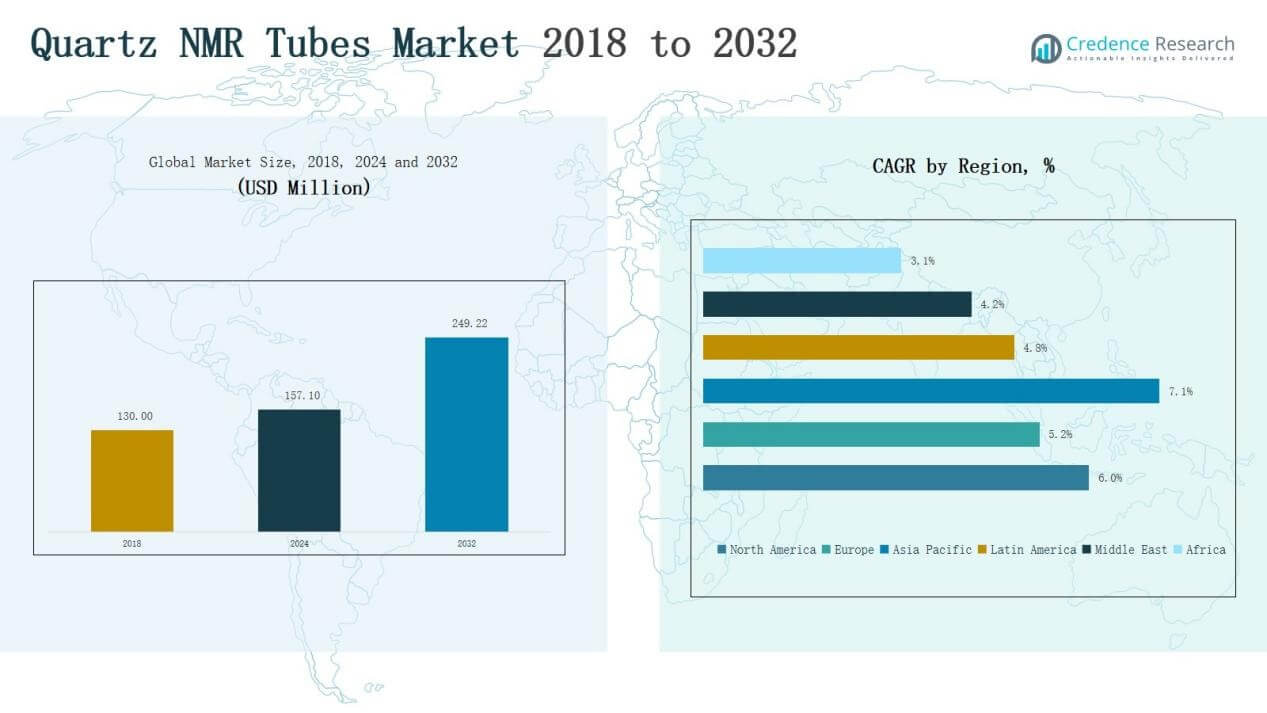
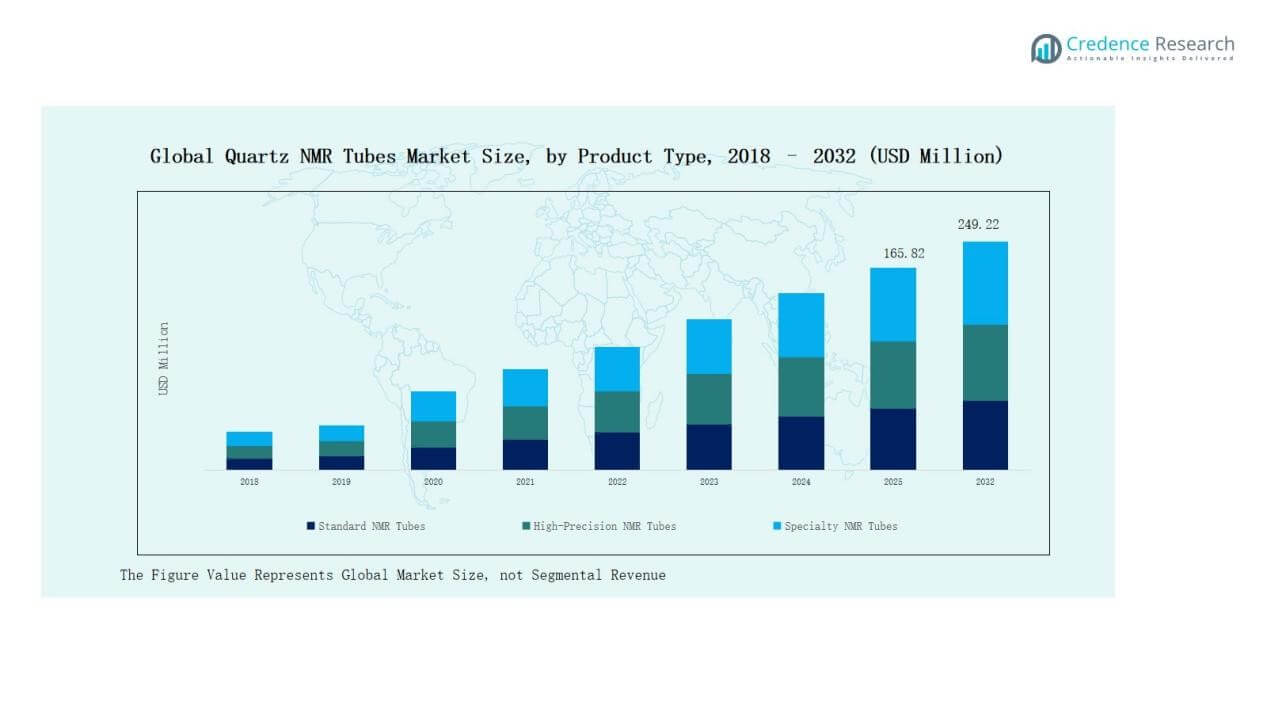
Quartz NMR Tubes Market size was valued at USD 130.00 million in 2018, reached USD 157.10 million in 2024, and is anticipated to reach USD 249.22 million by 2032, at a CAGR of 5.99% during the forecast period.
| REPORT ATTRIBUTE |
DETAILS |
| Historical Period |
2020-2023 |
| Base Year |
2024 |
| Forecast Period |
2025-2032 |
| Quartz NMR Tubes Market Size 2024 |
USD 157.10 Billion |
| Quartz NMR Tubes Market, CAGR |
5.99% |
| Quartz NMR Tubes Market Size 2032 |
USD 249.22 Billion |
The Quartz NMR Tubes Market is shaped by global leaders including Heraeus, Quartz Scientific Inc., Saint-Gobain, Momentive Performance Materials, Tosoh Corporation, Herbert Schneider GmbH, Savvy Glass, Maxsil, Koufu, Mondi Group, SGL Carbon, Wacker Chemie AG, KBTW, Vesuvius, and QSI Quartz. These companies compete through innovations in quartz purity, precision manufacturing, and specialized product portfolios targeting pharmaceuticals, biotechnology, and academic research. Among regions, North America emerged as the leading market in 2024 with a 34% share, supported by robust pharmaceutical pipelines, advanced research infrastructure, and strong adoption of high-precision tubes across laboratories and institutions.
Market Insights
- The Quartz NMR Tubes Market grew from USD 130.00 million in 2018 to USD 157.10 million in 2024, and is projected to reach USD 249.22 million by 2032, at a CAGR of 99%.
- Standard NMR tubes dominated product type with 48% share in 2024, supported by cost-effectiveness and suitability for routine applications, while high-precision tubes held 32% and specialty tubes 20%.
- By application, pharmaceuticals led with 41% share in 2024, followed by academic and research institutes at 29%, biotechnology at 18%, and chemical industry at 12%.
- Among end-users, laboratories dominated with 44% share in 2024, research institutions contributed 33%, and commercial enterprises accounted for 23%, driven by automation and structural analysis needs.
- North America led with 34% share in 2024, Europe held 24%, Asia Pacific captured 29%, while Latin America, Middle East, and Africa collectively accounted for the remaining 13%.
Access crucial information at unmatched prices!
Request your sample report today & start making informed decisions powered by Credence Research Inc.!
Download Sample
Market Segment Insights
By Product Type
The Quartz NMR Tubes Market by product type is dominated by standard NMR tubes, accounting for nearly 48% share in 2024. Their cost-effectiveness, wide availability, and suitability for routine nuclear magnetic resonance applications drive demand across industries. High-precision tubes, with around 32% share, gain traction in advanced research requiring superior dimensional accuracy. Specialty NMR tubes represent about 20% share, supported by growing use in complex experiments. Advancements in tube durability and consistent performance continue to reinforce segment growth.
For instance, Norell Inc. expanded its product line with precision quartz NMR tubes designed for 900 MHz spectrometers, supporting applications in pharmaceutical testing.
By Application
Within applications, the pharmaceuticals segment leads the Quartz NMR Tubes Market with approximately 41% share in 2024. This dominance stems from the rising use of NMR spectroscopy in drug discovery, quality control, and formulation analysis. Academic and research institutes contribute around 29%, reflecting strong demand in education and exploratory research. Biotechnology holds close to 18% share, driven by protein and molecular structure studies. The chemical industry segment, accounting for 12%, benefits from increasing material characterization and compound analysis.
For instance, Bruker launched its AvanceCore compact NMR system, designed to support pharmaceutical laboratories in routine quality control and formulation validation.
By End-User
The laboratories segment dominates the Quartz NMR Tubes Market, holding around 44% share in 2024. This leadership is driven by extensive use in analytical testing, clinical research, and routine spectroscopic operations. Research institutions account for nearly 33% share, fueled by advanced studies in molecular biology and applied sciences. Commercial enterprises, with about 23% share, are expanding adoption to improve R&D capabilities and product validation. Growth in laboratory automation and rising demand for structural analysis tools further supports overall market expansion.
Key Growth Drivers
Rising Demand in Pharmaceutical Research
The Quartz NMR Tubes Market is driven by expanding pharmaceutical research activities. Increasing use of nuclear magnetic resonance spectroscopy for drug discovery, structural analysis, and quality testing boosts demand for durable and precise tubes. Pharmaceutical companies rely heavily on NMR for ensuring drug safety and efficacy, which creates steady consumption. Standard and high-precision tubes are widely used in both small-scale and industrial-level applications. Continuous investment in drug development pipelines strengthens market growth, positioning pharmaceuticals as a critical driver.
Expanding Academic and Research Investments
Growing funding for academic and research institutes significantly fuels the Quartz NMR Tubes Market. Universities and laboratories are investing in advanced NMR systems for teaching, training, and exploratory research, especially in chemistry and life sciences. Rising enrollment in higher education programs further increases adoption of NMR tubes. Research collaborations between institutes and private enterprises enhance demand for both standard and specialty tubes. Government initiatives supporting scientific innovation amplify this growth, ensuring long-term demand across diverse educational and research segments.
For instance, the NSF-backed Network for Advanced NMR ordered two 1.1 GHz Bruker AVANCE NEO systems. Such high-field installs expand sample throughput and drive ongoing tube consumption.
Advancements in Biotechnology Applications
Biotechnology’s rising dependence on molecular characterization strengthens demand in the Quartz NMR Tubes Market. High-precision tubes are vital for protein structure analysis, metabolomics, and genomics, where accuracy and sample purity are crucial. As biotechnology firms focus on new therapies and biologics, adoption of advanced NMR solutions grows. Specialty NMR tubes gain traction in handling complex biological samples, offering reliability in advanced experiments. Expanding biopharmaceutical pipelines, combined with greater investment in biotech R&D, makes this sector a fast-emerging growth driver.
For instance, Norell, Inc. introduced ultra-precision machined NMR tubes tailored for Bruker MATCH™ systems, enhancing molecular characterization accuracy especially in metabolomics research.
 Key Trends & Opportunities
Shift Toward High-Precision and Specialty Tubes
A major trend in the Quartz NMR Tubes Market is the rising adoption of high-precision and specialty tubes. Research institutions and advanced laboratories demand tubes with better dimensional stability, durability, and performance consistency for complex experiments. These segments, though niche, are gaining importance due to their critical role in biotechnology and pharmaceuticals. Manufacturers are innovating with enhanced quartz purity and strength to address these needs. This trend opens opportunities for premium products with higher margins, strengthening competitive positioning.
For instance, Wilmad-LabGlass, a brand of SP Scienceware, introduced a line of precision-grade NMR tubes designed for improved concentricity and greater resistance to breakage under repeated solvent exchanges.
Expansion of E-Commerce and Direct Sales
Growing adoption of online sales platforms is creating new opportunities in the Quartz NMR Tubes Market. E-commerce channels allow laboratories, universities, and smaller enterprises to access a wide variety of NMR tubes at competitive prices. Direct sales by manufacturers ensure customization and technical support, adding value for end users. The shift toward digital procurement simplifies supply chains and broadens global reach, particularly in developing regions. This trend strengthens market accessibility, encouraging small and mid-sized labs to expand usage.
For instance, Wilmad-LabGlass, a subsidiary of SP Industries, offers certified quartz NMR tubes through digital platforms such as Fisher Scientific’s e-commerce store, enabling universities and research institutes to streamline procurement.
Key Challenges
High Cost of Precision and Specialty Tubes
The Quartz NMR Tubes Market faces a major challenge with the high cost of precision and specialty tubes. Advanced tubes require superior quartz purity and intricate fabrication processes, which drive up prices. Smaller laboratories and academic institutions often face budget constraints, limiting adoption despite growing demand. The price-sensitive nature of emerging markets further slows penetration. Manufacturers need to balance affordability with quality to expand customer base while maintaining profitability, making cost management a continuing challenge for market expansion.
Breakage and Handling Limitations
Quartz NMR tubes, while durable, remain fragile compared to alternative sample containers, posing handling challenges. Breakage during transportation or routine lab use leads to recurring replacement costs for users. Laboratories conducting high-frequency testing experience frequent losses, raising concerns over operational efficiency. Additionally, improper handling or cleaning can compromise precision, affecting results. Manufacturers must focus on improving design robustness and developing protective accessories. This challenge continues to impact customer satisfaction and restricts wider adoption across cost-sensitive research environments.
Competition from Alternative Materials and Technologies
The Quartz NMR Tubes Market faces competition from alternative materials and advanced spectroscopy technologies. While quartz remains dominant for high-precision applications, polymers and glass substitutes are increasingly considered for cost-sensitive uses. Technological advancements in imaging and spectroscopy also offer alternative methods for molecular analysis, reducing reliance on traditional NMR in some sectors. This shift challenges market growth, particularly in entry-level applications. Sustaining competitiveness requires manufacturers to innovate with enhanced quartz tube designs, improved cost efficiency, and broader application versatility.
Regional Analysis
North America
North America led the Quartz NMR Tubes Market with 34% share in 2024, valued at USD 54.92 million, rising from USD 46.02 million in 2018. It is projected to reach USD 87.00 million by 2032, growing at a CAGR of 6.0%. The region benefits from strong pharmaceutical R&D pipelines, advanced biotechnology investments, and extensive academic research activities. The U.S. dominates with major laboratories and research institutions adopting both standard and high-precision tubes. Continuous innovation in drug discovery and clinical trials sustains demand, ensuring North America maintains its leadership throughout the forecast period.
Europe
Europe accounted for 24% share in 2024, valued at USD 38.30 million, up from USD 33.02 million in 2018, and is expected to reach USD 57.26 million by 2032 at a CAGR of 5.2%. Growth is driven by strong chemical and pharmaceutical industries in Germany, France, and the UK. Academic institutions across Europe heavily use NMR spectroscopy in advanced research programs. Demand for high-precision and specialty tubes is expanding, particularly in biotechnology. Government-funded scientific initiatives and collaborations between universities and commercial enterprises further support market expansion, reinforcing Europe’s steady position in global adoption.
Asia Pacific
Asia Pacific held 29% share in 2024, with a market size of USD 47.73 million, up from USD 38.09 million in 2018, and is projected to reach USD 82.32 million by 2032, at the fastest CAGR of 7.1%. The region benefits from rapid expansion of pharmaceutical and biotechnology sectors in China, India, and Japan. Rising investment in higher education and research institutions also supports demand. Strong government initiatives for R&D and increasing collaborations with global companies fuel growth. Asia Pacific is emerging as a dynamic hub for both standard and specialty NMR tubes, strengthening its global influence.
Latin America
Latin America represented 4% share in 2024, with revenues of USD 8.26 million, up from USD 6.92 million in 2018, and projected to reach USD 11.98 million by 2032, at a CAGR of 4.8%. Growth is supported by expanding pharmaceutical industries in Brazil and Mexico and rising investment in academic research. While smaller in scale compared to other regions, the adoption of NMR spectroscopy is increasing for drug testing and chemical studies. Growing partnerships with international suppliers and gradual modernization of laboratory infrastructure are helping Latin America steadily expand its presence in the market.
Middle East
The Middle East captured 3% share in 2024, valued at USD 4.18 million, increasing from USD 3.77 million in 2018, and forecasted to reach USD 5.76 million by 2032, at a CAGR of 4.2%. Growth is driven by rising investment in healthcare and pharmaceutical research, especially in GCC countries. Universities and specialized labs in Israel and Turkey are also contributing to demand. Limited infrastructure poses challenges, yet increasing collaborations with global players provide opportunities. The region shows consistent growth potential, supported by government-driven efforts to diversify economies and enhance scientific innovation capacity.
Africa
Africa held 2% share in 2024, valued at USD 3.71 million, rising from USD 2.18 million in 2018, and expected to reach USD 4.90 million by 2032, at a CAGR of 3.1%. Growth remains modest due to limited research infrastructure and high cost of NMR equipment. However, South Africa leads with relatively stronger academic and industrial research activities, followed by Egypt. International funding programs for healthcare and academic research are gradually improving accessibility. Despite constraints, steady modernization of laboratories creates opportunities, positioning Africa as an emerging but slow-growing market for Quartz NMR tubes.
 Market Segmentations:
By Product Type
- Standard NMR Tubes
- High-Precision NMR Tubes
- Specialty NMR Tubes
By Application
- Pharmaceuticals
- Academic & Research Institutes
- Biotechnology
- Chemical Industry
By End-User
- Laboratories
- Research Institutions
- Commercial Enterprises
By Power Rating
- Low Power (<100W)
- Medium Power (100W–500W)
- High Power (>500W)
By Distribution Channel
- OEMs (Original Equipment Manufacturers)
- Aftermarket / Distributors
- Direct Sales
- Online / E-Commerce
- Others
By Region
- North America
- Europe
- Germany
- France
- U.K.
- Italy
- Spain
- Rest of Europe
- Asia Pacific
- China
- Japan
- India
- South Korea
- South-east Asia
- Rest of Asia Pacific
- Latin America
- Brazil
- Argentina
- Rest of Latin America
- Middle East & Africa
- GCC Countries
- South Africa
- Rest of the Middle East and Africa
Competitive Landscape
The Quartz NMR Tubes Market is moderately consolidated, with competition shaped by global leaders and specialized regional manufacturers. Key players such as Heraeus, Quartz Scientific Inc., Saint-Gobain, Momentive Performance Materials, and Tosoh Corporation dominate through advanced fabrication capabilities, strong R&D investment, and broad product portfolios. These companies emphasize high-precision and specialty NMR tubes, catering to growing demand in pharmaceuticals, biotechnology, and academic research. Regional firms including Herbert Schneider GmbH, Savvy Glass, and Maxsil enhance competition by offering cost-effective and customized solutions for niche applications. Strategic partnerships, product innovation, and expansion of e-commerce distribution are central to gaining market share. Companies also focus on enhancing quartz purity, durability, and consistency to strengthen customer loyalty. Competitive intensity is further driven by rising demand from emerging economies, where smaller players are entering with lower-cost alternatives. Overall, the market reflects a balance between global technological leadership and regional adaptability, shaping future consolidation opportunities.
Shape Your Report to Specific Countries or Regions & Enjoy 30% Off!
Key Players
- Heraeus
- Quartz Scientific, Inc.
- Saint-Gobain
- Momentive Performance Materials
- Herbert Schneider GmbH
- Savvy Glass
- Tosoh Corporation
- KBTW
- Vesuvius
- Maxsil
- Koufu
- Mondi Group
- SGL Carbon
- Wacker Chemie AG
- QSI Quartz
Recent Developments
- In August 2025, Vesuvius plc acquired Molten Metal Systems, strengthening its materials portfolio with potential downstream benefits for quartz-based applications including NMR tubes.
- In October 2023, Ferroglobe secured a high-purity quartz mine, reinforcing raw material supply crucial for advanced quartz products such as NMR tubes.
- In March 2025, Heraeus opened a new high-purity synthetic quartz plant in Shenyang, China, enhancing production capacity for advanced applications including NMR spectroscopy tubes.
- In July 2023, Heraeus Comvance acquired part of the OFS Fitel Denmark plant in Brøndby, expanding its optical materials and quartz processing capabilities.
Report Coverage
The research report offers an in-depth analysis based on Product Type, Application, End User, Power Rating, Distribution Channel and Region. It details leading market players, providing an overview of their business, product offerings, investments, revenue streams, and key applications. Additionally, the report includes insights into the competitive environment, SWOT analysis, current market trends, as well as the primary drivers and constraints. Furthermore, it discusses various factors that have driven market expansion in recent years. The report also explores market dynamics, regulatory scenarios, and technological advancements that are shaping the industry. It assesses the impact of external factors and global economic changes on market growth. Lastly, it provides strategic recommendations for new entrants and established companies to navigate the complexities of the market.
Future Outlook
- Demand for high-precision NMR tubes will rise with advanced pharmaceutical research needs.
- Academic and research institutes will continue driving adoption through expanded scientific programs.
- Biotechnology applications will strengthen demand for specialty NMR tubes in molecular studies.
- Laboratories will remain the largest end-users due to routine testing and analysis requirements.
- Online distribution channels will gain traction as procurement processes shift toward digital platforms.
- Manufacturers will focus on enhancing quartz purity and durability to improve product performance.
- Partnerships between suppliers and research institutions will expand innovation opportunities.
- Emerging economies will gradually increase adoption as research infrastructure develops.
- Price sensitivity in smaller labs will drive demand for cost-effective standard tube variants.
- Competition will intensify as global leaders and regional players invest in product differentiation.



