Market Overview
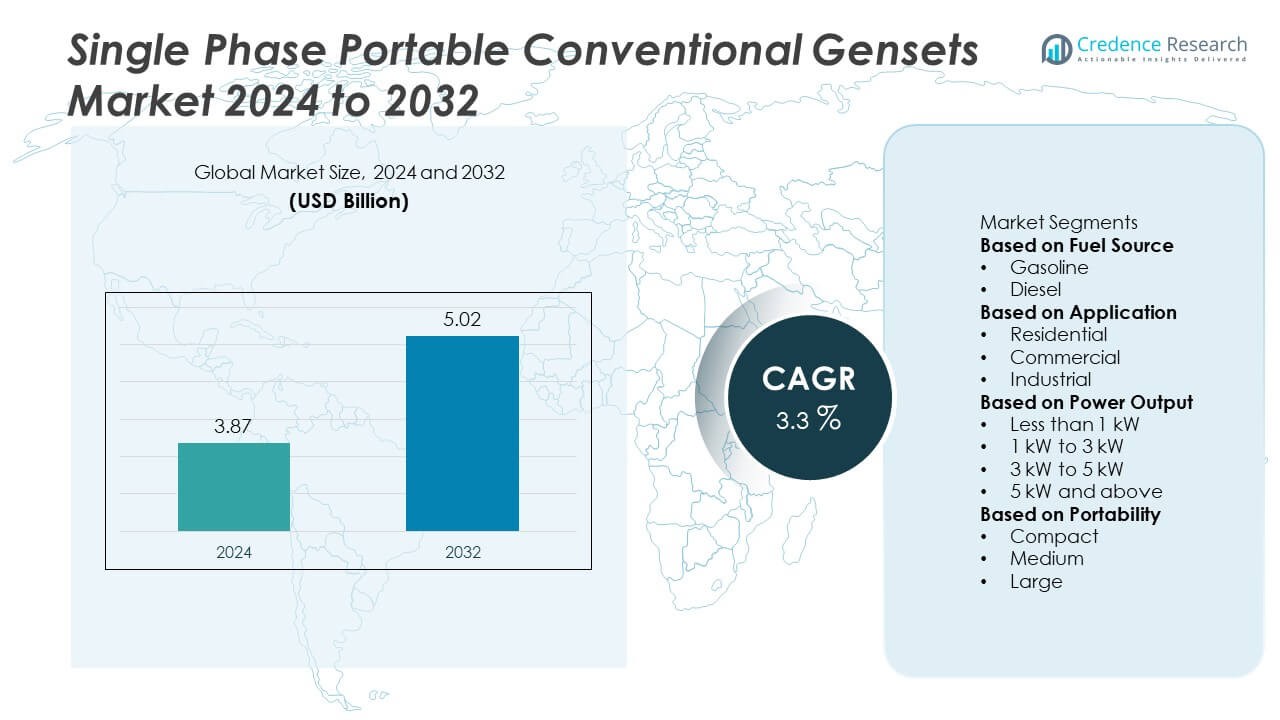
The Single Phase Portable Conventional Gensets Market was valued at USD 3.87 billion in 2024 and is projected to reach USD 5.02 billion by 2032, growing at a CAGR of 3.3% during the forecast period.
| REPORT ATTRIBUTE |
DETAILS |
| Historical Period |
2020-2024 |
| Base Year |
2024 |
| Forecast Period |
2025-2032 |
| Single Phase Portable Conventional Gensets Market Size 2024 |
USD 3.87 Billion |
| Single Phase Portable Conventional Gensets Market, CAGR |
3.3% |
| Single Phase Portable Conventional Gensets Market Size 2032 |
USD 5.02 Billion |
The Single Phase Portable Conventional Gensets Market is driven by rising demand for reliable backup power across residential, commercial, and small-scale industrial sectors, particularly in regions with unstable grid infrastructure. Growing use in construction, agriculture, and outdoor activities strengthens its utility as a cost-effective and flexible power solution.
The Single Phase Portable Conventional Gensets Market shows strong geographical diversity, with Asia Pacific leading growth due to rapid urbanization, expanding construction activities, and frequent grid instability across countries like India, China, and Southeast Asia. North America maintains steady demand, supported by widespread use in residential backup power and outdoor recreational activities, while Europe focuses on compliance with emission norms and adoption of efficient models for residential and agricultural purposes. Latin America and the Middle East & Africa also witness increasing adoption, driven by unreliable power infrastructure and the need for portable solutions in construction, mining, and rural electrification projects. Prominent players shaping the market include Honda Motor Co., Ltd., Yamaha Motor Co., Ltd., Cummins Inc., Generac Power Systems, Inc., and Caterpillar Inc., all of which emphasize product reliability, technological enhancements, and expanding distribution networks to strengthen their presence across global markets.
Access crucial information at unmatched prices!
Request your sample report today & start making informed decisions powered by Credence Research Inc.!
Download Sample
Market Insights
- The Single Phase Portable Conventional Gensets Market was valued at USD 3.87 billion in 2024 and is expected to reach USD 5.02 billion by 2032, growing at a CAGR of 3.3% during the forecast period.
- Rising demand for reliable backup power in residential, commercial, and small-scale industrial sectors drives consistent market expansion across both developed and emerging economies.
- Trends highlight increasing use of portable gensets for outdoor recreation, disaster preparedness, and rural electrification projects, alongside steady upgrades in fuel efficiency, noise control, and safety features.
- Competitive dynamics feature key players such as Honda Motor Co., Ltd., Yamaha Motor Co., Ltd., Generac Power Systems, Inc., Cummins Inc., and Caterpillar Inc., who focus on innovation, cost efficiency, and expanding distribution networks to retain strong global positions.
- The market faces restraints from environmental regulations, emission standards, and rising adoption of alternative power solutions such as inverter-based gensets, solar-powered systems, and battery storage technologies.
- Asia Pacific emerges as the most significant region, driven by rapid urbanization, unstable grid infrastructure, and expanding construction and agricultural sectors, while North America shows consistent demand linked to household backup and recreational usage.
- Europe emphasizes compliance with environmental standards and technological improvements, Latin America gains momentum from infrastructure development and rural electrification, and the Middle East & Africa continues to grow due to persistent reliance on portable gensets in off-grid regions and industrial applications.
Market Drivers
Rising Demand for Reliable Backup Power in Residential and Small-Scale Applications
The Single Phase Portable Conventional Gensets Market benefits from rising demand for dependable backup power in homes, small offices, and retail spaces. Frequent power outages in developing economies drive purchases among households and small businesses. It offers an affordable and accessible solution compared to larger multi-phase generators. Growing urbanization amplifies the need for portable power, particularly in regions with unstable grid infrastructure. The convenience of portability supports use during outdoor activities and emergencies. Increasing awareness of energy security continues to strengthen adoption across diverse end-users.
- For instance, Honda Motor Co., Ltd. reported sales of over 500,000 portable generators in North America in 2023, supported by strong demand from residential users seeking reliable backup solutions during storm seasons.
Expanding Utility in Construction, Agriculture, and Remote Operations
Growing adoption of gensets in construction sites, agricultural operations, and remote areas drives market momentum. Construction firms rely on it to power tools and equipment where grid access is limited. Farmers utilize gensets for irrigation pumps, storage facilities, and seasonal operations. The demand is also significant in mining camps and rural projects that require dependable electricity. It provides an economical and flexible solution for temporary and distributed power needs. The market expands steadily as industries prioritize operational continuity in challenging environments.
- For instance, Caterpillar portable generator units to support construction and mining projects across Africa and the Middle East, reinforcing its role in powering remote operations.
Cost-Effectiveness and Ease of Maintenance Enhancing Adoption
The market grows due to cost advantages, simple design, and straightforward maintenance. Small enterprises and households favor it because of lower upfront costs compared to advanced inverter-based alternatives. Routine servicing requires minimal expertise, making gensets accessible in rural and semi-urban regions. The durability of these units strengthens their appeal in harsh operating conditions. It remains a preferred option where affordability and practicality are critical purchase criteria. The combination of price efficiency and reliability positions gensets as an attractive choice for widespread use.
Government Policies, Infrastructure Growth, and Disaster Preparedness Supporting Growth
Government focus on rural electrification, disaster management, and infrastructure projects provides additional opportunities. It serves as an immediate backup in healthcare centers, schools, and emergency shelters during natural calamities. Infrastructure expansion in developing regions raises demand for portable units across multiple sectors. Regulations that promote reliable backup solutions indirectly boost market penetration. The emphasis on disaster preparedness ensures long-term relevance of gensets in vulnerable areas. The Single Phase Portable Conventional Gensets Market continues to strengthen its role in critical public and private operations.
Market Trends
Increasing Integration of Portable Power in Outdoor and Recreational Activities
The Single Phase Portable Conventional Gensets Market reflects growing interest in outdoor and recreational use. Rising participation in camping, festivals, and off-grid activities drives steady demand for compact, easy-to-transport units. It provides reliable electricity for lighting, cooking, and communication in outdoor environments. Consumers value flexibility in accessing power where conventional supply is unavailable. The popularity of leisure activities in both developed and emerging regions sustains interest in portable gensets. Manufacturers respond by improving portability and durability while maintaining cost efficiency.
- For instance, Yamaha Motor Co., Ltd. reported sales of more than 120,000 portable generators in 2023, with its EF2200iS model specifically designed for outdoor activities and integrated with CO-sensor technology to meet ANSI/PGMA G300-2018 safety standards.
Steady Demand from Emerging Economies with Unstable Grid Infrastructure
Expanding economies with frequent electricity fluctuations drive higher adoption of portable gensets. It fills the gap in regions where grid reliability remains a challenge for households and small businesses. Urban expansion increases demand for backup power to support retail, hospitality, and residential facilities. Industrializing nations in Asia and Africa show consistent reliance on gensets to stabilize operations. Rural electrification programs create demand for affordable, localized solutions before permanent connections are established. The Single Phase Portable Conventional Gensets Market continues to find opportunity in markets facing infrastructure gaps.
- For instance, Cummins Inc. supplied over 2,500 portable gensets to India and Sub-Saharan Africa in 2023, targeting rural electrification programs and critical backup solutions for schools and healthcare centers.
Focus on Fuel Efficiency and Lower Emissions Enhancing Market Appeal
Environmental concerns encourage manufacturers to design gensets with improved fuel efficiency and reduced emissions. It offers buyers a balance between affordability and responsible energy use. Compact engines with cleaner combustion technology are gaining preference across customer groups. Awareness of sustainability motivates users to select models with reduced environmental footprint. Governments promote cleaner energy practices, which indirectly pushes adoption of efficient gensets. The market responds with upgraded designs that meet emission standards while preserving cost advantages.
Technological Upgrades and Product Diversification Strengthening Competitiveness
Manufacturers invest in upgrading designs to increase user convenience and reliability. It includes noise reduction features, digital control panels, and enhanced safety mechanisms. The variety of models expands to cater to residential, commercial, and small-scale industrial needs. Continuous product diversification strengthens brand competitiveness in price-sensitive markets. Portable gensets with improved durability appeal to regions prone to harsh conditions. The Single Phase Portable Conventional Gensets Market evolves steadily by aligning technology upgrades with diverse customer demands.
Market Challenges Analysis
Environmental Regulations and Rising Pressure for Cleaner Alternatives
The Single Phase Portable Conventional Gensets Market faces significant pressure from environmental regulations aimed at reducing carbon emissions and noise pollution. Stricter standards on fuel use and exhaust emissions challenge manufacturers to adapt designs without raising costs beyond consumer affordability. It struggles to maintain competitiveness when cleaner technologies such as inverter-based gensets and renewable-powered solutions attract increasing attention. Noise restrictions in urban and residential areas further limit usage in sensitive environments. Rising consumer awareness of sustainability amplifies the demand for greener options. These constraints force producers to balance compliance with cost-effectiveness while protecting market presence.
Volatility in Fuel Prices and Growing Competition from Alternative Power Solutions
Fluctuating fuel prices create uncertainty for end-users who depend on gensets for daily or emergency power needs. It becomes less appealing when operational costs rise sharply due to fuel market instability. Customers in price-sensitive regions may shift toward solar-powered or battery-based alternatives that offer long-term cost savings. Strong competition from inverter gensets, known for better efficiency and reduced emissions, intensifies the challenge for conventional models. Limited technological innovation in conventional designs makes differentiation difficult in competitive markets. The Single Phase Portable Conventional Gensets Market continues to face obstacles from shifting energy preferences and evolving cost structures.
Market Opportunities
Rising Rural Electrification Programs and Expanding Infrastructure Projects
The Single Phase Portable Conventional Gensets Market holds strong opportunities in regions where rural electrification and infrastructure development remain priorities. Governments and private sectors continue to invest in connecting remote areas, yet gaps in stable electricity supply create space for portable gensets. It supports agricultural operations, small retail establishments, and educational facilities in areas awaiting permanent power infrastructure. Infrastructure projects in construction, mining, and logistics also increase the need for temporary and mobile power solutions. Growing focus on energy access in emerging economies enhances demand for reliable and affordable units. These conditions position the market to capture long-term growth through practical and scalable deployment.
Technological Enhancements and Diversification into Niche Applications
Opportunities also emerge from integrating incremental technological improvements into conventional designs. It benefits from innovations such as compact engines, noise reduction systems, and improved safety features that enhance customer satisfaction. Expanding product ranges tailored for residential, commercial, and outdoor recreational users opens new demand segments. The market can leverage demand for affordable power in disaster relief, healthcare support, and emergency management applications. Rising popularity of outdoor activities and mobile workstations extends potential adoption in non-traditional sectors. The Single Phase Portable Conventional Gensets Market strengthens its relevance by aligning innovation with diversified and cost-sensitive applications.
Market Segmentation Analysis:
By Fuel Source
The Single Phase Portable Conventional Gensets Market is segmented by fuel source into gasoline, diesel, and others such as LPG or natural gas. Gasoline-based gensets dominate due to their lower upfront cost, ease of use, and availability in residential and small commercial settings. Diesel units hold relevance in regions where efficiency and durability are critical for extended operations, particularly in construction and agricultural fields. It finds steady demand among consumers seeking economical solutions with reliable fuel access. Alternative fuels such as LPG and natural gas create niche opportunities where emissions standards and sustainability concerns influence purchase decisions. Growing acceptance of cleaner fuels in urban regions continues to shape this segment.
- For instance, Kohler Co. introduced its 30RCL liquid-cooled generator in August 2025, capable of operating on both natural gas and LPG, with a power output of 30 kW designed to meet stricter emission standards in residential and commercial applications.
By Application
The market demonstrates strong adoption across residential, commercial, and industrial applications. Residential users drive demand by relying on it for backup during outages and outdoor recreational activities. Commercial users, including retail stores, small businesses, and hospitality establishments, integrate gensets to maintain continuity in operations. Construction and agricultural operations benefit from portable gensets to power machinery and irrigation in off-grid environments. Small-scale industrial users employ these units for temporary electricity in workshops and remote job sites. The Single Phase Portable Conventional Gensets Market supports diverse applications, aligning its role with both everyday household needs and operational continuity in critical sectors.
- For instance, Caterpillar Inc. supplied more than 3,200 portable gensets in 2023 to construction sites across Africa and the Middle East, each unit delivering outputs between 5 kW and 10 kW to sustain essential equipment in remote projects.
By Power Output
Segmentation by power output highlights varying needs across user groups. Low-capacity gensets, typically below 5 kW, dominate the residential sector, meeting basic requirements such as lighting, small appliances, and electronic devices. Medium-capacity units in the 5–10 kW range attract commercial and small industrial customers needing reliable backup for tools, refrigeration, and limited machinery. High-capacity gensets above 10 kW find niche adoption in larger commercial establishments and demanding job sites that prioritize resilience against frequent outages. It ensures flexibility for users across different operating conditions, balancing affordability and output performance. The wide range of power output options strengthens accessibility for customers with varying needs.
Segments:
Based on Fuel Source
Based on Application
- Residential
- Commercial
- Industrial
Based on Power Output
- Less than 1 kW
- 1 kW to 3 kW
- 3 kW to 5 kW
- 5 kW and above
Based on Portability
Based on the Geography:
- North America
- Europe
- UK
- France
- Germany
- Italy
- Spain
- Russia
- Belgium
- Netherlands
- Austria
- Sweden
- Poland
- Denmark
- Switzerland
- Rest of Europe
- Asia Pacific
- China
- Japan
- South Korea
- India
- Australia
- Thailand
- Indonesia
- Vietnam
- Malaysia
- Philippines
- Taiwan
- Rest of Asia Pacific
- Latin America
- Brazil
- Argentina
- Peru
- Chile
- Colombia
- Rest of Latin America
- Middle East
- UAE
- KSA
- Israel
- Turkey
- Iran
- Rest of Middle East
- Africa
- Egypt
- Nigeria
- Algeria
- Morocco
- Rest of Africa
Regional Analysis
North America
North America holds a market share of around 24% in the Single Phase Portable Conventional Gensets Market, supported by consistent demand for backup power in residential and commercial sectors. The region experiences frequent power interruptions from hurricanes, storms, and wildfires, particularly in the United States, which increases reliance on portable gensets. It finds adoption in outdoor recreational activities such as camping and RV use, where compact power solutions remain essential. Canada contributes to demand through both residential users and rural communities that require emergency power in colder climates. The presence of established manufacturers and distributors further strengthens accessibility and brand penetration. Growing consumer preference for reliable yet affordable energy options positions North America as a steady contributor to global market revenues.
Europe
Europe accounts for approximately 19% of the market, with emphasis on efficiency and compliance with stringent environmental regulations. Demand rises in regions with aging grid infrastructure and seasonal dependence on portable units during storms and harsh winters. Countries such as Germany, the United Kingdom, and France show steady adoption among residential and small commercial users. It maintains presence in agricultural sectors across Eastern Europe, where dependable portable units support irrigation and storage facilities. Regulations focused on lowering emissions encourage manufacturers to introduce cleaner and quieter genset models to retain competitiveness. The market in Europe reflects a preference for technologically improved models that balance cost with regulatory compliance.
Asia Pacific
Asia Pacific commands the largest market share at around 38%, driven by rapid urbanization, industrial expansion, and frequent power shortages. High population density in countries such as India and China amplifies reliance on gensets in both urban and rural households. It plays a crucial role in supporting small businesses, agricultural operations, and construction projects where electricity infrastructure remains inconsistent. Southeast Asia, including Indonesia, Vietnam, and the Philippines, shows rising adoption due to vulnerability to natural disasters and unstable grids. Strong government-led infrastructure projects increase dependence on affordable and portable energy solutions. The Single Phase Portable Conventional Gensets Market gains maximum traction in this region, supported by large-scale distribution networks and competitive pricing strategies.
Latin America
Latin America holds a market share of about 11%, with growth concentrated in Brazil, Mexico, and Argentina. Power supply instability in both urban and remote areas drives reliance on portable gensets for residential and commercial use. It supports critical needs in mining, agriculture, and construction, which remain vital economic contributors across the region. Demand also increases during seasonal weather disruptions that affect electricity reliability. Consumers prefer gasoline-powered gensets for affordability, though diesel units remain relevant for large agricultural and industrial projects. The market reflects steady expansion as governments invest in rural electrification and infrastructure upgrades, creating supplementary demand for portable solutions.
Middle East & Africa
The Middle East & Africa represents nearly 8% of the global market share, with demand fueled by both off-grid needs and emergency preparedness. In Africa, inadequate and unstable electricity supply across rural and semi-urban regions accelerates reliance on portable gensets. It supports households, educational institutions, and healthcare facilities where grid connection is limited. In the Middle East, adoption is stronger in construction, oil and gas, and remote desert operations that require continuous electricity. Seasonal reliance during extreme heat conditions also strengthens demand for backup units in residential and commercial spaces. Market expansion is reinforced by international suppliers offering affordable models that meet basic energy access needs across diverse sectors.
Shape Your Report to Specific Countries or Regions & Enjoy 30% Off!
Key Player Analysis
- Kohler Co.
- Doosan Infracore Co., Ltd.
- Briggs Stratton Corporation
- Yamaha Motor Co., Ltd.
- Caterpillar Inc.
- Generac Power Systems, Inc.
- Cummins Inc.
- Eisemann Automotive GmbH
- Honda Motor Co., Ltd.
- Hyundai Heavy Industries Co., Ltd.
Competitive Analysis
The competitive landscape of the Single Phase Portable Conventional Gensets Market is defined by the presence of established global manufacturers that emphasize product reliability, affordability, and wide distribution networks to secure market share. Leading players such as Honda Motor Co., Ltd., Yamaha Motor Co., Ltd., Cummins Inc., Caterpillar Inc., Generac Power Systems, Inc., Kohler Co., Hyundai Heavy Industries Co., Ltd., Doosan Infracore Co., Ltd., Briggs Stratton Corporation, and Eisemann Automotive GmbH compete by introducing durable and fuel-efficient gensets tailored for residential, commercial, and light industrial applications. Companies invest in incremental technological enhancements including noise reduction, improved safety features, and compact designs to appeal to both developed and emerging markets. Strong brand reputation and global presence allow these firms to capture steady demand in regions with unreliable power infrastructure while addressing recreational and disaster preparedness needs in mature economies. Competition remains intense as players focus on balancing compliance with environmental regulations, cost efficiency, and customer-focused innovation to retain leadership in a market that values both affordability and performance.
Recent Developments
- In June 2025, Cummins Inc. launched a groundbreaking 17-liter engine generator set, delivering up to 1 MW of power and expanding its Centum™ Series roster.
- In June 2025, Cummins received the Gold Award from Consulting Specifying Engineer for its 1750–2000 kW and 2750–3000 kW Centum™ Series generators, recognizing its excellence for the fifth consecutive year
- In May 2025, Generac launched six new portable generators, including inverter models tailored for both California and other states, plus traditional-type portables compliant with EPA (and CARB in one variant) standards.
- In January 2025, Generac also unveiled a new 28 kW air-cooled home standby generator, marking the most powerful air-cooled model to date, with expected availability in the second half of 2025.
Market Concentration & Characteristics
The Single Phase Portable Conventional Gensets Market demonstrates moderate concentration, with competition led by a mix of global manufacturers and regional suppliers catering to diverse consumer needs. Leading companies focus on cost efficiency, product reliability, and distribution strength to retain presence in both developed and emerging economies. It reflects fragmented characteristics in price-sensitive regions where local manufacturers offer low-cost alternatives, while international brands emphasize technology upgrades, durability, and compliance with emission standards. The market shows balanced demand across residential, commercial, and small-scale industrial applications, driven by affordability, portability, and ease of maintenance. It remains resilient to substitution in areas with unstable electricity supply, although environmental regulations and growing adoption of inverter and renewable-powered alternatives present long-term structural challenges. The Single Phase Portable Conventional Gensets Market combines global competition, regional customization, and shifting consumer expectations, shaping a dynamic environment where innovation and cost alignment determine competitiveness.
Report Coverage
The research report offers an in-depth analysis based on Fuel Source, Application, Power Output, Portability and Geography. It details leading market players, providing an overview of their business, product offerings, investments, revenue streams, and key applications. Additionally, the report includes insights into the competitive environment, SWOT analysis, current market trends, as well as the primary drivers and constraints. Furthermore, it discusses various factors that have driven market expansion in recent years. The report also explores market dynamics, regulatory scenarios, and technological advancements that are shaping the industry. It assesses the impact of external factors and global economic changes on market growth. Lastly, it provides strategic recommendations for new entrants and established companies to navigate the complexities of the market.
Future Outlook
- Growing reliance on backup power during frequent outages and aging grid systems will sustain market growth.
- Infrastructure expansion and construction projects in emerging markets will elevate demand for portable gensets.
- Rental and leasing trends will gain momentum as users prioritize flexibility over ownership for short-term power needs.
- Technological improvements like electric start, remote control, and fuel-efficient engines will boost adoption.
- Integration of emission control systems and remote monitoring will support regulatory compliance and efficiency goals.
- Rising consumer demand for eco-friendly and quieter units will push manufacturers to innovate in design and performance.
- Smart features and IoT connectivity will become standard, enhancing control and diagnostics capabilities.
- Residential segment will drive growth as homeowners invest in reliable backup solutions.
- Portable gensets will see diversification into outdoor events and recreational applications, broadening market reach.
- Stronger government incentives and policy support for energy resilience will underpin sustained investment in portable power.



