Market Overview
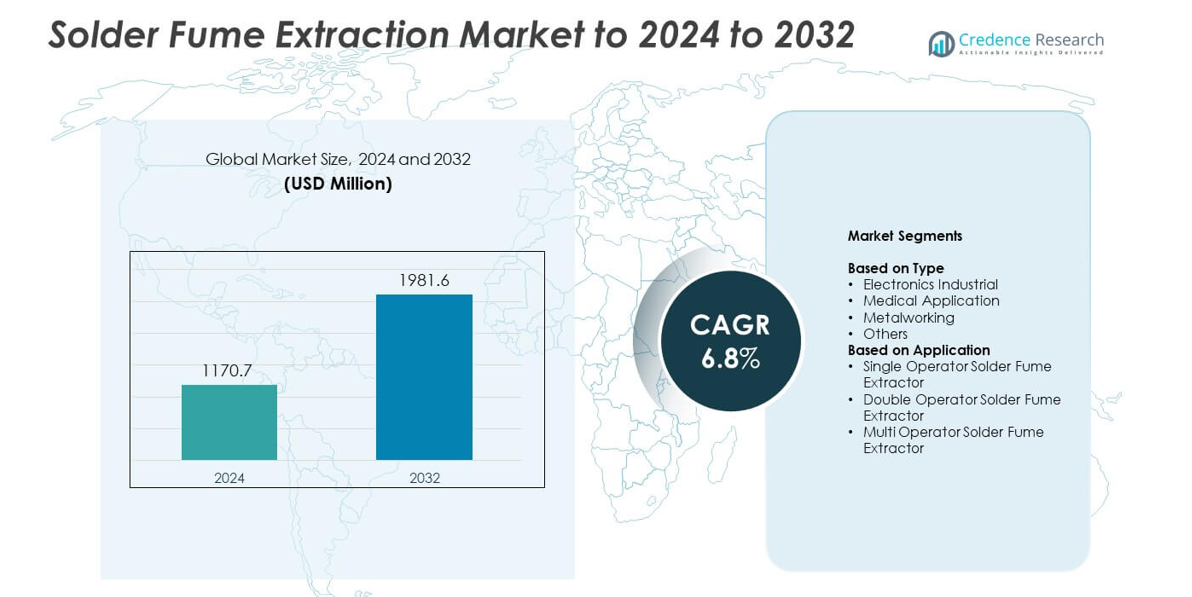
Solder Fume Extraction Market size was valued at USD 1170.7 million in 2024 and is anticipated to reach USD 1981.6 million by 2032, at a CAGR of 6.8% during the forecast period.
| REPORT ATTRIBUTE | DETAILS |
|---|---|
| Historical Period | 2020-2023 |
| Base Year | 2024 |
| Forecast Period | 2025-2032 |
| Solder Fume Extraction Market Size 2024 | USD 1170.7 million |
| Solder Fume Extraction Market, CAGR | 6.8% |
| Solder Fume Extraction Market Size 2032 | USD 1981.6 million |
The Solder Fume Extraction Market is influenced by major players including Hakko, EUROVAC, BOFA, Quatro-air, Metcal, Sentry Air Systems, FUMEX, Weller, Nederman, and CLARCOR. These companies support global demand through advanced filtration systems, smart airflow control, and durable workstation extractors suited for electronics manufacturing and industrial environments. North America remained the leading region in 2024 with about 34% share, driven by strict occupational safety rules and high adoption in automated assembly lines. Europe followed with nearly 29% share due to strong regulatory compliance, while Asia Pacific accounted for about 27% as electronics and semiconductor production expanded across major manufacturing hubs.
Market Insights
- The Solder Fume Extraction Market reached USD 1170.7 million in 2024 and is projected to hit USD 1981.6 million by 2032 at a 6.8% CAGR.
- Strong market drivers include rising electronics manufacturing, tighter workplace safety rules, and wider use of automated soldering lines that increase demand for high-efficiency extraction systems.
- Key trends show growing adoption of smart, energy-efficient extractors and rising demand for portable units; the electronics industrial segment led the market with about 52% share in 2024.
- Competitive activity focuses on advanced multi-stage filtration, improved airflow control, and expansion of global service networks to support long-term compliance and operational reliability.
- North America held about 34% share in 2024, followed by Europe at nearly 29% and Asia Pacific at around 27%, while Latin America and the Middle East & Africa accounted for smaller but steadily growing regional shares.
Market Segmentation Analysis:
By Type
Electronics industrial applications held the dominant share in 2024 with about 52% of the Solder Fume Extraction Market. Growth came from tighter workplace safety rules and wider use of automated soldering lines in PCB assembly. Electronics manufacturers adopted high-efficiency extractors to control airborne particulate levels and protect workers from long exposure to rosin-based fumes. Medical applications expanded due to cleanroom compliance needs, while metalworking demand rose as welding and brazing stations added localized extraction units. Other end users showed steady adoption as small workshops upgraded ventilation systems to meet safety standards.
- For instance, Bakon’s BK261 soldering fume extractor is rated at 150 W input power on 220 V AC and is designed for continuous PCB rework use.
By Application
Single operator solder fume extractors led the market in 2024 with nearly 46% share. Small and mid-sized electronics assembly units favored these systems because they offer flexible placement, low maintenance, and precise filtration at individual workbenches. Demand increased as manufacturers shifted toward workstation-level extraction to meet occupational exposure limits. Double-operator units gained traction in medium facilities seeking cost-optimized shared extraction. Multi-operator systems expanded in high-volume assembly lines where centralized fume control improves efficiency and reduces long-term operating costs.
- For instance, BOFA’s V200 solder fume extractor for individual benches provides a maximum airflow of 90 cubic metres per hour (\(\mathbf{90\ }\text{m}^{\mathbf{3}}\mathbf{/}\text{h}\)) with a 90 W motor. However, the compact cabinet has dimensions of 380 x 260 x 260 millimeters and weighs only 7 kilograms (\(\mathbf{7\ }\text{kg}\)).
Key Growth Drivers
Rising Compliance with Occupational Safety Regulations
Stricter global safety standards pushed factories to adopt certified fume extraction systems. Governments tightened limits on airborne particulate and toxic gases, especially in electronics assembly where soldering is continuous. Companies upgraded extraction units to protect workers from long-term respiratory risks. This regulatory push raised installation rates in both small workshops and large production plants. Higher inspections and mandatory ventilation rules strengthened steady demand across regions.
- For instance, a Donaldson single-phase weld and fume collector specified for one workstation delivers about 780 CFM airflow at 115 V supply and uses a MERV 15 filter rating to capture fine particulates in regulated production cells.
Expansion of Electronics Manufacturing Capacity
Electronics production grew due to rising output of consumer devices, automotive electronics, and industrial automation systems. PCB assembly units increased their soldering lines, which raised the need for efficient fume extraction near workstations. Manufacturers preferred high-efficiency filters to support stable throughput and maintain clean environments. Growth in semiconductor packaging and LED assembly also boosted equipment use. This expansion created sustained demand from large factories and contract manufacturers.
- For instance, Pure-Air’s PA-300TD-IQ soldering fume extractor is listed with about 300 m³/h airflow and two freestanding capture arms, enabling simultaneous extraction from multiple solder points on dense electronics assembly lines.
Shift Toward Automated and High-Precision Soldering
Automated soldering technologies, including reflow and selective soldering, expanded across electronics plants. These systems require reliable fume extraction to maintain air quality around sensitive components. Companies invested in advanced extractors with stronger airflow control and multi-stage filtration. Growth in high-precision assembly increased the need for consistent air handling to protect both workers and delicate electronic parts. This shift supported steady upgrades to modern extraction solutions.
Key Trends & Opportunities
Adoption of Smart and Energy-Efficient Extraction Systems
Producers introduced systems with smart sensors, variable-speed control, and automated air-quality monitoring. These solutions optimize airflow and reduce power use, which helps facilities cut operating costs. The rise of connected factories increased demand for units that integrate with digital dashboards. Better filter-life prediction tools also lowered maintenance downtime. These advancements created strong opportunities for suppliers offering intelligent and efficient designs.
- For instance, Plymovent’s MobilePro mobile filter unit combines a 1.1 kW fan with a maximum extraction capacity of 1,200 cubic metres per hour
Rising Use in Medical and Laboratory Environments
Cleanrooms, diagnostic labs, and medical device assembly units expanded adoption of compact extraction systems. Healthcare facilities preferred units that ensure low particulate levels and limit chemical exposure during delicate manufacturing tasks. Demand grew as medical device production scaled, especially for imaging components and surgical tools. This shift opened new opportunities in highly regulated and hygiene-focused applications.
- For instance, Sentry Air Systems’ SS-400 Portable Floor Sentry offers variable air volume from 50 CFM to 700 CFM high through a 6-inch diameter, 72-inch long self-supporting arm, which suits point-of-use extraction in labs and clean manufacturing cells
Growing Preference for Portable and Modular Extractors
Small and mid-sized enterprises increased the use of movable and modular extraction solutions. These units support flexible workstation layouts and quick reconfiguration during production changes. Growth in repair and rework centers also elevated demand for portable extractors. Manufacturers offering compact, low-noise systems saw rising interest across emerging markets. This trend supported wider accessibility and easier installation.
Key Challenges
High Installation and Maintenance Costs
Advanced extraction systems require significant upfront investment, which limits adoption among small manufacturers. Multi-stage filters, high-power motors, and airflow controls add to long-term operational costs. Facilities also face recurring expenses for filter replacement and periodic system upkeep. These financial barriers slow adoption in cost-sensitive regions. Price pressure remains a major challenge for wider deployment.
Limited Awareness in Small Workshops and Informal Sectors
Many small workshops still rely on basic ventilation and lack understanding of long-term health risks linked to solder fumes. Limited training and weak enforcement of safety rules reduce adoption of certified extractors. Informal electronics repair units often delay upgrades due to low budgets and minimal regulatory pressure. This gap restricts market penetration in developing regions and slows overall industry growth.
Regional Analysis
North America
North America held about 34% share of the Solder Fume Extraction Market in 2024. Demand stayed strong due to strict workplace safety rules and high adoption across electronics assembly plants. Manufacturers in the United States and Canada invested in advanced extraction systems to protect workers from hazardous fumes and maintain clean production spaces. Growth in semiconductor packaging and medical device manufacturing supported wider use of high-efficiency filtration units. Rising automation in electronics assembly also boosted upgrades to smart and energy-efficient extraction equipment across factories.
Europe
Europe accounted for nearly 29% share in 2024, driven by strong regulatory enforcement and a mature electronics manufacturing base. Countries such as Germany, France, and the United Kingdom adopted high-performance fume extraction systems to meet strict worker-protection standards. Automotive electronics production and industrial automation created steady demand for advanced extraction solutions. The region also saw rising adoption of energy-efficient and low-noise units in precision assembly environments. Ongoing expansion in medical technology manufacturing further supported consistent system installations.
Asia Pacific
Asia Pacific dominated growth momentum with around 27% share of the global market in 2024. Expanding PCB manufacturing, rising consumer electronics production, and strong investment in semiconductor facilities drove high demand for extraction equipment. China, Japan, South Korea, and India increased adoption across automated assembly lines to ensure compliance with worker-safety guidelines. Growing adoption of portable and modular extractors among small and mid-sized manufacturers also supported regional expansion. Rapid industrialization and large-scale electronics exports strengthened long-term demand.
Latin America
Latin America held about 6% share in 2024, supported by growing electronics assembly and rising awareness of workplace safety. Countries such as Mexico and Brazil expanded adoption of localized extraction systems in repair centers and mid-scale manufacturing units. Regulatory frameworks improved gradually, encouraging industries to replace outdated ventilation setups with certified fume extraction solutions. Demand also increased within metalworking and small workshop environments. Continued industrial expansion and training initiatives strengthened prospects for steady growth.
Middle East and Africa
The Middle East and Africa accounted for nearly 4% share in 2024. Adoption grew in electronics servicing hubs, industrial workshops, and emerging manufacturing zones. Countries in the Gulf region increased investments in safety-compliant production environments, leading to modest but steady uptake of advanced extraction systems. Growth in medical device assembly and laboratory environments supported additional installations. Limited awareness in smaller workshops remained a challenge, but expanding industrial activity and gradual regulatory improvements supported future demand.
Market Segmentations:
By Type
- Electronics Industrial
- Medical Application
- Metalworking
- Others
By Application
- Single Operator Solder Fume Extractor
- Double Operator Solder Fume Extractor
- Multi Operator Solder Fume Extractor
By Geography
- North America
- U.S.
- Canada
- Mexico
- Europe
- Germany
- France
- U.K.
- Italy
- Spain
- Rest of Europe
- Asia Pacific
- China
- Japan
- India
- South Korea
- South-east Asia
- Rest of Asia Pacific
- Latin America
- Brazil
- Argentina
- Rest of Latin America
- Middle East & Africa
- GCC Countries
- South Africa
- Rest of the Middle East and Africa
Competitive Landscape
The Solder Fume Extraction Market is shaped by leading companies such as Hakko, EUROVAC, BOFA, Quatro-air, Metcal, Sentry Air Systems, FUMEX, Weller, Nederman, and CLARCOR. These firms strengthened their positions by expanding product ranges that target electronics assembly, medical environments, and industrial workstations. Major suppliers focused on high-efficiency filtration systems with multi-stage filters designed to capture fine particulate and chemical vapors. Manufacturers invested in smart airflow controls that support stable extraction during continuous soldering operations. Energy-efficient designs, reduced noise levels, and long-life filtration technologies helped attract larger production facilities. Companies also improved distribution networks and aftermarket service to support global customers seeking reliable compliance with evolving workplace air-quality standards.
Key Player Analysis
Recent Developments
- In 2025, Fumex introduced a new LED lamp option for three extraction-arm models, improving visibility and ergonomics at fume capture points while highlighting ongoing upgrades to its arm-based extraction portfolio.
- In 2024, BOFA (Donaldson Company, Inc.) continued to offer its existing product line of portable extraction systems for automated soldering processes, such as the V 2000 iQ, while also making strategic announcements.
- In 2023, Metcal released the BVX-250 fume extraction system, designed for efficient benchtop use in soldering environments.
Report Coverage
The research report offers an in-depth analysis based on Type, Application and Geography. It details leading market players, providing an overview of their business, product offerings, investments, revenue streams, and key applications. Additionally, the report includes insights into the competitive environment, SWOT analysis, current market trends, as well as the primary drivers and constraints. Furthermore, it discusses various factors that have driven market expansion in recent years. The report also explores market dynamics, regulatory scenarios, and technological advancements that are shaping the industry. It assesses the impact of external factors and global economic changes on market growth. Lastly, it provides strategic recommendations for new entrants and established companies to navigate the complexities of the market.
Future Outlook
- Demand will rise as global factories tighten workplace air-quality standards.
- Electronics manufacturing growth will continue to drive new installations.
- Smart fume extraction systems with sensors will gain stronger adoption.
- Energy-efficient units will become a major buying focus across industries.
- Portable and modular extractors will see higher demand in small facilities.
- Medical and laboratory applications will expand due to strict hygiene needs.
- Multi-operator systems will grow as large assembly lines scale production.
- Manufacturers will invest more in long-life filters and low-maintenance designs.
- Emerging markets will adopt extraction systems as regulations strengthen.
- Integration of extraction units into automated soldering lines will accelerate.

Request a Free Sample
Fill in your details and we'll send you a free sample report.
- Sample data tables & charts
- Research methodology
Market Dynamics
Rising Compliance with Occupational Safety Regulations
Stricter global safety standards and enforcement are compelling factories to install certified solder fume extraction systems, especially in electronics assembly where continuous soldering creates hazardous airborne particulates. This regulatory push is driving both new installations and upgrades across all facility sizes.
Expansion of Electronics Manufacturing Capacity
Growth in consumer electronics, automotive electronics, and industrial automation is increasing the number of PCB assembly lines, which in turn raises the need for efficient fume extraction at workstations to maintain clean environments and protect worker health.
Shift Toward Automated and High-Precision Soldering
The adoption of automated soldering technologies such as reflow and selective soldering requires reliable fume extraction to maintain air quality around sensitive components, prompting investments in advanced extraction systems with stronger airflow control and multi-stage filtration.
Adoption of Smart and Energy-Efficient Extraction Systems
Manufacturers are increasingly seeking extraction units with smart sensors, variable-speed controls, and automated air-quality monitoring to optimize airflow, reduce energy consumption, and lower maintenance costs, supporting the trend toward connected and efficient production environments.
Growing Use in Medical and Laboratory Environments
The expansion of cleanrooms, diagnostic labs, and medical device manufacturing is driving demand for compact, high-efficiency extraction systems that ensure low particulate levels and limit chemical exposure, opening new opportunities in highly regulated and hygiene-sensitive sectors.
Need a Custom Version of This Report?
Tailor the scope, geography, or segments to your exact requirements.
- Custom geography or segment scope
- Direct access to our analyst team
Frequently Asked Questions
What is the current market size for Solder Fume Extraction Market, and what is its projected size in 2032?
At what Compound Annual Growth Rate is the Solder Fume Extraction Market projected to grow between 2025 and 2032?
What is the major growth driving factors for global Solder Fume Extraction market?
What are the primary factors fueling the growth of the Solder Fume Extraction Market?
Who are the leading companies in the Solder Fume Extraction Market?
Table of Content
Chapter 1 Market Segmentation
- 1.1 Segmentation Framework
- 1.1.1 Product and Service Classification
- 1.1.2 Application and End-Use Classification
- 1.1.3 Technology and Solution Classification
- 1.1.4 Customer and Distribution Channel Classification
- 1.1.5 Geographic Segmentation
- 1.1.6 Market Segment Definitions and Boundaries
- 1.2 By Type
- 1.2.1 Electronics Industrial
- 1.2.2 Medical Application
- 1.2.3 Metalworking
- 1.2.4 Others
- 1.3 By Application
- 1.3.1 Single Operator Solder Fume Extractor
- 1.3.2 Double Operator Solder Fume Extractor
- 1.3.3 Multi Operator Solder Fume Extractor
Chapter 2 Introduction
- 2.1 Report Objectives and Scope
- 2.2 Product Definition and Industry Terminology
- 2.3 Market Inclusions and Exclusions
- 2.4 Research Process
- 2.4.1 Primary Research and Expert Interviews
- 2.4.2 Secondary Research and Source Review
- 2.4.3 Top-Down and Bottom-Up Estimation
- 2.4.4 Data Triangulation and Verification
- 2.5 Market Size Measurement Basis
- 2.5.1 2024: USD 1170.7 million → 2032: USD 1981.6 million
- 2.6 Historical and Forecast Reference Periods
- 2.6.1 Base Year: 2024
- 2.6.2 Forecast Period: 2024-2032
- 2.7 Research Assumptions and Limitations
Chapter 3 Executive Summary
- 3.1 Market Snapshot and Key Findings
- 3.2 Base-Year Market Size, 2024
- 3.3 Forecast Market Size, 2032
- 3.4 Revenue and Volume Growth Outlook
- 3.5 Key Demand and Supply Indicators
- 3.6 Leading Market Segments
- 3.7 Fastest-Growing Market Opportunities
- 3.8 Regional Performance Highlights
- 3.9 Technology and Industry Transformation
- 3.10 Competitive Landscape Summary
- 3.11 Analyst View and Strategic Implications
Chapter 4 Global Solder Fume Extraction Market Trends and Developments
- 4.1 Historical Industry Development
- 4.2 Recent Market Trends and Developments
- 4.3 Demand and Customer Behavior Trends
- 4.4 Technology and Product Innovation
- 4.5 Artificial Intelligence, Automation and Digitalization
- 4.6 Local Manufacturing and Supply Chain Realignment
- 4.7 Industry Partnerships, Mergers and Acquisitions
- 4.8 Sustainability and Circular Economy Developments
- 4.9 Government and Private Sector Investment Trends
- 4.10 Emerging Business Models and Commercialization
- 4.11 Industry Developments and Announcements
Chapter 5 Global Solder Fume Extraction Market Production, Supply and Demand Analysis
- 5.1 Demand Trend and Consumption Analysis
- 5.2 Demand Forecast, 2024-2032
- 5.3 Production and Output Trend
- 5.4 Production and Output Forecast, 2024-2032
- 5.5 Installed Capacity and Capacity Utilization
- 5.6 Company-Wise Production Plants and Statistics
- 5.6.1 Installed Production Capacity
- 5.6.2 Actual Production
- 5.6.3 Planned Capacity and Expansion Targets
- 5.7 Supply Chain Structure and Procurement Trends
- 5.8 Supply-Demand Gap and Bottlenecks
- 5.9 Import Dependence and Sourcing Structure
- 5.10 Contract Manufacturing and Outsourcing
- 5.11 Regional Supply and Demand Concentration
Chapter 6 Global Solder Fume Extraction Market Pricing Analysis
- 6.1 Pricing Structure and Measurement
- 6.2 Historical Pricing Trends
- 6.3 Pricing Outlook, 2024-2032
- 6.4 Average Selling Price and Unit Economics
- 6.5 Pricing by Product and Market Segment
- 6.6 Geographic Pricing Differences
- 6.7 Key Input, Energy, Labor and Logistics Costs
- 6.8 Contract Pricing and Purchasing Models
- 6.9 Pricing Sensitivity and Competitive Positioning
- 6.10 Price, Margin and Profitability Implications
Chapter 7 Global Solder Fume Extraction Market Dynamics
- 7.1 Market Growth Drivers
- 7.1.1 Demand-Side Drivers
- 7.1.2 Technology and Innovation Drivers
- 7.1.3 Infrastructure and Investment Drivers
- 7.1.4 Regulatory and Policy Drivers
- 7.2 Market Restraints
- 7.2.1 Cost and Affordability Constraints
- 7.2.2 Technology and Adoption Barriers
- 7.2.3 Supply Chain and Operational Constraints
- 7.3 Market Challenges
- 7.3.1 Competitive Pressure and Margin Erosion
- 7.3.2 Skills, Infrastructure and Implementation Gaps
- 7.4 Emerging Market Opportunities
- 7.5 Market Dynamics Impact and Time-Horizon Assessment
Chapter 8 Global Solder Fume Extraction Value Chain Analysis
- 8.1 Industry Value Chain Overview
- 8.2 Upstream Suppliers and Critical Inputs
- 8.3 Technology and Component Providers
- 8.4 Manufacturing or Service Delivery
- 8.5 Distribution, Channel Partners and Integrators
- 8.6 Downstream Applications and End Users
- 8.7 Value Addition and Profit Pools
- 8.8 Vertical Integration and Outsourcing
- 8.9 Supplier Concentration and Risk
- 8.10 Supply Chain Localization and Resilience
Chapter 9 Global Solder Fume Extraction Market Regulations and Policies
- 9.1 Relevant Laws, Standards and Compliance Frameworks
- 9.2 Product, Service, Safety and Quality Requirements
- 9.3 Government Policies, Incentives and Subsidies
- 9.4 Imports, Exports and Trade Barriers
- 9.5 Public Procurement and Local Content Requirements
- 9.6 Environmental and Sustainability Compliance
- 9.7 Upcoming Policy Changes and Market Implications
Chapter 10 Global Solder Fume Extraction Market Hotspots and Opportunities
- 10.1 Market Opportunity Mapping and Growth Hotspots
- 10.2 High-Growth Applications and Customer Groups
- 10.3 Underserved Markets and White-Space Opportunities
- 10.4 Emerging Technology and Product Opportunities
- 10.5 New Capacity and Investment Hotspots
- 10.6 Market Entry and Expansion Opportunities
- 10.7 Distribution and Partnership Opportunities
- 10.8 Near-Term and Long-Term Commercial Potential
- 10.9 Opportunity Attractiveness and Execution Risks
Chapter 11 Global Solder Fume Extraction Market Outlook, 2024-2032
- 11.1 Market Size and Analysis
- 11.1.1 Revenue (Market Measurement: 2024: USD 1170.7 million → 2032: USD 1981.6 million)
- 11.1.2 Market Volume and Quantity Sold
- 11.1.3 Historical Market Size
- 11.1.4 Base-Year Market Size, 2024
- 11.2 Market Forecast, 2024-2032
- 11.2.1 Revenue Forecast to 2032
- 11.2.2 Volume Forecast to 2032
- 11.2.3 CAGR and Year-on-Year Growth
- 11.2.4 Incremental Revenue Opportunity
- 11.3 Forecast Assumptions and Scenario Analysis
- 11.3.1 Base-Case Forecast
- 11.3.2 Optimistic and Conservative Scenarios
- 11.3.3 Technology, Pricing and Policy Sensitivities
- 11.4 Market Attractiveness and Growth Outlook
Chapter 12 Global Solder Fume Extraction Market Segmentation and Outlook
- 12.1 Segmentation Summary and Market Shares, 2024
- 12.2 Largest and Fastest-Growing Segments
- 12.3 By Type - Market Size and Forecast, 2024-2032
- 12.3.1 Segment Definition and Scope
- 12.3.2 Historical Market Size
- 12.3.3 Revenue Forecast, 2024-2032
- 12.3.4 Volume Forecast, 2024-2032
- 12.3.5 Base-Year Market Share, 2024
- 12.3.6 Segment CAGR and Growth Drivers
- 12.3.7 Subsegment Market Size and Forecast
- 12.3.7.1 Electronics Industrial
- 12.3.7.2 Medical Application
- 12.3.7.3 Metalworking
- 12.3.7.4 Others
- 12.3.8 Subsegment Pricing and Adoption Trends
- 12.3.9 Leading Suppliers and Competition
- 12.3.10 Regional Demand and Opportunities
- 12.4 By Application - Market Size and Forecast, 2024-2032
- 12.4.1 Segment Definition and Scope
- 12.4.2 Historical Market Size
- 12.4.3 Revenue Forecast, 2024-2032
- 12.4.4 Volume Forecast, 2024-2032
- 12.4.5 Base-Year Market Share, 2024
- 12.4.6 Segment CAGR and Growth Drivers
- 12.4.7 Subsegment Market Size and Forecast
- 12.4.7.1 Single Operator Solder Fume Extractor
- 12.4.7.2 Double Operator Solder Fume Extractor
- 12.4.7.3 Multi Operator Solder Fume Extractor
- 12.4.8 Subsegment Pricing and Adoption Trends
- 12.4.9 Leading Suppliers and Competition
- 12.4.10 Regional Demand and Opportunities
- 12.5 Segment Growth Comparison
- 12.6 Segment Attractiveness and Priority Matrix
Chapter 13 Global Solder Fume Extraction End-Use and Application Market Outlook
- 13.1 End-Use Industry and Customer Demand Structure
- 13.2 Leading Applications and Customer Groups
- 13.3 End-Use Market Size, Share and Forecast
- 13.4 Major End-Use Industry Deep Dives
- 13.4.1 Customer Requirements and Use Cases
- 13.4.2 Demand and Replacement Cycles
- 13.4.3 Technical and Regulatory Considerations
- 13.4.4 Purchasing and Procurement Models
- 13.4.5 Leading Vendors and Distribution Channels
- 13.4.6 Forecast and Commercial Opportunities
- 13.5 Emerging Applications and Cross-Segment Demand
- 13.6 End-Use Industry Investment Priorities
Chapter 14 Global Solder Fume Extraction Geographic Market Outlook, 2024-2032
- 14.1 Regional Market Size and Share, 2024
- 14.2 Regional Market Forecast, 2024-2032
- 14.3 Regional Pricing, Production and Demand Differences
- 14.4 North America
- 14.4.1 United States
- 14.4.2 Canada
- 14.4.3 Mexico
- 14.5 Europe
- 14.5.1 Germany
- 14.5.2 France
- 14.5.3 Italy
- 14.5.4 United Kingdom
- 14.5.5 Spain
- 14.5.6 Poland
- 14.5.7 Russia
- 14.5.8 Netherlands
- 14.5.9 Belgium
- 14.5.10 Sweden
- 14.5.11 Denmark
- 14.5.12 Norway
- 14.5.13 Rest of Europe
- 14.6 Asia Pacific
- 14.6.1 China
- 14.6.2 India
- 14.6.3 Japan
- 14.6.4 South Korea
- 14.6.5 Thailand
- 14.6.6 Indonesia
- 14.6.7 Vietnam
- 14.6.8 Malaysia
- 14.6.9 Australia
- 14.6.10 Rest of Asia Pacific
- 14.7 Latin America
- 14.7.1 Brazil
- 14.7.2 Argentina
- 14.7.3 Colombia
- 14.7.4 Chile
- 14.7.5 Rest of Latin America
- 14.8 Middle East
- 14.8.1 Saudi Arabia
- 14.8.2 United Arab Emirates
- 14.8.3 Turkey
- 14.8.4 Israel
- 14.8.5 Iran
- 14.8.6 Rest of the Middle East
- 14.9 Africa
- 14.9.1 South Africa
- 14.9.2 Egypt
- 14.9.3 Nigeria
- 14.9.4 Morocco
- 14.9.5 Rest of Africa
- 14.10 Regional Investment, Policy and Supply Chain Differences
- 14.11 Regional Competitive Landscape
- 14.12 Geographic Growth Hotspots
Chapter 15 Global Solder Fume Extraction Technology, Innovation and Sustainability Outlook
- 15.1 Technology Landscape and Maturity
- 15.2 Product, Process and Service Innovation
- 15.3 AI, Automation and Digital Tools in the Industry
- 15.4 Technology Adoption and Performance Benchmarking
- 15.5 Innovation Pipeline and R&D Investment
- 15.6 Patent and Intellectual Property Trends
- 15.7 Energy Efficiency and Resource Management
- 15.8 Sustainability, Recycling and Circularity
- 15.9 Technology Roadmap, 2024-2032
- 15.10 Risks of Obsolescence and Technology Substitution
Chapter 16 Global Solder Fume Extraction Market Key Strategic Imperatives
- 16.1 Growth and Market Entry Priorities
- 16.2 High-Return Products and Segments
- 16.3 Pricing, Profitability and Cost Optimization
- 16.4 Technology Investment and Product Differentiation
- 16.5 Supply Chain Localization and Resilience
- 16.6 Distribution and Customer Acquisition
- 16.7 Partnership, Acquisition and Capacity Strategy
- 16.8 Regional Expansion Priorities
- 16.9 Short-, Medium- and Long-Term Actions
Chapter 17 Competition Outlook
- 17.1 Industry Competition Characteristics
- 17.2 Market Structure and Concentration
- 17.3 Market Share and Competitive Positioning, 2024
- 17.4 Company-Wise Revenue and Product Benchmarking
- 17.5 Production and Service Capacity Benchmarking
- 17.6 Technology, Pricing and Differentiation
- 17.7 Regional Footprint and Distribution Strength
- 17.8 Mergers, Acquisitions and Strategic Alliances
- 17.9 New Entrants and Competitive Threats
- 17.10 Porter's Five Forces and Industry Attractiveness
- 17.11 Competitive Outlook, 2024-2032
Chapter 18 Company Profiles
- 18.1 Company Coverage and Selection Criteria
- 18.2 Hakko
- 18.2.1 Business Description
- 18.2.2 Company Ownership and Geographic Presence
- 18.2.3 Product and Service Portfolio
- 18.2.4 Manufacturing and Operating Footprint
- 18.2.5 Production Capacity and Expansion Plans
- 18.2.6 Financial Performance and Investment
- 18.2.7 Market Share and Competitive Position
- 18.2.8 Technology and Innovation Capabilities
- 18.2.9 Strategic Alliances or Partnerships
- 18.2.10 Recent Developments
- 18.2.11 Growth Strategy and Outlook
- 18.3 EUROVAC
- 18.4 BOFA
- 18.5 Quatro-air
- 18.6 Metcal
- 18.7 Sentry Air Systems
- 18.8 FUMEX
- 18.9 Weller
- 18.10 Nederman
- 18.11 CLARCOR
- 18.12 Other Relevant Market Participants
Note: Every listed company is profiled on the structure shown under the first company. The company list is preliminary and may change based on research findings, market developments, data availability and client requirements.
Chapter 19 Disclaimer
- 19.1 Research and Forecast Disclaimer
- 19.2 Data Source and Estimation Limitations
Note: The depth of individual sections depends on data availability for this market. Volume, capacity, trade and other unit-based metrics are included where applicable.