
| REPORT ATTRIBUTE | DETAILS |
|---|---|
| Historical Period | 2019-2022 |
| Base Year | 2023 |
| Forecast Period | 2024-2032 |
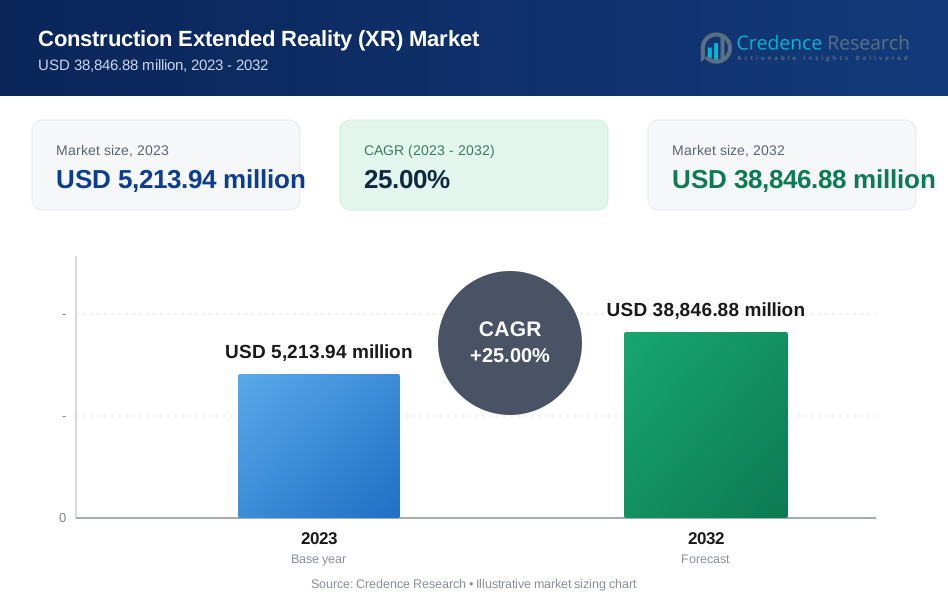
| Construction Extended Reality (XR) Market Size 2023 | USD 5,213.94 Million |
| Construction Extended Reality (XR) Market, CAGR | 25.00% |
| Construction Extended Reality (XR) Market Size 2032 | USD 38,846.88 Million |
Market Overview
The Construction Extended Reality (XR) market encompasses technologies such as Virtual Reality (VR), Augmented Reality (AR), and Mixed Reality (MR) that are used to improve various processes in the construction sector. These technologies offer immersive visualization, enhanced communication, and improved project management, significantly contributing to the efficiency and effectiveness of construction operations. The Construction XR market is projected to grow from USD 5,213.94 million in 2023 to USD 38,846.88 million in 2032, at a Compound Annual Growth Rate (CAGR) of 25.00%.
Extended Reality in construction has seen rapid adoption due to its ability to provide detailed architectural previews, safety training simulations, and real-time project adjustments. This surge is driven by the increasing demand for cost-effective and efficient construction solutions that can minimize errors, reduce waste, and improve safety standards.
North America currently leads the market due to technological advancements and the presence of key players in the region. However, Asia-Pacific is expected to exhibit the highest growth rate due to rapid urbanization, increasing infrastructure projects, and the adoption of advanced technologies in emerging economies like China and India.
Key Market Drivers
Technological Advancements and Integration in Construction XR
One of the primary drivers of the Construction Extended Reality (XR) market is the rapid advancement in Augmented Reality (AR), Virtual Reality (VR), and Mixed Reality (MR) technologies. These technologies have become more accessible and affordable, which encourages their adoption across the construction industry. The integration of XR with other technologies such as Artificial Intelligence (AI) and the Internet of Things (IoT) further enhances its capabilities, leading to more precise and efficient construction processes. For instance, using AR to overlay project information on physical sites helps in accurate installations and reduces the chances of errors, thereby saving time and resources.
Demand for Enhanced Safety and Training Solutions
Another significant driver in the Construction XR market is the growing emphasis on workplace safety and the need for effective training solutions. XR technologies provide immersive and interactive environments that are ideal for training workers in a safe, controlled setting. Virtual reality simulations can replicate hazardous situations without the associated risks, allowing workers to gain experience and improve their response strategies. This not only enhances safety but also boosts worker confidence and compliance with safety protocols.
Rising Demand for Improved Efficiency and Productivity
Construction projects are notorious for delays, budget overruns, and safety hazards. XR technologies like AR and VR offer solutions to these challenges by providing immersive training simulations for workers, facilitating remote collaboration, and enabling visualization of complex building plans. These technologies can lead to significant improvements in efficiency, productivity, and overall project outcomes, addressing some of the most persistent problems in the construction industry. For instance, the US government alone has an estimated productivity improvement opportunity of $725 billion to $765 billion, split among the federal level and the state and local level.
Advancements in XR Technology and Market Growth Factors
The XR industry is witnessing continuous advancements in both hardware and software. VR headsets are becoming more lightweight, affordable, and powerful, making them more accessible for construction companies. AR technology is also evolving rapidly, with the integration of smart glasses and head-mounted displays that overlay digital information onto the real world. Additionally, the rollout of 5G networks is expected to be a major game-changer for the construction XR market, offering ultra-fast speeds, low latency, and high bandwidth, critical for seamless streaming of XR content and real-time collaboration on complex construction projects. Furthermore, XR technologies play a vital role in improving worker safety by providing immersive training simulations and highlighting safety protocols on job sites, and they promote sustainable construction practices by optimizing building designs for energy efficiency and reducing material waste.
Key Market Restraints
High Initial Investment and Maintenance Costs
Despite the benefits, the high cost of implementing and maintaining XR solutions remains a major restraint for the market. The initial investment includes not only the cost of hardware and software but also the integration with existing systems and training of personnel. Small and medium-sized enterprises (SMEs) in particular find it challenging to afford such technologies, which can hinder market growth. Additionally, the ongoing maintenance and necessary upgrades to keep up with technological advancements add to the total cost of ownership, making it a less viable option for cost-sensitive businesses.
Market Opportunities
- Integration with Cloud and Big Data Analytics: Leveraging cloud computing and big data analytics can enhance the capabilities of XR in construction by enabling real-time data analysis and accessibility. This integration can lead to more informed decision-making and better project outcomes.
- Sustainable Construction Practices: XR can play a pivotal role in promoting sustainability in construction by optimizing resource utilization and reducing waste. This aligns with the global push towards greener construction practices.
- Expansion into Emerging Markets: Developing countries offer new opportunities for the deployment of XR technologies as they continue to increase their infrastructure and urban development.
- Advanced Customization of Construction Projects: XR technologies allow for greater customization of construction projects, catering to the specific needs and preferences of clients more effectively.
- Enhanced Collaboration Tools: Developing more collaborative tools using XR can help streamline communication between architects, engineers, and construction workers, reducing errors and improving project delivery times.
- Government Initiatives and Funding: Increasing government support and funding for digitalization in the construction industry could open up significant opportunities for the growth of the XR market.
- Training and Education: Establishing more comprehensive training programs and educational initiatives to equip workers with the necessary XR skills can expand the market further.
Interesting Facts About the Market
- Rapid Adoption Rate: The adoption rate of XR technologies in construction has significantly increased by over 50% in the past three years.
- Impact on Project Time Management: Projects utilizing XR technologies report a reduction in completion time by up to 20%.
- Safety Improvements: There has been a 30% decrease in workplace accidents on projects where XR technologies are implemented for training and operational management.
- Cost Reduction: XR can reduce project costs by minimizing errors and reworks, which typically account for up to 25% of the total project cost.
- Enhanced Stakeholder Engagement: XR enables better stakeholder engagement by providing immersive project previews, which help in securing approvals and funding.
- Global Reach: The technology is being adopted worldwide, with significant growth in regions like the Middle East and Southeast Asia, beyond the traditional strongholds of North America and Europe.
- Diverse Applications: Beyond visualization and training, XR is used for maintenance, repair operations, and historical reconstruction in construction.
- Mobile Integration: The integration of mobile technologies with XR allows for on-site applications, enhancing accessibility and usability for field workers.
- Software Development: An increasing number of software solutions are being developed specifically for construction applications, catering to various aspects from design to demolition.
- Partnerships and Collaborations: Major tech companies are forming partnerships with construction firms to develop tailored XR solutions, indicating a strong future trend in collaborative innovation.
Top Leading Players
Some of the top players in the Construction XR market include:
- Trimble Inc.
- Autodesk, Inc.
- Unity Technologies
- DAQRI
- Microsoft Corporation
- Bentley Systems, Incorporated
- Scope AR
- ViewAR
These companies are at the forefront of developing innovative XR solutions tailored for the construction industry. They are instrumental in pushing the boundaries of what's possible in construction processes and management through the use of AR, VR, and MR technologies.
Competitive Landscape
The competitive landscape in the Construction XR market is characterized by a mix of large technology firms and specialized startups. The market is highly competitive, with companies continuously innovating and improving their offerings. There is also a significant focus on strategic partnerships and collaborations between construction companies and technology providers to leverage mutual strengths in technology development and market penetration.
Recent Developments:
- Autodesk, Inc. has also been active in this field. They introduced a new immersive design review workspace, Autodesk Workshop XR. Furthermore, in March 2022, Autodesk announced its acquisition of The Wild, a cloud-connected, extended reality (XR) platform.
- Unity Technologies has been adding features like a Generic Android loader, support for foveated rendering, motion vector-based space warp, and support for 3+ views to their XR technologies. In April 2023, they launched a series of workshops for building immersive extended reality (XR) experiences.
- Microsoft Corporation has been transforming the construction landscape with their mixed reality experiences. They have worked with leading brands to transform the way futuristic machinery can be designed.
- Bentley Systems, Incorporated presented SYNCHRO XR, its app for immersively visualizing 4D construction digital twins with the new Microsoft HoloLens 2.
Segmentations:
By Device Type Segment
- Augmented Reality (AR)
- Virtual Reality (VR)
- Mixed Reality (MR)
By Component Segment
- Head-Mounted Displays (HMDs)
- Smart Glasses
- Sensors
- Simulation Software
- Content Management Software
- Design Software
- Others
By Application Segment
- Design and Planning
- Project Management
- Training and Simulation
- Maintenance and Operations
- Others
By End-user Segment
- Architecture, Engineering, and Construction (AEC) Firms
- Real Estate Developers
- Contractors and Builders
- Government and Public Infrastructure Agencies
- Others
By Regional
- North America
- The U.S.
- Canada
- Mexico
- Europe
- Germany
- France
- The U.K.
- Italy
- Spain
- Rest of Europe
- Asia Pacific
- China
- Japan
- India
- South Korea
- South-east Asia
- Rest of Asia Pacific
- Latin America
- Brazil
- Argentina
- Rest of Latin America
- Middle East & Africa
- GCC Countries
- South Africa
- Rest of the Middle East and Africa
Regional Analysis
North America
North America is a leader in the Construction XR market, characterized by early adoption and high penetration of AR, VR, and MR technologies. The region's market dominance is supported by robust technological infrastructure and the presence of major players like Autodesk and Microsoft. The U.S. holds the largest market share in the region, driven by its advanced construction industry and high focus on innovation.
Europe
Europe follows North America in terms of market size, with significant growth potential. The region benefits from strong governmental support for digital infrastructure and a focus on sustainable construction practices, which are conducive to XR adoption.
Asia-Pacific
The Asia-Pacific region is expected to witness the highest growth in the Construction XR market. This growth is fueled by rapid urbanization in countries like China and India, coupled with increasing technological adoption in the construction sector. The region's vast infrastructure development projects offer ample opportunities for the application of XR technologies.
Latin America and Middle East & Africa
These regions are gradually embracing XR technologies, with growing awareness and technological advancements. The focus is primarily on major urban centers where large-scale construction projects are prevalent.
Future Outlook
- Technological Convergence: The future will likely see a convergence of XR with other cutting-edge technologies like 5G, AI, and IoT, which will enhance the efficiency and capabilities of XR in construction.
- Standardization and Regulations: As the market matures, there will be a greater need for standardization of technologies and regulatory frameworks to ensure safety and effectiveness.
- Education and Training Programs: Expanding educational programs and training for XR will be crucial to support its adoption and integration into mainstream construction practices.
- Innovative Use Cases: We will see more innovative applications of XR in construction, including disaster recovery simulations and accessibility enhancements.
- Increased Investment: Investment in XR technology by construction companies is expected to rise as the benefits become more apparent and technologies more affordable.
- Customization and User Experience Improvements: There will be a focus on enhancing the user experience and customizing solutions to better meet the specific needs of the construction industry.
- Expansion into New Markets: XR technologies will continue to penetrate new geographical markets, particularly in developing regions where construction activity is booming.
- Collaborative Platforms: Development of more collaborative XR platforms that integrate various stakeholders in a construction project will enhance communication and project management.
- Sustainability Focus: XR will increasingly be used to drive sustainability in construction projects, aiding in achieving global sustainability goals.
- Broader Industry Adoption: Beyond large enterprises, small and medium-sized enterprises will increasingly adopt XR as the technology becomes more accessible and proves its ROI in construction settings.
Request a Free Sample
Fill in your details and we'll send you a free sample report.
- Sample data tables & charts
- Research methodology
Need a Custom Version of This Report?
Tailor the scope, geography, or segments to your exact requirements.
- Custom geography or segment scope
- Direct access to our analyst team
Frequently Asked Questions
What technologies are included in the Construction XR market, and what benefits do they offer?
What is the projected growth of the Construction XR market from 2023 to 2032?
Why has the Construction XR market seen rapid adoption recently?
Which regions are leading and expected to grow in the Construction XR market?
Table of Content
Chapter 1 Market Segmentation
- 1.1 Segmentation Framework
- 1.1.1 Product and Service Classification
- 1.1.2 Application and End-Use Classification
- 1.1.3 Technology and Solution Classification
- 1.1.4 Customer and Distribution Channel Classification
- 1.1.5 Geographic Segmentation
- 1.1.6 Market Segment Definitions and Boundaries
Chapter 2 Introduction
- 2.1 Report Objectives and Scope
- 2.2 Product Definition and Industry Terminology
- 2.3 Market Inclusions and Exclusions
- 2.4 Research Process
- 2.4.1 Primary Research and Expert Interviews
- 2.4.2 Secondary Research and Source Review
- 2.4.3 Top-Down and Bottom-Up Estimation
- 2.4.4 Data Triangulation and Verification
- 2.5 Market Size Measurement Basis
- 2.5.1 2023: USD 5,213.94 million → 2032: USD 38,846.88 million
- 2.6 Historical and Forecast Reference Periods
- 2.6.1 Base Year: 2023
- 2.6.2 Forecast Period: 2023-2032
- 2.7 Research Assumptions and Limitations
Chapter 3 Executive Summary
- 3.1 Market Snapshot and Key Findings
- 3.2 Base-Year Market Size, 2023
- 3.3 Forecast Market Size, 2032
- 3.4 Revenue and Volume Growth Outlook
- 3.5 Key Demand and Supply Indicators
- 3.6 Leading Market Segments
- 3.7 Fastest-Growing Market Opportunities
- 3.8 Regional Performance Highlights
- 3.9 Technology and Industry Transformation
- 3.10 Competitive Landscape Summary
- 3.11 Analyst View and Strategic Implications
Chapter 4 Global Construction Extended Reality (XR) Market Trends and Developments
- 4.1 Historical Industry Development
- 4.2 Recent Market Trends and Developments
- 4.3 Demand and Customer Behavior Trends
- 4.4 Technology and Product Innovation
- 4.5 Artificial Intelligence, Automation and Digitalization
- 4.6 Local Manufacturing and Supply Chain Realignment
- 4.7 Industry Partnerships, Mergers and Acquisitions
- 4.8 Sustainability and Circular Economy Developments
- 4.9 Government and Private Sector Investment Trends
- 4.10 Emerging Business Models and Commercialization
- 4.11 Industry Developments and Announcements
Chapter 5 Global Construction Extended Reality (XR) Market Production, Supply and Demand Analysis
- 5.1 Demand Trend and Consumption Analysis
- 5.2 Demand Forecast, 2023-2032
- 5.3 Production and Output Trend
- 5.4 Production and Output Forecast, 2023-2032
- 5.5 Installed Capacity and Capacity Utilization
- 5.6 Company-Wise Production Plants and Statistics
- 5.6.1 Installed Production Capacity
- 5.6.2 Actual Production
- 5.6.3 Planned Capacity and Expansion Targets
- 5.7 Supply Chain Structure and Procurement Trends
- 5.8 Supply-Demand Gap and Bottlenecks
- 5.9 Import Dependence and Sourcing Structure
- 5.10 Contract Manufacturing and Outsourcing
- 5.11 Regional Supply and Demand Concentration
Chapter 6 Global Construction Extended Reality (XR) Market Pricing Analysis
- 6.1 Pricing Structure and Measurement
- 6.2 Historical Pricing Trends
- 6.3 Pricing Outlook, 2023-2032
- 6.4 Average Selling Price and Unit Economics
- 6.5 Pricing by Product and Market Segment
- 6.6 Geographic Pricing Differences
- 6.7 Key Input, Energy, Labor and Logistics Costs
- 6.8 Contract Pricing and Purchasing Models
- 6.9 Pricing Sensitivity and Competitive Positioning
- 6.10 Price, Margin and Profitability Implications
Chapter 7 Global Construction Extended Reality (XR) Market Dynamics
- 7.1 Market Growth Drivers
- 7.1.1 Demand-Side Drivers
- 7.1.2 Technology and Innovation Drivers
- 7.1.3 Infrastructure and Investment Drivers
- 7.1.4 Regulatory and Policy Drivers
- 7.2 Market Restraints
- 7.2.1 Cost and Affordability Constraints
- 7.2.2 Technology and Adoption Barriers
- 7.2.3 Supply Chain and Operational Constraints
- 7.3 Market Challenges
- 7.3.1 Competitive Pressure and Margin Erosion
- 7.3.2 Skills, Infrastructure and Implementation Gaps
- 7.4 Emerging Market Opportunities
- 7.5 Market Dynamics Impact and Time-Horizon Assessment
Chapter 8 Global Construction Extended Reality (XR) Value Chain Analysis
- 8.1 Industry Value Chain Overview
- 8.2 Upstream Suppliers and Critical Inputs
- 8.3 Technology and Component Providers
- 8.4 Manufacturing or Service Delivery
- 8.5 Distribution, Channel Partners and Integrators
- 8.6 Downstream Applications and End Users
- 8.7 Value Addition and Profit Pools
- 8.8 Vertical Integration and Outsourcing
- 8.9 Supplier Concentration and Risk
- 8.10 Supply Chain Localization and Resilience
Chapter 9 Global Construction Extended Reality (XR) Market Regulations and Policies
- 9.1 Relevant Laws, Standards and Compliance Frameworks
- 9.2 Product, Service, Safety and Quality Requirements
- 9.3 Government Policies, Incentives and Subsidies
- 9.4 Imports, Exports and Trade Barriers
- 9.5 Public Procurement and Local Content Requirements
- 9.6 Environmental and Sustainability Compliance
- 9.7 Upcoming Policy Changes and Market Implications
Chapter 10 Global Construction Extended Reality (XR) Market Hotspots and Opportunities
- 10.1 Market Opportunity Mapping and Growth Hotspots
- 10.2 High-Growth Applications and Customer Groups
- 10.3 Underserved Markets and White-Space Opportunities
- 10.4 Emerging Technology and Product Opportunities
- 10.5 New Capacity and Investment Hotspots
- 10.6 Market Entry and Expansion Opportunities
- 10.7 Distribution and Partnership Opportunities
- 10.8 Near-Term and Long-Term Commercial Potential
- 10.9 Opportunity Attractiveness and Execution Risks
Chapter 11 Global Construction Extended Reality (XR) Market Outlook, 2023-2032
- 11.1 Market Size and Analysis
- 11.1.1 Revenue (Market Measurement: 2023: USD 5,213.94 million → 2032: USD 38,846.88 million)
- 11.1.2 Market Volume and Quantity Sold
- 11.1.3 Historical Market Size
- 11.1.4 Base-Year Market Size, 2023
- 11.2 Market Forecast, 2023-2032
- 11.2.1 Revenue Forecast to 2032
- 11.2.2 Volume Forecast to 2032
- 11.2.3 CAGR and Year-on-Year Growth
- 11.2.4 Incremental Revenue Opportunity
- 11.3 Forecast Assumptions and Scenario Analysis
- 11.3.1 Base-Case Forecast
- 11.3.2 Optimistic and Conservative Scenarios
- 11.3.3 Technology, Pricing and Policy Sensitivities
- 11.4 Market Attractiveness and Growth Outlook
Chapter 12 Global Construction Extended Reality (XR) Market Segmentation and Outlook
- 12.1 Segmentation Summary and Market Shares, 2023
- 12.2 Largest and Fastest-Growing Segments
- 12.3 Segment Growth Comparison
- 12.4 Segment Attractiveness and Priority Matrix
Chapter 13 Global Construction Extended Reality (XR) Geographic Market Outlook, 2023-2032
- 13.1 Regional Market Size and Share, 2023
- 13.2 Regional Market Forecast, 2023-2032
- 13.3 Regional Pricing, Production and Demand Differences
- 13.4 North America
- 13.4.1 United States
- 13.4.2 Canada
- 13.4.3 Mexico
- 13.5 Europe
- 13.5.1 Germany
- 13.5.2 France
- 13.5.3 Italy
- 13.5.4 United Kingdom
- 13.5.5 Spain
- 13.5.6 Poland
- 13.5.7 Russia
- 13.5.8 Netherlands
- 13.5.9 Belgium
- 13.5.10 Sweden
- 13.5.11 Denmark
- 13.5.12 Norway
- 13.5.13 Rest of Europe
- 13.6 Asia Pacific
- 13.6.1 China
- 13.6.2 India
- 13.6.3 Japan
- 13.6.4 South Korea
- 13.6.5 Thailand
- 13.6.6 Indonesia
- 13.6.7 Vietnam
- 13.6.8 Malaysia
- 13.6.9 Australia
- 13.6.10 Rest of Asia Pacific
- 13.7 Latin America
- 13.7.1 Brazil
- 13.7.2 Argentina
- 13.7.3 Colombia
- 13.7.4 Chile
- 13.7.5 Rest of Latin America
- 13.8 Middle East
- 13.8.1 Saudi Arabia
- 13.8.2 United Arab Emirates
- 13.8.3 Turkey
- 13.8.4 Israel
- 13.8.5 Iran
- 13.8.6 Rest of the Middle East
- 13.9 Africa
- 13.9.1 South Africa
- 13.9.2 Egypt
- 13.9.3 Nigeria
- 13.9.4 Morocco
- 13.9.5 Rest of Africa
- 13.10 Regional Investment, Policy and Supply Chain Differences
- 13.11 Regional Competitive Landscape
- 13.12 Geographic Growth Hotspots
Chapter 14 Global Construction Extended Reality (XR) Technology, Innovation and Sustainability Outlook
- 14.1 Technology Landscape and Maturity
- 14.2 Product, Process and Service Innovation
- 14.3 AI, Automation and Digital Tools in the Industry
- 14.4 Technology Adoption and Performance Benchmarking
- 14.5 Innovation Pipeline and R&D Investment
- 14.6 Patent and Intellectual Property Trends
- 14.7 Energy Efficiency and Resource Management
- 14.8 Sustainability, Recycling and Circularity
- 14.9 Technology Roadmap, 2023-2032
- 14.10 Risks of Obsolescence and Technology Substitution
Chapter 15 Global Construction Extended Reality (XR) Market Key Strategic Imperatives
- 15.1 Growth and Market Entry Priorities
- 15.2 High-Return Products and Segments
- 15.3 Pricing, Profitability and Cost Optimization
- 15.4 Technology Investment and Product Differentiation
- 15.5 Supply Chain Localization and Resilience
- 15.6 Distribution and Customer Acquisition
- 15.7 Partnership, Acquisition and Capacity Strategy
- 15.8 Regional Expansion Priorities
- 15.9 Short-, Medium- and Long-Term Actions
Chapter 16 Competition Outlook
- 16.1 Industry Competition Characteristics
- 16.2 Market Structure and Concentration
- 16.3 Market Share and Competitive Positioning, 2023
- 16.4 Company-Wise Revenue and Product Benchmarking
- 16.5 Production and Service Capacity Benchmarking
- 16.6 Technology, Pricing and Differentiation
- 16.7 Regional Footprint and Distribution Strength
- 16.8 Mergers, Acquisitions and Strategic Alliances
- 16.9 New Entrants and Competitive Threats
- 16.10 Porter's Five Forces and Industry Attractiveness
- 16.11 Competitive Outlook, 2023-2032
Chapter 17 Company Profiles
- 17.1 Company Coverage and Selection Criteria
- 17.2 Leading Market Participants – Standard Profile Structure
- 17.2.1 Business Description
- 17.2.2 Company Ownership and Geographic Presence
- 17.2.3 Product and Service Portfolio
- 17.2.4 Manufacturing and Operating Footprint
- 17.2.5 Production Capacity and Expansion Plans
- 17.2.6 Financial Performance and Investment
- 17.2.7 Market Share and Competitive Position
- 17.2.8 Technology and Innovation Capabilities
- 17.2.9 Strategic Alliances or Partnerships
- 17.2.10 Recent Developments
- 17.2.11 Growth Strategy and Outlook
- 17.3 Other Relevant Market Participants
Note: Every listed company is profiled on the structure shown under the first company. The company list is preliminary and may change based on research findings, market developments, data availability and client requirements.
Chapter 18 Disclaimer
- 18.1 Research and Forecast Disclaimer
- 18.2 Data Source and Estimation Limitations
Note: The depth of individual sections depends on data availability for this market. Volume, capacity, trade and other unit-based metrics are included where applicable.
