
Market Overview:
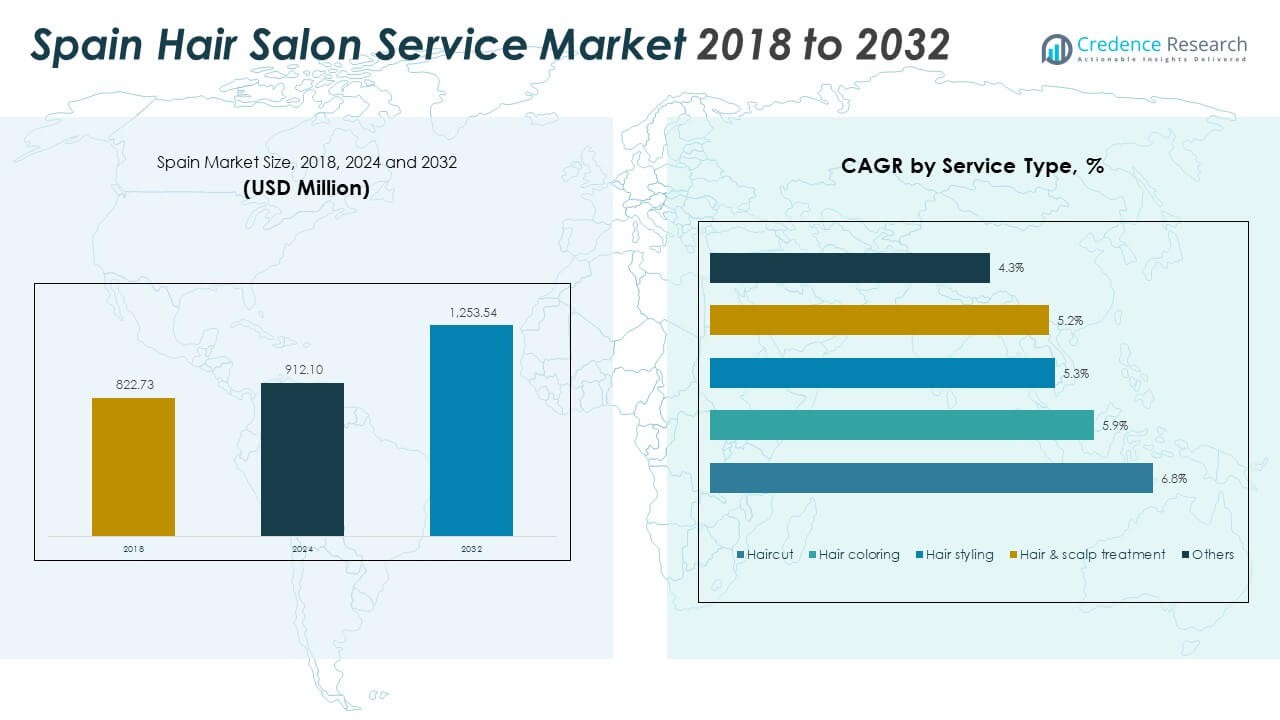
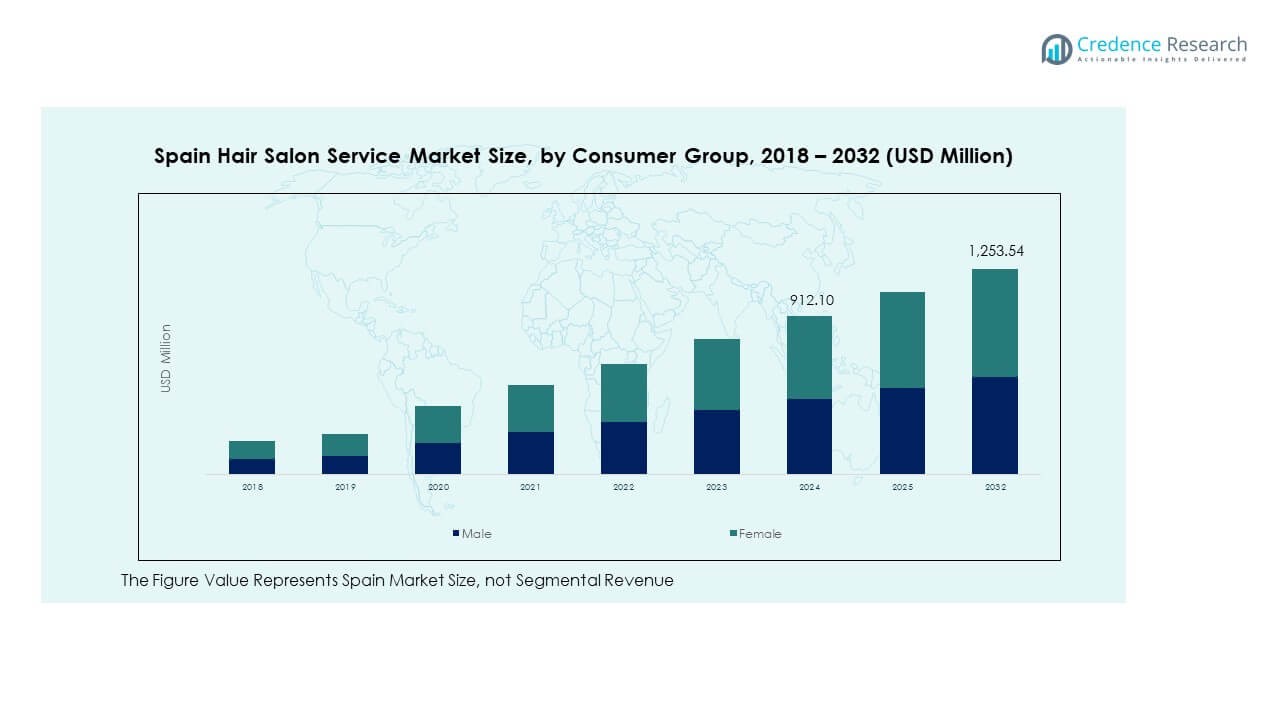
The Spain Hair Salon Service Market size was valued at USD 822.73 million in 2018 to USD 912.10 million in 2024 and is anticipated to reach USD 1,253.54 million by 2032, at a CAGR of 4.05% during the forecast period.
| REPORT ATTRIBUTE | DETAILS |
|---|---|
| Historical Period | 2020-2023 |
| Base Year | 2024 |
| Forecast Period | 2025-2032 |
| Spain Hair Salon Service Market Size 2024 | USD 912.10 Million |
| Spain Hair Salon Service Market, CAGR | 4.05% |
| Spain Hair Salon Service Market Size 2032 | USD 1,253.54 Million |
The Spain Hair Salon Service Market is driven by increasing disposable incomes and a growing focus on personal grooming among consumers. The demand for premium services like advanced hair treatments, coloring, and styling is rising. Technological advancements in hair care and salon management are also propelling growth. Consumers are increasingly opting for personalized experiences, which drives salons to adopt innovative solutions and high-quality products. As social media influences beauty trends, salon visits continue to rise.
Regionally, Spain’s major urban areas, including Madrid and Barcelona, lead the market, with high disposable incomes and a dense concentration of premium salons. These regions offer a strong customer base for luxury services, particularly among the working and affluent populations. Emerging regions like coastal areas benefit from tourism, which boosts salon demand. Smaller towns and rural areas are growing more gradually, with a growing interest in both traditional and modern beauty services.
Market Insights
- The Spain Hair Salon Service Market was valued at USD 822.73 million in 2018, grew to USD 912.10 million in 2024, and is projected to reach USD 1,253.54 million by 2032, expanding at a CAGR of 4.05%.
- Central Spain, particularly Madrid, holds the largest market share due to its urban population and demand for premium services. The northern regions follow with consistent demand driven by both local consumers and tourism.
- The fastest-growing region is Southern Spain, particularly the coastal areas, with a strong boost from the tourism industry and increasing demand for beauty services among visitors.
- The consumer group segment shows male clients contributing significantly to the market, while females dominate overall salon service demand, especially for premium and customized treatments.
- The service type segment is evenly split, with haircuts and hair coloring services holding the largest shares, while hair & scalp treatments are seeing a gradual increase in demand.
 Market Drivers:
Increased Consumer Focus on Personal Grooming
The growing emphasis on personal grooming drives demand in the Spain Hair Salon Service Market. As disposable income rises, consumers are allocating more to beauty and self-care services. The trend of self-care and wellness continues to gain popularity across Spain, encouraging more frequent visits to salons. This increase in salon footfall boosts demand for various services, including haircuts, styling, and treatments. As people become more conscious of their appearance, the frequency of salon visits also rises. More consumers are investing in premium services, opting for advanced styling, hair colouring, and other specialized treatments.
- For example, Jean Louis David salons in Spain have consistently introduced new ammonia-free oil-based color services, such as INOA and DIA COLOR (by L'Oréal Professionnel). These services are actively promoted across all age groups, with a particular focus on their popularity in Madrid's urban locations, reflecting the brand's commitment to offering innovative and gentle hair coloring solutions in the Spain Hair Salon Service Market.
Technological Advancements in Salon Services
Technological innovations are significantly shaping the Spain Hair Salon Service Market. New tools and equipment improve service efficiency and quality, attracting more customers. High-definition colour treatments, scalp health analysis, and laser hair restoration are gaining popularity due to their enhanced results. This technological evolution allows salons to offer better, more personalized experiences, which resonates well with modern consumers. Technological advancements also enable salons to manage appointments, payments, and customer records digitally, improving operational efficiency.
Urbanisation and Changing Lifestyles
Urbanisation in cities like Madrid and Barcelona has contributed to the growing demand for hair salon services in Spain. As people migrate to cities, busy lifestyles lead to an increase in demand for quick, accessible beauty services. Salons in urban areas benefit from a larger customer base and higher consumer spending. The presence of more high-income households in urban locations has resulted in greater spending on premium hair services. Additionally, the increasing number of professional women in urban areas has further boosted salon visits.
- For example, Marco Aldany salons in urban centers like Madrid and Barcelona are known for their express services, including fast blow-dry and styling. Verified customer reviews consistently highlight the efficiency and high-quality of these services, particularly for professionals with tight schedules.
Rising Influence of Social Media and Beauty Trends
Social media platforms like Instagram and YouTube are a major influence on the Spain Hair Salon Service Market. Beauty influencers and celebrities often share haircare tips, new styles, and colour trends, encouraging followers to replicate those looks. Consumers are inspired to visit salons to achieve the latest hair trends seen online. With the rise of “selfie culture” and social media sharing, individuals are more concerned about their appearance, prompting higher salon footfall. The connection between social media trends and real-world beauty services is expected to drive continuous market growth.
Market Trends:
Growth of Sustainable and Organic Salon Services
The Spain Hair Salon Service Market is witnessing a growing preference for organic and sustainable products. Consumers are increasingly concerned with the environmental impact of beauty treatments, and this has led to a surge in demand for eco-friendly salon services. Natural and organic hair care products, free from harsh chemicals, are becoming more popular. Many salons are responding by adopting greener practices, such as using biodegradable products and reducing waste. This trend is aligned with the global movement towards sustainability, influencing the local market dynamics.
- For instance, L’Oréal’s Professional Products Division reports that its iNOA and Dia Light color tubes are now made from 95% recycled aluminum. Additionally, the company has equipped 3,000 salons worldwide, including those in Spain, with recycling systems that divert 110 tons of waste annually. This initiative reflects L’Oréal’s commitment to sustainability within the hair salon service market.
Personalized Hair Treatments and Services
Consumers in the Spain Hair Salon Service Market are increasingly seeking personalized treatments tailored to their specific needs. Hair and scalp analysis technology enables salons to offer customized haircare solutions. Clients now expect salons to recommend products and treatments that suit their hair type and concerns, whether it’s hair thinning, dry scalp, or colour care. Personalization in service offerings, from haircuts to treatment plans, is becoming a key differentiator for salons. Salons providing tailored experiences are more likely to build loyal customer bases.
- For instance, Schwarzkopf Professional’s SalonLab Smart Analyzer uses a near-infrared sensor to measure the inner strength of hair, enabling hyper-personalized recommendations based on molecular data. The system is in commercial use across Europe, including Spain, offering features such as measuring product efficacy and tracking personalized results for clients. This award-winning technology has been adopted by leading salons, enhancing service quality and customer satisfaction in the Spain Hair Salon Service Market.
Integration of Wellness and Beauty Services
Salons in Spain are increasingly blending beauty services with wellness offerings, such as hair and scalp treatments, massage therapies, and relaxation zones. Consumers are looking for an all-encompassing beauty experience that includes stress relief and relaxation in addition to hair services. This integration of wellness into salon services is enhancing the customer experience and attracting a broader clientele. The rise of salon-spas that combine beauty and wellness is a growing trend in the Spain Hair Salon Service Market.
Growth of Mobile and At-Home Salon Services
Mobile salons are becoming more popular in Spain, especially in metropolitan areas, due to the convenience they offer. Many consumers prefer the option of at-home beauty treatments, especially for haircuts, styling, and colour services. The trend towards mobile and at-home salon services is particularly appealing to busy professionals, elderly clients, and those with limited mobility. With mobile services, consumers can enjoy high-quality treatments in the comfort of their own homes, offering salons an opportunity to expand their customer base.
Market Challenges Analysis:
High Competition and Market Saturation
The Spain Hair Salon Service Market faces significant competition due to a high number of salons, especially in urban centres. Many new entrants are providing similar services, making it difficult for established salons to differentiate themselves. Price wars, along with pressure on quality and customer service, intensify this competition. This oversupply of salons leads to challenges in attracting and retaining customers. Many salons need to innovate constantly to stay relevant and meet the evolving demands of consumers. Differentiation based on premium services, advanced technology, and exceptional customer experiences is essential for survival in this saturated market.
Rising Operational Costs
The increasing operational costs in Spain pose challenges for hair salons. Rent, staff salaries, and the cost of premium hair products have risen over the years. For salons in metropolitan areas, maintaining profitability while keeping prices competitive becomes difficult due to high overhead costs. Additionally, the need for continuous investment in staff training, technological upgrades, and salon maintenance adds to operational pressures. Salons must find ways to balance cost efficiency while maintaining service quality. This rising cost burden can discourage smaller or independent salons from thriving in a highly competitive market.
Market Opportunities:
Expansion of Premium and Niche Services
There is a growing opportunity for salons in Spain to tap into the premium and niche service markets. As disposable incomes rise, more consumers are willing to pay for high-end services such as luxury hair treatments, scalp massages, and specialised colour services. Salons can also focus on specific customer segments, offering tailored services for people with particular hair types or concerns. By providing exclusive, personalised experiences, salons can differentiate themselves from the competition and attract a loyal customer base.
Increasing Demand for Men’s Grooming Services
There is an emerging opportunity in the Spain Hair Salon Service Market with the growing demand for men's grooming services. Traditionally dominated by barbershops, men’s grooming is now a mainstream trend in high-end salons. As men become more concerned with their appearance, they seek professional grooming services, from haircuts to beard care. Salons can tap into this market by offering specialized services aimed at male customers. Providing gender-neutral or male-focused beauty services presents significant growth potential.
Market Segmentation Analysis:
By Service Type
The Spain Hair Salon Service Market is segmented by service type, with haircuts, hair colouring, and hair styling being key categories. Haircuts dominate as they are essential for most salon visits, catering to diverse customer preferences. Hair colouring has seen steady growth, driven by trends in vibrant and natural colour choices. Styling services, including blowouts and updos, continue to be popular, especially for events. Hair and scalp treatments are gaining popularity as consumers focus more on scalp health and overall hair wellness. Specialized services like keratin treatments and deep conditioning are also growing in demand.
- For example, Llongueras salons are renowned for their “Llongueras Method,” which incorporates geometric cutting and visagism training. The brand also operates a globally recognized educational system for hair professionals and is committed to incorporating sustainability practices in some of its locations.
By Salon Type
The Spain Hair Salon Service Market is divided into several salon types, including full-service salons, chain/franchise salons, barbershops, mobile/at-home salons, and salon-spas. Full-service salons lead the market due to their broad range of offerings. Chain and franchise salons are expanding rapidly across Spain, attracting consumers with consistent quality and brand recognition. Barbershops are still popular, especially for men’s grooming. Mobile/at-home salons are growing due to consumer preference for convenience. Salon-spas are gaining traction as they offer integrated beauty and wellness services, catering to customers seeking holistic treatments.
- For example, Marco Aldany is Spain’s largest salon franchise, known for its widespread presence and use of digital booking platforms. The company has been actively modernizing its services to enhance customer convenience and streamline operations, as confirmed through various public announcements and press coverage.
By Consumer Group
The market is also segmented by consumer group, with male and female consumers being the primary groups. While women historically account for the majority of salon services, the growing demand for men’s grooming has led to an increase in male clientele. Salons are adapting to cater to both genders, offering tailored services for each group. Women continue to drive market growth, particularly in services like colouring, styling, and advanced treatments. Male customers, however, are increasingly opting for premium haircuts, beard grooming, and skincare services.
By Price Range
The Spain Hair Salon Service Market offers services across different price ranges: premium, mid-market, and value/economy. Premium services attract high-income consumers looking for luxury experiences and high-end treatments. Mid-market services cater to the broader consumer base, offering a balance between quality and affordability. The value/economy segment appeals to budget-conscious consumers who seek essential services without added frills. The growing demand for premium services is noticeable in urban centres, while mid-market and value segments maintain strong demand in suburban and rural areas.
 Segmentation
By Service Type
- Haircut
- Hair colouring
- Hair styling
- Hair & scalp treatment
- Others
By Salon Type
- Full-Service Salons
- Chain/Franchise Salons
- Barbershops
- Mobile/At-Home Salons
- Salon-Spas
By Consumer Group
- Male
- Female
By Price Range
- Premium
- Mid-Market
- Value/Economy
Regional Analysis
Northern Spain
Northern Spain, including regions like Galicia and the Basque Country, holds a significant share of the Spain Hair Salon Service Market, accounting for around 20%. The market in this region benefits from a mix of traditional and modern services, with a strong demand for quality and value. The population in cities like Bilbao and Santander is increasingly investing in both basic and advanced beauty services. While the region has a solid customer base, the growth rate in smaller towns is slower compared to larger urban centres. The focus remains on haircuts, styling, and scalp treatments, reflecting a more conservative yet steadily growing market.
Central Spain
Central Spain, particularly Madrid and the surrounding areas, dominates the Spain Hair Salon Service Market with a market share of approximately 40%. Madrid, being the capital, is the primary hub for premium salons and advanced beauty treatments, attracting both locals and international clientele. The urban population's high disposable income contributes to the demand for specialized hair treatments, organic products, and personalized services. Central Spain also benefits from a high concentration of chain salons and salon-spas, which offer both convenience and luxury. The region is expected to continue its upward trend, with innovation and service differentiation playing a key role in its growth.
Southern Spain
Southern Spain, including Andalusia, accounts for 25% of the Spain Hair Salon Service Market. Cities like Seville, Málaga, and Cádiz are experiencing steady growth due to their vibrant tourism industries, with many visitors seeking beauty services. The region’s customer base consists largely of middle-income households, who favor affordable yet quality hair care services. Hair salons in Southern Spain are increasingly adopting new trends such as eco-friendly and organic treatments, aligning with consumer preferences for sustainable beauty services. As tourism continues to rise, salons in these regions are diversifying to meet the demands of both locals and tourists.
Key Player Analysis
- L’Oréal Professionnel / L’Oréal S.A.
- Jean Louis David
- Llongueras
- Raffel Pages
- Carche
- Toni & Guy
- Rizos Peluqueros
- Oh My Cut!
- Cebado
- Luis & Tachi
Competitive Analysis
The Spain Hair Salon Service Market remains highly competitive, with several large and small players battling for market share. Chain salons such as Jean Louis David, Toni & Guy, and Saloons are major players, dominating both urban and suburban markets. These brands offer a wide range of services, from basic haircuts to advanced treatments, and are recognized for their consistency in service quality. Independent salons still play a crucial role, especially in smaller cities and rural areas, where personalized services and local customer relationships drive loyalty. Mobile and at-home services, such as those offered by companies like The Glam App, are gaining traction, appealing to busy professionals and those seeking home convenience. Regional competitors also cater to specific consumer preferences, including eco-friendly and organic beauty services. The rise in mobile bookings and online consultations is reshaping the competitive dynamics, with salons increasingly leveraging technology to streamline operations. The continuous need for innovation, cost management, and customer satisfaction keeps competition intense across the Spain Hair Salon Service Market.
Recent Developments
- In November 2025, L’Oréal announced the acquisition of Kering Beauté, a major deal facilitated in part by a €3 billion bond sale. The acquisition aims to enhance L’Oréal’s global beauty portfolio, including professional hair care services in Spain. The move underscores L’Oréal’s continued expansion and influence in the Spanish salon industry, where their Professional Products Division has also reported sustained sales growth and driven market innovation this year.
- In June 2025, L’Oréal S.A. signed an agreement to acquire Color Wow, a rapidly growing premium haircare brand known for its innovative solutions specifically tailored for colour-treated hair. The acquisition was made through L’Oréal’s Professional Products Division and reflects the Group’s commitment to strengthening its leadership and expanding its professional-grade product portfolio for the hair salon service sector in Italy and globally.
Report Coverage
The research report offers an in-depth analysis based on Service Type, Salon Type, Consumer Group and Price Range. It details leading market players, providing an overview of their business, product offerings, investments, revenue streams, and key applications. Additionally, the report includes insights into the competitive environment, SWOT analysis, current market trends, as well as the primary drivers and constraints. Furthermore, it discusses various factors that have driven market expansion in recent years. The report also explores market dynamics, regulatory scenarios, and technological advancements that are shaping the industry. It assesses the impact of external factors and global economic changes on market growth. Lastly, it provides strategic recommendations for new entrants and established companies to navigate the complexities of the market.
Future Outlook
- The Spain Hair Salon Service Market is expected to see continued growth driven by increasing consumer investment in personal grooming.
- Premium services will dominate, with consumers gravitating towards high-quality and personalized hair treatments.
- Mobile and at-home services will likely expand, reflecting the demand for convenience and on-demand beauty services.
- Eco-friendly and organic treatments will continue to gain popularity, as consumers become more eco-conscious.
- Technological advancements such as AI-driven consultations and online booking systems will reshape how salons operate.
- Regional markets will see differentiated growth, with urban areas leading and smaller regions gradually catching up.
- Hair and scalp treatments will see strong demand, as consumers increasingly focus on hair health and wellness.
- Salons will adopt more sustainable practices, reducing their environmental footprint and aligning with consumer preferences.
- The competitive landscape will become more fragmented, with both large chains and independent salons vying for market share.
- Partnerships between beauty brands and salons will be crucial, with new collaborations expected to enhance service offerings.

Request a Free Sample
Fill in your details and we'll send you a free sample report.
- Sample data tables & charts
- Research methodology
Need a Custom Version of This Report?
Tailor the scope, geography, or segments to your exact requirements.
- Custom geography or segment scope
- Direct access to our analyst team
Frequently Asked Questions
What is the current market size for the Spain Hair Salon Service Market, and what is its projected size in 2032?
At what Compound Annual Growth Rate is the Spain Hair Salon Service Market projected to grow between 2024 and 2032?
Which Spain Hair Salon Service Market segment held the largest share in 2024?
What are the primary factors fueling the growth of the Spain Hair Salon Service Market?
Who are the leading companies in the Spain Hair Salon Service Market?
Which region commanded the largest share of the Spain Hair Salon Service Market in 2024?
Table of Content
Chapter 1 Market Segmentation
- 1.1 Segmentation Framework
- 1.1.1 Product and Service Classification
- 1.1.2 Application and End-Use Classification
- 1.1.3 Technology and Solution Classification
- 1.1.4 Customer and Distribution Channel Classification
- 1.1.5 Geographic Segmentation
- 1.1.6 Market Segment Definitions and Boundaries
Chapter 2 Introduction
- 2.1 Report Objectives and Scope
- 2.2 Product Definition and Industry Terminology
- 2.3 Market Inclusions and Exclusions
- 2.4 Research Process
- 2.4.1 Primary Research and Expert Interviews
- 2.4.2 Secondary Research and Source Review
- 2.4.3 Top-Down and Bottom-Up Estimation
- 2.4.4 Data Triangulation and Verification
- 2.5 Market Size Measurement Basis
- 2.5.1 2024: USD 912.10 million → 2032: USD 1,253.54 million
- 2.6 Historical and Forecast Reference Periods
- 2.6.1 Base Year: 2024
- 2.6.2 Forecast Period: 2024-2032
- 2.7 Research Assumptions and Limitations
Chapter 3 Executive Summary
- 3.1 Market Snapshot and Key Findings
- 3.2 Base-Year Market Size, 2024
- 3.3 Forecast Market Size, 2032
- 3.4 Revenue and Volume Growth Outlook
- 3.5 Key Demand and Supply Indicators
- 3.6 Leading Market Segments
- 3.7 Fastest-Growing Market Opportunities
- 3.8 Regional Performance Highlights
- 3.9 Technology and Industry Transformation
- 3.10 Competitive Landscape Summary
- 3.11 Analyst View and Strategic Implications
Chapter 4 Spain Hair Salon Service Market Trends and Developments
- 4.1 Historical Industry Development
- 4.2 Recent Market Trends and Developments
- 4.3 Demand and Customer Behavior Trends
- 4.4 Technology and Product Innovation
- 4.5 Artificial Intelligence, Automation and Digitalization
- 4.6 Local Manufacturing and Supply Chain Realignment
- 4.7 Industry Partnerships, Mergers and Acquisitions
- 4.8 Sustainability and Circular Economy Developments
- 4.9 Government and Private Sector Investment Trends
- 4.10 Emerging Business Models and Commercialization
- 4.11 Industry Developments and Announcements
Chapter 5 Spain Hair Salon Service Market Supply and Demand Analysis
- 5.1 Demand Trend and Consumption Analysis
- 5.2 Demand Forecast, 2024-2032
- 5.3 Supply Chain Structure and Procurement Trends
- 5.4 Supply-Demand Gap and Bottlenecks
- 5.5 Import Dependence and Sourcing Structure
- 5.6 Regional Supply and Demand Concentration
Chapter 6 Spain Hair Salon Service Market Pricing Analysis
- 6.1 Pricing Structure and Measurement
- 6.2 Historical Pricing Trends
- 6.3 Pricing Outlook, 2024-2032
- 6.4 Pricing by Product and Market Segment
- 6.5 Geographic Pricing Differences
- 6.6 Key Input, Energy, Labor and Logistics Costs
- 6.7 Contract Pricing and Purchasing Models
- 6.8 Pricing Sensitivity and Competitive Positioning
- 6.9 Price, Margin and Profitability Implications
Chapter 7 Spain Hair Salon Service Market Dynamics
- 7.1 Market Growth Drivers
- 7.1.1 Demand-Side Drivers
- 7.1.2 Technology and Innovation Drivers
- 7.1.3 Infrastructure and Investment Drivers
- 7.1.4 Regulatory and Policy Drivers
- 7.2 Market Restraints
- 7.2.1 Cost and Affordability Constraints
- 7.2.2 Technology and Adoption Barriers
- 7.2.3 Supply Chain and Operational Constraints
- 7.3 Market Challenges
- 7.3.1 Competitive Pressure and Margin Erosion
- 7.3.2 Skills, Infrastructure and Implementation Gaps
- 7.4 Emerging Market Opportunities
- 7.5 Market Dynamics Impact and Time-Horizon Assessment
Chapter 8 Spain Hair Salon Service Value Chain Analysis
- 8.1 Industry Value Chain Overview
- 8.2 Upstream Suppliers and Critical Inputs
- 8.3 Technology and Component Providers
- 8.4 Manufacturing or Service Delivery
- 8.5 Distribution, Channel Partners and Integrators
- 8.6 Downstream Applications and End Users
- 8.7 Value Addition and Profit Pools
- 8.8 Vertical Integration and Outsourcing
- 8.9 Supplier Concentration and Risk
- 8.10 Supply Chain Localization and Resilience
Chapter 9 Spain Hair Salon Service Market Regulations and Policies
- 9.1 Relevant Laws, Standards and Compliance Frameworks
- 9.2 Product, Service, Safety and Quality Requirements
- 9.3 Government Policies, Incentives and Subsidies
- 9.4 Imports, Exports and Trade Barriers
- 9.5 Public Procurement and Local Content Requirements
- 9.6 Data Protection, AI and Cybersecurity Compliance
- 9.7 Upcoming Policy Changes and Market Implications
Chapter 10 Spain Hair Salon Service Market Hotspots and Opportunities
- 10.1 Market Opportunity Mapping and Growth Hotspots
- 10.2 High-Growth Applications and Customer Groups
- 10.3 Underserved Markets and White-Space Opportunities
- 10.4 Emerging Technology and Product Opportunities
- 10.5 New Capacity and Investment Hotspots
- 10.6 Market Entry and Expansion Opportunities
- 10.7 Distribution and Partnership Opportunities
- 10.8 Near-Term and Long-Term Commercial Potential
- 10.9 Opportunity Attractiveness and Execution Risks
Chapter 11 Spain Hair Salon Service Market Outlook, 2024-2032
- 11.1 Market Size and Analysis
- 11.1.1 Revenue (Market Measurement: 2024: USD 912.10 million → 2032: USD 1,253.54 million)
- 11.1.2 Historical Market Size
- 11.1.3 Base-Year Market Size, 2024
- 11.2 Market Forecast, 2024-2032
- 11.2.1 Revenue Forecast to 2032
- 11.2.2 CAGR and Year-on-Year Growth
- 11.2.3 Incremental Revenue Opportunity
- 11.3 Forecast Assumptions and Scenario Analysis
- 11.3.1 Base-Case Forecast
- 11.3.2 Optimistic and Conservative Scenarios
- 11.3.3 Technology, Pricing and Policy Sensitivities
- 11.4 Market Attractiveness and Growth Outlook
Chapter 12 Spain Hair Salon Service Market Segmentation and Outlook
- 12.1 Segmentation Summary and Market Shares, 2024
- 12.2 Largest and Fastest-Growing Segments
- 12.3 Segment Growth Comparison
- 12.4 Segment Attractiveness and Priority Matrix
Chapter 13 Spain Hair Salon Service Geographic Market Outlook, 2024-2032
- 13.1 Domestic Market Distribution and Demand Clusters
- 13.2 State- or Province-Wise Market Size and Forecast, 2024-2032
- 13.3 City and Metropolitan Market Outlook
- 13.4 Industrial, Manufacturing and Commercial Clusters
- 13.5 Geographic Concentration of Key End Users
- 13.6 Local Pricing and Purchasing Differences
- 13.7 Domestic Production Facilities and Capacity Map
- 13.8 Local Infrastructure and Project Pipeline
- 13.9 State-Level Policy and Incentive Differences
- 13.10 Subnational Investment Hotspots and Opportunities
- 13.11 Distribution and Logistics Networks
- 13.12 Domestic Competitive Footprint
Chapter 14 Spain Hair Salon Service Technology, Innovation and Sustainability Outlook
- 14.1 Technology Landscape and Maturity
- 14.2 Product, Process and Service Innovation
- 14.3 AI, Automation and Digital Tools in the Industry
- 14.4 Technology Adoption and Performance Benchmarking
- 14.5 Innovation Pipeline and R&D Investment
- 14.6 Energy Efficiency and Resource Management
- 14.7 Sustainability, Recycling and Circularity
- 14.8 Technology Roadmap, 2024-2032
- 14.9 Risks of Obsolescence and Technology Substitution
Chapter 15 Spain Hair Salon Service Market Key Strategic Imperatives
- 15.1 Growth and Market Entry Priorities
- 15.2 High-Return Products and Segments
- 15.3 Pricing, Profitability and Cost Optimization
- 15.4 Technology Investment and Product Differentiation
- 15.5 Supply Chain Localization and Resilience
- 15.6 Distribution and Customer Acquisition
- 15.7 Partnership, Acquisition and Capacity Strategy
- 15.8 Regional Expansion Priorities
- 15.9 Short-, Medium- and Long-Term Actions
Chapter 16 Competition Outlook
- 16.1 Industry Competition Characteristics
- 16.2 Market Structure and Concentration
- 16.3 Market Share and Competitive Positioning, 2024
- 16.4 Company-Wise Revenue and Product Benchmarking
- 16.5 Production and Service Capacity Benchmarking
- 16.6 Technology, Pricing and Differentiation
- 16.7 Regional Footprint and Distribution Strength
- 16.8 Mergers, Acquisitions and Strategic Alliances
- 16.9 New Entrants and Competitive Threats
- 16.10 Porter's Five Forces and Industry Attractiveness
- 16.11 Competitive Outlook, 2024-2032
Chapter 17 Company Profiles
- 17.1 Company Coverage and Selection Criteria
- 17.2 Leading Market Participants – Standard Profile Structure
- 17.2.1 Business Description
- 17.2.2 Company Ownership and Geographic Presence
- 17.2.3 Product and Service Portfolio
- 17.2.4 Manufacturing and Operating Footprint
- 17.2.5 Financial Performance and Investment
- 17.2.6 Market Share and Competitive Position
- 17.2.7 Technology and Innovation Capabilities
- 17.2.8 Strategic Alliances or Partnerships
- 17.2.9 Recent Developments
- 17.2.10 Growth Strategy and Outlook
- 17.3 Other Relevant Market Participants
Note: Every listed company is profiled on the structure shown under the first company. The company list is preliminary and may change based on research findings, market developments, data availability and client requirements.
Chapter 18 Disclaimer
- 18.1 Research and Forecast Disclaimer
- 18.2 Data Source and Estimation Limitations
Note: The depth of individual sections depends on data availability for this market. Volume, capacity, trade and other unit-based metrics are included where applicable.

