
Specialty Cheese Market Overview:
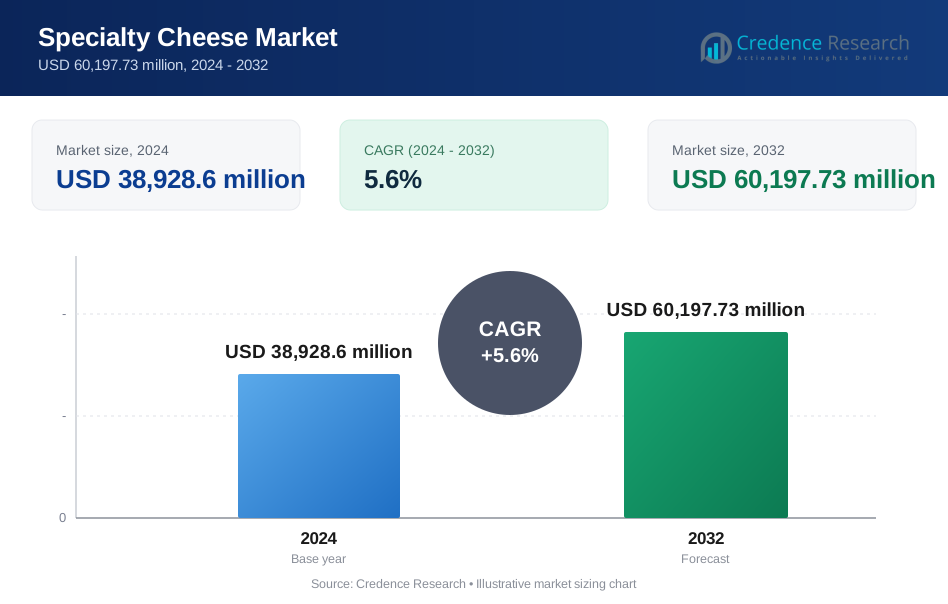
The specialty cheese market was valued at USD 38,928.6 million in 2024 and is projected to reach USD 60,197.73 million by 2032, expanding at a compound annual growth rate (CAGR) of 5.6% during the forecast period.
| REPORT ATTRIBUTE | DETAILS |
|---|---|
| Historical Period | 2020-2023 |
| Base Year | 2024 |
| Forecast Period | 2025-2032 |
| Specialty Cheese Market Size 2024 | USD 38,928.6 million |
| Specialty Cheese Market, CAGR | 5.6% |
| Specialty Cheese Market Size 2032 | USD 60,197.73 million |
Specialty Cheese Market Insights
- Market growth is primarily driven by increasing consumer preference for premium, aged, and origin-specific cheeses, strong foodservice demand from gourmet dining and cafés, and higher disposable incomes, with aged cheese dominating the product segment due to flavor depth and longer shelf life.
- Key market trends include flavor innovation, organic and clean-label specialty cheeses, and growing demand for convenient formats such as sliced and shredded products, while block cheese remains the leading form segment due to versatility and foodservice preference.
- The competitive landscape features multinational dairy groups and artisanal producers competing on quality, heritage branding, and distribution strength, with private-label expansion and portfolio diversification intensifying competition.
- Regionally, Europe leads with ~39% market share, followed by North America at ~35%, while Asia Pacific holds ~17% and represents the fastest-growing region, supported by urbanization and expanding modern retail.
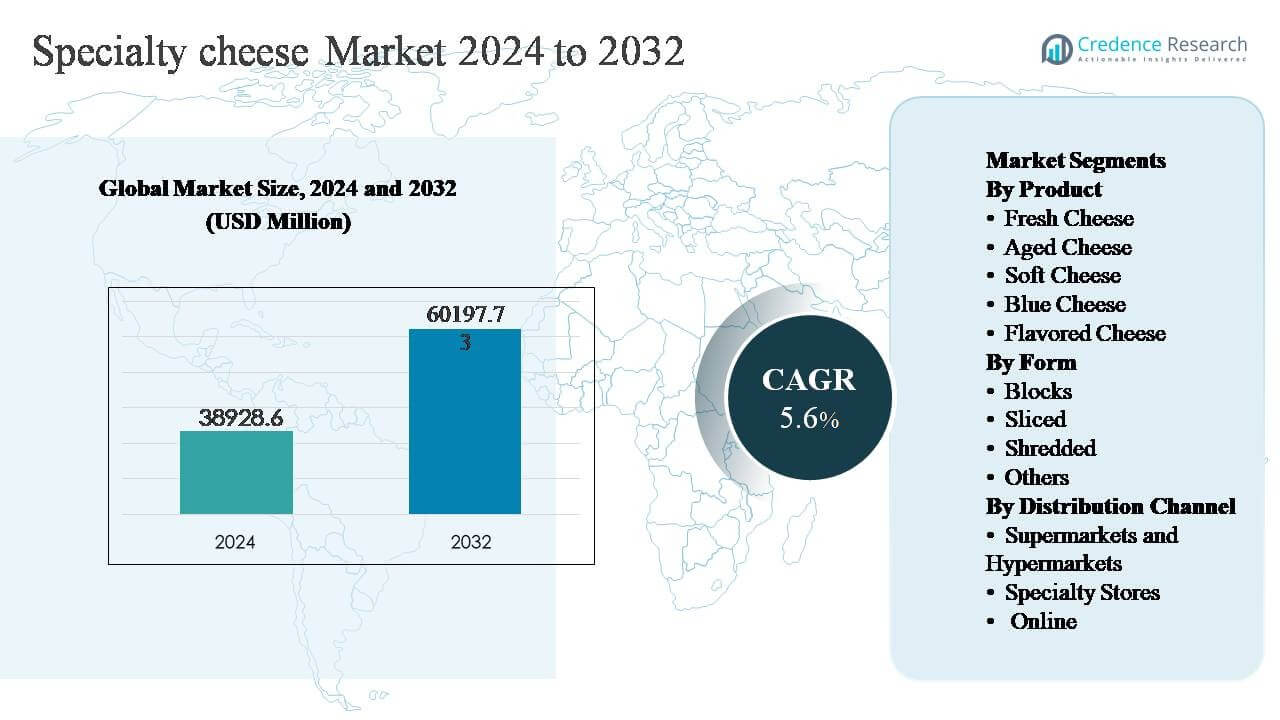
Specialty Cheese Market Segmentation Analysis:
By Product:
By product, aged cheese represents the dominant sub-segment in the specialty cheese market, accounting for the largest market share due to its premium positioning, complex flavor profiles, and strong cultural association with European culinary traditions. Varieties such as Parmigiano Reggiano, Cheddar, Gouda, and Gruyère benefit from long maturation periods that enhance taste, texture, and perceived value. Demand is driven by affluent consumers, gourmet cooking trends, and foodservice adoption in fine dining and premium casual restaurants. Fresh and soft cheeses maintain steady demand for everyday consumption, while flavored cheeses gain traction through innovation.
- For instance, Parmigiano Reggiano produced by members of the Consorzio del Formaggio Parmigiano Reggiano must be aged for a minimum of 12 months, with many premium wheels matured for 24-36 months, during which each 38-40 kg wheel is regularly turned and brushed to ensure uniform aging.
By Form:
By form, block cheese dominates the specialty cheese market, holding the highest market share owing to its versatility, longer shelf life, and preference among both households and foodservice operators. Blocks allow consumers and chefs to customize portion sizes for slicing, shredding, or grating, making them suitable for diverse culinary applications. Retailers also favor block formats for reduced processing costs and improved freshness retention. Sliced and shredded forms show growing adoption driven by convenience and ready-to-use appeal, particularly in urban households, while other formats remain niche due to limited scalability.
- For instance, Arla Foods’ block-format Gouda and Havarti are typically produced in 3 kg and 5 kg blocks, vacuum-sealed using multilayer barrier films that achieve oxygen transmission rates below 20 cm³/m²/24 h, significantly extending refrigerated shelf stability.
By Distribution Channel:
By distribution channel, supermarkets and hypermarkets account for the dominant market share in specialty cheese sales, supported by wide product assortments, strong cold-chain infrastructure, and high consumer footfall. These outlets enable brand visibility and offer imported, artisanal, and private-label specialty cheeses under one roof. Growth is driven by organized retail expansion and consumer preference for one-stop shopping. Specialty stores cater to premium and artisanal segments through expert curation and tasting experiences, while online channels grow steadily due to improved logistics, subscription models, and premium home delivery services.
Key Growth Drivers
Rising Consumer Preference for Premium and Artisanal Foods
Growing consumer inclination toward premium, artisanal, and authentic food products is a major driver of the specialty cheese market. Consumers increasingly value origin-specific cheeses, traditional production methods, and distinctive flavor profiles, viewing specialty cheese as a symbol of quality and culinary sophistication. Higher disposable incomes and exposure to global cuisines through travel, media, and dining experiences further reinforce demand for aged, blue, and soft cheeses. This trend is particularly strong among urban consumers and younger demographics who associate specialty cheese with lifestyle, indulgence, and experimentation. The willingness to pay premium prices for provenance, craftsmanship, and sensory differentiation continues to elevate specialty cheese consumption beyond occasional indulgence into regular purchase behavior.
- For instance,Comté AOP cheese, produced by cooperative dairies (fruitières) affiliated with the Comité Interprofessionnel de Gestion du Comté, is made exclusively from raw milk of Montbéliarde or French Simmental cows. Each wheel, weighing approximately 40 kg, is aged for a minimum of 4 months, with premium selections often matured for 12 to 36 months in temperature- and humidity-controlled cellars."
Expansion of Foodservice and Gourmet Dining Channels
The expanding foodservice sector plays a critical role in driving specialty cheese demand. Fine-dining restaurants, premium casual dining, cafés, and bakeries increasingly incorporate specialty cheeses into menus to enhance differentiation and perceived value. Cheeses are widely used in gourmet burgers, artisanal pizzas, cheese boards, and fusion cuisines, creating consistent bulk demand. Hotels and catering services also rely on specialty cheeses for premium breakfast spreads and event menus. This foodservice adoption not only boosts volume consumption but also acts as a discovery channel, familiarizing consumers with new cheese varieties and driving subsequent retail purchases, thereby reinforcing overall market growth.
- For instance, Bel Group supplies foodservice-grade portions of The Laughing Cow and Kiri, produced on automated lines capable of forming portions typically ranging from 16.6g to 20g. These high-speed production systems can exceed wrapping speeds of 500 units per minute, ensuring the high volume and uniformity required for hotel breakfast buffets and airline catering.
Improved Cold Chain and Organized Retail Infrastructure
Advancements in cold-chain logistics and the expansion of organized retail significantly support specialty cheese market growth. Supermarkets and hypermarkets now offer dedicated cheese sections with controlled storage conditions, enabling wider availability of imported and artisanal cheeses. Improved refrigeration, packaging technologies, and inventory management reduce spoilage risks and extend shelf life, making specialty cheese more accessible across regions. Organized retail also supports private-label specialty cheese development, increasing affordability and penetration. These infrastructure improvements allow manufacturers and distributors to scale distribution efficiently while maintaining product quality, directly contributing to market expansion.
Key Trends & Opportunities
Product Innovation and Flavor Experimentation
Ongoing innovation in flavors, textures, and formulations presents strong growth opportunities. Manufacturers increasingly introduce flavored specialty cheeses infused with herbs, spices, truffles, fruits, and regional ingredients to attract adventurous consumers. Limited-edition and seasonal offerings further stimulate trial purchases and brand engagement. Innovation also extends to organic, grass-fed, and clean-label specialty cheeses, aligning with health-conscious consumer preferences. These developments allow brands to differentiate portfolios, command premium pricing, and expand consumption occasions beyond traditional uses, strengthening long-term market potential.
- For instance,"Castello (an Arla Foods brand) produces its Double Cream Brie with Truffle using real black summer truffle shavings (Tuber aestivum). To achieve its signature consistency, the cheese is crafted using a unique process that allows it to mature from the inside out, ensuring a smooth, extra creamy texture throughout.
Growth of Online and Direct-to-Consumer Channels
The rise of online retail and direct-to-consumer models creates new opportunities for specialty cheese brands. E-commerce platforms enable access to niche, imported, and artisanal cheeses that may not be widely available in physical stores. Subscription boxes, curated cheese assortments, and temperature-controlled home delivery enhance consumer convenience and discovery. Digital channels also allow brands to educate consumers through storytelling, origin details, and pairing suggestions, strengthening brand loyalty. As logistics capabilities improve, online sales are expected to become a strategic growth avenue for premium cheese producers.
- For instance, Murray’s Cheese operates an e-commerce fulfillment model using insulated packaging with phase-change gel packs designed to maintain internal temperatures between 1°C and 4°C for transit durations of up to 48 hours, preserving texture and microbial stability of aged and soft cheeses.
Key Challenges
High Production Costs and Price Sensitivity
Specialty cheese production involves higher costs due to premium milk sourcing, extended aging periods, skilled labor, and strict quality controls. These factors result in higher retail prices, limiting affordability for price-sensitive consumers. Fluctuations in raw milk prices and energy costs further pressure margins. In developing markets, high prices can restrict specialty cheese consumption to niche urban segments, slowing volume growth. Balancing premium positioning with cost efficiency remains a key challenge for producers.
Regulatory and Supply Chain Complexity
The specialty cheese market faces complex regulatory requirements related to food safety, labeling, aging standards, and import restrictions. Compliance with varying regional regulations increases operational complexity, particularly for cross-border trade. Additionally, specialty cheeses are sensitive to storage and transportation conditions, making supply chains vulnerable to disruptions. Any breakdown in cold-chain integrity can impact quality and lead to product losses. Managing regulatory compliance while maintaining consistent supply and quality poses an ongoing challenge for market participants.
Regional Analysis
North America
North America holds a significant share of the specialty cheese market, accounting for approximately 34-36% of global revenue. The region benefits from high per-capita cheese consumption, strong demand for premium and artisanal products, and well-established cold-chain and retail infrastructure. The United States dominates regional demand, driven by gourmet dining, widespread use of specialty cheese in foodservice, and growing interest in imported European varieties. Canada also contributes through premium dairy consumption and specialty retail penetration. Continuous product innovation, private-label expansion by large retailers, and strong foodservice recovery sustain North America’s leading market position.
Europe
Europe represents the largest regional market with around 38-40% market share, supported by its deep-rooted cheese-making heritage and protected designation of origin (PDO) products. Countries such as France, Italy, Germany, the Netherlands, and Switzerland drive demand through strong domestic consumption and exports of aged, blue, and specialty regional cheeses. Consumers demonstrate high willingness to pay for authenticity, origin labeling, and traditional production methods. Specialty cheese is widely embedded in everyday diets as well as premium dining. Strong regulatory frameworks, artisanal producers, and mature retail channels reinforce Europe’s dominance in the global specialty cheese market.
Asia Pacific
Asia Pacific accounts for approximately 16-18% of the global specialty cheese market and represents the fastest-growing regional segment. Rising urbanization, expanding middle-class populations, and increasing exposure to Western cuisines are key demand drivers. Markets such as Japan, South Korea, China, and Australia show strong growth in premium cheese consumption through restaurants, cafés, and modern retail formats. Cheese adoption is expanding beyond foodservice into home cooking and snacking. While per-capita consumption remains lower than Western regions, rapid retail modernization, e-commerce growth, and premiumization trends position Asia Pacific as a high-growth market.
Latin America
Latin America holds an estimated 5-6% share of the global specialty cheese market, driven by evolving consumer preferences and gradual premiumization of dairy products. Brazil, Mexico, Argentina, and Chile are the primary contributors, supported by growing urban populations and expanding modern retail networks. Specialty cheese demand is rising in foodservice, particularly in casual dining, pizza chains, and gourmet restaurants. Local artisanal cheese producers also gain visibility alongside imported products. However, price sensitivity and uneven cold-chain infrastructure limit penetration beyond major cities, keeping specialty cheese consumption concentrated in urban and higher-income segments.
Middle East & Africa
The Middle East & Africa region accounts for around 3-4% of the global specialty cheese market, supported by premium food consumption in the Gulf Cooperation Council (GCC) countries. The UAE and Saudi Arabia lead regional demand due to high disposable incomes, strong hospitality sectors, and reliance on imported specialty cheeses. European cheese varieties are widely used in hotels, restaurants, and premium retail outlets. In Africa, consumption remains limited but shows gradual growth in South Africa and select urban markets. High import dependence and logistics challenges constrain broader regional expansion.
Specialty Cheese Market Segmentations:
By Product
- Fresh Cheese
- Aged Cheese
- Soft Cheese
- Blue Cheese
- Flavored Cheese
By Form
- Blocks
- Sliced
- Shredded
- Others
By Distribution Channel
- Supermarkets and Hypermarkets
- Specialty Stores
- Online
By Geography
- North America
- U.S.
- Canada
- Mexico
- Europe
- Germany
- France
- U.K.
- Italy
- Spain
- Rest of Europe
- Asia Pacific
- China
- Japan
- India
- South Korea
- South-east Asia
- Rest of Asia Pacific
- Latin America
- Brazil
- Argentina
- Rest of Latin America
- Middle East & Africa
- GCC Countries
- South Africa
- Rest of the Middle East and Africa
Competitive Landscape
The competitive landscape of the specialty cheese market is moderately fragmented, characterized by the presence of multinational dairy companies, regional processors, and artisanal producers competing on quality, origin, and product differentiation. Leading players leverage strong brand portfolios, extensive distribution networks, and advanced aging and processing capabilities to maintain market position. European producers benefit from protected designation and heritage-based branding, while North American companies focus on innovation, private-label partnerships, and convenience-oriented formats. Artisanal and small-scale producers compete through authenticity, limited-batch offerings, and premium positioning. Strategic initiatives include portfolio expansion into flavored and organic specialty cheeses, investment in cold-chain logistics, and collaborations with foodservice operators. Mergers, acquisitions, and geographic expansion remain key strategies for accessing new markets and strengthening supply chains. Overall, competition intensifies around premiumization, consistency in quality, and the ability to scale specialty offerings without compromising traditional production standards.
Key Player Analysis
- Arla Foods
- Lactalis Group
- Saputo Inc.
- Groupe Savencia Fromage & Dairy
- Emmi Group
- Bel Group
- Fonterra Co-operative Group
- Sargento Foods Inc.
- Zanetti S.P.A
- Murray's Cheese
Recent Developments
- In August 2025,Lactalis finalized the acquisition of multiple consumer dairy brands from Fonterra, including key cheese brands such as Anchor, Mainland, and Kāpiti, and expanded its global manufacturing footprint with 17 production sites across New Zealand and other regions. This transaction significantly broadens Lactalis’ specialty cheese and dairy offerings in Oceania and adjacent markets.
- In August 2025, Arla Foods marked its 25th anniversary of the cooperative merger and reaffirmed its strategic focus on dairy production and investments (including continued capacity and sustainability initiatives that support cheese portfolio development across traditional and specialty formats).
- In June 2025, Arla Foods announced an investment of 59.4 million euros to expand its cream cheese production capacity at the Holstebro Dairy in Denmark, aimed at meeting increasing demand for cream cheese varieties globally, particularly in retail and foodservice segments.
Report Coverage
The research report offers an in-depth analysis based on Product, Form, Distribution channel and Geography. It details leading market players, providing an overview of their business, product offerings, investments, revenue streams, and key applications. Additionally, the report includes insights into the competitive environment, SWOT analysis, current market trends, as well as the primary drivers and constraints. Furthermore, it discusses various factors that have driven market expansion in recent years. The report also explores market dynamics, regulatory scenarios, and technological advancements that are shaping the industry. It assesses the impact of external factors and global economic changes on market growth. Lastly, it provides strategic recommendations for new entrants and established companies to navigate the complexities of the market.
Future Outlook
- Premiumization will continue to drive specialty cheese consumption as consumers increasingly prioritize quality, origin, and authentic production methods.
- Demand for aged, artisanal, and region-specific cheeses will strengthen across both retail and foodservice channels.
- Product innovation will accelerate, with greater focus on flavored, organic, and clean-label specialty cheese offerings.
- Foodservice adoption will expand as restaurants and cafés use specialty cheese to enhance menu differentiation and value perception.
- Block cheese will remain the preferred format, while sliced and shredded variants gain share due to convenience-led consumption.
- Online and direct-to-consumer channels will play a larger role in expanding access to premium and niche cheese varieties.
- Emerging markets will show higher growth rates as urbanization and exposure to global cuisines increase.
- Cold-chain and packaging advancements will improve shelf life and support wider geographic distribution.
- Sustainability initiatives, including responsible sourcing and reduced environmental impact, will influence purchasing decisions.
- Competitive intensity will increase as global players and artisanal producers expand portfolios and strengthen regional presence.
Request a Free Sample
Fill in your details and we'll send you a free sample report.
- Sample data tables & charts
- Research methodology
Need a Custom Version of This Report?
Tailor the scope, geography, or segments to your exact requirements.
- Custom geography or segment scope
- Direct access to our analyst team
Frequently Asked Questions
What is the current market size for specialty cheese, and what is its projected size in 2032?
At what Compound Annual Growth Rate is the specialty cheese market projected to grow between 2024 and 2032?
Which specialty cheese segment held the largest share in 2024?
What are the primary factors fueling the growth of the specialty cheese market?
Who are the leading companies in the specialty cheese market?
Which region commanded the largest share of the specialty cheese market in 2024?
Table of Content
Chapter 1. Report Introduction
- 1.1 Report Description & Purpose
- 1.1.1 Report Title & Market Definition
- 1.1.2 Unique Selling Propositions (USP) & Key Differentiators
- 1.1.3 Value Proposition for Stakeholders
- 1.2 Research Objectives
- 1.2.1 Market Sizing Objectives (Volume & Revenue)
- 1.2.2 Segmentation Objectives
- 1.2.3 Competitive Intelligence Objectives
- 1.2.4 Forecast & Scenario Objectives
- 1.3 Report Scope
- 1.3.1 Specialty Cheese Scope – Types & Subtypes Covered
- 1.3.2 Geographic Scope – Regions & Countries Covered
- 1.3.3 Historical Period, Base Year & Forecast Period (2024; forecast to 2032)
- 1.3.4 Inclusions & Exclusions
- 1.4 HS Code & Classification Framework
- 1.5 Currency, Units & Pricing Basis
- 1.6 Target Stakeholders
- 1.7 Limitations & Assumptions
Chapter 2. Executive Summary
- 2.1 Global Specialty Cheese Market Snapshot
- 2.1.1 Market Size – Historical (2024) & Forecast (2024-2032) (2024: USD 38,928.6 million → 2032: USD 60,197.73 million)
- 2.1.2 Volume & Revenue – Global Totals
- 2.1.3 Key Market Highlights – Top Five Facts
- 2.2 Specialty Cheese Market Segmentation Snapshot
- 2.2.1 Market Split by Region – 2024 vs. 2032
- 2.3 Competitive Snapshot
- 2.3.1 Top 10 Players by Revenue Share – 2024
- 2.3.2 Top 10 Players by Volume Share – 2024
- 2.3.3 Recent Strategic Developments (18-Month Summary)
- 2.4 Key Investment Highlights & Strategic Conclusions
Chapter 3. Specialty Cheese Market Dynamics & Industry Analysis
- 3.1 Market Overview & Context
- 3.1.1 Specialty Cheese Market Position in the Broader Automotive Value Chain
- 3.1.2 OEM vs. Replacement Market Dynamics
- 3.1.3 Market Maturity & Development Stage by Region
- 3.2 Specialty Cheese Market Drivers
- 3.3 Specialty Cheese Market Restraints & Challenges
- 3.4 Specialty Cheese Market Opportunities
- 3.5 Porter's Five Forces Analysis
- 3.5.1 Threat of New Entrants
- 3.5.2 Bargaining Power of Suppliers
- 3.5.3 Bargaining Power of Buyers
- 3.5.4 Threat of Substitutes
- 3.5.5 Competitive Rivalry – Intensity Assessment
- 3.6 Specialty Cheese Value Chain Analysis
- 3.6.1 Upstream – Raw Material/Input Suppliers
- 3.6.1.1 Raw Material/Input 1
- 3.6.1.2 Raw Material/Input 2
- 3.6.1.3 Raw Material/Input 3
- 3.6.2 Midstream – Production/Manufacturing/Service Delivery
- 3.6.2.1 Production/Process Overview
- 3.6.2.2 Key Facility Locations & Capacity by Manufacturer
- 3.6.3 Downstream – Distribution & End Consumer
- 3.6.3.1 Primary Channel – B2B/OEM
- 3.6.3.2 Secondary Channels – Dealer, Retail, Online, Direct
- 3.6.4 Value Chain Profitability Analysis
- 3.6.1 Upstream – Raw Material/Input Suppliers
- 3.7 PESTEL Analysis
- 3.7.1 Political Factors
- 3.7.2 Economic Factors
- 3.7.3 Social Factors
- 3.7.4 Technological Factors
- 3.7.5 Environmental Factors
- 3.7.6 Legal Factors
- 3.8 Specialty Cheese Supply Chain Analysis
- 3.8.1 Raw Material/Input Supply Risk Assessment
- 3.8.2 Manufacturing Concentration Risk (Geographic Exposure)
- 3.8.3 Trade Disruption Impact Analysis
- 3.9 Regulatory & Policy Landscape
Note: The regulatory and policy landscape section covers regulations based on their applicability to the market, Specialty Cheese category, geography, and scope of the study. Only regulatory frameworks with a material impact on operations, compliance, trade, sustainability, or market access are analyzed in detail.
Chapter 4. Key Investment Pockets & Opportunity Analysis
- 4.1 Specialty Cheese Market Attractiveness Analysis
- 4.1.1 By Region – Investment Attractiveness Matrix (Volume × CAGR)
- 4.2 Absolute Revenue Growth Opportunity
- 4.2.1 By Region – Absolute USD Growth Through 2032
- 4.3 Incremental Volume Opportunity
- 4.3.1 By Region – Incremental Volume Through 2032
- 4.3.2 Segment – Incremental Volume
- 4.4 Emerging Submarket Opportunity Deep Dive (Subject to Applicability)
- 4.5 Emerging Market Opportunity Scorecards
- 4.5.1 United States
- 4.5.2 Europe
- 4.5.3 Asia
- 4.5.4 Middle East & Africa
Note: Emerging Market Opportunity Scorecards will be included based on relevance and strategic importance. Regions listed are indicative and may vary depending on data availability and market dynamics.
Chapter 5. Specialty Cheese Import-Export Analysis & Trade Flows
- 5.1 Global Trade Overview
- 5.1.1 Global Export Value by Country (2024)
- 5.1.2 Global Export Volume by Country (2024)
- 5.1.3 Global Import Value by Country (2024)
- 5.1.4 Global Import Volume by Country (2024)
- 5.1.5 Net Trade Balance by Country (2024)
- 5.2 Export Analysis – Segment
- 5.2.1 Type 1 (HS Code)
- 5.2.2 Type 2 (HS Code)
- 5.2.3 Type 3 (HS Code)
- 5.2.4 Type 4 (HS Code)
- 5.2.5 Type 5 (HS Code)
- 5.3 Import Analysis – Segment
- 5.3.1 Type 1 (HS Code)
- 5.3.2 Type 2 (HS Code)
- 5.3.3 Type 3 (HS Code)
- 5.3.4 Type 4 (HS Code)
- 5.3.5 Type 5 (HS Code)
- 5.4 Average Unit Trade Prices
- 5.4.1 Average Export Price – Segment & Country
- 5.4.2 Average Import Price – Segment & Source Country
- 5.4.3 Price Trends (2024)
- 5.5 Key Trade Route Analysis
- 5.5.1 Trade Route 1
- 5.5.2 Trade Route 2
- 5.5.3 Trade Route 3
- 5.5.4 Trade Route 4
- 5.5.5 Trade Route 5
- 5.6 Trade Policy Impact Assessment
- 5.6.1 US Anti-Dumping & Section 301 Tariffs
- 5.6.2 EU Customs Union Impact
- 5.6.3 Major Free Trade Agreements
- 5.6.4 USMCA Rules of Origin
Note: Trade policy analysis will be included only where relevant to the Specialty Cheese market.
Chapter 6. Competitive Landscape & Company Benchmarking
- 6.1 Specialty Cheese Market Concentration & Structure
- 6.1.1 Herfindahl-Hirschman Index (HHI) – vs. 2024
- 6.1.2 Tier 1, Tier 2 & Tier 3 Market Structure
- 6.1.3 Global, Regional & Local Player Dynamics
- 6.2 Specialty Cheese Market Share Analysis – 2024
- 6.2.1 Global Revenue Share by Company
- 6.2.2 Global Volume Share by Company
- 6.2.3 Regional Revenue Share
- 6.2.4 Market Share Evolution ( vs. 2024)
- 6.2.5 OEM Segment Share by Company
- 6.2.6 Replacement Segment Share by Company
- 6.3 Production/Delivery Capacity & Facility Analysis
- 6.3.1 Global Installed Capacity
- 6.3.2 Capacity Utilization Rates
- 6.3.3 Production/Output Volume
- 6.3.4 Facility Locations & Capacity Map
- 6.3.5 Planned Capacity Additions
- 6.4 Specialty Cheese Competitive Benchmarking Matrix
- 6.4.1 Revenue, Volume, CAGR & Profitability Comparison
- 6.4.2 Channel Revenue Mix
- 6.4.3 Geographic Revenue Exposure
- 6.4.4 R&D Intensity
- 6.4.5 Sustainability Maturity
- 6.5 Strategic Developments in Specialty Cheese (Last 24 Months)
- 6.5.1 Mergers, Acquisitions & Divestments
- 6.5.2 New Specialty Cheese Launches
- 6.5.3 Facility Expansions
- 6.5.4 Strategic Alliances, Joint Ventures & Partnerships
- 6.5.5 Distribution Expansion & Market Entry
- 6.5.6 Sustainability & ESG Initiatives
- 6.6 Competitive Strategy Mapping
- 6.6.1 Leader, Challenger, Follower & Niche Classification
- 6.6.2 Pricing Strategy Comparison
- 6.6.3 Channel Strategy Matrix
Note: Strategic developments are included based on their materiality and the availability of reliable information.
Chapter 7. Global Specialty Cheese Market – By Distribution Channel
- 7.1 Segment Overview
- 7.1.1 Volume & Revenue Split by Channel (2024 & 2032)
- 7.1.2 Channel Mix Evolution (2024-2032)
Chapter 8. Regional Market Analysis – Global Overview
- 8.1 Global Regional Overview
- 8.1.1 Regional Volume Share
- 8.1.2 Regional Revenue Share
- 8.1.3 Regional Volume by Region
- 8.1.4 Regional Revenue by Region
- 8.1.5 Regional Forecast Through 2032
- 8.2 Cross-Regional Segment Analysis
- 8.2.1 By Distribution Channel
- 8.2.2 By Brand/Price Tier
Chapter 9. North America Specialty Cheese Market
- 9.1 United States
- 9.2 Canada
- 9.3 Mexico
Chapter 10. Europe Specialty Cheese Market
- 10.1 Germany
- 10.2 France
- 10.3 Italy
- 10.4 United Kingdom
- 10.5 Spain
- 10.6 Poland
- 10.7 Russia
- 10.8 Netherlands
- 10.9 Belgium
- 10.10 Sweden
- 10.11 Denmark
- 10.12 Norway
- 10.13 Rest of Europe
Chapter 11. Asia Pacific Specialty Cheese Market
- 11.1 China
- 11.2 India
- 11.3 Japan
- 11.4 South Korea
- 11.5 Thailand
- 11.6 Indonesia
- 11.7 Vietnam
- 11.8 Malaysia
- 11.9 Australia
- 11.10 Rest of Asia Pacific
Chapter 12. Latin America Specialty Cheese Market
- 12.1 Brazil
- 12.2 Argentina
- 12.3 Colombia
- 12.4 Chile
- 12.5 Rest of Latin America
Chapter 13. Middle East Specialty Cheese Market
- 13.1 Saudi Arabia
- 13.2 United Arab Emirates
- 13.3 Turkey
- 13.4 Israel
- 13.5 Iran
- 13.6 Rest of the Middle East
Chapter 14. Africa Specialty Cheese Market
- 14.1 South Africa
- 14.2 Egypt
- 14.3 Nigeria
- 14.4 Morocco
- 14.5 Rest of Africa
Chapter 15. Specialty Cheese Company Profiles
- 15.1 [Company 01]
- 15.1.1 Company Overview
- 15.1.2 Key Management Personnel
- 15.1.3 Products & Services Portfolio
- 15.1.4 Financial Performance
- 15.1.5 Key Market Focus & Geographic Presence
- 15.1.6 Recent Developments & Strategic Initiatives
Note: The company profile list is preliminary and may change based on research findings, market developments, data availability, and client requirements.
Chapter 16. Appendices
- Appendix A – List of Abbreviations & Acronyms
- Appendix B – Industry Classification Code Reference – Full Series
- Appendix C – Production & Capacity Data Tables
- Appendix D – End-Use & Demand Base Tables
- Appendix E – Consumption & Replacement Rate Assumptions
- Appendix F – ASP Reference Tables
- Appendix G – Manufacturing & Facility Database
- Appendix H – Import-Export Data Tables
- Appendix I – Regulatory Summary Tables
- Appendix J – Primary Research Participant List (Anonymized)
- Appendix K – Primary Research Questionnaire Framework
- Appendix L – Data Sources & Bibliography
- Appendix M – Market Size Divergence & Source Comparison
Chapter 17. Research Methodology
- 17.1 Research Framework & Philosophy
- 17.2 Secondary Research – Sources, Hierarchy & Data Extraction
- 17.3 Data Modeling – Bottom-Up & Top-Down Market Sizing
- 17.4 Primary Research – Stakeholder Framework, LOI & Sample Sizes
- 17.5 Forecast Methodology – Regression, Scenario & Sensitivity Analysis
- 17.6 Quality Control – Four-Layer Validation Framework
- 17.7 Limitations & Standard Assumptions
- 17.8 Disclaimer
