Market Overview:
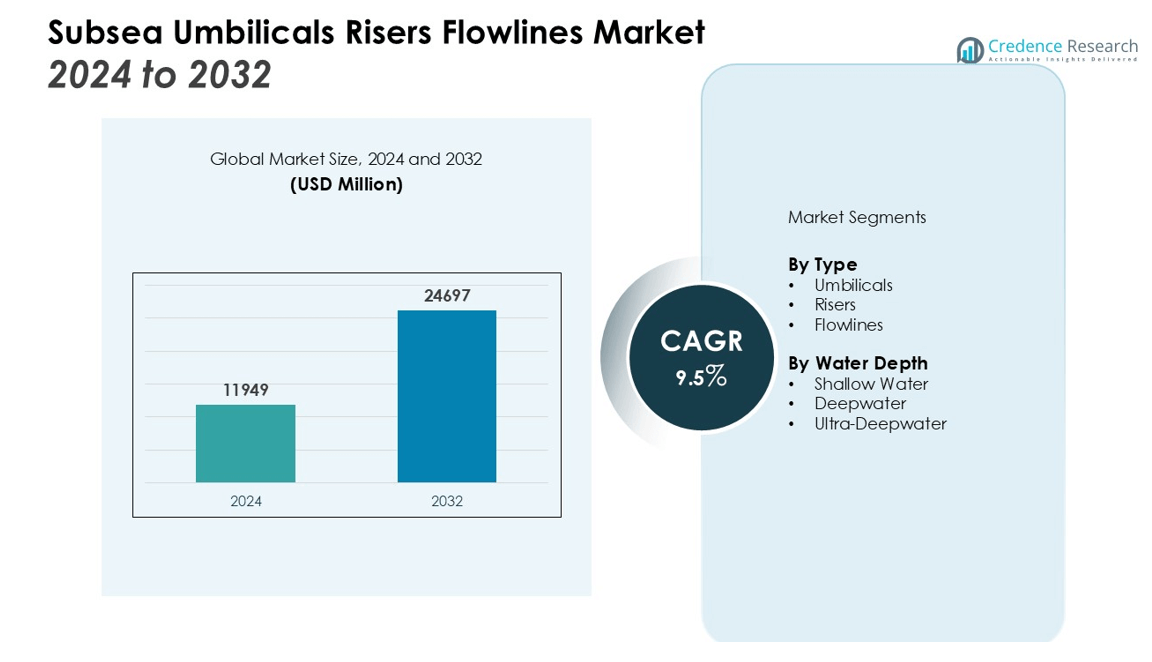
The Subsea Umbilicals, Risers and Flowlines Market size was valued at USD 11949 million in 2024 and is anticipated to reach USD 24697 million by 2032, at a CAGR of 9.5% during the forecast period (2024-2032).
| REPORT ATTRIBUTE | DETAILS |
|---|---|
| Historical Period | 2019-2022 |
| Base Year | 2023 |
| Forecast Period | 2024-2032 |
| Subsea Umbilicals, Risers and Flowlines Market Size 2024 | USD 11949 million |
| Subsea Umbilicals, Risers and Flowlines Market, CAGR | 9.5% |
| Subsea Umbilicals, Risers and Flowlines Market Size 2032 | USD 24697 million |
Key drivers of market growth include the rise in global energy demand, particularly from emerging markets, and advancements in subsea technologies that improve operational efficiency, safety, and reliability. Additionally, the need for enhanced offshore infrastructure to meet the growing energy requirements has spurred investments in SURF systems. Increasing oil and gas exploration activities in deepwater and remote areas, along with regulatory support for subsea engineering innovations, are further propelling the market. The growing focus on reducing carbon emissions is also driving the adoption of more efficient subsea technologies.
Regionally, North America holds the largest market share, driven by extensive offshore operations in the Gulf of Mexico and East Coast regions of the U.S. Europe, led by Norway and the U.K., also plays a significant role in the market, particularly with North Sea exploration. The Asia-Pacific region is expected to witness the highest growth due to rising offshore exploration activities in countries like China, Malaysia, and Australia.
Market Insights:
- The Subsea Umbilicals, Risers, and Flowlines Market size was valued at USD 11,949 million in 2024 and is anticipated to reach USD 24,697 million by 2032, growing at a CAGR of 9.5% during the forecast period (2024–2032).
- Increasing global energy demand, particularly in emerging markets, is driving growth in offshore oil and gas exploration. These regions are focusing on expanding energy infrastructures, requiring advanced subsea systems for efficient extraction from deepwater and remote locations.
- Technological advancements, such as hybrid risers and flexible flowlines, are enhancing the efficiency, safety, and reliability of subsea systems. These innovations reduce operational risks and costs, supporting the market's expansion.
- The need for enhanced offshore infrastructure to meet rising energy demands is prompting substantial investments in subsea systems. Upgraded subsea infrastructure is essential for accessing new deepwater reserves and improving operational safety and efficiency.
- Governments worldwide are offering regulatory support for deepwater exploration, encouraging investments in subsea infrastructure. Policies that promote offshore drilling and subsea system development are boosting market growth, particularly in North America, Europe, and Asia-Pacific.
- The market faces challenges from high installation and maintenance costs of subsea systems. These expenses, driven by specialized materials and complex offshore conditions, limit the adoption of SURF systems, especially in smaller projects.
- The Asia-Pacific region is expected to witness the highest growth due to rising offshore exploration in countries like China, Malaysia, and Australia. The increasing demand for energy and government support for offshore projects drive significant opportunities in this region.
Market Drivers:
Increasing Global Energy Demand
The growing global energy demand, particularly from emerging markets, is one of the key drivers of the Subsea Umbilicals, Risers, and Flowlines (SURF) market. These regions are increasingly focusing on expanding their energy infrastructures to meet the rising need for power, particularly as industrialization and urbanization accelerate. This demand has led to increased offshore oil and gas exploration, pushing for more advanced subsea systems to efficiently extract and transport energy from deepwater and remote locations.
- For instance, in 2024, the push for new energy sources resulted in at least 8 billion barrels of oil equivalent being announced in new offshore discoveries, highlighting the significant scale of recent exploration activities.
Technological Advancements in Subsea Engineering
Technological advancements in subsea engineering have significantly improved the efficiency, safety, and reliability of subsea systems, driving growth in the SURF market. Innovations such as hybrid risers, flexible flowlines, and advanced umbilical systems enhance operational capabilities in extreme offshore environments. These technological developments have reduced operational risks and costs, making it easier to manage complex offshore infrastructure and contributing to the market's expansion.
- For example, in October 2024, energy technology company Baker Hughes secured a major contract from Petrobras to supply 77 kilometers of flexible pipes for oil production and injection services across several of Brazil's pre-salt fields.
Offshore Infrastructure Development
The need to enhance offshore infrastructure to meet increasing energy requirements has driven substantial investments in SURF systems. Energy companies are focusing on upgrading their subsea infrastructure to access new reserves in deepwater and ultra-deepwater regions. These investments not only support extraction but also improve safety, monitoring, and maintenance of offshore platforms, further fueling demand for subsea umbilicals, risers, and flowlines.
Regulatory Support for Deepwater Exploration
Regulatory frameworks that support deepwater exploration have contributed to the growth of the SURF market. Governments in key regions, including North America, Europe, and Asia-Pacific, are providing incentives and regulations that promote offshore drilling and subsea infrastructure development. These policies encourage oil and gas companies to invest in the technologies required to operate efficiently in challenging offshore environments.
Market Trends:
Integration of Digital Technologies and Automation
A significant trend in the Subsea Umbilicals, Risers, and Flowlines (SURF) market is the integration of digital technologies and automation in subsea operations. The adoption of smart sensors, real-time data analytics, and automated control systems is transforming offshore oil and gas exploration. These technologies enable operators to monitor and manage subsea systems more effectively, ensuring higher operational efficiency and lower risk of downtime. Automation of tasks such as inspection, maintenance, and monitoring of subsea systems reduces human intervention and enhances safety in harsh offshore environments. This trend is expected to drive the demand for more advanced and reliable subsea systems, making subsea infrastructure smarter and more resilient.
- For instance, TechnipFMC has successfully installed more than 3,000 of its subsea connection systems in fields around the world.
Growing Focus on Environmental Sustainability
Environmental sustainability is becoming a key focus in the Subsea Umbilicals, Risers, and Flowlines market as companies seek to minimize the environmental impact of offshore operations. There is an increasing demand for eco-friendly materials, such as recyclable composites and non-toxic coatings, in the design and construction of subsea infrastructure. The growing emphasis on reducing carbon footprints is encouraging energy companies to implement greener technologies and practices in offshore energy extraction. These sustainability initiatives not only meet regulatory requirements but also align with industry expectations for responsible environmental practices. As a result, subsea system providers are adapting their offerings to include solutions that reduce waste, energy consumption, and potential environmental damage.
- For instance, Prysmian Group has a long history of developing and installing SURF technology in progressively more challenging situations, including in deepwater fields with depths reaching up to 2,500 meters.
Market Challenges Analysis:
High Costs and Complex Installation Processes
One of the primary challenges facing the Subsea Umbilicals, Risers, and Flowlines (SURF) market is the high cost of installation and maintenance of subsea systems. The materials used in these systems, such as high-strength steel and specialized composites, are expensive, and their installation requires significant resources and expertise. The complexity of subsea operations, including the harsh environmental conditions, demands specialized equipment and advanced technology, further driving up costs. These high upfront expenses often limit the adoption of SURF systems, particularly in smaller projects or regions with less established offshore infrastructure.
Technical Limitations and Reliability Concerns
Another challenge in the Subsea Umbilicals, Risers, and Flowlines market is the technical limitations and reliability concerns associated with subsea systems. Over time, subsea infrastructure is subject to wear and tear due to extreme underwater conditions such as high pressure, corrosive environments, and mechanical stress. Maintaining and ensuring the reliability of these systems in remote and harsh offshore locations is a significant challenge. The risk of failure or damage to key components can result in costly downtime, affecting overall production efficiency and increasing the financial burden on operators. These concerns require constant innovation and robust maintenance strategies to ensure the long-term reliability of subsea systems.
Market Opportunities:
Expansion of Offshore Exploration in Emerging Markets
The Subsea Umbilicals, Risers, and Flowlines (SURF) market presents significant opportunities due to the expansion of offshore exploration in emerging markets. Countries in regions such as Asia-Pacific, Africa, and Latin America are increasing their focus on deepwater and ultra-deepwater exploration to tap into untapped oil and gas reserves. This growing interest in offshore energy resources offers a lucrative opportunity for SURF system providers to support the development of new offshore projects. As these markets expand their offshore operations, the demand for reliable and cost-effective subsea infrastructure will increase, opening up new revenue streams for companies in the market.
Advancements in Subsea System Innovation
There is a growing opportunity in the Subsea Umbilicals, Risers, and Flowlines market driven by advancements in subsea system innovations. Emerging technologies, such as hybrid risers, advanced umbilical materials, and autonomous subsea robots, are improving operational efficiency and safety. These innovations not only increase the reliability and performance of subsea systems but also help reduce operational costs. Companies that can develop and implement these advanced technologies will find a competitive advantage, catering to the increasing demand for efficient, sustainable subsea systems. As offshore exploration moves toward deeper, more challenging environments, technological advancements will play a crucial role in driving future market growth.
Market Segmentation Analysis:
By Type
The Subsea Umbilicals, Risers, and Flowlines (SURF) market is segmented into umbilicals, risers, and flowlines, each serving a crucial role in offshore energy extraction. Umbilicals are used to transport hydraulic power, chemicals, and electrical signals, while risers are designed to transfer produced fluids from the seabed to surface facilities. Flowlines are used for the transportation of produced hydrocarbons. Among these, risers hold the largest market share due to their critical role in offshore deepwater and ultra-deepwater exploration. As energy exploration shifts to deeper waters, the demand for risers is expected to grow significantly.
- For instance, Saipem SpA's contract for the Baleine Phase 2 project off Côte d'Ivoire includes engineering and installing approximately 20 km of rigid flowlines, 10 km of flexible risers, and 15 km of umbilicals designed for a water depth of 1,200 meters.
By Water Depth
The Subsea Umbilicals, Risers, and Flowlines market is also categorized by water depth: shallow water, deepwater, and ultra-deepwater. Ultra-deepwater systems represent the largest segment due to the growing exploration activities in deepwater and ultra-deepwater fields, where reserves are abundant but challenging to access. These systems require advanced subsea technologies and innovations that can withstand extreme conditions. Deepwater exploration also continues to grow, but ultra-deepwater is expected to dominate the market due to the increasing emphasis on untapped reserves located at greater depths. Shallow water systems hold a smaller share as exploration moves to more complex offshore environments.
- For instance, SLB was awarded a contract for Woodside Energy's Trion development in an ultra-deepwater region of the Gulf of Mexico, where it will use AI-enabled capabilities to drill 18 wells in challenging water depths of up to 2,500 meters.
Segmentations:
By Type:
- Umbilicals
- Risers
- Flowlines
By Water Depth:
- Shallow Water
- Deepwater
- Ultra-Deepwater
By Region:
- North America
- U.S.
- Canada
- Mexico
- Europe
- Germany
- France
- U.K.
- Italy
- Spain
- Rest of Europe
- Asia Pacific
- China
- Japan
- India
- South Korea
- South-east Asia
- Rest of Asia Pacific
- Latin America
- Brazil
- Argentina
- Rest of Latin America
- Middle East & Africa
- GCC Countries
- South Africa
- Rest of the Middle East and Africa
Regional Analysis:
North America: Dominance in the Subsea Umbilicals, Risers, and Flowlines Market
North America holds 35% of the Subsea Umbilicals, Risers, and Flowlines (SURF) market share, primarily due to extensive offshore exploration in regions like the Gulf of Mexico and the U.S. East Coast. The region's well-established offshore infrastructure, coupled with significant investments in deepwater drilling technologies, creates a strong demand for advanced subsea systems. The U.S. government's supportive policies, including tax incentives for energy exploration, further drive market growth. Canada’s offshore projects, particularly in the Atlantic region, also contribute to the regional demand for SURF systems. Continued innovation and demand for energy security will sustain North America's dominance in the market.
Europe: Key Player in Offshore Energy Development
Europe captures 28% of the Subsea Umbilicals, Risers, and Flowlines market share, with substantial growth driven by subsea oil and gas projects in the North Sea. Countries like Norway, the U.K., and the Netherlands lead with investments in both existing and new subsea infrastructure. The region's focus on maximizing production from aging fields and expanding into deeper offshore areas is increasing the need for reliable subsea systems. Additionally, regulatory frameworks in Europe encourage offshore exploration, making the region an attractive market for SURF providers. The ongoing shift toward sustainable offshore technologies also contributes to the market's growth in Europe.
Asia-Pacific: Rapid Growth from Expanding Offshore Projects
Asia-Pacific holds 22% of the Subsea Umbilicals, Risers, and Flowlines market share, driven by increasing offshore exploration activities in countries like China, Malaysia, and Australia. Rising energy demand in emerging economies is propelling investments in offshore oil and gas infrastructure. As offshore reserves become more challenging to access, the demand for advanced subsea technologies that ensure efficiency and safety will increase. With several countries focusing on expanding their energy supply and improving offshore capabilities, Asia-Pacific presents significant opportunities for SURF system providers. Growing government support and the push for energy independence further drive the market's potential in this region.
Key Player Analysis:
- General Electric
- TechnipFMC plc.
- Oceaneering International Inc.
- Schlumberger Limited
- Siemens
- Tenaris SA
- John Wood Group PLC
- Prysmian Group
- McDermott
- Saipem
- National Oilwell Varco
- Aker Solutions
- Halliburton
- Vallourec
Competitive Analysis:
The Subsea Umbilicals, Risers, and Flowlines (SURF) market is highly competitive, with major players like TechnipFMC, Subsea 7, McDermott International, and Aker Solutions leading the market. These companies focus on technological innovation, offering advanced subsea systems that enhance efficiency, safety, and reliability. They secure large contracts through strategic partnerships with offshore energy companies, particularly in deepwater and ultra-deepwater exploration. Smaller regional players are gaining ground by offering cost-effective solutions and targeting emerging markets in Asia-Pacific and Latin America. To maintain their competitive edge, leading companies prioritize research and development, reduce operational costs, and expand their geographic reach, especially in areas where offshore exploration is rapidly growing.
Recent Developments:
- In December 2024, SLB launched its Neuro™ autonomous geosteering system, which uses artificial intelligence to enhance drilling efficiency and the placement of wells.
- In September 2024, SLB launched the Lumi™ platform, which is powered by artificial intelligence to improve data capabilities for its energy sector clients.
- In August 2024, Saipem launched a share buyback program to repurchase up to 18.6 million of its own shares as part of a three-year incentive plan.
Market Concentration & Characteristics:
The Subsea Umbilicals, Risers, and Flowlines (SURF) market is moderately concentrated, with a few large players dominating the landscape, including TechnipFMC, Subsea 7, McDermott International, and Aker Solutions. These companies hold significant market share due to their advanced technological capabilities and strong global presence. The market is characterized by high capital investment requirements and long project cycles, which limit the number of players involved. Key factors influencing competition include innovation in subsea technologies, cost efficiency, and the ability to execute complex offshore projects. Smaller players often target niche markets or offer cost-effective solutions in emerging regions. The market’s dynamics are shaped by the increasing demand for deeper and more challenging offshore exploration, pushing major players to expand their capabilities and regional reach.
Report Coverage:
The research report offers an in-depth analysis based on Type, Water Depth and Region. It details leading market players, providing an overview of their business, product offerings, investments, revenue streams, and key applications. Additionally, the report includes insights into the competitive environment, SWOT analysis, current market trends, as well as the primary drivers and constraints. Furthermore, it discusses various factors that have driven market expansion in recent years. The report also explores market dynamics, regulatory scenarios, and technological advancements that are shaping the industry. It assesses the impact of external factors and global economic changes on market growth. Lastly, it provides strategic recommendations for new entrants and established companies to navigate the complexities of the market.
Future Outlook:
- Technological advancements are enhancing the efficiency and safety of subsea operations, with increasing integration of automation and real-time monitoring systems.
- The focus on sustainability is rising, with more emphasis on using eco-friendly materials and processes to minimize environmental impacts.
- Deepwater and ultra-deepwater exploration is driving demand for subsea systems designed to operate in extreme conditions.
- Companies are adopting cost-effective solutions and modular designs to reduce both installation and maintenance expenses.
- Emerging markets, particularly in Asia-Pacific and Latin America, are experiencing significant investments in offshore oil and gas projects, broadening market reach.
- Government policies and incentives are supporting the development of subsea technologies, fostering growth in the market.
- Strategic alliances among industry players are facilitating resource and expertise sharing, promoting innovation.
- Advancements in materials science are leading to the development of more durable and corrosion-resistant subsea components.
- Artificial intelligence and machine learning integration is streamlining operations and predictive maintenance, increasing efficiency.
- Mergers and acquisitions are reshaping the competitive landscape, resulting in more integrated service offerings.

Request a Free Sample
Fill in your details and we'll send you a free sample report.
- Sample data tables & charts
- Research methodology
Market Dynamics
Increasing Global Energy Demand
Rising energy needs, especially in emerging markets, are driving offshore oil and gas exploration, which in turn increases demand for advanced subsea umbilicals, risers, and flowlines to efficiently extract and transport hydrocarbons from deepwater and remote locations.
Technological Advancements in Subsea Engineering
Innovations such as hybrid risers, flexible flowlines, and advanced umbilical systems are improving operational efficiency, safety, and reliability, making it more feasible and cost-effective to develop challenging offshore reserves.
Expansion of Offshore Infrastructure
Substantial investments in upgrading and expanding offshore infrastructure are necessary to access new deepwater and ultra-deepwater reserves, fueling demand for SURF systems that enable safe and efficient extraction.
Regulatory Support for Deepwater Exploration
Government incentives and supportive regulatory frameworks in key regions are encouraging oil and gas companies to invest in subsea technologies, accelerating market growth by reducing barriers to offshore project development.
Focus on Environmental Sustainability
The industry’s shift toward reducing carbon emissions and adopting eco-friendly materials and processes is driving the adoption of more efficient and sustainable subsea technologies, aligning with both regulatory requirements and industry expectations.
Need a Custom Version of This Report?
Tailor the scope, geography, or segments to your exact requirements.
- Custom geography or segment scope
- Direct access to our analyst team
Frequently Asked Questions
What is the current market size for Subsea Umbilicals Risers Flowlines, and what is its projected size in 2032?
At what Compound Annual Growth Rate is the Subsea Umbilicals Risers Flowlines market projected to grow between 2024 and 2032?
Which Subsea Umbilicals Risers Flowlines market segment held the largest share in 2024?
What are the primary factors fueling the growth of the Subsea Umbilicals Risers Flowlines market?
Table of Content
Chapter 1 Market Segmentation
- 1.1 Segmentation Framework
- 1.1.1 Product and Service Classification
- 1.1.2 Application and End-Use Classification
- 1.1.3 Technology and Solution Classification
- 1.1.4 Customer and Distribution Channel Classification
- 1.1.5 Geographic Segmentation
- 1.1.6 Market Segment Definitions and Boundaries
- 1.2 By Type
- 1.2.1 Umbilicals
- 1.2.2 Risers
- 1.2.3 Flowlines
- 1.3 By Water Depth
- 1.3.1 Shallow Water
- 1.3.2 Deepwater
- 1.3.3 Ultra-Deepwater
Chapter 2 Introduction
- 2.1 Report Objectives and Scope
- 2.2 Product Definition and Industry Terminology
- 2.3 Market Inclusions and Exclusions
- 2.4 Research Process
- 2.4.1 Primary Research and Expert Interviews
- 2.4.2 Secondary Research and Source Review
- 2.4.3 Top-Down and Bottom-Up Estimation
- 2.4.4 Data Triangulation and Verification
- 2.5 Market Size Measurement Basis
- 2.5.1 2024: USD 11,949 million → 2032: USD 24,697 million
- 2.6 Historical and Forecast Reference Periods
- 2.6.1 Base Year: 2024
- 2.6.2 Forecast Period: 2024-2032
- 2.7 Research Assumptions and Limitations
Chapter 3 Executive Summary
- 3.1 Market Snapshot and Key Findings
- 3.2 Base-Year Market Size, 2024
- 3.3 Forecast Market Size, 2032
- 3.4 Revenue and Volume Growth Outlook
- 3.5 Key Demand and Supply Indicators
- 3.6 Leading Market Segments
- 3.7 Fastest-Growing Market Opportunities
- 3.8 Regional Performance Highlights
- 3.9 Technology and Industry Transformation
- 3.10 Competitive Landscape Summary
- 3.11 Analyst View and Strategic Implications
Chapter 4 Global Subsea Umbilicals, Risers and Flowlines Market Trends and Developments
- 4.1 Historical Industry Development
- 4.2 Recent Market Trends and Developments
- 4.3 Demand and Customer Behavior Trends
- 4.4 Technology and Product Innovation
- 4.5 Artificial Intelligence, Automation and Digitalization
- 4.6 Local Manufacturing and Supply Chain Realignment
- 4.7 Industry Partnerships, Mergers and Acquisitions
- 4.8 Sustainability and Circular Economy Developments
- 4.9 Government and Private Sector Investment Trends
- 4.10 Emerging Business Models and Commercialization
- 4.11 Industry Developments and Announcements
Chapter 5 Global Subsea Umbilicals, Risers and Flowlines Market Production, Supply and Demand Analysis
- 5.1 Demand Trend and Consumption Analysis
- 5.2 Demand Forecast, 2024-2032
- 5.3 Production and Output Trend
- 5.4 Production and Output Forecast, 2024-2032
- 5.5 Installed Capacity and Capacity Utilization
- 5.6 Company-Wise Production Plants and Statistics
- 5.6.1 Installed Production Capacity
- 5.6.2 Actual Production
- 5.6.3 Planned Capacity and Expansion Targets
- 5.7 Supply Chain Structure and Procurement Trends
- 5.8 Supply-Demand Gap and Bottlenecks
- 5.9 Import Dependence and Sourcing Structure
- 5.10 Contract Manufacturing and Outsourcing
- 5.11 Regional Supply and Demand Concentration
Chapter 6 Global Subsea Umbilicals, Risers and Flowlines Market Pricing Analysis
- 6.1 Pricing Structure and Measurement
- 6.2 Historical Pricing Trends
- 6.3 Pricing Outlook, 2024-2032
- 6.4 Average Selling Price and Unit Economics
- 6.5 Pricing by Product and Market Segment
- 6.6 Geographic Pricing Differences
- 6.7 Key Input, Energy, Labor and Logistics Costs
- 6.8 Contract Pricing and Purchasing Models
- 6.9 Pricing Sensitivity and Competitive Positioning
- 6.10 Price, Margin and Profitability Implications
Chapter 7 Global Subsea Umbilicals, Risers and Flowlines Market Dynamics
- 7.1 Market Growth Drivers
- 7.1.1 Demand-Side Drivers
- 7.1.2 Technology and Innovation Drivers
- 7.1.3 Infrastructure and Investment Drivers
- 7.1.4 Regulatory and Policy Drivers
- 7.2 Market Restraints
- 7.2.1 Cost and Affordability Constraints
- 7.2.2 Technology and Adoption Barriers
- 7.2.3 Supply Chain and Operational Constraints
- 7.3 Market Challenges
- 7.3.1 Competitive Pressure and Margin Erosion
- 7.3.2 Skills, Infrastructure and Implementation Gaps
- 7.4 Emerging Market Opportunities
- 7.5 Market Dynamics Impact and Time-Horizon Assessment
Chapter 8 Global Subsea Umbilicals, Risers and Flowlines Value Chain Analysis
- 8.1 Industry Value Chain Overview
- 8.2 Upstream Suppliers and Critical Inputs
- 8.3 Technology and Component Providers
- 8.4 Manufacturing or Service Delivery
- 8.5 Distribution, Channel Partners and Integrators
- 8.6 Downstream Applications and End Users
- 8.7 Value Addition and Profit Pools
- 8.8 Vertical Integration and Outsourcing
- 8.9 Supplier Concentration and Risk
- 8.10 Supply Chain Localization and Resilience
Chapter 9 Global Subsea Umbilicals, Risers and Flowlines Market Regulations and Policies
- 9.1 Relevant Laws, Standards and Compliance Frameworks
- 9.2 Product, Service, Safety and Quality Requirements
- 9.3 Government Policies, Incentives and Subsidies
- 9.4 Imports, Exports and Trade Barriers
- 9.5 Public Procurement and Local Content Requirements
- 9.6 Environmental and Sustainability Compliance
- 9.7 Upcoming Policy Changes and Market Implications
Chapter 10 Global Subsea Umbilicals, Risers and Flowlines Market Hotspots and Opportunities
- 10.1 Market Opportunity Mapping and Growth Hotspots
- 10.2 High-Growth Applications and Customer Groups
- 10.3 Underserved Markets and White-Space Opportunities
- 10.4 Emerging Technology and Product Opportunities
- 10.5 New Capacity and Investment Hotspots
- 10.6 Market Entry and Expansion Opportunities
- 10.7 Distribution and Partnership Opportunities
- 10.8 Near-Term and Long-Term Commercial Potential
- 10.9 Opportunity Attractiveness and Execution Risks
Chapter 11 Global Subsea Umbilicals, Risers and Flowlines Market Outlook, 2024-2032
- 11.1 Market Size and Analysis
- 11.1.1 Revenue (Market Measurement: 2024: USD 11,949 million → 2032: USD 24,697 million)
- 11.1.2 Market Volume and Quantity Sold
- 11.1.3 Historical Market Size
- 11.1.4 Base-Year Market Size, 2024
- 11.2 Market Forecast, 2024-2032
- 11.2.1 Revenue Forecast to 2032
- 11.2.2 Volume Forecast to 2032
- 11.2.3 CAGR and Year-on-Year Growth
- 11.2.4 Incremental Revenue Opportunity
- 11.3 Forecast Assumptions and Scenario Analysis
- 11.3.1 Base-Case Forecast
- 11.3.2 Optimistic and Conservative Scenarios
- 11.3.3 Technology, Pricing and Policy Sensitivities
- 11.4 Market Attractiveness and Growth Outlook
Chapter 12 Global Subsea Umbilicals, Risers and Flowlines Market Segmentation and Outlook
- 12.1 Segmentation Summary and Market Shares, 2024
- 12.2 Largest and Fastest-Growing Segments
- 12.3 By Type - Market Size and Forecast, 2024-2032
- 12.3.1 Segment Definition and Scope
- 12.3.2 Historical Market Size
- 12.3.3 Revenue Forecast, 2024-2032
- 12.3.4 Volume Forecast, 2024-2032
- 12.3.5 Base-Year Market Share, 2024
- 12.3.6 Segment CAGR and Growth Drivers
- 12.3.7 Subsegment Market Size and Forecast
- 12.3.7.1 Umbilicals
- 12.3.7.2 Risers
- 12.3.7.3 Flowlines
- 12.3.8 Subsegment Pricing and Adoption Trends
- 12.3.9 Leading Suppliers and Competition
- 12.3.10 Regional Demand and Opportunities
- 12.4 By Water Depth - Market Size and Forecast, 2024-2032
- 12.4.1 Segment Definition and Scope
- 12.4.2 Historical Market Size
- 12.4.3 Revenue Forecast, 2024-2032
- 12.4.4 Volume Forecast, 2024-2032
- 12.4.5 Base-Year Market Share, 2024
- 12.4.6 Segment CAGR and Growth Drivers
- 12.4.7 Subsegment Market Size and Forecast
- 12.4.7.1 Shallow Water
- 12.4.7.2 Deepwater
- 12.4.7.3 Ultra-Deepwater
- 12.4.8 Subsegment Pricing and Adoption Trends
- 12.4.9 Leading Suppliers and Competition
- 12.4.10 Regional Demand and Opportunities
- 12.5 Segment Growth Comparison
- 12.6 Segment Attractiveness and Priority Matrix
Chapter 13 Global Subsea Umbilicals, Risers and Flowlines Geographic Market Outlook, 2024-2032
- 13.1 Regional Market Size and Share, 2024
- 13.2 Regional Market Forecast, 2024-2032
- 13.3 Regional Pricing, Production and Demand Differences
- 13.4 North America
- 13.4.1 United States
- 13.4.2 Canada
- 13.4.3 Mexico
- 13.5 Europe
- 13.5.1 Germany
- 13.5.2 France
- 13.5.3 Italy
- 13.5.4 United Kingdom
- 13.5.5 Spain
- 13.5.6 Poland
- 13.5.7 Russia
- 13.5.8 Netherlands
- 13.5.9 Belgium
- 13.5.10 Sweden
- 13.5.11 Denmark
- 13.5.12 Norway
- 13.5.13 Rest of Europe
- 13.6 Asia Pacific
- 13.6.1 China
- 13.6.2 India
- 13.6.3 Japan
- 13.6.4 South Korea
- 13.6.5 Thailand
- 13.6.6 Indonesia
- 13.6.7 Vietnam
- 13.6.8 Malaysia
- 13.6.9 Australia
- 13.6.10 Rest of Asia Pacific
- 13.7 Latin America
- 13.7.1 Brazil
- 13.7.2 Argentina
- 13.7.3 Colombia
- 13.7.4 Chile
- 13.7.5 Rest of Latin America
- 13.8 Middle East
- 13.8.1 Saudi Arabia
- 13.8.2 United Arab Emirates
- 13.8.3 Turkey
- 13.8.4 Israel
- 13.8.5 Iran
- 13.8.6 Rest of the Middle East
- 13.9 Africa
- 13.9.1 South Africa
- 13.9.2 Egypt
- 13.9.3 Nigeria
- 13.9.4 Morocco
- 13.9.5 Rest of Africa
- 13.10 Regional Investment, Policy and Supply Chain Differences
- 13.11 Regional Competitive Landscape
- 13.12 Geographic Growth Hotspots
Chapter 14 Global Subsea Umbilicals, Risers and Flowlines Technology, Innovation and Sustainability Outlook
- 14.1 Technology Landscape and Maturity
- 14.2 Product, Process and Service Innovation
- 14.3 AI, Automation and Digital Tools in the Industry
- 14.4 Technology Adoption and Performance Benchmarking
- 14.5 Innovation Pipeline and R&D Investment
- 14.6 Patent and Intellectual Property Trends
- 14.7 Energy Efficiency and Resource Management
- 14.8 Sustainability, Recycling and Circularity
- 14.9 Technology Roadmap, 2024-2032
- 14.10 Risks of Obsolescence and Technology Substitution
Chapter 15 Global Subsea Umbilicals, Risers and Flowlines Market Key Strategic Imperatives
- 15.1 Growth and Market Entry Priorities
- 15.2 High-Return Products and Segments
- 15.3 Pricing, Profitability and Cost Optimization
- 15.4 Technology Investment and Product Differentiation
- 15.5 Supply Chain Localization and Resilience
- 15.6 Distribution and Customer Acquisition
- 15.7 Partnership, Acquisition and Capacity Strategy
- 15.8 Regional Expansion Priorities
- 15.9 Short-, Medium- and Long-Term Actions
Chapter 16 Competition Outlook
- 16.1 Industry Competition Characteristics
- 16.2 Market Structure and Concentration
- 16.3 Market Share and Competitive Positioning, 2024
- 16.4 Company-Wise Revenue and Product Benchmarking
- 16.5 Production and Service Capacity Benchmarking
- 16.6 Technology, Pricing and Differentiation
- 16.7 Regional Footprint and Distribution Strength
- 16.8 Mergers, Acquisitions and Strategic Alliances
- 16.9 New Entrants and Competitive Threats
- 16.10 Porter's Five Forces and Industry Attractiveness
- 16.11 Competitive Outlook, 2024-2032
Chapter 17 Company Profiles
- 17.1 Company Coverage and Selection Criteria
- 17.2 TechnipFMC plc.
- 17.2.1 Business Description
- 17.2.2 Company Ownership and Geographic Presence
- 17.2.3 Product and Service Portfolio
- 17.2.4 Manufacturing and Operating Footprint
- 17.2.5 Production Capacity and Expansion Plans
- 17.2.6 Financial Performance and Investment
- 17.2.7 Market Share and Competitive Position
- 17.2.8 Technology and Innovation Capabilities
- 17.2.9 Strategic Alliances or Partnerships
- 17.2.10 Recent Developments
- 17.2.11 Growth Strategy and Outlook
- 17.3 Subsea 7
- 17.4 McDermott International
- 17.5 Aker Solutions
- 17.6 Schlumberger Limited (SLB)
- 17.7 Prysmian Group
- 17.8 Saipem
- 17.9 Oceaneering International Inc.
- 17.10 Halliburton
- 17.11 General Electric
- 17.12 Other Relevant Market Participants
Note: Every listed company is profiled on the structure shown under the first company. The company list is preliminary and may change based on research findings, market developments, data availability and client requirements.
Chapter 18 Disclaimer
- 18.1 Research and Forecast Disclaimer
- 18.2 Data Source and Estimation Limitations
Note: The depth of individual sections depends on data availability for this market. Volume, capacity, trade and other unit-based metrics are included where applicable.