
Market Overview:
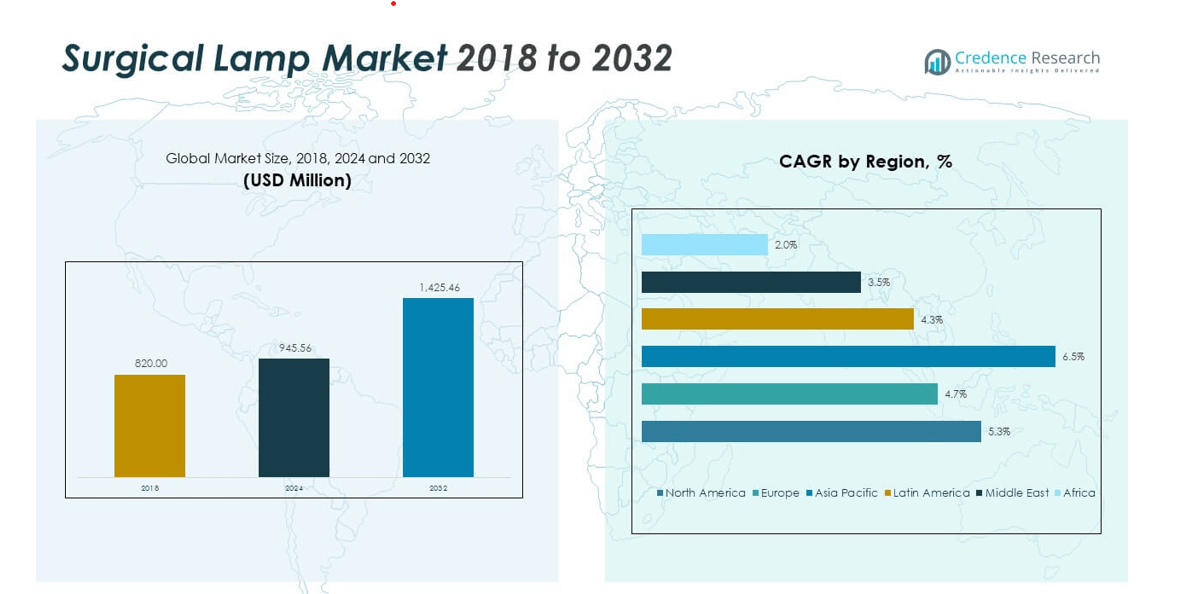
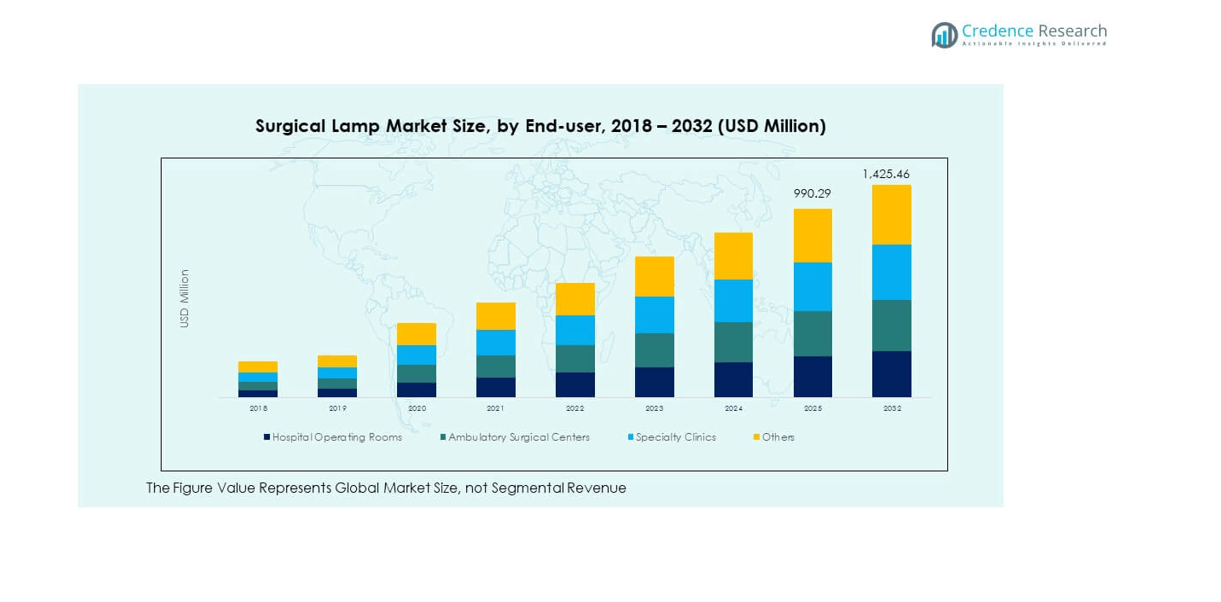
The Global Surgical Lamp Market size was valued at USD 820.00 million in 2018, increased to USD 945.56 million in 2024, and is anticipated to reach USD 1,425.46 million by 2032, at a CAGR of 5.34% during the forecast period.
| REPORT ATTRIBUTE | DETAILS |
|---|---|
| Historical Period | 2020-2023 |
| Base Year | 2024 |
| Forecast Period | 2025-2032 |
| Surgical Lamp Market Size 2024 | USD 945.56 million |
| Surgical Lamp Market, CAGR | 5.34% |
| Surgical Lamp Market Size 2032 | USD 1,425.46 million |
The market growth is driven by the rising number of surgeries globally, growing hospital infrastructure, and demand for advanced lighting systems that enhance surgical precision. Technological advancements such as LED-based lamps offering superior illumination and lower heat generation are boosting adoption. Increasing emphasis on infection control, coupled with the growing number of outpatient surgical centers, supports the consistent market expansion.
Regionally, North America dominates due to advanced healthcare infrastructure and high surgical procedure volumes. Europe follows with strong public healthcare systems and continuous innovation in medical lighting technologies. The Asia-Pacific region is emerging rapidly, supported by rising healthcare investments, medical tourism, and expanding hospital networks in China, India, and Southeast Asia. Latin America and the Middle East are gradually gaining momentum through healthcare modernization and infrastructure upgrades.
Market Insights:
- The Global Surgical Lamp Market was valued at USD 820.00 million in 2018, grew to USD 945.56 million in 2024, and is projected to reach USD 1,425.46 million by 2032, expanding at a CAGR of 5.34%.
- North America (34%), Europe (26%), and Asia Pacific (25%) dominate the market due to advanced healthcare systems, high surgical procedure volumes, and strong hospital infrastructure.
- Asia Pacific, holding a 25% share, is the fastest-growing region, driven by rising healthcare investments, expanding hospital networks, and increasing adoption of LED lighting systems.
- Hospital Operating Rooms account for around 45% of the market, reflecting high demand for advanced illumination and continuous equipment upgrades in surgical suites.
- Ambulatory Surgical Centers represent nearly 25% of the share, fueled by cost-efficient outpatient procedures and the need for compact, energy-efficient lighting systems.
Market Drivers:
Rising Global Surgical Volumes and Expanding Hospital Infrastructure
The Global Surgical Lamp Market benefits from a consistent rise in surgical procedures worldwide. Growing cases of chronic diseases, trauma incidents, and complex surgeries demand improved lighting solutions. Expanding hospital infrastructure in emerging economies strengthens product adoption. Governments are investing in healthcare modernization, driving procurement of advanced lighting equipment. Technological innovations have improved energy efficiency and visibility in surgical environments. Increasing focus on patient safety and surgical accuracy supports market penetration. LED-based lamps are preferred for their precision and cost savings. Overall, rising surgical demand continues to propel sustained market growth.
- For instance, manufacturers are focusing on developing LED systems that offer superior illumination and color rendering, which is crucial for surgical precision. Expanding hospital infrastructure in emerging economies further strengthens product adoption.
Technological Advancements Enhancing Surgical Efficiency and Accuracy
Innovations in lighting technologies such as shadow-free illumination and color rendering improve surgical precision. The Global Surgical Lamp Market benefits from advanced LEDs that provide clear visual fields with minimal heat. Integration of wireless controls and motion sensors enhances operating room efficiency. Manufacturers are focusing on ergonomic designs for comfort and reduced fatigue. High durability and maintenance-free performance attract healthcare facilities worldwide. Integration with imaging systems offers improved intraoperative visibility. Hybrid operating rooms require reliable lighting systems for diverse procedures. These innovations foster global adoption among hospitals and surgical centers.
- For instance, Skytron Lumos LED lamp delivers a maximum intensity of 160,000 lux-well above the clinical threshold to illuminate deep surgical cavities for procedures such as neurosurgery, which sees over 12,700 new brain tumor cases annually in the UK alone. Getinge’s systems integrate imaging and wireless controls, enabling customizable lighting configurations in more than 1,000 newly constructed operating rooms. Leading manufacturers deliver up to 50,000 hours of maintenance-free performance, which reduces facility downtime and improves clinical effectiveness.
Growing Shift Toward Energy-Efficient and Sustainable Lighting Solutions
The healthcare industry increasingly prioritizes sustainable technologies to lower energy costs. The Global Surgical Lamp Market experiences higher demand for energy-efficient LED lamps. These lamps offer extended life cycles and lower operational costs. Hospitals prefer eco-friendly materials and recyclable components. Energy savings align with hospital sustainability goals and government mandates. Reduced maintenance enhances operational uptime in busy surgical suites. Manufacturers are adopting designs compliant with green building certifications. This transition toward sustainable lighting continues to drive market expansion.
Rising Focus on Infection Control and Sterile Operating Environments
Infection control remains a key factor influencing lighting equipment design. The Global Surgical Lamp Market is supported by demand for lamps with smooth, sealed surfaces. These designs minimize contamination and simplify cleaning procedures. Growth in surgical procedures within sterile environments increases the need for hygienic lighting. Manufacturers are introducing antimicrobial coatings and sealed housings. Hospitals emphasize devices that support regulatory compliance and safety standards. The development of touchless controls further supports sterile conditions. The ongoing focus on patient safety and infection prevention sustains steady demand.
Market Trends:
Integration of Smart and Connected Lighting Technologies in Operating Rooms
Smart operating rooms are becoming more common across modern healthcare facilities. The Global Surgical Lamp Market is witnessing increased use of connected lighting systems. These systems allow real-time adjustment of brightness and color temperature. Integration with surgical cameras improves visualization and recording quality. IoT-enabled features support predictive maintenance and energy monitoring. Voice and motion control capabilities enhance workflow efficiency. Hospitals prefer customizable lighting configurations for different procedures. The shift toward smart systems defines the future of surgical illumination.
- For instance, Getinge's Maquet PowerLED II features a Flux Stability Program (FSP) to ensure consistent illumination over time. Stryker offers lighting platforms with options like the Sterile Control +, which allows surgeons to adjust brightness, spot size, and color from a customizable light handle. Skytron's smart lighting systems, such as the Lumos surgical light, include "scene presets" and wireless wall controls to help maximize efficiency during case setup.
Rising Adoption of LED-Based Lighting for High Efficiency and Longevity
LED technology continues to dominate new product installations. The Global Surgical Lamp Market is shifting from halogen to LED-based solutions. LEDs provide superior illumination intensity and color accuracy. Lower heat emission improves comfort for surgeons during lengthy operations. Extended lamp lifespan reduces replacement frequency and cost. Manufacturers are offering modular LED arrays for specific applications. Compact and lightweight designs improve positioning flexibility. The long-term reliability of LEDs ensures their continued market leadership.
- For instance, A-dec 500 LED lamps consume 80% less energy than conventional halogen systems and provide a rated lifespan exceeding 40,000 hours, directly verified in manufacturer documentation. STERIS HarmonyAIR lights in U.S. hospitals deliver over 60,000 operational hours per system with reduced maintenance frequency. Skytron modular LED arrays achieve up to 160,000 lux illumination with flexible intensity-meeting rigorous requirements for minimally invasive procedures.
Customization and Ergonomic Design Driving User Preference
Manufacturers are focusing on customizable and ergonomic lighting systems. The Global Surgical Lamp Market benefits from user-centered product innovations. Surgeons prefer adjustable arms and lightweight handles for precise control. Designs that reduce shadowing enhance accuracy during complex procedures. Height and angle adjustability increase versatility in hybrid operating rooms. Hospitals seek lamps compatible with imaging and diagnostic tools. Compact mounting options support space optimization in smaller surgical suites. These design improvements continue to enhance operational comfort and performance.
Increased Focus on Portable and Mobile Surgical Lighting Solutions
Mobile surgical lamps are gaining popularity across outpatient centers and field hospitals. The Global Surgical Lamp Market is seeing demand for portable and battery-powered options. These systems offer flexibility and easy deployment in emergency conditions. Compact models support smaller facilities with limited infrastructure. Battery technology improvements extend operational duration. Portability enables use in rural or remote healthcare locations. Hospitals and NGOs invest in mobile units for disaster and humanitarian missions. The trend supports accessibility and affordability in global healthcare delivery.
Market Challenges Analysis:
High Initial Investment and Maintenance Costs Limiting Adoption in Developing Regions
The Global Surgical Lamp Market faces barriers due to high procurement costs. Advanced LED and hybrid lighting systems require substantial capital investment. Smaller hospitals and clinics in low-income regions struggle to afford premium models. Replacement parts and regular maintenance further increase operating costs. Limited budgets delay technology upgrades in public healthcare sectors. Import tariffs and logistics costs raise final pricing in developing countries. Hospitals often extend the use of outdated halogen systems to manage costs. The financial burden limits wider adoption across emerging markets.
Technical Limitations and Regulatory Compliance Issues Affecting Market Expansion
The Global Surgical Lamp Market encounters challenges in meeting international safety standards. Compliance with stringent regulations adds to development timelines and expenses. Inconsistent certification processes across regions complicate global distribution. Technical failures such as overheating or uneven light intensity disrupt surgeries. Integration with older infrastructure poses compatibility issues in many facilities. Shortages of skilled technicians impact installation and servicing quality. Delays in government approvals slow down product rollouts. These factors collectively constrain the market’s pace of technological expansion.
Market Opportunities:
Expanding Healthcare Infrastructure and Growing Investments in Emerging Economies
Emerging nations are rapidly investing in modern healthcare facilities. The Global Surgical Lamp Market benefits from increasing hospital construction and upgradation projects. Governments are allocating higher budgets for medical equipment procurement. Rising awareness about quality healthcare boosts demand for advanced lighting. The shift toward universal healthcare coverage opens new growth avenues. Private hospitals are expanding surgical capacities in urban and semi-urban areas. International donors support modernization programs in developing regions. These developments strengthen long-term market opportunities.
Technological Integration with Imaging, AI, and Visualization Systems
Integration of surgical lamps with imaging and AI-driven tools offers new possibilities. The Global Surgical Lamp Market is expanding toward intelligent visualization systems. AI-enabled lighting can adjust intensity based on surgical stages. Integration with 3D imaging enhances precision and visibility. Digital connectivity improves documentation and remote monitoring. Manufacturers exploring hybrid lighting solutions gain competitive advantages. Continuous R&D investment creates scope for next-generation illumination products. These advancements are expected to transform the surgical lighting landscape.
Market Segmentation Analysis:
By Technology
The Global Surgical Lamp Market is divided into LED and Halogen segments. LED lamps dominate due to higher energy efficiency, durability, and superior brightness. They offer improved color rendering and minimal heat emission, enhancing surgeon comfort and visibility. Hospitals prefer LEDs for their long lifespan and lower operational cost. Halogen lamps maintain a smaller share, primarily in older infrastructure with limited upgrade capacity. Their lower initial cost appeals to small clinics and regional healthcare centers. However, the market is rapidly transitioning toward LED systems due to sustainability and performance benefits. This shift aligns with technological modernization and global energy efficiency goals.
- For instance, LEDs hold approximately 68% shadowless surgical lighting market share, delivering real measured intensity values between 40,000 and 160,000 lux and color rendering indices above 95-enabling true-color visualization. Halogen lamps, still present in about 30% of smaller facilities, appeal where initial investment is constrained but are rapidly being replaced as hospitals transition to sustainable LED models.
By End-User
Hospitals hold the largest share owing to high surgical volumes and advanced facilities. The Global Surgical Lamp Market benefits from significant demand within hospital operating rooms. Ambulatory surgical centers are expanding their adoption to support cost-effective outpatient procedures. Specialty clinics prefer compact lamps suitable for specific surgeries such as ENT and ophthalmic operations. The “Others” category includes emergency setups, dental clinics, and small healthcare units with moderate equipment needs. Growing investments in healthcare infrastructure strengthen adoption across all end-user types. The trend favors technologically advanced and customizable surgical lighting solutions.
- For instance, in the United States alone, the American Hospital Association confirms 6,093 hospitals, all requiring modern surgical lighting for clinical operations. Specialty clinics, like ENT and ophthalmology units, prefer articulated LED lamps with 540° movement to accommodate precision requirements. Portable BihlerMed models offer up to 3-hour battery life for field medicine and dental applications where grid power may be unavailable.
By Application
Cardiac surgery represents a leading segment due to the precision required in complex procedures. The Global Surgical Lamp Market sees steady demand from ENT, neurosurgery, and gynecological departments. Each application demands lighting consistency and minimal shadow interference. Advanced multi-lamp systems support diverse surgical environments with adjustable intensity and positioning. Hospitals focus on lamps that integrate with imaging and monitoring tools. Neurosurgery and gynecology applications are gaining traction due to rising surgical volumes. The “Others” segment includes general and orthopedic surgeries supported by multipurpose lighting systems. The broad application range underscores the market’s essential role in modern surgical operations.
Segmentation:
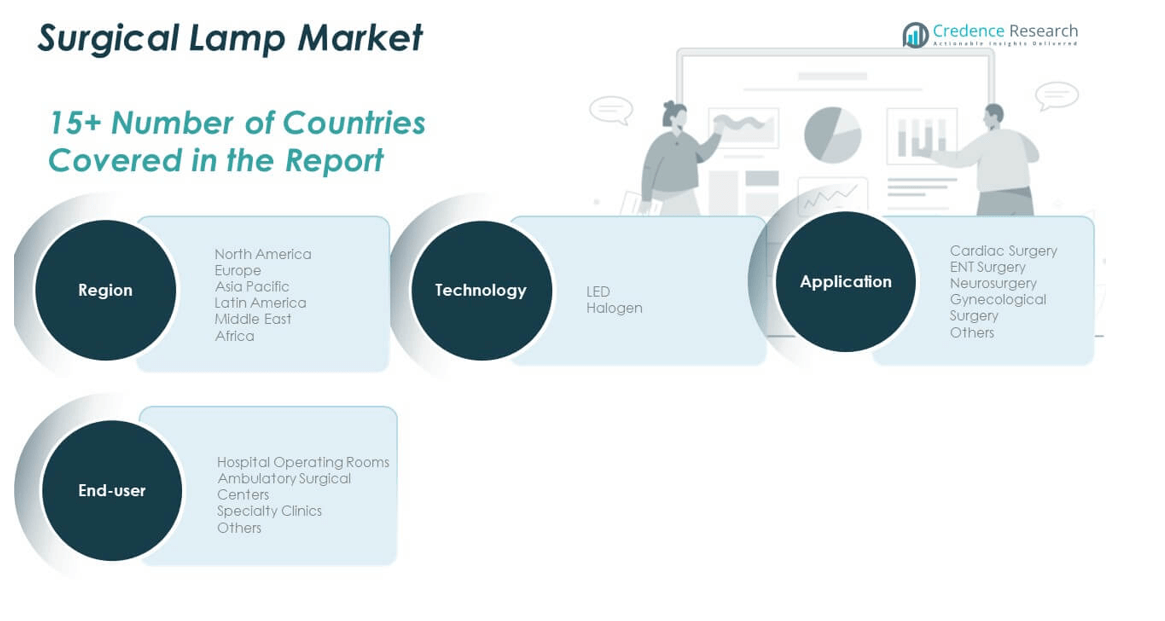
By Technology:
- LED
- Halogen
By End-User:
- Hospital Operating Rooms
- Ambulatory Surgical Centers
- Specialty Clinics
- Others
By Application:
- Cardiac Surgery
- ENT Surgery
- Neurosurgery
- Gynaecological Surgery
- Others
By Region:
- North America
- U.S.
- Canada
- Europe
- Germany
- France
- Italy
- U.K.
- Russia
- Rest of Europe
- Asia-Pacific
- India
- China
- Japan
- Rest of Asia-Pacific
- Latin America
- Brazil
- Mexico
- Rest of Latin America
- Middle East and Africa
- GCC Countries
- South Africa
- Rest of Middle East and Africa
Regional Analysis:
North America
The North America Surgical Lamp Market size was valued at USD 284.54 million in 2018, increased to USD 323.94 million in 2024, and is anticipated to reach USD 487.65 million by 2032, at a CAGR of 5.3% during the forecast period. North America holds the largest market share of around 34% in the Global Surgical Lamp Market. The region benefits from advanced healthcare infrastructure, high surgical volumes, and continuous technological innovation. Strong adoption of LED-based lamps in hospitals and surgical centers enhances energy efficiency and illumination accuracy. The United States leads the region due to early adoption of smart lighting systems and high healthcare expenditure. Canada and Mexico are experiencing steady growth driven by public hospital modernization and private investments. Increasing demand for outpatient surgeries and minimally invasive procedures further strengthens the regional market. Continuous government initiatives supporting healthcare quality and safety contribute to sustained market dominance.
Europe
The Europe Surgical Lamp Market size was valued at USD 233.54 million in 2018, increased to USD 259.62 million in 2024, and is anticipated to reach USD 371.41 million by 2032, at a CAGR of 4.7% during the forecast period. Europe accounts for approximately 26% market share in the Global Surgical Lamp Market. The region benefits from advanced medical infrastructure and a strong presence of key manufacturers. Germany, France, and the UK remain the largest contributors due to continuous investment in hospital modernization. Demand for sustainable and energy-efficient lighting solutions is increasing across European hospitals. Governments promote green healthcare initiatives, accelerating LED lamp adoption. Aging populations and high surgical intervention rates sustain market growth. Regulatory standards emphasizing safety and performance encourage consistent technological advancement. The region continues to prioritize precision lighting in specialized surgical environments.
Asia Pacific
The Asia Pacific Surgical Lamp Market size was valued at USD 220.09 million in 2018, increased to USD 264.04 million in 2024, and is anticipated to reach USD 435.77 million by 2032, at a CAGR of 6.5% during the forecast period. Asia Pacific represents about 25% market share in the Global Surgical Lamp Market and is the fastest-growing region. Rapid healthcare expansion, medical tourism, and increasing hospital investments drive growth. China, India, and Japan lead with rising surgical procedures and infrastructure upgrades. Local manufacturers are introducing cost-effective LED models to cater to public and private hospitals. Government-led healthcare reforms support equipment modernization and improved patient outcomes. Growing awareness of infection control and efficiency drives the replacement of older halogen systems. The region’s affordability and technological adaptation continue to attract global suppliers. Asia Pacific remains a critical hub for future market expansion.
Latin America
The Latin America Surgical Lamp Market size was valued at USD 47.56 million in 2018, increased to USD 54.27 million in 2024, and is anticipated to reach USD 75.36 million by 2032, at a CAGR of 4.3% during the forecast period. Latin America holds around 7% share in the Global Surgical Lamp Market. Brazil and Mexico are the key contributors due to ongoing hospital infrastructure development. Government healthcare programs are improving access to advanced surgical facilities. The private healthcare sector invests heavily in LED lighting for operational efficiency. Rising elective surgeries and medical tourism in coastal countries support growth. Limited import regulations in some markets encourage international product entry. Challenges include uneven healthcare funding and dependence on imported equipment. Continuous partnerships between regional distributors and global manufacturers enhance product availability.
Middle East
The Middle East Surgical Lamp Market size was valued at USD 22.96 million in 2018, increased to USD 24.20 million in 2024, and is anticipated to reach USD 31.51 million by 2032, at a CAGR of 3.5% during the forecast period. The region accounts for about 5% market share in the Global Surgical Lamp Market. Growth is supported by investments in hospital modernization and medical tourism. GCC countries lead due to large-scale healthcare projects and smart hospital initiatives. High demand for surgical lighting in specialty care segments enhances regional adoption. Energy-efficient technologies gain traction amid sustainability goals. Regional distributors focus on partnerships with European and Asian suppliers. Infrastructure development in Saudi Arabia and the UAE drives strong equipment procurement. Continued investment in public healthcare is expected to support moderate growth over the next decade.
Africa
The Africa Surgical Lamp Market size was valued at USD 11.32 million in 2018, increased to USD 19.48 million in 2024, and is anticipated to reach USD 23.76 million by 2032, at a CAGR of 2.0% during the forecast period. Africa holds an estimated 3% market share in the Global Surgical Lamp Market. Growth remains modest due to limited healthcare budgets and reliance on imported medical equipment. South Africa dominates the region due to better infrastructure and higher private hospital density. Several countries are investing in improving surgical capacity and basic healthcare access. NGOs and international agencies are aiding procurement of essential surgical equipment. Local production remains minimal, leading to dependency on external suppliers. Gradual modernization and public health reforms are expected to create new opportunities. The region’s long-term growth relies on strategic healthcare funding and infrastructure support.
Key Player Analysis:
- Stryker Corporation
- Steris Corporation
- A-dec Inc.
- BihlerMed
- SKYTRON, LLC
- Herbert Waldmann GmbH & Co. KG
- Getinge AB
- Integra LifeSciences Corporation
- I.M.E.O.N. Medical GmbH & Co. KG
- KLS Martin Group
- Koninklijke Philips N.V.
- DRE Inc.
Competitive Analysis:
The Global Surgical Lamp Market is highly competitive, featuring both multinational corporations and specialized regional manufacturers. Leading companies such as Stryker Corporation, Steris Corporation, and Getinge AB dominate through advanced product innovation and strategic distribution networks. It is driven by increasing adoption of LED and hybrid lighting systems in hospitals and surgical centers. Companies compete on energy efficiency, illumination performance, and ergonomic design. Continuous R&D investments and collaborations with healthcare providers strengthen market presence. Pricing competitiveness and after-sales service quality remain key differentiators. Global expansion through mergers and acquisitions supports brand consolidation and market penetration.
Recent Developments:
- In January 2025, Stryker Corporation announced a definitive agreement to acquire Inari Medical, Inc. for approximately $4.9 billion, a move that will see Stryker expand into the high-growth peripheral vascular segment. This acquisition is expected to close by the end of the first quarter in 2025, providing Stryker with access to Inari’s innovative thrombectomy solutions for patients suffering from venous thromboembolism and related vascular conditions.
- A-dec Inc. formed a new distribution partnership with Benco Dental in January 2025. Starting February 3, 2025, A-dec’s comprehensive product line will be made available to Benco Dental customers across the United States, with dedicated A-dec experiences set up in major CenterPoint showrooms to provide immersive, hands-on demonstrations for dental professionals.
- In June 2023, Steris Corporation reached a definitive agreement to acquire the Surgical Instrumentation Platform from BD (Becton, Dickinson and Company) for $540 million. The transaction, finalized during BD’s fiscal year 2023, brings a 120-year legacy of reliable surgical instrumentation products into Steris’ robust healthcare portfolio and is expected to enhance their product and service offerings for hospitals and surgery centers globally.
Report Coverage:
The research report offers an in-depth analysis based on technology, end-user, and application segments. It details leading market players, providing an overview of their business, product offerings, investments, revenue streams, and key applications. Additionally, the report includes insights into the competitive environment, SWOT analysis, current market trends, as well as the primary drivers and constraints. Furthermore, it discusses various factors that have driven market expansion in recent years. The report also explores market dynamics, regulatory scenarios, and technological advancements that are shaping the industry. It assesses the impact of external factors and global economic changes on market growth. Lastly, it provides strategic recommendations for new entrants and established companies to navigate the complexities of the market.
Future Outlook:
- Demand for LED-based surgical lamps will continue to dominate due to energy efficiency and precision.
- Integration of AI-driven lighting control will enhance surgical visibility and workflow automation.
- Emerging economies will drive new investments in hospital modernization and surgical infrastructure.
- Hybrid operating rooms will increase the need for multi-functional, adjustable lighting systems.
- Infection control designs with antimicrobial coatings will gain stronger regulatory focus.
- Remote monitoring and IoT integration will improve maintenance and uptime in hospitals.
- Partnerships between global manufacturers and local distributors will expand product accessibility.
- Portable and battery-powered surgical lamps will support rural and mobile healthcare centers.
- Sustainable manufacturing practices will shape product development and procurement decisions.
- Continuous R&D in color rendering and shadow management will define the next generation of surgical lighting.

Request a Free Sample
Fill in your details and we'll send you a free sample report.
- Sample data tables & charts
- Research methodology
Market Dynamics
Rising Global Surgical Volumes and Expanding Hospital Infrastructure
The increasing number of surgeries worldwide, driven by higher rates of chronic diseases and trauma, is fueling demand for advanced surgical lamps. Expanding hospital infrastructure, especially in emerging economies, is further accelerating market growth as new and upgraded facilities require modern lighting solutions.
Technological Advancements in LED and Smart Lighting
Innovations such as LED-based lamps, which offer superior illumination, energy efficiency, and lower heat generation, are rapidly replacing older halogen systems. Integration of smart features like wireless controls, motion sensors, and connectivity with imaging systems enhances surgical precision and workflow efficiency.
Emphasis on Infection Control and Sterile Environments
Hospitals are prioritizing surgical lamps with smooth, sealed surfaces and antimicrobial coatings to minimize contamination risks. The need for easy-to-clean, touchless, and hygienic lighting solutions is growing as infection control becomes a critical focus in surgical settings.
Shift Toward Energy-Efficient and Sustainable Solutions
Healthcare facilities are increasingly adopting energy-efficient LED lamps to reduce operational costs and align with sustainability goals. Extended lamp lifespans, lower maintenance requirements, and compliance with green building standards are driving the transition from halogen to LED technologies.
Growth of Outpatient and Ambulatory Surgical Centers
The rise of cost-effective outpatient procedures and the proliferation of ambulatory surgical centers are boosting demand for compact, portable, and energy-efficient surgical lighting systems. These centers require flexible and reliable lighting to support a wide range of minimally invasive surgeries.
Need a Custom Version of This Report?
Tailor the scope, geography, or segments to your exact requirements.
- Custom geography or segment scope
- Direct access to our analyst team
Frequently Asked Questions
What is the current size of the global Surgical Lamp market?
What are the major opportunities in Surgical Lamp industry?
What is major growth driving factor for Surgical Lamp industry?
Which region is expected to have the largest share of the Surgical Lamp market?
Who are the leading companies in the Global Surgical Lamp Market?
Table of Content
Chapter 1 Market Segmentation
- 1.1 Segmentation Framework
- 1.1.1 Product and Service Classification
- 1.1.2 Application and End-Use Classification
- 1.1.3 Technology and Solution Classification
- 1.1.4 Customer and Distribution Channel Classification
- 1.1.5 Geographic Segmentation
- 1.1.6 Market Segment Definitions and Boundaries
- 1.2 By End-User
- 1.2.1 Hospital Operating Rooms
- 1.2.2 Ambulatory Surgical Centers
- 1.2.3 Specialty Clinics
- 1.2.4 Others
- 1.3 By Technology
- 1.3.1 LED
- 1.3.2 Halogen
- 1.4 By Application
- 1.4.1 Cardiac Surgery
- 1.4.2 ENT Surgery
- 1.4.3 Neurosurgery
- 1.4.4 Gynaecological Surgery
- 1.4.5 Others
Chapter 2 Introduction
- 2.1 Report Objectives and Scope
- 2.2 Product Definition and Industry Terminology
- 2.3 Market Inclusions and Exclusions
- 2.4 Research Process
- 2.4.1 Primary Research and Expert Interviews
- 2.4.2 Secondary Research and Source Review
- 2.4.3 Top-Down and Bottom-Up Estimation
- 2.4.4 Data Triangulation and Verification
- 2.5 Market Size Measurement Basis
- 2.5.1 2024: USD 945.56 million → 2032: USD 1,425.46 million
- 2.6 Historical and Forecast Reference Periods
- 2.6.1 Base Year: 2024
- 2.6.2 Forecast Period: 2024-2032
- 2.7 Research Assumptions and Limitations
Chapter 3 Executive Summary
- 3.1 Market Snapshot and Key Findings
- 3.2 Base-Year Market Size, 2024
- 3.3 Forecast Market Size, 2032
- 3.4 Revenue and Volume Growth Outlook
- 3.5 Key Demand and Supply Indicators
- 3.6 Leading Market Segments
- 3.7 Fastest-Growing Market Opportunities
- 3.8 Regional Performance Highlights
- 3.9 Technology and Industry Transformation
- 3.10 Competitive Landscape Summary
- 3.11 Analyst View and Strategic Implications
Chapter 4 Global Surgical Lamp Market Trends and Developments
- 4.1 Historical Industry Development
- 4.2 Recent Market Trends and Developments
- 4.3 Demand and Customer Behavior Trends
- 4.4 Technology and Product Innovation
- 4.5 Artificial Intelligence, Automation and Digitalization
- 4.6 Local Manufacturing and Supply Chain Realignment
- 4.7 Industry Partnerships, Mergers and Acquisitions
- 4.8 Sustainability and Circular Economy Developments
- 4.9 Government and Private Sector Investment Trends
- 4.10 Emerging Business Models and Commercialization
- 4.11 Industry Developments and Announcements
Chapter 5 Global Surgical Lamp Market Production, Supply and Demand Analysis
- 5.1 Demand Trend and Consumption Analysis
- 5.2 Demand Forecast, 2024-2032
- 5.3 Production and Output Trend
- 5.4 Production and Output Forecast, 2024-2032
- 5.5 Installed Capacity and Capacity Utilization
- 5.6 Company-Wise Production Plants and Statistics
- 5.6.1 Installed Production Capacity
- 5.6.2 Actual Production
- 5.6.3 Planned Capacity and Expansion Targets
- 5.7 Supply Chain Structure and Procurement Trends
- 5.8 Supply-Demand Gap and Bottlenecks
- 5.9 Import Dependence and Sourcing Structure
- 5.10 Contract Manufacturing and Outsourcing
- 5.11 Regional Supply and Demand Concentration
Chapter 6 Global Surgical Lamp Market Pricing Analysis
- 6.1 Pricing Structure and Measurement
- 6.2 Historical Pricing Trends
- 6.3 Pricing Outlook, 2024-2032
- 6.4 Average Selling Price and Unit Economics
- 6.5 Pricing by Product and Market Segment
- 6.6 Geographic Pricing Differences
- 6.7 Key Input, Energy, Labor and Logistics Costs
- 6.8 Contract Pricing and Purchasing Models
- 6.9 Pricing Sensitivity and Competitive Positioning
- 6.10 Price, Margin and Profitability Implications
Chapter 7 Global Surgical Lamp Market Dynamics
- 7.1 Market Growth Drivers
- 7.1.1 Demand-Side Drivers
- 7.1.2 Technology and Innovation Drivers
- 7.1.3 Infrastructure and Investment Drivers
- 7.1.4 Regulatory and Policy Drivers
- 7.2 Market Restraints
- 7.2.1 Cost and Affordability Constraints
- 7.2.2 Technology and Adoption Barriers
- 7.2.3 Supply Chain and Operational Constraints
- 7.3 Market Challenges
- 7.3.1 Competitive Pressure and Margin Erosion
- 7.3.2 Skills, Infrastructure and Implementation Gaps
- 7.4 Emerging Market Opportunities
- 7.5 Market Dynamics Impact and Time-Horizon Assessment
Chapter 8 Global Surgical Lamp Value Chain Analysis
- 8.1 Industry Value Chain Overview
- 8.2 Upstream Suppliers and Critical Inputs
- 8.3 Technology and Component Providers
- 8.4 Manufacturing or Service Delivery
- 8.5 Distribution, Channel Partners and Integrators
- 8.6 Downstream Applications and End Users
- 8.7 Value Addition and Profit Pools
- 8.8 Vertical Integration and Outsourcing
- 8.9 Supplier Concentration and Risk
- 8.10 Supply Chain Localization and Resilience
Chapter 9 Global Surgical Lamp Market Regulations and Policies
- 9.1 Relevant Laws, Standards and Compliance Frameworks
- 9.2 Product, Service, Safety and Quality Requirements
- 9.3 Government Policies, Incentives and Subsidies
- 9.4 Imports, Exports and Trade Barriers
- 9.5 Public Procurement and Local Content Requirements
- 9.6 Environmental and Sustainability Compliance
- 9.7 Upcoming Policy Changes and Market Implications
Chapter 10 Global Surgical Lamp Market Hotspots and Opportunities
- 10.1 Market Opportunity Mapping and Growth Hotspots
- 10.2 High-Growth Applications and Customer Groups
- 10.3 Underserved Markets and White-Space Opportunities
- 10.4 Emerging Technology and Product Opportunities
- 10.5 New Capacity and Investment Hotspots
- 10.6 Market Entry and Expansion Opportunities
- 10.7 Distribution and Partnership Opportunities
- 10.8 Near-Term and Long-Term Commercial Potential
- 10.9 Opportunity Attractiveness and Execution Risks
Chapter 11 Global Surgical Lamp Market Outlook, 2024-2032
- 11.1 Market Size and Analysis
- 11.1.1 Revenue (Market Measurement: 2024: USD 945.56 million → 2032: USD 1,425.46 million)
- 11.1.2 Market Volume and Quantity Sold
- 11.1.3 Historical Market Size
- 11.1.4 Base-Year Market Size, 2024
- 11.2 Market Forecast, 2024-2032
- 11.2.1 Revenue Forecast to 2032
- 11.2.2 Volume Forecast to 2032
- 11.2.3 CAGR and Year-on-Year Growth
- 11.2.4 Incremental Revenue Opportunity
- 11.3 Forecast Assumptions and Scenario Analysis
- 11.3.1 Base-Case Forecast
- 11.3.2 Optimistic and Conservative Scenarios
- 11.3.3 Technology, Pricing and Policy Sensitivities
- 11.4 Market Attractiveness and Growth Outlook
Chapter 12 Global Surgical Lamp Market Segmentation and Outlook
- 12.1 Segmentation Summary and Market Shares, 2024
- 12.2 Largest and Fastest-Growing Segments
- 12.3 By End-User - Market Size and Forecast, 2024-2032
- 12.3.1 Segment Definition and Scope
- 12.3.2 Historical Market Size
- 12.3.3 Revenue Forecast, 2024-2032
- 12.3.4 Volume Forecast, 2024-2032
- 12.3.5 Base-Year Market Share, 2024
- 12.3.6 Segment CAGR and Growth Drivers
- 12.3.7 Subsegment Market Size and Forecast
- 12.3.7.1 Hospital Operating Rooms
- 12.3.7.2 Ambulatory Surgical Centers
- 12.3.7.3 Specialty Clinics
- 12.3.7.4 Others
- 12.3.8 Subsegment Pricing and Adoption Trends
- 12.3.9 Leading Suppliers and Competition
- 12.3.10 Regional Demand and Opportunities
- 12.4 By Technology - Market Size and Forecast, 2024-2032
- 12.4.1 Segment Definition and Scope
- 12.4.2 Historical Market Size
- 12.4.3 Revenue Forecast, 2024-2032
- 12.4.4 Volume Forecast, 2024-2032
- 12.4.5 Base-Year Market Share, 2024
- 12.4.6 Segment CAGR and Growth Drivers
- 12.4.7 Subsegment Market Size and Forecast
- 12.4.7.1 LED
- 12.4.7.2 Halogen
- 12.4.8 Subsegment Pricing and Adoption Trends
- 12.4.9 Leading Suppliers and Competition
- 12.4.10 Regional Demand and Opportunities
- 12.5 By Application - Market Size and Forecast, 2024-2032
- 12.5.1 Segment Definition and Scope
- 12.5.2 Historical Market Size
- 12.5.3 Revenue Forecast, 2024-2032
- 12.5.4 Volume Forecast, 2024-2032
- 12.5.5 Base-Year Market Share, 2024
- 12.5.6 Segment CAGR and Growth Drivers
- 12.5.7 Subsegment Market Size and Forecast
- 12.5.7.1 Cardiac Surgery
- 12.5.7.2 ENT Surgery
- 12.5.7.3 Neurosurgery
- 12.5.7.4 Gynaecological Surgery
- 12.5.7.5 Others
- 12.5.8 Subsegment Pricing and Adoption Trends
- 12.5.9 Leading Suppliers and Competition
- 12.5.10 Regional Demand and Opportunities
- 12.6 Segment Growth Comparison
- 12.7 Segment Attractiveness and Priority Matrix
Chapter 13 Global Surgical Lamp End-Use and Application Market Outlook
- 13.1 End-Use Industry and Customer Demand Structure
- 13.2 Leading Applications and Customer Groups
- 13.3 End-Use Market Size, Share and Forecast
- 13.4 Major End-Use Industry Deep Dives
- 13.4.1 Customer Requirements and Use Cases
- 13.4.2 Demand and Replacement Cycles
- 13.4.3 Technical and Regulatory Considerations
- 13.4.4 Purchasing and Procurement Models
- 13.4.5 Leading Vendors and Distribution Channels
- 13.4.6 Forecast and Commercial Opportunities
- 13.5 Emerging Applications and Cross-Segment Demand
- 13.6 End-Use Industry Investment Priorities
Chapter 14 Global Surgical Lamp Geographic Market Outlook, 2024-2032
- 14.1 Regional Market Size and Share, 2024
- 14.2 Regional Market Forecast, 2024-2032
- 14.3 Regional Pricing, Production and Demand Differences
- 14.4 North America
- 14.4.1 United States
- 14.4.2 Canada
- 14.4.3 Mexico
- 14.5 Europe
- 14.5.1 Germany
- 14.5.2 France
- 14.5.3 Italy
- 14.5.4 United Kingdom
- 14.5.5 Spain
- 14.5.6 Poland
- 14.5.7 Russia
- 14.5.8 Netherlands
- 14.5.9 Belgium
- 14.5.10 Sweden
- 14.5.11 Denmark
- 14.5.12 Norway
- 14.5.13 Rest of Europe
- 14.6 Asia Pacific
- 14.6.1 China
- 14.6.2 India
- 14.6.3 Japan
- 14.6.4 South Korea
- 14.6.5 Thailand
- 14.6.6 Indonesia
- 14.6.7 Vietnam
- 14.6.8 Malaysia
- 14.6.9 Australia
- 14.6.10 Rest of Asia Pacific
- 14.7 Latin America
- 14.7.1 Brazil
- 14.7.2 Argentina
- 14.7.3 Colombia
- 14.7.4 Chile
- 14.7.5 Rest of Latin America
- 14.8 Middle East
- 14.8.1 Saudi Arabia
- 14.8.2 United Arab Emirates
- 14.8.3 Turkey
- 14.8.4 Israel
- 14.8.5 Iran
- 14.8.6 Rest of the Middle East
- 14.9 Africa
- 14.9.1 South Africa
- 14.9.2 Egypt
- 14.9.3 Nigeria
- 14.9.4 Morocco
- 14.9.5 Rest of Africa
- 14.10 Regional Investment, Policy and Supply Chain Differences
- 14.11 Regional Competitive Landscape
- 14.12 Geographic Growth Hotspots
Chapter 15 Global Surgical Lamp Technology, Innovation and Sustainability Outlook
- 15.1 Technology Landscape and Maturity
- 15.2 Product, Process and Service Innovation
- 15.3 AI, Automation and Digital Tools in the Industry
- 15.4 Technology Adoption and Performance Benchmarking
- 15.5 Innovation Pipeline and R&D Investment
- 15.6 Patent and Intellectual Property Trends
- 15.7 Energy Efficiency and Resource Management
- 15.8 Sustainability, Recycling and Circularity
- 15.9 Technology Roadmap, 2024-2032
- 15.10 Risks of Obsolescence and Technology Substitution
Chapter 16 Global Surgical Lamp Market Key Strategic Imperatives
- 16.1 Growth and Market Entry Priorities
- 16.2 High-Return Products and Segments
- 16.3 Pricing, Profitability and Cost Optimization
- 16.4 Technology Investment and Product Differentiation
- 16.5 Supply Chain Localization and Resilience
- 16.6 Distribution and Customer Acquisition
- 16.7 Partnership, Acquisition and Capacity Strategy
- 16.8 Regional Expansion Priorities
- 16.9 Short-, Medium- and Long-Term Actions
Chapter 17 Competition Outlook
- 17.1 Industry Competition Characteristics
- 17.2 Market Structure and Concentration
- 17.3 Market Share and Competitive Positioning, 2024
- 17.4 Company-Wise Revenue and Product Benchmarking
- 17.5 Production and Service Capacity Benchmarking
- 17.6 Technology, Pricing and Differentiation
- 17.7 Regional Footprint and Distribution Strength
- 17.8 Mergers, Acquisitions and Strategic Alliances
- 17.9 New Entrants and Competitive Threats
- 17.10 Porter's Five Forces and Industry Attractiveness
- 17.11 Competitive Outlook, 2024-2032
Chapter 18 Company Profiles
- 18.1 Company Coverage and Selection Criteria
- 18.2 Stryker Corporation
- 18.2.1 Business Description
- 18.2.2 Company Ownership and Geographic Presence
- 18.2.3 Product and Service Portfolio
- 18.2.4 Manufacturing and Operating Footprint
- 18.2.5 Production Capacity and Expansion Plans
- 18.2.6 Financial Performance and Investment
- 18.2.7 Market Share and Competitive Position
- 18.2.8 Technology and Innovation Capabilities
- 18.2.9 Strategic Alliances or Partnerships
- 18.2.10 Recent Developments
- 18.2.11 Growth Strategy and Outlook
- 18.3 Steris Corporation
- 18.4 A-dec Inc.
- 18.5 BihlerMed
- 18.6 SKYTRON, LLC
- 18.7 Herbert Waldmann GmbH & Co. KG
- 18.8 Getinge AB
- 18.9 Integra LifeSciences Corporation
- 18.10 KLS Martin Group
- 18.11 Koninklijke Philips N.V.
- 18.12 Other Relevant Market Participants
Note: Every listed company is profiled on the structure shown under the first company. The company list is preliminary and may change based on research findings, market developments, data availability and client requirements.
Chapter 19 Disclaimer
- 19.1 Research and Forecast Disclaimer
- 19.2 Data Source and Estimation Limitations
Note: The depth of individual sections depends on data availability for this market. Volume, capacity, trade and other unit-based metrics are included where applicable.

