
Market Overview
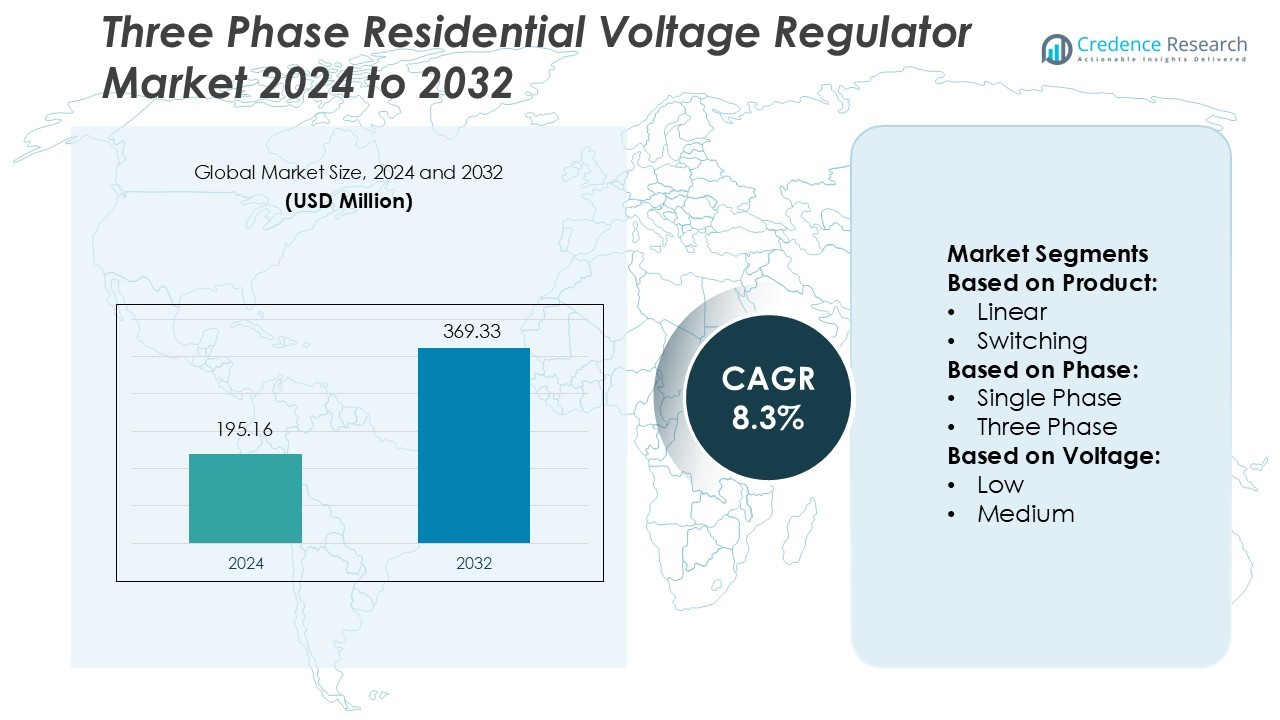
Three Phase Residential Voltage Regulator Market size was valued USD 195.16 million in 2024 and is anticipated to reach USD 369.33 million by 2032, at a CAGR of 8.3% during the forecast period.
| REPORT ATTRIBUTE | DETAILS |
|---|---|
| Historical Period | 2020-2023 |
| Base Year | 2024 |
| Forecast Period | 2025-2032 |
| Three Phase Residential Voltage Regulator Market Size 2024 | USD 195.16 Million |
| Three Phase Residential Voltage Regulator Market, CAGR | 8.3% |
| Three Phase Residential Voltage Regulator Market Size 2032 | USD 369.33 Million |
The three‑phase residential voltage regulator market include Analog Devices, Inc., Eaton Corporation, General Electric Company, Infineon Technologies AG, Legrand S.A. and Siemens AG. These firms lead through strong brand recognition, global channel networks and broad technical portfolios in residential power‑quality solutions. The Asia‑Pacific region commands the largest share of the global market with an exact figure of 36 %. The region’s dominance stems from rapid urbanisation, increasing residential electricity demand and aging grid infrastructure, all of which drive adoption of three‑phase regulators.
Market Insights
- The three phase residential voltage regulator market was valued at USD 195.16 million in 2024 and is projected to reach USD 369.33 million by 2032, growing at a CAGR of 8.3% during the forecast period.
- Asia Pacific leads the market with a 36 % share, driven by urbanisation, rising residential electricity demand, and aging grid infrastructure, followed by North America and Europe with significant adoption rates.
- Analog Devices, Inc., Eaton Corporation, General Electric Company, Infineon Technologies AG, Legrand S.A., and Siemens AG dominate the competitive landscape, leveraging strong brand presence, extensive distribution networks, and advanced technical portfolios.
- Linear regulators hold a dominant segment share due to their efficiency in maintaining stable voltage levels for residential applications, while three‑phase systems are preferred for high-load residential setups.
- Market trends include smart voltage monitoring, integration with renewable energy, and IoT-enabled solutions, whereas restraints involve high installation costs and regulatory compliance challenges in emerging regions.
Market Segmentation Analysis:
By Product
The linear voltage regulator segment dominates the Three Phase Residential Voltage Regulator Market, holding a 61% share in 2024. Its popularity stems from simple circuit design, low noise output, and cost efficiency for household appliances. Linear regulators provide stable voltage with minimal electromagnetic interference, ideal for sensitive residential electronics. Their high reliability in low-voltage environments further drives adoption in smart homes and modular power distribution systems. The switching regulator segment, while smaller, is expanding due to energy-efficient designs and higher power conversion capabilities for modern household devices.
- For instance, Purevolt offers three‑phase air‑cooled servo voltage stabilizers rated from 1 kVA to 2,000 kVA. These units maintain output voltage at 380/400/415 V ±1% for three‑phase configurations.
By Phase
The three-phase segment accounts for a 58% share, emerging as the dominant phase configuration in the market. Its high efficiency and superior load-balancing capacity make it suitable for large residential complexes, high-rise buildings, and smart grid integrations. Three-phase systems enable stable voltage regulation during peak loads, reducing power loss and extending appliance lifespan. Demand is further driven by the growing shift toward energy-efficient electrical infrastructure and integration of solar-based residential power systems, where three-phase regulators enhance distributed power control and stability.
- For instance, Microchip’s MCP1702 series delivers up to 250 mA output current while consuming only 2.0 µA quiescent current, and its input operating voltage range is 2.7 V to 13.2 V.
By Voltage
The low-voltage segment leads the market with a 64% share, driven by widespread use in household electrical circuits and appliances. These regulators are ideal for operating below 1 kV, ensuring consistent power quality and safety in residential setups. Their compact design and easy installation make them preferred for low-load home applications such as lighting, air conditioning, and refrigeration. Increasing demand for home automation systems and smart metering further supports this segment, as low-voltage regulators ensure reliable operation of connected devices and sensitive electronic components.
Key Growth Drivers
- Rising Residential Power Demand and Electrification Increasing household electricity consumption is a major driver for the Three Phase Residential Voltage Regulator Market. Rapid urbanization and the expansion of smart housing projects boost demand for efficient voltage management systems. Households depend on regulators to protect modern electronic appliances from voltage fluctuations. The push toward electrification of residential infrastructure, combined with increasing use of HVAC systems, lifts the adoption of advanced three-phase regulators designed for consistent voltage delivery and energy stability in densely populated areas.
- For instance, MaxLinear’s G.hn baseband processors and analog front‑end chipsets deliver physical data rates up to 2 Gbps over power‑lines and support up to 250 network nodes across distances of up to 700 m, thus enabling high‑speed communication in smart residential electrical systems.
- Integration of Smart Grid and IoT-Based Systems The growing integration of smart grid infrastructure and IoT-enabled systems supports market expansion. Three-phase voltage regulators equipped with digital monitoring and automated control help utilities manage distributed loads more efficiently. These regulators ensure voltage optimization through real-time communication with grid systems, improving power reliability. The adoption of smart homes and connected devices increases the need for regulators that can adapt to dynamic load variations while minimizing energy waste and enhancing overall grid efficiency.
- For instance, Ricoh’s regulator model R1560 accepts an input voltage range up to 60 V (absolute max rating up to 80 V) and consumes only 3.0 µA supply current in its operating mode, making it suitable for integration into electrified residential infrastructure.
- Expansion of Renewable Energy in Residential Power Supply The rising penetration of solar and wind energy in residential power networks drives demand for reliable voltage regulation. Three-phase voltage regulators stabilize fluctuations caused by variable renewable inputs, ensuring steady power delivery. They are essential in hybrid energy systems combining grid and solar sources. The global focus on sustainability and government incentives for renewable integration encourage households to adopt efficient regulators capable of managing distributed power generation while reducing power loss and improving energy quality.
Key Trends & Opportunities
- Adoption of Energy-Efficient and Eco-Friendly Regulators Manufacturers are increasingly developing energy-efficient voltage regulators that reduce power losses and carbon emissions. Modern three-phase systems use advanced semiconductor materials and digital control circuits to optimize energy flow. The shift toward green technologies aligns with global energy efficiency standards and consumer preferences for sustainable solutions. This trend creates opportunities for companies to innovate eco-friendly designs that meet regulatory norms while supporting renewable integration and energy conservation in smart residential environments.
- For instance, GE’s pole‑mounted voltage regulator model VR‑PM supports over 2 million mechanical load‑tap changer operations, demonstrating extreme durability in variable power networks.
- Growing Demand for Smart Monitoring and Automation The trend of remote monitoring and automation in residential power systems enhances the appeal of intelligent voltage regulators. These systems enable homeowners to track energy performance and detect voltage anomalies in real time through connected interfaces. Cloud-based analytics and AI-driven control further improve operational efficiency and maintenance scheduling. As smart home ecosystems expand, integrating automated voltage regulation technologies becomes an opportunity for manufacturers to differentiate through digital performance and predictive reliability features.
- For instance, Cooper Power Series step‑voltage regulators operate in 32 discrete tap positions (~5/8% per step) to achieve ±10% voltage regulation in wye‑connected banks.
Key Challenges
- High Installation and Maintenance Costs The adoption of three-phase residential voltage regulators faces hurdles due to higher installation and maintenance costs compared to single-phase systems. These regulators require complex wiring and periodic calibration, increasing total ownership expenses for homeowners. In regions with limited technical expertise, installation inefficiencies can delay adoption. Addressing cost constraints through modular design and low-maintenance components remains a key challenge for market expansion in price-sensitive economies.
- Compatibility Issues with Legacy Residential Infrastructure Integrating advanced three-phase regulators into existing residential electrical networks presents compatibility challenges. Older housing systems often lack the wiring capacity or safety provisions needed for multi-phase regulation. Retrofitting such structures can be costly and time-consuming, discouraging end-user adoption. Manufacturers must design adaptable solutions that offer backward compatibility while meeting safety and performance standards, enabling broader implementation in both modern and legacy residential environments.
Regional Analysis
North America The North American market commands roughly 24 % of global revenue, driven by extensive residential electrification and strengthening grid infrastructure. The U.S. housing sector’s new builds and upgrades support demand for three‑phase regulators in suburban and multi‑unit homes. Advanced energy‑efficiency mandates and increasing smart home adoption boost regulator usage. Aging distribution systems and frequent voltage disturbances further reinforce investing in stabilisation devices. Manufacturers and utilities collaborate to bundle voltage regulation with automation offerings. The combination of regulatory incentives and consumer awareness positions North America as a mature but steadily expanding region for three‑phase residential voltage regulation.
Europe
Europe holds approximately 22 % share of the market, with growth propelled by retrofitting legacy grids and integrating renewable micro‑generation at the residential level. Mature housing stock in Germany, France and the UK often uses three‑phase supply in multi dwelling units, supporting regulator adoption. Stringent power‑quality standards and increasing electric‑vehicle loads contribute to demand for three‑phase voltage stabilisers. Manufacturers are targeting smart‑grid enabled solutions that tie voltage regulation into home energy management systems. While growth rates are lower than in emerging regions, Europe remains a key region for high‑performance residential voltage regulation solutions.
Asia‑Pacific
Asia‑Pacific leads the market with about 34 % share, driven by rapid urbanisation, electrification of new residential developments, and rising appliance loads in India, China and Southeast Asia. Many new residential complexes are wired with three‑phase supply, enabling the roll‑out of three‑phase regulators to improve power quality and protect electronics. The region’s ageing grids, frequent outages and surge in rooftop solar setups create high demand for voltage stabilisation devices. Affordable manufacturing and increasing local infrastructure investment support regional solution providers. Asia‑Pacific presents the largest growth opportunity for three‑phase residential regulator vendors.
Latin America
Latin America accounts for roughly 9 % of the global market, supported by expanding residential segments in Brazil, Argentina and Mexico that adopt three‑phase systems in higher‑end homes and small‑scale apartment blocks. Grid instability, voltage fluctuations and growing solar‑PV installations fuel demand for residential‑grade three‑phase voltage regulators. Some regulatory environments are evolving to promote power‑quality devices in new housing. However, budget constraints and slower infrastructure refresh cycles dampen penetration compared to developed regions. Suppliers focusing on cost‑efficient models find favourable traction in Latin America’s emerging residential regulator market.
Middle East & Africa
The Middle East & Africa region holds about 11 % share, driven by new residential developments, smart‑city projects and large‑scale electrification in the Gulf and Africa. Many properties in the Middle East deploy three‑phase connections to serve high loads in villas and residential towers, making three‑phase voltage regulation a relevant value proposition. Regions with extreme ambient conditions and grid volatility particularly benefit from high‑reliability regulators. Market growth is supported by government initiatives targeting energy‑efficient homes and grid resilience. Nonetheless, fragmented supply chains and varying regulatory frameworks across countries moderate growth pace.
Market Segmentations:
By Product:
- Linear
- Switching
By Phase:
- Single Phase
- Three Phase
By Voltage:
- Low
- Medium
By Geography
- North America
- U.S.
- Canada
- Mexico
- Europe
- Germany
- France
- U.K.
- Italy
- Spain
- Rest of Europe
- Asia Pacific
- China
- Japan
- India
- South Korea
- South-east Asia
- Rest of Asia Pacific
- Latin America
- Brazil
- Argentina
- Rest of Latin America
- Middle East & Africa
- GCC Countries
- South Africa
- Rest of the Middle East and Africa
Competitive Landscape
The Three Phase Residential Voltage Regulator Market include Maschinenfabrik Reinhausen GmbH, Infineon Technologies AG, Purevolt, Microchip Technology Inc., MaxLinear, Ricoh USA, Inc., General Electric, Legrand, Eaton, and NXP Semiconductors. The Three Phase Residential Voltage Regulator Market is highly competitive, driven by continuous technological innovation and increasing demand for reliable power quality solutions. Companies focus on enhancing regulator efficiency, integrating smart monitoring, and improving surge protection to meet growing residential and multi-unit housing needs. Product differentiation through modular designs, compact form factors, and energy-efficient operation is critical. Strategic collaborations, mergers, and regional expansions help strengthen market presence and reach emerging markets. Additionally, investments in R&D accelerate development of advanced solutions that support smart grids, renewable energy integration, and remote diagnostics. The competitive environment encourages continuous improvement in product performance, reliability, and cost-effectiveness, driving overall market growth while addressing residential energy stability and sustainability requirements.
Key Player Analysis
- Maschinenfabrik Reinhausen GmbH
- Infineon Technologies AG
- Purevolt
- Microchip Technology Inc.
- MaxLinear
- Ricoh USA, Inc.
- General Electric
- Legrand
- Eaton
- NXP Semiconductors
Recent Developments
- In May 2024, Eaton has inaugurated its new manufacturing plant in Santiago de los Caballeros. This expansion is in line with the company’s commitment to enhancing supply capabilities essential for data centers, energy storage systems, renewable energy projects, and electric vehicles. Moreover, the company is enhancing manufacturing capabilities for voltage regulators, transformers, and EV charging technologies.
- In April 2024, STMicroelectronics introduced the LDQ40 and LDH40 voltage regulators, designed to operate efficiently from a low 3.3V input and up to 40V. The LDH40 offers adjustable output ranging from 1.2V to 22V, providing up to 200mA, while the LDQ40 delivers 250mA with adjustable outputs from 1.2V to 12V, along with fixed options of 1.8V, 2.5V, 3.3V, and 5.0V.
- In March 2024, Maschinenfabrik Reinhausen has completed the acquisition of Easun-MR Tap Changers. This acquisition solidified EMR as a fully owned subsidiary of MR while preserving its autonomous market role. This acquisition not only strengthens MR’s commitment to the Indian market but also positions the company to capitalize on emerging opportunities in the dynamic global energy landscape.
- In May 2023, Toshiba International Corporation launched the TCR1HF series of regulators offering high voltage and a wide input voltage range and industry-leading low standby current consumption. These regulators support input voltages from 4V to 36V, making them ideal for a variety of applications, including USB PD. The company intends to expand the series to meet the diverse needs of different applications.
Report Coverage
The research report offers an in-depth analysis based on Product, Phase, Voltage and Geography. It details leading market players, providing an overview of their business, product offerings, investments, revenue streams, and key applications. Additionally, the report includes insights into the competitive environment, SWOT analysis, current market trends, as well as the primary drivers and constraints. Furthermore, it discusses various factors that have driven market expansion in recent years. The report also explores market dynamics, regulatory scenarios, and technological advancements that are shaping the industry. It assesses the impact of external factors and global economic changes on market growth. Lastly, it provides strategic recommendations for new entrants and established companies to navigate the complexities of the market.
Future Outlook
- Adoption of smart home technologies will drive demand for advanced three-phase regulators.
- Integration with renewable energy systems will enhance regulator relevance in residential settings.
- Increasing urbanization and high-rise housing developments will expand market opportunities.
- Aging electrical infrastructure will prompt upgrades to improve power quality and stability.
- Manufacturers will focus on energy-efficient and compact designs for modern homes.
- Growth in electric vehicle charging at residences will require stable three-phase supply.
- Regulatory standards for voltage quality will encourage wider deployment of regulators.
- Digital monitoring and IoT-enabled devices will support predictive maintenance and performance optimization.
- Expansion into emerging markets will sustain regional growth and competitive advantage.
- Continuous R&D will lead to more reliable, durable, and cost-effective voltage regulation solutions.

Request a Free Sample
Fill in your details and we'll send you a free sample report.
- Sample data tables & charts
- Research methodology
Need a Custom Version of This Report?
Tailor the scope, geography, or segments to your exact requirements.
- Custom geography or segment scope
- Direct access to our analyst team
Frequently Asked Questions
What is the current market size for Three Phase Residential Voltage Regulator Market, and what is its projected size in 2032?
At what Compound Annual Growth Rate is the Three Phase Residential Voltage Regulator Market projected to grow between 2025 and 2032?
Which Three Phase Residential Voltage Regulator Market segment held the largest share in 2024?
What are the primary factors fueling the growth of the Three Phase Residential Voltage Regulator Market?
Who are the leading companies in the Three Phase Residential Voltage Regulator Market?
Which region commanded the largest share of the Three Phase Residential Voltage Regulator Market in 2024?
Table of Content
Chapter 1 Market Segmentation
- 1.1 Segmentation Framework
- 1.1.1 Product and Service Classification
- 1.1.2 Application and End-Use Classification
- 1.1.3 Technology and Solution Classification
- 1.1.4 Customer and Distribution Channel Classification
- 1.1.5 Geographic Segmentation
- 1.1.6 Market Segment Definitions and Boundaries
Chapter 2 Introduction
- 2.1 Report Objectives and Scope
- 2.2 Product Definition and Industry Terminology
- 2.3 Market Inclusions and Exclusions
- 2.4 Research Process
- 2.4.1 Primary Research and Expert Interviews
- 2.4.2 Secondary Research and Source Review
- 2.4.3 Top-Down and Bottom-Up Estimation
- 2.4.4 Data Triangulation and Verification
- 2.5 Market Size Measurement Basis
- 2.5.1 2024: USD 195.16 million → 2032: USD 369.33 million
- 2.6 Historical and Forecast Reference Periods
- 2.6.1 Base Year: 2024
- 2.6.2 Forecast Period: 2024-2032
- 2.7 Research Assumptions and Limitations
Chapter 3 Executive Summary
- 3.1 Market Snapshot and Key Findings
- 3.2 Base-Year Market Size, 2024
- 3.3 Forecast Market Size, 2032
- 3.4 Revenue and Volume Growth Outlook
- 3.5 Key Demand and Supply Indicators
- 3.6 Leading Market Segments
- 3.7 Fastest-Growing Market Opportunities
- 3.8 Regional Performance Highlights
- 3.9 Technology and Industry Transformation
- 3.10 Competitive Landscape Summary
- 3.11 Analyst View and Strategic Implications
Chapter 4 Global Three Phase Residential Voltage Regulator Market Trends and Developments
- 4.1 Historical Industry Development
- 4.2 Recent Market Trends and Developments
- 4.3 Demand and Customer Behavior Trends
- 4.4 Technology and Product Innovation
- 4.5 Artificial Intelligence, Automation and Digitalization
- 4.6 Local Manufacturing and Supply Chain Realignment
- 4.7 Industry Partnerships, Mergers and Acquisitions
- 4.8 Sustainability and Circular Economy Developments
- 4.9 Government and Private Sector Investment Trends
- 4.10 Emerging Business Models and Commercialization
- 4.11 Industry Developments and Announcements
Chapter 5 Global Three Phase Residential Voltage Regulator Market Production, Supply and Demand Analysis
- 5.1 Demand Trend and Consumption Analysis
- 5.2 Demand Forecast, 2024-2032
- 5.3 Production and Output Trend
- 5.4 Production and Output Forecast, 2024-2032
- 5.5 Installed Capacity and Capacity Utilization
- 5.6 Company-Wise Production Plants and Statistics
- 5.6.1 Installed Production Capacity
- 5.6.2 Actual Production
- 5.6.3 Planned Capacity and Expansion Targets
- 5.7 Supply Chain Structure and Procurement Trends
- 5.8 Supply-Demand Gap and Bottlenecks
- 5.9 Import Dependence and Sourcing Structure
- 5.10 Contract Manufacturing and Outsourcing
- 5.11 Regional Supply and Demand Concentration
Chapter 6 Global Three Phase Residential Voltage Regulator Market Pricing Analysis
- 6.1 Pricing Structure and Measurement
- 6.2 Historical Pricing Trends
- 6.3 Pricing Outlook, 2024-2032
- 6.4 Average Selling Price and Unit Economics
- 6.5 Pricing by Product and Market Segment
- 6.6 Geographic Pricing Differences
- 6.7 Key Input, Energy, Labor and Logistics Costs
- 6.8 Contract Pricing and Purchasing Models
- 6.9 Pricing Sensitivity and Competitive Positioning
- 6.10 Price, Margin and Profitability Implications
Chapter 7 Global Three Phase Residential Voltage Regulator Market Dynamics
- 7.1 Market Growth Drivers
- 7.1.1 Demand-Side Drivers
- 7.1.2 Technology and Innovation Drivers
- 7.1.3 Infrastructure and Investment Drivers
- 7.1.4 Regulatory and Policy Drivers
- 7.2 Market Restraints
- 7.2.1 Cost and Affordability Constraints
- 7.2.2 Technology and Adoption Barriers
- 7.2.3 Supply Chain and Operational Constraints
- 7.3 Market Challenges
- 7.3.1 Competitive Pressure and Margin Erosion
- 7.3.2 Skills, Infrastructure and Implementation Gaps
- 7.4 Emerging Market Opportunities
- 7.5 Market Dynamics Impact and Time-Horizon Assessment
Chapter 8 Global Three Phase Residential Voltage Regulator Value Chain Analysis
- 8.1 Industry Value Chain Overview
- 8.2 Upstream Suppliers and Critical Inputs
- 8.3 Technology and Component Providers
- 8.4 Manufacturing or Service Delivery
- 8.5 Distribution, Channel Partners and Integrators
- 8.6 Downstream Applications and End Users
- 8.7 Value Addition and Profit Pools
- 8.8 Vertical Integration and Outsourcing
- 8.9 Supplier Concentration and Risk
- 8.10 Supply Chain Localization and Resilience
Chapter 9 Global Three Phase Residential Voltage Regulator Market Regulations and Policies
- 9.1 Relevant Laws, Standards and Compliance Frameworks
- 9.2 Product, Service, Safety and Quality Requirements
- 9.3 Government Policies, Incentives and Subsidies
- 9.4 Imports, Exports and Trade Barriers
- 9.5 Public Procurement and Local Content Requirements
- 9.6 Environmental and Sustainability Compliance
- 9.7 Upcoming Policy Changes and Market Implications
Chapter 10 Global Three Phase Residential Voltage Regulator Market Hotspots and Opportunities
- 10.1 Market Opportunity Mapping and Growth Hotspots
- 10.2 High-Growth Applications and Customer Groups
- 10.3 Underserved Markets and White-Space Opportunities
- 10.4 Emerging Technology and Product Opportunities
- 10.5 New Capacity and Investment Hotspots
- 10.6 Market Entry and Expansion Opportunities
- 10.7 Distribution and Partnership Opportunities
- 10.8 Near-Term and Long-Term Commercial Potential
- 10.9 Opportunity Attractiveness and Execution Risks
Chapter 11 Global Three Phase Residential Voltage Regulator Market Outlook, 2024-2032
- 11.1 Market Size and Analysis
- 11.1.1 Revenue (Market Measurement: 2024: USD 195.16 million → 2032: USD 369.33 million)
- 11.1.2 Market Volume and Quantity Sold
- 11.1.3 Historical Market Size
- 11.1.4 Base-Year Market Size, 2024
- 11.2 Market Forecast, 2024-2032
- 11.2.1 Revenue Forecast to 2032
- 11.2.2 Volume Forecast to 2032
- 11.2.3 CAGR and Year-on-Year Growth
- 11.2.4 Incremental Revenue Opportunity
- 11.3 Forecast Assumptions and Scenario Analysis
- 11.3.1 Base-Case Forecast
- 11.3.2 Optimistic and Conservative Scenarios
- 11.3.3 Technology, Pricing and Policy Sensitivities
- 11.4 Market Attractiveness and Growth Outlook
Chapter 12 Global Three Phase Residential Voltage Regulator Market Segmentation and Outlook
- 12.1 Segmentation Summary and Market Shares, 2024
- 12.2 Largest and Fastest-Growing Segments
- 12.3 Segment Growth Comparison
- 12.4 Segment Attractiveness and Priority Matrix
Chapter 13 Global Three Phase Residential Voltage Regulator Geographic Market Outlook, 2024-2032
- 13.1 Regional Market Size and Share, 2024
- 13.2 Regional Market Forecast, 2024-2032
- 13.3 Regional Pricing, Production and Demand Differences
- 13.4 North America
- 13.4.1 United States
- 13.4.2 Canada
- 13.4.3 Mexico
- 13.5 Europe
- 13.5.1 Germany
- 13.5.2 France
- 13.5.3 Italy
- 13.5.4 United Kingdom
- 13.5.5 Spain
- 13.5.6 Poland
- 13.5.7 Russia
- 13.5.8 Netherlands
- 13.5.9 Belgium
- 13.5.10 Sweden
- 13.5.11 Denmark
- 13.5.12 Norway
- 13.5.13 Rest of Europe
- 13.6 Asia Pacific
- 13.6.1 China
- 13.6.2 India
- 13.6.3 Japan
- 13.6.4 South Korea
- 13.6.5 Thailand
- 13.6.6 Indonesia
- 13.6.7 Vietnam
- 13.6.8 Malaysia
- 13.6.9 Australia
- 13.6.10 Rest of Asia Pacific
- 13.7 Latin America
- 13.7.1 Brazil
- 13.7.2 Argentina
- 13.7.3 Colombia
- 13.7.4 Chile
- 13.7.5 Rest of Latin America
- 13.8 Middle East
- 13.8.1 Saudi Arabia
- 13.8.2 United Arab Emirates
- 13.8.3 Turkey
- 13.8.4 Israel
- 13.8.5 Iran
- 13.8.6 Rest of the Middle East
- 13.9 Africa
- 13.9.1 South Africa
- 13.9.2 Egypt
- 13.9.3 Nigeria
- 13.9.4 Morocco
- 13.9.5 Rest of Africa
- 13.10 Regional Investment, Policy and Supply Chain Differences
- 13.11 Regional Competitive Landscape
- 13.12 Geographic Growth Hotspots
Chapter 14 Global Three Phase Residential Voltage Regulator Technology, Innovation and Sustainability Outlook
- 14.1 Technology Landscape and Maturity
- 14.2 Product, Process and Service Innovation
- 14.3 AI, Automation and Digital Tools in the Industry
- 14.4 Technology Adoption and Performance Benchmarking
- 14.5 Innovation Pipeline and R&D Investment
- 14.6 Patent and Intellectual Property Trends
- 14.7 Energy Efficiency and Resource Management
- 14.8 Sustainability, Recycling and Circularity
- 14.9 Technology Roadmap, 2024-2032
- 14.10 Risks of Obsolescence and Technology Substitution
Chapter 15 Global Three Phase Residential Voltage Regulator Market Key Strategic Imperatives
- 15.1 Growth and Market Entry Priorities
- 15.2 High-Return Products and Segments
- 15.3 Pricing, Profitability and Cost Optimization
- 15.4 Technology Investment and Product Differentiation
- 15.5 Supply Chain Localization and Resilience
- 15.6 Distribution and Customer Acquisition
- 15.7 Partnership, Acquisition and Capacity Strategy
- 15.8 Regional Expansion Priorities
- 15.9 Short-, Medium- and Long-Term Actions
Chapter 16 Competition Outlook
- 16.1 Industry Competition Characteristics
- 16.2 Market Structure and Concentration
- 16.3 Market Share and Competitive Positioning, 2024
- 16.4 Company-Wise Revenue and Product Benchmarking
- 16.5 Production and Service Capacity Benchmarking
- 16.6 Technology, Pricing and Differentiation
- 16.7 Regional Footprint and Distribution Strength
- 16.8 Mergers, Acquisitions and Strategic Alliances
- 16.9 New Entrants and Competitive Threats
- 16.10 Porter's Five Forces and Industry Attractiveness
- 16.11 Competitive Outlook, 2024-2032
Chapter 17 Company Profiles
- 17.1 Company Coverage and Selection Criteria
- 17.2 Leading Market Participants – Standard Profile Structure
- 17.2.1 Business Description
- 17.2.2 Company Ownership and Geographic Presence
- 17.2.3 Product and Service Portfolio
- 17.2.4 Manufacturing and Operating Footprint
- 17.2.5 Production Capacity and Expansion Plans
- 17.2.6 Financial Performance and Investment
- 17.2.7 Market Share and Competitive Position
- 17.2.8 Technology and Innovation Capabilities
- 17.2.9 Strategic Alliances or Partnerships
- 17.2.10 Recent Developments
- 17.2.11 Growth Strategy and Outlook
- 17.3 Other Relevant Market Participants
Note: Every listed company is profiled on the structure shown under the first company. The company list is preliminary and may change based on research findings, market developments, data availability and client requirements.
Chapter 18 Disclaimer
- 18.1 Research and Forecast Disclaimer
- 18.2 Data Source and Estimation Limitations
Note: The depth of individual sections depends on data availability for this market. Volume, capacity, trade and other unit-based metrics are included where applicable.
