
| REPORT ATTRIBUTE | DETAILS |
|---|---|
| Historical Period | 2020-2023 |
| Base Year | 2024 |
| Forecast Period | 2025-2032 |
| X-Ray Security Screening Market Size 2023 | USD 3,351.20 Million |
| X-Ray Security Screening Market, CAGR | 9.20% |
| X-Ray Security Screening Market Size 2032 | USD 7,399.50 Million |
Market Overview
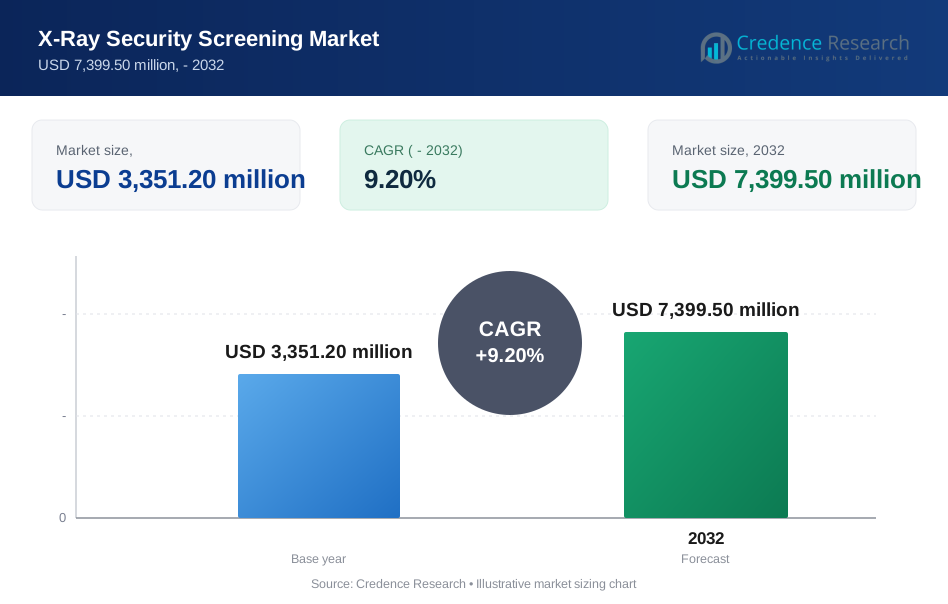
The global X-Ray Security Screening Market is projected to grow from USD 3,351.20 million in 2023 to an estimated USD 7,399.50 million by 2032, with a compound annual growth rate (CAGR) of 9.20% from 2024 to 2032. This growth is driven by the increasing demand for enhanced security measures in public spaces, transportation hubs, and critical infrastructure.
Key drivers of the market include heightened security concerns globally, technological advancements, and the adoption of X-ray security screening systems in airports, government buildings, and industrial sectors. The market is also benefiting from innovations in X-ray imaging, such as 3D scanning, automated threat detection, and the integration of artificial intelligence to improve accuracy and efficiency. Furthermore, the rising implementation of strict safety regulations in various industries is expected to drive demand for these security solutions.
Geographically, North America is expected to hold the largest market share due to the high adoption rate of advanced security systems in airports, government facilities, and critical infrastructure. The Asia-Pacific region, however, is anticipated to experience the highest growth due to rapid urbanization, increased government spending on security infrastructure, and the expansion of airports and transportation networks. Key players in the market include Smiths Detection, Rapiscan Systems, L3 Technologies, and Nuctech.
Market Insights
- The global X-ray security screening market is projected to grow from USD 3,351.20 million in 2023 to USD 7,399.50 million by 2032, at a CAGR of 9.20% from 2024 to 2032.
- Increasing global security threats, such as terrorism and criminal activities, are driving the demand for enhanced X-ray screening solutions in public and private sectors.
- Advancements in X-ray technology, including AI integration and 3D imaging, are improving the accuracy and efficiency of security screening systems.
- The high initial investment and ongoing maintenance costs of advanced X-ray systems may limit adoption, particularly in developing markets.
- Growing concerns regarding data privacy and security regulations may pose challenges in the widespread adoption of X-ray screening technologies.
- North America holds the largest market share, driven by high adoption rates of advanced security systems in airports, government buildings, and critical infrastructure.
- The Asia-Pacific region is expected to experience the highest growth due to rapid urbanization, increased government spending on security, and expanding transportation infrastructure.
Market Drivers
Increasing Security Threats and Rising Demand for Safety Measures
The growing global concern regarding security threats is driving demand for X-ray security screening systems. Increasing terrorist attacks, violence, and criminal activities have heightened the need for robust security measures at transportation hubs, public spaces, and critical infrastructure. X-ray screening equipment is crucial in preventing unauthorized items, weapons, and explosives from entering secure areas. Airports, seaports, government buildings, and industrial sites are deploying X-ray machines for screening luggage, cargo, and individuals to ensure public safety.For instance, the Transportation Security Administration (TSA) in the U.S. is modernizing its airport checkpoints by deploying over 1,200 CT X-ray scanners to enhance aviation security, reflecting the growing need for robust security measures at transportation hubs. This deployment demonstrates the significant investment in advanced screening technologies to maintain safety standards and protect citizens. Geopolitical tensions and cross-border threats further highlight the need for advanced security technologies, especially in regions that have witnessed conflicts or civil unrest. This surge in demand, driven by security concerns, is expected to continue fueling the market for X-ray security screening equipment, creating opportunities for manufacturers to innovate and meet evolving security sector needs.
Technological Advancements in X-ray Imaging and Threat Detection
Technological advancements in X-ray imaging technologies are revolutionizing security screening, driving significant growth in the global market. Innovations such as 3D X-ray imaging, advanced digital imaging, and automated threat detection have improved the accuracy, speed, and efficiency of security checks. These advancements enable security personnel to quickly identify potential threats with greater precision, reducing screening time and improving overall throughput. The integration of artificial intelligence (AI) and machine learning algorithms has enhanced X-ray machines' capability to detect hidden threats within complex items.For example, Smiths Detection has launched advanced cabin baggage screening systems using Computed Tomography (CT) technology, which allows for 3D volumetric images, significantly increasing checkpoint throughput and accuracy in identifying threats. Modern X-ray screening systems now provide real-time, high-resolution images for more in-depth analysis and better decision-making. AI-based systems can quickly analyze X-ray images, identify potential threats, and alert security operators, enabling faster and more confident action. The constant development of new features like dual-energy X-ray scanning, multi-view screening, and automated inspection processes is expected to enhance the appeal of these systems across various sectors, further expanding their global usage and driving market growth.
Government Regulations and Mandates on Security Infrastructure
Government regulations and mandates surrounding the installation and use of security screening systems are significantly driving growth in the X-ray security screening market. Many countries have implemented stringent security standards to protect their citizens and critical infrastructure. The International Civil Aviation Organization (ICAO) has established guidelines for aviation security that include the installation of advanced screening systems in airports worldwide. National security agencies and regulatory bodies continuously update their security protocols to include modern X-ray screening systems in response to evolving threats.For instance, the Bureau of Civil Aviation Security (BCAS) in India has mandated the installation of 3D computed tomography X-ray machines at major airports, highlighting the role of government regulations in driving the adoption of advanced security technologies. Such regulations, particularly those aimed at enhancing safety in public transportation and high-risk areas, are creating demand for new and upgraded X-ray security equipment. Regulatory agencies are setting standards for the performance, quality, and safety of X-ray screening systems, compelling airport authorities, transport agencies, and private security firms to adopt the latest technologies that comply with these requirements. As security regulations tighten in various sectors, the need for reliable, effective, and compliant X-ray security screening technologies continues to rise, boosting demand for these systems.
Expansion of Airport and Transportation Infrastructure
The global expansion of airport and transportation infrastructure is a key driver of the X-ray security screening market. The increasing number of travelers, both domestically and internationally, requires advanced security screening systems to ensure smooth and secure operations. According to the International Air Transport Association (IATA), global air passenger traffic is expected to continue growing, leading to a greater need for efficient and effective security measures at airports. As new airports are constructed and existing ones renovated or expanded, there is a heightened focus on improving security to handle the increasing volume of travelers and goods.For example, the global air passenger traffic is expected to continue growing, necessitating the deployment of state-of-the-art X-ray screening systems to handle the increasing volume of travelers efficiently and securely. This expansion requires advanced X-ray screening systems that can provide faster, more accurate inspections without compromising security. In addition to air travel, the growth of other transportation networks such as railways, subways, seaports, and bus stations further drives the need for X-ray security screening solutions. As governments and private entities continue to invest in enhancing transportation infrastructure to meet growing demand, the installation of advanced security systems, including X-ray machines, is becoming a key component of these upgrades. The ongoing expansion of transportation networks, coupled with the increasing need to ensure safety, will contribute significantly to the sustained growth of the global X-ray security screening market.
Market Trends
Integration of Artificial Intelligence and Machine Learning for Enhanced Threat Detection
One of the most prominent trends in the global X-ray security screening market is the integration of artificial intelligence (AI) and machine learning (ML) technologies to enhance threat detection and improve operational efficiency. AI and ML algorithms are increasingly being embedded into X-ray machines, allowing them to autonomously analyze scanned images and identify potential threats with greater precision and speed. By training these algorithms on vast amounts of data, security systems can detect subtle anomalies that may be missed by human operators. The automation of threat detection reduces the reliance on human intervention, lowering the chances of errors and minimizing false positives, which can lead to delays or unnecessary alarms.This shift toward AI-enhanced screening systems is especially evident in airport security, where rapid and accurate screening of large volumes of luggage and cargo is critical. AI-based systems can quickly assess scanned items for potential threats, ranging from explosives to weapons or illicit substances. Additionally, these AI solutions can continuously improve through machine learning, refining their detection capabilities over time based on real-world usage data. The increased efficiency, combined with faster processing times, is pushing the adoption of AI-driven X-ray screening systems across various sectors, such as transportation, government buildings, and critical infrastructure.
Advancement in 3D and Dual-Energy X-Ray Imaging
Another key trend shaping the X-ray security screening market is the shift towards 3D imaging and dual-energy X-ray technology. Traditional 2D X-ray systems have limitations when it comes to visualizing complex or dense materials, which can make it difficult to accurately assess certain items for potential threats. As a result, there is an increasing demand for 3D imaging technology, which provides a more comprehensive view of scanned objects. By creating three-dimensional representations of luggage, packages, or cargo, 3D X-ray systems allow security personnel to better visualize the internal contents, making it easier to detect hidden threats or illegal substances.Similarly, dual-energy X-ray systems are gaining traction due to their ability to differentiate between materials based on their atomic number and density. This technology allows the system to analyze scanned objects at two different energy levels, providing clearer and more distinct imaging that can help operators quickly identify materials such as explosives, drugs, and metal components. Dual-energy X-ray systems improve the accuracy and reliability of threat detection, especially in complex scenarios where the presence of multiple materials might obscure the detection of dangerous substances. These advancements are driving significant demand for more sophisticated X-ray screening solutions that offer enhanced clarity and deeper insights into the scanned objects.
Increased Adoption of Non-Intrusive Screening Systems Across Various Sectors
The growing demand for non-intrusive screening technologies is another significant trend in the X-ray security screening market. Non-intrusive methods are preferred for their ability to screen individuals and cargo without causing delays or disruptions. X-ray systems that enable quick, non-intrusive scanning are being deployed in various sectors beyond aviation, including government buildings, public venues, shopping malls, stadiums, and even stadiums or event venues. The benefits of non-intrusive screening systems include improved passenger experience, reduced screening time, and enhanced operational efficiency while still maintaining high security standards.The adoption of these systems is particularly important in high-traffic environments where long lines and delays can lead to frustration and potential security risks. For instance, at airports, X-ray screening systems are increasingly being used not only for luggage but also for personnel, cargo, and even vehicles. As governments and private sector organizations continue to prioritize safety and efficiency, they are investing in modern, non-intrusive X-ray screening systems that offer higher throughput and lower operational costs. These systems are expected to gain more prominence as they align with the growing demand for faster and more seamless security screening processes, helping to reduce bottlenecks and improve the overall passenger experience in public spaces.
Focus on Security and Privacy Compliance
As global security concerns continue to rise, so does the emphasis on maintaining compliance with security and privacy regulations. One of the most significant current trends in the X-ray security screening market is the heightened focus on ensuring that screening systems meet regulatory requirements set forth by governments, international organizations, and industry bodies. These regulations typically govern the types of equipment that can be used, the processes by which screenings are conducted, and the way data is handled. As a result, manufacturers and security providers are developing X-ray screening solutions that not only meet regulatory standards but also incorporate advanced security features to protect sensitive data and ensure compliance with privacy laws.In many regions, there are specific guidelines in place that govern the screening of individuals and their belongings. For example, the International Civil Aviation Organization (ICAO) and the U.S. Transportation Security Administration (TSA) provide detailed specifications for the deployment of X-ray systems at airports. At the same time, organizations are being encouraged to adopt more secure and transparent practices regarding the storage, transmission, and sharing of scanned images or data. For example, integrating encryption technologies within X-ray systems ensures that any sensitive data captured during screenings is securely stored and protected against unauthorized access.As privacy regulations such as the General Data Protection Regulation (GDPR) in the European Union and similar laws in other regions continue to evolve, companies that manufacture and deploy X-ray security screening systems will need to continuously update their technologies to ensure they meet compliance standards. This trend is driving innovation in the industry, as companies strive to build solutions that not only enhance security but also align with increasingly stringent data protection and privacy laws.
Market Challenges
High Initial Investment and Maintenance Costs
One of the primary challenges faced by the global X-ray security screening market is the high initial investment and ongoing maintenance costs associated with these advanced systems. The implementation of sophisticated X-ray technology, particularly systems with features like 3D imaging, dual-energy scanning, and AI-based threat detection, often requires significant financial outlay. This can be a barrier, especially for smaller airports, transit stations, or public facilities with limited budgets. The cost of purchasing, installing, and configuring these systems can be prohibitive for organizations, especially in developing countries or regions where security budgets are constrained. In addition to the initial investment, maintenance costs add to the financial burden. X-ray security systems require regular calibration, servicing, and software updates to ensure optimal performance. Over time, as technology advances, older systems may become outdated or less effective, necessitating further investments in upgrades or replacements. For organizations, especially those operating in industries with tight margins or limited funding, these ongoing expenses can be a challenge in justifying the long-term value of adopting and maintaining high-end X-ray security screening solutions. This cost-related challenge may hinder the rapid global adoption of these systems in regions or sectors that cannot afford frequent system upgrades or ongoing maintenance.
Concerns over Privacy and Data Security
As X-ray screening systems increasingly incorporate digital imaging and AI technology, concerns over data privacy and security have become significant challenges in the market. The capture, storage, and transmission of sensitive data, including scanned images of personal belongings or even people, raises questions about compliance with privacy laws and regulations. Governments around the world are tightening regulations on data protection, such as the European Union’s General Data Protection Regulation (GDPR), which mandates strict measures for the storage and processing of personal information. Security personnel handling these systems must ensure that sensitive data is protected from unauthorized access, tampering, or misuse. Moreover, organizations deploying X-ray systems must integrate robust data encryption, storage protocols, and access controls to ensure compliance with legal requirements. Failure to address these data security and privacy concerns can lead to significant legal and reputational risks for organizations, especially those involved in high-profile or sensitive operations, such as airports, government buildings, and military facilities. Ensuring that these systems not only meet security standards but also adhere to privacy regulations is a challenge that must be overcome to maintain public trust and avoid potential legal repercussions.
Market Opportunities
Growing Demand for Advanced Screening Solutions in Emerging Markets
A significant opportunity in the global X-ray security screening market lies in the growing demand for advanced security solutions in emerging markets. As economic development accelerates in regions such as Asia-Pacific, Latin America, and parts of the Middle East and Africa, there is an increasing need for enhanced security measures across airports, transportation hubs, government buildings, and critical infrastructure. Governments and private sector organizations in these regions are investing in upgrading their security infrastructure, driven by rising concerns over terrorism, criminal activity, and public safety. This provides a substantial opportunity for manufacturers of X-ray security screening systems to expand their market presence by offering cost-effective and scalable solutions tailored to the specific needs of these regions. As urbanization and industrialization continue to rise in these areas, the demand for advanced and non-intrusive security systems will increase, positioning the X-ray security screening market for significant growth.
Technological Advancements Enabling New Applications
Another key market opportunity arises from the continuous advancements in X-ray technology, which are creating new applications for security screening systems. The integration of artificial intelligence, machine learning, and enhanced imaging capabilities such as 3D and dual-energy scanning is revolutionizing the functionality of X-ray systems, making them more efficient and effective in detecting a wider range of threats. These innovations open opportunities to expand beyond traditional sectors like airports and into new industries, including healthcare, entertainment venues, and high-security governmental institutions. Furthermore, as regulations surrounding security and privacy become more stringent, there is growing demand for advanced screening technologies that comply with these requirements, offering manufacturers the opportunity to innovate and develop products that cater to a broad range of sectors seeking reliable and compliant security solutions.
Market Segmentation Analysis
By Type
The X-ray security screening market is divided into analogue and digital X-ray systems. Digital X-ray systems are anticipated to dominate the market due to their ability to produce high-resolution images, faster processing times, and improved accuracy in detecting potential threats. Digital systems, often integrated with advanced features such as 3D imaging and AI-based threat detection, are preferred in high-traffic environments like airports, where speed and precision are crucial. Analogue X-ray systems, while still in use, are gradually being phased out in favor of more advanced digital solutions, as digital systems offer better overall efficiency, reliability, and lower long-term maintenance costs.
By Application
X-ray security screening systems are primarily used for people screening and product screening. People screening involves inspecting individuals’ belongings and personal items, often in airports, public transportation hubs, and government buildings, to detect potential threats such as weapons, explosives, or contraband. Product screening is applied to luggage, cargo, and packages to ensure that goods transported via air, sea, or land meet security standards. Product screening is becoming increasingly important in logistics, particularly with the rise in e-commerce and global trade. Both applications are experiencing growth as the need for enhanced security measures escalates worldwide.
Segments
Based on Type
- Analogue X-Ray Systems
- Digital X-Ray Systems
Based on Application
- People Screening
- Product Screening
Based on End User
- Transit
- Commercial
Based on Region
- North America
- U.S.
- Canada
- Mexico
- Europe
- Germany
- France
- U.K.
- Italy
- Spain
- Rest of Europe
- Asia Pacific
- China
- Japan
- India
- South Korea
- South-east Asia
- Rest of Asia Pacific
- Latin America
- Brazil
- Argentina
- Rest of Latin America
- Middle East & Africa
- GCC Countries
- South Africa
- Rest of the Middle East and Africa
Regional Analysis
North America (35%)
North America holds the largest market share in the global X-ray security screening market. The region’s dominance can be attributed to stringent security regulations, high adoption of advanced technologies, and a significant presence of key market players. The United States, in particular, is a major contributor to the market, with the transportation sector, including airports, railways, and seaports, deploying state-of-the-art X-ray systems to meet security requirements. Moreover, the U.S. Department of Homeland Security and other federal agencies continue to invest in enhancing security infrastructure, ensuring the widespread use of X-ray systems in critical public spaces. The region’s focus on innovation, as well as its regulatory framework, ensures steady market growth.
Europe (28%)
Europe ranks second in terms of market share, driven by high investments in security infrastructure across various sectors, including airports, transit stations, and government buildings. The European Union’s stringent safety and security regulations, along with countries like the UK, Germany, and France implementing cutting-edge security technologies, contribute to the region’s growth. Europe also has a high adoption rate of digital and AI-enhanced X-ray systems, facilitating improved threat detection and faster processing times in busy transit hubs. The region is expected to maintain a significant share of the market due to ongoing investments in infrastructure and safety measures.
Key players
- Smiths Group plc
- Rapiscan Systems (OSI Systems)
- L3Harris Technologies
- Nuctech Company Limited
- Leidos Holdings, Inc.
- Astrophysics, Inc
- Adani Systems Inc
- Autoclear, LLC
- Analogic Corporation (a subsidiary of BK Medical Holding Company, Inc.)
- Gilardoni S.p.A.
- Kromek Group plc
- Hamamatsu Photonics K.K.
- Gilardoni S.p.A.
- Vidisco Ltd.
- VMI Security
- Shenzhen Security Electronic Equipment Co., Ltd
- Todd Research Ltd.
- OSI Systems, Inc.
- Teledyne Technologies Incorporated
- VJ Technologies, Inc.
Competitive Analysis
The global X-ray security screening market is highly competitive, with numerous key players striving for technological leadership and market share. Leading companies like Smiths Group, Rapiscan Systems, and L3Harris Technologies offer advanced X-ray screening solutions, often incorporating AI and 3D imaging for superior threat detection. These players focus on product innovation, customer-specific solutions, and strategic mergers or acquisitions to expand their portfolios and market presence. For example, companies like Nuctech and Leidos Holdings, Inc. have gained traction through their focus on delivering high-performance systems that comply with international security standards. Smaller players, such as VJ Technologies and Todd Research, differentiate themselves by offering specialized solutions or focusing on niche markets. Overall, the competitive landscape is marked by rapid technological advancements, extensive product offerings, and strategic efforts to meet the growing demand for advanced, non-intrusive security measures.
Recent Developments
- In January 2025, Smiths Group plc expanded partnership with Fukuoka International Airport to provide 3D X-ray technology, enhancing security and passenger experience.
- In June 2024, Nuctech Company Limited announced a new line of dual-energy X-ray scanners to improve border security and cargo inspection.
Market Concentration and Characteristics
The global X-ray security screening market exhibits moderate concentration, with a few major players such as Smiths Group, Rapiscan Systems, L3Harris Technologies, and Nuctech Company Limited dominating the industry. These companies hold significant market share due to their advanced technological offerings, strong global presence, and extensive customer bases. The market is characterized by a high level of innovation, with key players continually advancing their product portfolios through AI integration, 3D imaging, and dual-energy X-ray systems to meet evolving security demands. However, there is still room for smaller companies and niche players to thrive, particularly by offering specialized solutions tailored to specific industries or geographic regions. Overall, the market's competitive dynamics are driven by technological differentiation, regulatory compliance, and strategic partnerships to expand reach and capture emerging market opportunities.
Report Coverage
The research report offers an in-depth analysis based on Type, Application, End User and Region. It details leading market players, providing an overview of their business, product offerings, investments, revenue streams, and key applications. Additionally, the report includes insights into the competitive environment, SWOT analysis, current market trends, as well as the primary drivers and constraints. Furthermore, it discusses various factors that have driven market expansion in recent years. The report also explores market dynamics, regulatory scenarios, and technological advancements that are shaping the industry. It assesses the impact of external factors and global economic changes on market growth. Lastly, it provides strategic recommendations for new entrants and established companies to navigate the complexities of the market.
Future Outlook
- As global security risks continue to rise, the demand for advanced X-ray security screening solutions will grow to ensure safer public spaces and transportation systems.
- Continuous innovations in 3D imaging, AI integration, and dual-energy X-ray technology will enhance threat detection, making security screenings faster and more accurate.
- The global expansion and modernization of airports, railways, and seaports will drive demand for advanced X-ray systems to handle increased passenger and cargo flows efficiently.
- Non-intrusive screening solutions will become more prevalent, offering faster, more efficient security checks without compromising safety in high-traffic areas.
- As regulatory requirements for security screening evolve, X-ray systems will be increasingly designed to meet stricter safety and data protection standards worldwide.
- Emerging economies in Asia-Pacific, Latin America, and the Middle East are expected to rapidly adopt X-ray security screening systems as their infrastructure and security needs expand.
- The integration of AI and machine learning technologies will optimize threat detection capabilities, reducing human error and increasing operational efficiency in security processes.
- The ongoing rise in global terrorism and criminal activity will continue to spur investments in high-tech security solutions, making X-ray screening an essential tool in public safety.
- With the increasing volume of global trade and e-commerce, there will be a growing need for advanced X-ray systems to screen products and cargo quickly and accurately.
- The competitive landscape will remain dynamic, with both large players and niche companies focusing on innovation, regional expansion, and compliance with evolving security regulations.
Request a Free Sample
Fill in your details and we'll send you a free sample report.
- Sample data tables & charts
- Research methodology
Market Dynamics
Increasing Security Threats and Demand for Safety Measures
Rising incidents of terrorism, criminal activity, and geopolitical tensions are prompting governments and private organizations to invest in advanced X-ray security screening systems to protect public spaces, transportation hubs, and critical infrastructure.
Technological Advancements in X-ray Imaging and Threat Detection
Innovations such as 3D imaging, dual-energy scanning, and AI-based automated threat detection are making X-ray screening systems more accurate, efficient, and capable of identifying complex threats, driving their adoption across multiple sectors.
Government Regulations and Security Mandates
Stringent security standards and regulatory requirements from international and national agencies are compelling airports, transit authorities, and commercial facilities to upgrade or install compliant X-ray screening systems, fueling market growth.
Expansion of Airport and Transportation Infrastructure
The global increase in air passenger traffic and the expansion of airports, railways, and seaports are creating a greater need for efficient and high-throughput X-ray security screening solutions to manage growing volumes of people and cargo.
Emerging Market Investments in Security Infrastructure
Rapid urbanization and increased government spending on security in emerging regions, particularly Asia-Pacific and Latin America, are opening new opportunities for X-ray security screening system deployment.
Need a Custom Version of This Report?
Tailor the scope, geography, or segments to your exact requirements.
- Custom geography or segment scope
- Direct access to our analyst team
Frequently Asked Questions
What is the market size of the global X-ray security screening market in 2023 and 2032?
What are the key drivers of growth in the global X-ray security screening market?
Which regions are expected to dominate the global X-ray security screening market?
How is artificial intelligence influencing the X-ray security screening market?
What are the applications of X-ray security screening systems?
Table of Content
Chapter 1 Market Segmentation
- 1.1 Segmentation Framework
- 1.1.1 Product and Service Classification
- 1.1.2 Application and End-Use Classification
- 1.1.3 Technology and Solution Classification
- 1.1.4 Customer and Distribution Channel Classification
- 1.1.5 Geographic Segmentation
- 1.1.6 Market Segment Definitions and Boundaries
- 1.2 By Type
- 1.2.1 Analogue X-Ray Systems
- 1.2.2 Digital X-Ray Systems
- 1.3 By End User
- 1.3.1 Transit
- 1.3.2 Commercial
- 1.4 By Application
- 1.4.1 People Screening
- 1.4.2 Product Screening
Chapter 2 Introduction
- 2.1 Report Objectives and Scope
- 2.2 Product Definition and Industry Terminology
- 2.3 Market Inclusions and Exclusions
- 2.4 Research Process
- 2.4.1 Primary Research and Expert Interviews
- 2.4.2 Secondary Research and Source Review
- 2.4.3 Top-Down and Bottom-Up Estimation
- 2.4.4 Data Triangulation and Verification
- 2.5 Market Size Measurement Basis
- 2.5.1 2023: USD 3,351.20 million → 2032: USD 7,399.50 million
- 2.6 Historical and Forecast Reference Periods
- 2.6.1 Base Year: 2023
- 2.6.2 Forecast Period: 2023-2032
- 2.7 Research Assumptions and Limitations
Chapter 3 Executive Summary
- 3.1 Market Snapshot and Key Findings
- 3.2 Base-Year Market Size, 2023
- 3.3 Forecast Market Size, 2032
- 3.4 Revenue and Volume Growth Outlook
- 3.5 Key Demand and Supply Indicators
- 3.6 Leading Market Segments
- 3.7 Fastest-Growing Market Opportunities
- 3.8 Regional Performance Highlights
- 3.9 Technology and Industry Transformation
- 3.10 Competitive Landscape Summary
- 3.11 Analyst View and Strategic Implications
Chapter 4 Global X-Ray Security Screening Market Trends and Developments
- 4.1 Historical Industry Development
- 4.2 Recent Market Trends and Developments
- 4.3 Demand and Customer Behavior Trends
- 4.4 Technology and Product Innovation
- 4.5 Artificial Intelligence, Automation and Digitalization
- 4.6 Local Manufacturing and Supply Chain Realignment
- 4.7 Industry Partnerships, Mergers and Acquisitions
- 4.8 Sustainability and Circular Economy Developments
- 4.9 Government and Private Sector Investment Trends
- 4.10 Emerging Business Models and Commercialization
- 4.11 Industry Developments and Announcements
Chapter 5 Global X-Ray Security Screening Market Production, Supply and Demand Analysis
- 5.1 Demand Trend and Consumption Analysis
- 5.2 Demand Forecast, 2023-2032
- 5.3 Production and Output Trend
- 5.4 Production and Output Forecast, 2023-2032
- 5.5 Installed Capacity and Capacity Utilization
- 5.6 Company-Wise Production Plants and Statistics
- 5.6.1 Installed Production Capacity
- 5.6.2 Actual Production
- 5.6.3 Planned Capacity and Expansion Targets
- 5.7 Supply Chain Structure and Procurement Trends
- 5.8 Supply-Demand Gap and Bottlenecks
- 5.9 Import Dependence and Sourcing Structure
- 5.10 Contract Manufacturing and Outsourcing
- 5.11 Regional Supply and Demand Concentration
Chapter 6 Global X-Ray Security Screening Market Pricing Analysis
- 6.1 Pricing Structure and Measurement
- 6.2 Historical Pricing Trends
- 6.3 Pricing Outlook, 2023-2032
- 6.4 Average Selling Price and Unit Economics
- 6.5 Pricing by Product and Market Segment
- 6.6 Geographic Pricing Differences
- 6.7 Key Input, Energy, Labor and Logistics Costs
- 6.8 Contract Pricing and Purchasing Models
- 6.9 Pricing Sensitivity and Competitive Positioning
- 6.10 Price, Margin and Profitability Implications
Chapter 7 Global X-Ray Security Screening Market Dynamics
- 7.1 Market Growth Drivers
- 7.1.1 Demand-Side Drivers
- 7.1.2 Technology and Innovation Drivers
- 7.1.3 Infrastructure and Investment Drivers
- 7.1.4 Regulatory and Policy Drivers
- 7.2 Market Restraints
- 7.2.1 Cost and Affordability Constraints
- 7.2.2 Technology and Adoption Barriers
- 7.2.3 Supply Chain and Operational Constraints
- 7.3 Market Challenges
- 7.3.1 Competitive Pressure and Margin Erosion
- 7.3.2 Skills, Infrastructure and Implementation Gaps
- 7.4 Emerging Market Opportunities
- 7.5 Market Dynamics Impact and Time-Horizon Assessment
Chapter 8 Global X-Ray Security Screening Value Chain Analysis
- 8.1 Industry Value Chain Overview
- 8.2 Upstream Suppliers and Critical Inputs
- 8.3 Technology and Component Providers
- 8.4 Manufacturing or Service Delivery
- 8.5 Distribution, Channel Partners and Integrators
- 8.6 Downstream Applications and End Users
- 8.7 Value Addition and Profit Pools
- 8.8 Vertical Integration and Outsourcing
- 8.9 Supplier Concentration and Risk
- 8.10 Supply Chain Localization and Resilience
Chapter 9 Global X-Ray Security Screening Market Regulations and Policies
- 9.1 Relevant Laws, Standards and Compliance Frameworks
- 9.2 Product, Service, Safety and Quality Requirements
- 9.3 Government Policies, Incentives and Subsidies
- 9.4 Imports, Exports and Trade Barriers
- 9.5 Public Procurement and Local Content Requirements
- 9.6 Environmental and Sustainability Compliance
- 9.7 Upcoming Policy Changes and Market Implications
Chapter 10 Global X-Ray Security Screening Market Hotspots and Opportunities
- 10.1 Market Opportunity Mapping and Growth Hotspots
- 10.2 High-Growth Applications and Customer Groups
- 10.3 Underserved Markets and White-Space Opportunities
- 10.4 Emerging Technology and Product Opportunities
- 10.5 New Capacity and Investment Hotspots
- 10.6 Market Entry and Expansion Opportunities
- 10.7 Distribution and Partnership Opportunities
- 10.8 Near-Term and Long-Term Commercial Potential
- 10.9 Opportunity Attractiveness and Execution Risks
Chapter 11 Global X-Ray Security Screening Market Outlook, 2023-2032
- 11.1 Market Size and Analysis
- 11.1.1 Revenue (Market Measurement: 2023: USD 3,351.20 million → 2032: USD 7,399.50 million)
- 11.1.2 Market Volume and Quantity Sold
- 11.1.3 Historical Market Size
- 11.1.4 Base-Year Market Size, 2023
- 11.2 Market Forecast, 2023-2032
- 11.2.1 Revenue Forecast to 2032
- 11.2.2 Volume Forecast to 2032
- 11.2.3 CAGR and Year-on-Year Growth
- 11.2.4 Incremental Revenue Opportunity
- 11.3 Forecast Assumptions and Scenario Analysis
- 11.3.1 Base-Case Forecast
- 11.3.2 Optimistic and Conservative Scenarios
- 11.3.3 Technology, Pricing and Policy Sensitivities
- 11.4 Market Attractiveness and Growth Outlook
Chapter 12 Global X-Ray Security Screening Market Segmentation and Outlook
- 12.1 Segmentation Summary and Market Shares, 2023
- 12.2 Largest and Fastest-Growing Segments
- 12.3 By Type - Market Size and Forecast, 2023-2032
- 12.3.1 Segment Definition and Scope
- 12.3.2 Historical Market Size
- 12.3.3 Revenue Forecast, 2023-2032
- 12.3.4 Volume Forecast, 2023-2032
- 12.3.5 Base-Year Market Share, 2023
- 12.3.6 Segment CAGR and Growth Drivers
- 12.3.7 Subsegment Market Size and Forecast
- 12.3.7.1 Analogue X-Ray Systems
- 12.3.7.2 Digital X-Ray Systems
- 12.3.8 Subsegment Pricing and Adoption Trends
- 12.3.9 Leading Suppliers and Competition
- 12.3.10 Regional Demand and Opportunities
- 12.4 By End User - Market Size and Forecast, 2023-2032
- 12.4.1 Segment Definition and Scope
- 12.4.2 Historical Market Size
- 12.4.3 Revenue Forecast, 2023-2032
- 12.4.4 Volume Forecast, 2023-2032
- 12.4.5 Base-Year Market Share, 2023
- 12.4.6 Segment CAGR and Growth Drivers
- 12.4.7 Subsegment Market Size and Forecast
- 12.4.7.1 Transit
- 12.4.7.2 Commercial
- 12.4.8 Subsegment Pricing and Adoption Trends
- 12.4.9 Leading Suppliers and Competition
- 12.4.10 Regional Demand and Opportunities
- 12.5 By Application - Market Size and Forecast, 2023-2032
- 12.5.1 Segment Definition and Scope
- 12.5.2 Historical Market Size
- 12.5.3 Revenue Forecast, 2023-2032
- 12.5.4 Volume Forecast, 2023-2032
- 12.5.5 Base-Year Market Share, 2023
- 12.5.6 Segment CAGR and Growth Drivers
- 12.5.7 Subsegment Market Size and Forecast
- 12.5.7.1 People Screening
- 12.5.7.2 Product Screening
- 12.5.8 Subsegment Pricing and Adoption Trends
- 12.5.9 Leading Suppliers and Competition
- 12.5.10 Regional Demand and Opportunities
- 12.6 Segment Growth Comparison
- 12.7 Segment Attractiveness and Priority Matrix
Chapter 13 Global X-Ray Security Screening End-Use and Application Market Outlook
- 13.1 End-Use Industry and Customer Demand Structure
- 13.2 Leading Applications and Customer Groups
- 13.3 End-Use Market Size, Share and Forecast
- 13.4 Major End-Use Industry Deep Dives
- 13.4.1 Customer Requirements and Use Cases
- 13.4.2 Demand and Replacement Cycles
- 13.4.3 Technical and Regulatory Considerations
- 13.4.4 Purchasing and Procurement Models
- 13.4.5 Leading Vendors and Distribution Channels
- 13.4.6 Forecast and Commercial Opportunities
- 13.5 Emerging Applications and Cross-Segment Demand
- 13.6 End-Use Industry Investment Priorities
Chapter 14 Global X-Ray Security Screening Geographic Market Outlook, 2023-2032
- 14.1 Regional Market Size and Share, 2023
- 14.2 Regional Market Forecast, 2023-2032
- 14.3 Regional Pricing, Production and Demand Differences
- 14.4 North America
- 14.4.1 United States
- 14.4.2 Canada
- 14.4.3 Mexico
- 14.5 Europe
- 14.5.1 Germany
- 14.5.2 France
- 14.5.3 Italy
- 14.5.4 United Kingdom
- 14.5.5 Spain
- 14.5.6 Poland
- 14.5.7 Russia
- 14.5.8 Netherlands
- 14.5.9 Belgium
- 14.5.10 Sweden
- 14.5.11 Denmark
- 14.5.12 Norway
- 14.5.13 Rest of Europe
- 14.6 Asia Pacific
- 14.6.1 China
- 14.6.2 India
- 14.6.3 Japan
- 14.6.4 South Korea
- 14.6.5 Thailand
- 14.6.6 Indonesia
- 14.6.7 Vietnam
- 14.6.8 Malaysia
- 14.6.9 Australia
- 14.6.10 Rest of Asia Pacific
- 14.7 Latin America
- 14.7.1 Brazil
- 14.7.2 Argentina
- 14.7.3 Colombia
- 14.7.4 Chile
- 14.7.5 Rest of Latin America
- 14.8 Middle East
- 14.8.1 Saudi Arabia
- 14.8.2 United Arab Emirates
- 14.8.3 Turkey
- 14.8.4 Israel
- 14.8.5 Iran
- 14.8.6 Rest of the Middle East
- 14.9 Africa
- 14.9.1 South Africa
- 14.9.2 Egypt
- 14.9.3 Nigeria
- 14.9.4 Morocco
- 14.9.5 Rest of Africa
- 14.10 Regional Investment, Policy and Supply Chain Differences
- 14.11 Regional Competitive Landscape
- 14.12 Geographic Growth Hotspots
Chapter 15 Global X-Ray Security Screening Technology, Innovation and Sustainability Outlook
- 15.1 Technology Landscape and Maturity
- 15.2 Product, Process and Service Innovation
- 15.3 AI, Automation and Digital Tools in the Industry
- 15.4 Technology Adoption and Performance Benchmarking
- 15.5 Innovation Pipeline and R&D Investment
- 15.6 Patent and Intellectual Property Trends
- 15.7 Energy Efficiency and Resource Management
- 15.8 Sustainability, Recycling and Circularity
- 15.9 Technology Roadmap, 2023-2032
- 15.10 Risks of Obsolescence and Technology Substitution
Chapter 16 Global X-Ray Security Screening Market Key Strategic Imperatives
- 16.1 Growth and Market Entry Priorities
- 16.2 High-Return Products and Segments
- 16.3 Pricing, Profitability and Cost Optimization
- 16.4 Technology Investment and Product Differentiation
- 16.5 Supply Chain Localization and Resilience
- 16.6 Distribution and Customer Acquisition
- 16.7 Partnership, Acquisition and Capacity Strategy
- 16.8 Regional Expansion Priorities
- 16.9 Short-, Medium- and Long-Term Actions
Chapter 17 Competition Outlook
- 17.1 Industry Competition Characteristics
- 17.2 Market Structure and Concentration
- 17.3 Market Share and Competitive Positioning, 2023
- 17.4 Company-Wise Revenue and Product Benchmarking
- 17.5 Production and Service Capacity Benchmarking
- 17.6 Technology, Pricing and Differentiation
- 17.7 Regional Footprint and Distribution Strength
- 17.8 Mergers, Acquisitions and Strategic Alliances
- 17.9 New Entrants and Competitive Threats
- 17.10 Porter's Five Forces and Industry Attractiveness
- 17.11 Competitive Outlook, 2023-2032
Chapter 18 Company Profiles
- 18.1 Company Coverage and Selection Criteria
- 18.2 Smiths Group plc
- 18.2.1 Business Description
- 18.2.2 Company Ownership and Geographic Presence
- 18.2.3 Product and Service Portfolio
- 18.2.4 Manufacturing and Operating Footprint
- 18.2.5 Production Capacity and Expansion Plans
- 18.2.6 Financial Performance and Investment
- 18.2.7 Market Share and Competitive Position
- 18.2.8 Technology and Innovation Capabilities
- 18.2.9 Strategic Alliances or Partnerships
- 18.2.10 Recent Developments
- 18.2.11 Growth Strategy and Outlook
- 18.3 Rapiscan Systems (OSI Systems)
- 18.4 L3Harris Technologies
- 18.5 Nuctech Company Limited
- 18.6 Leidos Holdings, Inc.
- 18.7 Astrophysics, Inc.
- 18.8 Adani Systems Inc
- 18.9 Analogic Corporation
- 18.10 Gilardoni S.p.A.
- 18.11 VJ Technologies, Inc.
- 18.12 Other Relevant Market Participants
Note: Every listed company is profiled on the structure shown under the first company. The company list is preliminary and may change based on research findings, market developments, data availability and client requirements.
Chapter 19 Disclaimer
- 19.1 Research and Forecast Disclaimer
- 19.2 Data Source and Estimation Limitations
Note: The depth of individual sections depends on data availability for this market. Volume, capacity, trade and other unit-based metrics are included where applicable.

