Market Overview:
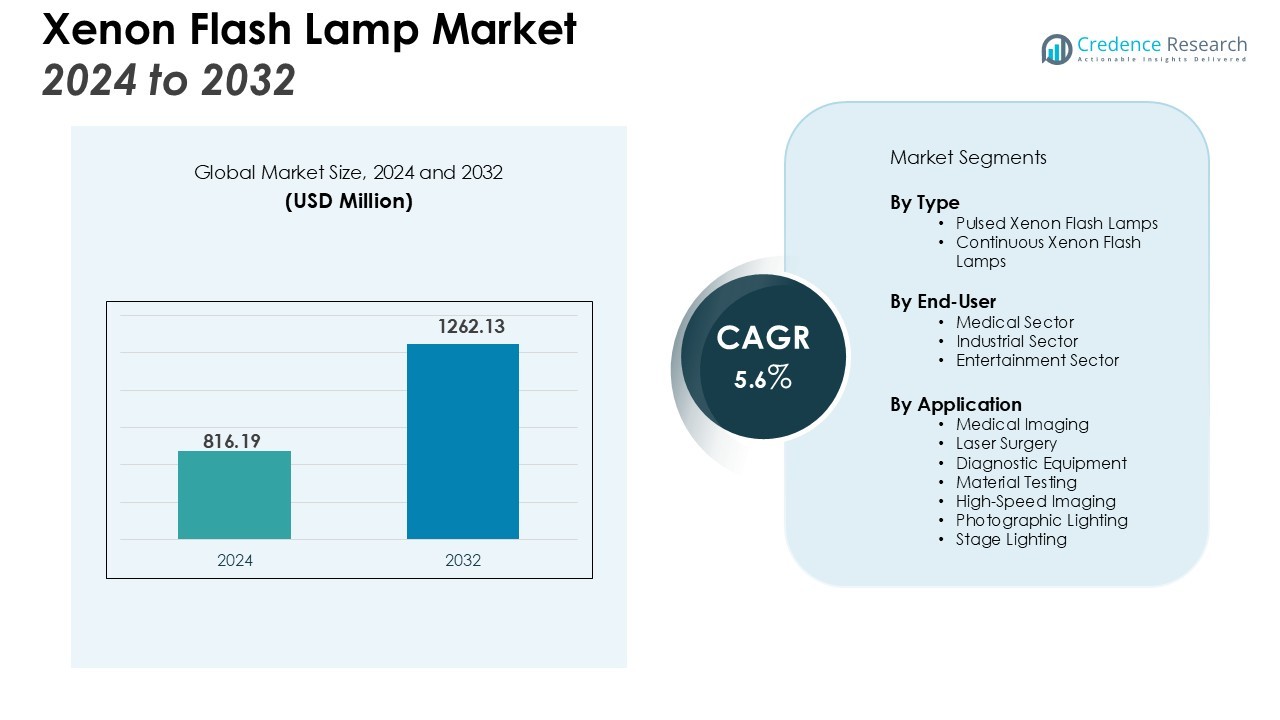
The Xenon Flash Lamp Market size was valued at USD 816.19 million in 2024 and is anticipated to reach USD 1262.13 million by 2032, at a CAGR of 5.6% during the forecast period (2024-2032).
| REPORT ATTRIBUTE |
DETAILS |
| Historical Period |
2020-2023 |
| Base Year |
2024 |
| Forecast Period |
2025-2032 |
| Xenon Flash Lamp Market Size 2024 |
USD 816.19 Million |
| Xenon Flash Lamp Market, CAGR |
5.6% |
| Xenon Flash Lamp Market Size 2032 |
USD 1262.13 Million |
Key drivers for the market include the growing adoption of Xenon flash lamps in medical devices, particularly in laser surgeries, dental applications, and diagnostic equipment. Additionally, their use in industrial applications for materials testing and in entertainment for high-speed imaging and photographic lighting further propels the market’s expansion. Advancements in technology, including improved lamp performance and energy efficiency, also contribute to the market’s positive trajectory.
Regionally, North America holds a dominant position in the Xenon Flash Lamp Market, driven by the high demand in medical, scientific, and military applications. The Asia Pacific region is expected to witness the highest growth during the forecast period due to expanding industrial sectors and increasing healthcare investments in countries like China and India. Europe also shows significant market potential, supported by stringent regulations on medical device technologies and innovation in lighting solutions.
Access crucial information at unmatched prices!
Request your sample report today & start making informed decisions powered by Credence Research Inc.!
Download Sample
Market Insights:
- The Xenon Flash Lamp Market was valued at USD 816.19 million in 2024 and is projected to reach USD 1262.13 million by 2032, growing at a CAGR of 5.6% during the forecast period (2024-2032).
- The medical sector is a key driver for market growth, particularly in laser surgeries, dental applications, and diagnostic equipment, where Xenon flash lamps provide the necessary high-intensity light.
- Scientific research and industrial applications, such as high-speed imaging, spectrometry, and material testing, are increasing the demand for Xenon flash lamps, contributing to the market’s expansion.
- Advancements in technology, including improved energy efficiency and lamp performance, play a critical role in boosting the adoption of Xenon flash lamps across various sectors.
- North America dominates the Xenon Flash Lamp Market with 35% market share in 2024, driven by strong demand in medical, scientific, and military applications.
- The Asia Pacific region is expected to experience the highest growth rate, with 30% of the market share, fueled by industrialization, expanding manufacturing sectors, and growing healthcare investments in China and India.
- Europe holds 25% of the market share, supported by regulatory push for sustainable and energy-efficient solutions, alongside innovation in medical devices and industrial applications.
Market Drivers:
Increasing Demand in Medical Applications
The Xenon Flash Lamp Market experiences significant growth due to its widespread use in medical applications. It plays a crucial role in laser surgeries, particularly in ophthalmology, where it helps in precise tissue ablation and photocoagulation. Its high-intensity light output is essential for effective treatments in dental and dermatology procedures. The growing need for advanced diagnostic equipment, such as X-ray machines and CT scanners, further drives its adoption in the healthcare sector.
Rising Applications in Scientific Research
Xenon flash lamps are widely utilized in scientific research for high-speed imaging and spectrometry. They provide short, intense light pulses required in various analytical techniques, enhancing precision and efficiency. Research labs employ these lamps in spectroscopy, where they help in detecting materials based on their absorption of light at specific wavelengths. As scientific and technological advancements continue, the demand for Xenon flash lamps in research settings expands, pushing market growth.
- For instance, Hamamatsu’s L11033 series 150W xenon lamps, developed for scientific instruments, offer a guaranteed life of 3,000 hours.
Advancements in Industrial Testing and Manufacturing
The industrial sector increasingly relies on Xenon flash lamps for materials testing and quality control. It helps simulate real-world conditions for items exposed to prolonged light exposure, such as automotive parts and textiles. Xenon flash lamps provide consistent and reliable light output, crucial for evaluating the durability of materials in production environments. The expanding need for high-quality manufacturing processes drives the growth of the Xenon Flash Lamp Market.
Growing Demand in Photography and Entertainment
Xenon flash lamps are integral to the photography and entertainment industries, where they are used in high-speed imaging, motion picture lighting, and stage effects. Their ability to produce extremely bright and short-duration light pulses makes them ideal for capturing fast-moving objects in films or photoshoots. As the demand for professional-grade lighting solutions in photography and entertainment increases, it directly impacts the market for Xenon flash lamps.
- For instance, Ushio’s DXL-40SN2 4000W xenon lamp, designed for cinema projectors, has a lifespan of 1,000 hours.
Market Trends:
Technological Advancements Driving Efficiency and Performance
The Xenon Flash Lamp Market is witnessing significant technological advancements that enhance the efficiency and performance of these light sources. Recent innovations focus on improving energy efficiency, increasing lamp life, and offering more consistent light output. Manufacturers are integrating advanced materials and coatings to enhance the durability and brightness of Xenon flash lamps, making them more reliable in critical applications. These improvements are driving their adoption in medical, industrial, and scientific applications, where high-performance lighting is crucial. New designs also incorporate better heat management solutions, ensuring more stable operations, which is particularly important for medical and industrial equipment.
- For instance, Hamamatsu Photonics provides a guaranteed lamp input energy range for its 10 W xenon flash lamps between 0.01 J and 0.1 J.
Shift Towards Sustainable and Energy-Efficient Lighting Solutions
A noticeable trend in the Xenon Flash Lamp Market is the growing demand for sustainable and energy-efficient lighting solutions. Environmental concerns are pushing industries to adopt energy-efficient technologies that reduce overall carbon footprints. Xenon flash lamps, with their improved energy performance, cater to this demand, offering an alternative to traditional lighting technologies that consume more power. These lamps are increasingly being integrated into eco-friendly designs and applications that focus on energy conservation. The ability to provide high-intensity light while minimizing energy consumption makes Xenon flash lamps an attractive option for industries looking to meet environmental and operational efficiency goals. This trend is expected to continue shaping the market, aligning with global sustainability efforts.
- For instance, Hamamatsu Photonics provides 10 W xenon flash lamps that operate with a guaranteed lamp input energy as low as 0.01 joules, enhancing energy efficiency in their application.
Market Challenges Analysis:
High Cost and Complex Manufacturing Process
One of the key challenges in the Xenon Flash Lamp Market is the high cost associated with the manufacturing of these lamps. The production process involves specialized materials and precise assembly, which drives up costs. These lamps require specific components, such as Xenon gas and precise electrodes, which contribute to the overall expense. This makes Xenon flash lamps more expensive than alternative lighting solutions, limiting their accessibility for certain industries, especially in regions with lower investment capacities. The high upfront costs may hinder their widespread adoption in cost-sensitive applications.
Competition from Alternative Lighting Technologies
The Xenon Flash Lamp Market also faces significant competition from alternative lighting technologies, particularly LEDs and lasers, which offer lower energy consumption and longer lifespan. These alternatives are gaining traction across various industries, including medical, industrial, and entertainment sectors, due to their cost-effectiveness and lower maintenance needs. While Xenon flash lamps provide intense light output, the development of energy-efficient and cost-effective alternatives poses a challenge to market growth. Manufacturers of Xenon flash lamps must continue to innovate in terms of performance and cost-efficiency to maintain their competitive edge.
Market Opportunities:
Expansion in Emerging Markets
The Xenon Flash Lamp Market has significant growth potential in emerging markets, particularly in regions like Asia Pacific and Latin America. The increasing industrialization, coupled with rising investments in healthcare infrastructure, presents a major opportunity for market expansion. As industries in these regions adopt advanced technologies for manufacturing, medical, and scientific applications, the demand for high-performance lighting solutions, such as Xenon flash lamps, is expected to rise. Growing economies with expanding healthcare sectors and research initiatives can further propel the adoption of Xenon flash lamps, providing opportunities for companies to establish a strong foothold in these untapped markets.
Advancements in Medical and Scientific Applications
The ongoing advancements in medical and scientific applications present a promising opportunity for the Xenon Flash Lamp Market. In medical devices, especially in diagnostic imaging and laser surgeries, the demand for high-intensity light sources remains strong. The growing focus on precision medicine and non-invasive procedures offers opportunities for Xenon flash lamps to be integrated into advanced technologies. Similarly, scientific research, including spectrometry and imaging, continues to expand globally, further driving the need for powerful light sources. These advancements enable the Xenon Flash Lamp Market to explore new avenues for growth across various sectors, particularly in research and healthcare innovation.
Market Segmentation Analysis:
By Type
The Xenon Flash Lamp Market is segmented into pulsed Xenon flash lamps and continuous Xenon flash lamps. Pulsed Xenon flash lamps dominate the market due to their ability to generate high-intensity light for short durations, which is crucial in applications such as laser surgery, photography, and scientific research. Continuous Xenon flash lamps, while less common, are preferred for applications requiring sustained light output, such as in industrial and environmental testing. The demand for pulsed lamps continues to rise, driven by advancements in medical technologies and entertainment lighting.
- For instance, Hamamatsu Photonics offers a high-output 20 W xenon flash lamp that can operate at a maximum repetition rate of 40 Hz.
By End-User
The market serves several end-users, with the medical sector being the largest consumer. Xenon flash lamps are widely used in laser surgeries, dermatology, and dental procedures due to their precision and high-intensity light. Other key end-users include industries such as automotive, electronics, and manufacturing, where Xenon lamps are used in material testing and quality control. The entertainment industry also significantly contributes to the market, particularly in high-speed imaging, photographic lighting, and stage effects, where bright, short-duration flashes are essential.
By Application
The Xenon Flash Lamp Market is widely applied in medical, industrial, and entertainment sectors. In the medical field, it is used for diagnostic imaging and laser procedures. Industrial applications focus on material testing, where it simulates real-world conditions for products exposed to light. The entertainment industry utilizes Xenon flash lamps in motion picture lighting and photographic flash systems. The versatility of Xenon lamps in these diverse applications continues to drive market growth.
- For instance, for industrial applications, Hamamatsu Photonics provides a xenon flash lamp with a special Magnesium Fluoride window that emits a light spectrum from 160 nm to 7500 nm, making it ideal for industrial inspections and chemical analysis.
Segmentations:
- By Type
- Pulsed Xenon Flash Lamps
- Continuous Xenon Flash Lamps
- By End-User
- Medical Sector
- Industrial Sector
- Entertainment Sector
- Scientific Research Sector
- By Application
- Medical Imaging
- Laser Surgery
- Diagnostic Equipment
- Material Testing
- High-Speed Imaging
- Photographic Lighting
- Stage Lighting
- By Region
- North America
- Europe
- Germany
- France
- U.K.
- Italy
- Spain
- Rest of Europe
- Asia Pacific
- China
- Japan
- India
- South Korea
- South-east Asia
- Rest of Asia Pacific
- Latin America
- Brazil
- Argentina
- Rest of Latin America
- Middle East & Africa
- GCC Countries
- South Africa
- Rest of the Middle East and Africa
Regional Analysis:
North America: Market Leader with Strong Demand in Medical and Industrial Sectors
North America holds the largest share of the Xenon Flash Lamp Market, accounting for 35% of the global market in 2024. The robust demand across medical, industrial, and scientific applications drives this market dominance. The healthcare sector in the U.S. heavily relies on Xenon flash lamps for diagnostic imaging and laser surgeries, fueling market growth. The region’s well-established industrial base further contributes to the demand for these lamps in quality testing and manufacturing processes. Technological advancements and increasing investments in R&D are driving innovation, ensuring North America remains a key player in shaping market trends.
Asia Pacific: Rapid Growth Driven by Industrialization and Healthcare Investments
The Asia Pacific region captures 30% of the Xenon Flash Lamp Market share in 2024 and is expected to witness the highest growth rate. Rapid industrialization and expanding manufacturing capabilities in countries like China and India present significant opportunities for market players. The rising demand for high-performance lighting solutions in automotive, electronics, and textiles further boosts the adoption of Xenon flash lamps. Additionally, growing investments in healthcare infrastructure and scientific research contribute to the rising demand for these lamps in medical and laboratory applications. The expanding middle class and increasing disposable income in key markets are expected to accelerate the uptake of advanced technologies.
Europe: Innovation and Regulatory Push Supporting Market Growth
Europe accounts for 25% of the global Xenon Flash Lamp Market share, driven by innovation in medical devices and stringent manufacturing regulations. Countries like Germany, the UK, and France lead the demand, particularly in medical imaging and diagnostic devices, where Xenon flash lamps are essential. The region also benefits from a well-established industrial base that uses Xenon lamps for material testing and quality control. European markets are increasingly adopting energy-efficient and sustainable solutions, which enhance the appeal of Xenon flash lamps. The focus on innovation and sustainability will continue to support market growth in this region throughout the forecast period.
Shape Your Report to Specific Countries or Regions & Enjoy 30% Off!
Key Player Analysis:
Competitive Analysis:
The Xenon Flash Lamp Market is highly competitive, with leading global players like Hamamatsu Photonics, Excelitas Technologies, and PerkinElmer dominating the landscape. These companies focus on innovation, investing in R&D to enhance lamp performance, energy efficiency, and durability to meet growing demands in medical, industrial, and scientific applications. Regional players, particularly from China and Southeast Asia, are gaining ground by offering cost-effective solutions, tapping into emerging markets in the Middle East and Africa. Competitive strategies revolve around technological advancements, efficient manufacturing, and regional expansion. Companies that adapt quickly to market demands and provide tailored solutions across various sectors are well-positioned to maintain a strong market presence and drive future growth.
Report Coverage:
The research report offers an in-depth analysis based on Type, End-User, Application and Region. It details leading market players, providing an overview of their business, product offerings, investments, revenue streams, and key applications. Additionally, the report includes insights into the competitive environment, SWOT analysis, current market trends, as well as the primary drivers and constraints. Furthermore, it discusses various factors that have driven market expansion in recent years. The report also explores market dynamics, regulatory scenarios, and technological advancements that are shaping the industry. It assesses the impact of external factors and global economic changes on market growth. Lastly, it provides strategic recommendations for new entrants and established companies to navigate the complexities of the market.
Future Outlook:
- The demand for Xenon flash lamps will continue to rise as their applications expand across medical, industrial, and entertainment sectors.
- Advancements in technology will lead to more energy-efficient and durable Xenon flash lamps, enhancing their appeal in cost-sensitive industries.
- The medical sector will remain a significant driver, particularly for laser surgeries and diagnostic imaging, where high-intensity light is crucial.
- Increased industrialization in emerging markets, especially in Asia Pacific, will boost the demand for Xenon flash lamps in material testing and quality control.
- The rise in scientific research, including spectroscopy and high-speed imaging, will fuel further adoption of Xenon flash lamps in laboratories and research facilities.
- The entertainment industry’s need for high-speed imaging and photographic lighting will continue to support market growth.
- Sustainability efforts will push manufacturers to innovate and create more eco-friendly and energy-efficient Xenon flash lamps.
- Strong regional growth in North America and Asia Pacific will drive new market opportunities, particularly in medical and industrial applications.
- The trend toward automation and smart technologies will increase the use of Xenon flash lamps in advanced manufacturing and robotics.
- Strategic partnerships, mergers, and acquisitions will shape the competitive landscape as companies seek to strengthen their market presence.



