
| REPORT ATTRIBUTE | DETAILS |
|---|---|
| Historical Period | 2019-2022 |
| Base Year | 2023 |
| Forecast Period | 2024-2032 |
| HVAC (Heating, Ventilation, And Air Conditioning) Equipment Market Size 2023 | USD 209.5 Billion |
| HVAC (Heating, Ventilation, And Air Conditioning) Equipment Market, CAGR | 6.80% |
| HVAC (Heating, Ventilation, And Air Conditioning) Equipment Market Size 2032 | USD 378.7 Billion |
Market Insights
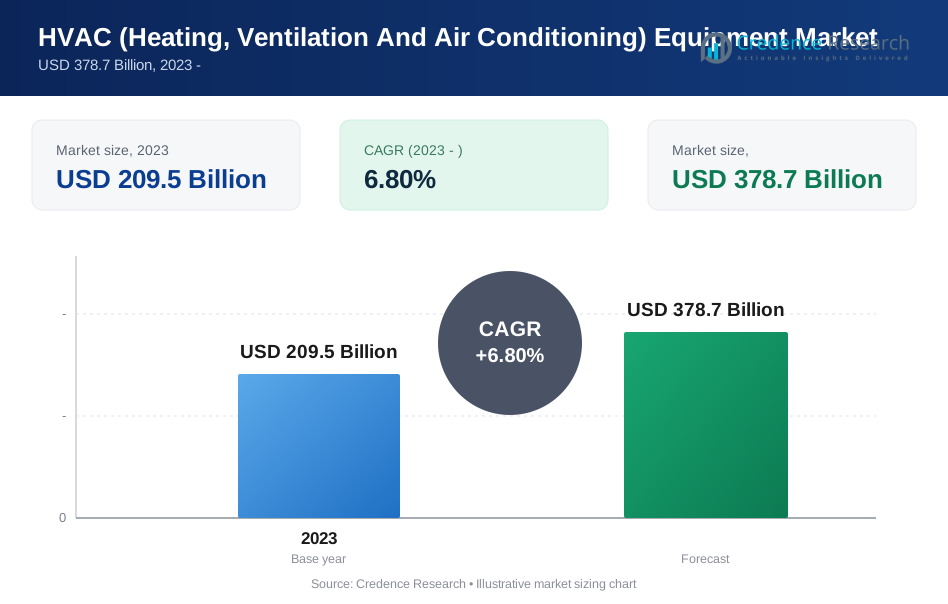
- The HVAC (Heating, Ventilation, And Air Conditioning) Equipment Market's global demand was valued at USD 209.5 Billion in 2023 and is expected to reach USD 378.7 Billion in 2032, growing at a CAGR of 6.80% between 2024 and 2032.
- The Air Conditioning Equipment sector is the market leader by product type, accounting for more than 25% of the total value in 2023, while the Ventilation Control Systems segment is expected to grow rapidly throughout the forecast period.
- The commercial end-user category dominates the global HVAC Equipment Market, accounting for more than 30% in 2023, and is predicted to expand at a high CAGR.
- The application of industrial processes is predicted to grow fastest over the projection period, while the new construction segment will have a market share of more than 35% in 2023.
- Over the projection period, the Smart HVAC Systems category is expected to expand at the highest rate, while the Traditional HVAC Systems category will dominate the market in 2023 with a 35% share.
- The Control Systems component is expected to expand quickly over the forecast period, while the Compressors segment will have the greatest market share in 2023.
- The online retailer's distribution channel holds significant revenue share by sales channel segment. In contrast, the distributors category will expand fastest throughout the projected period.
- With a significant market share of over 40% in 2023 and projections of high CAGR growth, the Electric fuel type will likely continue to dominate the HVAC Equipment Market globally.
- North America is fueling the growth of the HVAC Equipment Market with over one-third share in 2023, while Asia-Pacific and Europe collectively account for just under 60% share in 2023. Europe held over 15% share in 2023.
- Due to the limitations of traditional HVAC systems in energy efficiency, the market for HVAC Equipment is driven by the increased focus on smart and energy-efficient HVAC systems.
- The market's primary possibilities include the significant growth potential in North America, increased adoption in commercial establishments, and advancements in HVAC technology.
Executive Summary
Market Definition
The HVAC (Heating, Ventilation, And Air Conditioning) Equipment Market encompasses various devices that facilitate heating, ventilation, and air conditioning through interconnected systems using a combination of technologies. These systems utilize a network of equipment for controlling temperature, air quality, and airflow within residential, commercial, and industrial spaces. HVAC equipment is widely utilized for creating comfortable environments in buildings and ensuring proper air circulation. The HVAC Equipment Market involves the use of furnaces, heat pumps, boilers, air handling units (AHUs), ventilation fans, split systems, packaged systems, chillers, and other components to provide comprehensive climate control solutions. These systems play a crucial role in new construction, renovation, industrial processes, and other applications to meet the evolving demands of energy efficiency and environmental regulations.
Market Overview
The HVAC (Heating, Ventilation, And Air Conditioning) Equipment Market has experienced robust growth in recent years and is projected to maintain a Compound Annual Growth Rate (CAGR) of 6.80% from 2024 to 2032, reaching an estimated valuation of USD 378.7 billion in 2032, up from USD 209.5 billion in 2023.
One of the key drivers propelling the expansion of the HVAC Equipment Market is the increasing demand for advanced heating, ventilation, and air conditioning solutions. This growth is fueled by the necessity for more efficient climate control systems, particularly as traditional HVAC systems face challenges in achieving optimal energy efficiency.
Additionally, the market is experiencing an upswing due to the increased integration of HVAC systems in new construction projects and the retrofitting of existing structures. Ongoing technological advancements position the HVAC Equipment Market to capitalize on opportunities arising from the development of innovative HVAC solutions and the growing need for climate control across various applications.
However, the industry faces significant challenges related to high maintenance, repair, and installation costs for HVAC systems. Despite these constraints, the expansion of the construction sector and the rising demand for energy-efficient HVAC equipment present opportunities for sustained market growth.
Segmentation Product Type
- Heating Equipment: Furnaces, heat pumps, boilers, and unit heaters collectively held over 30% share in the HVAC (Heating, Ventilation, And Air Conditioning) Equipment Market in 2023. Furnaces, in particular, contribute significantly to space heating applications in various sectors.
- Ventilation Equipment: Air handling units (AHUs), ventilation fans, and ventilation control systems are expected to exhibit a notable CAGR, collectively contributing to around 25% share during the forecast period. AHUs and ventilation fans play essential roles in maintaining indoor air quality.
- Air Conditioning Equipment: Split systems, packaged systems, chillers, rooftop units, and VRF (Variable Refrigerant Flow) systems hold a substantial market share, with a combined contribution of approximately 45%. The need for efficient temperature control in diverse environments drives the demand for air conditioning solutions.
Segmentation by End User
- The residential segment holds a significant share of around 35%, driven by the demand for HVAC solutions in homes for both heating and cooling purposes.
- Commercial users, including office buildings, retail spaces, and hotels, collectively contribute to approximately 50% of the market. The need for climate control and air quality management in commercial establishments fuels the demand for diverse HVAC solutions.
- The industrial segment holds around 15% share, with applications in manufacturing facilities and warehouses. Industrial HVAC solutions cater to large-scale temperature control and ventilation needs.
Segmentation by Application
- The new construction segment drives approximately 40% of the demand for HVAC systems. The growth of the construction industry globally contributes to increased installations in new buildings.
- Renovation and retrofit projects account for around 30% of the market, reflecting the need to upgrade existing HVAC systems for improved efficiency and compliance with updated standards.
- HVAC solutions for industrial processes contribute to about 20% of the market. Customized HVAC systems play a crucial role in supporting diverse industrial applications.
- Others: The remaining 10% is attributed to niche applications and emerging trends, including specialized solutions for data centers, healthcare facilities, and unique environmental control requirements.
Segmentation by Technology
- Traditional systems maintain their significance, holding a market share of approximately 35%. These systems offer reliable and proven solutions for heating, ventilation, and air conditioning.
- Smart systems, incorporating advanced technologies, show strong growth with an estimated share of 25%. The integration of smart features enhances user control, energy savings, and overall system performance.
- Energy-efficient systems contribute to about 20% of the market, reflecting a focus on sustainability and reduced energy consumption.
- Ductless systems, providing flexibility in installation, hold a market share of around 20%.
Segmentation by Component
- Compressors are essential components and hold around 15% of the market.
- Heat exchangers play a crucial role and contribute to approximately 20% of the market.
- Control systems, including thermostats, sensors, and actuators, collectively hold around 25% of the market.
- Fans and blowers contribute to about 15% of the market.
- Humidifiers and dehumidifiers collectively hold around 10% of the market.
Segmentation by Fuel Type
- Electric HVAC Systems hold the majority share of approximately 45%, reflecting the growing trend of electrification in the HVAC industry.
- Gas HVAC Systems contribute to around 30% of the market, offering a cost-effective and widely available fuel source.
- Oil HVAC Systems remain relevant in certain regions, holding a share of approximately 10%.
- Hybrid HVAC Systems, combining multiple fuel sources, contribute to about 15% of the market.
Segmentation by Distribution Channel
- Direct sales channels represent around 40% of the market, providing a personalized approach and direct communication between manufacturers and customers.
- Distributors play a crucial role, holding approximately 35% of the market, ensuring efficient supply chains and after-sales support.
- Online retailers contribute to around 25% of the market, providing a convenient platform for customers to purchase HVAC equipment.
Segmentation by Regulatory Standards
- Compliance with energy efficiency standards is a significant focus, influencing around 30% of the market.
- Environmental regulations shape industry practices, with an estimated impact on about 20% of the market. Manufacturers adhere to these regulations for compliance and sustainability.
Segmentation by Region
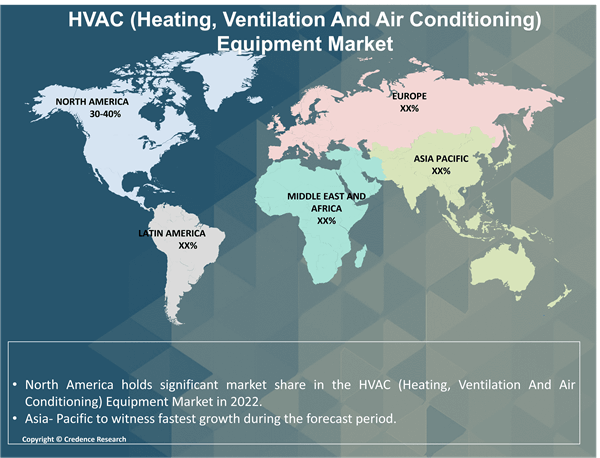
- North America is a major contributor to the growth of the HVAC Equipment Market, holding over one-third share in 2023. The region's increasing construction activities and the importance of efficient heating and cooling systems in diverse applications drive market expansion.
- Asia Pacific and Europe collectively account for nearly 60% share in 2023, with Europe holding over 20% share in the same year. The demand for HVAC equipment in these regions is fueled by urbanization, industrialization, and the need for energy-efficient solutions.
- The rest of the world, including Latin America, the Middle East, and Africa, contributes to the remaining demand for HVAC equipment. The market is influenced by factors such as climate conditions, infrastructure development, and the emphasis on sustainable and eco-friendly HVAC solutions.
The HVAC Equipment Market is propelled by the increasing awareness of indoor air quality, energy efficiency standards, and the continuous development of heating, ventilation, and air conditioning technologies. The diverse range of HVAC products caters to the rising demand in residential, commercial, and industrial sectors.
North America is at the forefront of adopting new technologies and is a hub for technical innovation. The market in North America is being propelled by factors such as rising consumer spending and the increasing adoption of advanced technologies. The need for efficient heating and cooling systems in residential and commercial settings is also contributing to the growth of the HVAC equipment market. Also, the region has a significant presence of prominent companies, such as Raytheon Technologies Corporation, Emerson Electric Co., Honeywell International, Inc., Mitsubishi Electric Trane HVAC U.S. LLC, and Nortek Global HVAC. Many of these companies are also focusing on expanding their global presence, entering new markets, and acquiring smaller companies to strengthen their position. For instance, in August 2023, UK-based industrial technology company Smiths Group plc acquired Heating & Cooling Products (HCP), a US-based HVAC solutions manufacturer. The move enhances Smiths' position in the North American HVAC market and contributes to its continuous growth over eight consecutive quarters.
Asia Pacific is expected to be the fastest-growing region during the forecast period. The abundance of electronic device manufacturers in the region, along with high disposable income and the expanding automotive and consumer electronics sectors, are key factors fuelling the growth of the HVAC equipment market. Governments in the region are also implementing policies and initiatives to promote the adoption of energy-efficient HVAC systems. For example, the Indian government's "Digital India" initiative aims to transform the country into a technology-enabled society, which is expected to boost the demand for HVAC equipment.
The primary driver of the HVAC equipment market's growth rate is the increasing acceptance of energy-efficient systems due to environmental concerns and government regulations. The rising need for air purification systems, particularly in urban areas, is another significant factor contributing to the market's growth.
Key Highlights of the Report
The global HVAC (Heating, Ventilation And Air Conditioning) Equipment Market is segmented by product type, end-user, application, technology, component, fuel type, distribution channel, and regulatory standards. Heating equipment such as furnaces, heat pumps, boilers, and unit heaters, along with ventilation and air conditioning equipment like air handling units, ventilation fans, split systems, packaged systems, chillers, and VRF systems, contribute to the comprehensive market landscape.
HVAC equipment, being crucial for maintaining comfortable indoor environments, has witnessed substantial growth. The market size is projected to reach USD 378.7 billion by 2032, with a Compound Annual Growth Rate (CAGR) of 6.80% from 2023. The residential, commercial, and industrial sectors drive demand, with applications ranging from new construction and renovation to industrial processes.
Leading companies in the HVAC Equipment Market include Daikin Industries, Ltd., Johnson Controls, Hitachi Air Conditioning Company, LG Electronics Inc., Raytheon Technologies Corporation (United Technologies), Emerson Electric Co., Honeywell International, Inc., Mitsubishi Electric Trane HVAC U.S. LLC, Nortek Global HVAC, and Danfoss AS.
The technology spectrum encompasses traditional HVAC systems, smart HVAC systems, energy-efficient HVAC systems, and ductless HVAC systems. Various components like compressors, heat exchangers, control systems, fans and blowers, humidifiers/dehumidifiers, thermostats, sensors, and actuators contribute to the functionality of HVAC systems.
The market is further segmented based on fuel types such as electric, gas, oil, and hybrid. Distribution channels include direct sales, distributors, and online retailers. Compliance with energy efficiency standards and environmental regulations are key regulatory standards shaping the HVAC Equipment Market.
North America leads the market growth, attributed to ongoing developments in HVAC technology and robust infrastructure development. The Asia-Pacific (APAC) region is expected to witness the highest growth rate owing to rising disposable income and increased growth of manufacturing sector in countries such as China and India.
What Are The Main Drivers Of The HVAC (Heating, Ventilation And Air Conditioning) Equipment Market?
The HVAC (Heating, Ventilation And Air Conditioning) Equipment Market is primarily driven by the growing need for efficient heating, ventilation, and air conditioning solutions. The increasing demand for HVAC equipment is propelled by factors such as the rising rising construction activities in residential and industrial sectors. Additionally, the market benefits from the government regulatory policies and incentives for energy saving.
What Are The Major Challenges Faced By The HVAC (Heating, Ventilation And Air Conditioning) Equipment Market?
Despite its growth prospects, the HVAC (Heating, Ventilation And Air Conditioning) Equipment Market encounters challenges such as high maintenance, repair, and installation costs for HVAC systems. Furthermore, adherence to product certification standards poses a potential obstacle to the market's expansion during the projected period.
What Are The Growth Opportunities In The HVAC (Heating, Ventilation And Air Conditioning) Equipment Market?
The HVAC (Heating, Ventilation And Air Conditioning) Equipment Market presents growth opportunities driven by the increasing consumer adoption of innovative technologies. The market is expected to flourish with the widespread use of HVAC equipment in new products, including smart and energy-efficient solutions. Additionally, The expansion of the construction sector and the rise in demand for energy-efficient HVAC equipment present opportunities for market growth.
Market Drivers
Surge in Construction Activities
The surge in construction activities is poised to significantly drive the HVAC (Heating, Ventilation, And Air Conditioning) Equipment Market. According to the U.S. Census Bureau and the U.S. Department of Housing and Urban Development, the total number of new housing permits in the U.S. reached 1,665.1 units in 2022. Simultaneously, in Great Britain, the Office for National Statistics reported a remarkable 15.8% increase in the value of construction new work, reaching a record high of $141,964 million in 2022. This notable growth in construction, both in the residential and industrial sectors, underscores a heightened demand for HVAC equipment. As new residential units are being developed and industrial infrastructure expands, there is an increased need for efficient heating, ventilation, and air conditioning solutions. The HVAC market stands to benefit significantly from the parallel growth in construction activities, positioning itself as an integral component in ensuring optimal indoor environments for these newly constructed spaces.
Market Restraints
High Maintenance, Repair, And Installation Costs
The global HVAC (Heating, Ventilation, and Air Conditioning) equipment market is encountering a significant obstacle due to the substantial costs associated with the installation, maintenance, and repair of HVAC systems. These elevated expenses are posing a challenge for both households and businesses looking to adopt or upgrade their HVAC equipment.
The considerable financial investment required for the installation of HVAC systems is a major deterrent for potential purchasers, particularly in the residential and commercial sectors, where budgetary constraints often play a decisive role in decision-making. Furthermore, the ongoing costs associated with maintenance and repair contribute to the overall cost of ownership, thereby diminishing the appeal of HVAC systems in the market.
Opportunities
Rising Demand For Energy-Efficient HVAC Equipment
The rising demand for energy-efficient HVAC equipment presents a significant opportunity for market players in the HVAC (Heating, Ventilation, and Air Conditioning) equipment market. Government initiatives worldwide underscore a commitment to promoting energy efficiency in heating and cooling systems. For instance, in the United States, the U.S. Department of Energy's Home Improvement Catalyst (HI Cat) Initiative is actively developing tools to support best practices in HVAC installation and quantify the benefits of enhancing current installation methods.
Additionally, government programs, including HVAC rebates, provide financial support to encourage the installation of energy-efficient heating and cooling equipment. Similarly, in the United Kingdom, the government has introduced schemes and measures, such as the Renewable Heat Initiative, aimed at improving indoor air quality and promoting the use of energy-efficient HVAC equipment. These initiatives are expected to drive the adoption of energy-efficient HVAC systems, creating a favorable environment for market players. As the global focus on energy efficiency intensifies, HVAC equipment manufacturers have the opportunity to capitalize on this trend by innovating and offering products that align with energy efficiency standards. By leveraging government programs and incentives, market players can not only contribute to sustainability goals but also position themselves for increased market share and growth in the evolving landscape of energy-efficient HVAC solutions.
Competitive Landscape
Key Players
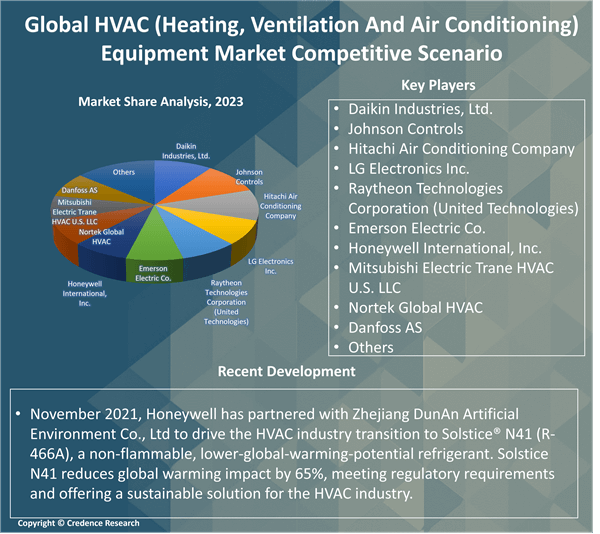
The global HVAC (Heating, Ventilation, and Air Conditioning) equipment market is highly competitive, with several key players. Some of the major players in the market and their market share are as follows:
- Daikin Industries, Ltd.
- Johnson Controls
- Hitachi Air Conditioning Company
- LG Electronics Inc.
- Raytheon Technologies Corporation (United Technologies)
- Emerson Electric Co.
- Honeywell International, Inc.
- Mitsubishi Electric Trane HVAC U.S. LLC
- Nortek Global HVAC
- Danfoss AS.
- Others
These organizations prioritize product innovation, distribution channel expansion, and mergers and acquisitions to stay competitive.
The global HVAC (Heating, Ventilation, and Air Conditioning) equipment market's key players continually seek to stay ahead by offering new products and developments.
- In October 2022, Mitsubishi Electric has introduced a new range of air-source chillers and heat pumps, manufactured in its Italian factory. The lineup includes the MECH-iS-G07 air-cooled chiller and the MEHP-iS-G07 air-source reversible heat pump chiller, both utilizing R32 refrigerant for enhanced efficiency. The products feature variable-speed scroll compressors, operate silently, and are suitable for applications such as comfort heating and IT cooling, offering a hydronic IT cooling package for small and medium enterprise data centers. The models are designed with the Japanese 'Poka-Yoke' system for error-free installation and maintenance.
- In January 2022, Emerson has launched the Copeland™ ZPK7 scroll compressor platform, designed for residential and light commercial HVAC applications. Copeland™ ZPK7 scroll compressor is optimized for R410A refrigerant, it meets 2023 DOE standards, features innovative compression technology, and supports the industry's shift to sustainable solutions.
Summary of Key Findings
- The HVAC Equipment Market is experiencing a surge in demand, driven by the increasing need for optimal indoor climate control in various sectors, including residential, commercial, and industrial settings.
- The global HVAC market is expected to reach USD 378.7 billion by 2032, with a Compound Annual Growth Rate (CAGR) of 6.80% from 2023, showcasing substantial growth potential in the coming years.
- Key companies such as Daikin Industries, Ltd., Johnson Controls, Hitachi Air Conditioning Company, and others play a pivotal role in driving innovation and competition within the HVAC Equipment Market.
- The technology spectrum encompasses traditional HVAC systems, smart HVAC systems, energy-efficient HVAC systems, and ductless HVAC systems, reflecting the industry's commitment to technological advancements.
- The market is responsive to various fuel types, distribution channels, and regulatory standards, indicating a flexible and adaptable industry that caters to diverse consumer needs and complies with global standards.
- North America leads in market growth, fueled by ongoing technological developments and robust infrastructure projects. The Asia-Pacific (APAC) region is poised for the highest growth rate, driven by a booming electronics manufacturing sector and increasing demand for data transferability.
Future Outlook for the HVAC Equipment Market:
- The HVAC Equipment Market holds a positive outlook with significant growth potential, especially in the North American region, where government and business sectors heavily rely on HVAC solutions for climate control.
- Despite the positive outlook, the increasing adoption of wireless solutions poses a challenge to the growth of the HVAC Equipment Market. Consumers' inclination toward wireless interfaces may impact the market, necessitating strategic responses from key players.
- Key firms in the HVAC industry should prioritize product innovation, expanding market reach, and maintaining competitive pricing strategies to stay ahead in this competitive landscape. Continuous adaptation to evolving consumer preferences and technological advancements will be crucial for sustained growth.
- The HVAC (Heating, Ventilation And Air Conditioning) Equipment Market is poised to thrive, driven by a combination of technological advancements, market segmentation, and a proactive approach to emerging challenges and opportunities.
How CXOs Can Benefit from the HVAC (Heating, Ventilation And Air Conditioning) Equipment Market Report
The HVAC (Heating, Ventilation And Air Conditioning) Equipment Market Report provides CXOs with a comprehensive overview of the market, including:
- Market size and growth forecast: The report provides detailed estimates of the global HVAC Equipment market size, segmented by Product Type, End-User, Application, Technology, Component, Fuel Type, Distribution Channel, Regulatory Standards, region. It also includes forecasts for the market through 2032, based on key trends and drivers.
- Market segmentation: The report segments the HVAC Equipment market by Product Type, End-User, Application, Technology, Component, Fuel Type, Distribution Channel, Regulatory Standards, region. This segmentation provides CXOs with a granular understanding of the market and the opportunities in each segment.
- Competitive landscape: The report profiles the key companies in the HVAC Equipment market and provides insights into their strategies, product offerings, and financial performance. This information can help CXOs to identify and assess their competition.
- Key trends and drivers: The report identifies and analyzes the key trends and drivers that are shaping the HVAC Equipment market. This information can help CXOs to make informed decisions about their investments and strategies.
CXOs can use the insights from the HVAC (Heating, Ventilation And Air Conditioning) Equipment Market Report to:
- Identify growth opportunities: The report can help CXOs to identify new growth opportunities in the HVAC Equipment market. For example, the report identifies the growing demand for energy-efficient HVAC systems in the residential and commercial sectors as a key opportunity.
- Make informed investment decisions: The report can help CXOs to make informed investment decisions about HVAC Equipment. For example, the report provides insights into the key factors to consider when evaluating HVAC equipment providers and selecting HVAC solutions.
- Develop competitive strategies: The report can help CXOs to develop competitive strategies for their HVAC equipment businesses. For example, the report identifies the key strategies that HVAC equipment providers are using to differentiate themselves from their competitors.
- Track market developments: The report can help CXOs to track market developments and stay ahead of the curve. For example, the report provides insights into the latest trends and innovations in the HVAC Equipment market.
Overall, the HVAC (Heating, Ventilation And Air Conditioning) Equipment Market Report is a valuable resource for CXOs who are looking to gain a deeper understanding of the market and identify opportunities for growth
Segmentation
- By Product Type
- Heating Equipment
- Furnaces
- Heat Pumps
- Boilers
- Unit Heaters
- Ventilation Equipment
- Air Handling Units (AHUs)
- Ventilation Fans
- Ventilation Control Systems
- Air Conditioning Equipment
- Split Systems
- Packaged Systems
- Chillers
- Rooftop Units
- VRF (Variable Refrigerant Flow) Systems
- By End-User
- Residential
- Commercial
- Office Buildings
- Retail Spaces
- Hotels
- Industrial
- Manufacturing Facilities
- Warehouses
- By Application:
- New Construction
- Renovation and Retrofit
- Industrial Processes
- Others
- By Technology:
- Traditional HVAC Systems
- Smart HVAC Systems
- Energy-Efficient HVAC Systems
- Ductless HVAC Systems
- By Component:
- Compressors
- Heat Exchangers
- Control Systems
- Fans and Blowers
- Humidifiers/Dehumidifiers
- Thermostats
- Sensors and Actuators
- By Fuel Type:
- Electric
- Gas
- Oil
- Hybrid
- By Distribution Channel:
- Direct Sales
- Distributors
- Online Retailers
- By Regulatory Standards:
- Compliance with Energy Efficiency Standards
- Environmental Regulations
- By Region
- North America
- US
- Canada
- Mexico
- Europe
- Germany
- France
- UK
- Italy
- Spain
- Rest of Europe
- Asia Pacific
- China
- Japan
- India
- South Korea
- South-east Asia
- Rest of Asia Pacific
- Latin America
- Brazil
- Argentina
- Rest of Latin America
- Middle East & Africa
- GCC Countries
- South Africa
- Rest of Middle East and Africa
- North America
- Residential
- Heating Equipment
Adjacent Markets
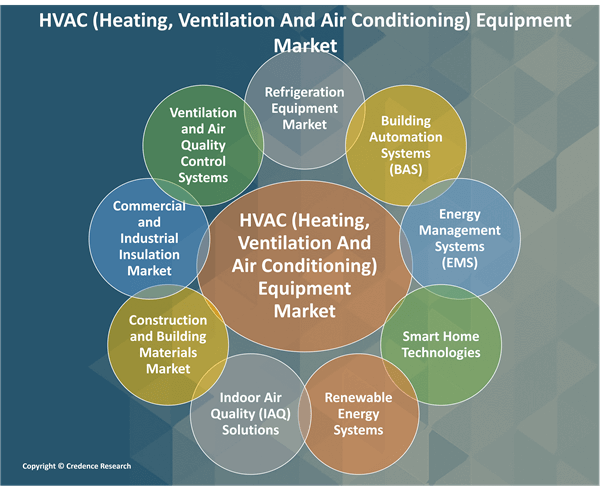
In the HVAC (Heating, Ventilation And Air Conditioning) Equipment Market, there are several adjacent markets which has high revenue growth opportunities. The key adjacent markets for HVAC (Heating, Ventilation And Air Conditioning) Equipment Market -
Request a Free Sample
Fill in your details and we'll send you a free sample report.
- Sample data tables & charts
- Research methodology
Need a Custom Version of This Report?
Tailor the scope, geography, or segments to your exact requirements.
- Custom geography or segment scope
- Direct access to our analyst team
Frequently Asked Questions
What is the current size of the global HVAC Equipment market?
What is the HVAC (Heating, Ventilation And Air Conditioning) Equipment Market CAGR?
Which segment is leading the market share in terms of product type?
Which end-users segment drives the demand for HVAC equipment globally?
Which application segment is expected to witness the highest CAGR during the forecastperiod?
Which region is contributing significantly to the growth of the HVAC Equipmentindustry?
Who are the major players in the global HVAC Equipment market?
What are the major market drivers of the HVAC Equipment industry?
What are the major market opportunities for the HVAC Equipment industry?
Table of Content
Chapter 1. Report Introduction
- 1.1 Report Description & Purpose
- 1.1.1 Report Title & Market Definition
- 1.1.2 Unique Selling Propositions (USP) & Key Differentiators
- 1.1.3 Value Proposition for Stakeholders
- 1.2 Research Objectives
- 1.2.1 Market Sizing Objectives (Volume & Revenue)
- 1.2.2 Segmentation Objectives
- 1.2.3 Competitive Intelligence Objectives
- 1.2.4 Forecast & Scenario Objectives
- 1.3 Report Scope
- 1.3.1 HVAC (Heating, Ventilation And Air Conditioning) Equipment Scope – Types & Subtypes Covered
- 1.3.2 Geographic Scope – Regions & Countries Covered
- 1.3.3 Historical Period, Base Year & Forecast Period (2023; forecast to the forecast period)
- 1.3.4 Inclusions & Exclusions
- 1.4 HS Code & Classification Framework
- 1.5 Currency, Units & Pricing Basis
- 1.6 Target Stakeholders
- 1.7 Limitations & Assumptions
Chapter 2. Executive Summary
- 2.1 Global HVAC (Heating, Ventilation And Air Conditioning) Equipment Market Snapshot
- 2.1.1 Market Size – Historical (2023) & Forecast (the forecast period) (2023: USD 209.5 Billion → forecast year: USD 378.7 Billion)
- 2.1.2 Volume & Revenue – Global Totals
- 2.1.3 Key Market Highlights – Top Five Facts
- 2.2 HVAC (Heating, Ventilation And Air Conditioning) Equipment Market Segmentation Snapshot
- 2.2.1 Market Split by Region – 2023 vs.
- 2.3 Competitive Snapshot
- 2.3.1 Top 10 Players by Revenue Share – 2023
- 2.3.2 Top 10 Players by Volume Share – 2023
- 2.3.3 Recent Strategic Developments (18-Month Summary)
- 2.4 Key Investment Highlights & Strategic Conclusions
Chapter 3. HVAC (Heating, Ventilation And Air Conditioning) Equipment Market Dynamics & Industry Analysis
- 3.1 Market Overview & Context
- 3.1.1 HVAC (Heating, Ventilation And Air Conditioning) Equipment Market Position in the Broader Automotive Value Chain
- 3.1.2 OEM vs. Replacement Market Dynamics
- 3.1.3 Market Maturity & Development Stage by Region
- 3.2 HVAC (Heating, Ventilation And Air Conditioning) Equipment Market Drivers
- 3.3 HVAC (Heating, Ventilation And Air Conditioning) Equipment Market Restraints & Challenges
- 3.4 HVAC (Heating, Ventilation And Air Conditioning) Equipment Market Opportunities
- 3.5 Porter's Five Forces Analysis
- 3.5.1 Threat of New Entrants
- 3.5.2 Bargaining Power of Suppliers
- 3.5.3 Bargaining Power of Buyers
- 3.5.4 Threat of Substitutes
- 3.5.5 Competitive Rivalry – Intensity Assessment
- 3.6 HVAC (Heating, Ventilation And Air Conditioning) Equipment Value Chain Analysis
- 3.6.1 Upstream – Raw Material/Input Suppliers
- 3.6.1.1 Raw Material/Input 1
- 3.6.1.2 Raw Material/Input 2
- 3.6.1.3 Raw Material/Input 3
- 3.6.2 Midstream – Production/Manufacturing/Service Delivery
- 3.6.2.1 Production/Process Overview
- 3.6.2.2 Key Facility Locations & Capacity by Manufacturer
- 3.6.3 Downstream – Distribution & End Consumer
- 3.6.3.1 Primary Channel – B2B/OEM
- 3.6.3.2 Secondary Channels – Dealer, Retail, Online, Direct
- 3.6.4 Value Chain Profitability Analysis
- 3.6.1 Upstream – Raw Material/Input Suppliers
- 3.7 PESTEL Analysis
- 3.7.1 Political Factors
- 3.7.2 Economic Factors
- 3.7.3 Social Factors
- 3.7.4 Technological Factors
- 3.7.5 Environmental Factors
- 3.7.6 Legal Factors
- 3.8 HVAC (Heating, Ventilation And Air Conditioning) Equipment Supply Chain Analysis
- 3.8.1 Raw Material/Input Supply Risk Assessment
- 3.8.2 Manufacturing Concentration Risk (Geographic Exposure)
- 3.8.3 Trade Disruption Impact Analysis
- 3.9 Regulatory & Policy Landscape
Note: The regulatory and policy landscape section covers regulations based on their applicability to the market, HVAC (Heating, Ventilation And Air Conditioning) Equipment category, geography, and scope of the study. Only regulatory frameworks with a material impact on operations, compliance, trade, sustainability, or market access are analyzed in detail.
Chapter 4. Key Investment Pockets & Opportunity Analysis
- 4.1 HVAC (Heating, Ventilation And Air Conditioning) Equipment Market Attractiveness Analysis
- 4.1.1 By Region – Investment Attractiveness Matrix (Volume × CAGR)
- 4.2 Absolute Revenue Growth Opportunity
- 4.2.1 By Region – Absolute USD Growth Through the forecast period
- 4.3 Incremental Volume Opportunity
- 4.3.1 By Region – Incremental Volume Through the forecast period
- 4.3.2 Segment – Incremental Volume
- 4.4 Emerging Submarket Opportunity Deep Dive (Subject to Applicability)
- 4.5 Emerging Market Opportunity Scorecards
- 4.5.1 United States
- 4.5.2 Europe
- 4.5.3 Asia
- 4.5.4 Middle East & Africa
Note: Emerging Market Opportunity Scorecards will be included based on relevance and strategic importance. Regions listed are indicative and may vary depending on data availability and market dynamics.
Chapter 5. HVAC (Heating, Ventilation And Air Conditioning) Equipment Import-Export Analysis & Trade Flows
- 5.1 Global Trade Overview
- 5.1.1 Global Export Value by Country (2023)
- 5.1.2 Global Export Volume by Country (2023)
- 5.1.3 Global Import Value by Country (2023)
- 5.1.4 Global Import Volume by Country (2023)
- 5.1.5 Net Trade Balance by Country (2023)
- 5.2 Export Analysis – Segment
- 5.2.1 Type 1 (HS Code)
- 5.2.2 Type 2 (HS Code)
- 5.2.3 Type 3 (HS Code)
- 5.2.4 Type 4 (HS Code)
- 5.2.5 Type 5 (HS Code)
- 5.3 Import Analysis – Segment
- 5.3.1 Type 1 (HS Code)
- 5.3.2 Type 2 (HS Code)
- 5.3.3 Type 3 (HS Code)
- 5.3.4 Type 4 (HS Code)
- 5.3.5 Type 5 (HS Code)
- 5.4 Average Unit Trade Prices
- 5.4.1 Average Export Price – Segment & Country
- 5.4.2 Average Import Price – Segment & Source Country
- 5.4.3 Price Trends (2023)
- 5.5 Key Trade Route Analysis
- 5.5.1 Trade Route 1
- 5.5.2 Trade Route 2
- 5.5.3 Trade Route 3
- 5.5.4 Trade Route 4
- 5.5.5 Trade Route 5
- 5.6 Trade Policy Impact Assessment
- 5.6.1 US Anti-Dumping & Section 301 Tariffs
- 5.6.2 EU Customs Union Impact
- 5.6.3 Major Free Trade Agreements
- 5.6.4 USMCA Rules of Origin
Note: Trade policy analysis will be included only where relevant to the HVAC (Heating, Ventilation And Air Conditioning) Equipment market.
Chapter 6. Competitive Landscape & Company Benchmarking
- 6.1 HVAC (Heating, Ventilation And Air Conditioning) Equipment Market Concentration & Structure
- 6.1.1 Herfindahl-Hirschman Index (HHI) – vs. 2023
- 6.1.2 Tier 1, Tier 2 & Tier 3 Market Structure
- 6.1.3 Global, Regional & Local Player Dynamics
- 6.2 HVAC (Heating, Ventilation And Air Conditioning) Equipment Market Share Analysis – 2023
- 6.2.1 Global Revenue Share by Company
- 6.2.2 Global Volume Share by Company
- 6.2.3 Regional Revenue Share
- 6.2.4 Market Share Evolution ( vs. 2023)
- 6.2.5 OEM Segment Share by Company
- 6.2.6 Replacement Segment Share by Company
- 6.3 Production/Delivery Capacity & Facility Analysis
- 6.3.1 Global Installed Capacity
- 6.3.2 Capacity Utilization Rates
- 6.3.3 Production/Output Volume
- 6.3.4 Facility Locations & Capacity Map
- 6.3.5 Planned Capacity Additions
- 6.4 HVAC (Heating, Ventilation And Air Conditioning) Equipment Competitive Benchmarking Matrix
- 6.4.1 Revenue, Volume, CAGR & Profitability Comparison
- 6.4.2 Channel Revenue Mix
- 6.4.3 Geographic Revenue Exposure
- 6.4.4 R&D Intensity
- 6.4.5 Sustainability Maturity
- 6.5 Strategic Developments in HVAC (Heating, Ventilation And Air Conditioning) Equipment (Last 24 Months)
- 6.5.1 Mergers, Acquisitions & Divestments
- 6.5.2 New HVAC (Heating, Ventilation And Air Conditioning) Equipment Launches
- 6.5.3 Facility Expansions
- 6.5.4 Strategic Alliances, Joint Ventures & Partnerships
- 6.5.5 Distribution Expansion & Market Entry
- 6.5.6 Sustainability & ESG Initiatives
- 6.6 Competitive Strategy Mapping
- 6.6.1 Leader, Challenger, Follower & Niche Classification
- 6.6.2 Pricing Strategy Comparison
- 6.6.3 Channel Strategy Matrix
Note: Strategic developments are included based on their materiality and the availability of reliable information.
Chapter 7. Global HVAC (Heating, Ventilation And Air Conditioning) Equipment Market – By Distribution Channel
- 7.1 Segment Overview
- 7.1.1 Volume & Revenue Split by Channel (2023 & )
- 7.1.2 Channel Mix Evolution (the forecast period)
Chapter 8. Regional Market Analysis – Global Overview
- 8.1 Global Regional Overview
- 8.1.1 Regional Volume Share
- 8.1.2 Regional Revenue Share
- 8.1.3 Regional Volume by Region
- 8.1.4 Regional Revenue by Region
- 8.1.5 Regional Forecast Through the forecast period
- 8.2 Cross-Regional Segment Analysis
- 8.2.1 By Distribution Channel
- 8.2.2 By Brand/Price Tier
Chapter 9. North America HVAC (Heating, Ventilation And Air Conditioning) Equipment Market
- 9.1 United States
- 9.2 Canada
- 9.3 Mexico
Chapter 10. Europe HVAC (Heating, Ventilation And Air Conditioning) Equipment Market
- 10.1 Germany
- 10.2 France
- 10.3 Italy
- 10.4 United Kingdom
- 10.5 Spain
- 10.6 Poland
- 10.7 Russia
- 10.8 Netherlands
- 10.9 Belgium
- 10.10 Sweden
- 10.11 Denmark
- 10.12 Norway
- 10.13 Rest of Europe
Chapter 11. Asia Pacific HVAC (Heating, Ventilation And Air Conditioning) Equipment Market
- 11.1 China
- 11.2 India
- 11.3 Japan
- 11.4 South Korea
- 11.5 Thailand
- 11.6 Indonesia
- 11.7 Vietnam
- 11.8 Malaysia
- 11.9 Australia
- 11.10 Rest of Asia Pacific
Chapter 12. Latin America HVAC (Heating, Ventilation And Air Conditioning) Equipment Market
- 12.1 Brazil
- 12.2 Argentina
- 12.3 Colombia
- 12.4 Chile
- 12.5 Rest of Latin America
Chapter 13. Middle East HVAC (Heating, Ventilation And Air Conditioning) Equipment Market
- 13.1 Saudi Arabia
- 13.2 United Arab Emirates
- 13.3 Turkey
- 13.4 Israel
- 13.5 Iran
- 13.6 Rest of the Middle East
Chapter 14. Africa HVAC (Heating, Ventilation And Air Conditioning) Equipment Market
- 14.1 South Africa
- 14.2 Egypt
- 14.3 Nigeria
- 14.4 Morocco
- 14.5 Rest of Africa
Chapter 15. HVAC (Heating, Ventilation And Air Conditioning) Equipment Company Profiles
- 15.1 [Company 01]
- 15.1.1 Company Overview
- 15.1.2 Key Management Personnel
- 15.1.3 Products & Services Portfolio
- 15.1.4 Financial Performance
- 15.1.5 Key Market Focus & Geographic Presence
- 15.1.6 Recent Developments & Strategic Initiatives
Note: The company profile list is preliminary and may change based on research findings, market developments, data availability, and client requirements.
Chapter 16. Appendices
- Appendix A – List of Abbreviations & Acronyms
- Appendix B – Industry Classification Code Reference – Full Series
- Appendix C – Production & Capacity Data Tables
- Appendix D – End-Use & Demand Base Tables
- Appendix E – Consumption & Replacement Rate Assumptions
- Appendix F – ASP Reference Tables
- Appendix G – Manufacturing & Facility Database
- Appendix H – Import-Export Data Tables
- Appendix I – Regulatory Summary Tables
- Appendix J – Primary Research Participant List (Anonymized)
- Appendix K – Primary Research Questionnaire Framework
- Appendix L – Data Sources & Bibliography
- Appendix M – Market Size Divergence & Source Comparison
Chapter 17. Research Methodology
- 17.1 Research Framework & Philosophy
- 17.2 Secondary Research – Sources, Hierarchy & Data Extraction
- 17.3 Data Modeling – Bottom-Up & Top-Down Market Sizing
- 17.4 Primary Research – Stakeholder Framework, LOI & Sample Sizes
- 17.5 Forecast Methodology – Regression, Scenario & Sensitivity Analysis
- 17.6 Quality Control – Four-Layer Validation Framework
- 17.7 Limitations & Standard Assumptions
- 17.8 Disclaimer
