
Hydraulic Tools And Equipment Market Overview:
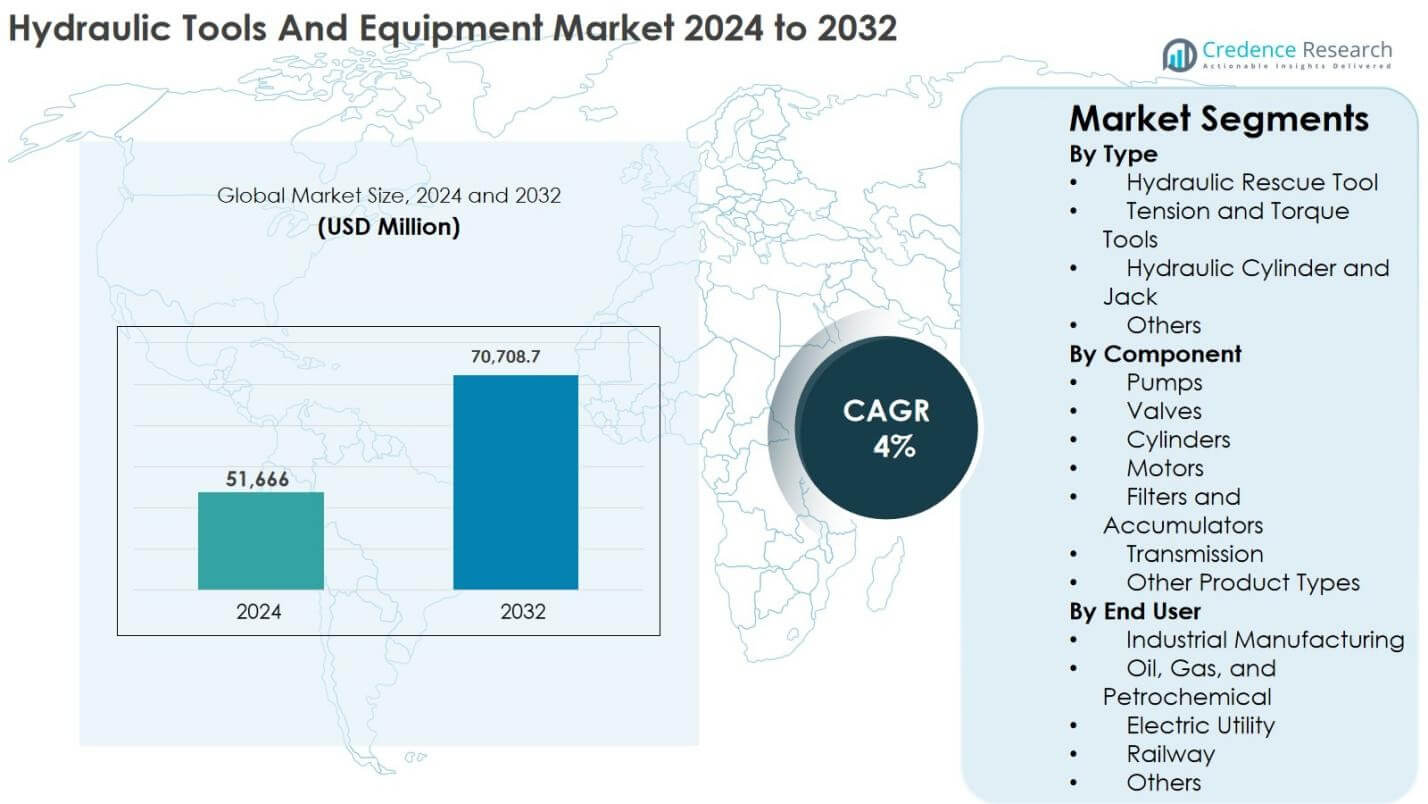
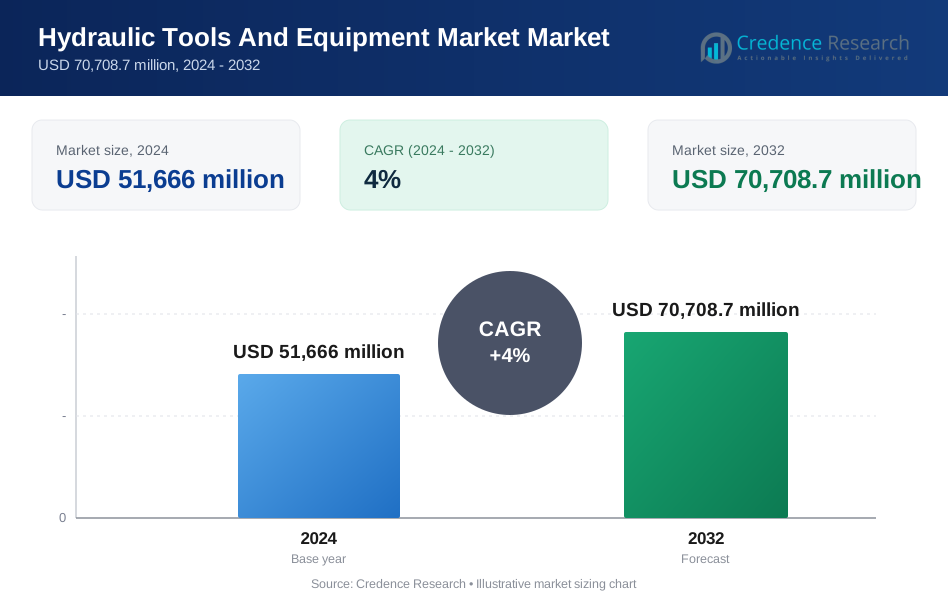
Hydraulic Tools And Equipment market size was valued at USD 51,666 million in 2024 and is anticipated to reach USD 70,708.7 million by 2032, at a CAGR of 4% during the forecast period.
| REPORT ATTRIBUTE | DETAILS |
|---|---|
| Historical Period | 2020-2024 |
| Base Year | 2025 |
| Forecast Period | 2026-2032 |
| Hydraulic Tools And Equipment Market Size 2024 | USD 51,666 million |
| Hydraulic Tools And Equipment Market, CAGR | 4% |
| Hydraulic Tools And Equipment Market Size 2032 | USD 70,708.7 million |
Hydraulic Tools And Equipment Market Insights
- Market growth is driven by rising industrial manufacturing, infrastructure development, and strong demand from oil, gas, utilities, and railway sectors, with Industrial Manufacturing emerging as the dominant end-user segment holding 41.8% share due to extensive use in lifting, assembly, and maintenance operations.
- Key trends include increasing adoption of high-capacity hydraulic cylinders and jacks, which represent the leading type segment with 38.6% share, along with growing integration of efficient pumps, valves, and digitally monitored hydraulic systems to improve safety and productivity.
- The competitive environment is led by global players such as Parker Hannifin Corporation, Bosch Rexroth AG, Eaton Corporation, Danfoss A/S, Atlas Copco AB, and Enerpac, focusing on product innovation, reliability, and aftermarket service expansion.
- Regionally, Asia Pacific dominates with 34.6% market share, followed by North America at 31.4% and Europe at 26.8%, while Latin America and the Middle East & Africa together account for 7.2%, supported by energy, mining, and infrastructure projects.
Hydraulic Tools And Equipment Market Segmentation Analysis:
By Type
The By Type segment in the Hydraulic Tools and Equipment market is led by Hydraulic Cylinder and Jack, which accounted for 38.6% market share in 2024, driven by extensive use in construction, industrial maintenance, lifting, and load-handling operations. These tools offer high load capacity, operational reliability, and precise control, making them indispensable across heavy-duty applications. Tension and Torque Tools follow, supported by growing adoption in bolting and fastening applications within oil and gas and power sectors. Hydraulic Rescue Tools gain traction from emergency response and disaster management needs, while other tools cater to niche industrial requirements.
- For instance, Enerpac’s RCH-series hollow hydraulic cylinders are used in bridge bearing replacement and heavy structural lifting due to their high tonnage ratings and compact form factor.
By Component
Within the By Component segment, Cylinders dominated the Hydraulic Tools and Equipment market with a 34.2% share in 2024, owing to their critical role in force generation, lifting, pressing, and linear motion applications. Rising investments in industrial automation and infrastructure development continue to support demand. Pumps represent the second-largest component, supported by continuous replacement cycles and efficiency upgrades. Valves and Motors benefit from increased system customization and precision control requirements, while Filters, Accumulators, and Transmission components witness steady growth due to rising emphasis on system efficiency, safety, and extended equipment lifespan.
- For instance, Bosch Rexroth’s tie-rod and welded hydraulic cylinders are widely deployed in presses and machine tools to deliver precise linear motion under high loads.
By End User
The By End User segment is primarily driven by Industrial Manufacturing, which held a 41.8% market share in 2024, supported by widespread use of hydraulic tools in metal fabrication, automotive assembly, heavy machinery production, and plant maintenance. Demand is reinforced by productivity gains, operational safety, and high force requirements. Oil, Gas, and Petrochemical industries follow, driven by maintenance, bolting, and pressure-handling needs in upstream and downstream operations. Electric Utilities and Railways contribute through infrastructure expansion and maintenance activities, while other end users support incremental market growth across specialized applications.
Key Growth Drivers
Expansion of Industrial Manufacturing and Infrastructure Development
The Hydraulic Tools and Equipment market is significantly driven by the expansion of industrial manufacturing and large-scale infrastructure development. Increasing investments in construction, mining, automotive production, and heavy engineering are accelerating demand for hydraulic cylinders, jacks, pumps, and torque tools capable of delivering high force with precision. Governments are prioritizing transportation networks, industrial corridors, and urban infrastructure, directly supporting sustained equipment usage. In manufacturing facilities, hydraulic tools improve productivity in material handling, metal forming, assembly, and maintenance operations. Their ability to operate reliably under heavy loads and harsh conditions makes hydraulic systems essential across infrastructure-intensive industries, reinforcing long-term market growth.
- For instance, Enerpac high-tonnage hydraulic cylinders and jacks are used in bridge lifting, structural moving, and heavy load positioning during major infrastructure works
Growth in Oil, Gas, and Energy Sector Investments
Rising investments across oil, gas, and energy sectors continue to drive demand for hydraulic tools and equipment. Exploration, drilling, refining, and pipeline maintenance activities rely heavily on hydraulic tensioning, bolting, lifting, and pressure-control systems. Expansion of offshore drilling, LNG terminals, and refinery modernization projects further strengthens demand for high-performance hydraulic pumps, valves, and cylinders. Additionally, power generation and grid infrastructure upgrades increase the use of hydraulic equipment for installation and maintenance. The sector’s stringent safety standards and need for precise force application favor hydraulic solutions, positioning energy-related applications as a stable growth driver.
- For instance, Hydratight’s hydraulic tensioners and torque tools are widely used on flanges and pressure vessels in offshore platforms and refineries to achieve controlled, repeatable bolt loads
Increasing Focus on Workplace Safety and Operational Efficiency
Growing emphasis on workplace safety and operational efficiency is another major driver of the Hydraulic Tools and Equipment market. Hydraulic tools reduce manual handling, enhance operator control, and minimize workplace injuries compared to mechanical alternatives. Industries such as railways, utilities, manufacturing, and petrochemicals increasingly adopt hydraulic systems to meet regulatory safety requirements and productivity targets. Advanced hydraulic tools deliver consistent performance, overload protection, and reduced downtime, improving operational reliability. As organizations prioritize safer, ergonomically designed, and high-efficiency equipment, demand for modern hydraulic tools continues to rise across multiple end-use sectors.
Key Trends & Opportunities
Integration of Smart and Digitally Enabled Hydraulic Systems
The integration of smart technologies is emerging as a key trend in the Hydraulic Tools and Equipment market. Manufacturers are embedding sensors, monitoring systems, and data analytics into hydraulic components to enable real-time performance tracking and predictive maintenance. These capabilities improve efficiency, reduce unplanned downtime, and extend equipment lifespan. Smart hydraulic systems align with Industry 4.0 initiatives, particularly in manufacturing and energy sectors, creating opportunities for advanced, value-added solutions. As end users increasingly seek connected and data-driven equipment, digitally enabled hydraulic tools are expected to gain wider adoption.
- For instance, Bosch Rexroth’s CytroBox and Hägglunds systems use integrated sensors and connectivity to monitor pressure, temperature, and operating cycles, enabling condition-based service.
Rising Demand from Renewable Energy and Rail Infrastructure Projects
Renewable energy development and rail infrastructure expansion present strong growth opportunities for the Hydraulic Tools and Equipment market. Wind energy installations, hydroelectric projects, and grid expansion require hydraulic jacks, cylinders, and lifting systems for assembly and maintenance. Similarly, railway construction and modernization rely on hydraulic tools for track laying, rolling stock servicing, and infrastructure repair. Increasing investments in sustainable transportation and clean energy are creating long-term project pipelines, enabling hydraulic equipment manufacturers to diversify revenue sources and reduce dependence on traditional industrial sectors.
- For instance, Stanley Infrastructure’s hydraulic rail tools are deployed for tasks such as clipping, cutting, and drilling during track construction and repair.
Key Challenges
High Initial Investment and Maintenance Complexity
High initial costs and maintenance complexity remain key challenges for the Hydraulic Tools and Equipment market. Advanced hydraulic systems involve significant capital expenditure, which can restrict adoption among small and medium-sized enterprises. Regular maintenance is essential to prevent leaks, contamination, and performance degradation, increasing operating costs. Improper servicing can lead to downtime and reduced efficiency, impacting overall productivity. These cost-related challenges may limit penetration in price-sensitive markets and developing regions, requiring manufacturers to focus on cost optimization and reliability improvements.
Growing Competition from Electric and Pneumatic Alternatives
Increasing competition from electric and pneumatic tools presents another challenge for the Hydraulic Tools and Equipment market. Technological advancements in electric motors, batteries, and control systems have improved the performance and efficiency of non-hydraulic alternatives. Electric tools offer cleaner operation, lower maintenance requirements, and easier automation integration, making them attractive for light- and medium-duty applications. This shift pressures hydraulic equipment manufacturers to innovate, improve efficiency, and highlight application-specific advantages where high force and durability remain critical.
Regional Analysis
North America
North America accounted for 31.4% of the Hydraulic Tools and Equipment market in 2024, driven by strong demand from industrial manufacturing, oil and gas, utilities, and infrastructure maintenance sectors. The United States leads regional growth due to extensive use of hydraulic tools in automotive production, energy infrastructure, and railway maintenance. High adoption of advanced and safety-compliant hydraulic systems supports replacement demand across mature industries. Additionally, investments in grid modernization, refinery upgrades, and large-scale construction projects continue to sustain market growth, while a strong presence of established manufacturers enhances technology adoption and aftermarket services.
Europe
Europe captured 26.8% market share in 2024, supported by robust industrial activity, infrastructure modernization, and stringent workplace safety regulations. Countries such as Germany, the United Kingdom, and France drive demand through advanced manufacturing, automotive assembly, and renewable energy projects. The region shows strong adoption of precision hydraulic tools for railways, utilities, and wind energy installations. Emphasis on energy efficiency and sustainable industrial operations encourages upgrades to modern hydraulic systems. Additionally, replacement demand and technological advancements in smart hydraulic components contribute to steady market expansion across Western and Northern Europe.
Asia Pacific
Asia Pacific held the largest share at 34.6% of the Hydraulic Tools and Equipment market in 2024, driven by rapid industrialization, infrastructure expansion, and manufacturing growth across China, India, Japan, and Southeast Asia. Large-scale investments in construction, railways, power generation, and oil and gas projects significantly boost demand for hydraulic cylinders, jacks, and pumps. The region benefits from rising automation adoption and increasing focus on workplace safety in industrial facilities. Cost-effective manufacturing, expanding industrial bases, and government-led infrastructure initiatives position Asia Pacific as the fastest-growing regional market.
Latin America
Latin America accounted for 4.2% market share in 2024, supported by gradual recovery in industrial activity and renewed investments in oil and gas, mining, and infrastructure projects. Countries such as Brazil and Mexico drive regional demand through refinery upgrades, pipeline maintenance, and transportation infrastructure development. Hydraulic tools are widely used in mining operations and heavy equipment maintenance, supporting steady adoption. While market growth is moderate due to economic volatility, increasing foreign investments and modernization of industrial facilities continue to create opportunities for hydraulic tools and equipment suppliers.
Middle East & Africa
The Middle East & Africa region represented 3.0% of the Hydraulic Tools and Equipment market in 2024, driven primarily by oil and gas operations, power generation, and infrastructure development. Gulf countries lead demand due to extensive use of hydraulic tools in drilling, pipeline installation, and refinery maintenance. Ongoing investments in utilities, railways, and large construction projects further support equipment demand. In Africa, growth is supported by mining and infrastructure development. Although adoption remains lower than other regions, energy sector investments sustain consistent market demand.
Hydraulic Tools And Equipment Market Segmentations:
By Type
- Hydraulic Rescue Tool
- Tension and Torque Tools
- Hydraulic Cylinder and Jack
- Others
By Component
- Pumps
- Valves
- Cylinders
- Motors
- Filters and Accumulators
- Transmission
- Other Product Types
By End User
- Industrial Manufacturing
- Oil, Gas, and Petrochemical
- Electric Utility
- Railway
- Others
By Geography
- North America
- U.S.
- Canada
- Mexico
- Europe
- Germany
- France
- U.K.
- Italy
- Spain
- Rest of Europe
- Asia Pacific
- China
- Japan
- India
- South Korea
- South-east Asia
- Rest of Asia Pacific
- Latin America
- Brazil
- Argentina
- Rest of Latin America
- Middle East & Africa
- GCC Countries
- South Africa
- Rest of the Middle East and Africa
Competitive Landscape
The competitive landscape of the Hydraulic Tools and Equipment market is moderately consolidated, characterized by the presence of global manufacturers and specialized regional players competing on product performance, reliability, and technological innovation. Key players such as Parker Hannifin Corporation, Bosch Rexroth AG, Eaton Corporation, Danfoss A/S, Emerson Electric Co., Atlas Copco AB, Stanley Black & Decker, Inc., Enerpac (Actuant Corporation), KYB Corporation, and SMC Corporation focus on expanding their hydraulic portfolios through advanced cylinders, pumps, valves, and torque solutions. These companies emphasize durability, safety compliance, and efficiency to serve industrial manufacturing, oil and gas, utilities, and infrastructure sectors. Strategic initiatives including product launches, system upgrades, and aftermarket service expansion strengthen customer retention. Additionally, manufacturers are investing in smart hydraulic technologies and energy-efficient systems to differentiate offerings, while regional players compete through cost-effective solutions and localized distribution networks.
Key Player Analysis
- Enerpac (Actuant Corporation)
- Bosch Rexroth AG
- Husqvarna AB
- Eaton Corporation
- Jiangsu Hengli Hydraulic Co., Ltd.
- Atlas Copco AB
- Stanley Black & Decker, Inc.
- Danfoss A/S
- KYB Corporation
- Emerson Electric Co.
Recent Developments
- In November 2025, Bosch Rexroth and HydraForce launched the i-CHoose compact hydraulics configuration tool, an all-in-one design platform to streamline hydraulic system configuration and design workflows
- In September 2025, Brennan acquired Aussie Adaptors & Hydraulics P/L, expanding its capabilities and distribution network for specialized hydraulic solutions in Australia.
- In July 2024, PMC Hydraulics Group acquired the remaining shares in Hydroquip Hydraulics in Bangalore, India, strengthening its presence in hydraulic systems and component distribution in the Indian market.
Report Coverage
The research report offers an in-depth analysis based on Type, Component, End-User and Geography. It details leading market players, providing an overview of their business, product offerings, investments, revenue streams, and key applications. Additionally, the report includes insights into the competitive environment, SWOT analysis, current market trends, as well as the primary drivers and constraints. Furthermore, it discusses various factors that have driven market expansion in recent years. The report also explores market dynamics, regulatory scenarios, and technological advancements that are shaping the industry. It assesses the impact of external factors and global economic changes on market growth. Lastly, it provides strategic recommendations for new entrants and established companies to navigate the complexities of the market.
Future Outlook
- Demand for hydraulic tools and equipment will continue to rise with sustained industrial manufacturing and infrastructure expansion worldwide.
- Increasing automation across manufacturing and maintenance operations will support wider adoption of advanced hydraulic systems.
- Oil, gas, and energy sector investments will remain a stable source of demand for high-pressure and torque-intensive hydraulic tools.
- Growth in renewable energy and rail infrastructure projects will create new application opportunities for hydraulic equipment.
- Manufacturers will focus on improving efficiency, durability, and safety features to meet evolving regulatory standards.
- Integration of smart monitoring and predictive maintenance capabilities will gain stronger acceptance among end users.
- Replacement demand in mature markets will support steady revenue generation over the forecast period.
- Emerging economies will witness faster adoption due to rapid industrialization and large-scale infrastructure development.
- Competition will intensify as players expand product portfolios and strengthen aftermarket service offerings.
- Technological innovation and application-specific customization will remain critical for long-term market differentiation.
Request a Free Sample
Fill in your details and we'll send you a free sample report.
- Sample data tables & charts
- Research methodology
Need a Custom Version of This Report?
Tailor the scope, geography, or segments to your exact requirements.
- Custom geography or segment scope
- Direct access to our analyst team
Frequently Asked Questions
What is the current market size for Hydraulic Tools And Equipment market, and what is its projected size in 2032?
At what Compound Annual Growth Rate is the Hydraulic Tools And Equipment market projected to grow between 2024 and 2032?
Which Hydraulic Tools And Equipment market segment held the largest share in 2024?
What are the primary factors fueling the growth of the Hydraulic Tools And Equipment market?
Who are the leading companies in the Hydraulic Tools And Equipment market?
Which region commanded the largest share of the Hydraulic Tools And Equipment market in 2024?
Table of Content
Chapter 1. Report Introduction
- 1.1 Report Description & Purpose
- 1.1.1 Report Title & Market Definition
- 1.1.2 Unique Selling Propositions (USP) & Key Differentiators
- 1.1.3 Value Proposition for Stakeholders
- 1.2 Research Objectives
- 1.2.1 Market Sizing Objectives (Volume & Revenue)
- 1.2.2 Segmentation Objectives
- 1.2.3 Competitive Intelligence Objectives
- 1.2.4 Forecast & Scenario Objectives
- 1.3 Report Scope
- 1.3.1 Hydraulic Tools And Equipment Market Scope – Types & Subtypes Covered
- 1.3.2 Geographic Scope – Regions & Countries Covered
- 1.3.3 Historical Period, Base Year & Forecast Period (2024; forecast to 2032)
- 1.3.4 Inclusions & Exclusions
- 1.4 HS Code & Classification Framework
- 1.5 Currency, Units & Pricing Basis
- 1.6 Target Stakeholders
- 1.7 Limitations & Assumptions
Chapter 2. Executive Summary
- 2.1 Global Hydraulic Tools And Equipment Market Market Snapshot
- 2.1.1 Market Size – Historical (2024) & Forecast (2024-2032) (2024: USD 51,666 million → 2032: USD 70,708.7 million)
- 2.1.2 Volume & Revenue – Global Totals
- 2.1.3 Key Market Highlights – Top Five Facts
- 2.2 Hydraulic Tools And Equipment Market Market Segmentation Snapshot
- 2.2.1 Market Split by Region – 2024 vs. 2032
- 2.3 Competitive Snapshot
- 2.3.1 Top 10 Players by Revenue Share – 2024
- 2.3.2 Top 10 Players by Volume Share – 2024
- 2.3.3 Recent Strategic Developments (18-Month Summary)
- 2.4 Key Investment Highlights & Strategic Conclusions
Chapter 3. Hydraulic Tools And Equipment Market Market Dynamics & Industry Analysis
- 3.1 Market Overview & Context
- 3.1.1 Hydraulic Tools And Equipment Market Market Position in the Broader Automotive Value Chain
- 3.1.2 OEM vs. Replacement Market Dynamics
- 3.1.3 Market Maturity & Development Stage by Region
- 3.2 Hydraulic Tools And Equipment Market Market Drivers
- 3.3 Hydraulic Tools And Equipment Market Market Restraints & Challenges
- 3.4 Hydraulic Tools And Equipment Market Market Opportunities
- 3.5 Porter's Five Forces Analysis
- 3.5.1 Threat of New Entrants
- 3.5.2 Bargaining Power of Suppliers
- 3.5.3 Bargaining Power of Buyers
- 3.5.4 Threat of Substitutes
- 3.5.5 Competitive Rivalry – Intensity Assessment
- 3.6 Hydraulic Tools And Equipment Market Value Chain Analysis
- 3.6.1 Upstream – Raw Material/Input Suppliers
- 3.6.1.1 Raw Material/Input 1
- 3.6.1.2 Raw Material/Input 2
- 3.6.1.3 Raw Material/Input 3
- 3.6.2 Midstream – Production/Manufacturing/Service Delivery
- 3.6.2.1 Production/Process Overview
- 3.6.2.2 Key Facility Locations & Capacity by Manufacturer
- 3.6.3 Downstream – Distribution & End Consumer
- 3.6.3.1 Primary Channel – B2B/OEM
- 3.6.3.2 Secondary Channels – Dealer, Retail, Online, Direct
- 3.6.4 Value Chain Profitability Analysis
- 3.6.1 Upstream – Raw Material/Input Suppliers
- 3.7 PESTEL Analysis
- 3.7.1 Political Factors
- 3.7.2 Economic Factors
- 3.7.3 Social Factors
- 3.7.4 Technological Factors
- 3.7.5 Environmental Factors
- 3.7.6 Legal Factors
- 3.8 Hydraulic Tools And Equipment Market Supply Chain Analysis
- 3.8.1 Raw Material/Input Supply Risk Assessment
- 3.8.2 Manufacturing Concentration Risk (Geographic Exposure)
- 3.8.3 Trade Disruption Impact Analysis
- 3.9 Regulatory & Policy Landscape
Note: The regulatory and policy landscape section covers regulations based on their applicability to the market, Hydraulic Tools And Equipment Market category, geography, and scope of the study. Only regulatory frameworks with a material impact on operations, compliance, trade, sustainability, or market access are analyzed in detail.
Chapter 4. Key Investment Pockets & Opportunity Analysis
- 4.1 Hydraulic Tools And Equipment Market Market Attractiveness Analysis
- 4.1.1 By Region – Investment Attractiveness Matrix (Volume × CAGR)
- 4.2 Absolute Revenue Growth Opportunity
- 4.2.1 By Region – Absolute USD Growth Through 2032
- 4.3 Incremental Volume Opportunity
- 4.3.1 By Region – Incremental Volume Through 2032
- 4.3.2 Segment – Incremental Volume
- 4.4 Emerging Submarket Opportunity Deep Dive (Subject to Applicability)
- 4.5 Emerging Market Opportunity Scorecards
- 4.5.1 United States
- 4.5.2 Europe
- 4.5.3 Asia
- 4.5.4 Middle East & Africa
Note: Emerging Market Opportunity Scorecards will be included based on relevance and strategic importance. Regions listed are indicative and may vary depending on data availability and market dynamics.
Chapter 5. Hydraulic Tools And Equipment Market Import-Export Analysis & Trade Flows
- 5.1 Global Trade Overview
- 5.1.1 Global Export Value by Country (2024)
- 5.1.2 Global Export Volume by Country (2024)
- 5.1.3 Global Import Value by Country (2024)
- 5.1.4 Global Import Volume by Country (2024)
- 5.1.5 Net Trade Balance by Country (2024)
- 5.2 Export Analysis – Segment
- 5.2.1 Type 1 (HS Code)
- 5.2.2 Type 2 (HS Code)
- 5.2.3 Type 3 (HS Code)
- 5.2.4 Type 4 (HS Code)
- 5.2.5 Type 5 (HS Code)
- 5.3 Import Analysis – Segment
- 5.3.1 Type 1 (HS Code)
- 5.3.2 Type 2 (HS Code)
- 5.3.3 Type 3 (HS Code)
- 5.3.4 Type 4 (HS Code)
- 5.3.5 Type 5 (HS Code)
- 5.4 Average Unit Trade Prices
- 5.4.1 Average Export Price – Segment & Country
- 5.4.2 Average Import Price – Segment & Source Country
- 5.4.3 Price Trends (2024)
- 5.5 Key Trade Route Analysis
- 5.5.1 Trade Route 1
- 5.5.2 Trade Route 2
- 5.5.3 Trade Route 3
- 5.5.4 Trade Route 4
- 5.5.5 Trade Route 5
- 5.6 Trade Policy Impact Assessment
- 5.6.1 US Anti-Dumping & Section 301 Tariffs
- 5.6.2 EU Customs Union Impact
- 5.6.3 Major Free Trade Agreements
- 5.6.4 USMCA Rules of Origin
Note: Trade policy analysis will be included only where relevant to the Hydraulic Tools And Equipment Market market.
Chapter 6. Competitive Landscape & Company Benchmarking
- 6.1 Hydraulic Tools And Equipment Market Market Concentration & Structure
- 6.1.1 Herfindahl-Hirschman Index (HHI) – vs. 2024
- 6.1.2 Tier 1, Tier 2 & Tier 3 Market Structure
- 6.1.3 Global, Regional & Local Player Dynamics
- 6.2 Hydraulic Tools And Equipment Market Market Share Analysis – 2024
- 6.2.1 Global Revenue Share by Company
- 6.2.2 Global Volume Share by Company
- 6.2.3 Regional Revenue Share
- 6.2.4 Market Share Evolution ( vs. 2024)
- 6.2.5 OEM Segment Share by Company
- 6.2.6 Replacement Segment Share by Company
- 6.3 Production/Delivery Capacity & Facility Analysis
- 6.3.1 Global Installed Capacity
- 6.3.2 Capacity Utilization Rates
- 6.3.3 Production/Output Volume
- 6.3.4 Facility Locations & Capacity Map
- 6.3.5 Planned Capacity Additions
- 6.4 Hydraulic Tools And Equipment Market Competitive Benchmarking Matrix
- 6.4.1 Revenue, Volume, CAGR & Profitability Comparison
- 6.4.2 Channel Revenue Mix
- 6.4.3 Geographic Revenue Exposure
- 6.4.4 R&D Intensity
- 6.4.5 Sustainability Maturity
- 6.5 Strategic Developments in Hydraulic Tools And Equipment Market (Last 24 Months)
- 6.5.1 Mergers, Acquisitions & Divestments
- 6.5.2 New Hydraulic Tools And Equipment Market Launches
- 6.5.3 Facility Expansions
- 6.5.4 Strategic Alliances, Joint Ventures & Partnerships
- 6.5.5 Distribution Expansion & Market Entry
- 6.5.6 Sustainability & ESG Initiatives
- 6.6 Competitive Strategy Mapping
- 6.6.1 Leader, Challenger, Follower & Niche Classification
- 6.6.2 Pricing Strategy Comparison
- 6.6.3 Channel Strategy Matrix
Note: Strategic developments are included based on their materiality and the availability of reliable information.
Chapter 7. Global Hydraulic Tools And Equipment Market Market – By Distribution Channel
- 7.1 Segment Overview
- 7.1.1 Volume & Revenue Split by Channel (2024 & 2032)
- 7.1.2 Channel Mix Evolution (2024-2032)
Chapter 8. Regional Market Analysis – Global Overview
- 8.1 Global Regional Overview
- 8.1.1 Regional Volume Share
- 8.1.2 Regional Revenue Share
- 8.1.3 Regional Volume by Region
- 8.1.4 Regional Revenue by Region
- 8.1.5 Regional Forecast Through 2032
- 8.2 Cross-Regional Segment Analysis
- 8.2.1 By Distribution Channel
- 8.2.2 By Brand/Price Tier
Chapter 9. North America Hydraulic Tools And Equipment Market Market
- 9.1 United States
- 9.2 Canada
- 9.3 Mexico
Chapter 10. Europe Hydraulic Tools And Equipment Market Market
- 10.1 Germany
- 10.2 France
- 10.3 Italy
- 10.4 United Kingdom
- 10.5 Spain
- 10.6 Poland
- 10.7 Russia
- 10.8 Netherlands
- 10.9 Belgium
- 10.10 Sweden
- 10.11 Denmark
- 10.12 Norway
- 10.13 Rest of Europe
Chapter 11. Asia Pacific Hydraulic Tools And Equipment Market Market
- 11.1 China
- 11.2 India
- 11.3 Japan
- 11.4 South Korea
- 11.5 Thailand
- 11.6 Indonesia
- 11.7 Vietnam
- 11.8 Malaysia
- 11.9 Australia
- 11.10 Rest of Asia Pacific
Chapter 12. Latin America Hydraulic Tools And Equipment Market Market
- 12.1 Brazil
- 12.2 Argentina
- 12.3 Colombia
- 12.4 Chile
- 12.5 Rest of Latin America
Chapter 13. Middle East Hydraulic Tools And Equipment Market Market
- 13.1 Saudi Arabia
- 13.2 United Arab Emirates
- 13.3 Turkey
- 13.4 Israel
- 13.5 Iran
- 13.6 Rest of the Middle East
Chapter 14. Africa Hydraulic Tools And Equipment Market Market
- 14.1 South Africa
- 14.2 Egypt
- 14.3 Nigeria
- 14.4 Morocco
- 14.5 Rest of Africa
Chapter 15. Hydraulic Tools And Equipment Market Company Profiles
- 15.1 [Company 01]
- 15.1.1 Company Overview
- 15.1.2 Key Management Personnel
- 15.1.3 Products & Services Portfolio
- 15.1.4 Financial Performance
- 15.1.5 Key Market Focus & Geographic Presence
- 15.1.6 Recent Developments & Strategic Initiatives
Note: The company profile list is preliminary and may change based on research findings, market developments, data availability, and client requirements.
Chapter 16. Appendices
- Appendix A – List of Abbreviations & Acronyms
- Appendix B – Industry Classification Code Reference – Full Series
- Appendix C – Production & Capacity Data Tables
- Appendix D – End-Use & Demand Base Tables
- Appendix E – Consumption & Replacement Rate Assumptions
- Appendix F – ASP Reference Tables
- Appendix G – Manufacturing & Facility Database
- Appendix H – Import-Export Data Tables
- Appendix I – Regulatory Summary Tables
- Appendix J – Primary Research Participant List (Anonymized)
- Appendix K – Primary Research Questionnaire Framework
- Appendix L – Data Sources & Bibliography
- Appendix M – Market Size Divergence & Source Comparison
Chapter 17. Research Methodology
- 17.1 Research Framework & Philosophy
- 17.2 Secondary Research – Sources, Hierarchy & Data Extraction
- 17.3 Data Modeling – Bottom-Up & Top-Down Market Sizing
- 17.4 Primary Research – Stakeholder Framework, LOI & Sample Sizes
- 17.5 Forecast Methodology – Regression, Scenario & Sensitivity Analysis
- 17.6 Quality Control – Four-Layer Validation Framework
- 17.7 Limitations & Standard Assumptions
- 17.8 Disclaimer
