Chain Saw Market Overview:
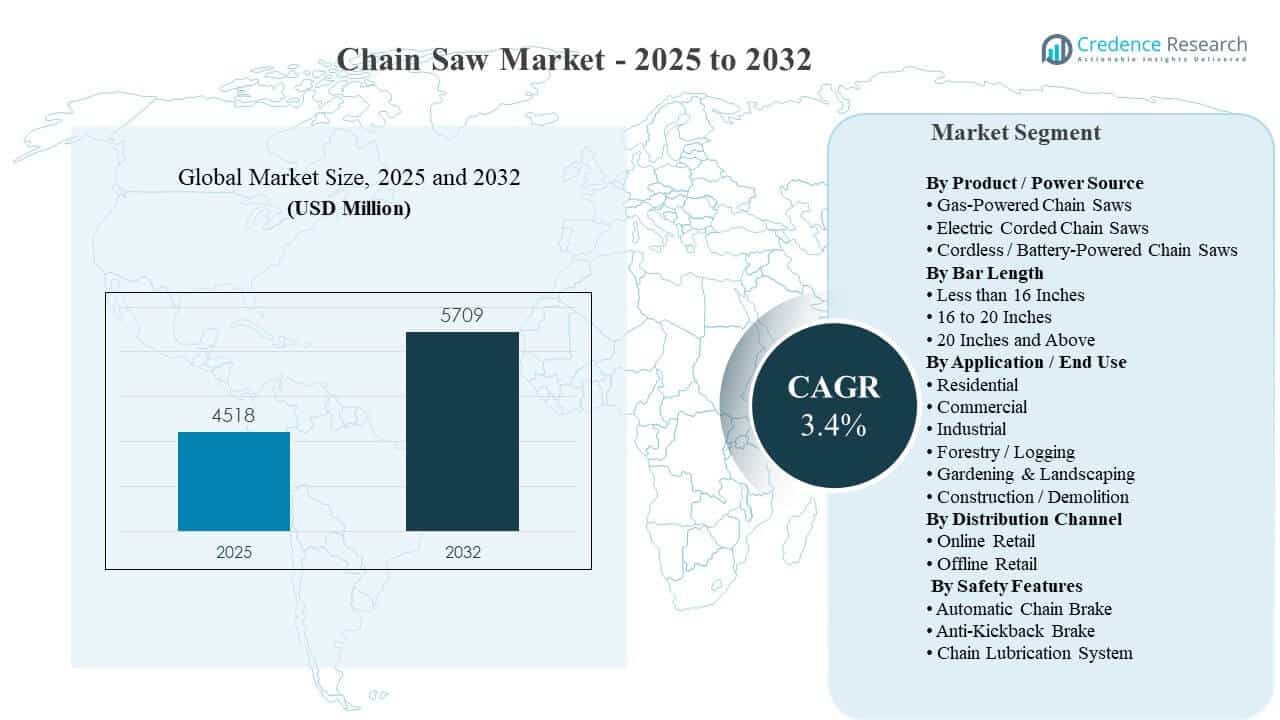
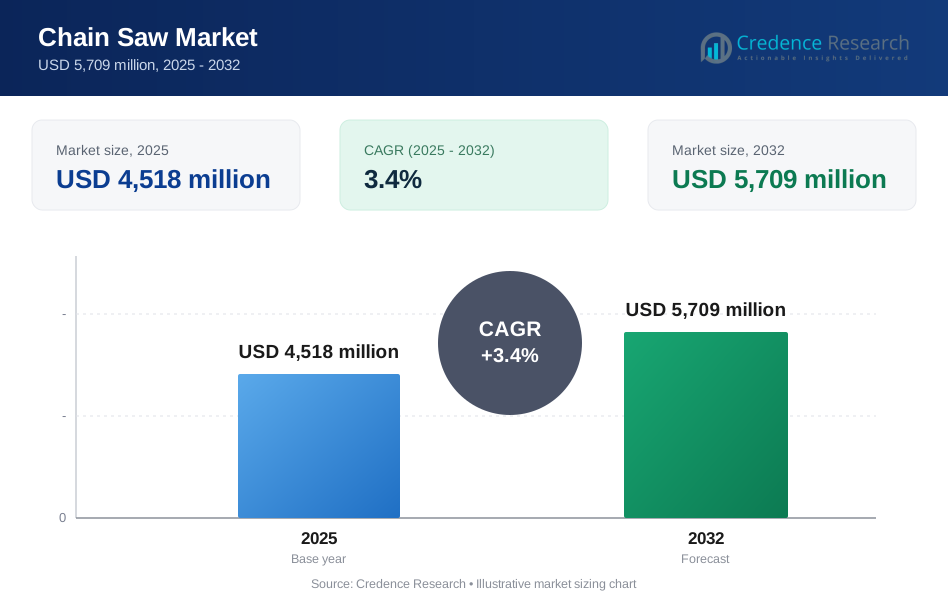
The global chain saw market size was estimated at USD 4,518 million in 2025 and is expected to reach USD 5,709 million by 2032, growing at a CAGR of 3.4% from 2025 to 2032. Demand is primarily supported by replacement cycles and productivity-driven purchases across forestry, land management, and property maintenance where cutting speed, uptime, and serviceability influence buying decisions. The chain saw market is also benefiting from the steady transition toward cordless platforms as battery performance and motor efficiency improve, supported by expanding dealer and retail availability across major regions.
| REPORT ATTRIBUTE | DETAILS |
|---|---|
| Historical Period | 2020-2024 |
| Base Year | 2025 |
| Forecast Period | 2026-2032 |
| Chain Saw Market Size 2025 | USD 4,518 million |
| Chain Saw Market, CAGR | 3.4% |
| Chain Saw Market Size 2032 | USD 5,709 million |
Key Market Trends & Insights
- Gas-powered chain saws accounted for the largest share of 52.1% in 2025, reflecting continued preference for high-torque, long-runtime use cases.
- Offline retail remained the leading channel with a 60.5% share in 2025, supported by dealer service, demonstrations, and parts availability.
- Forestry/logging represented the largest application share at 39.4% in 2025, sustaining demand for rugged, high-duty models and consumables.
- 16 to 20-inch bars led bar-length demand with a 36.2% share in 2025, driven by broad suitability for firewood, farms, and mixed professional tasks.
- North America led regional demand with a 32.7% share in 2025, reflecting strong installed base, storm cleanup cycles, and established distribution networks.
Segment Analysis
The chain saw market is shaped by a clear split between high-duty professional use and intermittent household use, which drives differentiated product design and channel strategies. Gas-powered models lead the installed base because runtime and cutting power remain critical in forestry, land clearing, and commercial work where downtime directly impacts productivity. At the same time, cordless demand is expanding as brushless motors, higher-capacity battery packs, and platform ecosystems improve performance and reduce total tool ownership friction for homeowners and contractors.
Buying behavior also reflects safety sensitivity and service expectations because chain saw ownership carries perceived risk and requires maintenance discipline. Offline dealers and retailers continue to capture the majority of purchases because product demonstrations, correct bar/chain selection, and local service support influence conversion, especially for first-time buyers and professional crews. Online retail is growing faster as shoppers use specifications, reviews, and bundled accessory offers to compare value, although many buyers still finalize decisions through offline touchpoints.
By Product / Power Source Insights
Gas-Powered Chain Saws accounted for the largest share of 52.1% in 2025. Gas-powered chain saws lead because continuous cutting under variable loads remains essential for forestry, farms, and commercial land management. Gas-powered platforms also retain an advantage in refuel speed and duty-cycle consistency during extended work sessions. Cordless adoption is accelerating as battery platforms improve torque delivery and runtime, supported by shared-battery ecosystems across outdoor power equipment portfolios.
By Bar Length Insights
16 to 20 Inches accounted for the largest share of 36.2% in 2025. Mid-length bars lead because the range fits the broadest mix of tasks across residential wood cutting, farm maintenance, and light-to-medium professional work. The segment balances reach and maneuverability, making the category a default choice for general-purpose buyers. Shorter bars are expanding as pruning, landscaping, and compact cordless saw usage increases and as buyers prioritize lower fatigue and easier control.
By Application / End Use Insights
Forestry / Logging accounted for the largest share of 39.4% in 2025. Forestry and logging lead because utilization rates are high and the application drives recurring replacement of bars, chains, and wear parts. Professional crews also maintain fleets, sustaining steady replacement purchases to minimize downtime. Residential demand remains structurally supported by storm cleanup and property maintenance, while landscaping and municipal work is increasingly aligned with lighter electric and cordless equipment preferences.
By Distribution Channel Insights
Offline Retail accounted for the largest share of 60.5% in 2025. Offline retail leads because buyers value guidance on model selection, bar and chain compatibility, and safety instruction at the point of purchase. Dealer networks also provide after-sales service, spare parts, and warranty handling, which matters for equipment with maintenance and consumable requirements. Online retail is expanding through broader assortment and convenient price and review comparison, strengthening omnichannel purchasing behavior.
By Safety Features Insights
Automatic Chain Brake accounted for the largest share of 2025. Safety-feature adoption is increasingly standardized across product tiers due to user expectations and risk management in both household and professional settings. Automatic chain brakes and anti-kickback systems are treated as essential for operator protection, especially for intermittent users and multi-operator fleets. Chain lubrication systems remain critical to control heat and wear, supporting consistent cutting performance and extending chain life.
Chain Saw Market Drivers
Replacement-driven purchasing and fleet renewal
The chain saw market is supported by replacement cycles tied to wear-intensive use in forestry, farming, and commercial property maintenance. Bars, chains, sprockets, and powerhead components experience measurable wear under repeated cutting loads, making periodic replacement economically rational. Professional users prioritize uptime, which sustains repeat purchases through dealer networks and service programs. The replacement dynamic also supports accessory attachment and consumable sales that reinforce brand loyalty across product families.
- For instance, Husqvarna lists the 365 X-Torq as a 71cc professional chain saw with a chain speed of 74.5 ft/s at max power, and the company says its X-Torq engine technology can reduce fuel consumption by up to 20% and exhaust emissions by up to 70%. Professional users prioritize uptime, which sustains repeat purchases through dealer networks and service programs.
Urban maintenance, storm cleanup, and property management demand
Residential and municipal demand is reinforced by periodic storm events, vegetation management, and routine property upkeep. Households and local agencies often maintain chain saw access as a readiness tool for debris clearing and urgent tree removal. Demand spikes are also influenced by seasonal trimming cycles and local regulations for tree and vegetation management. The chain saw market benefits when retailers and dealers bundle safety gear and accessories that reduce purchase hesitation for first-time buyers.
Expansion of cordless platforms and battery ecosystems
Cordless innovation is a structural driver as brushless motors, improved battery energy density, and better electronics expand the use cases for battery-powered chain saws. Battery ecosystems reduce total ownership cost when users share packs across outdoor and jobsite tools. Lower noise and reduced direct emissions improve suitability for urban landscaping, municipal work, and indoor-adjacent use areas. The shift supports broader adoption among homeowners and contractors seeking simpler start-up, reduced maintenance, and better storage convenience.
- For instance, STIHL says its AP 500 S battery operates at 36 V with 337 Wh of energy, offers up to 2,500 charge cycles, and delivers 40% more power output plus 20% more capacity than the AP 300 S. Lower noise and reduced direct emissions improve suitability for urban landscaping, municipal work, and indoor-adjacent use areas.
Channel performance and service availability shaping conversion
Distribution strength remains a major growth lever because buyers rely on service availability, spare parts, and product guidance. Offline retail captures a large share due to demonstrations, compatibility assurance for bars and chains, and proximity to repairs. E-commerce accelerates buyer education through reviews and specification comparison, expanding reach beyond local dealer footprints. Omnichannel strategies improve conversion by allowing online discovery while preserving offline validation and service continuity.
Chain Saw Market Challenges
The chain saw market faces demand variability driven by seasonality and weather events, which creates uneven sell-through patterns for retailers and dealers. Price sensitivity can rise when economic conditions weaken, pushing buyers toward lower-cost models that compress manufacturer margins. Safety concerns also create adoption friction among new users, increasing the importance of training, protective equipment, and clear product communication. Supply and pricing volatility in metals, batteries, and components can further pressure costs and complicate inventory planning.
Product differentiation is challenging in mid-tier segments where performance gaps narrow and buyers compare on price and brand familiarity. Battery systems introduce additional complexity because customers evaluate total platform cost rather than tool price alone. Compliance expectations and liability management increase engineering and testing requirements for safety-critical equipment. Counterfeit or low-quality accessories in the aftermarket can damage performance and safety outcomes, indirectly impacting brand perception.
- For instance, the Husqvarna 540i XP offers 36V lithium-ion power, 1.8 kW output, 24 m/s chain speed, and a 2.9 kg weight, but buyers must also consider battery, charger, and ecosystem costs beyond the tool itself.
Chain Saw Market Trends and Opportunities
The chain saw market is moving toward higher-efficiency cordless solutions that narrow performance distance versus gas-powered products, creating growth opportunities in prosumer and light commercial segments. Battery platform expansion enables ecosystem selling, where users add tools, batteries, and accessories over time. Smart features and improved ergonomics are becoming more visible differentiators as buyers demand lower vibration, easier maintenance, and clearer safety signaling. Retail bundling of chains, oils, and protective equipment supports higher average selling value and improves safe-use adoption.
- For instance, Milwaukee’s M18 FUEL 14-inch Top Handle Chainsaw delivers up to 2.7 HP peak power and 3.2 Nm of peak torque, is rated for 150 cuts per charge with an XC 8.0 battery or 225 cuts per charge with an HD12.0 battery in cedar 4x4, and sits within the M18 system of over 300 tools, while REDLINK PLUS Intelligence provides overload protection during heavy applications.
Opportunities are also developing in compact and mid-length saw categories aligned with landscaping, municipal maintenance, and residential property management. Dealer service models and subscription-style maintenance packages can support repeat engagement and reduce downtime for professional fleets. Product line segmentation by use case simplifies decision-making for first-time buyers and supports premiumization. Emerging-market distribution expansion and localized service coverage can increase adoption where mechanized land management is growing.
Regional Insights
North America
North America accounted for the largest share of 32.7% in 2025. The region benefits from a large installed base across residential property maintenance, municipal vegetation management, and commercial land clearing. Dealer coverage and service networks support replacement purchases and parts availability, strengthening offline conversion. Storm recovery cycles and seasonal maintenance needs reinforce periodic demand spikes for both homeowners and professional users.
Europe
Europe held a 23.9% share in 2025. Demand is supported by forestry activity, timber-related operations, and regulated maintenance practices that emphasize safety and equipment compliance. The region’s established retail infrastructure helps sustain aftermarket and service-driven purchasing behavior. Adoption of lower-noise equipment in urban environments supports growth for electric and cordless offerings in landscaping and municipal applications.
Asia Pacific
Asia Pacific captured a 27.6% share in 2025. Infrastructure buildout, expanding landscaping needs, and broader tool adoption across developing markets support rising demand. Cordless uptake is strengthening as battery platforms scale and as users prioritize portability and ease of use. Distribution expansion and improving after-sales capability will influence penetration across professional and household segments.
Latin America
Latin America represented 8.9% of the market in 2025. The region’s demand is linked to forestry, agriculture, and land management activity where durability and service availability drive purchase decisions. Distribution coverage and parts availability remain key adoption constraints and opportunities. Professional users tend to favor robust models due to operating conditions and higher utilization needs.
Middle East & Africa
Middle East & Africa accounted for 6.9% in 2025. Demand is anchored in landscaping, municipal maintenance, and commercial property management activities. Channel development and service infrastructure are critical for consistent growth because maintenance and consumables support repeat purchasing. Equipment choice often emphasizes reliability and operating simplicity to support mixed-user environments.
Competitive Landscape
The chain saw market is moderately concentrated, with competition centered on brand strength, power-to-weight performance, durability, and dealer/service coverage. Product strategy is increasingly segmented by duty cycle, with gas-powered products defending high-utilization applications and cordless lines expanding across residential and light commercial usage. Differentiation also comes from accessory ecosystems, safety feature integration, and channel execution that combines offline service advantages with online discovery and comparison behavior.
ANDREAS STIHL AG & Co. KG is widely positioned around professional-grade performance, reliability, and strong dealer-centric distribution, which supports service continuity and replacement-driven purchasing. Product portfolios are typically structured to address forestry, farm and land management, and residential maintenance with tiered configurations and compatible accessory lines. Dealer service capability and parts availability reinforce total ownership value, supporting repeat purchases in fleet settings. The chain saw market’s ongoing shift toward cordless platforms increases the importance of battery ecosystem strategy and performance benchmarking against traditional gas-powered use cases.
The industry research and growth report includes detailed analyses of the competitive landscape of the market and information about key companies, including:
- ANDREAS STIHL AG & Co. KG
- Husqvarna Group
- Makita Corporation
- Stanley Black & Decker, Inc.
- Robert Bosch GmbH
- Oregon Tool, Inc.
- Techtronic Industries Co. Ltd.
- Yamabiko Corporation
- STIGA S.p.A.
- Zhejiang Zomax Garden Machinery Co., Ltd.
Qualitative and quantitative analysis of companies has been conducted to help clients understand the wider business environment as well as the strengths and weaknesses of key industry players. Data is qualitatively analyzed to categorize companies as pure play, category-focused, industry-focused, and diversified; it is quantitatively analyzed to categorize companies as dominant, leading, strong, tentative, and weak.
Recent Developments
- In April 2025, STIHL said its recent product rollout included the new MSA 80 chainsaw from its AK battery system. STIHL described the MSA 80 as a lightweight battery-powered chainsaw for ambitious private users, especially for pruning and other tasks around the home.
- In October 2025, Husqvarna debuted an all-new lineup of professional and residential chainsaws at Equip Expo. The rollout included models such as the 564 XP fuel-injected chainsaw and the 550i XP battery chainsaw, with the company indicating availability beginning in early 2026.
- In December 2025, Makita introduced its new cordless chainsaw, the UC030G. Makita said the model is built to deliver petrol-like power comparable to a 50cc-class chainsaw and includes three chain-speed modes with a maximum cutting speed of 29.0 m/s, making it suitable for professional forestry work
Report Scope
| Report Attribute | Details |
| Market size value in 2025 | USD 4518 million |
| Revenue forecast in 2032 | USD 5709 million |
| Growth rate (CAGR) | 3.4% (2025–2032) |
| Base year | 2025 |
| Forecast period | 2026–2032 |
| Quantitative units | USD million |
| Segments covered | By Product / Power Source Outlook: Gas-Powered Chain Saws, Electric Corded Chain Saws, Cordless / Battery-Powered Chain Saws; By Bar Length Outlook: Less than 16 Inches, 16 to 20 Inches, 20 Inches and Above; By Application / End Use Outlook: Residential, Commercial, Industrial, Forestry / Logging, Gardening & Landscaping, Construction / Demolition; By Distribution Channel Outlook: Online Retail, Offline Retail; By Safety Features Outlook: Automatic Chain Brake, Anti-Kickback Brake, Chain Lubrication System |
| Regional scope | North America, Europe, Asia Pacific, Latin America, Middle East & Africa |
| Key companies profiled | ANDREAS STIHL AG & Co. KG, Husqvarna Group, Makita Corporation, Stanley Black & Decker, Inc., Robert Bosch GmbH, Oregon Tool, Inc., Techtronic Industries Co. Ltd., Yamabiko Corporation, STIGA S.p.A., Zhejiang Zomax Garden Machinery Co., Ltd. |
| No. of Pages | 338 |
Segmentation
By Product / Power Source
- Gas-Powered Chain Saws
- Electric Corded Chain Saws
- Cordless / Battery-Powered Chain Saws
By Bar Length
- Less than 16 Inches
- 16 to 20 Inches
- 20 Inches and Above
By Application / End Use
- Residential
- Commercial
- Industrial
- Forestry / Logging
- Gardening & Landscaping
- Construction / Demolition
By Distribution Channel
- Online Retail
- Offline Retail
By Safety Features
- Automatic Chain Brake
- Anti-Kickback Brake
- Chain Lubrication System
By Region
- North America
- U.S.
- Canada
- Mexico
- Europe
- Germany
- France
- U.K.
- Italy
- Spain
- Rest of Europe
- Asia Pacific
- China
- Japan
- India
- South Korea
- South-east Asia
- Rest of Asia Pacific
- Latin America
- Brazil
- Argentina
- Rest of Latin America
- Middle East & Africa
- GCC Countries
- South Africa
- Rest of the Middle East and Africa
Request a Free Sample
Fill in your details and we'll send you a free sample report.
- Sample data tables & charts
- Research methodology
Need a Custom Version of This Report?
Tailor the scope, geography, or segments to your exact requirements.
- Custom geography or segment scope
- Direct access to our analyst team
Frequently Asked Questions
What is the chain saw market size and forecast?
What is the CAGR for the chain saw market?
What is the largest segment in the chain saw market?
What factors are driving growth in the chain saw market?
Which companies are leading in the chain saw market?
Which region leads the chain saw market?
Table of Content
Chapter 1 Market Segmentation
- 1.1 Segmentation Framework
- 1.1.1 Product and Service Classification
- 1.1.2 Application and End-Use Classification
- 1.1.3 Technology and Solution Classification
- 1.1.4 Customer and Distribution Channel Classification
- 1.1.5 Geographic Segmentation
- 1.1.6 Market Segment Definitions and Boundaries
Chapter 2 Introduction
- 2.1 Report Objectives and Scope
- 2.2 Product Definition and Industry Terminology
- 2.3 Market Inclusions and Exclusions
- 2.4 Research Process
- 2.4.1 Primary Research and Expert Interviews
- 2.4.2 Secondary Research and Source Review
- 2.4.3 Top-Down and Bottom-Up Estimation
- 2.4.4 Data Triangulation and Verification
- 2.5 Market Size Measurement Basis
- 2.5.1 2025: USD 4,518 million → 2032: USD 5,709 million
- 2.6 Historical and Forecast Reference Periods
- 2.6.1 Base Year: 2025
- 2.6.2 Forecast Period: 2025-2032
- 2.7 Research Assumptions and Limitations
Chapter 3 Executive Summary
- 3.1 Market Snapshot and Key Findings
- 3.2 Base-Year Market Size, 2025
- 3.3 Forecast Market Size, 2032
- 3.4 Revenue and Volume Growth Outlook
- 3.5 Key Demand and Supply Indicators
- 3.6 Leading Market Segments
- 3.7 Fastest-Growing Market Opportunities
- 3.8 Regional Performance Highlights
- 3.9 Technology and Industry Transformation
- 3.10 Competitive Landscape Summary
- 3.11 Analyst View and Strategic Implications
Chapter 4 Global Chain Saw Market Trends and Developments
- 4.1 Historical Industry Development
- 4.2 Recent Market Trends and Developments
- 4.3 Demand and Customer Behavior Trends
- 4.4 Technology and Product Innovation
- 4.5 Artificial Intelligence, Automation and Digitalization
- 4.6 Local Manufacturing and Supply Chain Realignment
- 4.7 Industry Partnerships, Mergers and Acquisitions
- 4.8 Sustainability and Circular Economy Developments
- 4.9 Government and Private Sector Investment Trends
- 4.10 Emerging Business Models and Commercialization
- 4.11 Industry Developments and Announcements
Chapter 5 Global Chain Saw Market Production, Supply and Demand Analysis
- 5.1 Demand Trend and Consumption Analysis
- 5.2 Demand Forecast, 2025-2032
- 5.3 Production and Output Trend
- 5.4 Production and Output Forecast, 2025-2032
- 5.5 Installed Capacity and Capacity Utilization
- 5.6 Company-Wise Production Plants and Statistics
- 5.6.1 Installed Production Capacity
- 5.6.2 Actual Production
- 5.6.3 Planned Capacity and Expansion Targets
- 5.7 Supply Chain Structure and Procurement Trends
- 5.8 Supply-Demand Gap and Bottlenecks
- 5.9 Import Dependence and Sourcing Structure
- 5.10 Contract Manufacturing and Outsourcing
- 5.11 Regional Supply and Demand Concentration
Chapter 6 Global Chain Saw Market Pricing Analysis
- 6.1 Pricing Structure and Measurement
- 6.2 Historical Pricing Trends
- 6.3 Pricing Outlook, 2025-2032
- 6.4 Average Selling Price and Unit Economics
- 6.5 Pricing by Product and Market Segment
- 6.6 Geographic Pricing Differences
- 6.7 Key Input, Energy, Labor and Logistics Costs
- 6.8 Contract Pricing and Purchasing Models
- 6.9 Pricing Sensitivity and Competitive Positioning
- 6.10 Price, Margin and Profitability Implications
Chapter 7 Global Chain Saw Market Dynamics
- 7.1 Market Growth Drivers
- 7.1.1 Demand-Side Drivers
- 7.1.2 Technology and Innovation Drivers
- 7.1.3 Infrastructure and Investment Drivers
- 7.1.4 Regulatory and Policy Drivers
- 7.2 Market Restraints
- 7.2.1 Cost and Affordability Constraints
- 7.2.2 Technology and Adoption Barriers
- 7.2.3 Supply Chain and Operational Constraints
- 7.3 Market Challenges
- 7.3.1 Competitive Pressure and Margin Erosion
- 7.3.2 Skills, Infrastructure and Implementation Gaps
- 7.4 Emerging Market Opportunities
- 7.5 Market Dynamics Impact and Time-Horizon Assessment
Chapter 8 Global Chain Saw Value Chain Analysis
- 8.1 Industry Value Chain Overview
- 8.2 Upstream Suppliers and Critical Inputs
- 8.3 Technology and Component Providers
- 8.4 Manufacturing or Service Delivery
- 8.5 Distribution, Channel Partners and Integrators
- 8.6 Downstream Applications and End Users
- 8.7 Value Addition and Profit Pools
- 8.8 Vertical Integration and Outsourcing
- 8.9 Supplier Concentration and Risk
- 8.10 Supply Chain Localization and Resilience
Chapter 9 Global Chain Saw Market Regulations and Policies
- 9.1 Relevant Laws, Standards and Compliance Frameworks
- 9.2 Product, Service, Safety and Quality Requirements
- 9.3 Government Policies, Incentives and Subsidies
- 9.4 Imports, Exports and Trade Barriers
- 9.5 Public Procurement and Local Content Requirements
- 9.6 Environmental and Sustainability Compliance
- 9.7 Upcoming Policy Changes and Market Implications
Chapter 10 Global Chain Saw Market Hotspots and Opportunities
- 10.1 Market Opportunity Mapping and Growth Hotspots
- 10.2 High-Growth Applications and Customer Groups
- 10.3 Underserved Markets and White-Space Opportunities
- 10.4 Emerging Technology and Product Opportunities
- 10.5 New Capacity and Investment Hotspots
- 10.6 Market Entry and Expansion Opportunities
- 10.7 Distribution and Partnership Opportunities
- 10.8 Near-Term and Long-Term Commercial Potential
- 10.9 Opportunity Attractiveness and Execution Risks
Chapter 11 Global Chain Saw Market Outlook, 2025-2032
- 11.1 Market Size and Analysis
- 11.1.1 Revenue (Market Measurement: 2025: USD 4,518 million → 2032: USD 5,709 million)
- 11.1.2 Market Volume and Quantity Sold
- 11.1.3 Historical Market Size
- 11.1.4 Base-Year Market Size, 2025
- 11.2 Market Forecast, 2025-2032
- 11.2.1 Revenue Forecast to 2032
- 11.2.2 Volume Forecast to 2032
- 11.2.3 CAGR and Year-on-Year Growth
- 11.2.4 Incremental Revenue Opportunity
- 11.3 Forecast Assumptions and Scenario Analysis
- 11.3.1 Base-Case Forecast
- 11.3.2 Optimistic and Conservative Scenarios
- 11.3.3 Technology, Pricing and Policy Sensitivities
- 11.4 Market Attractiveness and Growth Outlook
Chapter 12 Global Chain Saw Market Segmentation and Outlook
- 12.1 Segmentation Summary and Market Shares, 2025
- 12.2 Largest and Fastest-Growing Segments
- 12.3 Segment Growth Comparison
- 12.4 Segment Attractiveness and Priority Matrix
Chapter 13 Global Chain Saw Geographic Market Outlook, 2025-2032
- 13.1 Regional Market Size and Share, 2025
- 13.2 Regional Market Forecast, 2025-2032
- 13.3 Regional Pricing, Production and Demand Differences
- 13.4 North America
- 13.4.1 United States
- 13.4.2 Canada
- 13.4.3 Mexico
- 13.5 Europe
- 13.5.1 Germany
- 13.5.2 France
- 13.5.3 Italy
- 13.5.4 United Kingdom
- 13.5.5 Spain
- 13.5.6 Poland
- 13.5.7 Russia
- 13.5.8 Netherlands
- 13.5.9 Belgium
- 13.5.10 Sweden
- 13.5.11 Denmark
- 13.5.12 Norway
- 13.5.13 Rest of Europe
- 13.6 Asia Pacific
- 13.6.1 China
- 13.6.2 India
- 13.6.3 Japan
- 13.6.4 South Korea
- 13.6.5 Thailand
- 13.6.6 Indonesia
- 13.6.7 Vietnam
- 13.6.8 Malaysia
- 13.6.9 Australia
- 13.6.10 Rest of Asia Pacific
- 13.7 Latin America
- 13.7.1 Brazil
- 13.7.2 Argentina
- 13.7.3 Colombia
- 13.7.4 Chile
- 13.7.5 Rest of Latin America
- 13.8 Middle East
- 13.8.1 Saudi Arabia
- 13.8.2 United Arab Emirates
- 13.8.3 Turkey
- 13.8.4 Israel
- 13.8.5 Iran
- 13.8.6 Rest of the Middle East
- 13.9 Africa
- 13.9.1 South Africa
- 13.9.2 Egypt
- 13.9.3 Nigeria
- 13.9.4 Morocco
- 13.9.5 Rest of Africa
- 13.10 Regional Investment, Policy and Supply Chain Differences
- 13.11 Regional Competitive Landscape
- 13.12 Geographic Growth Hotspots
Chapter 14 Global Chain Saw Technology, Innovation and Sustainability Outlook
- 14.1 Technology Landscape and Maturity
- 14.2 Product, Process and Service Innovation
- 14.3 AI, Automation and Digital Tools in the Industry
- 14.4 Technology Adoption and Performance Benchmarking
- 14.5 Innovation Pipeline and R&D Investment
- 14.6 Patent and Intellectual Property Trends
- 14.7 Energy Efficiency and Resource Management
- 14.8 Sustainability, Recycling and Circularity
- 14.9 Technology Roadmap, 2025-2032
- 14.10 Risks of Obsolescence and Technology Substitution
Chapter 15 Global Chain Saw Market Key Strategic Imperatives
- 15.1 Growth and Market Entry Priorities
- 15.2 High-Return Products and Segments
- 15.3 Pricing, Profitability and Cost Optimization
- 15.4 Technology Investment and Product Differentiation
- 15.5 Supply Chain Localization and Resilience
- 15.6 Distribution and Customer Acquisition
- 15.7 Partnership, Acquisition and Capacity Strategy
- 15.8 Regional Expansion Priorities
- 15.9 Short-, Medium- and Long-Term Actions
Chapter 16 Competition Outlook
- 16.1 Industry Competition Characteristics
- 16.2 Market Structure and Concentration
- 16.3 Market Share and Competitive Positioning, 2025
- 16.4 Company-Wise Revenue and Product Benchmarking
- 16.5 Production and Service Capacity Benchmarking
- 16.6 Technology, Pricing and Differentiation
- 16.7 Regional Footprint and Distribution Strength
- 16.8 Mergers, Acquisitions and Strategic Alliances
- 16.9 New Entrants and Competitive Threats
- 16.10 Porter's Five Forces and Industry Attractiveness
- 16.11 Competitive Outlook, 2025-2032
Chapter 17 Company Profiles
- 17.1 Company Coverage and Selection Criteria
- 17.2 Leading Market Participants – Standard Profile Structure
- 17.2.1 Business Description
- 17.2.2 Company Ownership and Geographic Presence
- 17.2.3 Product and Service Portfolio
- 17.2.4 Manufacturing and Operating Footprint
- 17.2.5 Production Capacity and Expansion Plans
- 17.2.6 Financial Performance and Investment
- 17.2.7 Market Share and Competitive Position
- 17.2.8 Technology and Innovation Capabilities
- 17.2.9 Strategic Alliances or Partnerships
- 17.2.10 Recent Developments
- 17.2.11 Growth Strategy and Outlook
- 17.3 Other Relevant Market Participants
Note: Every listed company is profiled on the structure shown under the first company. The company list is preliminary and may change based on research findings, market developments, data availability and client requirements.
Chapter 18 Disclaimer
- 18.1 Research and Forecast Disclaimer
- 18.2 Data Source and Estimation Limitations
Note: The depth of individual sections depends on data availability for this market. Volume, capacity, trade and other unit-based metrics are included where applicable.