Aseptic Filling Machine Market Overview:
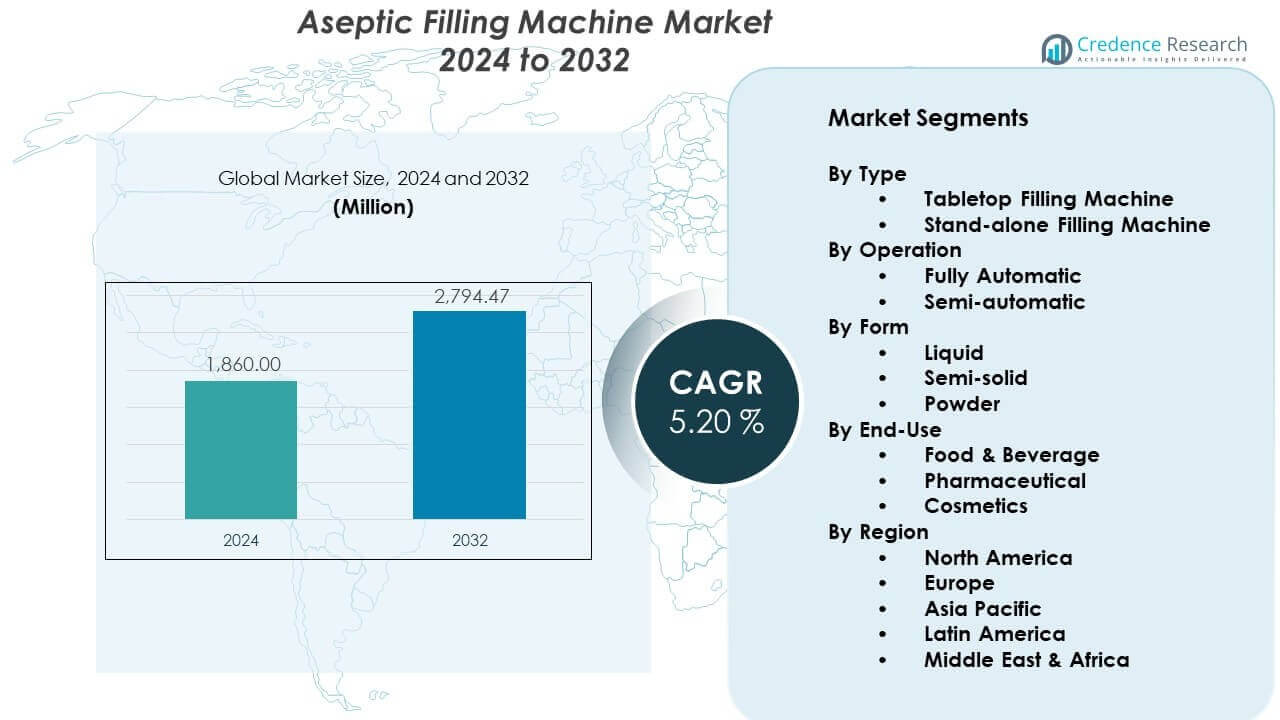
The Aseptic Filling Machine Market is projected to grow from USD 1,860 million in 2024 to an estimated USD 2,794.47 million by 2032, with a CAGR of 5.20% from 2024 to 2032.
| REPORT ATTRIBUTE |
DETAILS |
| Historical Period |
2020-2023 |
| Base Year |
2024 |
| Forecast Period |
2025-2032 |
| Aseptic Filling Machine Market Size 2024 |
USD 1,860 million |
| Aseptic Filling Machine Market, CAGR |
5.20% |
| Aseptic Filling Machine Market Size 2032 |
USD 2,794.47million |
Strong market drivers include the shift toward clean-label packaged foods, expanding production of ready-to-drink beverages, and stricter safety regulations. Manufacturers invest in advanced aseptic filling technologies that support higher throughput and minimize manual handling. The trend toward flexible packaging formats also pushes companies to modernize equipment. Pharmaceutical firms further support demand by using aseptic systems to maintain sterility in biologics and injectable drugs. These shifts show a clear move toward consistent quality control and improved hygiene standards across industries.
Regional growth varies with technology adoption and regulatory enforcement. North America leads due to established processing industries and the presence of advanced packaging technology providers. Europe follows with strong regulatory frameworks and high adoption of sterile manufacturing systems. Asia Pacific emerges as the fastest-growing region, fueled by rising packaged food consumption, expanding pharma manufacturing, and rapid industrialization. Countries in Latin America and the Middle East show steady development as companies scale up hygienic production capabilities to meet rising consumer expectations.
Aseptic Filling Machine Market Insights:
- The Aseptic Filling Machine Market is projected to grow from USD 1,860 million in 2024 to USD 2,794.47 million by 2032, reflecting a 20% CAGR driven by rising demand for sterile, shelf-stable products across major industries.
- North America (32%), Europe (28%), and Asia Pacific (30%) hold the highest shares due to strict hygiene regulations, strong manufacturing bases, and rapid modernization of food, beverage, and pharmaceutical facilities.
- Asia Pacific, with a 30% share, is the fastest-growing region supported by expanding packaged food demand, upgraded processing infrastructure, and rising adoption of automated sterile machinery.
- Stand-alone machines account for an estimated 58% share, driven by high-volume production needs and better integration with automated lines.
- Liquid filling systems hold about 62% share, supported by wide application across beverages, dairy alternatives, pharmaceuticals, and other sterile liquid products.
Access crucial information at unmatched prices!
Request your sample report today & start making informed decisions powered by Credence Research Inc.!
Download Sample
Aseptic Filling Machine Market Drivers:
Growing Focus on Sterile Packaging and Product Safety Across Food, Beverage, and Pharmaceutical Lines
The Aseptic Filling Machine Market expands with higher demand for safe, contamination-free packaging across global industries. Companies adopt sterile systems to reduce product recalls and protect brand trust. Regulatory bodies enforce strict hygiene standards that push producers to upgrade older equipment. Automation strengthens consistency in production and reduces workforce strain in high-volume facilities. Technology upgrades enable faster filling cycles and lower error rates. Rising demand for minimally processed foods supports wider adoption of aseptic formats. Pharmaceutical firms accelerate investments to safeguard complex biologics. It supports a major shift toward precision control in sterile manufacturing.
Rising Demand for Extended Shelf Life Solutions Across Consumer-Driven Product Categories
Consumers prefer food and beverage items with longer shelf stability and no preservatives, which strengthens the Aseptic Filling Machine Market. Brands adopt aseptic technologies to maintain texture, nutrition, and flavor without chemical additives. Retailers push for packaging formats that reduce spoilage and improve supply chain efficiency. Shelf-stable dairy drinks and functional beverages drive new machine installations. Producers meet export requirements through improved sterility compliance. Automation shortens downtime and increases accuracy for multi-SKU operations. Growing focus on energy-efficient machinery supports modernization plans. It improves long-term product protection in diverse categories.
- For instance, Tetra Pak’s E3/Speed Hyper technology utilizes e-beam sterilization instead of hydrogen peroxide, allowing dairy producers to reach a production capacity of 40,000 portion packs per hour while extending the shelf life of ambient milk products to 12 months.
Automation Adoption to Improve Throughput, Reduce Waste, and Enhance Operational Predictability
Industrial firms incorporate automated filling systems to improve throughput and cut material losses. The Aseptic Filling Machine Market benefits from facilities replacing manual pipelines with robotic modules. Automation improves output consistency during high-speed operations. Predictive controls help teams manage pressure, temperature, and sterility parameters. Production managers use digital dashboards to reduce changeover delays. Waste reduction creates measurable cost benefits for large plants. Machine learning tools improve filling accuracy for complex liquid products. It strengthens reliability across modern production environments.
- For instance, GEA Group implemented the “Whitebloc Neo” system, which utilizes dry H2O2 sterilization to achieve a 0.01% bottle rejection rate and reduces chemical consumption by 80% compared to traditional wet sterilization methods.
Shift Toward Versatile Filling Systems That Support Multiple Packaging Formats and Product Types
Producers adopt flexible aseptic filling units that handle diverse package sizes and viscosities. The Aseptic Filling Machine Market sees growth from rising demand for pouches, cartons, PET bottles, and specialty packs. Firms seek machines that adapt to changing consumer preferences. Quick-change features reduce downtime and improve operational agility. Multi-format capability supports innovation across beverage and dairy portfolios. Manufacturers respond faster to seasonal demand shifts. Advanced nozzles and sealing units support varied formulations. It helps companies expand product lines with fewer equipment constraints.
Aseptic Filling Machine Market Trends:
Integration of Digital Monitoring, Real-Time Controls, and Smart Diagnostics in High-Performance Lines
Digital transformation reshapes the Aseptic Filling Machine Market through adoption of real-time monitoring tools. Producers invest in sensors that track sterility parameters with high accuracy. Smart analytics detect anomalies before they halt production. Remote access platforms improve troubleshooting speed for technical teams. Advanced HMI systems enhance operator visibility. Predictive maintenance lowers downtime and improves operational certainty. Machine connectivity supports compliance documentation. It creates a stronger technological foundation in sterile processing.
- For instance, Rockwell Automation collaborated with industry partners to implement the FactoryTalk InnovationSuite, which enables a 20% increase in throughput by utilizing augmented reality (AR) and IoT sensors that monitor over 200 critical machine health variables in real-time.
Expansion of Sustainable Packaging Solutions Supported by Lower Energy Consumption Machines
Sustainability goals influence equipment upgrades within the Aseptic Filling Machine Market. Manufacturers design machines that reduce water and heat usage. Energy-efficient modules help firms meet internal carbon targets. Brands explore biodegradable and lightweight packaging formats. Equipment makers introduce systems that manage lower-impact materials without compromising sterility. Waste-reduction expectations shift design choices across plants. Eco-focused regulatory pressure drives wider adoption of sustainable machinery. It accelerates alignment with global environmental commitments.
Growing Movement Toward High-Speed Filling Lines to Support Surge in Ready-to-Drink Categories
High-speed solutions gain traction within the Aseptic Filling Machine Market due to rising demand for RTD beverages. Producers scale output to respond to lifestyle-driven consumption patterns. Faster lines support seasonal peaks and promotional cycles. Machine makers introduce advanced flow controls that maintain accuracy at higher speeds. Compact systems accommodate expansion in smaller facilities. Quality retention remains a priority for premium beverages. Multi-lane setups improve volume handling. It raises efficiency in fast-growing beverage categories.
R&D Focus on Enhanced Sterile Barrier Technologies and Next-Generation Nozzle Designs
Research teams introduce upgraded sterile chambers and more efficient nozzle structures. The Aseptic Filling Machine Market moves toward stronger contamination control performance. Firms test new materials that maintain sterility at higher speeds. Barrier innovations reduce dependency on chemical sterilants. Nozzle upgrades support complex and sensitive formulations. Improved sealing reliability supports premium liquid segments. Hygienic design principles shape the latest machine architecture. It improves production safety benchmarks across sectors.
- For instance, IMA Life developed the “SENSORLESS” robotic filling technology, which uses a wireless, contact-free weighing system to provide a 100% weight check for up to 400 vials per minute, eliminating traditional mechanical parts that pose a risk to sterile barrier integrity.
Aseptic Filling Machine Market Challenges Analysis:
High Capital Investment Requirements and Complex Integration Processes Across Existing Facilities
Producers face heavy investment needs when adopting new sterile equipment. The Aseptic Filling Machine Market reflects long approval cycles for machinery procurement. Firms struggle with integration challenges when connecting legacy systems to modern lines. Skilled technicians are required to manage installation steps. Training costs rise due to advanced digital controls. Maintenance and validation procedures extend setup timelines. Smaller manufacturers hesitate due to limited financial capacity. It slows adoption across cost-sensitive regions.
Increasing Regulatory Pressure and Difficulty Maintaining Sterile Uniformity Across Diverse Product Types
Regulatory standards create strict demands that require continuous oversight. The Aseptic Filling Machine Market sees companies navigate complex sterility audits. Variations in product viscosity and formulation create consistency challenges. Equipment must maintain sterility for wide product ranges. Requalification procedures stretch production schedules. Multinational producers manage differences in regional regulations. Validation costs rise with every machinery upgrade. It places sustained compliance pressure on technical teams.
Aseptic Filling Machine Market Opportunities:
Rising Demand for Shelf-Stable Functional Beverages and Clean-Label Food Products Across Global Markets
Producers identify strong opportunities as demand for premium shelf-stable drinks grows. The Aseptic Filling Machine Market benefits from firms expanding clean-label product portfolios. Long-life dairy alternatives, protein beverages, and fortified drinks increase machine adoption. Emerging markets show strong appetite for convenient packaged nutrition. Equipment makers introduce adaptable designs for experimental formulations. Growth in export-oriented brands supports higher equipment orders. It encourages investment in scalable sterile filling lines.
Adoption of Advanced Automation and Eco-Efficient Systems to Support Modernization Strategies
Automation-driven efficiency improvements create new prospects for industrial facilities. The Aseptic Filling Machine Market gains from modernization across mid-scale plants. Energy-efficient systems appeal to firms with sustainability mandates. Smart diagnostics reduce operational risks. Digital twins support performance simulations before installation. Upgraded sealing and nozzle designs unlock new product capabilities. It helps producers future-proof operations while meeting evolving regulatory and consumer expectations.
Aseptic Filling Machine Market Segmentation Analysis:
By Type
The Aseptic Filling Machine Market divides into tabletop and stand-alone units that serve varied production needs. Tabletop machines support small batches and offer compact designs for laboratories and pilot facilities. Stand-alone machines handle higher output and integrate with broader production lines. Producers select stand-alone systems for faster throughput and better automation compatibility. Tabletop formats appeal to firms that run frequent product trials. Stand-alone models dominate large-scale operations due to stronger durability. It supports flexible adoption across facilities with different volume targets.
By Operation
Operation-based segmentation covers fully automatic and semi-automatic systems that align with production efficiency goals. Fully automatic units attract high-volume plants that need consistent output and strict sterility control. These machines reduce manual handling and stabilize production cycles. Semi-automatic units offer cost benefits for small and mid-size facilities. Firms use semi-automatic setups during transitional phases before scaling. Automation levels influence long-term operating costs and training needs. It creates clear differentiation between investment choices for diverse users.
- For instance, Bosch Packaging Technology (Syntegon) developed the AFG 5000 series, a fully automatic system that utilizes a vacuum-powder filling principle to process 480 vials per minute with a rejected-vial rate of less than 0.1% through continuous sensor monitoring.
By Form
This segment includes machines designed for liquid, semi-solid, and powder products. Liquid filling systems dominate due to wide application in beverages and pharmaceuticals. Semi-solid units support creams, concentrates, and viscous blends. Powder-capable machines meet needs in nutrition, drug formulation, and specialty ingredients. Producers choose form-specific machines to maintain accuracy and sterility. Design features differ based on viscosity and flow behavior. It ensures reliable performance across varied formulation types.
By End-Use
Key end uses include food and beverage, pharmaceutical, and cosmetics industries. Food and beverage producers depend on aseptic filling for shelf-stable drinks and dairy alternatives. Pharmaceutical firms use the systems to protect sterile injectables and sensitive biologics. Cosmetics companies adopt them for creams and lotions that require contamination control. Each sector holds unique sterility and packaging requirements. It drives tailored machine configurations across global markets.
- For instance, Bausch+Ströbel’s VarioSys system for the pharmaceutical sector utilizes a standardized L-flange module that allows producers to switch between vial filling and pre-filled syringe processing in under 30 minutes while maintaining a Grade A (ISO 5) sterility environment.
Segmentation:
By Type
- Tabletop Filling Machine
- Stand-alone Filling Machine
By Operation
- Fully Automatic
- Semi-automatic
By Form
By End-Use
- Food & Beverage
- Pharmaceutical
- Cosmetics
By Region
- North America
- Europe
- Germany
- France
- U.K.
- Italy
- Spain
- Rest of Europe
- Asia Pacific
- China
- Japan
- India
- South Korea
- South-east Asia
- Rest of Asia Pacific
- Latin America
- Brazil
- Argentina
- Rest of Latin America
- Middle East & Africa
- GCC Countries
- South Africa
- Rest of the Middle East and Africa
Regional Analysis:
North America and Europe
The Aseptic Filling Machine Market secures a leading position in North America with an estimated 32% share, supported by strong investments across food, beverage, and pharmaceutical facilities. Producers upgrade sterile lines to meet high safety expectations and strengthen supply reliability. Europe follows with an estimated 28% share, driven by strict regulatory oversight and mature processing infrastructure. Companies in both regions adopt automated aseptic technologies to maintain uniform quality and reduce contamination risk. Demand rises with growth in clean-label and long-life product categories. It sustains consistent technology adoption among established manufacturers. Regulatory alignment further reinforces high equipment penetration across these markets.
Asia Pacific
Asia Pacific holds an estimated 30% share and represents the fastest-expanding region due to industrial growth and rising consumption of packaged foods and beverages. Producers introduce advanced aseptic systems to support export needs and enhance sterility control. Manufacturers in China, India, and Southeast Asia modernize facilities to gain efficiency and reduce production downtime. Demand strengthens with rising focus on hygiene and shelf stability. It encourages firms to adopt automated solutions that support larger production volumes. Expanding pharmaceutical manufacturing boosts equipment usage across sterile drug lines. Regional investments continue to elevate machine adoption across diverse end-use sectors.
Latin America and Middle East & Africa
Latin America accounts for an estimated 6% share, supported by gradual upgrades across dairy, juice, and ready-to-drink segments. Producers invest in sterile filling systems to reduce product losses and improve distribution reach. Middle East & Africa hold an estimated 4% share, with growth driven by expanding food processing capacity and new beverage manufacturing projects. Companies adopt aseptic systems to navigate temperature and logistics challenges. Emerging markets increase reliance on long-life packaged goods, which fuels adoption of sterile technologies. It supports consistent entry of modern equipment across newly built or expanding plants. Rising interest in high-quality packaged goods sustains market traction in both regions.
Shape Your Report to Specific Countries or Regions & Enjoy 30% Off!
Key Player Analysis:
- Alfa Laval
- GEA Group
- Groninger
- Syntegon Technology
- Bausch+Ströbel
- IMA Group
- Krones AG
- John Bean Technologies
Competitive Analysis:
The Aseptic Filling Machine Market shows strong competition among global equipment manufacturers that focus on precision engineering and sterile performance. Leading companies invest in advanced automation, hygienic designs, and flexible filling solutions to meet diverse product requirements. Firms pursue innovation to reduce downtime, improve sealing accuracy, and optimize throughput. Technology integration strengthens real-time monitoring and predictive maintenance capabilities. Players expand service networks to support complex installations in high-growth regions. It encourages continuous product upgrades and strategic expansion. Mergers and partnerships also support broader portfolios and stronger market positioning across key industries.
Recent Developments:
- In February 2026, IMA Group announced the acquisition of a majority stake in ProSys Sampling Systems Limited, an Irish specialist in high-containment sampling for liquids and powders. This move follows a November 2024 strategic partnership with RheaVita to integrate continuous freeze-drying technology and a January 2026 contribution to Sharp Sterile Manufacturing’s $28 million facility expansion.
- In January 2026, GEA Group expanded its hygienic valve portfolio for the beverage and pharmaceutical industries by acquiring Hydract A/S. This follows the 2025 introduction of an aseptic pharmaceutical spray dryer and the earlier launch of the Flowmodul rotary filler, which offers a 15% efficiency increase over previous models.
- In January 2025, John Bean Technologies (JBT) completed its massive $3.9 billion acquisition of Marel, officially rebranding as JBT Marel Corporation. The merger combines JBT’s liquid food and aseptic capabilities with Marel’s extensive food processing portfolio, targeting over $125 million in cost synergies by 2028.
- In May 2025, Syntegon Technology held the world premiere of SynTiso, a groundbreaking, highly autonomous “gloveless” isolator line for liquid pharmaceutical filling. This launch, developed with industry partners, addresses the highest Annex 1 compliance standards and follows the October 2024 acquisition of the Telstar Group to strengthen Syntegon’s turnkey freeze-drying and aseptic solutions.
Report Coverage:
The research report offers an in-depth analysis based on Type, Operation, Form, and End-Use. It details leading market players, providing an overview of their business, product offerings, investments, revenue streams, and key applications. Additionally, the report includes insights into the competitive environment, SWOT analysis, current market trends, as well as the primary drivers and constraints. Furthermore, it discusses various factors that have driven market expansion in recent years. The report also explores market dynamics, regulatory scenarios, and technological advancements that are shaping the industry. It assesses the impact of external factors and global economic changes on market growth. Lastly, it provides strategic recommendations for new entrants and established companies to navigate the complexities of the market.
Future Outlook:
- Rising adoption of sterile packaging systems will shape long-term investment priorities and support broader integration of aseptic filling technologies across global production networks.
- Demand for flexible filling formats will increase machine customization needs, with producers seeking designs that adapt to new formulations and packaging structures without extended changeover time.
- Growth in automation will strengthen output reliability, enhance workforce productivity, and push manufacturers to adopt digital tools that stabilize filling precision in high-speed environments.
- Smart diagnostics will gain wider use, helping operators predict mechanical issues earlier, reduce downtime, and improve the overall resilience of sterile processing lines.
- Expansion of clean-label beverages, nutritional drinks, and plant-based formulations will create strong opportunities that encourage producers to upgrade equipment capabilities.
- Pharmaceutical sector growth will elevate the need for high-accuracy aseptic modules that protect biologics, vaccines, and sensitive liquid drug products during filling.
- Sustainability goals will promote low-energy systems, reduced water consumption, and eco-focused engineering principles that improve environmental performance.
- Regional manufacturers will modernize their plants to align with international hygiene standards and unlock export potential across regulated markets.
- New packaging materials, including lightweight and recyclable formats, will influence equipment compatibility and drive research focused on improved sealing and handling systems.
- It will advance toward deeper digital integration, with intelligent software, real-time quality control, and automated adjustments shaping the next generation of sterile filling operations.



