
Automotive Artificial Intelligence Market Overview:
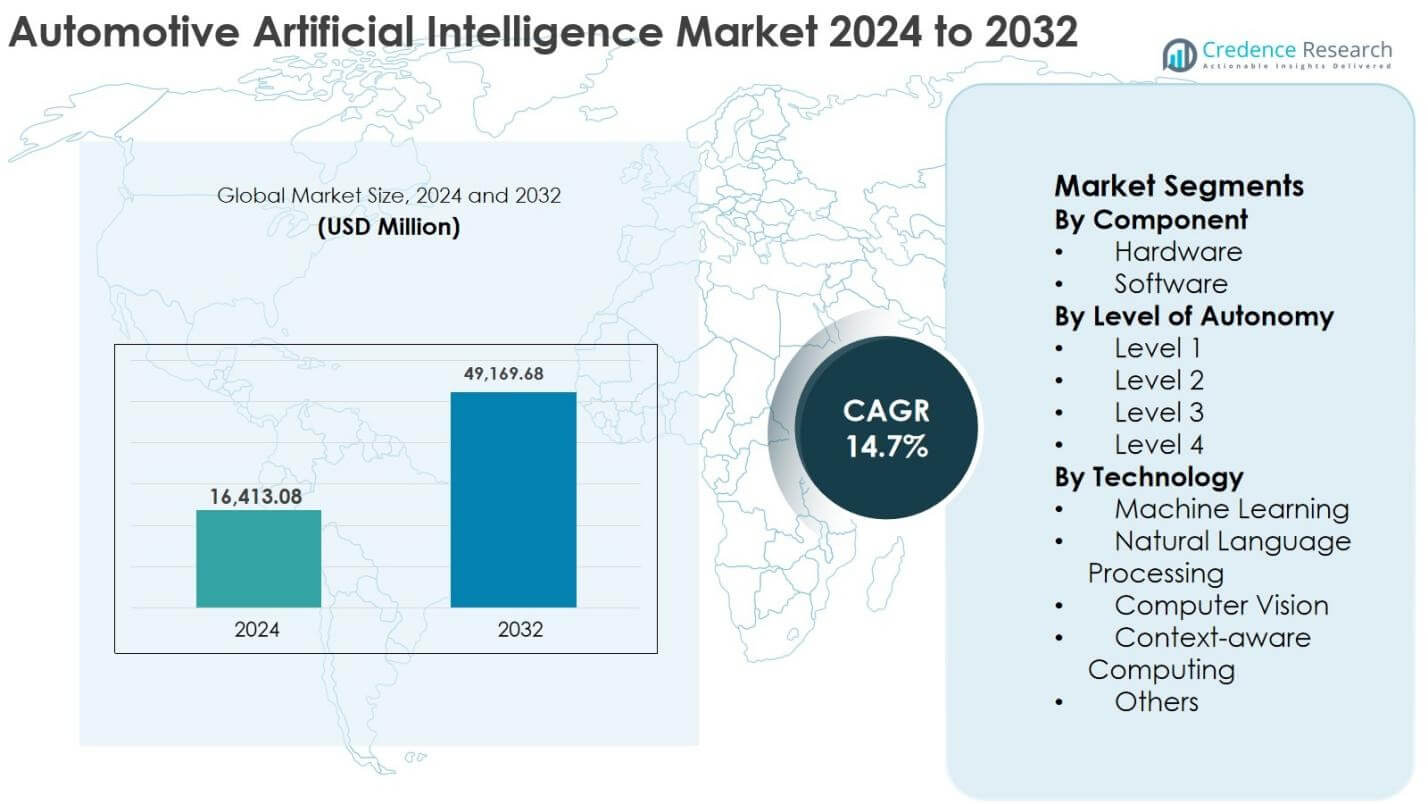
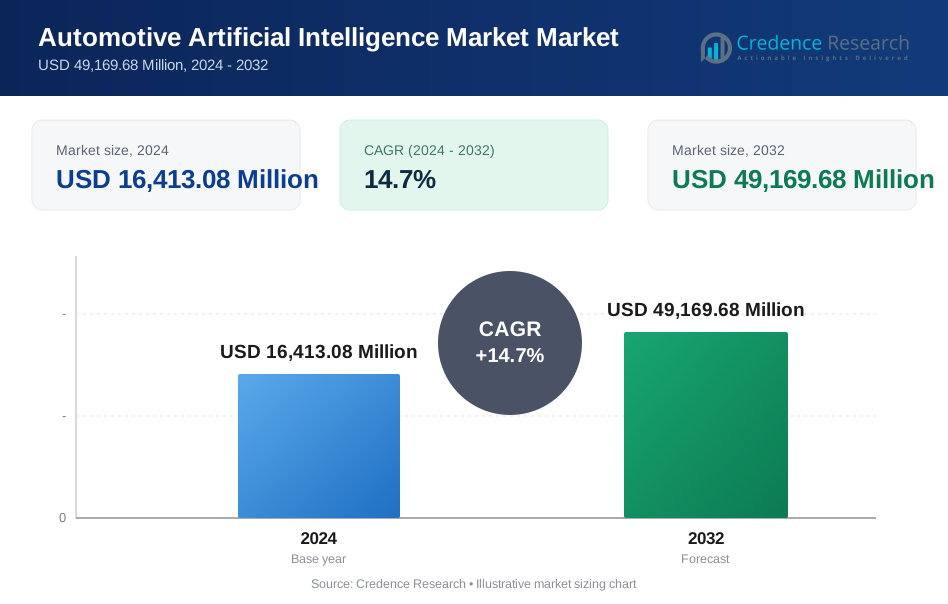
Automotive Artificial Intelligence market size was valued USD 16,413.08 Million in 2024 and is anticipated to reach USD 49,169.68 Million by 2032, at a CAGR of 14.7% during the forecast period.
| REPORT ATTRIBUTE | DETAILS |
|---|---|
| Historical Period | 2020-2024 |
| Base Year | 2025 |
| Forecast Period | 2026-2032 |
| Automotive Artificial Intelligence Market Size 2024 | USD 16,413.08 million |
| Automotive Artificial Intelligence Market, CAGR | 14.7% |
| Automotive Artificial Intelligence Market Size 2032 | USD 49,169.68 million |
Automotive Artificial Intelligence Market Insights
- Market growth is driven by rising adoption of ADAS, autonomous driving features, and intelligent cockpit systems, along with increasing OEM investments in AI-enabled perception, sensor fusion, predictive maintenance, and data analytics across passenger and commercial vehicles.
- Key trends include the transition toward software-defined vehicles, expansion of machine learning and computer-vision applications, growth in OTA-enabled AI services, and wider integration of Level 2 and emerging Level 3 automation supported by cloud-edge computing platforms.
- The market reflects strong participation from companies such as NVIDIA Corporation, Qualcomm Technologies, Mobileye, Bosch, Tesla, Aptiv, Waymo, Cruise, Ford, and TOYOTA RESEARCH INSTITUTE, with partnerships and platform-based AI ecosystems strengthening competitive positioning.
- Asia-Pacific led the market with a 34.8% share in 2024, followed by North America at 32.4% and Europe at 27.6%, while the Software segment dominated by component with a 58.6% share.
Automotive Artificial Intelligence Market Segmentation Analysis:
By Component
The Automotive Artificial Intelligence market by component is led by the Software segment, which accounted for 58.6% share in 2024, driven by the growing use of AI-based perception, decision-making, and over-the-air update capabilities across ADAS, autonomous driving, and infotainment platforms. Software adoption is further supported by expanding deployment of deep-learning models for sensor fusion, driver monitoring, and predictive maintenance. The Hardware segment holds the remaining market share, supported by increasing demand for AI-centric processors, GPUs, and edge-computing units that enable real-time data processing in autonomous and connected vehicle systems.
- For instance, Tesla’s Full Self-Driving (FSD) stack uses neural networks running on its in-car software to handle lane keeping, object detection, and traffic light control, with frequent OTA updates pushed to its global fleet.
By Level of Autonomy
By level of autonomy, Level 2 emerged as the dominant segment with a 46.3% share in 2024, supported by large-scale deployment of partially automated driving features such as adaptive cruise control, lane-keeping assist, and traffic-jam assistance in mainstream passenger vehicles. Rising safety mandates, wider OEM integration across mid-segment models, and improving driver confidence are accelerating segment growth. Level 1 remains significant due to cost-efficient systems, while Levels 3 and 4 are expanding through premium-vehicle integration, pilot fleets, and regulatory testing initiatives across selected regions and mobility programs.
- For instance, Toyota’s TSS (Toyota Safety Sense) and Hyundai’s Highway Driving Assist 2 offer Level 2 functions like lane tracing and adaptive cruise control on high-volume models such as the Toyota RAV4 and Hyundai Tucson.
By Technology
By technology, Machine Learning dominated the Automotive Artificial Intelligence market with a 41.8% share in 2024, owing to its essential role in autonomous navigation, object recognition, dynamic decision modeling, and behavior prediction across ADAS and self-driving platforms. The segment benefits from rapid advancements in neural-network training and reinforcement-learning frameworks. Computer Vision is the next major contributor, driven by applications in camera-based environment mapping and perception. Natural Language Processing, Context-aware Computing, and other technologies are growing steadily with rising adoption of intelligent cockpit systems, voice-enabled interfaces, and personalized in-vehicle user experiences.
Key Growth Drivers
Rising Adoption of ADAS and Autonomous Driving Capabilities
The Automotive Artificial Intelligence market is experiencing strong growth due to the rapid adoption of Advanced Driver Assistance Systems (ADAS) and gradual progression toward autonomous driving. Automakers are increasingly integrating AI-driven functionalities such as adaptive cruise control, collision avoidance, lane-keeping assistance, automated parking, and traffic-jam assist to enhance vehicle safety and driving comfort. These systems rely heavily on AI-enabled perception, decision-making, and sensor-fusion algorithms that process real-time data from cameras, LiDAR, radar, and ultrasonic sensors. Government safety regulations and consumer demand for safer mobility platforms are further accelerating deployment across passenger and commercial vehicles. In addition, premium and electric vehicle manufacturers are prioritizing semi-autonomous features as key product differentiators, encouraging large-scale investment in AI-centric electronics and onboard computing architectures. As vehicle automation advances toward higher autonomy levels, AI adoption continues to expand across core functions, solidifying its role as a foundational technology in next-generation mobility ecosystems.
- For instance, NVIDIA’s DRIVE platform powers perception and sensor fusion in vehicles from OEMs such as Mercedes-Benz and Volvo, using high-performance SoCs to run deep-learning models for object detection and path planning in real time.
Increasing Vehicle Connectivity, Data Analytics, and Intelligent Cockpit Advancements
Growth in the Automotive Artificial Intelligence market is strongly driven by rising vehicle connectivity and the expanding use of big-data analytics, intelligent infotainment, and personalized in-vehicle digital experiences. Modern vehicles generate vast volumes of operational and behavioral data that AI systems analyze to support functions such as predictive maintenance, driver-behavior analysis, fleet-efficiency optimization, and real-time performance monitoring. The development of intelligent cockpits, AI voice assistants, gesture-control systems, and personalized human–machine interfaces further strengthens adoption across passenger vehicles. Automakers are leveraging AI to deliver contextual services, route optimization, energy-management assistance in EVs, and subscription-based digital features, improving user engagement and lifetime vehicle value. The integration of cloud-based analytics, edge AI processors, and OTA software upgrade capabilities enables continuous performance enhancement and feature evolution. Together, these advancements reinforce the role of AI as a strategic enabler of connected-vehicle ecosystems and data-driven mobility innovation.
- For instance, Mercedes-Benz’s MBUX system uses AI-based natural language processing (“Hey Mercedes”) and user-profile learning to adapt navigation, media, and climate preferences, while BMW’s Intelligent Personal Assistant offers voice-driven control and contextual suggestions in models such as the BMW iX.
OEM and Supplier Investments, Partnerships, and Technology Commercialization
Another key growth driver for the Automotive Artificial Intelligence market is the rising level of strategic investments, R&D initiatives, and technology partnerships among OEMs, Tier-1 suppliers, semiconductor companies, and AI solution providers. Automakers are increasingly collaborating with technology firms to accelerate algorithm development, domain-specific AI platforms, autonomous driving stacks, and hardware-software co-design initiatives tailored for mobility applications. Large-scale funding in AI-optimized chipsets, neural-network accelerators, and domain controllers is enabling faster processing, improved reliability, and scalable deployment across vehicle segments. Pilot programs for robo-taxis, autonomous logistics, and intelligent fleet solutions are also advancing commercialization readiness. In addition, government-supported innovation programs, smart-mobility testbeds, and regulatory sandboxes are encouraging validation trials and technology maturity. These collaborative technology ecosystems are shortening development cycles, reducing integration risks, and supporting the transition of AI solutions from research environments into mass-market automotive production.
Key Trends & Opportunities
Expansion of Software-Defined and AI-Centric Vehicle Architectures
A major trend shaping the Automotive Artificial Intelligence market is the transition toward software-defined vehicles and centralized, AI-centric electronic architectures. Automakers are moving away from traditional distributed ECUs toward domain and zonal controllers capable of supporting advanced analytics, OTA feature upgrades, and continuous software evolution. This shift creates significant opportunities for AI-driven functionalities including automated driving modules, intelligent energy management in EVs, predictive diagnostics, and adaptive user-experience platforms. The growing emphasis on modular software stacks and subscription-based services enables ongoing monetization opportunities across a vehicle’s lifecycle. Technology suppliers are also introducing scalable AI platforms that support cross-functional applications, reducing system complexity and integration costs. As the industry aligns toward unified compute platforms and digital-first vehicle design, AI becomes deeply embedded in core vehicle intelligence, creating long-term opportunities for innovation, differentiation, and value creation across mobility ecosystems.
- For instance, NVIDIA’s DRIVE Thor, announced as a centralized compute platform capable of up to hundreds of TOPS, is intended to consolidate automated driving, infotainment, and cockpit functions on a single SoC for future vehicle generations.
Growing Role of AI in Manufacturing, Quality Control, and Mobility Services
Beyond in-vehicle applications, AI adoption is expanding across automotive manufacturing, supply-chain operations, and mobility service models, creating new growth opportunities. Automakers are deploying AI-enabled robotics, computer-vision-based inspection, defect detection, and predictive equipment maintenance to improve production efficiency, reduce downtime, and enhance quality assurance. In the mobility ecosystem, AI supports smart-fleet management, autonomous delivery solutions, driver-behavior monitoring, and route-optimization platforms for logistics and ride-hailing services. Electric and shared-mobility models further increase demand for AI-based battery monitoring, charging analytics, and operational optimization systems. Insurance, aftermarket services, and mobility-as-a-service providers are also leveraging AI for risk assessment, pricing intelligence, and customer-experience personalization. These expanding use cases extend the value proposition of AI beyond the vehicle itself, positioning it as a critical enabler across the broader automotive value chain.
- For instance, BYD and other EV manufacturers employ AI analytics on battery health and usage data to inform thermal management and longevity strategies in their electric buses and passenger vehicles.
Key Challenges
High System Costs, Hardware Complexity, and Integration Barriers
One of the major challenges in the Automotive Artificial Intelligence market is the high cost and complexity associated with AI hardware, sensing components, and compute architectures. AI-enabled systems require advanced processors, GPUs, specialized accelerators, high-resolution sensors, and redundant safety mechanisms, significantly increasing production and integration costs for OEMs. Achieving real-time processing reliability under automotive safety and environmental constraints adds further engineering complexity. Integration challenges also arise from interoperability issues between heterogeneous hardware platforms, software modules, and legacy vehicle architectures. Smaller manufacturers face greater financial and technical barriers to large-scale AI adoption. Additionally, the need for rigorous validation, testing, and functional-safety certification extends development timelines. These cost and engineering constraints continue to limit mass-market penetration, particularly in price-sensitive vehicle segments and emerging markets.
Data Privacy, Cybersecurity Risks, and Regulatory Uncertainty
The Automotive Artificial Intelligence market also faces challenges related to data privacy, cybersecurity vulnerabilities, and evolving regulatory frameworks governing autonomous and AI-assisted driving systems. AI-enabled vehicles collect and process sensitive user, location, and behavioral data, raising concerns about data security, ownership, and ethical use. Cyber-attacks targeting connected vehicle systems, over-the-air communication channels, and cloud platforms pose significant operational and safety risks. At the same time, regulatory policies for higher-level autonomy, liability frameworks, and safety validation standards remain fragmented across regions, slowing commercialization and cross-border deployment. Ensuring algorithm transparency, bias-free decision-making, and accountability in automated driving scenarios further increases compliance complexity. Addressing these legal, ethical, and security challenges is essential to strengthen trust, ensure safe AI deployment, and enable broader acceptance of intelligent and autonomous vehicle technologies.
Regional Analysis
North America
North America held a significant position in the Automotive Artificial Intelligence market in 2024 with a 32.4% share, driven by strong investments in autonomous driving programs, advanced ADAS deployment, and early commercialization pilots by leading OEMs and technology firms. The region benefits from a mature R&D ecosystem, robust semiconductor capabilities, and supportive regulatory frameworks for vehicle safety innovation. The U.S. leads regional demand due to high EV adoption, premium vehicle penetration, and large-scale testing of robo-taxis and mobility services. Growing integration of AI-based driver monitoring, predictive diagnostics, and connected-vehicle analytics continues to strengthen market expansion.
Europe
Europe accounted for 27.6% share of the Automotive Artificial Intelligence market in 2024, supported by stringent safety regulations, strong automaker digitization strategies, and rapid deployment of Level 1 and Level 2 automation across passenger vehicles. Germany, the U.K., and France drive adoption through premium OEM initiatives, smart-mobility programs, and AI-enabled engineering and simulation platforms. The region’s focus on sustainability, electrification, and software-defined vehicle architectures accelerates demand for AI-driven power-management, infotainment, and intelligent cockpit systems, while collaboration between suppliers, research institutes, and mobility startups further advances autonomous and connected-vehicle development.
Asia-Pacific
Asia-Pacific emerged as the leading regional market in 2024 with a 34.8% share, supported by large-scale automobile manufacturing, rapid electrification, and strong integration of AI-enabled ADAS across China, Japan, South Korea, and India. Expanding urban-mobility initiatives, government-supported smart-transportation programs, and advancements in automotive electronics and chip design continue to fuel growth. Chinese OEMs are increasingly deploying autonomous-driving software and intelligent cockpit platforms in mainstream EVs, while Japan and South Korea emphasize safety automation, robotics innovation, and manufacturing AI systems, reinforcing Asia-Pacific’s position as the fastest-growing hub for automotive AI deployment.
Latin America
Latin America represented a developing share of the Automotive Artificial Intelligence market in 2024 at 3.2%, with growth supported by increasing adoption of AI-assisted safety features and connected-vehicle technologies in Brazil, Mexico, and Argentina. Rising penetration of mid-range vehicles equipped with Level 1 and Level 2 driver-assistance systems and modernization initiatives in logistics and ride-hailing fleets are contributing to gradual AI uptake. Although infrastructure limitations and cost sensitivity restrict higher-level automation, improving regulatory support, EV ecosystem expansion, and OEM localization strategies are expected to enhance future market growth across the region.
Middle East & Africa
The Middle East & Africa accounted for 2.0% share of the Automotive Artificial Intelligence market in 2024, characterized by selective adoption concentrated in premium vehicles, smart-city mobility pilots, and connected-fleet applications in the UAE, Saudi Arabia, and South Africa. Government-driven digital-mobility projects, autonomous-shuttle trials, and investments in intelligent transportation infrastructure are gradually encouraging integration of AI-based telematics, safety monitoring, and vehicle-performance analytics. While broader deployment remains constrained by affordability gaps and limited advanced-vehicle penetration, continued investment in logistics automation, EV initiatives, and smart-mobility ecosystems is expected to support progressive AI adoption over the forecast period.
Automotive Artificial Intelligence Market Segmentations:
By Component
- Hardware
- Software
By Level of Autonomy
- Level 1
- Level 2
- Level 3
- Level 4
By Technology
- Machine Learning
- Natural Language Processing
- Computer Vision
- Context-aware Computing
- Others
By Geography
- North America
- U.S.
- Canada
- Mexico
- Europe
- Germany
- France
- U.K.
- Italy
- Spain
- Rest of Europe
- Asia Pacific
- China
- Japan
- India
- South Korea
- South-east Asia
- Rest of Asia Pacific
- Latin America
- Brazil
- Argentina
- Rest of Latin America
- Middle East & Africa
- GCC Countries
- South Africa
- Rest of the Middle East and Africa
Competitive Landscape
The Automotive Artificial Intelligence market is characterized by strong participation from global technology leaders, automotive OEMs, and semiconductor companies that are investing heavily in autonomous driving, ADAS intelligence, and software-defined vehicle platforms. The landscape includes key players such as NVIDIA Corporation, Qualcomm Technologies, Inc., Mobileye, Robert Bosch GmbH, Tesla, Aptiv, Waymo LLC, Cruise LLC, The Ford Motor Company, and TOYOTA RESEARCH INSTITUTE, all of whom are advancing AI-enabled perception, decision analytics, computer vision, and edge-processing architectures. Companies are increasingly focusing on strategic partnerships, joint development programs, and ecosystem collaborations with Tier-1 suppliers, AI research firms, and mobility service providers to accelerate innovation and commercialization. Major vendors are also expanding their presence in EV platforms, intelligent cockpits, data-driven vehicle services, and cloud-connected mobility solutions, strengthening recurring revenue opportunities through software upgrades and digital features. Continuous R&D investments, advancements in neural-network acceleration, and regional pilot deployments in autonomous mobility reinforce competition and support technology differentiation across the market.
Key Player Analysis
- TOYOTA RESEARCH INSTITUTE
- Cruise LLC
- Waymo LLC
- Qualcomm Technologies, Inc.
- Robert Bosch GmbH
- Tesla
- The Ford Motor Company
- NVIDIA Corporation
- Mobileye
- Aptiv
Recent Developments
- In August 2024, Intel Corporation introduced its first discrete graphics processing unit (dGPU) for the automotive sector, known as Intel Arc Graphics. By integrating Intel Arc graphics into its portfolio of AI-enabled, software-defined vehicle (SDV) system-on-chips (SoCs), Intel provides an open, scalable, and flexible platform that allows automakers to deliver immersive, high-quality in-vehicle experiences. This advancement strengthens vehicle performance and supports next-generation automotive features and applications.
- In June 2024, MORAI Inc., a provider of autonomous-vehicle simulation platforms, entered into a partnership with Automotive Artificial Intelligence (AAI) GmbH, a developer of autonomous driving software, to accelerate innovation in autonomous mobility technologies. The collaboration combines MORAI’s sophisticated simulation capabilities with AAI’s specialized software tools, enabling faster and safer development of autonomous driving systems.
- In March 2024, Arm Limited launched new Armv9-based technologies for the automotive industry, allowing automakers to leverage enhanced AI, security, and virtualization capabilities built into the latest Arm architecture. The company introduced its Arm Automotive Enhanced (AE) processors, which deliver server-class performance and are designed to support advanced AI-driven applications across a wide range of automotive use cases.
Report Coverage
The research report offers an in-depth analysis based on Component, Level of Autonomy, Technology and Geography. It details leading market players, providing an overview of their business, product offerings, investments, revenue streams, and key applications. Additionally, the report includes insights into the competitive environment, SWOT analysis, current market trends, as well as the primary drivers and constraints. Furthermore, it discusses various factors that have driven market expansion in recent years. The report also explores market dynamics, regulatory scenarios, and technological advancements that are shaping the industry. It assesses the impact of external factors and global economic changes on market growth. Lastly, it provides strategic recommendations for new entrants and established companies to navigate the complexities of the market.
Future Outlook
- The Automotive Artificial Intelligence market will expand as OEMs accelerate adoption of ADAS, autonomous functions, and intelligent driving capabilities across vehicle segments.
- AI will increasingly integrate into software-defined vehicle architectures, enabling continuous feature upgrades through connected and OTA platforms.
- Machine learning, computer vision, and neural-network processing will strengthen real-time perception, decision intelligence, and predictive analytics in mobility systems.
- AI-driven intelligent cockpits, personalized user experiences, and voice-based assistance will become standard features in next-generation vehicles.
- Collaboration between automakers, semiconductor companies, and technology firms will intensify to accelerate commercialization of advanced autonomous and connected-vehicle solutions.
- Edge AI and domain-controller platforms will reduce system latency and enhance safety performance in automated driving environments.
- AI will play a larger role in fleet optimization, logistics automation, robo-mobility, and smart transportation ecosystems.
- Regulatory support for safety automation and testing programs will encourage wider deployment of higher-level autonomy features.
- Cybersecurity, data governance, and ethical AI frameworks will evolve as critical enablers of trusted vehicle intelligence.
- Emerging markets will witness faster AI adoption as electrification, connectivity infrastructure, and smart-mobility programs continue to expand.
Request a Free Sample
Fill in your details and we'll send you a free sample report.
- Sample data tables & charts
- Research methodology
Need a Custom Version of This Report?
Tailor the scope, geography, or segments to your exact requirements.
- Custom geography or segment scope
- Direct access to our analyst team
Frequently Asked Questions
What is the current market size for the Automotive Artificial Intelligence Market, and what is its projected size in 2032?
At what Compound Annual Growth Rate is the Automotive Artificial Intelligence Market projected to grow between 2024 and 2032?
Which Automotive Artificial Intelligence Market segment held the largest share in 2024?
What are the primary factors fueling the growth of the Automotive Artificial Intelligence Market?
Who are the leading companies in the Automotive Artificial Intelligence Market?
Which region commanded the largest share of the Automotive Artificial Intelligence Market in 2024?
Table of Content
Chapter 1. Report Introduction
- 1.1 Report Description & Purpose
- 1.1.1 Report Title & Market Definition
- 1.1.2 Unique Selling Propositions (USP) & Key Differentiators
- 1.1.3 Value Proposition for Stakeholders
- 1.2 Research Objectives
- 1.2.1 Market Sizing Objectives (Volume & Revenue)
- 1.2.2 Segmentation Objectives
- 1.2.3 Competitive Intelligence Objectives
- 1.2.4 Forecast & Scenario Objectives
- 1.3 Report Scope
- 1.3.1 Automotive Artificial Intelligence Market Scope – Types & Subtypes Covered
- 1.3.2 Geographic Scope – Regions & Countries Covered
- 1.3.3 Historical Period, Base Year & Forecast Period (2024; forecast to 2032)
- 1.3.4 Inclusions & Exclusions
- 1.4 HS Code & Classification Framework
- 1.5 Currency, Units & Pricing Basis
- 1.6 Target Stakeholders
- 1.7 Limitations & Assumptions
Chapter 2. Executive Summary
- 2.1 Global Automotive Artificial Intelligence Market Market Snapshot
- 2.1.1 Market Size – Historical (2024) & Forecast (2024-2032) (2024: USD 16,413.08 Million → 2032: USD 49,169.68 Million)
- 2.1.2 Volume & Revenue – Global Totals
- 2.1.3 Key Market Highlights – Top Five Facts
- 2.2 Automotive Artificial Intelligence Market Market Segmentation Snapshot
- 2.2.1 Market Split by Region – 2024 vs. 2032
- 2.3 Competitive Snapshot
- 2.3.1 Top 10 Players by Revenue Share – 2024
- 2.3.2 Top 10 Players by Volume Share – 2024
- 2.3.3 Recent Strategic Developments (18-Month Summary)
- 2.4 Key Investment Highlights & Strategic Conclusions
Chapter 3. Automotive Artificial Intelligence Market Market Dynamics & Industry Analysis
- 3.1 Market Overview & Context
- 3.1.1 Automotive Artificial Intelligence Market Market Position in the Broader Automotive Value Chain
- 3.1.2 OEM vs. Replacement Market Dynamics
- 3.1.3 Market Maturity & Development Stage by Region
- 3.2 Automotive Artificial Intelligence Market Market Drivers
- 3.3 Automotive Artificial Intelligence Market Market Restraints & Challenges
- 3.4 Automotive Artificial Intelligence Market Market Opportunities
- 3.5 Porter's Five Forces Analysis
- 3.5.1 Threat of New Entrants
- 3.5.2 Bargaining Power of Suppliers
- 3.5.3 Bargaining Power of Buyers
- 3.5.4 Threat of Substitutes
- 3.5.5 Competitive Rivalry – Intensity Assessment
- 3.6 Automotive Artificial Intelligence Market Value Chain Analysis
- 3.6.1 Upstream – Raw Material/Input Suppliers
- 3.6.1.1 Raw Material/Input 1
- 3.6.1.2 Raw Material/Input 2
- 3.6.1.3 Raw Material/Input 3
- 3.6.2 Midstream – Production/Manufacturing/Service Delivery
- 3.6.2.1 Production/Process Overview
- 3.6.2.2 Key Facility Locations & Capacity by Manufacturer
- 3.6.3 Downstream – Distribution & End Consumer
- 3.6.3.1 Primary Channel – B2B/OEM
- 3.6.3.2 Secondary Channels – Dealer, Retail, Online, Direct
- 3.6.4 Value Chain Profitability Analysis
- 3.6.1 Upstream – Raw Material/Input Suppliers
- 3.7 PESTEL Analysis
- 3.7.1 Political Factors
- 3.7.2 Economic Factors
- 3.7.3 Social Factors
- 3.7.4 Technological Factors
- 3.7.5 Environmental Factors
- 3.7.6 Legal Factors
- 3.8 Automotive Artificial Intelligence Market Supply Chain Analysis
- 3.8.1 Raw Material/Input Supply Risk Assessment
- 3.8.2 Manufacturing Concentration Risk (Geographic Exposure)
- 3.8.3 Trade Disruption Impact Analysis
- 3.9 Regulatory & Policy Landscape
Note: The regulatory and policy landscape section covers regulations based on their applicability to the market, Automotive Artificial Intelligence Market category, geography, and scope of the study. Only regulatory frameworks with a material impact on operations, compliance, trade, sustainability, or market access are analyzed in detail.
Chapter 4. Key Investment Pockets & Opportunity Analysis
- 4.1 Automotive Artificial Intelligence Market Market Attractiveness Analysis
- 4.1.1 By Region – Investment Attractiveness Matrix (Volume × CAGR)
- 4.2 Absolute Revenue Growth Opportunity
- 4.2.1 By Region – Absolute USD Growth Through 2032
- 4.3 Incremental Volume Opportunity
- 4.3.1 By Region – Incremental Volume Through 2032
- 4.3.2 Segment – Incremental Volume
- 4.4 Emerging Submarket Opportunity Deep Dive (Subject to Applicability)
- 4.5 Emerging Market Opportunity Scorecards
- 4.5.1 United States
- 4.5.2 Europe
- 4.5.3 Asia
- 4.5.4 Middle East & Africa
Note: Emerging Market Opportunity Scorecards will be included based on relevance and strategic importance. Regions listed are indicative and may vary depending on data availability and market dynamics.
Chapter 5. Automotive Artificial Intelligence Market Import-Export Analysis & Trade Flows
- 5.1 Global Trade Overview
- 5.1.1 Global Export Value by Country (2024)
- 5.1.2 Global Export Volume by Country (2024)
- 5.1.3 Global Import Value by Country (2024)
- 5.1.4 Global Import Volume by Country (2024)
- 5.1.5 Net Trade Balance by Country (2024)
- 5.2 Export Analysis – Segment
- 5.2.1 Type 1 (HS Code)
- 5.2.2 Type 2 (HS Code)
- 5.2.3 Type 3 (HS Code)
- 5.2.4 Type 4 (HS Code)
- 5.2.5 Type 5 (HS Code)
- 5.3 Import Analysis – Segment
- 5.3.1 Type 1 (HS Code)
- 5.3.2 Type 2 (HS Code)
- 5.3.3 Type 3 (HS Code)
- 5.3.4 Type 4 (HS Code)
- 5.3.5 Type 5 (HS Code)
- 5.4 Average Unit Trade Prices
- 5.4.1 Average Export Price – Segment & Country
- 5.4.2 Average Import Price – Segment & Source Country
- 5.4.3 Price Trends (2024)
- 5.5 Key Trade Route Analysis
- 5.5.1 Trade Route 1
- 5.5.2 Trade Route 2
- 5.5.3 Trade Route 3
- 5.5.4 Trade Route 4
- 5.5.5 Trade Route 5
- 5.6 Trade Policy Impact Assessment
- 5.6.1 US Anti-Dumping & Section 301 Tariffs
- 5.6.2 EU Customs Union Impact
- 5.6.3 Major Free Trade Agreements
- 5.6.4 USMCA Rules of Origin
Note: Trade policy analysis will be included only where relevant to the Automotive Artificial Intelligence Market market.
Chapter 6. Competitive Landscape & Company Benchmarking
- 6.1 Automotive Artificial Intelligence Market Market Concentration & Structure
- 6.1.1 Herfindahl-Hirschman Index (HHI) – vs. 2024
- 6.1.2 Tier 1, Tier 2 & Tier 3 Market Structure
- 6.1.3 Global, Regional & Local Player Dynamics
- 6.2 Automotive Artificial Intelligence Market Market Share Analysis – 2024
- 6.2.1 Global Revenue Share by Company
- 6.2.2 Global Volume Share by Company
- 6.2.3 Regional Revenue Share
- 6.2.4 Market Share Evolution ( vs. 2024)
- 6.2.5 OEM Segment Share by Company
- 6.2.6 Replacement Segment Share by Company
- 6.3 Production/Delivery Capacity & Facility Analysis
- 6.3.1 Global Installed Capacity
- 6.3.2 Capacity Utilization Rates
- 6.3.3 Production/Output Volume
- 6.3.4 Facility Locations & Capacity Map
- 6.3.5 Planned Capacity Additions
- 6.4 Automotive Artificial Intelligence Market Competitive Benchmarking Matrix
- 6.4.1 Revenue, Volume, CAGR & Profitability Comparison
- 6.4.2 Channel Revenue Mix
- 6.4.3 Geographic Revenue Exposure
- 6.4.4 R&D Intensity
- 6.4.5 Sustainability Maturity
- 6.5 Strategic Developments in Automotive Artificial Intelligence Market (Last 24 Months)
- 6.5.1 Mergers, Acquisitions & Divestments
- 6.5.2 New Automotive Artificial Intelligence Market Launches
- 6.5.3 Facility Expansions
- 6.5.4 Strategic Alliances, Joint Ventures & Partnerships
- 6.5.5 Distribution Expansion & Market Entry
- 6.5.6 Sustainability & ESG Initiatives
- 6.6 Competitive Strategy Mapping
- 6.6.1 Leader, Challenger, Follower & Niche Classification
- 6.6.2 Pricing Strategy Comparison
- 6.6.3 Channel Strategy Matrix
Note: Strategic developments are included based on their materiality and the availability of reliable information.
Chapter 7. Global Automotive Artificial Intelligence Market Market – By Distribution Channel
- 7.1 Segment Overview
- 7.1.1 Volume & Revenue Split by Channel (2024 & 2032)
- 7.1.2 Channel Mix Evolution (2024-2032)
Chapter 8. Regional Market Analysis – Global Overview
- 8.1 Global Regional Overview
- 8.1.1 Regional Volume Share
- 8.1.2 Regional Revenue Share
- 8.1.3 Regional Volume by Region
- 8.1.4 Regional Revenue by Region
- 8.1.5 Regional Forecast Through 2032
- 8.2 Cross-Regional Segment Analysis
- 8.2.1 By Distribution Channel
- 8.2.2 By Brand/Price Tier
Chapter 9. North America Automotive Artificial Intelligence Market Market
- 9.1 United States
- 9.2 Canada
- 9.3 Mexico
Chapter 10. Europe Automotive Artificial Intelligence Market Market
- 10.1 Germany
- 10.2 France
- 10.3 Italy
- 10.4 United Kingdom
- 10.5 Spain
- 10.6 Poland
- 10.7 Russia
- 10.8 Netherlands
- 10.9 Belgium
- 10.10 Sweden
- 10.11 Denmark
- 10.12 Norway
- 10.13 Rest of Europe
Chapter 11. Asia Pacific Automotive Artificial Intelligence Market Market
- 11.1 China
- 11.2 India
- 11.3 Japan
- 11.4 South Korea
- 11.5 Thailand
- 11.6 Indonesia
- 11.7 Vietnam
- 11.8 Malaysia
- 11.9 Australia
- 11.10 Rest of Asia Pacific
Chapter 12. Latin America Automotive Artificial Intelligence Market Market
- 12.1 Brazil
- 12.2 Argentina
- 12.3 Colombia
- 12.4 Chile
- 12.5 Rest of Latin America
Chapter 13. Middle East Automotive Artificial Intelligence Market Market
- 13.1 Saudi Arabia
- 13.2 United Arab Emirates
- 13.3 Turkey
- 13.4 Israel
- 13.5 Iran
- 13.6 Rest of the Middle East
Chapter 14. Africa Automotive Artificial Intelligence Market Market
- 14.1 South Africa
- 14.2 Egypt
- 14.3 Nigeria
- 14.4 Morocco
- 14.5 Rest of Africa
Chapter 15. Automotive Artificial Intelligence Market Company Profiles
- 15.1 [Company 01]
- 15.1.1 Company Overview
- 15.1.2 Key Management Personnel
- 15.1.3 Products & Services Portfolio
- 15.1.4 Financial Performance
- 15.1.5 Key Market Focus & Geographic Presence
- 15.1.6 Recent Developments & Strategic Initiatives
Note: The company profile list is preliminary and may change based on research findings, market developments, data availability, and client requirements.
Chapter 16. Appendices
- Appendix A – List of Abbreviations & Acronyms
- Appendix B – Industry Classification Code Reference – Full Series
- Appendix C – Production & Capacity Data Tables
- Appendix D – End-Use & Demand Base Tables
- Appendix E – Consumption & Replacement Rate Assumptions
- Appendix F – ASP Reference Tables
- Appendix G – Manufacturing & Facility Database
- Appendix H – Import-Export Data Tables
- Appendix I – Regulatory Summary Tables
- Appendix J – Primary Research Participant List (Anonymized)
- Appendix K – Primary Research Questionnaire Framework
- Appendix L – Data Sources & Bibliography
- Appendix M – Market Size Divergence & Source Comparison
Chapter 17. Research Methodology
- 17.1 Research Framework & Philosophy
- 17.2 Secondary Research – Sources, Hierarchy & Data Extraction
- 17.3 Data Modeling – Bottom-Up & Top-Down Market Sizing
- 17.4 Primary Research – Stakeholder Framework, LOI & Sample Sizes
- 17.5 Forecast Methodology – Regression, Scenario & Sensitivity Analysis
- 17.6 Quality Control – Four-Layer Validation Framework
- 17.7 Limitations & Standard Assumptions
- 17.8 Disclaimer
