
| REPORT ATTRIBUTE | DETAILS |
|---|---|
| Historical Period | 2019-2022 |
| Base Year | 2023 |
| Forecast Period | 2024-2032 |
| Ultrasound Devices Market Size 2023 | USD 9125.8 Million |
| Ultrasound Devices Market, CAGR | 6.20% |
| Ultrasound Devices Market Size 2032 | USD 15681.6 Million |
Market Insights
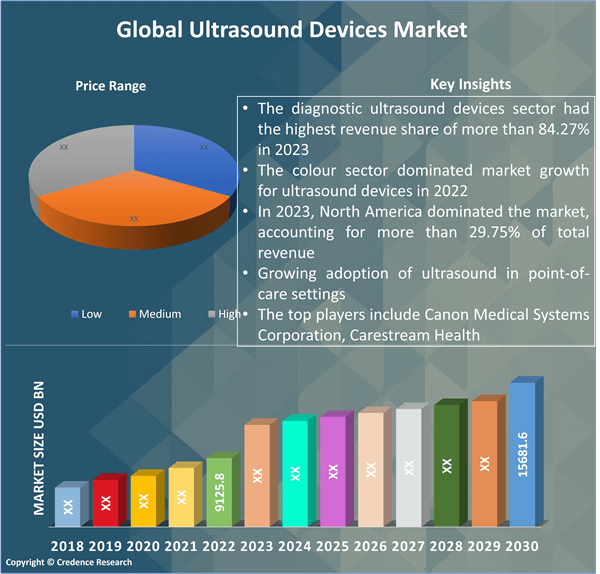
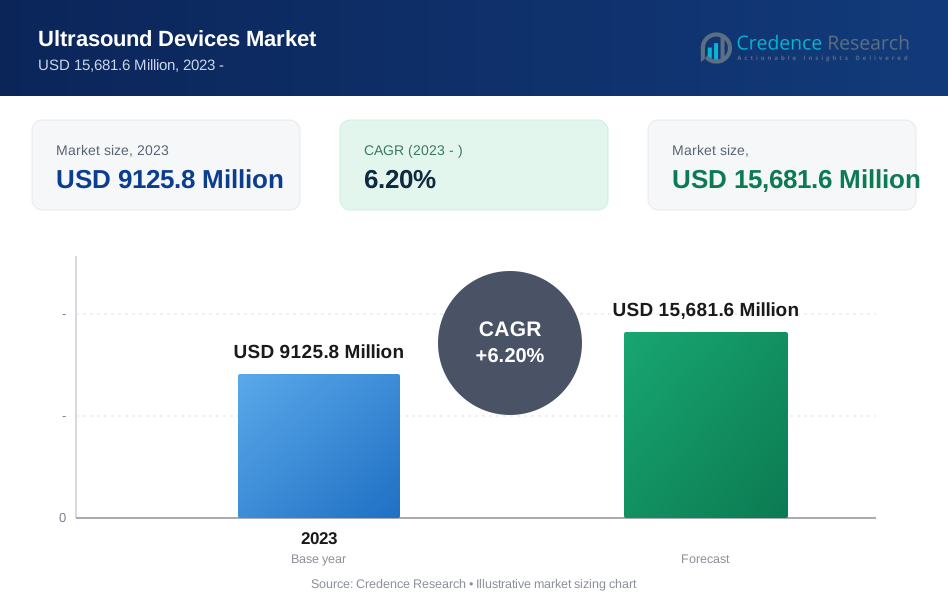
- The global demand for Ultrasound Devices was valued at USD 9125.8 Million in 2023 and is expected to reach USD 15681.6 Million in 2032, growing at a CAGR of 6.20% between 2024 and 2032.
- The diagnostic ultrasound devices sector had the biggest revenue share of more than 84.27% in 2023, while the therapeutic ultrasound devices segment is predicted to increase at the fastest CAGR.
- In 2023, the cart/trolley-based ultrasound instruments sector made the highest revenue.
- The Radiology / General Imaging Segment had the greatest market share in 2022, and the Cardiology category is predicted to develop at the fastest CAGR.
- The hospitals and diagnostic and surgical centres segment dominated the ultrasound device market in 2022, and the meternity centres sector has the greatest CAGR over the projected period.
- 2D Ultrasound Imaging dominates the ultrasound device industry, whereas 3D and 4D Ultrasound Imaging are among the fastest-growing categories.
- The ultrasound device market makes extensive use of high-frequency ultrasound equipment.
- Point-of-Care Ultrasound is the market's fastest growing segment.
- The colour sector dominated market growth for ultrasound devices in 2022 and is predicted to be the fastest-growing category over the forecast period (2022-2030).
- The ultrasound industry is dominated by transducers/probes, with workstations and software also being in great demand.
- In 2023, North America dominated the market, accounting for more than 29.75% of total revenue, and Asia Pacific is predicted to have the greatest CAGR throughout the forecast period.
- The increased frequency of chronic diseases and an expanding geriatric population will fuel market expansion.
- Product recalls and a lack of experienced technicians will limit the adoption of these devices.
Executive Summary
Market Definition
The Ultrasound Devices Market is the market for medical devices that employ ultrasound technology to create images of the internal Portabilitys of the body. Ultrasound equipment generate high-frequency sound waves that bounce off tissues and organs, resulting in real-time images that can be utilized for diagnosis. These devices are widely utilized in a variety of medical fields, including obstetrics and gynecology, cardiology, radiology, and others. The ultrasound device market covers the manufacture, distribution, and sale of these equipment to healthcare providers all over the world.
Market Overview
The global Ultrasound Devices Markethas witnessed steady growth in recent years and is expected to grow at a CAGR of 6.20% between 2024 and 2032. The market was valued at USD 9125.8 million in 2023 and is expected to reach USD 15681.6 million in 2032.
The Ultrasound Devices Market is a dynamic and fast-growing business. It is important in diagnostic imaging because it gives healthcare workers vital insights into the internal structures of the human body. Factors driving the market include the rising prevalence of chronic diseases, technological developments in ultrasound instruments, and increased demand for non-invasive diagnostic treatments. Ultrasound machines are commonly utilized in a variety of medical professions, including obstetrics, cardiology, radiology, and urology, among others. The market is characterized by the existence of numerous major manufacturers who provide a diverse variety of ultrasound devices with varying features and capabilities.
Segmentation by Type of Ultrasound Devices
- The diagnostic ultrasound devices sector had the highest revenue share of more than 84.27% in 2023. due to its vast range of uses in obstetrics, cardiology, and cancer. The need for diagnostic ultrasound devices is expected to rise as a result of technology advancements and the increased prevalence of various lifestyle disorders.
- The therapeutic ultrasound devices segment is expected to grow at the quickest CAGR of 4.90% between 2024 and 2030.
Segmentation by Portability
- In 2023, the cart/trolley-based ultrasound devices sector generated the most revenue, accounting for more than 67.75%. Cart/trolley ultrasounds eliminate the need to transfer important patients by transporting the device to the patient's location, whether that be an Intensive Care Unit (ICU) or an emergency department.
- Handheld ultrasound devices have proven effective for monitoring severely unwell patients. Thus, since the epidemic, demand for handheld ultrasound devices has only increased. Technological advances are projected to accelerate market expansion.
Segmentation by Application
- The Radiology / General Imaging Segment had the most market share in 2022. This rise is due to the low cost of general imaging. Doppler Ultrasound Imaging is one of several ultrasound imaging techniques.
- Furthermore, the Cardiology category is expected to grow at the quickest CAGR of 4.47% between 2022 and 2032, owing to the increasing prevalence of cardiovascular disorders worldwide that require the use of Doppler Ultrasound Imaging.
Segmentation by End-User
- The hospitals and diagnostic and surgical centres segment dominated the ultrasound device market in 2022 and is expected to be the fastest-growing segment during the forecast period, 2022-2030, due to an increase in people visiting hospitals for various lifestyle-related diseases and the widespread use of ultrasonography equipment in medical settings.
- The meternity centers segment is the highest CAGR over the forecast period.
Segmentation by Technology
- The dominant section of the ultrasound device market is 2D Ultrasound Imaging. It is the most extensively used and well-established type of ultrasound imaging, producing real-time two-dimensional images of the body's internal components.
- On the other hand, 3D and 4D Ultrasound Imaging are among the market's fastest-growing sectors.
Segmentation by Frequency
- High-frequency ultrasound devices are widely used in the ultrasound device market. High-frequency ultrasound devices typically run between 5 and 18 MHz and are often utilized for superficial imaging, such as the skin, breast, and musculoskeletal system. Their increased frequency enables more precise and detailed imaging of surface structures.
- Medium-frequency ultrasound devices are also an important component of the ultrasound device market.
Segmentation by Application Mode
- Point-of-Care Ultrasound is the market's fastest growing sector. POC ultrasonography is the use of portable ultrasound devices that can be utilized at the patient's bedside or in a clinical setting to provide immediate diagnostic evaluation. POC ultrasonography has various advantages, including real-time imaging, portability, ease of use, and cost effectiveness..
Segmentation by Display
- The colour sector dominated market growth for ultrasound devices in 2022 and is expected to be the fastest-growing segment over the forecast period (2022-2030). The market is expected to be driven by widespread adoption of technologically advanced ultrasound equipment and increased consumer awareness of the advantages of portable colour ultrasound devices.
Segmentation by Accessories
- Transducers/probes account for the largest market share in the ultrasound market. Transducers/probes are critical components of ultrasound systems because they emit and receive ultrasound waves to produce images. They are available in a variety of kinds and frequencies to meet the imaging needs of different body locations.
- Workstations and software are another high-demand market area.
- Printers and DVRs play an essential role in the ultrasound workflow for printing and archiving images, but their market share is smaller than that of transducers/probes and workstations/software.
Segmentation by Region
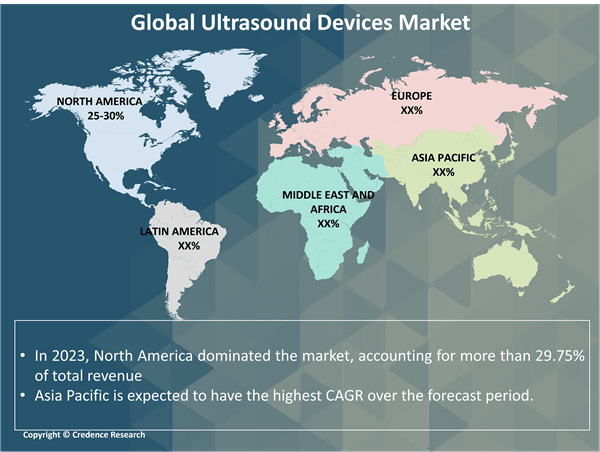
- In 2023, North America dominated the market, accounting for more than 29.75% of total revenue
- Asia Pacific is expected to have the highest CAGR over the forecast period.
- The rest of the world, including Latin America, the Middle East, and Africa, supplies the remaining demand for Ultrasound Devices.
In 2023, North America dominated the market. The region is predicted to increase significantly between 2024 and 2030. The presence of a large number of competitors in the region, as well as an increase in cancer incidence, are key factors driving regional market expansion. Increasing healthcare expenditure, a better grasp of various diagnostic technologies, and favourable reimbursement policies are expected to fuel regional market expansion.
Asia Pacific is expected to have the quickest CAGR of 4.90% between 2024 and 2030 due to rising demand for better imaging devices. Furthermore, prominent firms are implementing various measures to strengthen their presence in this region. Low research costs, less severe regulatory guidelines, and higher government financing for the development of the R&D sector in the various countries all contribute to the region's appeal for research studies. Furthermore, rapid economic development and improved healthcare services in Southeast Asian countries such as China, Japan, and India are likely to drive expansion.
Key Highlights of the Report
The global Ultrasound Devices Marketis segmented by Type of Ultrasound Devices, Portability, Applications, End-User, Technology, Frequency, Application Mode, Fire Rating and region. In 2022, 2D Ultrasound Imaging is the largest category of the ultrasound device market, with meternity centres showing the highest CAGR during the projection period. Furthermore, the market's fastest expanding sector is point-of-care ultrasound, while workstations and software are also in great demand. In addition, medium-frequency ultrasound devices play a significant role in the ultrasound device industry, with North America leading the market growth.
On the driver's side, the rising prevalence of chronic disorders causes a greater demand for precise diagnostic imaging solutions. Furthermore, technological advances in ultrasound equipment, such as higher image quality and enhanced functionalities, help to drive the market forward. Another motivator is the increasing desire for non-invasive, radiation-free diagnostic techniques. Furthermore, some restrictions include the expensive cost of contemporary ultrasound instruments, which restricts their use in certain locations and healthcare settings. It is also challenging to find qualified individuals to perform and interpret ultrasound scans. Furthermore, getting clear images in obese patients or those with high anatomical complexity can be difficult.
Nonetheless, In 2023, North America led the market. The region is expected to grow dramatically between 2024 and 2030. The presence of numerous rivals in the region, as well as an increase in cancer incidence, are important drivers of regional market expansion. Furthermore, Asia-Pacific is predicted to have the fastest CAGR of 4.90% between 2024 and 2030 due to rising need for better imaging devices.
What Are The Main Drivers Of The Global Ultrasound DevicesMarket?
One of the primary drivers of the Ultrasound Devices Market is the growing need for minimally invasive diagnostic treatments. Patients and healthcare professionals are looking for less invasive means of diagnosis, and ultrasound equipment provide a non-invasive and safe choice. Furthermore, advances in ultrasound technology, such as 3D and 4D imaging, have increased the capabilities and accuracy of ultrasound machines, fueling their popularity.
What Are The Major Challenges Faced By The Global Ultrasound DevicesMarket?
While there are numerous advantages to the Ultrasound Devices Market, there are also drawbacks to consider. One major constraint is the expensive cost of ultrasound instruments and their maintenance. These expenses can be prohibitive for healthcare facilities, particularly in resource-constrained environments. Another constraint is the scarcity of competent healthcare workers who can operate ultrasound equipment successfully. Proper training and competence are required to produce reliable results and interpretations.
What Are The Growth Opportunities In The Global Ultrasound DevicesMarket?
The Ultrasound Devices Market also offers numerous intriguing chances. One possibility is the increasing deployment of ultrasound equipment in emerging regions. As healthcare infrastructure improves and access to medical services develops, demand for ultrasound devices is likely to rise in these areas. Another possibility derives from the increased use of ultrasonography in point-of-care and distant healthcare settings. Portable and handheld ultrasound equipment allow healthcare providers to perform diagnostics in a variety of situations, improving accessibility and patient outcomes.
Market Drivers
Rising Prevalence Of Chronic Diseases And A Growing Geriatric Population
Globally, the rising frequency of chronic diseases has increased demand for healthcare services, including a rise in patient visits, hospital admissions, and procedures. For instance, In 2021, the CDC reported more than 1.0 billion physician office visits, 131.3 million emergency department visits, and 41.5 million outpatient surgeries in the United States.
The growing worldwide elderly population with chronic illnesses has increased the demand for medical imaging equipment, notably ultrasound, for diagnosis and treatment. Over the past decade, this technology has been applied in various therapeutic disciplines, including surgery, gastrointestinal, and musculoskeletal. Previously, these uses were limited to radiology, cardiology, obesity, and obstetrics. As a result, recent innovations and the introduction of various devices in the point-of-care (POC) and handheld systems have increased their use in primary care, anesthesia, emergency medicine, and critical care settings. This is likely to boost market growth throughout the forecast period.
Market Restraints
Product Recalls And A Shortage Of Trained Technicians Will Limit Adoption Of These Systems
The market is experiencing tremendous growth as a result of advances in the field of artificial imaging. However, recent recalls of these gadgets are harming the brand image of major players in the market. For instance, In August 2021, Koninklijke Philips N.V. recalled its Class 2 Sparq ultrasound instrument. The recall was initiated due to a battery data issue that caused the system to shut down sporadically, independent of battery state or the introduction of alternating current power.
This, combined with a dearth of skilled technicians in nations such as Australia, the United Kingdom, and Canada, is likely to limit growth potential over the forecast period.
For instance, according to the Diagnostic Radiography Workforce U.K. Census 2020, the sonographer vacancy rate in the UK is anticipated to be around 10.5%, with the inability to locate qualified applicants cited as one of the primary reasons.
Opportunities
Miniaturization Of Ultrasound Devices
As healthcare systems progressed to provide more portable medical instruments, a new trend of shrinking of ultrasound devices emerged. Thus, the increased demand for handheld and point-of-care ultrasound devices has paved the way for the development of technologically advanced tiny ultrasound devices. Such advancements continue to reduce the size and cost of ultrasound devices, making them more lightweight and mobile. This convergence of demand and technology has paved the way for the expansion of the portable ultrasound systems market.
Competitive Landscape
Key Players
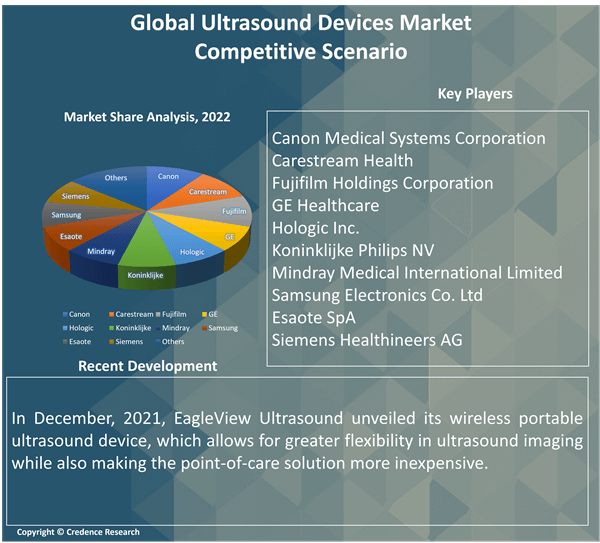
The global Ultrasound Devices Market is highly competitive, with several key players. Some of the major players in the market and their market share are as follows:
- Canon Medical Systems Corporation
- Carestream Health
- Fujifilm Holdings Corporation
- GE Healthcare
- Hologic Inc.
- Koninklijke Philips NV
- Mindray Medical International Limited
- Samsung Electronics Co. Ltd
- Esaote SpA
- Siemens Healthineers AG
These organizations prioritize product innovation, Ultrasound Devices Centers expansion, and mergers and acquisitions to stay competitive.
The global Ultrasound Devices Market's key players continually seek to stay ahead by offering new products and developments.
In February, 2022, Butterfly Network, Inc. and Ambra Health have established a collaboration to speed and simplify interoperability for bedside imaging data. This collaboration improves the scalability of Butterfly Blueprint, Butterfly's enterprise platform, and increases access to and shareability of valuable ultrasound data across hospitals and health systems.
In July 2020, Royal Philips has introduced a fresh line of DIY female grooming products for hair care and facial attractiveness. With tailored care high on the agenda, it has developed sophisticated microprocessor-enabled products that adjust in real time and deliver rare care for uncommon hair. Philips SenseIQ Hair Dryer and Hair Straightener, which are being introduced for the first time in India, use active sensors to monitor hair temperature during styling sessions and alter the temperature accordingly, resulting in a tailored styling experience.
Summary of Key Findings
- Miniaturization of ultrasound devices.
- Market segmented by Type of Ultrasound Devices, Portability, Applications, End-User, Technology, Frequency, Application Mode, Display, Accessories and region.
- The hospitals and diagnostic and surgical centres segment dominated the ultrasound device market in 2022
- In 2023, the cart/trolley-based ultrasound devices industry produced the greatest revenue.
- North America is leading market growth; the market is highly competitive with key players including Canon Medical Systems Corporation, Carestream Health, Fujifilm Holdings Corporation, GE Healthcare, Hologic Inc. and Others.
Future Outlook
- Continued technological advancements
- Increasing demand for portable and handheld ultrasound devices
- Growing adoption of ultrasound in point-of-care settings
- Expansion of applications beyond traditional medical specialties
- Rising focus on 3D and 4D ultrasound imaging
- Increasing investments in research and development
- Growing market presence in emerging economies
How CXOs Can Benefit from the Credence Research Ultrasound Devices MarketReport
The Credence Research Ultrasound Devices MarketReport provides CXOs with a comprehensive overview of the market, including:
- Market size and growth forecast:The report provides detailed estimates of the global Ultrasound Devices Marketsize, segmented by Type of Ultrasound Devices, Portability, Applications, End-User, Technology, Frequency, Application Mode, Display, Accessories and region. It also includes forecasts for the market through 2032, based on key trends and drivers.
- Market segmentation:The report segments the Ultrasound Devices Marketby Type of Ultrasound Devices, Portability, Applications, End-User, Technology, Frequency, Application Mode, Display, Accessories and region. This segmentation provides CXOs with a granular understanding of the market and the opportunities in each segment.
- Competitive landscape:The report profiles the key players in the Ultrasound Devices Marketand provides insights into their strategies, product offerings, and financial performance. This information can help CXOs to identify and assess their competition.
- Key trends and drivers:The report identifies and analyzes the key trends and drivers that are shaping the Ultrasound Devices Market. This information can help CXOs to make informed decisions about their investments and strategies.
CXOs can use the insights from the Credence Research Ultrasound Devices Market Report to:
- Identify growth opportunities:The report can help CXOs to identify new growth opportunities in the Ultrasound Devices Market. For example, the report can provide insights into emerging applications of ultrasound devices, such as point-of-care ultrasound or 3D/4D imaging, which may present untapped growth potential.
- Make informed investment decisions:The report can help CXOs to make informed investment decisions about Ultrasound Devices. For example, the report can provide CXOs with valuable insights on market trends, competitive landscape, and technological advancements in the Ultrasound Devices industry.
- Develop competitive strategies:The report can help CXOs to develop competitive strategies for their Ultrasound Devices businesses. For example, the report can provide CXOs with a comprehensive analysis of the competitive landscape in the Ultrasound Devices market. It can offer insights into the market share of key players, their product portfolios, pricing strategies, and distribution channels.
- Track market developments:The report can help CXOs to track market developments and stay ahead of the curve. For example, the report provides insights into the latest trends and innovations in the Ultrasound Devices Market.
Overall, the Credence Research Ultrasound Devices MarketReport is a valuable resource for CXOs who are looking to gain a deeper understanding of the market and identify opportunities for growth.
Segmentation
By Type of Ultrasound Devices:
- Diagnostic Ultrasound Devices:
- 2D Ultrasound
- 3D and 4D Ultrasound
- Doppler Ultrasound
- Therapeutic Ultrasound Devices:
- High-Intensity Focused Ultrasound (HIFU)
- Extracorporeal Shock Wave Lithotripsy (ESWL)
- Low-Intensity Pulsed Ultrasound (LIPUS)
By Portability:
- Cart/Trolley-based Ultrasound Devices
- Compact/Handheld Ultrasound Devices
By Application:
- Obstetrics and Gynecology
- Cardiology
- Radiology/General Imaging
- Urology
- Musculoskeletal
- Vascular
- Ophthalmology
- Others
By End-User:
- Hospitals and Surgical Centers
- Diagnostic Centers
- Maternity Centers
- Ambulatory Care Centers
- Research and Academic Institutes
By Technology:
- 2D Ultrasound Imaging
- 3D and 4D Ultrasound Imaging
- Doppler Imaging
- High-Intensity Focused Ultrasound (HIFU)
- Color Doppler Imaging
- Portable Ultrasound Imaging
By Frequency:
- Low-frequency Ultrasound Devices
- Medium-frequency Ultrasound Devices
- High-frequency Ultrasound Devices
By Application Mode:
- Point-of-Care (POC) Ultrasound
- Fixed Ultrasound Imaging
By Display:
- Black and White Ultrasound Imaging
- Color Ultrasound Imaging
By Accessories:
- Transducers/Probes
- Workstation and Software
- Printers and DVRs
- Others
By Region
- North America
- US
- Canada
- Mexico
- Europe
- Germany
- France
- UK.
- Italy
- Spain
- Rest of Europe
- Asia Pacific
- China
- Japan
- India
- South Korea
- South-east Asia
- Rest of Asia Pacific
- Latin America
- Brazil
- Argentina
- Rest of Latin America
- Middle East & Africa
- GCC Countries
- South Africa
- Rest of Middle East and Africa
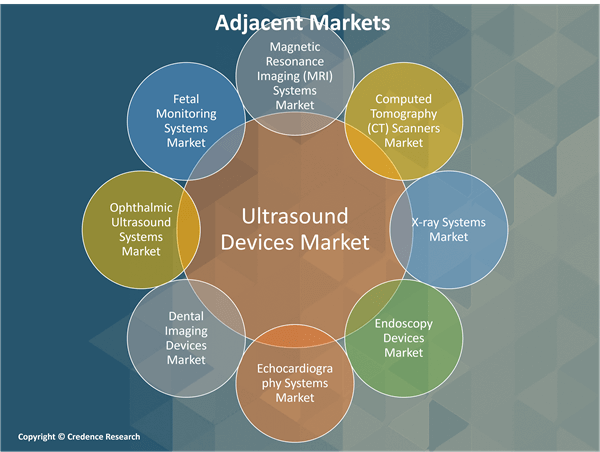
Adjacent Markets
In the Ultrasound Devices Market, there are several adjacent markets which has high revenue growth opportunities. The key adjacent markets for Ultrasound Devices Market-
Request a Free Sample
Fill in your details and we'll send you a free sample report.
- Sample data tables & charts
- Research methodology
Need a Custom Version of This Report?
Tailor the scope, geography, or segments to your exact requirements.
- Custom geography or segment scope
- Direct access to our analyst team
Frequently Asked Questions
What is the current size of the global Ultrasound Devices Market?
What is the expected growth rate of the Ultrasound Devices Market between 2024 and2032?
Which segment is leading the market share in terms of Type of Ultrasound Devices?
Which Accessories segment governs the demand for Technology?
Which Technology segment is expected to post the fastest growing during the forecastperiod?
Which region is fueling the growth of the Ultrasound Devices industry?
Who are the major players in the global Ultrasound Devices Market?
What are the major market drivers of the Ultrasound Devices industry?
What are the major market restraints of the Ultrasound Devices industry?
Table of Content
Chapter 1. Report Introduction
- 1.1 Report Description & Purpose
- 1.1.1 Report Title & Market Definition
- 1.1.2 Unique Selling Propositions (USP) & Key Differentiators
- 1.1.3 Value Proposition for Stakeholders
- 1.2 Research Objectives
- 1.2.1 Market Sizing Objectives (Volume & Revenue)
- 1.2.2 Segmentation Objectives
- 1.2.3 Competitive Intelligence Objectives
- 1.2.4 Forecast & Scenario Objectives
- 1.3 Report Scope
- 1.3.1 Ultrasound Devices Scope – Types & Subtypes Covered
- 1.3.2 Geographic Scope – Regions & Countries Covered
- 1.3.3 Historical Period, Base Year & Forecast Period (2023; forecast to the forecast period)
- 1.3.4 Inclusions & Exclusions
- 1.4 HS Code & Classification Framework
- 1.5 Currency, Units & Pricing Basis
- 1.6 Target Stakeholders
- 1.7 Limitations & Assumptions
Chapter 2. Executive Summary
- 2.1 Global Ultrasound Devices Market Snapshot
- 2.1.1 Market Size – Historical (2023) & Forecast (the forecast period) (2023: USD 9125.8 Million → forecast year: USD 15,681.6 Million)
- 2.1.2 Volume & Revenue – Global Totals
- 2.1.3 Key Market Highlights – Top Five Facts
- 2.2 Ultrasound Devices Market Segmentation Snapshot
- 2.2.1 Market Split by Region – 2023 vs.
- 2.3 Competitive Snapshot
- 2.3.1 Top 10 Players by Revenue Share – 2023
- 2.3.2 Top 10 Players by Volume Share – 2023
- 2.3.3 Recent Strategic Developments (18-Month Summary)
- 2.4 Key Investment Highlights & Strategic Conclusions
Chapter 3. Ultrasound Devices Market Dynamics & Industry Analysis
- 3.1 Market Overview & Context
- 3.1.1 Ultrasound Devices Market Position in the Broader Automotive Value Chain
- 3.1.2 OEM vs. Replacement Market Dynamics
- 3.1.3 Market Maturity & Development Stage by Region
- 3.2 Ultrasound Devices Market Drivers
- 3.3 Ultrasound Devices Market Restraints & Challenges
- 3.4 Ultrasound Devices Market Opportunities
- 3.5 Porter's Five Forces Analysis
- 3.5.1 Threat of New Entrants
- 3.5.2 Bargaining Power of Suppliers
- 3.5.3 Bargaining Power of Buyers
- 3.5.4 Threat of Substitutes
- 3.5.5 Competitive Rivalry – Intensity Assessment
- 3.6 Ultrasound Devices Value Chain Analysis
- 3.6.1 Upstream – Raw Material/Input Suppliers
- 3.6.1.1 Raw Material/Input 1
- 3.6.1.2 Raw Material/Input 2
- 3.6.1.3 Raw Material/Input 3
- 3.6.2 Midstream – Production/Manufacturing/Service Delivery
- 3.6.2.1 Production/Process Overview
- 3.6.2.2 Key Facility Locations & Capacity by Manufacturer
- 3.6.3 Downstream – Distribution & End Consumer
- 3.6.3.1 Primary Channel – B2B/OEM
- 3.6.3.2 Secondary Channels – Dealer, Retail, Online, Direct
- 3.6.4 Value Chain Profitability Analysis
- 3.6.1 Upstream – Raw Material/Input Suppliers
- 3.7 PESTEL Analysis
- 3.7.1 Political Factors
- 3.7.2 Economic Factors
- 3.7.3 Social Factors
- 3.7.4 Technological Factors
- 3.7.5 Environmental Factors
- 3.7.6 Legal Factors
- 3.8 Ultrasound Devices Supply Chain Analysis
- 3.8.1 Raw Material/Input Supply Risk Assessment
- 3.8.2 Manufacturing Concentration Risk (Geographic Exposure)
- 3.8.3 Trade Disruption Impact Analysis
- 3.9 Regulatory & Policy Landscape
Note: The regulatory and policy landscape section covers regulations based on their applicability to the market, Ultrasound Devices category, geography, and scope of the study. Only regulatory frameworks with a material impact on operations, compliance, trade, sustainability, or market access are analyzed in detail.
Chapter 4. Key Investment Pockets & Opportunity Analysis
- 4.1 Ultrasound Devices Market Attractiveness Analysis
- 4.1.1 By Region – Investment Attractiveness Matrix (Volume × CAGR)
- 4.2 Absolute Revenue Growth Opportunity
- 4.2.1 By Region – Absolute USD Growth Through the forecast period
- 4.3 Incremental Volume Opportunity
- 4.3.1 By Region – Incremental Volume Through the forecast period
- 4.3.2 Segment – Incremental Volume
- 4.4 Emerging Submarket Opportunity Deep Dive (Subject to Applicability)
- 4.5 Emerging Market Opportunity Scorecards
- 4.5.1 United States
- 4.5.2 Europe
- 4.5.3 Asia
- 4.5.4 Middle East & Africa
Note: Emerging Market Opportunity Scorecards will be included based on relevance and strategic importance. Regions listed are indicative and may vary depending on data availability and market dynamics.
Chapter 5. Ultrasound Devices Import-Export Analysis & Trade Flows
- 5.1 Global Trade Overview
- 5.1.1 Global Export Value by Country (2023)
- 5.1.2 Global Export Volume by Country (2023)
- 5.1.3 Global Import Value by Country (2023)
- 5.1.4 Global Import Volume by Country (2023)
- 5.1.5 Net Trade Balance by Country (2023)
- 5.2 Export Analysis – Segment
- 5.2.1 Type 1 (HS Code)
- 5.2.2 Type 2 (HS Code)
- 5.2.3 Type 3 (HS Code)
- 5.2.4 Type 4 (HS Code)
- 5.2.5 Type 5 (HS Code)
- 5.3 Import Analysis – Segment
- 5.3.1 Type 1 (HS Code)
- 5.3.2 Type 2 (HS Code)
- 5.3.3 Type 3 (HS Code)
- 5.3.4 Type 4 (HS Code)
- 5.3.5 Type 5 (HS Code)
- 5.4 Average Unit Trade Prices
- 5.4.1 Average Export Price – Segment & Country
- 5.4.2 Average Import Price – Segment & Source Country
- 5.4.3 Price Trends (2023)
- 5.5 Key Trade Route Analysis
- 5.5.1 Trade Route 1
- 5.5.2 Trade Route 2
- 5.5.3 Trade Route 3
- 5.5.4 Trade Route 4
- 5.5.5 Trade Route 5
- 5.6 Trade Policy Impact Assessment
- 5.6.1 US Anti-Dumping & Section 301 Tariffs
- 5.6.2 EU Customs Union Impact
- 5.6.3 Major Free Trade Agreements
- 5.6.4 USMCA Rules of Origin
Note: Trade policy analysis will be included only where relevant to the Ultrasound Devices market.
Chapter 6. Competitive Landscape & Company Benchmarking
- 6.1 Ultrasound Devices Market Concentration & Structure
- 6.1.1 Herfindahl-Hirschman Index (HHI) – vs. 2023
- 6.1.2 Tier 1, Tier 2 & Tier 3 Market Structure
- 6.1.3 Global, Regional & Local Player Dynamics
- 6.2 Ultrasound Devices Market Share Analysis – 2023
- 6.2.1 Global Revenue Share by Company
- 6.2.2 Global Volume Share by Company
- 6.2.3 Regional Revenue Share
- 6.2.4 Market Share Evolution ( vs. 2023)
- 6.2.5 OEM Segment Share by Company
- 6.2.6 Replacement Segment Share by Company
- 6.3 Production/Delivery Capacity & Facility Analysis
- 6.3.1 Global Installed Capacity
- 6.3.2 Capacity Utilization Rates
- 6.3.3 Production/Output Volume
- 6.3.4 Facility Locations & Capacity Map
- 6.3.5 Planned Capacity Additions
- 6.4 Ultrasound Devices Competitive Benchmarking Matrix
- 6.4.1 Revenue, Volume, CAGR & Profitability Comparison
- 6.4.2 Channel Revenue Mix
- 6.4.3 Geographic Revenue Exposure
- 6.4.4 R&D Intensity
- 6.4.5 Sustainability Maturity
- 6.5 Strategic Developments in Ultrasound Devices (Last 24 Months)
- 6.5.1 Mergers, Acquisitions & Divestments
- 6.5.2 New Ultrasound Devices Launches
- 6.5.3 Facility Expansions
- 6.5.4 Strategic Alliances, Joint Ventures & Partnerships
- 6.5.5 Distribution Expansion & Market Entry
- 6.5.6 Sustainability & ESG Initiatives
- 6.6 Competitive Strategy Mapping
- 6.6.1 Leader, Challenger, Follower & Niche Classification
- 6.6.2 Pricing Strategy Comparison
- 6.6.3 Channel Strategy Matrix
Note: Strategic developments are included based on their materiality and the availability of reliable information.
Chapter 7. Global Ultrasound Devices Market – By Distribution Channel
- 7.1 Segment Overview
- 7.1.1 Volume & Revenue Split by Channel (2023 & )
- 7.1.2 Channel Mix Evolution (the forecast period)
Chapter 8. Regional Market Analysis – Global Overview
- 8.1 Global Regional Overview
- 8.1.1 Regional Volume Share
- 8.1.2 Regional Revenue Share
- 8.1.3 Regional Volume by Region
- 8.1.4 Regional Revenue by Region
- 8.1.5 Regional Forecast Through the forecast period
- 8.2 Cross-Regional Segment Analysis
- 8.2.1 By Distribution Channel
- 8.2.2 By Brand/Price Tier
Chapter 9. North America Ultrasound Devices Market
- 9.1 United States
- 9.2 Canada
- 9.3 Mexico
Chapter 10. Europe Ultrasound Devices Market
- 10.1 Germany
- 10.2 France
- 10.3 Italy
- 10.4 United Kingdom
- 10.5 Spain
- 10.6 Poland
- 10.7 Russia
- 10.8 Netherlands
- 10.9 Belgium
- 10.10 Sweden
- 10.11 Denmark
- 10.12 Norway
- 10.13 Rest of Europe
Chapter 11. Asia Pacific Ultrasound Devices Market
- 11.1 China
- 11.2 India
- 11.3 Japan
- 11.4 South Korea
- 11.5 Thailand
- 11.6 Indonesia
- 11.7 Vietnam
- 11.8 Malaysia
- 11.9 Australia
- 11.10 Rest of Asia Pacific
Chapter 12. Latin America Ultrasound Devices Market
- 12.1 Brazil
- 12.2 Argentina
- 12.3 Colombia
- 12.4 Chile
- 12.5 Rest of Latin America
Chapter 13. Middle East Ultrasound Devices Market
- 13.1 Saudi Arabia
- 13.2 United Arab Emirates
- 13.3 Turkey
- 13.4 Israel
- 13.5 Iran
- 13.6 Rest of the Middle East
Chapter 14. Africa Ultrasound Devices Market
- 14.1 South Africa
- 14.2 Egypt
- 14.3 Nigeria
- 14.4 Morocco
- 14.5 Rest of Africa
Chapter 15. Ultrasound Devices Company Profiles
- 15.1 [Company 01]
- 15.1.1 Company Overview
- 15.1.2 Key Management Personnel
- 15.1.3 Products & Services Portfolio
- 15.1.4 Financial Performance
- 15.1.5 Key Market Focus & Geographic Presence
- 15.1.6 Recent Developments & Strategic Initiatives
Note: The company profile list is preliminary and may change based on research findings, market developments, data availability, and client requirements.
Chapter 16. Appendices
- Appendix A – List of Abbreviations & Acronyms
- Appendix B – Industry Classification Code Reference – Full Series
- Appendix C – Production & Capacity Data Tables
- Appendix D – End-Use & Demand Base Tables
- Appendix E – Consumption & Replacement Rate Assumptions
- Appendix F – ASP Reference Tables
- Appendix G – Manufacturing & Facility Database
- Appendix H – Import-Export Data Tables
- Appendix I – Regulatory Summary Tables
- Appendix J – Primary Research Participant List (Anonymized)
- Appendix K – Primary Research Questionnaire Framework
- Appendix L – Data Sources & Bibliography
- Appendix M – Market Size Divergence & Source Comparison
Chapter 17. Research Methodology
- 17.1 Research Framework & Philosophy
- 17.2 Secondary Research – Sources, Hierarchy & Data Extraction
- 17.3 Data Modeling – Bottom-Up & Top-Down Market Sizing
- 17.4 Primary Research – Stakeholder Framework, LOI & Sample Sizes
- 17.5 Forecast Methodology – Regression, Scenario & Sensitivity Analysis
- 17.6 Quality Control – Four-Layer Validation Framework
- 17.7 Limitations & Standard Assumptions
- 17.8 Disclaimer
