Electronic Stethoscope Market Overview:
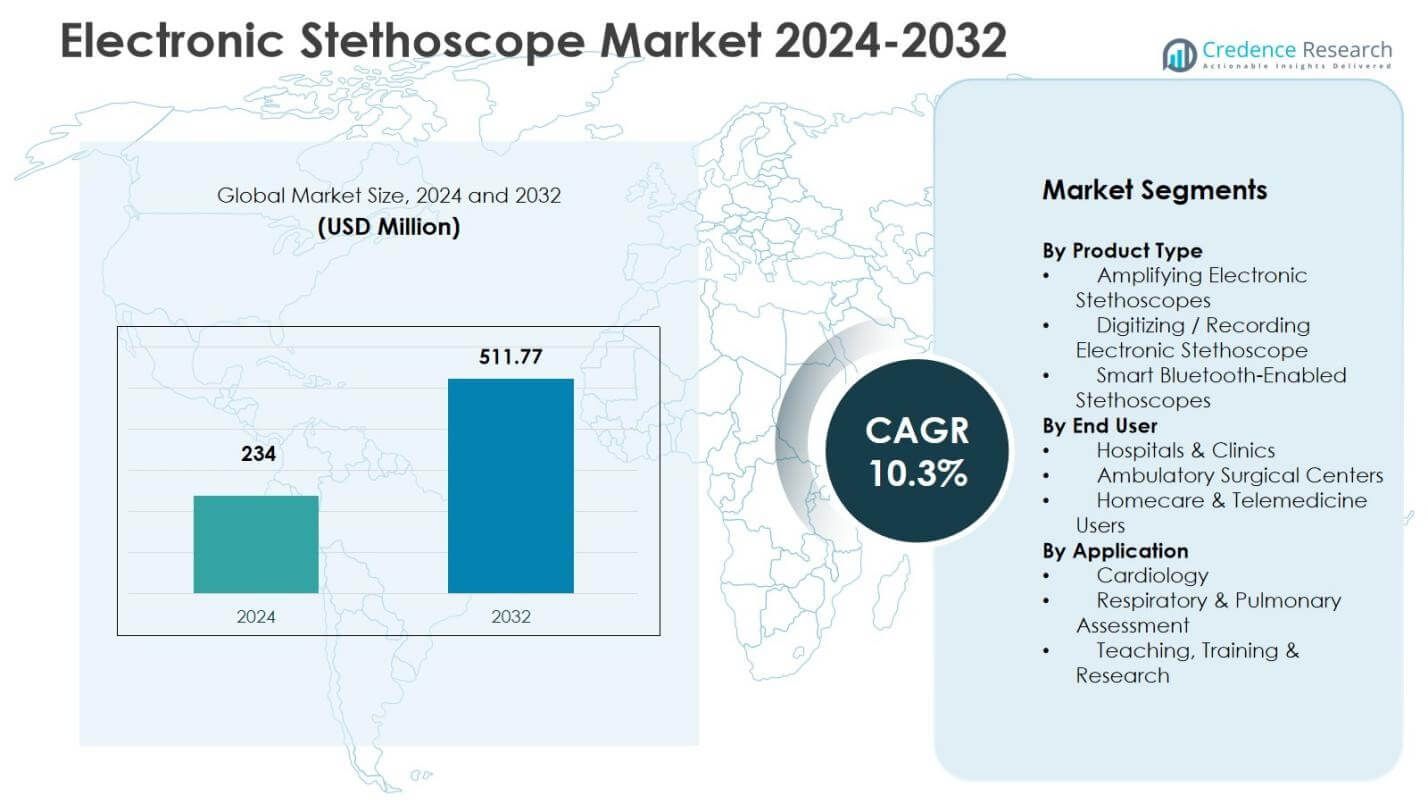
Electronic Stethoscope Market size was valued USD 234 Million in 2024 and is anticipated to reach USD 511.77 Million by 2032, at a CAGR of 10.3% during the forecast period.
| REPORT ATTRIBUTE | DETAILS |
|---|---|
| Historical Period | 2020-2024 |
| Base Year | 2025 |
| Forecast Period | 2026-2032 |
| Electronic Stethoscope Market Size 2024 | USD 234 million |
| Electronic Stethoscope Market, CAGR | 10.3% |
| Electronic Stethoscope Market Size 2032 | USD 511.77 million |
Electronic Stethoscope Market Insights
- Market growth is driven by rising adoption of telemedicine, AI-enabled diagnostics, remote patient monitoring, and increasing demand for advanced auscultation tools across cardiology and respiratory care segments.
- Market trends reflect strong uptake of Smart Bluetooth-Enabled Stethoscopes, which accounted for 44.2% share in 2024, supported by wireless connectivity, data recording functions, and integration with mobile health platforms
- Leading players focus on product innovation, digital sound amplification, cloud connectivity, and partnerships with hospitals and telehealth providers, while emerging manufacturers emphasize affordability and access expansion in developing markets.
- Regional performance is led by North America with 38.6% share in 2024, followed by Europe with 27.4% share and Asia-Pacific with 23.1% share, supported by rapid healthcare digitization and clinical technology adoption.
Electronic Stethoscope Market Segmentation Analysis:
By Product Type
The Product Type segment in the Electronic Stethoscope Market is led by Smart Bluetooth-Enabled Stethoscopes, which accounted for 44.2% market share in 2024, driven by rising adoption in telehealth, seamless wireless data transfer, AI-supported diagnostics, and integration with mobile health platforms. Amplifying Electronic Stethoscopes held 32.6% share, supported by strong demand in noisy clinical environments and enhanced sound amplification for cardiology screening. Digitizing / Recording Electronic Stethoscopes captured 23.2% share, gaining traction in academic training and remote consultation use cases, particularly where digital sound archiving and playback improve diagnostic accuracy and clinical documentation.
- For instance, Eko’s CORE 500 digital stethoscope combines Bluetooth connectivity, up to 40x sound amplification, a 3‑lead ECG, and an on-device color display, while pairing with AI algorithms to support arrhythmia detection in connected cardiac care workflows.
By End User
The End User segment is dominated by Hospitals & Clinics, which represented 57.8% market share in 2024, supported by large-scale deployment in emergency care, cardiology units, and specialized diagnostic departments, along with growing investments in connected medical devices. Ambulatory Surgical Centers accounted for 22.4% share, driven by the need for precise pre-operative and post-operative patient monitoring. Homecare & Telemedicine Users held 19.8% share, expanding rapidly due to remote patient monitoring programs, physician-patient virtual consultations, and increased acceptance of digital diagnostic tools among chronic disease and elderly patient groups.
- For instance, Medtronic offers the BIS™ Advance monitor and INVOS™ 7100 regional oximeter for brain and oxygenation monitoring during procedures. These tools aid anesthesia providers in tracking patient consciousness and regional oxygen saturation.
By Application
The Application segment is led by Cardiology, which recorded 46.9% market share in 2024, driven by increasing prevalence of cardiovascular disorders, demand for enhanced heart sound analysis, and wider adoption of amplified and AI-enabled cardiac auscultation tools. Respiratory & Pulmonary Assessment accounted for 34.1% share, supported by rising cases of asthma, COPD, and post-infection lung monitoring, where electronic stethoscopes enable clearer lung sound detection. Teaching, Training & Research contributed 19.0% share, with growth driven by simulation-based medical education, remote learning environments, and digital sound recording for clinical skill development.
Key Growth Drivers
Rising Adoption of Telemedicine and Remote Patient Monitoring
The Electronic Stethoscope Market experiences strong growth as healthcare systems accelerate the adoption of telemedicine and remote patient monitoring solutions. Clinicians increasingly rely on Bluetooth-enabled and cloud-connected stethoscopes to capture high-fidelity heart and lung sounds during virtual consultations, enabling accurate diagnosis without in-person visits. This trend is supported by the expansion of digital health infrastructure, improved reimbursement frameworks, and growing acceptance of home-based care among chronic and elderly patients. The ability to transmit auscultation data securely, integrate recordings into electronic health records, and support AI-assisted clinical interpretation further strengthens demand for electronic stethoscopes in telehealth ecosystems.
- For instance, Eko's DUO ECG + Digital Stethoscope amplifies heart, lung, and body sounds up to 60x with 12 volume levels and Bluetooth connectivity. It enables wireless streaming to smartphones for real-time visualization, recording, and secure sharing of auscultation data during remote exams.
Growing Burden of Cardiovascular and Respiratory Diseases
Rising global prevalence of cardiovascular disorders, COPD, asthma, and post-infectious respiratory complications significantly drives market demand for advanced auscultation technologies. Electronic stethoscopes provide enhanced sound amplification, noise reduction, and digital waveform visualization, improving early detection and monitoring of heart murmurs, arrhythmias, and lung abnormalities. Healthcare providers increasingly prefer these devices in cardiology, pulmonology, and critical-care environments because they support more precise clinical assessments compared to traditional acoustic models. The need for improved diagnostic accuracy, preventive screening programs, and continuous patient monitoring strengthens the market’s growth trajectory across hospitals, specialty clinics, and outpatient care settings.
- For instance, the 3M Littmann CORE Digital Stethoscope offers up to 40x amplification and active noise cancellation, reducing background distractions in noisy environments to enhance clarity of faint heart and lung sounds like murmurs or rubs.
Integration of AI, Data Analytics, and Smart Connectivity
Technological innovation plays a major role in accelerating market expansion as electronic stethoscopes evolve into intelligent diagnostic platforms. Integration of AI algorithms, signal-processing tools, and mobile-application connectivity enables automated sound interpretation, anomaly detection, and real-time clinical decision support. These capabilities enhance workflow efficiency, support evidence-based diagnosis, and expand usage in training and research environments. The ability to store, replay, and share auscultation recordings also facilitates collaborative care and teleconsultation models. Device interoperability with digital health ecosystems, wearable sensors, and smart diagnostic networks positions electronic stethoscopes as a core component of connected and data-driven healthcare delivery.
Key Trends & Opportunities
Expansion of Smart, Cloud-Enabled, and Interoperable Diagnostic Ecosystems
A major trend shaping the Electronic Stethoscope Market is the rapid shift toward cloud-enabled, interoperable, and ecosystem-driven diagnostic platforms. Manufacturers increasingly design devices that integrate seamlessly with hospital information systems, remote monitoring dashboards, and AI-powered analytics engines. This creates opportunities for advanced patient data management, clinical collaboration, and long-term disease tracking. Growing investments in digital hospitals, virtual care infrastructure, and mobile health applications further expand the adoption of connected stethoscopes. Vendors also explore partnerships with telehealth providers and software developers to deliver subscription-based diagnostic solutions, enabling recurring revenue streams and enhanced value delivery for healthcare organizations and clinicians.
- For instance, the 3M Littmann CORE Digital Stethoscope offers up to 40x amplification and active noise cancellation, connecting via Bluetooth to Eko software for HIPAA-compliant cloud storage of 15- to 120-second recordings.
Increasing Use in Medical Education, Simulation, and Clinical Training
The market benefits from expanding adoption of electronic stethoscopes in academic institutions, simulation laboratories, and competency-based medical training programs. Digital sound recording, playback capabilities, and waveform visualization allow students and trainees to analyze heart and lung sounds with greater accuracy and repeatability. Universities and teaching hospitals increasingly integrate electronic auscultation tools into virtual learning environments and remote training modules, supporting skill development beyond traditional classroom settings. Opportunities also emerge in standardized patient simulations, research-based clinical studies, and collaborative learning platforms, where electronic stethoscopes enhance instructional quality while aligning with the global transition toward digital and technology-enabled medical education.
- For instance, Eko Health launched the Eko Academy app to strengthen auscultation skills for medical students, offering high-fidelity heart and lung recordings for instant comparison of disease signals like systolic murmurs and arrhythmias with normal sounds.
Key Challenges
High Device Cost and Limited Accessibility in Low-Resource Healthcare Settings
Despite growing adoption, high acquisition and maintenance costs pose a significant challenge to widespread market penetration, particularly in small clinics and low-resource healthcare environments. Electronic stethoscopes are often priced higher than conventional acoustic models, limiting affordability for practitioners in emerging economies and rural care settings. Budget constraints, limited procurement funding, and inadequate digital infrastructure further restrict adoption, especially where telehealth ecosystems are still developing. These factors create price-sensitivity barriers and slow replacement cycles, encouraging healthcare providers to continue relying on traditional stethoscopes despite the diagnostic advantages offered by advanced electronic alternatives.
Data Security, Interoperability, and Regulatory Compliance Concerns
The increasing use of connected and AI-enabled stethoscopes introduces challenges related to data privacy, cybersecurity, and regulatory compliance. Transmission and storage of patient auscultation recordings require strict adherence to healthcare data-protection policies, which can complicate system integration and deployment. Variations in regulatory frameworks across regions create additional complexity for manufacturers, particularly when validating AI-driven diagnostic features. Interoperability gaps between devices, telehealth platforms, and clinical information systems may also hinder seamless workflow adoption. These challenges require continuous investment in secure software architecture, standards-based connectivity, and robust clinical validation to maintain user confidence and regulatory trust.
Regional Analysis
North America
North America holds a leading position in the Electronic Stethoscope Market, accounting for 38.6% market share in 2024, driven by strong adoption of telehealth, advanced diagnostic technologies, and AI-enabled auscultation devices across hospitals and specialty clinics. The region benefits from well-established healthcare infrastructure, higher spending on connected medical devices, and strong presence of key manufacturers and digital health innovators. Growing prevalence of cardiovascular and respiratory disorders, combined with increasing use of remote patient monitoring and training applications in academic institutions, further reinforces market growth across the United States and Canada, supporting continued technology integration in clinical workflows.
Europe
Europe represents a significant market with 27.4% share in 2024, supported by structured healthcare modernization programs, early adoption of digital diagnostics, and expanding use of electronic stethoscopes in cardiology and pulmonology departments. The region’s regulatory emphasis on clinical accuracy, patient safety, and data-driven care encourages investments in AI-supported diagnostic tools and interoperable telemedicine platforms. Demand strengthens across Germany, the United Kingdom, France, and Nordic countries due to rising chronic disease screening initiatives and growth in medical education and simulation-based training, positioning Europe as an important hub for technology adoption and collaborative digital healthcare deployment.
Asia-Pacific
Asia-Pacific is one of the fastest-growing regions and captured 23.1% market share in 2024, driven by expanding healthcare digitization, rapid telehealth penetration, and increasing investment in smart diagnostic devices across emerging economies. Demand rises in China, Japan, India, South Korea, and Australia as hospitals and telemedicine providers integrate Bluetooth-enabled and AI-supported stethoscopes into patient monitoring programs. Government initiatives to strengthen digital healthcare ecosystems, growing awareness of preventive cardiology and respiratory assessment, and rising healthcare workforce training needs further accelerate adoption, creating strong opportunities for manufacturers and technology partners across both developed and developing healthcare markets in the region.
Latin America
Latin America accounted for 6.1% market share in 2024, with growth supported by gradual digital health expansion, increasing urban healthcare investments, and rising acceptance of connected diagnostic devices in secondary and tertiary care facilities. Demand is concentrated in Brazil, Mexico, Argentina, and Colombia, where telemedicine networks and remote consultation models continue to strengthen. Market growth is influenced by the need for improved chronic disease monitoring and enhanced diagnostic accuracy in public and private hospitals, although adoption remains moderated by budget constraints and affordability gaps, encouraging progressive but steady transition from traditional acoustic stethoscopes to electronic alternatives.
Middle East & Africa
The Middle East & Africa region recorded 4.8% market share in 2024, supported by growing healthcare infrastructure development, rising investments in smart hospital projects, and increasing introduction of digital diagnostic technologies in Gulf Cooperation Council countries. Adoption advances in the United Arab Emirates, Saudi Arabia, and South Africa as healthcare providers integrate remote monitoring and teleconsultation capabilities into care delivery frameworks. Training and academic institutions also contribute to rising demand through simulation-based learning and digital auscultation programs, although variations in technology accessibility across low-resource settings continue to influence deployment pace and overall adoption levels in the region.
Electronic Stethoscope Market Segmentations:
By Product Type
- Amplifying Electronic Stethoscopes
- Digitizing / Recording Electronic Stethoscope
- Smart Bluetooth-Enabled Stethoscopes
By End User
- Hospitals & Clinics
- Ambulatory Surgical Centers
- Homecare & Telemedicine Users
By Application
- Cardiology
- Respiratory & Pulmonary Assessment
- Teaching, Training & Research
By Geography
- North America
- U.S.
- Canada
- Mexico
- Europe
- Germany
- France
- U.K.
- Italy
- Spain
- Rest of Europe
- Asia Pacific
- China
- Japan
- India
- South Korea
- South-east Asia
- Rest of Asia Pacific
- Latin America
- Brazil
- Argentina
- Rest of Latin America
- Middle East & Africa
- GCC Countries
- South Africa
- Rest of the Middle East and Afric
Competitive Landscape
Competitive landscape analysis in the Electronic Stethoscope Market features leading players such as 3M (Littmann), Eko Health Inc., Thinklabs Medical LLC, Contec Medical Systems Co., Ltd., American Diagnostic Corporation (ADC), Cardionics Inc., HD Medical Inc., eKuore, Linktop, and TaiDoc Technology Corporation. These companies focus on product innovation, AI-enabled sound analysis, wireless connectivity, and integration with telehealth platforms to strengthen market positioning. The landscape is characterized by continuous R&D investments, launch of Bluetooth-enabled and cloud-connected models, and strategic partnerships with hospitals, telemedicine providers, and academic institutions. Premium brands emphasize advanced amplification, noise-reduction features, and clinical accuracy, while emerging manufacturers compete through affordability and accessibility in developing markets. Vendors increasingly prioritize data security, interoperability, and mobile-app ecosystems to support remote diagnostics and digital health workflows. The market also witnesses growing activity in training and simulation-focused solutions, alongside expansion into homecare monitoring and chronic disease management segments, shaping a technology-driven and innovation-centric competitive environment.
Key Player Analysis
- 3M (Littmann)
- Eko Health Inc.
- Thinklabs Medical LLC
- Contec Medical Systems Co., Ltd.
- American Diagnostic Corporation (ADC)
- Cardionics Inc.
- HD Medical Inc.
- eKuore
- Linktop
- TaiDoc Technology Corporation
Recent Developments
- In November 2025, Impilo partnered with Eko Health, Inc. to feature the Eko CORE 500™ Digital Stethoscope through The Digital Health Store, enhancing clinician access to AI-enhanced diagnostic tools.
- In April 2025, Eko Health, Inc. launched its advanced CORE 500™ digital stethoscope in Canada after receiving regulatory approval, featuring AI-powered analysis, real-time visualization, and active noise cancellation.
- In 2025, Eko Health, Inc. formed a strategic collaboration with Boehringer Ingelheim to develop AI algorithms for early heart murmur detection in veterinary applications.
Report Coverage
The research report offers an in-depth analysis based on Product Type, End User, Application and Geography. It details leading market players, providing an overview of their business, product offerings, investments, revenue streams, and key applications. Additionally, the report includes insights into the competitive environment, SWOT analysis, current market trends, as well as the primary drivers and constraints. Furthermore, it discusses various factors that have driven market expansion in recent years. The report also explores market dynamics, regulatory scenarios, and technological advancements that are shaping the industry. It assesses the impact of external factors and global economic changes on market growth. Lastly, it provides strategic recommendations for new entrants and established companies to navigate the complexities of the market.
Future Outlook
- The market will witness broader integration of AI-enabled sound interpretation to support faster and more accurate clinical decision-making.
- Manufacturers will expand cloud connectivity and mobile-app ecosystems to enhance data sharing, remote consultations, and longitudinal patient monitoring.
- Adoption will increase across telemedicine programs and home-based care as healthcare systems strengthen remote diagnostic infrastructure.
- Electronic stethoscopes will gain wider acceptance in cardiology and pulmonology practices due to rising chronic disease management needs.
- Training institutions will use digital auscultation tools more extensively to support simulation-based learning and competency development.
- Product innovation will focus on noise reduction, battery efficiency, ergonomic design, and smart sensor integration.
- Market participation will expand in emerging economies as affordability improves and digital health investments accelerate.
- Regulatory emphasis on data security, interoperability, and clinical validation will shape product development strategies.
- Strategic partnerships between device manufacturers and telehealth platforms will strengthen ecosystem-based offerings.
- Ongoing technological convergence with wearable devices and connected diagnostics will create new growth opportunities.

Request a Free Sample
Fill in your details and we'll send you a free sample report.
- Sample data tables & charts
- Research methodology
Need a Custom Version of This Report?
Tailor the scope, geography, or segments to your exact requirements.
- Custom geography or segment scope
- Direct access to our analyst team
Frequently Asked Questions
What is the current market size for the Electronic Stethoscope Market, and what is its projected size in 2032?
At what Compound Annual Growth Rate is the Electronic Stethoscope Market projected to grow between 2024 and 2032?
Which Electronic Stethoscope Market segment held the largest share in 2024?
What are the primary factors fueling the growth of the Electronic Stethoscope Market?
Who are the leading companies in the Electronic Stethoscope Market?
Which region commanded the largest share of the Electronic Stethoscope Market in 2024?
Table of Content
Chapter 1 Market Segmentation
- 1.1 Segmentation Framework
- 1.1.1 Product and Service Classification
- 1.1.2 Application and End-Use Classification
- 1.1.3 Technology and Solution Classification
- 1.1.4 Customer and Distribution Channel Classification
- 1.1.5 Geographic Segmentation
- 1.1.6 Market Segment Definitions and Boundaries
Chapter 2 Introduction
- 2.1 Report Objectives and Scope
- 2.2 Product Definition and Industry Terminology
- 2.3 Market Inclusions and Exclusions
- 2.4 Research Process
- 2.4.1 Primary Research and Expert Interviews
- 2.4.2 Secondary Research and Source Review
- 2.4.3 Top-Down and Bottom-Up Estimation
- 2.4.4 Data Triangulation and Verification
- 2.5 Market Size Measurement Basis
- 2.5.1 2024: USD 234 Million → 2032: USD 511.77 Million
- 2.6 Historical and Forecast Reference Periods
- 2.6.1 Base Year: 2024
- 2.6.2 Forecast Period: 2024-2032
- 2.7 Research Assumptions and Limitations
Chapter 3 Executive Summary
- 3.1 Market Snapshot and Key Findings
- 3.2 Base-Year Market Size, 2024
- 3.3 Forecast Market Size, 2032
- 3.4 Revenue and Volume Growth Outlook
- 3.5 Key Demand and Supply Indicators
- 3.6 Leading Market Segments
- 3.7 Fastest-Growing Market Opportunities
- 3.8 Regional Performance Highlights
- 3.9 Technology and Industry Transformation
- 3.10 Competitive Landscape Summary
- 3.11 Analyst View and Strategic Implications
Chapter 4 Global Electronic Stethoscope Market Trends and Developments
- 4.1 Historical Industry Development
- 4.2 Recent Market Trends and Developments
- 4.3 Demand and Customer Behavior Trends
- 4.4 Technology and Product Innovation
- 4.5 Artificial Intelligence, Automation and Digitalization
- 4.6 Local Manufacturing and Supply Chain Realignment
- 4.7 Industry Partnerships, Mergers and Acquisitions
- 4.8 Sustainability and Circular Economy Developments
- 4.9 Government and Private Sector Investment Trends
- 4.10 Emerging Business Models and Commercialization
- 4.11 Industry Developments and Announcements
Chapter 5 Global Electronic Stethoscope Market Production, Supply and Demand Analysis
- 5.1 Demand Trend and Consumption Analysis
- 5.2 Demand Forecast, 2024-2032
- 5.3 Production and Output Trend
- 5.4 Production and Output Forecast, 2024-2032
- 5.5 Installed Capacity and Capacity Utilization
- 5.6 Company-Wise Production Plants and Statistics
- 5.6.1 Installed Production Capacity
- 5.6.2 Actual Production
- 5.6.3 Planned Capacity and Expansion Targets
- 5.7 Supply Chain Structure and Procurement Trends
- 5.8 Supply-Demand Gap and Bottlenecks
- 5.9 Import Dependence and Sourcing Structure
- 5.10 Contract Manufacturing and Outsourcing
- 5.11 Regional Supply and Demand Concentration
Chapter 6 Global Electronic Stethoscope Market Pricing Analysis
- 6.1 Pricing Structure and Measurement
- 6.2 Historical Pricing Trends
- 6.3 Pricing Outlook, 2024-2032
- 6.4 Average Selling Price and Unit Economics
- 6.5 Pricing by Product and Market Segment
- 6.6 Geographic Pricing Differences
- 6.7 Key Input, Energy, Labor and Logistics Costs
- 6.8 Contract Pricing and Purchasing Models
- 6.9 Pricing Sensitivity and Competitive Positioning
- 6.10 Price, Margin and Profitability Implications
Chapter 7 Global Electronic Stethoscope Market Dynamics
- 7.1 Market Growth Drivers
- 7.1.1 Demand-Side Drivers
- 7.1.2 Technology and Innovation Drivers
- 7.1.3 Infrastructure and Investment Drivers
- 7.1.4 Regulatory and Policy Drivers
- 7.2 Market Restraints
- 7.2.1 Cost and Affordability Constraints
- 7.2.2 Technology and Adoption Barriers
- 7.2.3 Supply Chain and Operational Constraints
- 7.3 Market Challenges
- 7.3.1 Competitive Pressure and Margin Erosion
- 7.3.2 Skills, Infrastructure and Implementation Gaps
- 7.4 Emerging Market Opportunities
- 7.5 Market Dynamics Impact and Time-Horizon Assessment
Chapter 8 Global Electronic Stethoscope Value Chain Analysis
- 8.1 Industry Value Chain Overview
- 8.2 Upstream Suppliers and Critical Inputs
- 8.3 Technology and Component Providers
- 8.4 Manufacturing or Service Delivery
- 8.5 Distribution, Channel Partners and Integrators
- 8.6 Downstream Applications and End Users
- 8.7 Value Addition and Profit Pools
- 8.8 Vertical Integration and Outsourcing
- 8.9 Supplier Concentration and Risk
- 8.10 Supply Chain Localization and Resilience
Chapter 9 Global Electronic Stethoscope Market Regulations and Policies
- 9.1 Relevant Laws, Standards and Compliance Frameworks
- 9.2 Product, Service, Safety and Quality Requirements
- 9.3 Government Policies, Incentives and Subsidies
- 9.4 Imports, Exports and Trade Barriers
- 9.5 Public Procurement and Local Content Requirements
- 9.6 Environmental and Sustainability Compliance
- 9.7 Upcoming Policy Changes and Market Implications
Chapter 10 Global Electronic Stethoscope Market Hotspots and Opportunities
- 10.1 Market Opportunity Mapping and Growth Hotspots
- 10.2 High-Growth Applications and Customer Groups
- 10.3 Underserved Markets and White-Space Opportunities
- 10.4 Emerging Technology and Product Opportunities
- 10.5 New Capacity and Investment Hotspots
- 10.6 Market Entry and Expansion Opportunities
- 10.7 Distribution and Partnership Opportunities
- 10.8 Near-Term and Long-Term Commercial Potential
- 10.9 Opportunity Attractiveness and Execution Risks
Chapter 11 Global Electronic Stethoscope Market Outlook, 2024-2032
- 11.1 Market Size and Analysis
- 11.1.1 Revenue (Market Measurement: 2024: USD 234 Million → 2032: USD 511.77 Million)
- 11.1.2 Market Volume and Quantity Sold
- 11.1.3 Historical Market Size
- 11.1.4 Base-Year Market Size, 2024
- 11.2 Market Forecast, 2024-2032
- 11.2.1 Revenue Forecast to 2032
- 11.2.2 Volume Forecast to 2032
- 11.2.3 CAGR and Year-on-Year Growth
- 11.2.4 Incremental Revenue Opportunity
- 11.3 Forecast Assumptions and Scenario Analysis
- 11.3.1 Base-Case Forecast
- 11.3.2 Optimistic and Conservative Scenarios
- 11.3.3 Technology, Pricing and Policy Sensitivities
- 11.4 Market Attractiveness and Growth Outlook
Chapter 12 Global Electronic Stethoscope Market Segmentation and Outlook
- 12.1 Segmentation Summary and Market Shares, 2024
- 12.2 Largest and Fastest-Growing Segments
- 12.3 Segment Growth Comparison
- 12.4 Segment Attractiveness and Priority Matrix
Chapter 13 Global Electronic Stethoscope Geographic Market Outlook, 2024-2032
- 13.1 Regional Market Size and Share, 2024
- 13.2 Regional Market Forecast, 2024-2032
- 13.3 Regional Pricing, Production and Demand Differences
- 13.4 North America
- 13.4.1 United States
- 13.4.2 Canada
- 13.4.3 Mexico
- 13.5 Europe
- 13.5.1 Germany
- 13.5.2 France
- 13.5.3 Italy
- 13.5.4 United Kingdom
- 13.5.5 Spain
- 13.5.6 Poland
- 13.5.7 Russia
- 13.5.8 Netherlands
- 13.5.9 Belgium
- 13.5.10 Sweden
- 13.5.11 Denmark
- 13.5.12 Norway
- 13.5.13 Rest of Europe
- 13.6 Asia Pacific
- 13.6.1 China
- 13.6.2 India
- 13.6.3 Japan
- 13.6.4 South Korea
- 13.6.5 Thailand
- 13.6.6 Indonesia
- 13.6.7 Vietnam
- 13.6.8 Malaysia
- 13.6.9 Australia
- 13.6.10 Rest of Asia Pacific
- 13.7 Latin America
- 13.7.1 Brazil
- 13.7.2 Argentina
- 13.7.3 Colombia
- 13.7.4 Chile
- 13.7.5 Rest of Latin America
- 13.8 Middle East
- 13.8.1 Saudi Arabia
- 13.8.2 United Arab Emirates
- 13.8.3 Turkey
- 13.8.4 Israel
- 13.8.5 Iran
- 13.8.6 Rest of the Middle East
- 13.9 Africa
- 13.9.1 South Africa
- 13.9.2 Egypt
- 13.9.3 Nigeria
- 13.9.4 Morocco
- 13.9.5 Rest of Africa
- 13.10 Regional Investment, Policy and Supply Chain Differences
- 13.11 Regional Competitive Landscape
- 13.12 Geographic Growth Hotspots
Chapter 14 Global Electronic Stethoscope Technology, Innovation and Sustainability Outlook
- 14.1 Technology Landscape and Maturity
- 14.2 Product, Process and Service Innovation
- 14.3 AI, Automation and Digital Tools in the Industry
- 14.4 Technology Adoption and Performance Benchmarking
- 14.5 Innovation Pipeline and R&D Investment
- 14.6 Patent and Intellectual Property Trends
- 14.7 Energy Efficiency and Resource Management
- 14.8 Sustainability, Recycling and Circularity
- 14.9 Technology Roadmap, 2024-2032
- 14.10 Risks of Obsolescence and Technology Substitution
Chapter 15 Global Electronic Stethoscope Market Key Strategic Imperatives
- 15.1 Growth and Market Entry Priorities
- 15.2 High-Return Products and Segments
- 15.3 Pricing, Profitability and Cost Optimization
- 15.4 Technology Investment and Product Differentiation
- 15.5 Supply Chain Localization and Resilience
- 15.6 Distribution and Customer Acquisition
- 15.7 Partnership, Acquisition and Capacity Strategy
- 15.8 Regional Expansion Priorities
- 15.9 Short-, Medium- and Long-Term Actions
Chapter 16 Competition Outlook
- 16.1 Industry Competition Characteristics
- 16.2 Market Structure and Concentration
- 16.3 Market Share and Competitive Positioning, 2024
- 16.4 Company-Wise Revenue and Product Benchmarking
- 16.5 Production and Service Capacity Benchmarking
- 16.6 Technology, Pricing and Differentiation
- 16.7 Regional Footprint and Distribution Strength
- 16.8 Mergers, Acquisitions and Strategic Alliances
- 16.9 New Entrants and Competitive Threats
- 16.10 Porter's Five Forces and Industry Attractiveness
- 16.11 Competitive Outlook, 2024-2032
Chapter 17 Company Profiles
- 17.1 Company Coverage and Selection Criteria
- 17.2 Leading Market Participants – Standard Profile Structure
- 17.2.1 Business Description
- 17.2.2 Company Ownership and Geographic Presence
- 17.2.3 Product and Service Portfolio
- 17.2.4 Manufacturing and Operating Footprint
- 17.2.5 Production Capacity and Expansion Plans
- 17.2.6 Financial Performance and Investment
- 17.2.7 Market Share and Competitive Position
- 17.2.8 Technology and Innovation Capabilities
- 17.2.9 Strategic Alliances or Partnerships
- 17.2.10 Recent Developments
- 17.2.11 Growth Strategy and Outlook
- 17.3 Other Relevant Market Participants
Note: Every listed company is profiled on the structure shown under the first company. The company list is preliminary and may change based on research findings, market developments, data availability and client requirements.
Chapter 18 Disclaimer
- 18.1 Research and Forecast Disclaimer
- 18.2 Data Source and Estimation Limitations
Note: The depth of individual sections depends on data availability for this market. Volume, capacity, trade and other unit-based metrics are included where applicable.