Digital Dentistry Market Overview:
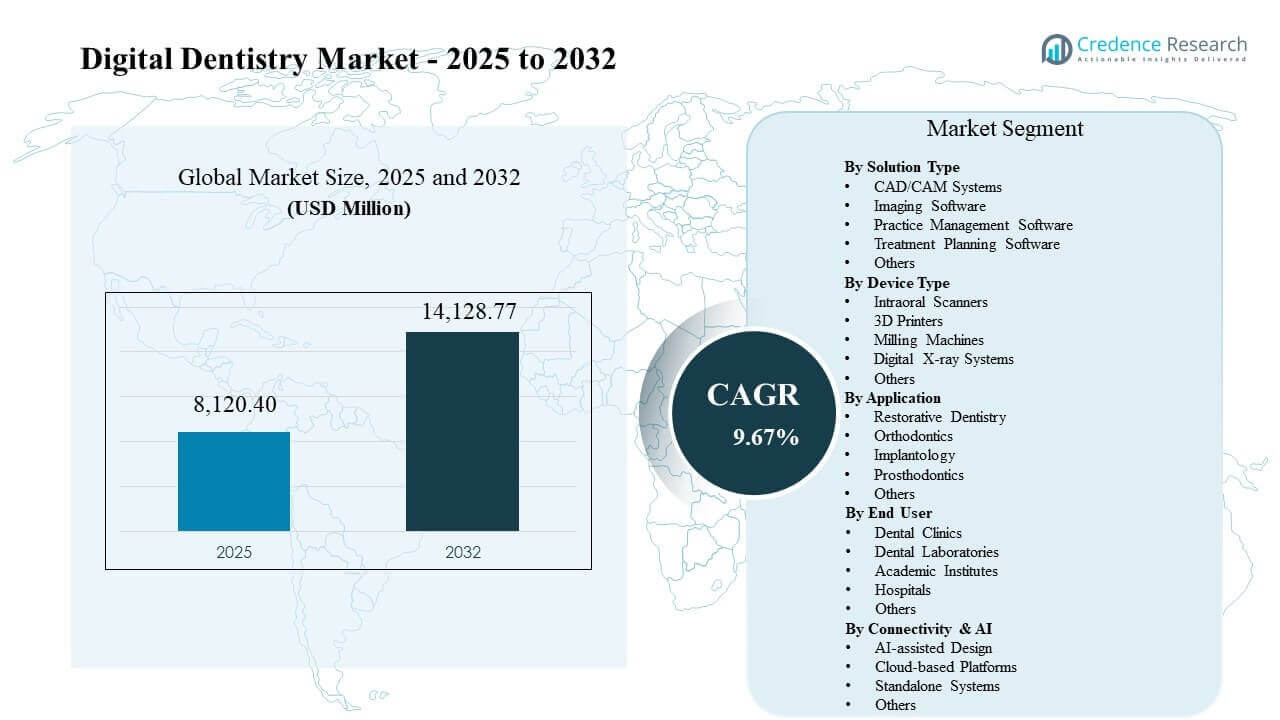
The global Digital Dentistry Market size was estimated at USD 8,120.40 million in 2025 and is expected to reach USD 14,128.77 million by 2032, growing at a CAGR of 9.67% from 2025 to 2032. Demand is being shaped by faster clinical workflows as intraoral scanning, digital planning, and chairside or lab production reduce turnaround times and improve case predictability. Growth is also being reinforced by expanding multi-site clinic networks that prioritize standardized digital protocols across capture, design, and fabrication to support consistent outcomes.
| REPORT ATTRIBUTE | DETAILS |
|---|---|
| Historical Period | 2020-2024 |
| Base Year | 2025 |
| Forecast Period | 2026-2032 |
| Digital Dentistry Market Size 2025 | USD 8,120.40 million |
| Digital Dentistry Market, CAGR | 9.67% |
| Digital Dentistry Market Size 2032 | USD 14,128.77 million |
Key Market Trends & Insights
- The Digital Dentistry Market is projected to expand at a CAGR of 9.67% from 2025–2032, rising from USD 8,120.40 million (2025) to USD 14,128.77 million (2032).
- North America accounted for 41.20% share in 2025, supported by higher technology penetration across scanners, CAD workflows, and connected production.
- Europe represented 24.60% share in 2025, reflecting strong lab infrastructure and steady adoption of integrated digital restorative workflows.
- Asia Pacific held 22.10% share in 2025, supported by expanding private clinic capacity and accelerating modernization of imaging and restorative workflows.
- Restorative Dentistry accounted for 33.10% share in 2025, reflecting high procedure volumes that benefit from digital impressions and design-to-fabrication standardization.
Segment Analysis
Digital dentistry adoption is strengthening as clinics and labs replace analog steps with digital capture, planning, and production workflows that reduce remakes and shorten delivery cycles. Integration across scanning, software, and manufacturing supports predictable outcomes for restorations, orthodontic workflows, and implant planning, especially when provider networks standardize protocols across locations. Procurement decisions increasingly prioritize platform compatibility, upgrade cadence, and ecosystem breadth to avoid workflow fragmentation across devices and software.
Buyer behavior is shifting toward connected workflows that improve collaboration between chairside teams and laboratories, particularly for higher-value restorative and implant cases. Cloud-based workflow hubs and AI-assisted features are being adopted to reduce operator variability, improve planning efficiency, and streamline case documentation. Value propositions are increasingly measured through operational throughput, reduction in rework, and the ability to scale consistent workflows across distributed sites.
By Solution Type Insights
CAD/CAM Systems accounted for the largest share in 2025. Leadership is supported by direct links between digital impressions, design workflows, and fabrication steps that improve speed and repeatability for restorative cases. Workflow integration across scanning, software, and manufacturing reduces handoffs and supports consistent outcomes across multi-site clinic groups. Platform ecosystems also improve adoption by bundling training, service support, and software updates into standardized clinical workflows.
By Device Type Insights
Intraoral Scanners accounted for the largest share in 2025. Intraoral scanners serve as the front-end data capture step that enables downstream design, simulation, and fabrication workflows across restorative, orthodontic, and implant cases. Clinical demand is supported by faster appointment flow and reduced discomfort compared with analog impressions. System selection is often driven by scan speed, ease of use, ecosystem compatibility, and reliability in day-to-day practice operations.
By Application Insights
Restorative Dentistry accounted for the largest share of 33.10% in 2025. Restorative workflows align strongly with digital impressions and CAD/CAM production because high procedure volumes amplify time savings and predictability gains. Digital case planning reduces remakes by improving fit consistency and streamlining lab communication. Standardized protocols across capture and design also support repeatable results, which strengthens utilization in clinics and lab networks.
By End User Insights
Dental Clinics accounted for the largest share of 40.40% in 2025. Clinic-level digitization captures value through improved patient experience, faster workflows, and tighter clinical control over impression quality and case documentation. Adoption is supported by growth in multi-chair practices and networked clinics seeking standardized workflows. Integration with labs and connected software tools improves collaboration and supports higher throughput for routine restorative and orthodontic caseloads.
By Connectivity & AI Insights
AI-assisted design and cloud-based platforms are gaining relevance as dental organizations scale across locations and seek consistent planning and documentation standards. Cloud workflow hubs support collaboration across clinics and laboratories by simplifying case sharing, version control, and manufacturing coordination. AI-enabled features support workflow efficiency by reducing manual steps in analysis and design, which can improve productivity for high-volume practices. Standalone systems remain relevant where on-prem workflows and simplified IT requirements are preferred.
Digital Dentistry Market Drivers
Workflow efficiency and chairside digitization
Digital dentistry adoption is driven by practice demand for faster workflows that reduce chair time and improve daily scheduling efficiency. Intraoral scanning, digital planning, and guided production reduce remakes and shorten the clinical-to-lab cycle for many routine cases. Same-day restorative capability improves throughput where clinic layouts and staffing support chairside production. Standardized digital protocols also support predictable outcomes across multi-site clinic groups.
Rising demand for esthetic and customized restorations
Patient expectations for esthetics and comfort support demand for digitally designed, patient-specific restorations. Digital capture and design enable consistent anatomy reproduction and improved fit, strengthening satisfaction for crowns, veneers, and prosthetic restorations. Labs benefit from repeatable design libraries and manufacturing consistency across cases. Digital workflows also improve the ability to document outcomes and refine case planning for more complex restorative needs.
Expanding implant planning and guided surgery workflows
Implantology is accelerating digital workflow adoption because planning accuracy and guided execution can reduce surgical variability. Digital dentistry platforms support implant case planning through integrated imaging, planning tools, and guide production. Collaboration between clinicians and labs improves when case data flows through a connected workflow rather than fragmented tools. Increased case confidence supports broader adoption across general dentistry settings.
- For instance, Straumann’s coDiagnostiX software enables fully digital implant planning integrated with CBCT data, supporting guided surgery with reported placement accuracy deviations typically within 1 mm at the entry point, while Nobel Biocare’s guided systems have demonstrated angular deviation control within approximately 2–4 degrees in clinical use.
Vendor ecosystem integration and software-driven upgrades
Digital dentistry platforms are increasingly sold as integrated ecosystems linking devices, software, and manufacturing. Integrated ecosystems reduce integration friction and simplify training, service, and updates across a practice or lab. Software upgrades add workflow automation and planning tools that extend value beyond hardware refresh cycles. Ecosystem breadth also influences procurement decisions by reducing long-term switching risk.
- For instance, 3Shape’s digital ecosystem connects TRIOS scanners with Dental System lab software used by over 10,000 labs globally, enabling seamless case transfer, while Planmeca’s Romexis platform integrates imaging, CAD/CAM, and patient data management in a single system supporting over 100 device types, streamlining multi-device interoperability within clinics.
Digital Dentistry Market Challenges
Digital dentistry implementation can face operational friction due to training requirements, workflow redesign, and integration complexity across devices and software. Practices often need to standardize scanning protocols, case management steps, and lab collaboration routines before full productivity gains materialize. Capital expenditure and service contracts can be difficult to justify for smaller clinics with lower procedure volumes. Compatibility constraints across vendor ecosystems can also increase switching costs and limit flexibility.
Data management and connectivity requirements introduce additional challenges, particularly for organizations operating across multiple sites. Cloud workflows and AI-enabled features require stable network performance, consistent cybersecurity practices, and structured data governance. Device uptime, calibration needs, and maintenance cycles can affect patient scheduling when contingency plans are not in place. Regulatory expectations around patient data handling can also add compliance overhead for connected platforms.
- For instance, Align Technology’s iTero scanners rely on cloud-based case submission workflows that can take 2–5 minutes per scan upload under optimal bandwidth conditions, while the system supports over 500,000 scans per day globally.
Digital Dentistry Market Trends and Opportunities
Digital dentistry is moving toward more connected workflows that link clinics and laboratories through shared platforms, improving collaboration and traceability. Cloud-based case management can reduce handoff delays and support standardized protocols across distributed sites. AI-assisted features are becoming more common in routine planning and workflow automation, enabling productivity gains for high-volume practices. Vendors that simplify integration across imaging, scanning, design, and fabrication can strengthen long-term retention.
- For instance, Dentsply Sirona’s DS Core cloud platform has connected over 100,000 dental professionals globally, enabling secure case sharing and reducing case turnaround times by up to 30% through integrated workflows across imaging, CAD/CAM design, and manufacturing systems.
Opportunities are expanding in markets where private dental infrastructure is scaling and modernization efforts are accelerating across imaging and restorative workflows. Centralized laboratory production can gain share as networked clinics seek predictable turnaround and standardized quality. Service-led models that bundle training, workflow optimization, and ongoing software upgrades can improve adoption, especially for clinics transitioning from analog processes. Interoperability solutions that reduce ecosystem lock-in can also support broader adoption.
Regional Insights
North America
North America held 41.20% share in 2025, supported by higher technology penetration across clinics and laboratories and strong adoption of integrated scanning-to-fabrication workflows. Multi-site clinic networks continue to prioritize standardized protocols to improve throughput and case predictability. Procurement decisions often emphasize ecosystem compatibility, service coverage, and upgrade cadence to maintain operational continuity. Demand is also supported by strong utilization in restorative and orthodontic workflows.
Europe
Europe represented 24.60% share in 2025, supported by mature laboratory ecosystems and steady modernization of restorative production workflows. Digital case communication between clinics and labs supports consistent outcomes and efficient remanufacturing cycles when refinements are required. Adoption is strengthened by demand for esthetic restorations and predictable fit, which benefits from standardized digital capture and design. Investments also focus on production efficiency and consistent quality across high-mix case loads.
Asia Pacific
Asia Pacific held 22.10% share in 2025, supported by expanding private dental capacity and accelerating investment in imaging, scanning, and digital restorative workflows. Clinics and labs are increasingly adopting connected platforms to improve turnaround time and support scaling operations. Growth is reinforced by modernization of clinical workflows and increasing demand for esthetic dentistry in urban markets. Vendor strategies often emphasize training, workflow support, and scalable platform deployment across diverse practice settings.
Latin America
Latin America accounted for 6.80% share in 2025, with adoption shaped by selective investment in scanning and digital planning where workflow efficiency gains are most visible. Larger clinics and laboratories tend to lead adoption due to better ability to manage capital investment and training needs. Demand is supported by restorative and orthodontic workflows that benefit from digital capture and improved case communication. Distribution partnerships and service coverage influence purchasing decisions.
Middle East & Africa
Middle East and Africa represented 5.30% share in 2025, supported by growth in private clinics and gradual modernization of imaging and restorative workflows. Adoption is strongest in urban centers where premium dental services are expanding and clinics prioritize patient experience and predictable outcomes. Training availability and service infrastructure can influence adoption pace across countries. Opportunities remain strongest for scalable workflows that reduce operational complexity for clinics transitioning from analog steps.
Competitive Landscape
Competition in the Digital Dentistry Market is shaped by ecosystem breadth, workflow integration, and software-led differentiation across scanning, planning, and manufacturing. Vendors compete on interoperability, upgrade cadence, clinical usability, and service infrastructure that supports deployment across clinics and lab partners. Platform strategies emphasize connected case management and standardized protocols that reduce remakes and shorten turnaround. Partnerships and distribution expansion are used to extend reach and strengthen installed bases.
Dentsply Sirona positions offerings around connected dentistry workflows that link clinical capture, planning, and fabrication across integrated product portfolios. Product and software alignment supports standardization for multi-site dental organizations seeking repeatable workflows. Distribution and service partnerships can expand accessibility for clinics adopting full digital stacks. Training and workflow support remain central to improving utilization after hardware installation.
The industry research and growth report includes detailed analyses of the competitive landscape of the market and information about key companies, including:
- Dentsply Sirona
- Align Technology
- Straumann Group
- Planmeca
- 3Shape
- Carestream Dental
- Ivoclar Vivadent
- Envista Holdings
- GC Corporation
- ZimVie
Qualitative and quantitative analysis of companies has been conducted to help clients understand the wider business environment as well as the strengths and weaknesses of key industry players. Data is qualitatively analyzed to categorize companies as pure play, category-focused, industry-focused, and diversified; it is quantitatively analyzed to categorize companies as dominant, leading, strong, tentative, and weak.
Recent Developments
- In February 2026, Toothsi (often stylized as toothsialigners), an Indian clear aligner and dental tech brand, advanced its regional ambitions through an acquisition‑driven partnership with Zenyum, a Southeast Asia–focused dental consumer brand, creating a combined platform that aims to become India’s largest dental care consumer brand and a top player across Asia while operating in about a dozen countries.
- In January 2026, Dentalkart, a leading Indian digital marketplace for dental products, entered into a strategic partnership with NSK Japan, a globally recognized manufacturer of dental rotary instruments and precision dental technologies, to strengthen access to high‑quality dental equipment for clinicians across India through an authorized digital distribution model.
- In September 2025, SprintRay expanded its digital dentistry capabilities by acquiring EnvisionTEC’s dental portfolio from Desktop Health, adding more than 200 patents, continuous digital light manufacturing (cDLM) technology, and the Flexcera material line, thereby strengthening its offering for both chairside practices and dental laboratories across the digital dentistry workflow.
Report Scope
| Report Attribute | Details |
| Market size value in 2025 | USD 8,120.40 million |
| Revenue forecast in 2032 | USD 14,128.77 million |
| Growth rate (CAGR) | 9.67% (2025–2032) |
| Base year | 2025 |
| Forecast period | 2026–2032 |
| Quantitative units | USD million |
| Segments covered | By Solution Type; By Device Type; By Application; By End User; By Connectivity & AI |
| Regional scope | North America, Europe, Asia Pacific, Latin America, Middle East & Africa |
| Key companies profiled | Dentsply Sirona; Align Technology; Straumann Group; Planmeca; 3Shape; Carestream Dental; Ivoclar Vivadent; Envista Holdings; GC Corporation; ZimVie |
| No.of Pages | 345 |
Segmentation
By Solution Type
- CAD/CAM Systems
- Imaging Software
- Practice Management Software
- Treatment Planning Software
- Others
By Device Type
- Intraoral Scanners
- 3D Printers
- Milling Machines
- Digital X-ray Systems
- Others
By Application
- Restorative Dentistry
- Orthodontics
- Implantology
- Prosthodontics
- Others
By End User
- Dental Clinics
- Dental Laboratories
- Academic Institutes
- Hospitals
- Others
By Connectivity & AI
- AI-assisted Design
- Cloud-based Platforms
- Standalone Systems
- Others
By Region
- North America
- U.S.
- Canada
- Mexico
- Europe
- Germany
- France
- U.K.
- Italy
- Spain
- Rest of Europe
- Asia Pacific
- China
- Japan
- India
- South Korea
- South-east Asia
- Rest of Asia Pacific
- Latin America
- Brazil
- Argentina
- Rest of Latin America
- Middle East & Africa
- GCC Countries
- South Africa
- Rest of the Middle East and Afric

Request a Free Sample
Fill in your details and we'll send you a free sample report.
- Sample data tables & charts
- Research methodology
Need a Custom Version of This Report?
Tailor the scope, geography, or segments to your exact requirements.
- Custom geography or segment scope
- Direct access to our analyst team
Frequently Asked Questions
What is the market size and forecast for the Digital Dentistry Market?
What is the CAGR for the Digital Dentistry Market?
Which segment is the largest in the Digital Dentistry Market?
What factors are driving growth in the Digital Dentistry Market?
Which companies are leading in the Digital Dentistry Market?
Which region leads the Digital Dentistry Market?
Table of Content
Chapter 1 Market Segmentation
- 1.1 Segmentation Framework
- 1.1.1 Product and Service Classification
- 1.1.2 Application and End-Use Classification
- 1.1.3 Technology and Solution Classification
- 1.1.4 Customer and Distribution Channel Classification
- 1.1.5 Geographic Segmentation
- 1.1.6 Market Segment Definitions and Boundaries
Chapter 2 Introduction
- 2.1 Report Objectives and Scope
- 2.2 Product Definition and Industry Terminology
- 2.3 Market Inclusions and Exclusions
- 2.4 Research Process
- 2.4.1 Primary Research and Expert Interviews
- 2.4.2 Secondary Research and Source Review
- 2.4.3 Top-Down and Bottom-Up Estimation
- 2.4.4 Data Triangulation and Verification
- 2.5 Market Size Measurement Basis
- 2.5.1 2025: USD 8,120.40 million → 2032: USD 14,128.77 million
- 2.6 Historical and Forecast Reference Periods
- 2.6.1 Base Year: 2025
- 2.6.2 Forecast Period: 2025-2032
- 2.7 Research Assumptions and Limitations
Chapter 3 Executive Summary
- 3.1 Market Snapshot and Key Findings
- 3.2 Base-Year Market Size, 2025
- 3.3 Forecast Market Size, 2032
- 3.4 Revenue and Volume Growth Outlook
- 3.5 Key Demand and Supply Indicators
- 3.6 Leading Market Segments
- 3.7 Fastest-Growing Market Opportunities
- 3.8 Regional Performance Highlights
- 3.9 Technology and Industry Transformation
- 3.10 Competitive Landscape Summary
- 3.11 Analyst View and Strategic Implications
Chapter 4 Global Digital Dentistry Market Trends and Developments
- 4.1 Historical Industry Development
- 4.2 Recent Market Trends and Developments
- 4.3 Demand and Customer Behavior Trends
- 4.4 Technology and Product Innovation
- 4.5 Artificial Intelligence, Automation and Digitalization
- 4.6 Local Manufacturing and Supply Chain Realignment
- 4.7 Industry Partnerships, Mergers and Acquisitions
- 4.8 Sustainability and Circular Economy Developments
- 4.9 Government and Private Sector Investment Trends
- 4.10 Emerging Business Models and Commercialization
- 4.11 Industry Developments and Announcements
Chapter 5 Global Digital Dentistry Market Production, Supply and Demand Analysis
- 5.1 Demand Trend and Consumption Analysis
- 5.2 Demand Forecast, 2025-2032
- 5.3 Production and Output Trend
- 5.4 Production and Output Forecast, 2025-2032
- 5.5 Installed Capacity and Capacity Utilization
- 5.6 Company-Wise Production Plants and Statistics
- 5.6.1 Installed Production Capacity
- 5.6.2 Actual Production
- 5.6.3 Planned Capacity and Expansion Targets
- 5.7 Supply Chain Structure and Procurement Trends
- 5.8 Supply-Demand Gap and Bottlenecks
- 5.9 Import Dependence and Sourcing Structure
- 5.10 Contract Manufacturing and Outsourcing
- 5.11 Regional Supply and Demand Concentration
Chapter 6 Global Digital Dentistry Market Pricing Analysis
- 6.1 Pricing Structure and Measurement
- 6.2 Historical Pricing Trends
- 6.3 Pricing Outlook, 2025-2032
- 6.4 Average Selling Price and Unit Economics
- 6.5 Pricing by Product and Market Segment
- 6.6 Geographic Pricing Differences
- 6.7 Key Input, Energy, Labor and Logistics Costs
- 6.8 Contract Pricing and Purchasing Models
- 6.9 Pricing Sensitivity and Competitive Positioning
- 6.10 Price, Margin and Profitability Implications
Chapter 7 Global Digital Dentistry Market Dynamics
- 7.1 Market Growth Drivers
- 7.1.1 Demand-Side Drivers
- 7.1.2 Technology and Innovation Drivers
- 7.1.3 Infrastructure and Investment Drivers
- 7.1.4 Regulatory and Policy Drivers
- 7.2 Market Restraints
- 7.2.1 Cost and Affordability Constraints
- 7.2.2 Technology and Adoption Barriers
- 7.2.3 Supply Chain and Operational Constraints
- 7.3 Market Challenges
- 7.3.1 Competitive Pressure and Margin Erosion
- 7.3.2 Skills, Infrastructure and Implementation Gaps
- 7.4 Emerging Market Opportunities
- 7.5 Market Dynamics Impact and Time-Horizon Assessment
Chapter 8 Global Digital Dentistry Value Chain Analysis
- 8.1 Industry Value Chain Overview
- 8.2 Upstream Suppliers and Critical Inputs
- 8.3 Technology and Component Providers
- 8.4 Manufacturing or Service Delivery
- 8.5 Distribution, Channel Partners and Integrators
- 8.6 Downstream Applications and End Users
- 8.7 Value Addition and Profit Pools
- 8.8 Vertical Integration and Outsourcing
- 8.9 Supplier Concentration and Risk
- 8.10 Supply Chain Localization and Resilience
Chapter 9 Global Digital Dentistry Market Regulations and Policies
- 9.1 Relevant Laws, Standards and Compliance Frameworks
- 9.2 Product, Service, Safety and Quality Requirements
- 9.3 Government Policies, Incentives and Subsidies
- 9.4 Imports, Exports and Trade Barriers
- 9.5 Public Procurement and Local Content Requirements
- 9.6 Environmental and Sustainability Compliance
- 9.7 Upcoming Policy Changes and Market Implications
Chapter 10 Global Digital Dentistry Market Hotspots and Opportunities
- 10.1 Market Opportunity Mapping and Growth Hotspots
- 10.2 High-Growth Applications and Customer Groups
- 10.3 Underserved Markets and White-Space Opportunities
- 10.4 Emerging Technology and Product Opportunities
- 10.5 New Capacity and Investment Hotspots
- 10.6 Market Entry and Expansion Opportunities
- 10.7 Distribution and Partnership Opportunities
- 10.8 Near-Term and Long-Term Commercial Potential
- 10.9 Opportunity Attractiveness and Execution Risks
Chapter 11 Global Digital Dentistry Market Outlook, 2025-2032
- 11.1 Market Size and Analysis
- 11.1.1 Revenue (Market Measurement: 2025: USD 8,120.40 million → 2032: USD 14,128.77 million)
- 11.1.2 Market Volume and Quantity Sold
- 11.1.3 Historical Market Size
- 11.1.4 Base-Year Market Size, 2025
- 11.2 Market Forecast, 2025-2032
- 11.2.1 Revenue Forecast to 2032
- 11.2.2 Volume Forecast to 2032
- 11.2.3 CAGR and Year-on-Year Growth
- 11.2.4 Incremental Revenue Opportunity
- 11.3 Forecast Assumptions and Scenario Analysis
- 11.3.1 Base-Case Forecast
- 11.3.2 Optimistic and Conservative Scenarios
- 11.3.3 Technology, Pricing and Policy Sensitivities
- 11.4 Market Attractiveness and Growth Outlook
Chapter 12 Global Digital Dentistry Market Segmentation and Outlook
- 12.1 Segmentation Summary and Market Shares, 2025
- 12.2 Largest and Fastest-Growing Segments
- 12.3 Segment Growth Comparison
- 12.4 Segment Attractiveness and Priority Matrix
Chapter 13 Global Digital Dentistry Geographic Market Outlook, 2025-2032
- 13.1 Regional Market Size and Share, 2025
- 13.2 Regional Market Forecast, 2025-2032
- 13.3 Regional Pricing, Production and Demand Differences
- 13.4 North America
- 13.4.1 United States
- 13.4.2 Canada
- 13.4.3 Mexico
- 13.5 Europe
- 13.5.1 Germany
- 13.5.2 France
- 13.5.3 Italy
- 13.5.4 United Kingdom
- 13.5.5 Spain
- 13.5.6 Poland
- 13.5.7 Russia
- 13.5.8 Netherlands
- 13.5.9 Belgium
- 13.5.10 Sweden
- 13.5.11 Denmark
- 13.5.12 Norway
- 13.5.13 Rest of Europe
- 13.6 Asia Pacific
- 13.6.1 China
- 13.6.2 India
- 13.6.3 Japan
- 13.6.4 South Korea
- 13.6.5 Thailand
- 13.6.6 Indonesia
- 13.6.7 Vietnam
- 13.6.8 Malaysia
- 13.6.9 Australia
- 13.6.10 Rest of Asia Pacific
- 13.7 Latin America
- 13.7.1 Brazil
- 13.7.2 Argentina
- 13.7.3 Colombia
- 13.7.4 Chile
- 13.7.5 Rest of Latin America
- 13.8 Middle East
- 13.8.1 Saudi Arabia
- 13.8.2 United Arab Emirates
- 13.8.3 Turkey
- 13.8.4 Israel
- 13.8.5 Iran
- 13.8.6 Rest of the Middle East
- 13.9 Africa
- 13.9.1 South Africa
- 13.9.2 Egypt
- 13.9.3 Nigeria
- 13.9.4 Morocco
- 13.9.5 Rest of Africa
- 13.10 Regional Investment, Policy and Supply Chain Differences
- 13.11 Regional Competitive Landscape
- 13.12 Geographic Growth Hotspots
Chapter 14 Global Digital Dentistry Technology, Innovation and Sustainability Outlook
- 14.1 Technology Landscape and Maturity
- 14.2 Product, Process and Service Innovation
- 14.3 AI, Automation and Digital Tools in the Industry
- 14.4 Technology Adoption and Performance Benchmarking
- 14.5 Innovation Pipeline and R&D Investment
- 14.6 Patent and Intellectual Property Trends
- 14.7 Energy Efficiency and Resource Management
- 14.8 Sustainability, Recycling and Circularity
- 14.9 Technology Roadmap, 2025-2032
- 14.10 Risks of Obsolescence and Technology Substitution
Chapter 15 Global Digital Dentistry Market Key Strategic Imperatives
- 15.1 Growth and Market Entry Priorities
- 15.2 High-Return Products and Segments
- 15.3 Pricing, Profitability and Cost Optimization
- 15.4 Technology Investment and Product Differentiation
- 15.5 Supply Chain Localization and Resilience
- 15.6 Distribution and Customer Acquisition
- 15.7 Partnership, Acquisition and Capacity Strategy
- 15.8 Regional Expansion Priorities
- 15.9 Short-, Medium- and Long-Term Actions
Chapter 16 Competition Outlook
- 16.1 Industry Competition Characteristics
- 16.2 Market Structure and Concentration
- 16.3 Market Share and Competitive Positioning, 2025
- 16.4 Company-Wise Revenue and Product Benchmarking
- 16.5 Production and Service Capacity Benchmarking
- 16.6 Technology, Pricing and Differentiation
- 16.7 Regional Footprint and Distribution Strength
- 16.8 Mergers, Acquisitions and Strategic Alliances
- 16.9 New Entrants and Competitive Threats
- 16.10 Porter's Five Forces and Industry Attractiveness
- 16.11 Competitive Outlook, 2025-2032
Chapter 17 Company Profiles
- 17.1 Company Coverage and Selection Criteria
- 17.2 Leading Market Participants – Standard Profile Structure
- 17.2.1 Business Description
- 17.2.2 Company Ownership and Geographic Presence
- 17.2.3 Product and Service Portfolio
- 17.2.4 Manufacturing and Operating Footprint
- 17.2.5 Production Capacity and Expansion Plans
- 17.2.6 Financial Performance and Investment
- 17.2.7 Market Share and Competitive Position
- 17.2.8 Technology and Innovation Capabilities
- 17.2.9 Strategic Alliances or Partnerships
- 17.2.10 Recent Developments
- 17.2.11 Growth Strategy and Outlook
- 17.3 Other Relevant Market Participants
Note: Every listed company is profiled on the structure shown under the first company. The company list is preliminary and may change based on research findings, market developments, data availability and client requirements.
Chapter 18 Disclaimer
- 18.1 Research and Forecast Disclaimer
- 18.2 Data Source and Estimation Limitations
Note: The depth of individual sections depends on data availability for this market. Volume, capacity, trade and other unit-based metrics are included where applicable.