
Diagnostic Radiopharmaceuticals Contrast Media Market Overview:
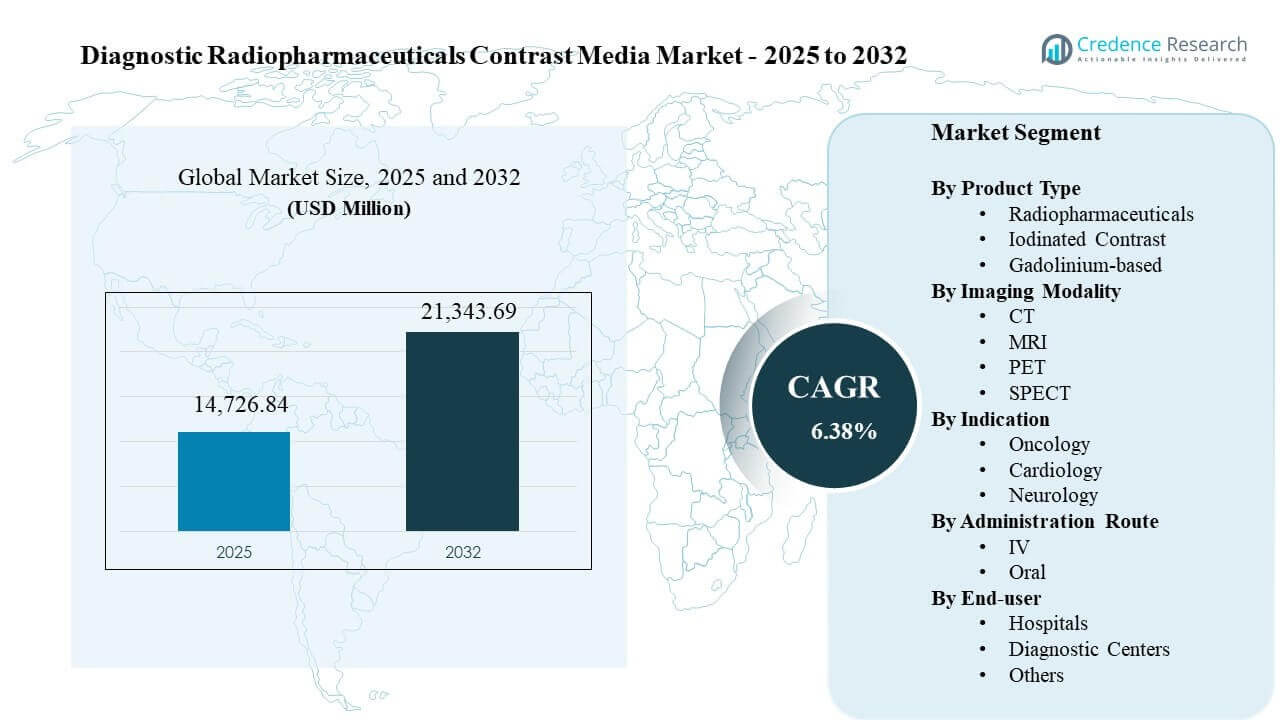
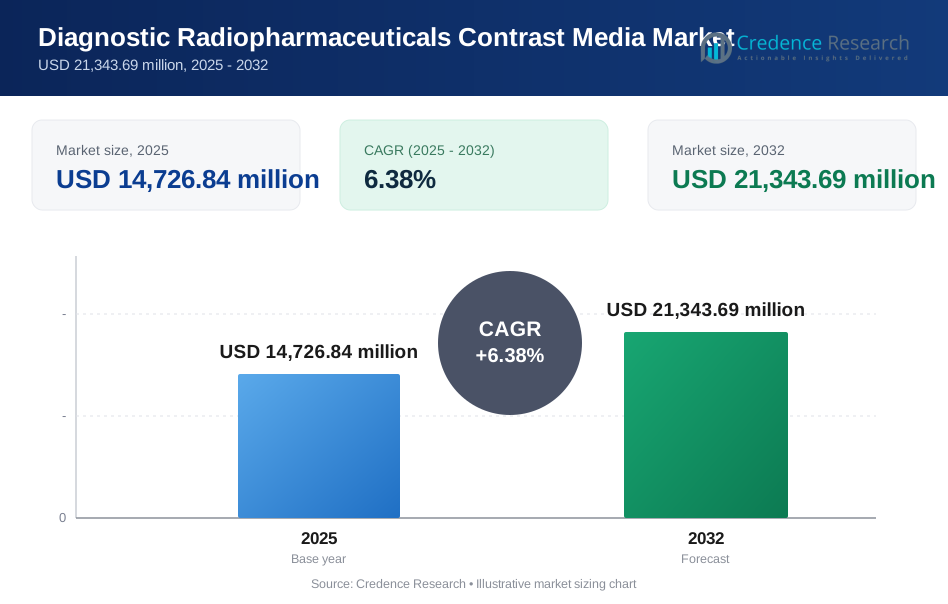
The global Diagnostic Radiopharmaceuticals Contrast Media Market size was estimated at USD 14,726.84 million in 2025 and is expected to reach USD 21,343.69 million by 2032, growing at a CAGR of 6.38% from 2025 to 2032. Demand is being propelled by expanding diagnostic imaging volumes across oncology and cardiovascular care, where earlier detection and therapy planning increasingly rely on PET, SPECT, CT, and MRI workflows. Growing investment in modern imaging infrastructure and protocol standardization across large health systems is reinforcing recurring utilization of contrast agents and diagnostic radiopharmaceuticals.
| REPORT ATTRIBUTE | DETAILS |
|---|---|
| Historical Period | 2020-2024 |
| Base Year | 2025 |
| Forecast Period | 2026-2032 |
| Diagnostic Radiopharmaceuticals Contrast Media Market Size 2025 | USD 14,726.84 million |
| Diagnostic Radiopharmaceuticals Contrast Media Market, CAGR | 6.38% |
| Diagnostic Radiopharmaceuticals Contrast Media Market Size 2032 | USD 21,343.69 million |
Key Market Trends & Insights
- The market is projected to expand from USD 14,726.84 million (2025) to USD 21,343.69 million (2032), reflecting a 6.38% CAGR over 2025–2032.
- North America accounted for the largest regional share of 40.40% in 2025 due to high imaging procedure density and broad access to advanced modalities.
- CT held the leading imaging modality share of 50.90% in 2025, supported by high-throughput diagnostics and emergency care utilization.
- Oncology represented the largest indication share of 46.70% in 2025 as staging, response assessment, and surveillance drive repeat imaging.
- Hospitals led the end-user mix with a 41.80% share in 2025 because complex care pathways and integrated imaging departments concentrate demand.
Segment Analysis
Diagnostic radiopharmaceuticals and contrast media demand is closely tied to how health systems prioritize early diagnosis and treatment monitoring, particularly in cancer and cardiology pathways where imaging frequency is higher. Product selection is shaped by modality-specific protocols, safety positioning, and operational efficiency, with sites emphasizing predictable workflow, dosing consistency, and compatibility with existing scanners and injector systems. Increased use of molecular imaging is expanding utilization of PET and SPECT tracers, especially where imaging directly informs therapy decisions or patient selection.
Purchasing behavior tends to concentrate around hospital networks and high-volume diagnostic providers that value reliable supply and standardized protocols. Diagnostic centers are strengthening their role as imaging continues shifting toward outpatient settings, and the adoption of modern CT and MRI platforms supports consistent demand for iodinated and gadolinium-based agents. Across product categories, suppliers compete on clinical performance, safety confidence, supply continuity, and ease of integration into established imaging workflows.
By Product Type Insights
Contrast reagents accounted for the largest share of 56.80% in 2025. High CT utilization sustains broad iodinated contrast consumption, particularly in acute care and high-throughput diagnostic pathways. MRI contrast remains supported by protocol-driven use in neuro, oncology, and body imaging where lesion characterization is important. Diagnostic radiopharmaceutical uptake is rising as molecular imaging becomes more embedded in oncology decision-making and patient monitoring workflows.
By Imaging Modality Insights
CT accounted for the largest share of 50.90% in 2025. CT remains a frontline modality for rapid diagnosis and broad clinical coverage, which supports routine contrast utilization. Scan standardization and workflow automation increase throughput, reinforcing repeat demand for contrast products. PET and SPECT utilization is expanding as molecular imaging becomes more central in oncology and cardiology workups and as sites invest in capability upgrades.
By Indication Insights
Oncology accounted for the largest share of 46.70% in 2025. Cancer care increasingly relies on imaging for staging, therapy selection, response assessment, and surveillance, which raises repeat scan volumes. Adoption of molecular imaging supports more precise disease characterization and strengthens tracer utilization in oncology pathways. Continued expansion of advanced imaging capacity and more structured protocols in cancer centers support sustained demand across both radiopharmaceuticals and contrast media.
By Administration Route Insights
Intravenous administration remained the primary route for diagnostic radiopharmaceuticals and most contrast-enhanced CT and MRI procedures because it provides predictable biodistribution and consistent timing for image acquisition. Standardized IV protocols support efficient workflow in high-throughput imaging centers and help align dosing and safety monitoring practices. Oral administration remains important in select gastrointestinal imaging protocols but plays a smaller role in molecular imaging-driven growth.
By End-user Insights
Hospitals accounted for the largest share of 41.80% in 2025. Complex inpatient and emergency imaging volumes, alongside integrated radiology and nuclear medicine departments, concentrate demand in hospital settings. Hospital systems also support advanced imaging pathways that require coordinated scheduling, clinical oversight, and protocol standardization. Diagnostic centers continue to expand capacity as outpatient imaging grows, supporting broader access and rising utilization across community-based care.
Diagnostic Radiopharmaceuticals Contrast Media Market Drivers
Rising burden of complex diseases requiring imaging-led decisions
Growing prevalence of oncology and cardiovascular conditions is increasing reliance on imaging for diagnosis, staging, treatment planning, and follow-up. Protocol-driven CT and MRI usage supports recurring demand for iodinated and gadolinium-based agents in routine and specialized exams. Molecular imaging adoption strengthens the role of PET and SPECT in identifying disease extent and therapy response. Provider emphasis on earlier detection is increasing scan frequency across high-risk cohorts and structured care pathways.
- For instance, Lantheus reported that its PSMA-targeted PET imaging agent PYLARIFY supported over 400,000 scans in the U.S. within two years of launch, reflecting rapid clinical uptake in prostate cancer detection and monitoring.
Expansion of advanced imaging infrastructure and capacity
Health systems are modernizing imaging fleets and expanding access to advanced CT, MRI, PET/CT, and hybrid capabilities to reduce wait times and improve diagnostic throughput. Higher scanner density and better scheduling infrastructure support more examinations per site, reinforcing baseline reagent consumption. Outpatient imaging growth is also broadening demand beyond tertiary centers. Investments in capability upgrades further support tracer availability and standardized utilization across oncology and cardiology service lines.
Increasing adoption of molecular imaging and theranostics workflows
The shift toward precision medicine is accelerating use of molecular imaging in oncology and select cardiology and neurology applications. Diagnostic radiopharmaceuticals are increasingly used to inform treatment selection and monitor response, supporting expanding tracer volumes. As more sites integrate molecular imaging into routine practice, demand rises for reliable supply chains and consistent production quality. This trend supports both tracers and complementary cross-sectional imaging that often uses contrast to refine anatomical interpretation.
- For instance, Novartis reported treating over 20,000 patients globally with its radioligand therapy Lutathera within a few years of approval, demonstrating the scaling integration of theranostics into clinical oncology workflows.
Operational focus on workflow efficiency and standardized protocols
Radiology and nuclear medicine departments are prioritizing predictable workflows, dosing consistency, and compatibility with installed equipment. Standardized protocols simplify procurement, reduce variability in scan quality, and support routine utilization across large provider networks. As imaging shifts toward higher throughput and outpatient settings, reliable supply and integrated delivery systems become more important. This operational emphasis encourages repeat purchasing and long-term supplier relationships.
Diagnostic Radiopharmaceuticals Contrast Media Market Challenges
Supply continuity and logistics remain persistent challenges, particularly for time-sensitive radiopharmaceuticals that require controlled production, distribution, and scheduling discipline. Any disruption can reduce scan availability and create backlogs, which can affect both patient care and provider economics. Safety perceptions and protocol constraints also influence usage patterns, especially where patients have renal risk factors or where sites tighten governance around contrast administration. Price pressure from procurement consolidation can also constrain margins and intensify competition.
- For instance, Curium operates a network of over 50 production and distribution sites globally for SPECT imaging isotopes such as Technetium-99m, which has a short half-life of approximately 6 hours, requiring multiple daily deliveries to hospitals to avoid cancellation of diagnostic scans.
Regulatory complexity and varied clinical guidelines across regions can slow adoption of newer agents and increase the cost and time associated with approvals, labeling updates, and post-market monitoring. Imaging providers may also face infrastructure constraints, including limited PET/SPECT capacity, staffing shortages, and scheduling bottlenecks that reduce the pace of utilization growth. These factors can lead to uneven regional penetration and delayed adoption of advanced protocols outside major urban centers.
Diagnostic Radiopharmaceuticals Contrast Media Market Trends and Opportunities
Dose optimization and safety-forward positioning are shaping product development and provider adoption, with growing emphasis on minimizing exposure while maintaining diagnostic performance. This trend supports opportunity for differentiated formulations, improved dosing workflows, and stronger clinical education around appropriate use. In parallel, imaging providers are increasing investments in modern equipment, which creates pull-through demand for products that integrate seamlessly with newer scanners and standardized injection systems. Suppliers that align with protocol modernization can strengthen long-term utilization.
- For instance, GE HealthCare’s Clariscan (gadoteric acid) demonstrated equivalent image quality at a reduced dose of 0.1 mmol/kg while maintaining a macrocyclic structure associated with higher stability, and the company has deployed over 20,000 contrast injector systems globally that integrate with automated dosing protocols, improving workflow consistency and reducing administration variability.
Outpatient migration and expanding diagnostic center networks are creating new demand pockets, particularly where providers prioritize faster access and lower cost per scan. Growth in oncology-focused imaging pathways also supports expanding demand for PET tracers, especially in markets increasing molecular imaging capacity. Opportunities also exist in improving supply chain resilience and delivery reliability, including expanded production footprints and distribution partnerships to meet rising procedure volumes and reduce scheduling disruption risk.
Regional Insights
North America
North America held a 40.40% share in 2025, supported by high imaging procedure density, strong reimbursement structures, and broad access to advanced CT, MRI, and PET capabilities. Large integrated delivery networks promote standardized protocols, which supports consistent utilization of contrast agents and diagnostic radiopharmaceuticals. Concentration of specialized cancer centers and cardiac programs increases demand for imaging-led decision-making and repeat monitoring. Supplier competition in the region emphasizes supply reliability, protocol compatibility, and product differentiation tied to clinical performance and safety confidence.
Europe
Europe accounted for 24.10% in 2025, reflecting mature imaging utilization across major health systems and strong adoption of advanced diagnostic protocols in oncology and neurology. Procurement discipline and structured clinical governance influence product selection and standardization, with emphasis on predictable outcomes and safety considerations. Upgrades in imaging infrastructure and expansion of specialized diagnostic pathways support stable demand across CT, MRI, and nuclear medicine. Suppliers typically compete on clinical confidence, portfolio breadth, and alignment with formulary and protocol requirements across large hospital networks.
Asia Pacific
Asia Pacific represented 26.30% in 2025, driven by expanding imaging capacity, rising chronic disease burden, and increasing access to advanced diagnostics in large population markets. Growth is supported by rapid installation of modern CT and MRI platforms and increasing investment in oncology diagnostics, which expands use of contrast-enhanced imaging. PET and SPECT capacity continues to expand in major urban centers, supporting rising utilization of diagnostic radiopharmaceuticals. Supplier strategies often prioritize distribution reach, pricing adaptability, and partnerships that improve access and service continuity.
Latin America
Latin America captured 5.90% in 2025, shaped by uneven access to advanced imaging infrastructure and variable public health funding across countries. Demand is concentrated in private hospital groups and major metropolitan centers where advanced imaging is more accessible. Import dependence and procurement constraints can affect product availability and pricing stability, influencing utilization consistency. Opportunities are strongest where imaging networks expand outpatient capacity and where cancer diagnostics investments increase procedure volumes.
Middle East & Africa
Middle East & Africa held 3.30% in 2025, with demand concentrated in well-funded health systems and major referral hubs that operate advanced CT, MRI, and selected PET capabilities. Limited nuclear medicine infrastructure in many areas constrains broader radiopharmaceutical penetration outside key centers. Growth is supported by modernization initiatives, increasing medical tourism in select markets, and investment in specialty care pathways. Suppliers often focus on distribution partnerships, service support, and supply reliability to address operational constraints.
Competitive Landscape
The competitive landscape is defined by portfolio breadth, manufacturing and supply reliability, and deep integration into provider workflows. Established players benefit from long-standing hospital relationships, broad distribution networks, and protocol familiarity across imaging departments. Differentiation is increasingly tied to safety positioning, operational efficiency, and the ability to support standardized protocols at scale. Radiopharmaceutical competition is also influenced by production footprint, logistics capability, and alignment with expanding molecular imaging pathways.
GE HealthCare maintains strong positioning through imaging ecosystem alignment across CT, PET, and related workflow infrastructure that supports consistent utilization of diagnostic agents within standardized protocols. The company’s approach typically emphasizes integration with imaging platforms and clinical workflow enablement to improve scan throughput and diagnostic confidence. Capability alignment across hospital networks supports recurring utilization where providers prefer streamlined procurement and consistent imaging protocols. Competitive strength is reinforced when product and workflow priorities match oncology and cardiology imaging growth pathways.
The industry research and growth report includes detailed analyses of the competitive landscape of the market and information about key companies, including:
- GE HealthCare
- Bayer
- Bracco
- Guerbet
- Siemens Healthineers
- Lantheus
- Curium
- Jubilant Radiopharma
- Cardinal Health
- Fujifilm
Qualitative and quantitative analysis of companies has been conducted to help clients understand the wider business environment as well as the strengths and weaknesses of key industry players. Data is qualitatively analyzed to categorize companies as pure play, category-focused, industry-focused, and diversified; it is quantitatively analyzed to categorize companies as dominant, leading, strong, tentative, and weak.
Recent Developments
- In April 2026, Bracco Imaging announced a strategic alliance with NYU Langone Health through a multi-year Master Research Agreement to advance innovation in MRI, photon-counting CT, targeted ultrasound, and AI-enabled PET/CT and MRI image analysis. In the same announcement, Bracco said the collaboration is intended to accelerate imaging technology development and strengthen precision-medicine decision-making by linking research more closely with clinical practice.
- In November 2025, Bracco featured AiMIFY software at RSNA 2025 as its AI-powered contrast enhancement solution for MR imaging in the U.S., offered exclusively with Subtle Medical. Bracco said the software had FDA clearance as a class II medical device and is intended for image enhancement in brain MRI.
- In March 2025, Bracco highlighted its collaboration with Zereau BV at ECR 2025 through “The Water Project,” an initiative focused on an advanced urine filtration system designed to address contrast agents in wastewater. Bracco presented this partnership as part of its broader push to improve contrast media efficiency while reducing environmental impact in radiology.
- In December 2024, Siemens Healthineers completed its acquisition from Novartis of Advanced Accelerator Applications Molecular Imaging, a European manufacturing and distribution network for PET diagnostic radiopharmaceuticals. Siemens Healthineers said the transaction added 13 manufacturing sites across France, Spain, Portugal, Italy, and Germany, along with product distribution into Switzerland, expanding the reach of its PETNET Solutions business.
Report Scope
| Report Attribute | Details |
| Market size value in 2025 | USD 14,726.84 million |
| Revenue forecast in 2032 | USD 21,343.69 million |
| Growth rate (CAGR) | 6.38% (2025–2032) |
| Base year | 2025 |
| Forecast period | 2026-2032 |
| Quantitative units | USD million |
| Segments covered | Product Type Outlook: Radiopharmaceuticals, Iodinated Contrast, Gadolinium-based; Imaging Modality Outlook: CT, MRI, PET, SPECT; Indication Outlook: Oncology, Cardiology, Neurology; Administration Route Outlook: IV, Oral; End-user Outlook: Hospitals, Diagnostic Centers, Others |
| Regional scope | North America, Europe, Asia Pacific, Latin America, Middle East & Africa |
| Key companies profiled | GE HealthCare; Bayer; Bracco; Guerbet; Siemens Healthineers; Lantheus; Curium; Jubilant Radiopharma; Cardinal Health; Fujifilm |
| No. of Pages | 328 |
Segmentation
By Product Type
- Radiopharmaceuticals
- Iodinated Contrast
- Gadolinium-based
By Imaging Modality
- CT
- MRI
- PET
- SPECT
By Indication
- Oncology
- Cardiology
- Neurology
By Administration Route
- IV
- Oral
By End-user
- Hospitals
- Diagnostic Centers
- Others
By Region
- North America
- U.S.
- Canada
- Mexico
- Europe
- Germany
- France
- U.K.
- Italy
- Spain
- Rest of Europe
- Asia Pacific
- China
- Japan
- India
- South Korea
- South-east Asia
- Rest of Asia Pacific
- Latin America
- Brazil
- Argentina
- Rest of Latin America
- Middle East & Africa
- GCC Countries
- South Africa
- Rest of the Middle East and Africa
Request a Free Sample
Fill in your details and we'll send you a free sample report.
- Sample data tables & charts
- Research methodology
Need a Custom Version of This Report?
Tailor the scope, geography, or segments to your exact requirements.
- Custom geography or segment scope
- Direct access to our analyst team
Frequently Asked Questions
What is the market size and forecast for the Diagnostic Radiopharmaceuticals Contrast Media Market?
What is the growth rate for the Diagnostic Radiopharmaceuticals Contrast Media Market?
What is the largest segment in the Diagnostic Radiopharmaceuticals Contrast Media Market?
What factors are driving growth in the Diagnostic Radiopharmaceuticals Contrast Media Market?
Which companies are leading in the Diagnostic Radiopharmaceuticals Contrast Media Market?
Which region leads the Diagnostic Radiopharmaceuticals Contrast Media Market?
Table of Content
Chapter 1. Report Introduction
- 1.1 Report Description & Purpose
- 1.1.1 Report Title & Market Definition
- 1.1.2 Unique Selling Propositions (USP) & Key Differentiators
- 1.1.3 Value Proposition for Stakeholders
- 1.2 Research Objectives
- 1.2.1 Market Sizing Objectives (Volume & Revenue)
- 1.2.2 Segmentation Objectives
- 1.2.3 Competitive Intelligence Objectives
- 1.2.4 Forecast & Scenario Objectives
- 1.3 Report Scope
- 1.3.1 Diagnostic Radiopharmaceuticals Contrast Media Scope – Types & Subtypes Covered
- 1.3.2 Geographic Scope – Regions & Countries Covered
- 1.3.3 Historical Period, Base Year & Forecast Period (2025; forecast to 2032)
- 1.3.4 Inclusions & Exclusions
- 1.4 HS Code & Classification Framework
- 1.5 Currency, Units & Pricing Basis
- 1.6 Target Stakeholders
- 1.7 Limitations & Assumptions
Chapter 2. Executive Summary
- 2.1 Global Diagnostic Radiopharmaceuticals Contrast Media Market Snapshot
- 2.1.1 Market Size – Historical (2025) & Forecast (2025-2032) (2025: USD 14,726.84 million → 2032: USD 21,343.69 million)
- 2.1.2 Volume & Revenue – Global Totals
- 2.1.3 Key Market Highlights – Top Five Facts
- 2.2 Diagnostic Radiopharmaceuticals Contrast Media Market Segmentation Snapshot
- 2.2.1 Market Split by Region – 2025 vs. 2032
- 2.3 Competitive Snapshot
- 2.3.1 Top 10 Players by Revenue Share – 2025
- 2.3.2 Top 10 Players by Volume Share – 2025
- 2.3.3 Recent Strategic Developments (18-Month Summary)
- 2.4 Key Investment Highlights & Strategic Conclusions
Chapter 3. Diagnostic Radiopharmaceuticals Contrast Media Market Dynamics & Industry Analysis
- 3.1 Market Overview & Context
- 3.1.1 Diagnostic Radiopharmaceuticals Contrast Media Market Position in the Broader Automotive Value Chain
- 3.1.2 OEM vs. Replacement Market Dynamics
- 3.1.3 Market Maturity & Development Stage by Region
- 3.2 Diagnostic Radiopharmaceuticals Contrast Media Market Drivers
- 3.3 Diagnostic Radiopharmaceuticals Contrast Media Market Restraints & Challenges
- 3.4 Diagnostic Radiopharmaceuticals Contrast Media Market Opportunities
- 3.5 Porter's Five Forces Analysis
- 3.5.1 Threat of New Entrants
- 3.5.2 Bargaining Power of Suppliers
- 3.5.3 Bargaining Power of Buyers
- 3.5.4 Threat of Substitutes
- 3.5.5 Competitive Rivalry – Intensity Assessment
- 3.6 Diagnostic Radiopharmaceuticals Contrast Media Value Chain Analysis
- 3.6.1 Upstream – Raw Material/Input Suppliers
- 3.6.1.1 Raw Material/Input 1
- 3.6.1.2 Raw Material/Input 2
- 3.6.1.3 Raw Material/Input 3
- 3.6.2 Midstream – Production/Manufacturing/Service Delivery
- 3.6.2.1 Production/Process Overview
- 3.6.2.2 Key Facility Locations & Capacity by Manufacturer
- 3.6.3 Downstream – Distribution & End Consumer
- 3.6.3.1 Primary Channel – B2B/OEM
- 3.6.3.2 Secondary Channels – Dealer, Retail, Online, Direct
- 3.6.4 Value Chain Profitability Analysis
- 3.6.1 Upstream – Raw Material/Input Suppliers
- 3.7 PESTEL Analysis
- 3.7.1 Political Factors
- 3.7.2 Economic Factors
- 3.7.3 Social Factors
- 3.7.4 Technological Factors
- 3.7.5 Environmental Factors
- 3.7.6 Legal Factors
- 3.8 Diagnostic Radiopharmaceuticals Contrast Media Supply Chain Analysis
- 3.8.1 Raw Material/Input Supply Risk Assessment
- 3.8.2 Manufacturing Concentration Risk (Geographic Exposure)
- 3.8.3 Trade Disruption Impact Analysis
- 3.9 Regulatory & Policy Landscape
Note: The regulatory and policy landscape section covers regulations based on their applicability to the market, Diagnostic Radiopharmaceuticals Contrast Media category, geography, and scope of the study. Only regulatory frameworks with a material impact on operations, compliance, trade, sustainability, or market access are analyzed in detail.
Chapter 4. Key Investment Pockets & Opportunity Analysis
- 4.1 Diagnostic Radiopharmaceuticals Contrast Media Market Attractiveness Analysis
- 4.1.1 By Region – Investment Attractiveness Matrix (Volume × CAGR)
- 4.2 Absolute Revenue Growth Opportunity
- 4.2.1 By Region – Absolute USD Growth Through 2032
- 4.3 Incremental Volume Opportunity
- 4.3.1 By Region – Incremental Volume Through 2032
- 4.3.2 Segment – Incremental Volume
- 4.4 Emerging Submarket Opportunity Deep Dive (Subject to Applicability)
- 4.5 Emerging Market Opportunity Scorecards
- 4.5.1 United States
- 4.5.2 Europe
- 4.5.3 Asia
- 4.5.4 Middle East & Africa
Note: Emerging Market Opportunity Scorecards will be included based on relevance and strategic importance. Regions listed are indicative and may vary depending on data availability and market dynamics.
Chapter 5. Diagnostic Radiopharmaceuticals Contrast Media Import-Export Analysis & Trade Flows
- 5.1 Global Trade Overview
- 5.1.1 Global Export Value by Country (2025)
- 5.1.2 Global Export Volume by Country (2025)
- 5.1.3 Global Import Value by Country (2025)
- 5.1.4 Global Import Volume by Country (2025)
- 5.1.5 Net Trade Balance by Country (2025)
- 5.2 Export Analysis – Segment
- 5.2.1 Type 1 (HS Code)
- 5.2.2 Type 2 (HS Code)
- 5.2.3 Type 3 (HS Code)
- 5.2.4 Type 4 (HS Code)
- 5.2.5 Type 5 (HS Code)
- 5.3 Import Analysis – Segment
- 5.3.1 Type 1 (HS Code)
- 5.3.2 Type 2 (HS Code)
- 5.3.3 Type 3 (HS Code)
- 5.3.4 Type 4 (HS Code)
- 5.3.5 Type 5 (HS Code)
- 5.4 Average Unit Trade Prices
- 5.4.1 Average Export Price – Segment & Country
- 5.4.2 Average Import Price – Segment & Source Country
- 5.4.3 Price Trends (2025)
- 5.5 Key Trade Route Analysis
- 5.5.1 Trade Route 1
- 5.5.2 Trade Route 2
- 5.5.3 Trade Route 3
- 5.5.4 Trade Route 4
- 5.5.5 Trade Route 5
- 5.6 Trade Policy Impact Assessment
- 5.6.1 US Anti-Dumping & Section 301 Tariffs
- 5.6.2 EU Customs Union Impact
- 5.6.3 Major Free Trade Agreements
- 5.6.4 USMCA Rules of Origin
Note: Trade policy analysis will be included only where relevant to the Diagnostic Radiopharmaceuticals Contrast Media market.
Chapter 6. Competitive Landscape & Company Benchmarking
- 6.1 Diagnostic Radiopharmaceuticals Contrast Media Market Concentration & Structure
- 6.1.1 Herfindahl-Hirschman Index (HHI) – vs. 2025
- 6.1.2 Tier 1, Tier 2 & Tier 3 Market Structure
- 6.1.3 Global, Regional & Local Player Dynamics
- 6.2 Diagnostic Radiopharmaceuticals Contrast Media Market Share Analysis – 2025
- 6.2.1 Global Revenue Share by Company
- 6.2.2 Global Volume Share by Company
- 6.2.3 Regional Revenue Share
- 6.2.4 Market Share Evolution ( vs. 2025)
- 6.2.5 OEM Segment Share by Company
- 6.2.6 Replacement Segment Share by Company
- 6.3 Production/Delivery Capacity & Facility Analysis
- 6.3.1 Global Installed Capacity
- 6.3.2 Capacity Utilization Rates
- 6.3.3 Production/Output Volume
- 6.3.4 Facility Locations & Capacity Map
- 6.3.5 Planned Capacity Additions
- 6.4 Diagnostic Radiopharmaceuticals Contrast Media Competitive Benchmarking Matrix
- 6.4.1 Revenue, Volume, CAGR & Profitability Comparison
- 6.4.2 Channel Revenue Mix
- 6.4.3 Geographic Revenue Exposure
- 6.4.4 R&D Intensity
- 6.4.5 Sustainability Maturity
- 6.5 Strategic Developments in Diagnostic Radiopharmaceuticals Contrast Media (Last 24 Months)
- 6.5.1 Mergers, Acquisitions & Divestments
- 6.5.2 New Diagnostic Radiopharmaceuticals Contrast Media Launches
- 6.5.3 Facility Expansions
- 6.5.4 Strategic Alliances, Joint Ventures & Partnerships
- 6.5.5 Distribution Expansion & Market Entry
- 6.5.6 Sustainability & ESG Initiatives
- 6.6 Competitive Strategy Mapping
- 6.6.1 Leader, Challenger, Follower & Niche Classification
- 6.6.2 Pricing Strategy Comparison
- 6.6.3 Channel Strategy Matrix
Note: Strategic developments are included based on their materiality and the availability of reliable information.
Chapter 7. Global Diagnostic Radiopharmaceuticals Contrast Media Market – By Distribution Channel
- 7.1 Segment Overview
- 7.1.1 Volume & Revenue Split by Channel (2025 & 2032)
- 7.1.2 Channel Mix Evolution (2025-2032)
Chapter 8. Regional Market Analysis – Global Overview
- 8.1 Global Regional Overview
- 8.1.1 Regional Volume Share
- 8.1.2 Regional Revenue Share
- 8.1.3 Regional Volume by Region
- 8.1.4 Regional Revenue by Region
- 8.1.5 Regional Forecast Through 2032
- 8.2 Cross-Regional Segment Analysis
- 8.2.1 By Distribution Channel
- 8.2.2 By Brand/Price Tier
Chapter 9. North America Diagnostic Radiopharmaceuticals Contrast Media Market
- 9.1 United States
- 9.2 Canada
- 9.3 Mexico
Chapter 10. Europe Diagnostic Radiopharmaceuticals Contrast Media Market
- 10.1 Germany
- 10.2 France
- 10.3 Italy
- 10.4 United Kingdom
- 10.5 Spain
- 10.6 Poland
- 10.7 Russia
- 10.8 Netherlands
- 10.9 Belgium
- 10.10 Sweden
- 10.11 Denmark
- 10.12 Norway
- 10.13 Rest of Europe
Chapter 11. Asia Pacific Diagnostic Radiopharmaceuticals Contrast Media Market
- 11.1 China
- 11.2 India
- 11.3 Japan
- 11.4 South Korea
- 11.5 Thailand
- 11.6 Indonesia
- 11.7 Vietnam
- 11.8 Malaysia
- 11.9 Australia
- 11.10 Rest of Asia Pacific
Chapter 12. Latin America Diagnostic Radiopharmaceuticals Contrast Media Market
- 12.1 Brazil
- 12.2 Argentina
- 12.3 Colombia
- 12.4 Chile
- 12.5 Rest of Latin America
Chapter 13. Middle East Diagnostic Radiopharmaceuticals Contrast Media Market
- 13.1 Saudi Arabia
- 13.2 United Arab Emirates
- 13.3 Turkey
- 13.4 Israel
- 13.5 Iran
- 13.6 Rest of the Middle East
Chapter 14. Africa Diagnostic Radiopharmaceuticals Contrast Media Market
- 14.1 South Africa
- 14.2 Egypt
- 14.3 Nigeria
- 14.4 Morocco
- 14.5 Rest of Africa
Chapter 15. Diagnostic Radiopharmaceuticals Contrast Media Company Profiles
- 15.1 [Company 01]
- 15.1.1 Company Overview
- 15.1.2 Key Management Personnel
- 15.1.3 Products & Services Portfolio
- 15.1.4 Financial Performance
- 15.1.5 Key Market Focus & Geographic Presence
- 15.1.6 Recent Developments & Strategic Initiatives
Note: The company profile list is preliminary and may change based on research findings, market developments, data availability, and client requirements.
Chapter 16. Appendices
- Appendix A – List of Abbreviations & Acronyms
- Appendix B – Industry Classification Code Reference – Full Series
- Appendix C – Production & Capacity Data Tables
- Appendix D – End-Use & Demand Base Tables
- Appendix E – Consumption & Replacement Rate Assumptions
- Appendix F – ASP Reference Tables
- Appendix G – Manufacturing & Facility Database
- Appendix H – Import-Export Data Tables
- Appendix I – Regulatory Summary Tables
- Appendix J – Primary Research Participant List (Anonymized)
- Appendix K – Primary Research Questionnaire Framework
- Appendix L – Data Sources & Bibliography
- Appendix M – Market Size Divergence & Source Comparison
Chapter 17. Research Methodology
- 17.1 Research Framework & Philosophy
- 17.2 Secondary Research – Sources, Hierarchy & Data Extraction
- 17.3 Data Modeling – Bottom-Up & Top-Down Market Sizing
- 17.4 Primary Research – Stakeholder Framework, LOI & Sample Sizes
- 17.5 Forecast Methodology – Regression, Scenario & Sensitivity Analysis
- 17.6 Quality Control – Four-Layer Validation Framework
- 17.7 Limitations & Standard Assumptions
- 17.8 Disclaimer
