
Adhesives Dispersions Market Overview:
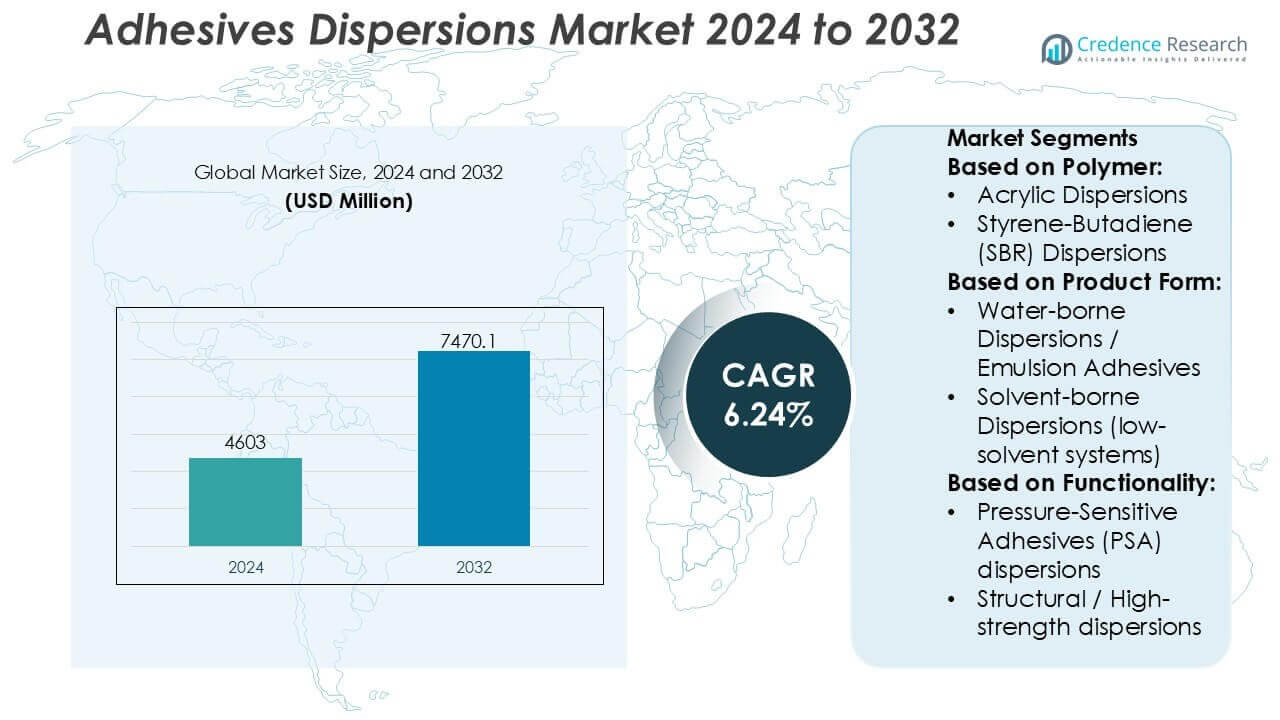
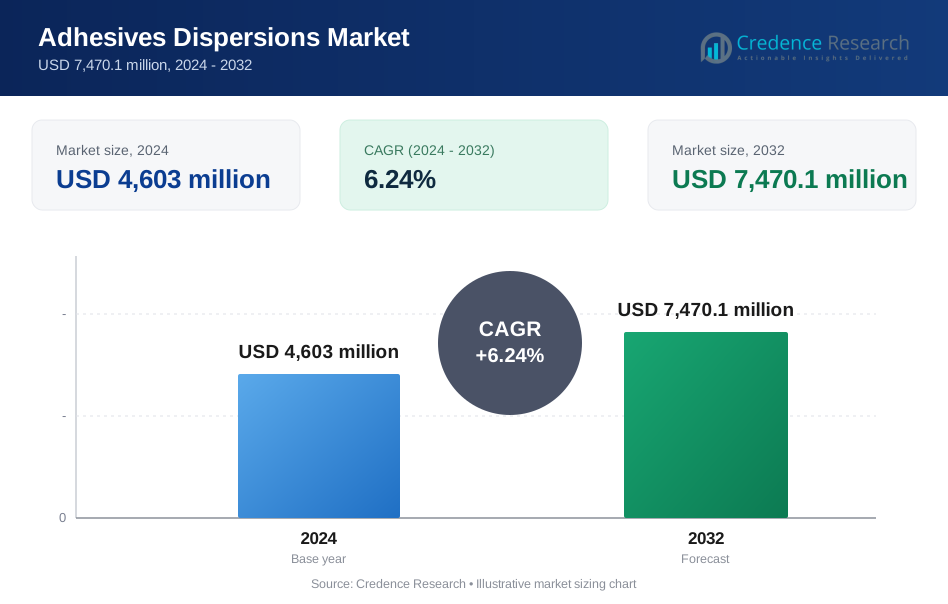
Adhesives Dispersions Market size was valued USD 4603 million in 2024 and is anticipated to reach USD 7470.1 million by 2032, at a CAGR of 6.24% during the forecast period.
| REPORT ATTRIBUTE | DETAILS |
|---|---|
| Historical Period | 2020-2023 |
| Base Year | 2024 |
| Forecast Period | 2025-2032 |
| Adhesives Dispersions Market Size 2024 | USD 4603 million |
| Adhesives Dispersions Market , CAGR | 6.24% |
| Adhesives Dispersions Market Size 2032 | USD 7470.1 million |
Adhesives Dispersions Market Insights
- Market growth is primarily driven by rising demand from packaging, construction, and woodworking industries, where water-based and low-VOC dispersion adhesives offer strong bonding performance, process efficiency, and regulatory compliance across paper, board, wood, and flexible substrates.
- Key market trends include increasing adoption of sustainable and bio-based dispersions, innovation in acrylic and polyurethane chemistries, and growing demand for customized, application-specific formulations compatible with automated, high-speed production lines.
- Competitive dynamics focus on formulation expertise, consistent product quality, technical service, and capacity optimization, while price volatility of raw materials and performance limitations in extreme conditions remain notable market restraints.
- Regionally, Asia-Pacific leads with an exact 35% market share, driven by large-scale manufacturing and packaging demand, while water-based adhesive dispersions represent the dominant segment due to environmental compliance and wide end-use applicability.
Adhesives Dispersions Market Segmentation Analysis:
By Polymer
By polymer type, acrylic dispersions represent the dominant sub-segment in the adhesives dispersions market, accounting for an estimated 38–40% market share, driven by their strong adhesion to diverse substrates, excellent aging resistance, and compatibility with low-VOC water-borne formulations. Acrylic systems are widely adopted in packaging, construction, tapes, and labels. Styrene-butadiene (SBR) dispersions follow, supported by cost efficiency and flexibility in paper and carpet applications. Polyvinyl acetate (PVAc) dispersions maintain steady demand in woodworking and consumer adhesives, while EVA and polyurethane dispersions gain traction in high-performance, flexible, and durability-driven applications.
- For instance, H.B. Fuller has commercialized high-performance water-based acrylic dispersions, such as those in its Swift®tak and Gel-Tac® portfolios, engineered for sustainable packaging and labeling. These adhesives deliver excellent peel adhesion values often exceeding 10 N/25 mm on paperboard and maintain high shear resistance for permanent applications, all while operating with VOC levels below 3 g/L to meet stringent global environmental and food-safety regulations.
By Product Form
By product form, water-borne dispersions / emulsion adhesives dominate the market with approximately 62–65% share, supported by stringent VOC regulations, improved worker safety, and compatibility with sustainable manufacturing practices. These systems are extensively used in packaging, construction, and automotive interiors. Solvent-borne dispersions persist in niche applications requiring fast setting and high initial tack, while reactive and radiation-curable dispersions gain adoption in electronics, automotive, and specialty laminations due to enhanced crosslink density and performance control. Hot-melt dispersion blends also expand steadily, combining thermoplastic strength with dispersion-based processing advantages.
- For instance, Dow Inc. has advanced its RHOBARR™ 320 Polyolefin Dispersion, an aqueous functionalized dispersion engineered for barrier coatings in paperboard applications, capable of forming liquid water barriers with heat seal strength tailored for hot and cold liquids as measured by industry standards documented in product literature.
By Functionality
By functionality, pressure-sensitive adhesive (PSA) dispersions hold the leading position with an estimated 34–36% market share, driven by strong demand from labels, tapes, hygiene products, and flexible packaging. Their balance of tack, peel strength, and shear resistance supports broad end-use adoption. Structural and high-strength dispersions are gaining importance in automotive, construction, and industrial bonding, while non-structural dispersions remain widely used in packaging and paper applications. Tackifier, primer, and coating-grade adhesive dispersions support surface preparation and performance enhancement, reinforcing overall system efficiency across multiple end-use sectors.
Key Growth Drivers
Rising Demand for Water-Based and Low-VOC Adhesives
The global shift toward environmentally compliant manufacturing strongly drives the adhesives dispersions market. Water-based and low-VOC dispersions increasingly replace solvent-borne systems across packaging, construction, automotive, and woodworking applications due to stricter environmental regulations and workplace safety standards. Manufacturers favor these systems for their reduced emissions, lower odor, and improved regulatory acceptance without compromising bonding performance. This transition is further supported by advancements in polymer chemistry that enhance adhesion strength, drying speed, and durability, making water-borne dispersions suitable for both high-volume industrial and specialty applications.
- For instance, 3M has developed water-based acrylic adhesive technologies used in its industrial tapes and bonding solutions that achieve 180-degree peel adhesion above 8 N/cm on stainless steel and maintain shear holding power exceeding 10,000 minutes at 23 °C under 1 kg load, as documented in 3M technical data sheets.
Growth of Packaging, Construction, and Woodworking Industries
Rapid expansion of packaging, construction, and furniture manufacturing sectors significantly accelerates demand for adhesive dispersions. Flexible packaging, paper & board laminations, flooring, insulation panels, and engineered wood products rely heavily on dispersion-based adhesives for consistent bonding and process efficiency. Urbanization, infrastructure development, and increased consumer goods production continue to stimulate these end-use industries. Adhesive dispersions offer strong substrate compatibility with paper, textiles, plastics, and wood, enabling manufacturers to optimize production speed, reduce material waste, and meet performance expectations across diverse applications.
- For instance, Arkema’s Bostik R&D teams have developed acrylic and hybrid dispersion adhesives delivering peel strengths exceeding 6 N/mm on paper-to-film laminations while maintaining open times above 8 minutes to support high-speed packaging lines.
Technological Advancements in Polymer and Formulation Design
Continuous innovation in acrylic, polyurethane, EVA, and hybrid dispersion technologies acts as a key growth catalyst. Improved polymer architectures deliver enhanced heat resistance, moisture tolerance, flexibility, and mechanical strength, expanding the application range of adhesive dispersions. Developments such as self-crosslinking systems, fast-setting formulations, and improved rheology control support automated and high-speed manufacturing lines. These technological improvements enable adhesive suppliers to tailor solutions for specific substrates and performance requirements, strengthening adoption across demanding industrial and specialty bonding applications.
Key Trends & Opportunities
Shift Toward Bio-Based and Sustainable Adhesive Dispersions
Sustainability is emerging as a major trend shaping product development in the adhesives dispersions market. Manufacturers increasingly invest in bio-based polymers, renewable raw materials, and recyclable formulations to align with circular-economy goals. Brand owners and end users demand adhesives that support recyclability of packaging and reduce overall environmental impact. This trend creates opportunities for innovation in green chemistry, allowing suppliers to differentiate through eco-labels, improved life-cycle performance, and compliance with evolving sustainability regulations across global markets.
- For instance, PPG’s recent dispersion platforms for packaging and industrial bonding incorporate bio-based raw material content above 30% by mass, verified through mass-balance certification, while achieving VOC levels below 5 g/L in finished adhesive systems.
Increasing Adoption in High-Performance and Specialty Applications
Adhesive dispersions are gaining traction in high-performance and specialty applications, including automotive interiors, technical textiles, hygiene products, and electronics assembly. These applications require precise bonding, durability, and compatibility with lightweight or sensitive substrates. Advancements in polyurethane and hybrid dispersions enable superior flexibility, heat resistance, and long-term performance. This trend opens opportunities for customized, value-added formulations that command higher margins and strengthen supplier partnerships with OEMs seeking application-specific adhesive solutions.
- For instance, Henkel’s latest polyurethane and hybrid dispersion systems for automotive interior laminations demonstrate heat resistance up to 120 °C under continuous load and elongation at break exceeding 300%, supporting flexible substrates such as PU foams and lightweight fabrics.
Key Challenges
Performance Limitations Compared to Solvent-Based Systems
Despite continuous improvements, adhesive dispersions still face performance challenges in extreme conditions compared to solvent-based alternatives. Limitations related to water resistance, heat tolerance, and curing speed can restrict adoption in heavy-duty or outdoor applications. Achieving equivalent performance often requires complex formulations or additional processing steps, increasing development time and costs. These technical constraints may slow penetration into certain industrial segments where solvent-borne adhesives remain the preferred choice due to proven reliability.
Raw Material Price Volatility and Supply Chain Constraints
The adhesives dispersions market is exposed to volatility in raw material prices, particularly for polymers, additives, and specialty chemicals derived from petrochemical sources. Fluctuating costs impact production economics and pricing stability for manufacturers. Additionally, supply chain disruptions can affect material availability and lead times, challenging consistent product supply. Managing these risks requires strategic sourcing, formulation flexibility, and cost optimization, which can strain margins and complicate long-term planning for adhesive producers.
Regional Analysis
North America
North America represents a mature and technology-driven market for adhesive dispersions, holding around 28% market share. Demand is supported by strong packaging, construction, woodworking, and automotive industries, along with early adoption of water-based and low-VOC adhesive technologies. Stringent environmental regulations encourage the replacement of solvent-borne adhesives with compliant dispersion systems. High levels of automation and advanced manufacturing practices further support demand for consistent, high-performance formulations. The presence of established adhesive producers and continuous product innovation strengthens regional competitiveness and sustains steady consumption across industrial and consumer applications.
Europe
Europe accounts for approximately 25% market share in the adhesives dispersions market, driven by strict environmental policies and strong sustainability mandates. Regulations related to VOC emissions and worker safety accelerate the shift toward water-borne and bio-based dispersion adhesives. The region benefits from well-developed construction, furniture, packaging, and automotive sectors that demand reliable and environmentally compliant bonding solutions. Innovation in acrylic and polyurethane dispersions, along with recycling-friendly formulations, supports market stability. Western Europe leads consumption, while Eastern Europe shows gradual growth due to expanding manufacturing and infrastructure activities.
Asia-Pacific
Asia-Pacific dominates the global adhesives dispersions market with about 35% market share, supported by rapid industrialization and large-scale manufacturing activity. Strong growth in packaging, construction, textiles, and consumer goods production fuels high demand for dispersion-based adhesives. Cost-efficient manufacturing, expanding urban infrastructure, and rising domestic consumption strengthen regional leadership. Countries across East and South Asia benefit from increasing investments in production capacity and growing adoption of water-based adhesives to meet evolving environmental standards. Export-oriented manufacturing further amplifies volume demand across multiple end-use industries.
Latin America
Latin America holds nearly 7% market share, supported by gradual expansion in packaging, construction, and furniture manufacturing. Infrastructure development and rising consumer goods production contribute to steady demand for adhesive dispersions. Adoption of water-based systems is increasing as environmental awareness and regulatory alignment improve across the region. While price sensitivity remains high, manufacturers benefit from the cost-effectiveness and versatility of dispersion adhesives. Brazil and Mexico lead regional consumption due to stronger industrial bases, while other countries show moderate but consistent growth potential.
Middle East & Africa
The Middle East & Africa region accounts for around 5% market share, driven by construction activity, infrastructure projects, and growing packaging demand. Expansion of residential and commercial construction supports the use of dispersion adhesives in flooring, insulation, and interior applications. Industrial diversification and gradual adoption of environmentally compliant adhesive technologies contribute to market development. Although the region remains smaller in scale, improving manufacturing capabilities and increasing awareness of low-emission adhesive solutions create long-term growth opportunities across select markets.
Adhesives Dispersions Market Segmentations:
By Polymer:
- Acrylic Dispersions
- Styrene-Butadiene (SBR) Dispersions
By Product Form:
- Water-borne Dispersions / Emulsion Adhesives
- Solvent-borne Dispersions (low-solvent systems)
By Functionality:
- Pressure-Sensitive Adhesives (PSA) dispersions
- Structural / High-strength dispersions
By Geography
- North America
- U.S.
- Canada
- Mexico
- Europe
- Germany
- France
- U.K.
- Italy
- Spain
- Rest of Europe
- Asia Pacific
- China
- Japan
- India
- South Korea
- South-east Asia
- Rest of Asia Pacific
- Latin America
- Brazil
- Argentina
- Rest of Latin America
- Middle East & Africa
- GCC Countries
- South Africa
- Rest of the Middle East and Africa
Competitive Landscape
The competitive landscape of the adhesives dispersions market players such as Akzo Nobel N.V., H.B. Fuller, Sika AG, Dow, 3M, Arkema, PPG Industries, Henkel AG & Co. KGaA, Bayer AG, Ashland. The adhesives dispersions market features a competitive environment driven by formulation expertise, application performance, and sustainability leadership rather than pure scale.
Companies compete by offering high-performance water-based and low-VOC dispersion systems tailored to packaging, construction, automotive, woodworking, and industrial uses. Continuous innovation in acrylic, polyurethane, and hybrid dispersions supports improved adhesion strength, durability, and process efficiency.
Competitive positioning increasingly depends on the ability to deliver customized solutions, ensure consistent product quality, and provide strong technical support. Investments in sustainable chemistries, regulatory compliance, and supply chain reliability further shape differentiation, while close collaboration with end users strengthens long-term market presence.
Key Player Analysis
- Akzo Nobel N.V.
- B. Fuller
- Sika AG
- Dow
- 3M
- Arkema
- PPG Industries
- Henkel AG & Co. KGaA
- Bayer AG
- Ashland
Recent Developments
- In July 2025, APPLIED Adhesives acquired BTmix (static mixers/cartridges) and HG Adhesive Dispensing (dispensing/filling equipment) to enhance its integrated adhesive solutions, adding vital parts and equipment to its offerings for industries like automotive, aerospace, and construction, supported by their new owner, Bertram Capital.
- In June 2025, Techcon announced the launch of a new side-up side (SBS) dispensing line for 2-component adhesives and sealants (available in 50 ml and 200 ml sizes with mixing ratios of 1:1, 2:1, and 10:1).
- In November 2024, Henkel and Celanese, a global adhesives leader to create water-based adhesives using CO2 captured by Celanese and converted into methanol, a key adhesive ingredient, offering packaging and consumer goods companies a sustainable way to boost renewable content by using these emissions in their products, advancing circular economy goals.
Report Coverage
The research report offers an in-depth analysis based on Polymer, Product Form, Functionality and Geography. It details leading market players, providing an overview of their business, product offerings, investments, revenue streams, and key applications. Additionally, the report includes insights into the competitive environment, SWOT analysis, current market trends, as well as the primary drivers and constraints. Furthermore, it discusses various factors that have driven market expansion in recent years. The report also explores market dynamics, regulatory scenarios, and technological advancements that are shaping the industry. It assesses the impact of external factors and global economic changes on market growth. Lastly, it provides strategic recommendations for new entrants and established companies to navigate the complexities of the market.
Future Outlook
- Water-based and low-VOC adhesive dispersions will continue to gain preference due to tightening environmental and workplace safety regulations.
- Advancements in polymer chemistry will enhance adhesion strength, heat resistance, and durability across diverse substrates.
- Sustainable and bio-based dispersion formulations will see wider adoption to support circular-economy and recyclability goals.
- Growth in packaging, construction, and woodworking industries will remain a primary demand driver.
- Customized and application-specific dispersion solutions will increase as end users seek optimized bonding performance.
- Adoption of adhesive dispersions in automotive and technical textile applications will expand steadily.
- Emerging markets will contribute higher volume growth supported by industrialization and infrastructure development.
- Digitalization and process automation will influence demand for consistent and high-speed compatible dispersion adhesives.
- Strategic investments in capacity expansion and regional manufacturing will strengthen supply reliability.
- Competitive differentiation will increasingly depend on sustainability credentials, technical support, and long-term customer partnerships.
Request a Free Sample
Fill in your details and we'll send you a free sample report.
- Sample data tables & charts
- Research methodology
Need a Custom Version of This Report?
Tailor the scope, geography, or segments to your exact requirements.
- Custom geography or segment scope
- Direct access to our analyst team
Frequently Asked Questions
What is the current market size for Adhesives Dispersions Market, and what is its projected size in 2032?
At what Compound Annual Growth Rate is the Adhesives Dispersions Market projected to grow between 2024 and 2032?
Which Adhesives Dispersions Market segment held the largest share in 2024?
What are the primary factors fueling the growth of the Adhesives Dispersions Market?
Who are the leading companies in the Adhesives Dispersions Market?
Which region commanded the largest share of the Adhesives Dispersions Market in 2024?
Table of Content
Chapter 1. Report Introduction
- 1.1 Report Description & Purpose
- 1.1.1 Report Title & Market Definition
- 1.1.2 Unique Selling Propositions (USP) & Key Differentiators
- 1.1.3 Value Proposition for Stakeholders
- 1.2 Research Objectives
- 1.2.1 Market Sizing Objectives (Volume & Revenue)
- 1.2.2 Segmentation Objectives
- 1.2.3 Competitive Intelligence Objectives
- 1.2.4 Forecast & Scenario Objectives
- 1.3 Report Scope
- 1.3.1 Adhesives Dispersions Scope – Types & Subtypes Covered
- 1.3.2 Geographic Scope – Regions & Countries Covered
- 1.3.3 Historical Period, Base Year & Forecast Period (2024; forecast to 2032)
- 1.3.4 Inclusions & Exclusions
- 1.4 HS Code & Classification Framework
- 1.5 Currency, Units & Pricing Basis
- 1.6 Target Stakeholders
- 1.7 Limitations & Assumptions
Chapter 2. Executive Summary
- 2.1 Global Adhesives Dispersions Market Snapshot
- 2.1.1 Market Size – Historical (2024) & Forecast (2024-2032) (2024: USD 4,603 million → 2032: USD 7,470.1 million)
- 2.1.2 Volume & Revenue – Global Totals
- 2.1.3 Key Market Highlights – Top Five Facts
- 2.2 Adhesives Dispersions Market Segmentation Snapshot
- 2.2.1 Market Split by Region – 2024 vs. 2032
- 2.3 Competitive Snapshot
- 2.3.1 Top 10 Players by Revenue Share – 2024
- 2.3.2 Top 10 Players by Volume Share – 2024
- 2.3.3 Recent Strategic Developments (18-Month Summary)
- 2.4 Key Investment Highlights & Strategic Conclusions
Chapter 3. Adhesives Dispersions Market Dynamics & Industry Analysis
- 3.1 Market Overview & Context
- 3.1.1 Adhesives Dispersions Market Position in the Broader Automotive Value Chain
- 3.1.2 OEM vs. Replacement Market Dynamics
- 3.1.3 Market Maturity & Development Stage by Region
- 3.2 Adhesives Dispersions Market Drivers
- 3.3 Adhesives Dispersions Market Restraints & Challenges
- 3.4 Adhesives Dispersions Market Opportunities
- 3.5 Porter's Five Forces Analysis
- 3.5.1 Threat of New Entrants
- 3.5.2 Bargaining Power of Suppliers
- 3.5.3 Bargaining Power of Buyers
- 3.5.4 Threat of Substitutes
- 3.5.5 Competitive Rivalry – Intensity Assessment
- 3.6 Adhesives Dispersions Value Chain Analysis
- 3.6.1 Upstream – Raw Material/Input Suppliers
- 3.6.1.1 Raw Material/Input 1
- 3.6.1.2 Raw Material/Input 2
- 3.6.1.3 Raw Material/Input 3
- 3.6.2 Midstream – Production/Manufacturing/Service Delivery
- 3.6.2.1 Production/Process Overview
- 3.6.2.2 Key Facility Locations & Capacity by Manufacturer
- 3.6.3 Downstream – Distribution & End Consumer
- 3.6.3.1 Primary Channel – B2B/OEM
- 3.6.3.2 Secondary Channels – Dealer, Retail, Online, Direct
- 3.6.4 Value Chain Profitability Analysis
- 3.6.1 Upstream – Raw Material/Input Suppliers
- 3.7 PESTEL Analysis
- 3.7.1 Political Factors
- 3.7.2 Economic Factors
- 3.7.3 Social Factors
- 3.7.4 Technological Factors
- 3.7.5 Environmental Factors
- 3.7.6 Legal Factors
- 3.8 Adhesives Dispersions Supply Chain Analysis
- 3.8.1 Raw Material/Input Supply Risk Assessment
- 3.8.2 Manufacturing Concentration Risk (Geographic Exposure)
- 3.8.3 Trade Disruption Impact Analysis
- 3.9 Regulatory & Policy Landscape
Note: The regulatory and policy landscape section covers regulations based on their applicability to the market, Adhesives Dispersions category, geography, and scope of the study. Only regulatory frameworks with a material impact on operations, compliance, trade, sustainability, or market access are analyzed in detail.
Chapter 4. Key Investment Pockets & Opportunity Analysis
- 4.1 Adhesives Dispersions Market Attractiveness Analysis
- 4.1.1 By Region – Investment Attractiveness Matrix (Volume × CAGR)
- 4.2 Absolute Revenue Growth Opportunity
- 4.2.1 By Region – Absolute USD Growth Through 2032
- 4.3 Incremental Volume Opportunity
- 4.3.1 By Region – Incremental Volume Through 2032
- 4.3.2 Segment – Incremental Volume
- 4.4 Emerging Submarket Opportunity Deep Dive (Subject to Applicability)
- 4.5 Emerging Market Opportunity Scorecards
- 4.5.1 United States
- 4.5.2 Europe
- 4.5.3 Asia
- 4.5.4 Middle East & Africa
Note: Emerging Market Opportunity Scorecards will be included based on relevance and strategic importance. Regions listed are indicative and may vary depending on data availability and market dynamics.
Chapter 5. Adhesives Dispersions Import-Export Analysis & Trade Flows
- 5.1 Global Trade Overview
- 5.1.1 Global Export Value by Country (2024)
- 5.1.2 Global Export Volume by Country (2024)
- 5.1.3 Global Import Value by Country (2024)
- 5.1.4 Global Import Volume by Country (2024)
- 5.1.5 Net Trade Balance by Country (2024)
- 5.2 Export Analysis – Segment
- 5.2.1 Type 1 (HS Code)
- 5.2.2 Type 2 (HS Code)
- 5.2.3 Type 3 (HS Code)
- 5.2.4 Type 4 (HS Code)
- 5.2.5 Type 5 (HS Code)
- 5.3 Import Analysis – Segment
- 5.3.1 Type 1 (HS Code)
- 5.3.2 Type 2 (HS Code)
- 5.3.3 Type 3 (HS Code)
- 5.3.4 Type 4 (HS Code)
- 5.3.5 Type 5 (HS Code)
- 5.4 Average Unit Trade Prices
- 5.4.1 Average Export Price – Segment & Country
- 5.4.2 Average Import Price – Segment & Source Country
- 5.4.3 Price Trends (2024)
- 5.5 Key Trade Route Analysis
- 5.5.1 Trade Route 1
- 5.5.2 Trade Route 2
- 5.5.3 Trade Route 3
- 5.5.4 Trade Route 4
- 5.5.5 Trade Route 5
- 5.6 Trade Policy Impact Assessment
- 5.6.1 US Anti-Dumping & Section 301 Tariffs
- 5.6.2 EU Customs Union Impact
- 5.6.3 Major Free Trade Agreements
- 5.6.4 USMCA Rules of Origin
Note: Trade policy analysis will be included only where relevant to the Adhesives Dispersions market.
Chapter 6. Competitive Landscape & Company Benchmarking
- 6.1 Adhesives Dispersions Market Concentration & Structure
- 6.1.1 Herfindahl-Hirschman Index (HHI) – vs. 2024
- 6.1.2 Tier 1, Tier 2 & Tier 3 Market Structure
- 6.1.3 Global, Regional & Local Player Dynamics
- 6.2 Adhesives Dispersions Market Share Analysis – 2024
- 6.2.1 Global Revenue Share by Company
- 6.2.2 Global Volume Share by Company
- 6.2.3 Regional Revenue Share
- 6.2.4 Market Share Evolution ( vs. 2024)
- 6.2.5 OEM Segment Share by Company
- 6.2.6 Replacement Segment Share by Company
- 6.3 Production/Delivery Capacity & Facility Analysis
- 6.3.1 Global Installed Capacity
- 6.3.2 Capacity Utilization Rates
- 6.3.3 Production/Output Volume
- 6.3.4 Facility Locations & Capacity Map
- 6.3.5 Planned Capacity Additions
- 6.4 Adhesives Dispersions Competitive Benchmarking Matrix
- 6.4.1 Revenue, Volume, CAGR & Profitability Comparison
- 6.4.2 Channel Revenue Mix
- 6.4.3 Geographic Revenue Exposure
- 6.4.4 R&D Intensity
- 6.4.5 Sustainability Maturity
- 6.5 Strategic Developments in Adhesives Dispersions (Last 24 Months)
- 6.5.1 Mergers, Acquisitions & Divestments
- 6.5.2 New Adhesives Dispersions Launches
- 6.5.3 Facility Expansions
- 6.5.4 Strategic Alliances, Joint Ventures & Partnerships
- 6.5.5 Distribution Expansion & Market Entry
- 6.5.6 Sustainability & ESG Initiatives
- 6.6 Competitive Strategy Mapping
- 6.6.1 Leader, Challenger, Follower & Niche Classification
- 6.6.2 Pricing Strategy Comparison
- 6.6.3 Channel Strategy Matrix
Note: Strategic developments are included based on their materiality and the availability of reliable information.
Chapter 7. Global Adhesives Dispersions Market – By Distribution Channel
- 7.1 Segment Overview
- 7.1.1 Volume & Revenue Split by Channel (2024 & 2032)
- 7.1.2 Channel Mix Evolution (2024-2032)
Chapter 8. Regional Market Analysis – Global Overview
- 8.1 Global Regional Overview
- 8.1.1 Regional Volume Share
- 8.1.2 Regional Revenue Share
- 8.1.3 Regional Volume by Region
- 8.1.4 Regional Revenue by Region
- 8.1.5 Regional Forecast Through 2032
- 8.2 Cross-Regional Segment Analysis
- 8.2.1 By Distribution Channel
- 8.2.2 By Brand/Price Tier
Chapter 9. North America Adhesives Dispersions Market
- 9.1 United States
- 9.2 Canada
- 9.3 Mexico
Chapter 10. Europe Adhesives Dispersions Market
- 10.1 Germany
- 10.2 France
- 10.3 Italy
- 10.4 United Kingdom
- 10.5 Spain
- 10.6 Poland
- 10.7 Russia
- 10.8 Netherlands
- 10.9 Belgium
- 10.10 Sweden
- 10.11 Denmark
- 10.12 Norway
- 10.13 Rest of Europe
Chapter 11. Asia Pacific Adhesives Dispersions Market
- 11.1 China
- 11.2 India
- 11.3 Japan
- 11.4 South Korea
- 11.5 Thailand
- 11.6 Indonesia
- 11.7 Vietnam
- 11.8 Malaysia
- 11.9 Australia
- 11.10 Rest of Asia Pacific
Chapter 12. Latin America Adhesives Dispersions Market
- 12.1 Brazil
- 12.2 Argentina
- 12.3 Colombia
- 12.4 Chile
- 12.5 Rest of Latin America
Chapter 13. Middle East Adhesives Dispersions Market
- 13.1 Saudi Arabia
- 13.2 United Arab Emirates
- 13.3 Turkey
- 13.4 Israel
- 13.5 Iran
- 13.6 Rest of the Middle East
Chapter 14. Africa Adhesives Dispersions Market
- 14.1 South Africa
- 14.2 Egypt
- 14.3 Nigeria
- 14.4 Morocco
- 14.5 Rest of Africa
Chapter 15. Adhesives Dispersions Company Profiles
- 15.1 [Company 01]
- 15.1.1 Company Overview
- 15.1.2 Key Management Personnel
- 15.1.3 Products & Services Portfolio
- 15.1.4 Financial Performance
- 15.1.5 Key Market Focus & Geographic Presence
- 15.1.6 Recent Developments & Strategic Initiatives
Note: The company profile list is preliminary and may change based on research findings, market developments, data availability, and client requirements.
Chapter 16. Appendices
- Appendix A – List of Abbreviations & Acronyms
- Appendix B – Industry Classification Code Reference – Full Series
- Appendix C – Production & Capacity Data Tables
- Appendix D – End-Use & Demand Base Tables
- Appendix E – Consumption & Replacement Rate Assumptions
- Appendix F – ASP Reference Tables
- Appendix G – Manufacturing & Facility Database
- Appendix H – Import-Export Data Tables
- Appendix I – Regulatory Summary Tables
- Appendix J – Primary Research Participant List (Anonymized)
- Appendix K – Primary Research Questionnaire Framework
- Appendix L – Data Sources & Bibliography
- Appendix M – Market Size Divergence & Source Comparison
Chapter 17. Research Methodology
- 17.1 Research Framework & Philosophy
- 17.2 Secondary Research – Sources, Hierarchy & Data Extraction
- 17.3 Data Modeling – Bottom-Up & Top-Down Market Sizing
- 17.4 Primary Research – Stakeholder Framework, LOI & Sample Sizes
- 17.5 Forecast Methodology – Regression, Scenario & Sensitivity Analysis
- 17.6 Quality Control – Four-Layer Validation Framework
- 17.7 Limitations & Standard Assumptions
- 17.8 Disclaimer
