
Dimethyl Sulfoxide Market Overview:
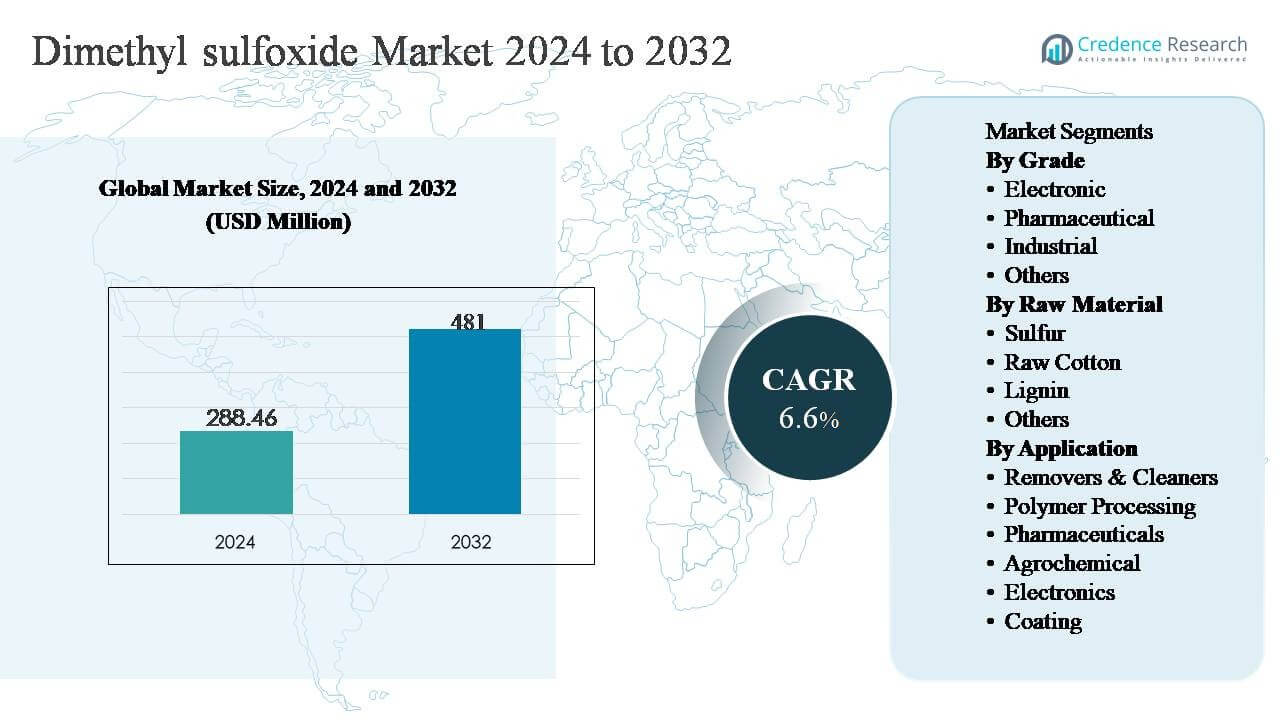
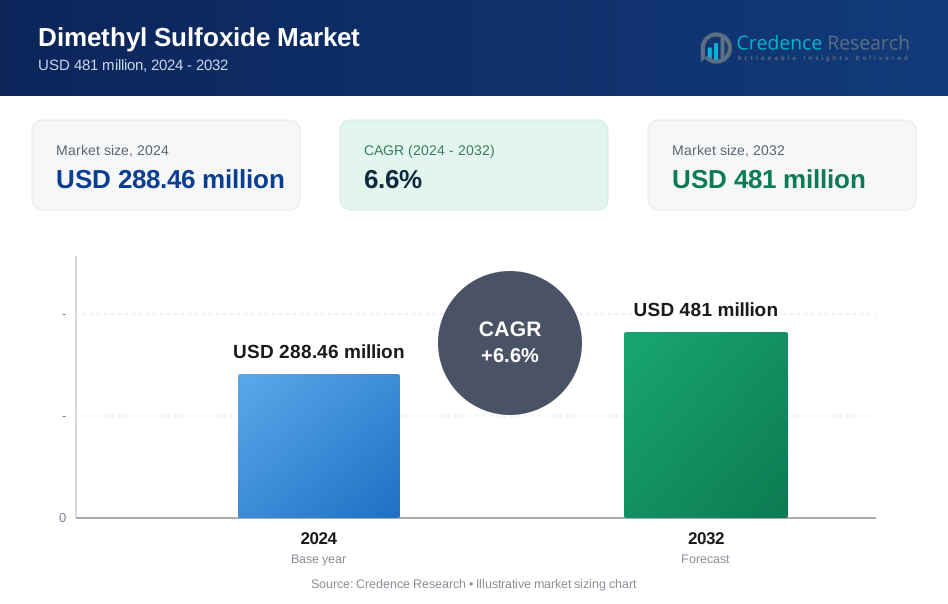
The global dimethyl sulfoxide (DMSO) market was valued at USD 288.46 million in 2024 and is projected to reach USD 481.0 million by 2032, expanding at a compound annual growth rate (CAGR) of 6.6% during the forecast period.
| REPORT ATTRIBUTE | DETAILS |
|---|---|
| Historical Period | 2020-2023 |
| Base Year | 2024 |
| Forecast Period | 2025-2032 |
| Dimethyl Sulfoxide Market Size 2024 | USD 288.46 million |
| Dimethyl Sulfoxide Market , CAGR | 6.6% |
| Dimethyl Sulfoxide Market Size 2032 | USD 481.0 million |
Dimethyl Sulfoxide Market Insights
- Market growth is primarily driven by expanding pharmaceutical usage, where pharmaceutical-grade DMSO holds the dominant segment share at around 45%, supported by its role as a solvent, cryoprotectant, and penetration enhancer in drug formulations and biotechnology research.
- Key market trends include rising demand for high-purity pharmaceutical and electronic grades, along with increasing use in semiconductor cleaning and advanced polymer processing, while sulfur-based production remains the leading raw material route with over 60% share due to cost efficiency.
- The competitive landscape features a mix of global chemical and life-science companies focusing on quality consistency, regulatory compliance, and long-term supply agreements, with premium grades offering higher margins compared to price-sensitive industrial segments.
- Regionally, Asia-Pacific leads with approximately 34% market share, followed by North America at 32% and Europe at 26%, while Latin America and the Middle East & Africa together account for the remaining share, driven by gradual industrial and pharmaceutical expansion.
Dimethyl Sulfoxide Market Segmentation Analysis:
By Grade:
By grade, the dimethyl sulfoxide market is led by the pharmaceutical grade, which accounts for an estimated around 45% of total demand due to its high purity requirements and widespread use as a drug solvent, cryoprotectant, and penetration enhancer. Stringent regulatory standards in drug manufacturing continue to favor pharmaceutical-grade DMSO over lower-purity alternatives. The industrial grade follows, supported by demand from chemical processing and polymer synthesis. Meanwhile, electronic grade DMSO is gaining traction in semiconductor and display manufacturing, driven by its ultra-low impurity profile and strong solvency performance.
- For instance, Gaylord Chemical produces pharmaceutical-grade DMSO with purity levels of ≥99.9% and water content controlled below 0.1%, meeting USP and EP specifications for injectable and topical drug applications.
By Raw Material:
Based on raw material, sulfur-based production dominates the dimethyl sulfoxide market with an estimated market share exceeding 60%, primarily due to its cost efficiency, established supply chains, and scalability in large-volume manufacturing. Sulfur-derived DMSO offers consistent quality, making it suitable for both industrial and pharmaceutical applications. Raw cotton–based and lignin-based routes remain niche, mainly adopted in specialty or sustainability-focused applications where bio-based sourcing is prioritized. However, higher processing costs and limited feedstock availability currently restrict their broader adoption compared to sulfur-based production.
- For instance, Arkema operates integrated sulfur-chemistry platforms where downstream sulfoxide units are linked to upstream sulfur recovery systems, enabling continuous production runs exceeding 300 operating days per year and delivering DMSO with purity levels above 99.9% for regulated applications.
By Application:
By application, pharmaceuticals represent the dominant segment, accounting for approximately 35% of total consumption, driven by DMSO’s extensive use in injectable formulations, topical drugs, and cell preservation processes. Its high polarity and ability to dissolve both polar and non-polar compounds make it indispensable in drug development. Polymer processing and removers & cleaners form the next major demand centers, benefiting from DMSO’s thermal stability and solvency strength. Additionally, growing use in electronics cleaning and coatings supports steady diversification across high-performance industrial applications.
Key Growth Drivers
Expanding Pharmaceutical and Biotechnology Utilization
Rising use of dimethyl sulfoxide (DMSO) in pharmaceutical and biotechnology applications is a primary growth driver. DMSO is widely employed as a solvent for active pharmaceutical ingredients, a penetration enhancer in topical formulations, and a cryoprotectant in cell and tissue preservation. The expansion of biologics, cell therapy, and regenerative medicine has reinforced demand for high-purity pharmaceutical-grade DMSO, particularly in controlled drug delivery and stem-cell storage. Increasing global drug development activity and the growing volume of clinical research further support consistent consumption. Regulatory acceptance of DMSO in approved formulations also enhances confidence among manufacturers, encouraging long-term supply agreements and capacity expansions across pharmaceutical-grade production facilities.
- For instance, Merck KGaA provides DMSO meeting USP and EP standards with purity of ≥99.9% and endotoxin levels controlled below 0.25 EU/mL, supporting its use in stem-cell banking and viral vector manufacturing.
Strong Demand from Polymer Processing and Specialty Chemicals
DMSO’s exceptional solvency, thermal stability, and chemical compatibility drive its extensive use in polymer processing and specialty chemical manufacturing. It plays a critical role as a reaction medium and processing aid in polymer synthesis, fiber spinning, and resin modification. Growth in high-performance polymers for automotive, construction, and electronics applications has directly increased DMSO consumption. Additionally, specialty chemical producers favor DMSO for its ability to dissolve complex organic compounds while maintaining reaction efficiency. Ongoing industrialization in emerging economies and rising investments in advanced materials manufacturing continue to sustain steady demand from industrial-grade DMSO users.
- For instance, Toray Fine Chemicals, as Japan’s sole manufacturer of high-purity Dimethyl Sulfoxide (DMSO), supplies industrial-grade solvent for the wet-spinning of polyacrylonitrile (PAN) fibers. In these closed-loop systems, advanced Solvent Recovery Systems (SRS) achieve recovery efficiencies exceeding 99%, maintaining high operational sustainability and cost-efficiency for carbon fiber precursor production."
Increasing Use in Electronics and Precision Cleaning Applications
The electronics sector represents a growing demand base for dimethyl sulfoxide due to its effectiveness in precision cleaning, photoresist stripping, and residue removal. Advanced semiconductor fabrication, display panel manufacturing, and printed circuit board production require high-purity solvents with low residue and controlled volatility, favoring electronic-grade DMSO. As device architectures become more complex and miniaturized, manufacturers increasingly rely on specialized solvents to maintain yield and performance. Expansion of electronics manufacturing hubs and continued investments in semiconductor capacity globally further support rising consumption, positioning electronics as a stable long-term growth contributor for the DMSO market.
Key Trends & Opportunities
Shift Toward High-Purity and Specialty Grades
A notable trend in the dimethyl sulfoxide market is the increasing shift toward high-purity pharmaceutical and electronic grades. End users are prioritizing consistent quality, low impurity profiles, and regulatory compliance, driving manufacturers to upgrade purification technologies and quality control systems. This trend creates opportunities for suppliers to differentiate through specialty-grade offerings with higher margins. Customized formulations tailored to drug delivery, cell therapy, and semiconductor processing are gaining attention, enabling producers to expand beyond commoditized industrial grades and strengthen long-term customer relationships.
- For instance, Hubei Xingfa Chemicals Group operates multi-stage vacuum distillation units for sulfoxide solvents, enabling routine production of DMSO with purity levels of ≥99.9% and moisture content controlled below 1,000 ppm, supported by on-site gas chromatography and Karl Fischer testing for every production batch.
Growth Opportunities in Emerging Healthcare and Industrial Markets
Emerging markets present significant opportunities for DMSO consumption, supported by expanding pharmaceutical manufacturing, chemical processing, and electronics assembly activities. Increasing healthcare spending and local drug production capacity in Asia-Pacific and Latin America are driving demand for pharmaceutical-grade DMSO. At the same time, industrial growth and infrastructure development are boosting consumption in polymer processing and specialty chemicals. Suppliers that establish regional distribution networks and local production capabilities can capitalize on these expanding end-use sectors while reducing logistics costs and improving supply reliability.
- For instance,"Parchem Fine & Specialty Chemicals provides dimethyl sulfoxide (DMSO) to industrial and pharmaceutical markets, maintaining a global supply network that includes regions like Latin America and Asia. The company offers flexible packaging ranging from 25-kg drums for specialized use to 1,000-kg IBCs for large-scale operations.
Key Challenges
Stringent Regulatory and Safety Considerations
Dimethyl sulfoxide faces challenges related to regulatory oversight and safety handling requirements. Its high skin permeability and strong solvent properties require strict controls in pharmaceutical and industrial environments. Regulatory authorities impose rigorous quality, labeling, and usage guidelines, particularly for pharmaceutical-grade DMSO, increasing compliance costs for manufacturers. Meeting evolving regulatory standards across multiple regions can complicate market entry and expansion, especially for smaller producers lacking advanced compliance infrastructure.
Raw Material Price Volatility and Supply Constraints
Volatility in raw material prices, particularly sulfur-based feedstocks, poses a challenge to stable DMSO production economics. Fluctuations in upstream chemical markets can impact manufacturing costs and margins, limiting pricing flexibility. In addition, dependence on specific feedstock supply chains exposes producers to disruptions from environmental regulations or capacity constraints in sulfur processing. These factors can affect long-term supply contracts and create uncertainty for end users relying on consistent DMSO availability.
Regional Analysis
North America
North America holds a market share of approximately 32% in the global dimethyl sulfoxide market, driven by strong pharmaceutical, biotechnology, and specialty chemical industries. The region benefits from high adoption of pharmaceutical-grade DMSO in drug formulation, cryopreservation, and clinical research. Well-established regulatory frameworks support consistent quality standards, encouraging long-term procurement by pharmaceutical manufacturers. Additionally, demand from polymer processing and electronics cleaning applications contributes to stable industrial consumption. Ongoing investments in biologics, cell therapy research, and advanced materials manufacturing continue to reinforce North America’s position as a leading regional market.
Europe
Europe accounts for around 26% of the global dimethyl sulfoxide market, supported by its mature pharmaceutical sector and strong presence of specialty chemical manufacturers. The region shows steady demand for high-purity DMSO, particularly in drug development, topical formulations, and laboratory applications. Stringent regulatory compliance across European countries favors premium pharmaceutical and electronic grades. Industrial usage in polymer processing, coatings, and chemical synthesis further supports market stability. Sustainability initiatives and interest in alternative raw material sourcing also influence procurement strategies, creating a balanced demand profile across pharmaceutical and industrial end-use segments.
Asia-Pacific
Asia-Pacific represents the largest regional market with an estimated 34% share, driven by rapid expansion of pharmaceutical manufacturing, electronics production, and chemical processing industries. Countries such as China, India, Japan, and South Korea contribute significantly to demand for both industrial and pharmaceutical-grade DMSO. Growing investments in generic drug production, contract manufacturing, and semiconductor fabrication fuel consumption across multiple applications. Cost-efficient manufacturing and expanding domestic supply chains further support market growth. Increasing healthcare expenditure and rising adoption of advanced materials position Asia-Pacific as the fastest-growing and most dynamic regional market.
Latin America
Latin America holds approximately 5% of the global dimethyl sulfoxide market, supported by gradual growth in pharmaceutical manufacturing and agrochemical applications. Brazil and Mexico are key contributors, with rising demand for DMSO in drug formulation, laboratory use, and agricultural chemical processing. Industrial applications such as polymer processing and coatings also support steady consumption. While the market remains smaller compared to developed regions, improving healthcare infrastructure and expanding local chemical production capabilities are enhancing regional demand. Imports continue to play a significant role, with suppliers focusing on distribution efficiency and regulatory alignment.
Middle East & Africa
The Middle East & Africa region accounts for about 3% of the global dimethyl sulfoxide market, reflecting developing industrial and pharmaceutical sectors. Demand is primarily driven by chemical processing, oilfield-related specialty chemicals, and limited pharmaceutical applications. Countries in the Gulf region show increasing interest in specialty solvents as part of broader industrial diversification strategies. In Africa, consumption remains modest but is gradually rising with improvements in healthcare access and local pharmaceutical production. The market relies heavily on imports, and growth is tied to industrial investment and regulatory development across the region.
Dimethyl Sulfoxide Market Segmentations:
By Grade
- Electronic
- Pharmaceutical
- Industrial
- Others
By Raw Material
- Sulfur
- Raw Cotton
- Lignin
- Others
By Application
- Removers & Cleaners
- Polymer Processing
- Pharmaceuticals
- Agrochemical
- Electronics
- Coating
By Geography
- North America
- U.S.
- Canada
- Mexico
- Europe
- Germany
- France
- U.K.
- Italy
- Spain
- Rest of Europe
- Asia Pacific
- China
- Japan
- India
- South Korea
- South-east Asia
- Rest of Asia Pacific
- Latin America
- Brazil
- Argentina
- Rest of Latin America
- Middle East & Africa
- GCC Countries
- South Africa
- Rest of the Middle East and Africa
Competitive Landscape
The competitive landscape of the dimethyl sulfoxide (DMSO) market is characterized by the presence of a limited number of global and regional manufacturers competing on product purity, regulatory compliance, and supply reliability. Leading players focus on pharmaceutical- and electronic-grade DMSO, where stringent quality standards and long-term customer contracts create high entry barriers. Companies emphasize process optimization, advanced purification technologies, and consistent batch quality to strengthen their positioning. Strategic priorities include capacity expansions, backward integration for raw material security, and geographic diversification to serve pharmaceutical and industrial customers efficiently. Competition also extends to technical support and customized specifications for drug development, electronics cleaning, and specialty chemical applications. While industrial-grade DMSO remains more price-sensitive, premium segments offer higher margins, prompting suppliers to shift toward value-added grades and long-term partnerships rather than purely volume-driven competition.
Key Player Analysis
- Arkema Group
- Merck KGaA
- Toray Fine Chemicals Co. Ltd.
- Gaylord Chemical Corporation
- Hubei Xingfa Chemicals Group
- Rimax Group
- Huangshi Hengchang Chemical Co., Ltd.
- Parchem Fine & Specialty Chemicals
- Sigma-Aldrich
- Acros Organics
Recent Developments
- In August 2024, Rimax upgraded solvent recovery and reuse systems at its DMSO production facilities, improving operational efficiency and reinforcing its positioning as a cost-competitive supplier for continuous polymer and resin manufacturing operations.
- In March 2024,Hubei Xingfa Chemicals Group strengthened its sulfur-based sulfoxide production chain in Hubei Province by upgrading purification and distillation systems used for DMSO manufacturing, aligning output with pharmaceutical and high-purity industrial specifications required by domestic chemical and drug manufacturers.
Report Coverage
The research report offers an in-depth analysis based on Grade, Raw material, Application and Geography. It details leading market players, providing an overview of their business, product offerings, investments, revenue streams, and key applications. Additionally, the report includes insights into the competitive environment, SWOT analysis, current market trends, as well as the primary drivers and constraints. Furthermore, it discusses various factors that have driven market expansion in recent years. The report also explores market dynamics, regulatory scenarios, and technological advancements that are shaping the industry. It assesses the impact of external factors and global economic changes on market growth. Lastly, it provides strategic recommendations for new entrants and established companies to navigate the complexities of the market.
Request a Free Sample
Fill in your details and we'll send you a free sample report.
- Sample data tables & charts
- Research methodology
Need a Custom Version of This Report?
Tailor the scope, geography, or segments to your exact requirements.
- Custom geography or segment scope
- Direct access to our analyst team
Frequently Asked Questions
What is the current market size for Dimethyl Sulfoxide, and what is its projected size in 2032?
At what Compound Annual Growth Rate is the Dimethyl Sulfoxide market projected to grow between 2024 and 2032?
Which Dimethyl Sulfoxide segment held the largest share in 2024?
What are the primary factors fueling the growth of the Dimethyl Sulfoxide market?
Who are the leading companies in the Dimethyl Sulfoxide market?
Which region commanded the largest share of the Dimethyl Sulfoxide market in 2024?
Table of Content
Chapter 1. Report Introduction
- 1.1 Report Description & Purpose
- 1.1.1 Report Title & Market Definition
- 1.1.2 Unique Selling Propositions (USP) & Key Differentiators
- 1.1.3 Value Proposition for Stakeholders
- 1.2 Research Objectives
- 1.2.1 Market Sizing Objectives (Volume & Revenue)
- 1.2.2 Segmentation Objectives
- 1.2.3 Competitive Intelligence Objectives
- 1.2.4 Forecast & Scenario Objectives
- 1.3 Report Scope
- 1.3.1 Dimethyl Sulfoxide Scope – Types & Subtypes Covered
- 1.3.2 Geographic Scope – Regions & Countries Covered
- 1.3.3 Historical Period, Base Year & Forecast Period (2024; forecast to 2032)
- 1.3.4 Inclusions & Exclusions
- 1.4 HS Code & Classification Framework
- 1.5 Currency, Units & Pricing Basis
- 1.6 Target Stakeholders
- 1.7 Limitations & Assumptions
Chapter 2. Executive Summary
- 2.1 Global Dimethyl Sulfoxide Market Snapshot
- 2.1.1 Market Size – Historical (2024) & Forecast (2024-2032) (2024: USD 288.46 million → 2032: USD 481 million)
- 2.1.2 Volume & Revenue – Global Totals
- 2.1.3 Key Market Highlights – Top Five Facts
- 2.2 Dimethyl Sulfoxide Market Segmentation Snapshot
- 2.2.1 Market Split by Region – 2024 vs. 2032
- 2.3 Competitive Snapshot
- 2.3.1 Top 10 Players by Revenue Share – 2024
- 2.3.2 Top 10 Players by Volume Share – 2024
- 2.3.3 Recent Strategic Developments (18-Month Summary)
- 2.4 Key Investment Highlights & Strategic Conclusions
Chapter 3. Dimethyl Sulfoxide Market Dynamics & Industry Analysis
- 3.1 Market Overview & Context
- 3.1.1 Dimethyl Sulfoxide Market Position in the Broader Automotive Value Chain
- 3.1.2 OEM vs. Replacement Market Dynamics
- 3.1.3 Market Maturity & Development Stage by Region
- 3.2 Dimethyl Sulfoxide Market Drivers
- 3.3 Dimethyl Sulfoxide Market Restraints & Challenges
- 3.4 Dimethyl Sulfoxide Market Opportunities
- 3.5 Porter's Five Forces Analysis
- 3.5.1 Threat of New Entrants
- 3.5.2 Bargaining Power of Suppliers
- 3.5.3 Bargaining Power of Buyers
- 3.5.4 Threat of Substitutes
- 3.5.5 Competitive Rivalry – Intensity Assessment
- 3.6 Dimethyl Sulfoxide Value Chain Analysis
- 3.6.1 Upstream – Raw Material/Input Suppliers
- 3.6.1.1 Raw Material/Input 1
- 3.6.1.2 Raw Material/Input 2
- 3.6.1.3 Raw Material/Input 3
- 3.6.2 Midstream – Production/Manufacturing/Service Delivery
- 3.6.2.1 Production/Process Overview
- 3.6.2.2 Key Facility Locations & Capacity by Manufacturer
- 3.6.3 Downstream – Distribution & End Consumer
- 3.6.3.1 Primary Channel – B2B/OEM
- 3.6.3.2 Secondary Channels – Dealer, Retail, Online, Direct
- 3.6.4 Value Chain Profitability Analysis
- 3.6.1 Upstream – Raw Material/Input Suppliers
- 3.7 PESTEL Analysis
- 3.7.1 Political Factors
- 3.7.2 Economic Factors
- 3.7.3 Social Factors
- 3.7.4 Technological Factors
- 3.7.5 Environmental Factors
- 3.7.6 Legal Factors
- 3.8 Dimethyl Sulfoxide Supply Chain Analysis
- 3.8.1 Raw Material/Input Supply Risk Assessment
- 3.8.2 Manufacturing Concentration Risk (Geographic Exposure)
- 3.8.3 Trade Disruption Impact Analysis
- 3.9 Regulatory & Policy Landscape
Note: The regulatory and policy landscape section covers regulations based on their applicability to the market, Dimethyl Sulfoxide category, geography, and scope of the study. Only regulatory frameworks with a material impact on operations, compliance, trade, sustainability, or market access are analyzed in detail.
Chapter 4. Key Investment Pockets & Opportunity Analysis
- 4.1 Dimethyl Sulfoxide Market Attractiveness Analysis
- 4.1.1 By Region – Investment Attractiveness Matrix (Volume × CAGR)
- 4.2 Absolute Revenue Growth Opportunity
- 4.2.1 By Region – Absolute USD Growth Through 2032
- 4.3 Incremental Volume Opportunity
- 4.3.1 By Region – Incremental Volume Through 2032
- 4.3.2 Segment – Incremental Volume
- 4.4 Emerging Submarket Opportunity Deep Dive (Subject to Applicability)
- 4.5 Emerging Market Opportunity Scorecards
- 4.5.1 United States
- 4.5.2 Europe
- 4.5.3 Asia
- 4.5.4 Middle East & Africa
Note: Emerging Market Opportunity Scorecards will be included based on relevance and strategic importance. Regions listed are indicative and may vary depending on data availability and market dynamics.
Chapter 5. Dimethyl Sulfoxide Import-Export Analysis & Trade Flows
- 5.1 Global Trade Overview
- 5.1.1 Global Export Value by Country (2024)
- 5.1.2 Global Export Volume by Country (2024)
- 5.1.3 Global Import Value by Country (2024)
- 5.1.4 Global Import Volume by Country (2024)
- 5.1.5 Net Trade Balance by Country (2024)
- 5.2 Export Analysis – Segment
- 5.2.1 Type 1 (HS Code)
- 5.2.2 Type 2 (HS Code)
- 5.2.3 Type 3 (HS Code)
- 5.2.4 Type 4 (HS Code)
- 5.2.5 Type 5 (HS Code)
- 5.3 Import Analysis – Segment
- 5.3.1 Type 1 (HS Code)
- 5.3.2 Type 2 (HS Code)
- 5.3.3 Type 3 (HS Code)
- 5.3.4 Type 4 (HS Code)
- 5.3.5 Type 5 (HS Code)
- 5.4 Average Unit Trade Prices
- 5.4.1 Average Export Price – Segment & Country
- 5.4.2 Average Import Price – Segment & Source Country
- 5.4.3 Price Trends (2024)
- 5.5 Key Trade Route Analysis
- 5.5.1 Trade Route 1
- 5.5.2 Trade Route 2
- 5.5.3 Trade Route 3
- 5.5.4 Trade Route 4
- 5.5.5 Trade Route 5
- 5.6 Trade Policy Impact Assessment
- 5.6.1 US Anti-Dumping & Section 301 Tariffs
- 5.6.2 EU Customs Union Impact
- 5.6.3 Major Free Trade Agreements
- 5.6.4 USMCA Rules of Origin
Note: Trade policy analysis will be included only where relevant to the Dimethyl Sulfoxide market.
Chapter 6. Competitive Landscape & Company Benchmarking
- 6.1 Dimethyl Sulfoxide Market Concentration & Structure
- 6.1.1 Herfindahl-Hirschman Index (HHI) – vs. 2024
- 6.1.2 Tier 1, Tier 2 & Tier 3 Market Structure
- 6.1.3 Global, Regional & Local Player Dynamics
- 6.2 Dimethyl Sulfoxide Market Share Analysis – 2024
- 6.2.1 Global Revenue Share by Company
- 6.2.2 Global Volume Share by Company
- 6.2.3 Regional Revenue Share
- 6.2.4 Market Share Evolution ( vs. 2024)
- 6.2.5 OEM Segment Share by Company
- 6.2.6 Replacement Segment Share by Company
- 6.3 Production/Delivery Capacity & Facility Analysis
- 6.3.1 Global Installed Capacity
- 6.3.2 Capacity Utilization Rates
- 6.3.3 Production/Output Volume
- 6.3.4 Facility Locations & Capacity Map
- 6.3.5 Planned Capacity Additions
- 6.4 Dimethyl Sulfoxide Competitive Benchmarking Matrix
- 6.4.1 Revenue, Volume, CAGR & Profitability Comparison
- 6.4.2 Channel Revenue Mix
- 6.4.3 Geographic Revenue Exposure
- 6.4.4 R&D Intensity
- 6.4.5 Sustainability Maturity
- 6.5 Strategic Developments in Dimethyl Sulfoxide (Last 24 Months)
- 6.5.1 Mergers, Acquisitions & Divestments
- 6.5.2 New Dimethyl Sulfoxide Launches
- 6.5.3 Facility Expansions
- 6.5.4 Strategic Alliances, Joint Ventures & Partnerships
- 6.5.5 Distribution Expansion & Market Entry
- 6.5.6 Sustainability & ESG Initiatives
- 6.6 Competitive Strategy Mapping
- 6.6.1 Leader, Challenger, Follower & Niche Classification
- 6.6.2 Pricing Strategy Comparison
- 6.6.3 Channel Strategy Matrix
Note: Strategic developments are included based on their materiality and the availability of reliable information.
Chapter 7. Global Dimethyl Sulfoxide Market – By Distribution Channel
- 7.1 Segment Overview
- 7.1.1 Volume & Revenue Split by Channel (2024 & 2032)
- 7.1.2 Channel Mix Evolution (2024-2032)
Chapter 8. Regional Market Analysis – Global Overview
- 8.1 Global Regional Overview
- 8.1.1 Regional Volume Share
- 8.1.2 Regional Revenue Share
- 8.1.3 Regional Volume by Region
- 8.1.4 Regional Revenue by Region
- 8.1.5 Regional Forecast Through 2032
- 8.2 Cross-Regional Segment Analysis
- 8.2.1 By Distribution Channel
- 8.2.2 By Brand/Price Tier
Chapter 9. North America Dimethyl Sulfoxide Market
- 9.1 United States
- 9.2 Canada
- 9.3 Mexico
Chapter 10. Europe Dimethyl Sulfoxide Market
- 10.1 Germany
- 10.2 France
- 10.3 Italy
- 10.4 United Kingdom
- 10.5 Spain
- 10.6 Poland
- 10.7 Russia
- 10.8 Netherlands
- 10.9 Belgium
- 10.10 Sweden
- 10.11 Denmark
- 10.12 Norway
- 10.13 Rest of Europe
Chapter 11. Asia Pacific Dimethyl Sulfoxide Market
- 11.1 China
- 11.2 India
- 11.3 Japan
- 11.4 South Korea
- 11.5 Thailand
- 11.6 Indonesia
- 11.7 Vietnam
- 11.8 Malaysia
- 11.9 Australia
- 11.10 Rest of Asia Pacific
Chapter 12. Latin America Dimethyl Sulfoxide Market
- 12.1 Brazil
- 12.2 Argentina
- 12.3 Colombia
- 12.4 Chile
- 12.5 Rest of Latin America
Chapter 13. Middle East Dimethyl Sulfoxide Market
- 13.1 Saudi Arabia
- 13.2 United Arab Emirates
- 13.3 Turkey
- 13.4 Israel
- 13.5 Iran
- 13.6 Rest of the Middle East
Chapter 14. Africa Dimethyl Sulfoxide Market
- 14.1 South Africa
- 14.2 Egypt
- 14.3 Nigeria
- 14.4 Morocco
- 14.5 Rest of Africa
Chapter 15. Dimethyl Sulfoxide Company Profiles
- 15.1 [Company 01]
- 15.1.1 Company Overview
- 15.1.2 Key Management Personnel
- 15.1.3 Products & Services Portfolio
- 15.1.4 Financial Performance
- 15.1.5 Key Market Focus & Geographic Presence
- 15.1.6 Recent Developments & Strategic Initiatives
Note: The company profile list is preliminary and may change based on research findings, market developments, data availability, and client requirements.
Chapter 16. Appendices
- Appendix A – List of Abbreviations & Acronyms
- Appendix B – Industry Classification Code Reference – Full Series
- Appendix C – Production & Capacity Data Tables
- Appendix D – End-Use & Demand Base Tables
- Appendix E – Consumption & Replacement Rate Assumptions
- Appendix F – ASP Reference Tables
- Appendix G – Manufacturing & Facility Database
- Appendix H – Import-Export Data Tables
- Appendix I – Regulatory Summary Tables
- Appendix J – Primary Research Participant List (Anonymized)
- Appendix K – Primary Research Questionnaire Framework
- Appendix L – Data Sources & Bibliography
- Appendix M – Market Size Divergence & Source Comparison
Chapter 17. Research Methodology
- 17.1 Research Framework & Philosophy
- 17.2 Secondary Research – Sources, Hierarchy & Data Extraction
- 17.3 Data Modeling – Bottom-Up & Top-Down Market Sizing
- 17.4 Primary Research – Stakeholder Framework, LOI & Sample Sizes
- 17.5 Forecast Methodology – Regression, Scenario & Sensitivity Analysis
- 17.6 Quality Control – Four-Layer Validation Framework
- 17.7 Limitations & Standard Assumptions
- 17.8 Disclaimer
