
Advanced Utility Boilers Market Overview:
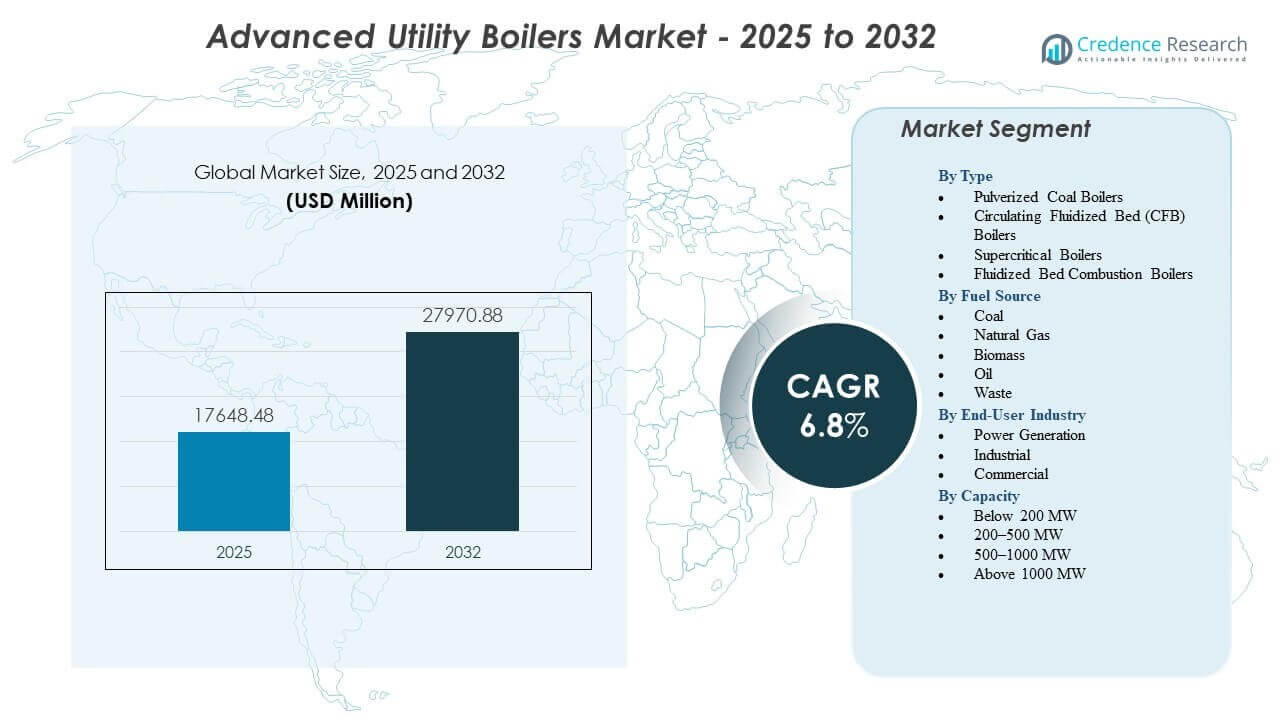
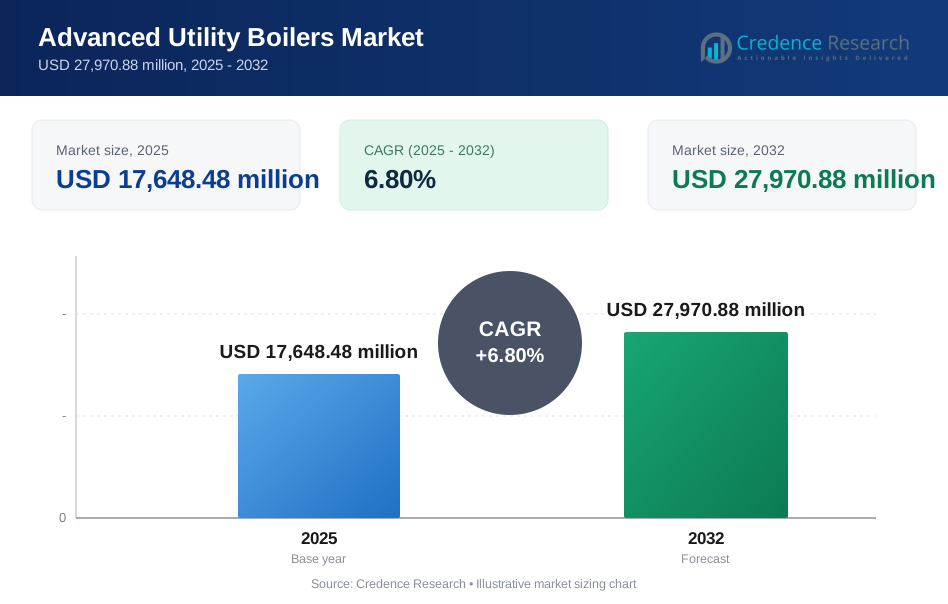
The Advanced Utility Boilers Market is projected to grow from USD 17,648.48 million in 2025 to an estimated USD 27,970.88 million by 2032, with a compound annual growth rate (CAGR) of 6.8% from 2025 to 2032.
| REPORT ATTRIBUTE | DETAILS |
|---|---|
| Historical Period | 2020-2024 |
| Base Year | 2025 |
| Forecast Period | 2026-2032 |
| Advanced Utility Boilers Market Size 2025 | USD 17,648.48 million |
| Advanced Utility Boilers Market, CAGR | 6.8% |
| Advanced Utility Boilers Market Size 2032 | USD 27,970.88 million |
Advanced Utility Boilers Market Insights:
- Strong market drivers include stricter emission norms, modernization of aging power plants, and increased adoption of supercritical and flexible-fuel boiler technologies across major utilities.
- Key restraints involve high capital requirements, long installation cycles, regulatory uncertainty, and competitive pressures from rapidly expanding renewable energy sources.
- Asia-Pacific leads the market due to large thermal capacity additions, while Europe and North America maintain stable demand through refurbishment and emission-control upgrades.
- Emerging regions in Latin America, the Middle East, and Africa continue to expand deployment as they strengthen grid reliability and invest in advanced baseload generation technologies.
Market Drivers
Growing Demand for High-Efficiency Power Generation Technologies
Improving power plant efficiency drives steady adoption of advanced boilers across major utility stations worldwide. Operators pursue higher thermal efficiency to reduce coal consumption and shrink operational losses. The Advanced Utility Boilers Market gains traction because advanced designs support supercritical and ultra-supercritical performance. It helps plants meet rising global electricity needs while lowering emissions. Many utilities also pursue fuel flexibility to stabilize their long-term cost structure. Efficiency mandates from regulators push firms to replace aging subcritical units. Industries upgrade boiler assets to align with modern performance targets. These shifts reinforce long-term demand for advanced systems.
- For instance, Mitsubishi Heavy Industries achieved a steam temperature of 700°C in its ultra-supercritical boiler demonstration plant under the USC700 Program, improving thermal efficiency by nearly 10% compared to prior USC models.
Strengthening Global Shift Toward Lower Emission Power Infrastructure
Tighter emission norms push utilities to adopt cleaner combustion systems with stronger environmental performance. New boiler technologies help plants reduce greenhouse gases and particulate emissions at scale. The global market expands because utilities must comply with strict NOx, SOx, and mercury limits. The Advanced Utility Boilers Market benefits from designs that integrate advanced flue gas cleaning systems to maintain compliance. Firms seek operational models that protect them from regulatory penalties. Cleaner boilers also help support energy transition goals for many developing economies. Governments offer incentives to replace outdated units with high-efficiency alternatives. Cleaner technology integration becomes standard in new utility plant planning.
Rising Expansion of Large Thermal Power Projects Across Emerging Regions
Increasing electricity demand across Asia and Africa fuels rising investment in large power stations. Many governments continue to depend on thermal plants to secure reliable baseload output. The Advanced Utility Boilers Market supports these projects through higher output and improved heat rate performance. New utility-scale facilities require designs that deliver long-term reliability under heavy load. Power developers choose advanced boilers to maintain stable operation during peak demand seasons. Growing industrialization places extra pressure on national grids to avoid supply gaps. Large thermal projects need robust boiler systems to ensure uninterrupted generation. This trend supports continuous procurement across fast-growing economies.
- For instance, Doosan Heavy Industries & Construction supplied 1,000 MW ultra-supercritical boilers for the Kudgi and Mundra power plants, achieving plant efficiency levels above 42% and supporting India’s large-scale grid expansion.
Increasing Replacement of Aging Power Plant Assets Across Mature Markets
Aging coal-fired plants in Europe and North America face declining efficiency and poor environmental performance. Utilities in these regions invest in advanced boilers to extend asset life and reduce fuel waste. The Advanced Utility Boilers Market benefits from asset refurbishment cycles focused on sustainability targets. Operators rely on modernized systems to cut downtime events and improve heat transfer rates. Many plants shift toward co-firing models that require compatible boiler upgrades. Government climate goals push utilities to adopt technology that reduces long-term environmental impact. Replacement activity offsets the reduction in new plant construction. These upgrades help maintain energy security while meeting new performance benchmarks.
Advanced Utility Boilers Market Trends
Integration of Digital Monitoring and Predictive Maintenance in Boiler Operations
Utilities deploy digital platforms to track boiler performance and reduce operational risks. Smart sensors help operators detect anomalies in real time. The Advanced Utility Boilers Market benefits from predictive analytics that supports stable thermal performance. Digital twins now help simulate combustion behavior for better tuning. Many facilities install connected control systems to optimize heat rate. Automation reduces manual inspection requirements and improves task accuracy. Remote diagnostics lower unplanned shutdowns across large utility fleets. Data-led optimization becomes a defining trend within modern boiler operations.
Growing Adoption of Flexible Fuel Combustion Capabilities
Utilities demand boilers capable of supporting varied fuel blends to stabilize fuel supply costs. Designs that handle coal, biomass, and alternative feedstocks gain interest. The Advanced Utility Boilers Market adapts to these shifts through enhanced combustion chambers. Many plants pursue co-firing strategies to meet sustainability targets. Flexible combustion improves grid resilience and protects plants from supply volatility. Advanced burner configurations support low-emission performance across diverse fuels. Operators use these boilers to extend plant relevance during energy transition. Fuel-flexible models now guide procurement discussions in several power regions.
Rise of Ultra-Supercritical and Advanced Steam Cycle Technologies
Higher steam parameters help plants achieve strong efficiency gains. Many new builds across Asia and the Middle East adopt ultra-supercritical technology. The Advanced Utility Boilers Market expands due to rising preference for high-temperature and high-pressure designs. These systems reduce fuel usage and strengthen grid stability. Operators choose them to lower long-term operational costs. Projects incorporate advanced metallurgy to support extreme working conditions. Improved thermal profiles reduce emission intensity at scale. Advanced steam cycles shift energy output toward cleaner baseload generation.
- For instance, Mitsubishi Heavy Industries achieved 700°C/350 bar steam parameters in its A-USC demonstration program, enabling efficiency improvements of roughly 10% over conventional USC units.
Increasing Use of Modular Boiler Construction Methods
Developers choose modular construction to shorten installation timelines and reduce field labor requirements. Pre-assembled modules help standardize project execution across regions. The Advanced Utility Boilers Market gains traction because modular units cut commissioning delays. Factory-built components improve manufacturing accuracy and quality control. Many utilities adopt modular systems to expand plants in constrained locations. Modularization reduces disruption at existing facilities. Compact layouts help developers fit modern boilers into older infrastructure. Faster deployment supports time-sensitive electricity capacity planning.
- For instance, Babcock & Wilcox Enterprises demonstrated that its modular industrial boiler packages reduced on-site installation time by nearly 30% and cut field labor requirements by more than 20% across multiple North American deployments.
Advanced Utility Boilers Market Challenges Analysis
High Capital Requirements and Lengthy Development Cycles for New Boiler Installations
New utility boiler projects demand heavy upfront investment. Many developers struggle to justify long payback periods under volatile energy markets. The Advanced Utility Boilers Market faces pressure because financing hurdles delay capacity expansions. Regulatory permits extend development timelines and complicate execution. High equipment costs reduce adoption across smaller utilities. Long procurement cycles also increase exposure to material price fluctuations. Project delays restrict the ability of large plants to meet rising demand. These barriers limit adoption across cost-sensitive markets.
Uncertain Energy Transition Policies and Growing Competition From Renewable Sources
Rapid growth of wind and solar reduces long-term confidence in thermal investments. Utilities hesitate to commit to advanced boilers without policy clarity. The Advanced Utility Boilers Market encounters planning challenges tied to shifting national energy priorities. Some governments reduce coal support programs, creating investment risk. Competition from renewables shrinks baseload share in certain regions. Operators fear stranded asset scenarios due to uncertain policy timelines. Environmental opposition adds pressure to traditional power infrastructure. These forces weaken new project pipelines in several developed markets.
Advanced Utility Boilers Market Opportunities
Expansion of Cleaner Coal and Biomass Co-Firing Technologies Across Developing Economies
Many emerging regions continue to rely on thermal assets to stabilize electricity supply. Co-firing strategies help utilities reduce emissions without replacing full systems. The Advanced Utility Boilers Market gains strong opportunities where fuel flexibility supports energy transition goals. Biomass integration helps plants qualify for low-carbon incentives. Utilities use these upgrades to extend the life of existing units. Cleaner combustion reduces environmental criticism tied to coal usage. Co-firing also diversifies fuel sources for cost and supply security. These upgrades help align thermal plants with long-term sustainability plans.
Growing Refurbishment and Modernization Demand Across Aging Power Fleets
Many mature markets focus on modernizing installed boilers instead of building new plants. Upgrades help improve heat rate, extend equipment life, and cut emissions. The Advanced Utility Boilers Market benefits from retrofit programs driven by stricter standards. Utilities pursue advanced materials, digital controls, and improved burners for stronger performance. Refurbishment reduces operational expenses over a plant’s remaining life cycle. Modernization projects avoid the political challenges tied to new coal plants. Many operators prioritize these upgrades to maintain reliable baseload supply. The scale of aging assets worldwide creates steady opportunity for technology vendors.
Advanced Utility Boilers Market Segmentation Analysis:
By Type
Pulverized coal, CFB, supercritical, and fluidized bed combustion technologies shape demand patterns across the Advanced Utility Boilers Market. Pulverized coal units stay relevant where high-load baseload output remains essential. CFB systems gain traction because they help utilities handle varied fuels and reduce emission intensity. Supercritical units support higher efficiency targets for regions that invest in modern thermal fleets. Fluidized bed designs help plants manage low-grade fuels and maintain consistent output. Each type meets different operational goals tied to cost, efficiency, and compliance. Type selection often reflects a utility’s long-term grid strategy.
By Fuel Source
Coal, natural gas, biomass, oil, and waste streams guide procurement choices within the Advanced Utility Boilers Market. Coal-fired units dominate in countries that rely on domestic reserves to maintain energy security. Natural gas systems appeal to developers who prioritize cleaner combustion and faster operational flexibility. Biomass adoption strengthens where carbon-reduction programs support co-firing strategies. Oil-fired units serve plants that need backup fuel capability or operate in remote regions. Waste-to-energy boilers support circular economy goals for municipalities. Fuel selection depends on availability, policy direction, and operational cost control.
- For instance, Andritz AG deployed biomass boilers capable of delivering steam outputs exceeding 220 tonnes per hour, enabling utilities to scale co-firing operations without compromising combustion stability.
By End-User Industry
Power generation leads demand within the Advanced Utility Boilers Market because utilities require high-capacity units for steady grid supply. Industrial users adopt boilers to support process heat needs across chemicals, metals, and manufacturing. Commercial facilities use advanced systems for district heating and centralized energy solutions. Each end user group evaluates technology based on efficiency, footprint, and emission performance. Power plants prioritize long-duration output, while industrial sites focus on operational reliability. Commercial buyers focus on systems that reduce long-term operating costs. End-use profiles shape preferred boiler configurations.
- For instance, General Electric Company enhanced industrial boiler efficiency by integrating digital controls that improved heat rate by nearly 3% across several process-industry installations, reducing energy losses in high-duty environments.
By Capacity
Below 200 MW, 200–500 MW, 500–1000 MW, and above 1000 MW units define deployment scale in the Advanced Utility Boilers Market. Smaller units support industrial clusters and captive power applications. Mid-range units address regional grid demand where balanced capacity expansion is required. Larger systems above 500 MW dominate utility-grade projects that prioritize high-efficiency baseload output. Units above 1000 MW serve mega-projects designed for long-term national supply stability. Capacity selection depends on grid size, fuel planning, and investment approach. Developers match boiler scale with projected electricity demand profiles.
Segmentation:
By Type
- Pulverized Coal Boilers
- Circulating Fluidized Bed (CFB) Boilers
- Supercritical Boilers
- Fluidized Bed Combustion Boilers
By Fuel Source
- Coal
- Natural Gas
- Biomass
- Oil
- Waste
By End-User Industry
- Power Generation
- Industrial
- Commercial
By Capacity
- Below 200 MW
- 200–500 MW
- 500–1000 MW
- Above 1000 MW
By Region
- North America
- U.S.
- Canada
- Mexico
- Europe
- Germany
- France
- U.K.
- Italy
- Spain
- Rest of Europe
- Asia Pacific
- China
- Japan
- India
- South Korea
- South-east Asia
- Rest of Asia Pacific
- Latin America
- Brazil
- Argentina
- Rest of Latin America
- Middle East & Africa
- GCC Countries
- South Africa
- Rest of the Middle East and Africa
Regional Analysis:
North America holds a stable share of the Advanced Utility Boilers Market, accounting for nearly 18–20% of global demand. Strong refurbishment cycles support regional activity because many plants operate with aging assets. Utilities invest in high-efficiency units to comply with federal emission targets. Adoption remains steady in the U.S., while Canada maintains modest growth through industrial demand. The region focuses on modernization over greenfield construction. It expects long-term interest in advanced systems that support flexible fuel strategies.
Europe commands 16–18% of the global share and strengthens adoption through strict emission norms. The Advanced Utility Boilers Market in this region reflects demand tied to decarbonization programs and the shift toward cleaner thermal output. Western Europe pursues biomass co-firing strategies to support energy transition goals. Eastern Europe continues to deploy high-capacity units for grid stability. Regulatory pressure drives persistent upgrades across coal-dependent economies. It maintains interest in technologies that lower particulate and sulfur emissions.
Asia-Pacific dominates global demand with nearly 45–50% share, supported by large-scale thermal expansion. The Advanced Utility Boilers Market grows rapidly because countries such as China, India, and Indonesia depend on thermal fleets for baseload security. High-capacity supercritical and ultra-supercritical units remain central to national energy strategies. Southeast Asia invests in fuel-flexible systems to manage supply volatility. Industrial expansion strengthens regional deployment across several emerging markets. It continues to attract global manufacturers due to strong project pipelines.
Key Player Analysis:
- General Electric Company (GE)
- Mitsubishi Heavy Industries (MHI)
- Doosan Heavy Industries & Construction
- Babcock & Wilcox Enterprises
- Larsen & Toubro Limited
- Andritz AG
- Dongturbo Electric Company Ltd
- Sumitomo Corporation
Competitive Analysis:
The Advanced Utility Boilers Market features strong competition among global manufacturers that supply high-capacity systems for utility and industrial applications. Companies differentiate through advanced combustion design, material durability, and digital control platforms. Product portfolios emphasize efficiency gains, emission control, and operational reliability. Vendors compete for long-cycle contracts tied to national grid expansion and large industrial hubs. Many firms focus on long-term service agreements to secure recurring revenue and strengthen customer retention. The market favors suppliers that offer integrated solutions combining boilers, pollution control systems, and predictive monitoring tools. It continues to shift toward firms with strong technological capabilities and proven large-scale project execution.
Recent Developments:
- In March 2025, The Environmental Group Limited (ASX: EGL)announced it had entered into a binding agreement to acquire Advanced Boilers & Combustion Pty Ltd for $5.5 million.
- In April 2024, Mutares SE & Co. KGaA completed the acquisition of a majority stake in Sofinter Group, a leading global provider of industrial and utility boilers specializing in Heat Recovery Steam Generation (HRSG).
Report Coverage:
The research report offers an in-depth analysis based on Type, Fuel Source, End-User, Capacity and Region. It details leading market players, providing an overview of their business, product offerings, investments, revenue streams, and key applications. Additionally, the report includes insights into the competitive environment, SWOT analysis, current market trends, as well as the primary drivers and constraints. Furthermore, it discusses various factors that have driven market expansion in recent years. The report also explores market dynamics, regulatory scenarios, and technological advancements that are shaping the industry. It assesses the impact of external factors and global economic changes on market growth. Lastly, it provides strategic recommendations for new entrants and established companies to navigate the complexities of the market.
Future Outlook:
- Demand strengthens as utilities prioritize modern high-efficiency boilers that support stricter emission norms.
- Investment rises in supercritical and ultra-supercritical systems as countries seek long-term thermal stability.
- Digital monitoring tools expand adoption by improving predictive maintenance and lowering operational disruptions.
- Biomass and waste co-firing technologies gain acceptance as plants pursue cleaner combustion pathways.
- Retrofitting activity grows in mature markets where utilities modernize aging fleets instead of building new units.
- Flexible fuel boilers attract interest for supporting supply security across volatile energy regions.
- Modular construction techniques shorten project timelines and support capacity additions in constrained sites.
- Industrial demand increases as process-intensive sectors upgrade thermal systems for greater efficiency.
- Emerging economies accelerate deployments to meet rising power demand and expand baseload capacity.
- Vendor competition intensifies with greater focus on integrated solutions spanning efficiency, emissions, and digital control.
Request a Free Sample
Fill in your details and we'll send you a free sample report.
- Sample data tables & charts
- Research methodology
Need a Custom Version of This Report?
Tailor the scope, geography, or segments to your exact requirements.
- Custom geography or segment scope
- Direct access to our analyst team
Frequently Asked Questions
What is the current market size for the Advanced Utility Boilers Market, and what is its projected size in 2032?
At what Compound Annual Growth Rate is the Advanced Utility Boilers Market projected to grow between 2025 and 2032?
Which Advanced Utility Boilers Market segment held the largest share in 2025?
What are the primary factors fueling the growth of the Advanced Utility Boilers Market?
Who are the leading companies in the Advanced Utility Boilers Market?
Which region commanded the largest share of the Advanced Utility Boilers Market in 2025?
Table of Content
Chapter 1. Report Introduction
- 1.1 Report Description & Purpose
- 1.1.1 Report Title & Market Definition
- 1.1.2 Unique Selling Propositions (USP) & Key Differentiators
- 1.1.3 Value Proposition for Stakeholders
- 1.2 Research Objectives
- 1.2.1 Market Sizing Objectives (Volume & Revenue)
- 1.2.2 Segmentation Objectives
- 1.2.3 Competitive Intelligence Objectives
- 1.2.4 Forecast & Scenario Objectives
- 1.3 Report Scope
- 1.3.1 Advanced Utility Boilers Scope – Types & Subtypes Covered
- 1.3.2 Geographic Scope – Regions & Countries Covered
- 1.3.3 Historical Period, Base Year & Forecast Period (2025; forecast to 2032)
- 1.3.4 Inclusions & Exclusions
- 1.4 HS Code & Classification Framework
- 1.5 Currency, Units & Pricing Basis
- 1.6 Target Stakeholders
- 1.7 Limitations & Assumptions
Chapter 2. Executive Summary
- 2.1 Global Advanced Utility Boilers Market Snapshot
- 2.1.1 Market Size – Historical (2025) & Forecast (2025-2032) (2025: USD 17,648.48 million → 2032: USD 27,970.88 million)
- 2.1.2 Volume & Revenue – Global Totals
- 2.1.3 Key Market Highlights – Top Five Facts
- 2.2 Advanced Utility Boilers Market Segmentation Snapshot
- 2.2.1 Market Split by Region – 2025 vs. 2032
- 2.3 Competitive Snapshot
- 2.3.1 Top 10 Players by Revenue Share – 2025
- 2.3.2 Top 10 Players by Volume Share – 2025
- 2.3.3 Recent Strategic Developments (18-Month Summary)
- 2.4 Key Investment Highlights & Strategic Conclusions
Chapter 3. Advanced Utility Boilers Market Dynamics & Industry Analysis
- 3.1 Market Overview & Context
- 3.1.1 Advanced Utility Boilers Market Position in the Broader Automotive Value Chain
- 3.1.2 OEM vs. Replacement Market Dynamics
- 3.1.3 Market Maturity & Development Stage by Region
- 3.2 Advanced Utility Boilers Market Drivers
- 3.3 Advanced Utility Boilers Market Restraints & Challenges
- 3.4 Advanced Utility Boilers Market Opportunities
- 3.5 Porter's Five Forces Analysis
- 3.5.1 Threat of New Entrants
- 3.5.2 Bargaining Power of Suppliers
- 3.5.3 Bargaining Power of Buyers
- 3.5.4 Threat of Substitutes
- 3.5.5 Competitive Rivalry – Intensity Assessment
- 3.6 Advanced Utility Boilers Value Chain Analysis
- 3.6.1 Upstream – Raw Material/Input Suppliers
- 3.6.1.1 Raw Material/Input 1
- 3.6.1.2 Raw Material/Input 2
- 3.6.1.3 Raw Material/Input 3
- 3.6.2 Midstream – Production/Manufacturing/Service Delivery
- 3.6.2.1 Production/Process Overview
- 3.6.2.2 Key Facility Locations & Capacity by Manufacturer
- 3.6.3 Downstream – Distribution & End Consumer
- 3.6.3.1 Primary Channel – B2B/OEM
- 3.6.3.2 Secondary Channels – Dealer, Retail, Online, Direct
- 3.6.4 Value Chain Profitability Analysis
- 3.6.1 Upstream – Raw Material/Input Suppliers
- 3.7 PESTEL Analysis
- 3.7.1 Political Factors
- 3.7.2 Economic Factors
- 3.7.3 Social Factors
- 3.7.4 Technological Factors
- 3.7.5 Environmental Factors
- 3.7.6 Legal Factors
- 3.8 Advanced Utility Boilers Supply Chain Analysis
- 3.8.1 Raw Material/Input Supply Risk Assessment
- 3.8.2 Manufacturing Concentration Risk (Geographic Exposure)
- 3.8.3 Trade Disruption Impact Analysis
- 3.9 Regulatory & Policy Landscape
Note: The regulatory and policy landscape section covers regulations based on their applicability to the market, Advanced Utility Boilers category, geography, and scope of the study. Only regulatory frameworks with a material impact on operations, compliance, trade, sustainability, or market access are analyzed in detail.
Chapter 4. Key Investment Pockets & Opportunity Analysis
- 4.1 Advanced Utility Boilers Market Attractiveness Analysis
- 4.1.1 By Region – Investment Attractiveness Matrix (Volume × CAGR)
- 4.2 Absolute Revenue Growth Opportunity
- 4.2.1 By Region – Absolute USD Growth Through 2032
- 4.3 Incremental Volume Opportunity
- 4.3.1 By Region – Incremental Volume Through 2032
- 4.3.2 Segment – Incremental Volume
- 4.4 Emerging Submarket Opportunity Deep Dive (Subject to Applicability)
- 4.5 Emerging Market Opportunity Scorecards
- 4.5.1 United States
- 4.5.2 Europe
- 4.5.3 Asia
- 4.5.4 Middle East & Africa
Note: Emerging Market Opportunity Scorecards will be included based on relevance and strategic importance. Regions listed are indicative and may vary depending on data availability and market dynamics.
Chapter 5. Advanced Utility Boilers Import-Export Analysis & Trade Flows
- 5.1 Global Trade Overview
- 5.1.1 Global Export Value by Country (2025)
- 5.1.2 Global Export Volume by Country (2025)
- 5.1.3 Global Import Value by Country (2025)
- 5.1.4 Global Import Volume by Country (2025)
- 5.1.5 Net Trade Balance by Country (2025)
- 5.2 Export Analysis – Segment
- 5.2.1 Type 1 (HS Code)
- 5.2.2 Type 2 (HS Code)
- 5.2.3 Type 3 (HS Code)
- 5.2.4 Type 4 (HS Code)
- 5.2.5 Type 5 (HS Code)
- 5.3 Import Analysis – Segment
- 5.3.1 Type 1 (HS Code)
- 5.3.2 Type 2 (HS Code)
- 5.3.3 Type 3 (HS Code)
- 5.3.4 Type 4 (HS Code)
- 5.3.5 Type 5 (HS Code)
- 5.4 Average Unit Trade Prices
- 5.4.1 Average Export Price – Segment & Country
- 5.4.2 Average Import Price – Segment & Source Country
- 5.4.3 Price Trends (2025)
- 5.5 Key Trade Route Analysis
- 5.5.1 Trade Route 1
- 5.5.2 Trade Route 2
- 5.5.3 Trade Route 3
- 5.5.4 Trade Route 4
- 5.5.5 Trade Route 5
- 5.6 Trade Policy Impact Assessment
- 5.6.1 US Anti-Dumping & Section 301 Tariffs
- 5.6.2 EU Customs Union Impact
- 5.6.3 Major Free Trade Agreements
- 5.6.4 USMCA Rules of Origin
Note: Trade policy analysis will be included only where relevant to the Advanced Utility Boilers market.
Chapter 6. Competitive Landscape & Company Benchmarking
- 6.1 Advanced Utility Boilers Market Concentration & Structure
- 6.1.1 Herfindahl-Hirschman Index (HHI) – vs. 2025
- 6.1.2 Tier 1, Tier 2 & Tier 3 Market Structure
- 6.1.3 Global, Regional & Local Player Dynamics
- 6.2 Advanced Utility Boilers Market Share Analysis – 2025
- 6.2.1 Global Revenue Share by Company
- 6.2.2 Global Volume Share by Company
- 6.2.3 Regional Revenue Share
- 6.2.4 Market Share Evolution ( vs. 2025)
- 6.2.5 OEM Segment Share by Company
- 6.2.6 Replacement Segment Share by Company
- 6.3 Production/Delivery Capacity & Facility Analysis
- 6.3.1 Global Installed Capacity
- 6.3.2 Capacity Utilization Rates
- 6.3.3 Production/Output Volume
- 6.3.4 Facility Locations & Capacity Map
- 6.3.5 Planned Capacity Additions
- 6.4 Advanced Utility Boilers Competitive Benchmarking Matrix
- 6.4.1 Revenue, Volume, CAGR & Profitability Comparison
- 6.4.2 Channel Revenue Mix
- 6.4.3 Geographic Revenue Exposure
- 6.4.4 R&D Intensity
- 6.4.5 Sustainability Maturity
- 6.5 Strategic Developments in Advanced Utility Boilers (Last 24 Months)
- 6.5.1 Mergers, Acquisitions & Divestments
- 6.5.2 New Advanced Utility Boilers Launches
- 6.5.3 Facility Expansions
- 6.5.4 Strategic Alliances, Joint Ventures & Partnerships
- 6.5.5 Distribution Expansion & Market Entry
- 6.5.6 Sustainability & ESG Initiatives
- 6.6 Competitive Strategy Mapping
- 6.6.1 Leader, Challenger, Follower & Niche Classification
- 6.6.2 Pricing Strategy Comparison
- 6.6.3 Channel Strategy Matrix
Note: Strategic developments are included based on their materiality and the availability of reliable information.
Chapter 7. Global Advanced Utility Boilers Market – By Distribution Channel
- 7.1 Segment Overview
- 7.1.1 Volume & Revenue Split by Channel (2025 & 2032)
- 7.1.2 Channel Mix Evolution (2025-2032)
Chapter 8. Regional Market Analysis – Global Overview
- 8.1 Global Regional Overview
- 8.1.1 Regional Volume Share
- 8.1.2 Regional Revenue Share
- 8.1.3 Regional Volume by Region
- 8.1.4 Regional Revenue by Region
- 8.1.5 Regional Forecast Through 2032
- 8.2 Cross-Regional Segment Analysis
- 8.2.1 By Distribution Channel
- 8.2.2 By Brand/Price Tier
Chapter 9. North America Advanced Utility Boilers Market
- 9.1 United States
- 9.2 Canada
- 9.3 Mexico
Chapter 10. Europe Advanced Utility Boilers Market
- 10.1 Germany
- 10.2 France
- 10.3 Italy
- 10.4 United Kingdom
- 10.5 Spain
- 10.6 Poland
- 10.7 Russia
- 10.8 Netherlands
- 10.9 Belgium
- 10.10 Sweden
- 10.11 Denmark
- 10.12 Norway
- 10.13 Rest of Europe
Chapter 11. Asia Pacific Advanced Utility Boilers Market
- 11.1 China
- 11.2 India
- 11.3 Japan
- 11.4 South Korea
- 11.5 Thailand
- 11.6 Indonesia
- 11.7 Vietnam
- 11.8 Malaysia
- 11.9 Australia
- 11.10 Rest of Asia Pacific
Chapter 12. Latin America Advanced Utility Boilers Market
- 12.1 Brazil
- 12.2 Argentina
- 12.3 Colombia
- 12.4 Chile
- 12.5 Rest of Latin America
Chapter 13. Middle East Advanced Utility Boilers Market
- 13.1 Saudi Arabia
- 13.2 United Arab Emirates
- 13.3 Turkey
- 13.4 Israel
- 13.5 Iran
- 13.6 Rest of the Middle East
Chapter 14. Africa Advanced Utility Boilers Market
- 14.1 South Africa
- 14.2 Egypt
- 14.3 Nigeria
- 14.4 Morocco
- 14.5 Rest of Africa
Chapter 15. Advanced Utility Boilers Company Profiles
- 15.1 [Company 01]
- 15.1.1 Company Overview
- 15.1.2 Key Management Personnel
- 15.1.3 Products & Services Portfolio
- 15.1.4 Financial Performance
- 15.1.5 Key Market Focus & Geographic Presence
- 15.1.6 Recent Developments & Strategic Initiatives
Note: The company profile list is preliminary and may change based on research findings, market developments, data availability, and client requirements.
Chapter 16. Appendices
- Appendix A – List of Abbreviations & Acronyms
- Appendix B – Industry Classification Code Reference – Full Series
- Appendix C – Production & Capacity Data Tables
- Appendix D – End-Use & Demand Base Tables
- Appendix E – Consumption & Replacement Rate Assumptions
- Appendix F – ASP Reference Tables
- Appendix G – Manufacturing & Facility Database
- Appendix H – Import-Export Data Tables
- Appendix I – Regulatory Summary Tables
- Appendix J – Primary Research Participant List (Anonymized)
- Appendix K – Primary Research Questionnaire Framework
- Appendix L – Data Sources & Bibliography
- Appendix M – Market Size Divergence & Source Comparison
Chapter 17. Research Methodology
- 17.1 Research Framework & Philosophy
- 17.2 Secondary Research – Sources, Hierarchy & Data Extraction
- 17.3 Data Modeling – Bottom-Up & Top-Down Market Sizing
- 17.4 Primary Research – Stakeholder Framework, LOI & Sample Sizes
- 17.5 Forecast Methodology – Regression, Scenario & Sensitivity Analysis
- 17.6 Quality Control – Four-Layer Validation Framework
- 17.7 Limitations & Standard Assumptions
- 17.8 Disclaimer
