
Air Insulated Switchgear Market Overview:
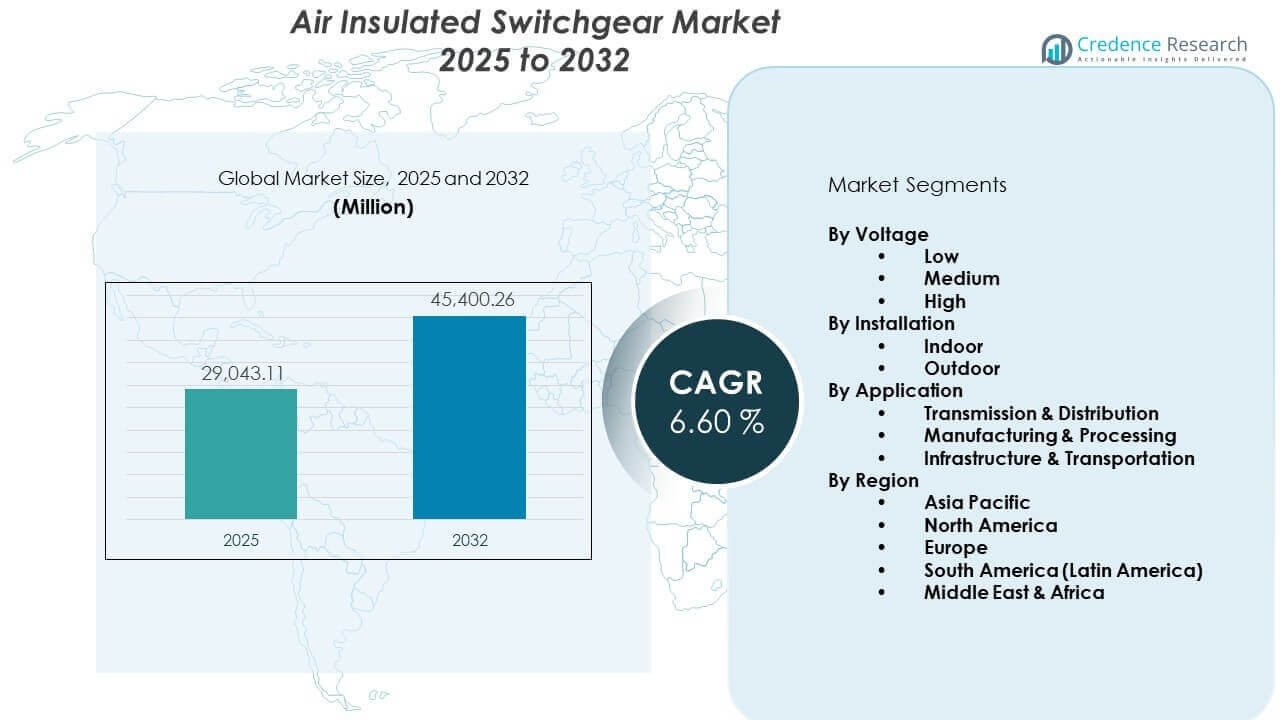
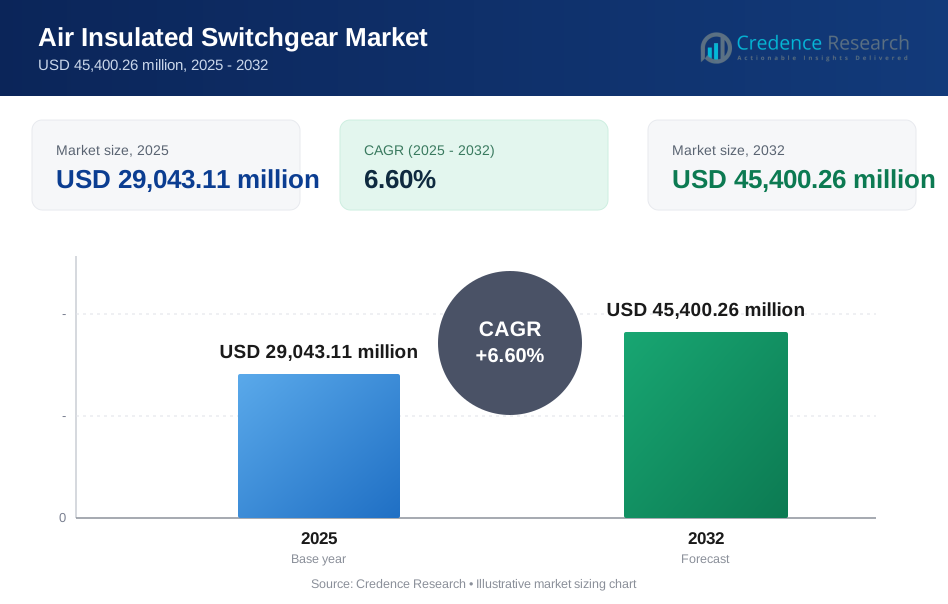
The Air Insulated Switchgear Market is projected to grow from USD 29,043.11 million in 2025 to an estimated USD 45,400.26 million by 2032, with a compound annual growth rate (CAGR) of 6.60% from 2025 to 2032.
| RT ATTRIBUTE | DETAILS |
|---|---|
| Historical Period | 2020-2023 |
| Base Year | 2024 |
| Forecast Period | 2025-2032 |
| Air Insulated Switchgear Market Size 2025 | USD 29,043.11 million |
| Air Insulated Switchgear Market, CAGR | 6.60% |
| Air Insulated Switchgear Market Size 2032 | USD 45,400.26 million |
Air Insulated Switchgear Market Insights:
- Asia Pacific leads with over 40% share due to rapid urbanization, renewable energy expansion, and strong government investment in transmission and distribution infrastructure.
- Europe holds around 25% share, driven by aging grid replacement, sustainability mandates, and increasing deployment of eco-efficient, SF6-free switchgear solutions across utility networks.
- North America accounts for nearly 18% share and remains the fastest-growing mature region, supported by grid resiliency projects, industrial modernization, and clean energy integration initiatives.
- By segment, medium voltage dominates with over 50% share due to widespread substation use, while indoor installations account for nearly 60% of demand owing to urban infrastructure and commercial applications.
Air Insulated Switchgear Market Drivers:
Urbanization, Electrification, and the Demand for Grid Modernization
Population growth and urban sprawl are driving the demand for robust power distribution infrastructure. Utilities are under pressure to expand transmission and distribution capacity across fast-developing urban clusters. The Air Insulated Switchgear Market benefits from the rising demand for cost-effective and scalable solutions. Governments are investing in electrification programs that require safe and reliable switchgear in substations and local networks. AIS offers a viable option due to its low operational cost and ease of maintenance. Growing emphasis on uninterrupted power access strengthens its adoption in both residential and industrial segments. It supports network reliability through modular deployment. Grid modernization goals support wide use in medium-voltage applications.
- For instance, Siemens provides the blue GIS/AIS hybrid technology that uses Clean Air as the insulation medium, eliminating 100% of SF₆ greenhouse gas emissions to meet urban sustainability mandates.
Rising Investment in Renewable Energy and Substation Upgrades
The renewable energy sector is expanding rapidly across regions with decarbonization commitments. Wind and solar farms require dependable switchgear solutions for grid integration and protection. The Air Insulated Switchgear Market is gaining traction due to its compatibility with renewable substations. Infrastructure upgrades for clean energy transmission rely on equipment with minimal operational risks. AIS units ensure service continuity in harsh environments and remote installations. Utilities prefer air insulated units to support distributed generation models. Increasing capacity additions in the renewable sector support steady AIS demand. Public funding accelerates renewable deployment, lifting AIS sales volumes.
- For instance, ABB automation technology and switchgear support the 2 GW Al Dhafra Solar PV plant in Abu Dhabi, which generates carbon-free electricity for approximately 200,000 homes while reducing CO2 emissions by 2.4 million metric tons annually.
Regulatory Push Toward Safety Standards and Equipment Efficiency
Global regulations mandate better safety features and environment-friendly materials in power infrastructure. AIS products comply with insulation and arc fault standards, aligning well with regulatory expectations. The Air Insulated Switchgear Market is growing due to strong conformance with utility and industrial safety norms. Manufacturers focus on extending operational life and minimizing downtime. Compact and modular systems reduce installation risks and physical footprint. Digitalization and diagnostics enhance operational safety. AIS helps utilities avoid costly failures by ensuring insulation stability. Regulations drive upgrades across older switchgear networks, increasing retrofit demand.
Industrial Expansion and Rising Automation in Emerging Economies
Emerging economies continue to invest in industrial development and process automation. Manufacturing and heavy industries require reliable medium-voltage switchgear for equipment protection. The Air Insulated Switchgear Market supports industrial uptime by reducing the chance of outages or equipment faults. AIS systems withstand fluctuating loads and help streamline electrical operations. Digital AIS units integrate with SCADA and monitoring platforms in smart factories. Industrial players choose AIS for its robustness and predictable performance in aggressive settings. Cross-sector energy demand boosts utility-level expansion into industrial hubs. Ongoing industrial investments maintain steady AIS procurement levels.
Air Insulated Switchgear Market Trends:
Integration of Digital Monitoring and Condition-Based Maintenance Platforms
Manufacturers are embedding sensors, IoT modules, and monitoring systems into air insulated switchgear. Operators gain real-time performance metrics and fault prediction capabilities using advanced analytics. The Air Insulated Switchgear Market benefits from this shift toward digitalized grid components. Condition-based maintenance reduces unplanned failures and lowers total cost of ownership. Asset managers can monitor load patterns and insulation health continuously. The trend supports smarter substations in utilities and industrial facilities. Digital AIS enhances lifecycle value and improves service continuity. Market players invest in AI-driven dashboards for remote diagnostics.
- For instance, Schneider Electric estimates that approximately 25% of all major electrical failures are due to faulty connections, which its EcoStruxure continuous thermal monitoring addresses by providing a 10:1 ROI over a 20-year asset lifetime compared to traditional periodic inspections.
Growing Preference for Compact and Modular Switchgear Designs
Space constraints in urban substations and indoor applications have led to rising demand for compact switchgear. Manufacturers now offer modular AIS panels that simplify transport, assembly, and system expansion. The Air Insulated Switchgear Market sees wider acceptance due to these design enhancements. Prefabricated and skidded AIS solutions reduce deployment time on project sites. Smaller footprints help utilities manage equipment placement in crowded or retrofitted buildings. Industries benefit from plug-and-play modularity when scaling power infrastructure. Flexible designs support system customization without compromising safety. The market moves toward scalable and pre-engineered solutions.
- For instance, Eaton engineered the Xiria system with panel widths as narrow as 350 mm for block-type configurations and 500 mm for extendable versions, allowing for significant floor space savings in restricted urban environments.
Shifting Supply Chain Models and Local Manufacturing Strategies
Rising geopolitical tensions and cost inflation impact the global switchgear supply chain. Manufacturers are focusing on localized production and regional vendor networks to reduce dependency. The Air Insulated Switchgear Market adapts to these dynamics by strengthening local assembly units. Lead time optimization and regional sourcing help players meet public procurement requirements. Governments support domestic manufacturing with incentives under industrialization policies. Local players enter partnerships with global OEMs to widen product availability. The shift improves market access in tier-2 and tier-3 cities. Decentralized production boosts service support and spares delivery.
Focus on Environment-Friendly Insulation and Decarbonization Goals
Sustainability goals are encouraging innovation in air-insulated systems that avoid harmful gases like SF6. Companies are actively developing SF6-free designs to reduce emissions during equipment use and disposal. The Air Insulated Switchgear Market aligns well with these low-impact technologies. Environmental regulators impose strict rules on fluorinated gas usage, accelerating demand for alternative insulation. Air insulation remains safer and more compliant across regulatory frameworks. Adoption grows in eco-sensitive installations such as renewable grids and public infrastructure. The trend reflects greater emphasis on sustainable materials in medium-voltage components. Industry targets net-zero compliance through AIS deployment.
Air Insulated Switchgear Market Challenges Analysis:
Space Constraints in High-Density Urban Installations Limit Deployment Flexibility
Despite strong growth prospects, urban infrastructure projects face limitations in available space for switchgear installations. AIS systems, while cost-effective, require more room compared to gas-insulated alternatives. The Air Insulated Switchgear Market encounters resistance in high-rise buildings, underground networks, and compact substations. Infrastructure planners prefer GIS for dense urban environments with constrained footprints. It challenges AIS adoption even with lower upfront cost advantages. Developers must redesign layouts or install remote switch rooms to accommodate AIS. Project feasibility may decline due to size constraints. Market penetration depends on innovation in compact system engineering.
Operational Limitations in Harsh or Contaminated Environments Affect Reliability
AIS systems rely on ambient air for insulation, which can reduce effectiveness in humid, dusty, or chemically active environments. These conditions elevate the risk of arc faults, insulation failure, and contact corrosion. The Air Insulated Switchgear Market experiences adoption limitations in mining, coastal, or heavy industrial zones. GIS often replaces AIS where environmental stability cannot be guaranteed. Utilities require extra enclosures or protection measures, raising system complexity. Maintenance frequency also increases to preserve safety standards. These limitations affect long-term reliability and cost-efficiency. Customers in aggressive settings often opt for sealed solutions.
Air Insulated Switchgear Market Opportunities:
Smart Grid Rollouts and Electrification Programs Open New Market Avenues
Government-led grid modernization and rural electrification projects present major growth prospects. AIS offers a scalable solution for mid-voltage applications in expanding energy access networks. The Air Insulated Switchgear Market gains from the push for universal electricity in underserved regions. AIS supports rapid deployments with reliable safety features and modular construction. National energy goals and clean power adoption further accelerate opportunity pipelines. Utilities and EPC players favor AIS for cost and delivery efficiency. AIS units become part of long-term digital grid strategies.
Adoption in Renewable Energy Storage and EV Charging Infrastructure
Growth in battery storage systems and electric vehicle charging networks opens new utility segments. AIS offers safe load control for distributed energy setups and high-power charging stations. The Air Insulated Switchgear Market benefits from demand for medium-voltage switching in these new grid layers. AIS aligns with low-emission infrastructure priorities and renewable energy frameworks. These applications require high uptime and modular layouts, which AIS delivers effectively. Storage operators and EV facility developers seek compact, field-serviceable gear. These emerging sectors expand AIS deployment beyond legacy power networks.
Air Insulated Switchgear Market Segmentation Analysis:
By Voltage Segment
The low voltage segment caters to commercial and residential networks that demand compact and cost-effective solutions. Medium voltage remains the leading segment due to widespread deployment in substations, distribution networks, and industrial applications. High voltage AIS is used in large-scale transmission projects, but adoption remains limited compared to medium voltage systems. The Air Insulated Switchgear Market sees consistent investment in medium voltage, driven by expanding utility-scale infrastructure and renewable energy integration. Each voltage tier supports specific operational needs tied to load handling and grid reliability. Medium voltage equipment strikes a balance between scalability and safety, making it the preferred choice. Urban networks and secondary substations strengthen demand. High voltage gains relevance in remote or inter-regional transmission systems.
- For instance, GE Vernova offers the DT1-145 63 circuit breaker for 145 kV networks, which is rated for a 63 kA short-circuit breaking current to handle high-fault levels in utility-scale transmission.
By Installation Segment
Indoor switchgear dominates urban and commercial settings, where controlled environments protect components and reduce failure risks. AIS is frequently installed indoors to serve residential blocks, industrial plants, and institutional buildings. The outdoor segment serves substations, transmission corridors, and rural electrification projects. It offers rugged construction and weather-resistant features suitable for exposed environments. The market favors indoor installations for reliability and serviceability, particularly in compact layouts. It also supports modular expansion, helping utilities and EPCs meet fluctuating demand. Outdoor systems gain use in utility zones requiring accessibility and thermal management. Both segments complement each other based on deployment conditions.
- For instance, GE Vernova developed the SF₆-free DT1-145g dead tank circuit breaker, which is designed for outdoor installation in severe environments and high seismic areas while maintaining a 145 kV voltage rating.
By Application Segment
Transmission and distribution form the core of AIS demand, covering utility-scale grids and substation upgrades. The manufacturing and processing segment deploys AIS for motor control, protection, and uninterrupted operations. Infrastructure and transportation applications include metro stations, airports, and public buildings where safety and uptime are critical. The Air Insulated Switchgear Market grows steadily across all three, but T&D remains dominant due to rising energy demand and network expansion. Industrial automation, electrification of transport, and infrastructure projects create stable AIS requirements across regions.
Segmentation:
By Voltage
- Low
- Medium
- High
By Installation
- Indoor
- Outdoor
By Application
- Transmission & Distribution
- Manufacturing & Processing
- Infrastructure & Transportation
By Region
- North America
- U.S.
- Canada
- Mexico
- Europe
- Germany
- France
- U.K.
- Italy
- Spain
- Rest of Europe
- Asia Pacific
- China
- Japan
- India
- South Korea
- South-east Asia
- Rest of Asia Pacific
- Latin America
- Brazil
- Argentina
- Rest of Latin America
- Middle East & Africa
- GCC Countries
- South Africa
- Rest of the Middle East and Africa
Regional Analysis:
Asia Pacific Leads with Rapid Urbanization and Energy Investments
Asia Pacific holds the largest share in the Air Insulated Switchgear Market, accounting for over 40% of the global revenue. Strong urbanization, industrial growth, and national electrification programs drive demand across countries like China, India, Japan, and Southeast Asian economies. Government-led infrastructure expansion and grid modernization support medium and low voltage AIS deployments in urban and rural settings. The region invests heavily in renewable energy projects, which increases the need for AIS in solar and wind substations. Large-scale industrialization and manufacturing hubs further boost switchgear installations. The presence of domestic manufacturers and favorable energy policies maintain its market leadership.
Europe Drives Growth Through Sustainability and Grid Modernization
Europe represents around 25% of the global Air Insulated Switchgear Market, driven by aging grid infrastructure and net-zero energy goals. Utilities across Germany, France, the UK, and Nordic countries are replacing legacy switchgear with modern, low-emission AIS systems. Strong emphasis on safety standards and eco-friendly designs supports the use of air insulation over SF6-based alternatives. Renewable energy integration across decentralized grids increases demand for medium-voltage AIS in urban substations and public infrastructure. The market benefits from R&D efforts and digitalization in switchgear monitoring and control. It maintains stable growth through retrofit projects and smart grid initiatives.
North America, Latin America, and Middle East & Africa Offer Varied Opportunities
North America holds about 18% of the market share, with the U.S. and Canada focusing on grid resiliency and industrial upgrades. AIS adoption is growing in transportation infrastructure, utility networks, and clean energy deployments. Latin America accounts for nearly 9% of the market, supported by transmission projects in Brazil, Mexico, and Chile. Public-private partnerships help strengthen electrification efforts in remote areas. The Middle East & Africa region holds close to 8% market share, with expansion led by Gulf nations and emerging demand in Sub-Saharan Africa. The Air Insulated Switchgear Market in these regions grows through infrastructure development, utility reforms, and industrial electrification. It faces challenges in harsh environments but gains from long-term energy planning.
Key Player Analysis:
- ABB Ltd.
- Siemens AG
- Schneider Electric
- Eaton Corporation
- General Electric (GE Vernova)
- Mitsubishi Electric
- Hitachi Energy
Competitive Analysis:
The Air Insulated Switchgear Market features a strong competitive landscape led by global players like ABB, Siemens, Schneider Electric, GE Vernova, and Eaton. These companies focus on product innovation, compact designs, and digital capabilities to strengthen their market presence. It remains moderately consolidated, with multinational corporations dominating medium and high voltage applications, while regional firms serve low voltage and localized projects. Companies invest in R&D, sustainability, and smart grid compatibility to maintain relevance. Strategic partnerships and expansion into emerging markets remain key growth strategies. Product customization and after-sales services also differentiate major players. Rising demand from utilities and renewables encourages portfolio diversification.
Recent Developments:
- In January 2026, ABB Ltd. launched its new ArTu Formula low-voltage switchgear in India, a modular solution designed to enhance safety and efficiency in power distribution for industrial, residential, and infrastructure sectors. This product complies with the latest international standards (IEC 61439 1 & 2) and supports digital integration, catering specifically to the rising demand for reliable power systems in rapidly urbanising regions.
- In November 2025, Schneider Electric unveiled the GM AirSeT, a primary switchgear that utilizes pure-air insulation technology instead of SF₆ gas. This launch, showcased at ENLIT Europe 2025, is a strategic move to help utilities and industries comply with tightening environmental regulations, such as the EU's 2026 fluorinated gas restrictions, while providing a decarbonised alternative for high-rating electrical networks.
- In November 2025, GE Vernova announced an investment of approximately Rs. 806 crore to expand its manufacturing footprint in India, specifically targeting a 25% increase in the capacity of its Air Insulated Switchgear (AIS) and Gas Insulated Switchgear (GIS) products at facilities in Padappai and Hosur. This expansion, slated to begin in 2026, is part of a broader strategy to meet global grid modernization and electrification needs.
Report Coverage:
The research report offers an in-depth analysis based on Voltage, Installation, and Application. It details leading market players, providing an overview of their business, product offerings, investments, revenue streams, and key applications. Additionally, the report includes insights into the competitive environment, SWOT analysis, current market trends, as well as the primary drivers and constraints. Furthermore, it discusses various factors that have driven market expansion in recent years. The report also explores market dynamics, regulatory scenarios, and technological advancements that are shaping the industry. It assesses the impact of external factors and global economic changes on market growth. Lastly, it provides strategic recommendations for new entrants and established companies to navigate the complexities of the market.
Future Outlook:
- Smart grid modernization will drive long-term demand for AIS integrated with remote monitoring, digital relays, and IoT-based control systems across utilities and commercial sectors.
- Medium-voltage switchgear will maintain its dominance as utilities expand sub-transmission and distribution networks to support growing urban and industrial power needs.
- Grid expansion in emerging economies, particularly in Asia Pacific and Africa, will remain a major catalyst for AIS deployment in rural electrification and infrastructure upgrades.
- Demand for SF6-free insulation technologies will rise due to stricter environmental regulations, pushing manufacturers to adopt clean air and vacuum-based insulation materials.
- Indoor installations will gain momentum in dense urban areas and high-rise buildings, where safety, space optimization, and aesthetic considerations shape design and adoption.
- Renewable energy projects, especially solar and wind farms, will drive adoption of AIS in medium-voltage substations and distributed generation integration.
- Modular and compact AIS designs will gain market share due to growing demand for faster installation, reduced space requirements, and simplified maintenance processes.
- Manufacturers will invest in localized production hubs and regional assembly units to reduce import dependency, minimize lead times, and meet local content regulations.
- Electrification of transportation infrastructure, including metro lines, airports, and EV charging networks, will open new AIS application areas requiring high reliability and scalability.
- The integration of predictive maintenance, condition monitoring, and asset management platforms will influence future AIS product development, enhancing operational efficiency and lifecycle performance.
Request a Free Sample
Fill in your details and we'll send you a free sample report.
- Sample data tables & charts
- Research methodology
Need a Custom Version of This Report?
Tailor the scope, geography, or segments to your exact requirements.
- Custom geography or segment scope
- Direct access to our analyst team
Frequently Asked Questions
What is the current market size for Air Insulated Switchgear Market, and what is its projected size in 2032?
At what Compound Annual Growth Rate is the Air Insulated Switchgear Market projected to grow between 2025 and 2032?
Which Air Insulated Switchgear Market segment held the largest share in 2025?
What are the primary factors fueling the growth of the Air Insulated Switchgear Market?
Who are the leading companies in the Air Insulated Switchgear Market?
Which region commanded the largest share of the Air Insulated Switchgear Market in 2025?
Table of Content
Chapter 1. Report Introduction
- 1.1 Report Description & Purpose
- 1.1.1 Report Title & Market Definition
- 1.1.2 Unique Selling Propositions (USP) & Key Differentiators
- 1.1.3 Value Proposition for Stakeholders
- 1.2 Research Objectives
- 1.2.1 Market Sizing Objectives (Volume & Revenue)
- 1.2.2 Segmentation Objectives
- 1.2.3 Competitive Intelligence Objectives
- 1.2.4 Forecast & Scenario Objectives
- 1.3 Report Scope
- 1.3.1 Air Insulated Switchgear Scope – Types & Subtypes Covered
- 1.3.2 Geographic Scope – Regions & Countries Covered
- 1.3.3 Historical Period, Base Year & Forecast Period (2025; forecast to 2032)
- 1.3.4 Inclusions & Exclusions
- 1.4 HS Code & Classification Framework
- 1.5 Currency, Units & Pricing Basis
- 1.6 Target Stakeholders
- 1.7 Limitations & Assumptions
Chapter 2. Executive Summary
- 2.1 Global Air Insulated Switchgear Market Snapshot
- 2.1.1 Market Size – Historical (2025) & Forecast (2025-2032) (2025: USD 29,043.11 million → 2032: USD 45,400.26 million)
- 2.1.2 Volume & Revenue – Global Totals
- 2.1.3 Key Market Highlights – Top Five Facts
- 2.2 Air Insulated Switchgear Market Segmentation Snapshot
- 2.2.1 Market Split by Region – 2025 vs. 2032
- 2.3 Competitive Snapshot
- 2.3.1 Top 10 Players by Revenue Share – 2025
- 2.3.2 Top 10 Players by Volume Share – 2025
- 2.3.3 Recent Strategic Developments (18-Month Summary)
- 2.4 Key Investment Highlights & Strategic Conclusions
Chapter 3. Air Insulated Switchgear Market Dynamics & Industry Analysis
- 3.1 Market Overview & Context
- 3.1.1 Air Insulated Switchgear Market Position in the Broader Automotive Value Chain
- 3.1.2 OEM vs. Replacement Market Dynamics
- 3.1.3 Market Maturity & Development Stage by Region
- 3.2 Air Insulated Switchgear Market Drivers
- 3.3 Air Insulated Switchgear Market Restraints & Challenges
- 3.4 Air Insulated Switchgear Market Opportunities
- 3.5 Porter's Five Forces Analysis
- 3.5.1 Threat of New Entrants
- 3.5.2 Bargaining Power of Suppliers
- 3.5.3 Bargaining Power of Buyers
- 3.5.4 Threat of Substitutes
- 3.5.5 Competitive Rivalry – Intensity Assessment
- 3.6 Air Insulated Switchgear Value Chain Analysis
- 3.6.1 Upstream – Raw Material/Input Suppliers
- 3.6.1.1 Raw Material/Input 1
- 3.6.1.2 Raw Material/Input 2
- 3.6.1.3 Raw Material/Input 3
- 3.6.2 Midstream – Production/Manufacturing/Service Delivery
- 3.6.2.1 Production/Process Overview
- 3.6.2.2 Key Facility Locations & Capacity by Manufacturer
- 3.6.3 Downstream – Distribution & End Consumer
- 3.6.3.1 Primary Channel – B2B/OEM
- 3.6.3.2 Secondary Channels – Dealer, Retail, Online, Direct
- 3.6.4 Value Chain Profitability Analysis
- 3.6.1 Upstream – Raw Material/Input Suppliers
- 3.7 PESTEL Analysis
- 3.7.1 Political Factors
- 3.7.2 Economic Factors
- 3.7.3 Social Factors
- 3.7.4 Technological Factors
- 3.7.5 Environmental Factors
- 3.7.6 Legal Factors
- 3.8 Air Insulated Switchgear Supply Chain Analysis
- 3.8.1 Raw Material/Input Supply Risk Assessment
- 3.8.2 Manufacturing Concentration Risk (Geographic Exposure)
- 3.8.3 Trade Disruption Impact Analysis
- 3.9 Regulatory & Policy Landscape
Note: The regulatory and policy landscape section covers regulations based on their applicability to the market, Air Insulated Switchgear category, geography, and scope of the study. Only regulatory frameworks with a material impact on operations, compliance, trade, sustainability, or market access are analyzed in detail.
Chapter 4. Key Investment Pockets & Opportunity Analysis
- 4.1 Air Insulated Switchgear Market Attractiveness Analysis
- 4.1.1 By Region – Investment Attractiveness Matrix (Volume × CAGR)
- 4.2 Absolute Revenue Growth Opportunity
- 4.2.1 By Region – Absolute USD Growth Through 2032
- 4.3 Incremental Volume Opportunity
- 4.3.1 By Region – Incremental Volume Through 2032
- 4.3.2 Segment – Incremental Volume
- 4.4 Emerging Submarket Opportunity Deep Dive (Subject to Applicability)
- 4.5 Emerging Market Opportunity Scorecards
- 4.5.1 United States
- 4.5.2 Europe
- 4.5.3 Asia
- 4.5.4 Middle East & Africa
Note: Emerging Market Opportunity Scorecards will be included based on relevance and strategic importance. Regions listed are indicative and may vary depending on data availability and market dynamics.
Chapter 5. Air Insulated Switchgear Import-Export Analysis & Trade Flows
- 5.1 Global Trade Overview
- 5.1.1 Global Export Value by Country (2025)
- 5.1.2 Global Export Volume by Country (2025)
- 5.1.3 Global Import Value by Country (2025)
- 5.1.4 Global Import Volume by Country (2025)
- 5.1.5 Net Trade Balance by Country (2025)
- 5.2 Export Analysis – Segment
- 5.2.1 Type 1 (HS Code)
- 5.2.2 Type 2 (HS Code)
- 5.2.3 Type 3 (HS Code)
- 5.2.4 Type 4 (HS Code)
- 5.2.5 Type 5 (HS Code)
- 5.3 Import Analysis – Segment
- 5.3.1 Type 1 (HS Code)
- 5.3.2 Type 2 (HS Code)
- 5.3.3 Type 3 (HS Code)
- 5.3.4 Type 4 (HS Code)
- 5.3.5 Type 5 (HS Code)
- 5.4 Average Unit Trade Prices
- 5.4.1 Average Export Price – Segment & Country
- 5.4.2 Average Import Price – Segment & Source Country
- 5.4.3 Price Trends (2025)
- 5.5 Key Trade Route Analysis
- 5.5.1 Trade Route 1
- 5.5.2 Trade Route 2
- 5.5.3 Trade Route 3
- 5.5.4 Trade Route 4
- 5.5.5 Trade Route 5
- 5.6 Trade Policy Impact Assessment
- 5.6.1 US Anti-Dumping & Section 301 Tariffs
- 5.6.2 EU Customs Union Impact
- 5.6.3 Major Free Trade Agreements
- 5.6.4 USMCA Rules of Origin
Note: Trade policy analysis will be included only where relevant to the Air Insulated Switchgear market.
Chapter 6. Competitive Landscape & Company Benchmarking
- 6.1 Air Insulated Switchgear Market Concentration & Structure
- 6.1.1 Herfindahl-Hirschman Index (HHI) – vs. 2025
- 6.1.2 Tier 1, Tier 2 & Tier 3 Market Structure
- 6.1.3 Global, Regional & Local Player Dynamics
- 6.2 Air Insulated Switchgear Market Share Analysis – 2025
- 6.2.1 Global Revenue Share by Company
- 6.2.2 Global Volume Share by Company
- 6.2.3 Regional Revenue Share
- 6.2.4 Market Share Evolution ( vs. 2025)
- 6.2.5 OEM Segment Share by Company
- 6.2.6 Replacement Segment Share by Company
- 6.3 Production/Delivery Capacity & Facility Analysis
- 6.3.1 Global Installed Capacity
- 6.3.2 Capacity Utilization Rates
- 6.3.3 Production/Output Volume
- 6.3.4 Facility Locations & Capacity Map
- 6.3.5 Planned Capacity Additions
- 6.4 Air Insulated Switchgear Competitive Benchmarking Matrix
- 6.4.1 Revenue, Volume, CAGR & Profitability Comparison
- 6.4.2 Channel Revenue Mix
- 6.4.3 Geographic Revenue Exposure
- 6.4.4 R&D Intensity
- 6.4.5 Sustainability Maturity
- 6.5 Strategic Developments in Air Insulated Switchgear (Last 24 Months)
- 6.5.1 Mergers, Acquisitions & Divestments
- 6.5.2 New Air Insulated Switchgear Launches
- 6.5.3 Facility Expansions
- 6.5.4 Strategic Alliances, Joint Ventures & Partnerships
- 6.5.5 Distribution Expansion & Market Entry
- 6.5.6 Sustainability & ESG Initiatives
- 6.6 Competitive Strategy Mapping
- 6.6.1 Leader, Challenger, Follower & Niche Classification
- 6.6.2 Pricing Strategy Comparison
- 6.6.3 Channel Strategy Matrix
Note: Strategic developments are included based on their materiality and the availability of reliable information.
Chapter 7. Global Air Insulated Switchgear Market – By Distribution Channel
- 7.1 Segment Overview
- 7.1.1 Volume & Revenue Split by Channel (2025 & 2032)
- 7.1.2 Channel Mix Evolution (2025-2032)
Chapter 8. Regional Market Analysis – Global Overview
- 8.1 Global Regional Overview
- 8.1.1 Regional Volume Share
- 8.1.2 Regional Revenue Share
- 8.1.3 Regional Volume by Region
- 8.1.4 Regional Revenue by Region
- 8.1.5 Regional Forecast Through 2032
- 8.2 Cross-Regional Segment Analysis
- 8.2.1 By Distribution Channel
- 8.2.2 By Brand/Price Tier
Chapter 9. North America Air Insulated Switchgear Market
- 9.1 United States
- 9.2 Canada
- 9.3 Mexico
Chapter 10. Europe Air Insulated Switchgear Market
- 10.1 Germany
- 10.2 France
- 10.3 Italy
- 10.4 United Kingdom
- 10.5 Spain
- 10.6 Poland
- 10.7 Russia
- 10.8 Netherlands
- 10.9 Belgium
- 10.10 Sweden
- 10.11 Denmark
- 10.12 Norway
- 10.13 Rest of Europe
Chapter 11. Asia Pacific Air Insulated Switchgear Market
- 11.1 China
- 11.2 India
- 11.3 Japan
- 11.4 South Korea
- 11.5 Thailand
- 11.6 Indonesia
- 11.7 Vietnam
- 11.8 Malaysia
- 11.9 Australia
- 11.10 Rest of Asia Pacific
Chapter 12. Latin America Air Insulated Switchgear Market
- 12.1 Brazil
- 12.2 Argentina
- 12.3 Colombia
- 12.4 Chile
- 12.5 Rest of Latin America
Chapter 13. Middle East Air Insulated Switchgear Market
- 13.1 Saudi Arabia
- 13.2 United Arab Emirates
- 13.3 Turkey
- 13.4 Israel
- 13.5 Iran
- 13.6 Rest of the Middle East
Chapter 14. Africa Air Insulated Switchgear Market
- 14.1 South Africa
- 14.2 Egypt
- 14.3 Nigeria
- 14.4 Morocco
- 14.5 Rest of Africa
Chapter 15. Air Insulated Switchgear Company Profiles
- 15.1 [Company 01]
- 15.1.1 Company Overview
- 15.1.2 Key Management Personnel
- 15.1.3 Products & Services Portfolio
- 15.1.4 Financial Performance
- 15.1.5 Key Market Focus & Geographic Presence
- 15.1.6 Recent Developments & Strategic Initiatives
Note: The company profile list is preliminary and may change based on research findings, market developments, data availability, and client requirements.
Chapter 16. Appendices
- Appendix A – List of Abbreviations & Acronyms
- Appendix B – Industry Classification Code Reference – Full Series
- Appendix C – Production & Capacity Data Tables
- Appendix D – End-Use & Demand Base Tables
- Appendix E – Consumption & Replacement Rate Assumptions
- Appendix F – ASP Reference Tables
- Appendix G – Manufacturing & Facility Database
- Appendix H – Import-Export Data Tables
- Appendix I – Regulatory Summary Tables
- Appendix J – Primary Research Participant List (Anonymized)
- Appendix K – Primary Research Questionnaire Framework
- Appendix L – Data Sources & Bibliography
- Appendix M – Market Size Divergence & Source Comparison
Chapter 17. Research Methodology
- 17.1 Research Framework & Philosophy
- 17.2 Secondary Research – Sources, Hierarchy & Data Extraction
- 17.3 Data Modeling – Bottom-Up & Top-Down Market Sizing
- 17.4 Primary Research – Stakeholder Framework, LOI & Sample Sizes
- 17.5 Forecast Methodology – Regression, Scenario & Sensitivity Analysis
- 17.6 Quality Control – Four-Layer Validation Framework
- 17.7 Limitations & Standard Assumptions
- 17.8 Disclaimer
