
Airway Management Tubes Market Overview:
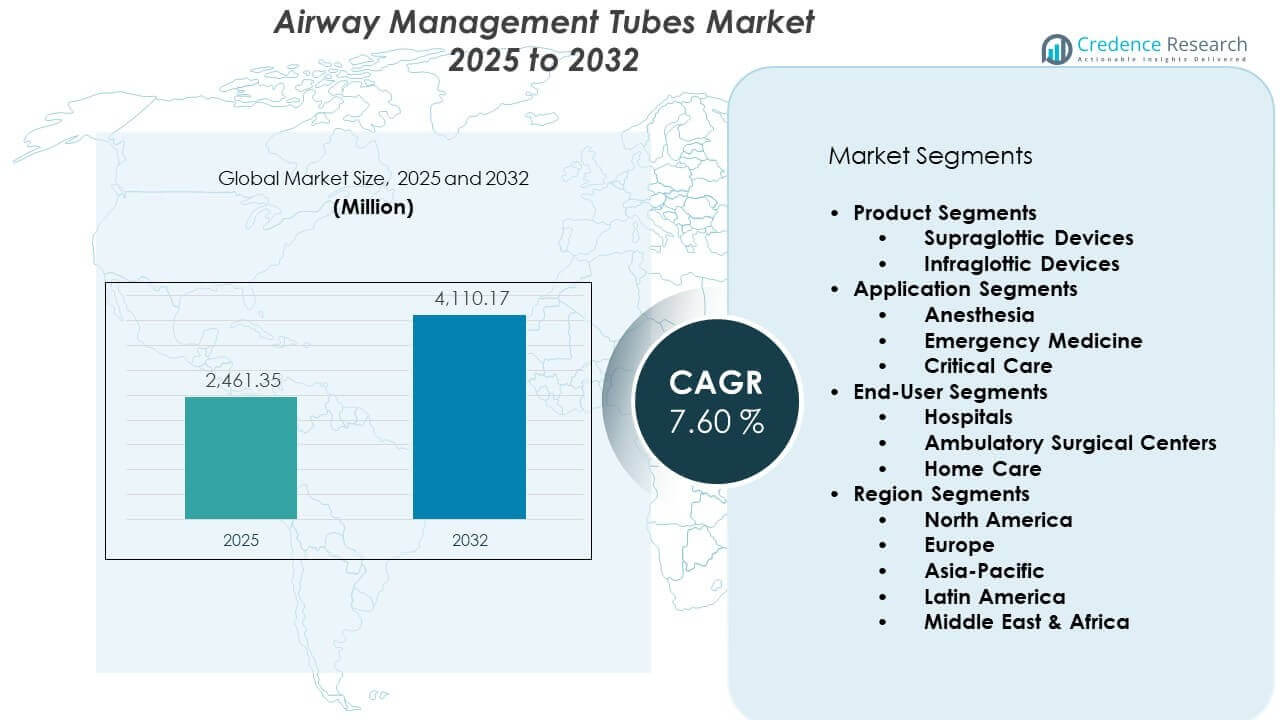
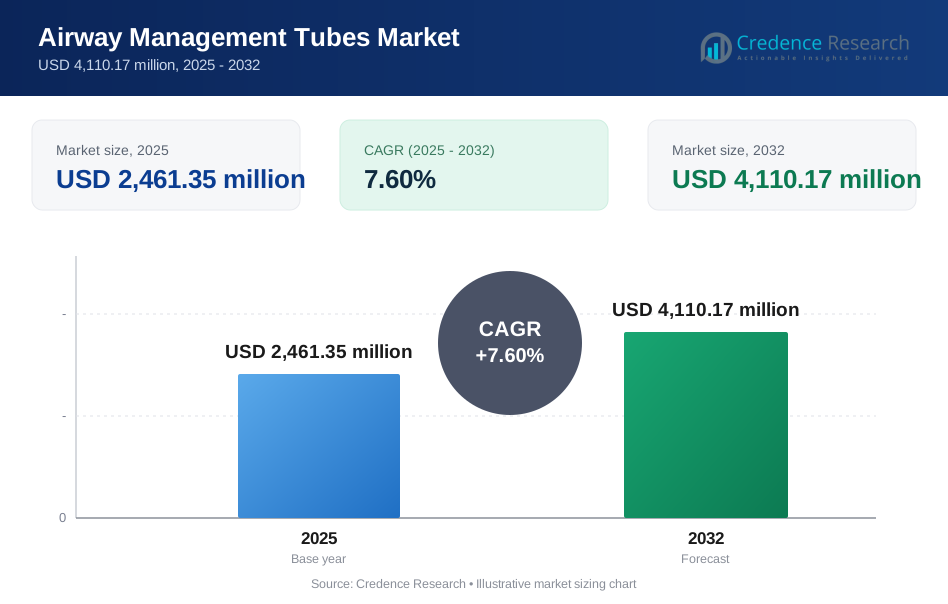
The Airway Management Tubes Market is projected to grow from USD 2,461.35 million in 2025 to an estimated USD 4,110.17 million by 2032, with a compound annual growth rate (CAGR) of 7.60% from 2025 to 2032.
| REPORT ATTRIBUTE | DETAILS |
|---|---|
| Historical Period | 2020-2024 |
| Base Year | 2025 |
| Forecast Period | 2026-2032 |
| Airway Management Tubes Market Size 2025 | USD 2,461.35 million |
| Airway Management Tubes Market, CAGR | 7.60% |
| Airway Management Tubes Market Size 2032 | USD 4,110.17 million |
Airway Management Tubes Market Insights:
- North America held the largest share at 37%, followed by Europe with 28% and Asia-Pacific with 22%, driven by surgical volume, ICU infrastructure, and healthcare expansion.
- Asia-Pacific is the fastest-growing region with 22% share, supported by rising hospital investments, medical tourism, and emergency care development.
- Hospitals dominated the end-user segment with over 50% share due to high usage in surgeries, ICUs, and ERs.
- Supraglottic devices accounted for approximately 40% of the product segment, favored for ease of use and rapid deployment in acute care.
Airway Management Tubes Market Drivers:
Rise in Surgical Procedures Across Aging Populations and Critical Care Needs
Increasing global surgical volumes contribute significantly to the growth of the Airway Management Tubes Market. Elderly populations require more surgeries involving anesthesia, driving demand for intubation devices. Hospitals invest in airway products to support cardiac, neurological, and orthopedic procedures. Aging-related comorbidities, such as COPD or sleep apnea, further increase reliance on airway management. Emergency departments see more acute cases needing rapid airway access. Intensive care units now implement early intubation strategies to stabilize high-risk patients. This drives continuous procurement of endotracheal and tracheostomy tubes. It expands usage across both planned and unplanned care settings.
- For instance, Medtronic reported that its Airway Management portfolio supported a significant portion of the 12 million procedures performed annually using their airway products, with their McGRATH™ MAC video laryngoscope reaching a milestone of over 15 million intubations globally.
Rapid Growth in Respiratory Disease Burden Globally Elevates Product Adoption
Rising incidence of respiratory disorders strengthens demand for airway tubes in hospital and home care settings. Conditions such as asthma, chronic bronchitis, and pneumonia require ventilatory support. Countries with high smoking rates and urban air pollution see greater hospitalization rates. Airway tubes support non-invasive and invasive interventions across care cycles. It benefits from expanded insurance coverage for chronic disease care. Global respiratory outbreaks, such as COVID-19, accelerated awareness and investments in airway products. Public and private providers expanded ventilator capacity to manage large patient volumes. This created a steady stream of institutional demand.
- For instance, Fisher & Paykel Healthcare noted that their Optiflow™ nasal high-flow therapy systems often used as a primary intervention for respiratory failure have been utilized to treat over 7 million patients worldwide, highlighting the scale of respiratory device adoption.
Advances in Tube Design, Material Safety, and Patient Comfort Drive Preference
Product innovation in biocompatible materials, kink-resistant design, and flexible cuffs enhances user and patient safety. Manufacturers develop tubes that reduce mucosal trauma and enable easier insertion. Hospitals increasingly adopt safety-oriented devices to reduce intubation failure and infection risk. Preformed tubes for pediatric and neonatal care improve positioning and reduce complications. It gains from hospitals prioritizing patient comfort alongside procedural efficiency. Enhanced materials help prevent pressure ulcers and airway injuries during extended intubation. Disposable variants with antimicrobial coatings are preferred in infection-sensitive settings. These features increase provider confidence in device safety and performance.
Increased Emergency and Pre-Hospital Care Investments Boost Market Penetration
Governments and health systems strengthen emergency medical services to reduce out-of-hospital mortality. Ambulance networks now carry portable airway devices for trauma, stroke, and cardiac events. Trained paramedics use supraglottic and endotracheal tubes in field interventions. The Airway Management Tubes Market benefits from protocols requiring immediate airway stabilization during emergencies. Disaster preparedness initiatives include large-scale procurement of airway consumables. Rural clinics and trauma centers stock airway kits to reduce transfer delays. This trend supports deeper product reach in remote and underserved areas. Public health policies now emphasize airway readiness in national emergency response frameworks.
Airway Management Tubes Market Trends:
Adoption of Video Laryngoscopy and Smart Intubation Tools is Accelerating
Clinicians now adopt video-assisted intubation tools to improve tube placement accuracy. Video laryngoscopy enables better visualization of the airway in difficult anatomy cases. These devices reduce failed intubation and support rapid decision-making. Integration of smart sensors allows monitoring of cuff pressure and tube positioning. It improves outcomes in ICU and high-risk surgical procedures. Teaching hospitals use these devices for training new clinicians. AI-enabled devices also support automatic detection of obstructions or tube dislocation. The Airway Management Tubes Market expands with these digital and smart-care integrations.
- For instance, Verathon’s GlideScope Core™system features a 10-inch high-definition touchscreen monitor with dual-connectivity, allowing for simultaneous visualization of two video sources. When used with GlideScope's specialized blades, which provide a 60-degree field of view, clinical studies have demonstrated that video laryngoscopy can achieve first-pass success rates as high as 98%, even in patients with predicted difficult airways
Rising Preference for Disposable Tubes to Prevent Cross-Contamination Risks
Infection control policies favor disposable airway tubes in both inpatient and outpatient settings. Hospitals reduce cross-use to minimize hospital-acquired infections and airway injuries. High-acuity settings, including ICUs and surgical suites, prefer sterile single-use tubes. These reduce the need for costly reprocessing and sterilization workflows. Portable disposable tubes are used in ambulatory and emergency care units. Manufacturers now offer biodegradable variants to support hospital sustainability goals. Demand rises for tubes with integrated infection-prevention coatings. This trend strengthens volume-based purchasing in large health systems.
- For instance, Ambu A/S, a leader in single-use endoscopy, reported that their unit sales for disposable bronchoscopes frequently used alongside airway tubes surpassed 1.5 million units in a single fiscal year, reflecting a massive institutional shift toward 100% sterile, single-use respiratory solutions.
Increased Demand for Pediatric and Neonatal Airway Products in Developed Regions
Specialized tubes for neonates and infants are gaining traction due to improved pediatric care standards. These products are smaller, softer, and tailored for underdeveloped airways. NICUs and children’s hospitals prioritize gentle, trauma-free airway access. Pediatric anesthesiologists require accurate fit and flexibility during surgeries. This trend supports new tube launches with better shape memory and depth markings. The Airway Management Tubes Market grows with increased pediatric surgical procedures and congenital airway defect treatments. Demand is strong in North America and Europe, where early intervention programs are well funded. These regions also support regulatory approvals for child-safe airway devices.
Integration of Tubes into Comprehensive Airway Management Kits Gains Momentum
Clinicians now prefer bundled airway kits for rapid deployment in surgical and trauma settings. These kits include tubes, connectors, bite blocks, and suction catheters. It reduces procedural time and ensures availability of all required accessories. Standardized kits are useful in pre-hospital and military settings. Hospitals now issue airway bundles for code-blue carts and surgical prep zones. Procurement teams benefit from unified sourcing and simplified inventory. OEMs offer customization for surgical specialties and regional protocols. It boosts the Airway Management Tubes Market by increasing bundled procurement across departments.
Airway Management Tubes Market Challenges Analysis:
Regulatory Approvals and Compliance Standards Limit Fast Product Launches Across Regions
Gaining regulatory clearance across global markets involves detailed documentation, clinical testing, and post-market surveillance. Each country enforces unique device safety requirements and quality control standards. Small manufacturers often face delays in entering high-growth regions due to approval timelines. Regulatory updates in regions like the EU MDR and U.S. FDA slow down pipeline commercialization. The Airway Management Tubes Market sees fragmented adoption due to this barrier. Companies must invest in compliance teams and product standardization to scale across borders. Regulatory audits and recalls add to cost and brand risk. It challenges smaller firms from competing with global OEMs.
Lack of Skilled Personnel and Training in Low-Income Regions Limits Adoption
Proper airway management requires well-trained staff to reduce risks such as aspiration, misplacement, or trauma. Many emerging economies face shortages of anesthesiologists and critical care nurses. Poorly equipped facilities often lack standard airway protocols or training resources. This limits safe use of advanced airway tubes during surgeries or emergencies. Governments and private hospitals are working to expand skill-based training. However, the pace remains slow, especially in rural and low-resource settings. It restricts broader market penetration and consistent usage. Device misuse or delayed intubation leads to clinical hesitancy among undertrained providers.
Airway Management Tubes Market Opportunities:
Expansion of Home Healthcare and Non-Hospital Settings Creates Growth Avenues
Patients with chronic respiratory illness often require long-term airway support at home. Home healthcare services now include tracheostomy care and ventilator management. The Airway Management Tubes Market sees new demand from non-hospital channels. Portable, easy-to-insert tubes with humidification and anti-microbial features meet these needs. Manufacturers develop home-use kits with safety instructions and telemonitoring support. This segment also grows with rising palliative care demand and post-ICU recovery needs.
Emerging Economies Offer Untapped Demand Through Health System Modernization
Asia-Pacific, Latin America, and Africa are witnessing healthcare expansion in both public and private sectors. Governments invest in ICU upgrades, trauma centers, and emergency medical systems. These upgrades drive procurement of basic and advanced airway tubes. International aid and public-private partnerships help equip underserved hospitals. Local manufacturing support and training programs also open market entry points. Growth in surgical tourism and insurance coverage further drives airway device uptake.
Airway Management Tubes Market Segmentation Analysis:
By Product Segments
Supraglottic devices hold strong share due to their ease of use in pre-hospital and emergency settings. Laryngeal masks dominate this category for short-term airway access in surgeries. Oropharyngeal and nasopharyngeal airways also support ventilation in non-invasive care. Infraglottic devices such as endotracheal and tracheostomy tubes remain critical for long-term ventilation and ICU use. Hospitals prefer cuffed endotracheal tubes to ensure secure airway control in complex procedures. The Airway Management Tubes Market continues to favor innovation in antimicrobial coatings and low-trauma materials across both segments.
- For instance, Teleflex Incorporated’s LMA Supreme™ second-generation laryngeal mask is designed to achieve high oropharyngeal seal pressures of up to 37 \(cmH_{2}O\), providing a documented safety profile with an integrated gastric channel that allows it to be used in over 50% of routine elective surgeries as a reliable and less invasive alternative to endotracheal intubation.
By Application Segments
Anesthesia applications lead the market due to growing volumes of surgical procedures requiring airway control. Emergency medicine drives demand for rapid-insertion airway tools suited for pre-hospital and trauma settings. Critical care units use both supraglottic and infraglottic devices for ventilator support and airway protection. Device selection varies by urgency, patient condition, and duration of support required. It remains a core part of clinical protocol in every phase of acute care.
- For instance, ICU Medical (which acquired Smiths Medical) manufactures the Portex® Blue Line Ultra® Tracheostomy Tubes, which feature a 105-degree arc design to enhance patient comfort by keeping the distal tip midline within the trachea. These tubes are widely utilized in healthcare settings for patients requiring prolonged mechanical ventilation and long-term airway management.
By End-User Segments
Hospitals are the largest end-user, driven by demand across surgery, ICU, and ER departments. Ambulatory surgical centers use single-use supraglottic devices to minimize infection risk. Home care settings are adopting tracheostomy tubes for long-term respiratory patients. Growing preference for portable and easy-to-manage devices supports home-based use. Bulk procurement remains high in institutional settings.
Segmentation:
By Product Segments
- Supraglottic Devices
- Infraglottic Devices
By Application Segments
- Anesthesia
- Emergency Medicine
- Critical Care
By End-User Segments
- Hospitals
- Ambulatory Surgical Centers
- Home Care
By Region Segments
- North America
- U.S.
- Canada
- Mexico
- Europe
- Germany
- France
- U.K.
- Italy
- Spain
- Rest of Europe
- Asia Pacific
- China
- Japan
- India
- South Korea
- South-east Asia
- Rest of Asia Pacific
- Latin America
- Brazil
- Argentina
- Rest of Latin America
- Middle East & Africa
- GCC Countries
- South Africa
- Rest of the Middle East and Africa
Regional Analysis:
North America
North America holds the largest share in the Airway Management Tubes Market, accounting for around 37% of the global revenue. The region benefits from high surgical volumes, advanced ICU infrastructure, and strong adoption of disposable airway devices. The U.S. leads the market due to rising incidences of chronic respiratory diseases and a growing geriatric population. Hospitals and emergency services deploy a wide range of airway tubes supported by strong reimbursement policies. Manufacturers in this region invest in smart airway technologies and infection control features. Demand remains steady across both public and private healthcare systems.
Europe
Europe captures nearly 28% of the global market share, driven by strict clinical guidelines, growing surgical procedures, and aging populations. Countries like Germany, France, and the UK have robust critical care units that widely use supraglottic and infraglottic devices. Healthcare providers focus on patient safety and adopt disposable tubes to reduce infection rates. Regulatory compliance under MDR frameworks influences innovation and procurement cycles. The region also supports specialized pediatric and neonatal airway products across high-tier hospitals. It sees consistent growth in airway device usage in ambulatory and elective care procedures.
Asia-Pacific, Latin America, and Middle East & Africa
Asia-Pacific contributes approximately 22% of the market and is the fastest-growing region. China, India, and Japan drive growth through rising investments in hospital infrastructure and emergency services. High population density and growing medical tourism increase demand for intubation devices across urban hospitals. Latin America holds around 7% market share, led by Brazil and Mexico, where trauma centers and surgical hubs are expanding. Middle East & Africa accounts for nearly 6%, supported by public health spending in GCC nations and emerging critical care facilities. The Airway Management Tubes Market in these regions benefits from international partnerships, skill-building programs, and localized manufacturing efforts.
Key Player Analysis:
- Medtronic
- Teleflex
- Ambu A/S
- Smiths Medical
- Fisher & Paykel Healthcare
- ICU Medical
- KARL STORZ
- Flexicare
Competitive Analysis:
The Airway Management Tubes Market is moderately consolidated, with global players competing on product safety, portfolio depth, and clinical trust. Leading companies focus on innovation in disposable tubes, infection control features, and ease of placement. Product differentiation centers on material quality, cuff design, and compatibility with advanced airway tools. Strong distribution networks and hospital contracts support market leadership. Companies also invest in clinician training and simulation programs to strengthen brand preference. It shows steady competition from regional manufacturers offering cost-effective alternatives. Strategic partnerships with hospitals and emergency services help vendors secure long-term demand.
Recent Developments:
- In February 2026, Ambu reported its Q1 2025/26financial results, showing an 6% organic growth driven largely by its endoscopy and airway management solutions. The company continues to market its comprehensive One Lung Ventilation (OLV) solution, which integrates the VivaSight™ 2 DLT and SLT tubes with built-in cameras to provide real-time visualization during complex intubation procedures.
- In December 2025, Teleflex Incorporated announced a definitive agreement to sell its Acute Care and Interventional Urology businesses to Intersurgical Ltd. for approximately $530 million. This strategic divestiture, expected to close in the second half of 2026, includes Teleflex's extensive airway management portfolio under the Hudson RCI and Rüsch brands, as the company shifts its focus toward its vascular access and surgical business units.
- In September 2025, ICU Medical, which acquired Smiths Medical in 2022, faced ongoing challenges regarding the quality and safety of its airway management devices, with several recalls flagged by the FDA. Despite these operational hurdles, the company remains a major player in the market, integrating the legacy Smiths Medical portfolio including tracheostomy and endotracheal tubes into its broader respiratory care division.
- In May 2025, Fisher & Paykel Healthcare announced record full-year revenue for the 2025 financial year, largely attributed to the expanded rollout of its F&P Airvo™ 3 device and the F&P 950™ System. The company also highlighted the increased clinical adoption of its Optiflow Switch™ and Optiflow Trace™ systems in anesthesia and acute care settings, enhancing non-invasive airway support.
Report Coverage:
The research report offers an in-depth analysis based on Product Segments, Application Segments, End-User Segments, and Region Segments. It details leading market players, providing an overview of their business, product offerings, investments, revenue streams, and key applications. Additionally, the report includes insights into the competitive environment, SWOT analysis, current market trends, as well as the primary drivers and constraints. Furthermore, it discusses various factors that have driven market expansion in recent years. The report also explores market dynamics, regulatory scenarios, and technological advancements that are shaping the industry. It assesses the impact of external factors and global economic changes on market growth. Lastly, it provides strategic recommendations for new entrants and established companies to navigate the complexities of the market.
Future Outlook:
- Global surgical volumes will continue to grow, supporting long-term demand for both supraglottic and infraglottic airway devices across healthcare facilities.
- Hospitals will increasingly adopt disposable tubes to meet infection control standards, especially in intensive care and emergency settings.
- Home healthcare will emerge as a significant growth area as tracheostomy care becomes more common for chronic respiratory patients.
- Smart airway management systems integrated with video laryngoscopes and sensors will enhance patient safety and reduce error rates during intubation.
- Pediatric and neonatal airway products will gain traction as advanced healthcare systems emphasize child-specific critical care tools.
- Asia-Pacific will see rising investment in emergency medical infrastructure, expanding access to modern airway tubes in Tier 2 and Tier 3 cities.
- Regulatory bodies will streamline medical device approvals, enabling faster market access for new and advanced airway solutions.
- Clinical education programs and simulation-based training will improve practitioner confidence and expand device usage in underpenetrated regions.
- Procurement models will shift toward bundled airway kits and long-term supply contracts to optimize resource allocation and response readiness.
- Competitive pressures will lead to consolidation, partnerships, and increased R&D spending among leading players to strengthen market positioning.
Request a Free Sample
Fill in your details and we'll send you a free sample report.
- Sample data tables & charts
- Research methodology
Need a Custom Version of This Report?
Tailor the scope, geography, or segments to your exact requirements.
- Custom geography or segment scope
- Direct access to our analyst team
Frequently Asked Questions
What is the current market size for Airway Management Tubes Market, and what is its projected size in 2032?
At what Compound Annual Growth Rate is the Airway Management Tubes Market projected to grow between 2025 and 2032?
Which Airway Management Tubes Market segment held the largest share in 2025?
What are the primary factors fueling the growth of the Airway Management Tubes Market?
Who are the leading companies in the Airway Management Tubes Market?
Which region commanded the largest share of the Airway Management Tubes Market in 2025?
Table of Content
Chapter 1. Report Introduction
- 1.1 Report Description & Purpose
- 1.1.1 Report Title & Market Definition
- 1.1.2 Unique Selling Propositions (USP) & Key Differentiators
- 1.1.3 Value Proposition for Stakeholders
- 1.2 Research Objectives
- 1.2.1 Market Sizing Objectives (Volume & Revenue)
- 1.2.2 Segmentation Objectives
- 1.2.3 Competitive Intelligence Objectives
- 1.2.4 Forecast & Scenario Objectives
- 1.3 Report Scope
- 1.3.1 Airway Management Tubes Scope – Types & Subtypes Covered
- 1.3.2 Geographic Scope – Regions & Countries Covered
- 1.3.3 Historical Period, Base Year & Forecast Period (2025; forecast to 2032)
- 1.3.4 Inclusions & Exclusions
- 1.4 HS Code & Classification Framework
- 1.5 Currency, Units & Pricing Basis
- 1.6 Target Stakeholders
- 1.7 Limitations & Assumptions
Chapter 2. Executive Summary
- 2.1 Global Airway Management Tubes Market Snapshot
- 2.1.1 Market Size – Historical (2025) & Forecast (2025-2032) (2025: USD 2,461.35 million → 2032: USD 4,110.17 million)
- 2.1.2 Volume & Revenue – Global Totals
- 2.1.3 Key Market Highlights – Top Five Facts
- 2.2 Airway Management Tubes Market Segmentation Snapshot
- 2.2.1 Market Split by Region – 2025 vs. 2032
- 2.3 Competitive Snapshot
- 2.3.1 Top 10 Players by Revenue Share – 2025
- 2.3.2 Top 10 Players by Volume Share – 2025
- 2.3.3 Recent Strategic Developments (18-Month Summary)
- 2.4 Key Investment Highlights & Strategic Conclusions
Chapter 3. Airway Management Tubes Market Dynamics & Industry Analysis
- 3.1 Market Overview & Context
- 3.1.1 Airway Management Tubes Market Position in the Broader Automotive Value Chain
- 3.1.2 OEM vs. Replacement Market Dynamics
- 3.1.3 Market Maturity & Development Stage by Region
- 3.2 Airway Management Tubes Market Drivers
- 3.3 Airway Management Tubes Market Restraints & Challenges
- 3.4 Airway Management Tubes Market Opportunities
- 3.5 Porter's Five Forces Analysis
- 3.5.1 Threat of New Entrants
- 3.5.2 Bargaining Power of Suppliers
- 3.5.3 Bargaining Power of Buyers
- 3.5.4 Threat of Substitutes
- 3.5.5 Competitive Rivalry – Intensity Assessment
- 3.6 Airway Management Tubes Value Chain Analysis
- 3.6.1 Upstream – Raw Material/Input Suppliers
- 3.6.1.1 Raw Material/Input 1
- 3.6.1.2 Raw Material/Input 2
- 3.6.1.3 Raw Material/Input 3
- 3.6.2 Midstream – Production/Manufacturing/Service Delivery
- 3.6.2.1 Production/Process Overview
- 3.6.2.2 Key Facility Locations & Capacity by Manufacturer
- 3.6.3 Downstream – Distribution & End Consumer
- 3.6.3.1 Primary Channel – B2B/OEM
- 3.6.3.2 Secondary Channels – Dealer, Retail, Online, Direct
- 3.6.4 Value Chain Profitability Analysis
- 3.6.1 Upstream – Raw Material/Input Suppliers
- 3.7 PESTEL Analysis
- 3.7.1 Political Factors
- 3.7.2 Economic Factors
- 3.7.3 Social Factors
- 3.7.4 Technological Factors
- 3.7.5 Environmental Factors
- 3.7.6 Legal Factors
- 3.8 Airway Management Tubes Supply Chain Analysis
- 3.8.1 Raw Material/Input Supply Risk Assessment
- 3.8.2 Manufacturing Concentration Risk (Geographic Exposure)
- 3.8.3 Trade Disruption Impact Analysis
- 3.9 Regulatory & Policy Landscape
Note: The regulatory and policy landscape section covers regulations based on their applicability to the market, Airway Management Tubes category, geography, and scope of the study. Only regulatory frameworks with a material impact on operations, compliance, trade, sustainability, or market access are analyzed in detail.
Chapter 4. Key Investment Pockets & Opportunity Analysis
- 4.1 Airway Management Tubes Market Attractiveness Analysis
- 4.1.1 By Region – Investment Attractiveness Matrix (Volume × CAGR)
- 4.2 Absolute Revenue Growth Opportunity
- 4.2.1 By Region – Absolute USD Growth Through 2032
- 4.3 Incremental Volume Opportunity
- 4.3.1 By Region – Incremental Volume Through 2032
- 4.3.2 Segment – Incremental Volume
- 4.4 Emerging Submarket Opportunity Deep Dive (Subject to Applicability)
- 4.5 Emerging Market Opportunity Scorecards
- 4.5.1 United States
- 4.5.2 Europe
- 4.5.3 Asia
- 4.5.4 Middle East & Africa
Note: Emerging Market Opportunity Scorecards will be included based on relevance and strategic importance. Regions listed are indicative and may vary depending on data availability and market dynamics.
Chapter 5. Airway Management Tubes Import-Export Analysis & Trade Flows
- 5.1 Global Trade Overview
- 5.1.1 Global Export Value by Country (2025)
- 5.1.2 Global Export Volume by Country (2025)
- 5.1.3 Global Import Value by Country (2025)
- 5.1.4 Global Import Volume by Country (2025)
- 5.1.5 Net Trade Balance by Country (2025)
- 5.2 Export Analysis – Segment
- 5.2.1 Type 1 (HS Code)
- 5.2.2 Type 2 (HS Code)
- 5.2.3 Type 3 (HS Code)
- 5.2.4 Type 4 (HS Code)
- 5.2.5 Type 5 (HS Code)
- 5.3 Import Analysis – Segment
- 5.3.1 Type 1 (HS Code)
- 5.3.2 Type 2 (HS Code)
- 5.3.3 Type 3 (HS Code)
- 5.3.4 Type 4 (HS Code)
- 5.3.5 Type 5 (HS Code)
- 5.4 Average Unit Trade Prices
- 5.4.1 Average Export Price – Segment & Country
- 5.4.2 Average Import Price – Segment & Source Country
- 5.4.3 Price Trends (2025)
- 5.5 Key Trade Route Analysis
- 5.5.1 Trade Route 1
- 5.5.2 Trade Route 2
- 5.5.3 Trade Route 3
- 5.5.4 Trade Route 4
- 5.5.5 Trade Route 5
- 5.6 Trade Policy Impact Assessment
- 5.6.1 US Anti-Dumping & Section 301 Tariffs
- 5.6.2 EU Customs Union Impact
- 5.6.3 Major Free Trade Agreements
- 5.6.4 USMCA Rules of Origin
Note: Trade policy analysis will be included only where relevant to the Airway Management Tubes market.
Chapter 6. Competitive Landscape & Company Benchmarking
- 6.1 Airway Management Tubes Market Concentration & Structure
- 6.1.1 Herfindahl-Hirschman Index (HHI) – vs. 2025
- 6.1.2 Tier 1, Tier 2 & Tier 3 Market Structure
- 6.1.3 Global, Regional & Local Player Dynamics
- 6.2 Airway Management Tubes Market Share Analysis – 2025
- 6.2.1 Global Revenue Share by Company
- 6.2.2 Global Volume Share by Company
- 6.2.3 Regional Revenue Share
- 6.2.4 Market Share Evolution ( vs. 2025)
- 6.2.5 OEM Segment Share by Company
- 6.2.6 Replacement Segment Share by Company
- 6.3 Production/Delivery Capacity & Facility Analysis
- 6.3.1 Global Installed Capacity
- 6.3.2 Capacity Utilization Rates
- 6.3.3 Production/Output Volume
- 6.3.4 Facility Locations & Capacity Map
- 6.3.5 Planned Capacity Additions
- 6.4 Airway Management Tubes Competitive Benchmarking Matrix
- 6.4.1 Revenue, Volume, CAGR & Profitability Comparison
- 6.4.2 Channel Revenue Mix
- 6.4.3 Geographic Revenue Exposure
- 6.4.4 R&D Intensity
- 6.4.5 Sustainability Maturity
- 6.5 Strategic Developments in Airway Management Tubes (Last 24 Months)
- 6.5.1 Mergers, Acquisitions & Divestments
- 6.5.2 New Airway Management Tubes Launches
- 6.5.3 Facility Expansions
- 6.5.4 Strategic Alliances, Joint Ventures & Partnerships
- 6.5.5 Distribution Expansion & Market Entry
- 6.5.6 Sustainability & ESG Initiatives
- 6.6 Competitive Strategy Mapping
- 6.6.1 Leader, Challenger, Follower & Niche Classification
- 6.6.2 Pricing Strategy Comparison
- 6.6.3 Channel Strategy Matrix
Note: Strategic developments are included based on their materiality and the availability of reliable information.
Chapter 7. Global Airway Management Tubes Market – By Distribution Channel
- 7.1 Segment Overview
- 7.1.1 Volume & Revenue Split by Channel (2025 & 2032)
- 7.1.2 Channel Mix Evolution (2025-2032)
Chapter 8. Regional Market Analysis – Global Overview
- 8.1 Global Regional Overview
- 8.1.1 Regional Volume Share
- 8.1.2 Regional Revenue Share
- 8.1.3 Regional Volume by Region
- 8.1.4 Regional Revenue by Region
- 8.1.5 Regional Forecast Through 2032
- 8.2 Cross-Regional Segment Analysis
- 8.2.1 By Distribution Channel
- 8.2.2 By Brand/Price Tier
Chapter 9. North America Airway Management Tubes Market
- 9.1 United States
- 9.2 Canada
- 9.3 Mexico
Chapter 10. Europe Airway Management Tubes Market
- 10.1 Germany
- 10.2 France
- 10.3 Italy
- 10.4 United Kingdom
- 10.5 Spain
- 10.6 Poland
- 10.7 Russia
- 10.8 Netherlands
- 10.9 Belgium
- 10.10 Sweden
- 10.11 Denmark
- 10.12 Norway
- 10.13 Rest of Europe
Chapter 11. Asia Pacific Airway Management Tubes Market
- 11.1 China
- 11.2 India
- 11.3 Japan
- 11.4 South Korea
- 11.5 Thailand
- 11.6 Indonesia
- 11.7 Vietnam
- 11.8 Malaysia
- 11.9 Australia
- 11.10 Rest of Asia Pacific
Chapter 12. Latin America Airway Management Tubes Market
- 12.1 Brazil
- 12.2 Argentina
- 12.3 Colombia
- 12.4 Chile
- 12.5 Rest of Latin America
Chapter 13. Middle East Airway Management Tubes Market
- 13.1 Saudi Arabia
- 13.2 United Arab Emirates
- 13.3 Turkey
- 13.4 Israel
- 13.5 Iran
- 13.6 Rest of the Middle East
Chapter 14. Africa Airway Management Tubes Market
- 14.1 South Africa
- 14.2 Egypt
- 14.3 Nigeria
- 14.4 Morocco
- 14.5 Rest of Africa
Chapter 15. Airway Management Tubes Company Profiles
- 15.1 [Company 01]
- 15.1.1 Company Overview
- 15.1.2 Key Management Personnel
- 15.1.3 Products & Services Portfolio
- 15.1.4 Financial Performance
- 15.1.5 Key Market Focus & Geographic Presence
- 15.1.6 Recent Developments & Strategic Initiatives
Note: The company profile list is preliminary and may change based on research findings, market developments, data availability, and client requirements.
Chapter 16. Appendices
- Appendix A – List of Abbreviations & Acronyms
- Appendix B – Industry Classification Code Reference – Full Series
- Appendix C – Production & Capacity Data Tables
- Appendix D – End-Use & Demand Base Tables
- Appendix E – Consumption & Replacement Rate Assumptions
- Appendix F – ASP Reference Tables
- Appendix G – Manufacturing & Facility Database
- Appendix H – Import-Export Data Tables
- Appendix I – Regulatory Summary Tables
- Appendix J – Primary Research Participant List (Anonymized)
- Appendix K – Primary Research Questionnaire Framework
- Appendix L – Data Sources & Bibliography
- Appendix M – Market Size Divergence & Source Comparison
Chapter 17. Research Methodology
- 17.1 Research Framework & Philosophy
- 17.2 Secondary Research – Sources, Hierarchy & Data Extraction
- 17.3 Data Modeling – Bottom-Up & Top-Down Market Sizing
- 17.4 Primary Research – Stakeholder Framework, LOI & Sample Sizes
- 17.5 Forecast Methodology – Regression, Scenario & Sensitivity Analysis
- 17.6 Quality Control – Four-Layer Validation Framework
- 17.7 Limitations & Standard Assumptions
- 17.8 Disclaimer
