
Asia-Pacific Breast Implants Market Overview:
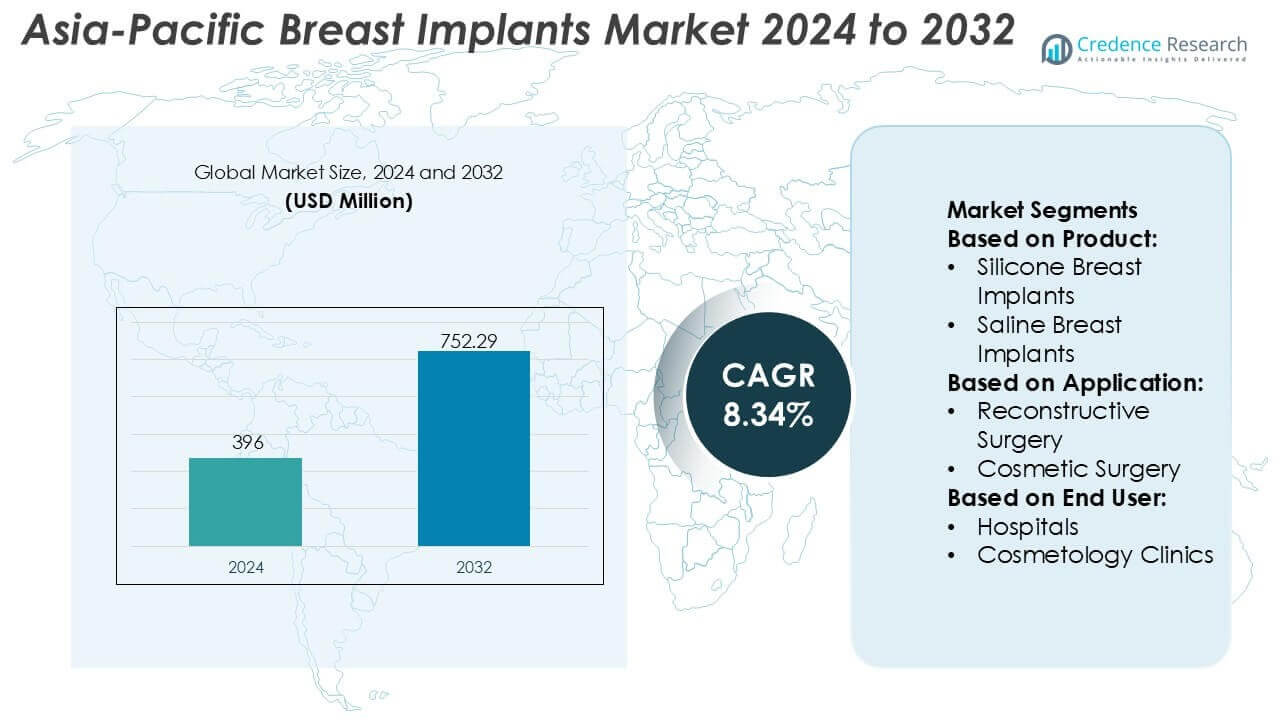
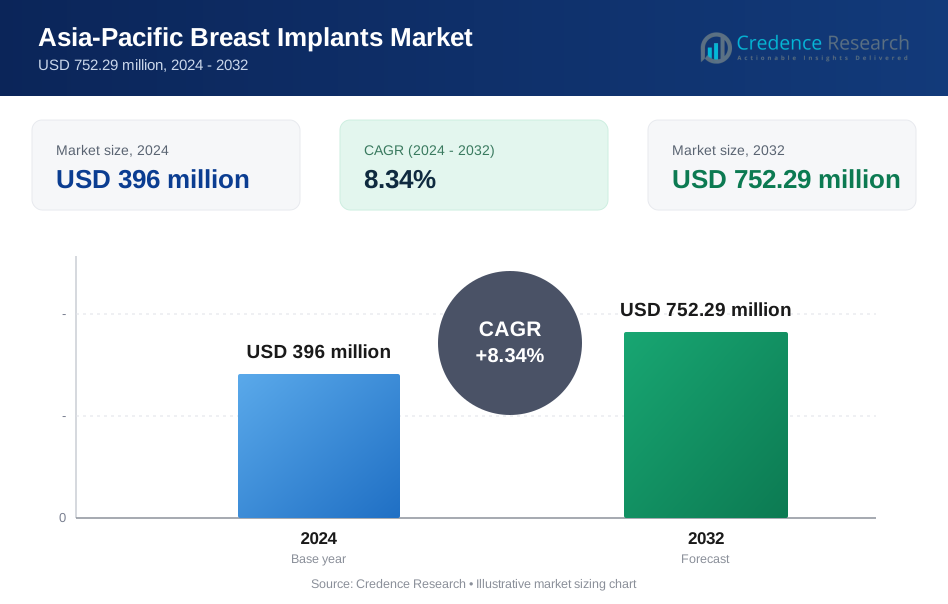
Asia-Pacific Breast Implants Market size was valued USD 396 million in 2024 and is anticipated to reach USD 752.29 million by 2032, at a CAGR of 8.34% during the forecast period.
| REPORT ATTRIBUTE | DETAILS |
|---|---|
| Historical Period | 2020-2023 |
| Base Year | 2024 |
| Forecast Period | 2025-2032 |
| Asia-Pacific Breast Implants Market Size 2024 | USD 396 million |
| Asia-Pacific Breast Implants Market , CAGR | 8.34% |
| Asia-Pacific Breast Implants Market Size 2032 | USD 752.29 million |
Asia-Pacific Breast Implants Market Insights
- Rising demand for cosmetic and reconstructive surgeries acts as a key market driver, supported by growing awareness of body aesthetics, higher disposable incomes, and improved access to certified plastic surgeons, with silicone breast implants dominating due to their natural feel and long-term safety profile.
- Key market trends include increased adoption of advanced silicone gel implants, anatomical and textured designs, and a growing preference for minimally invasive procedures, while reconstructive surgery accounts for a significant segment share driven by post-mastectomy demand.
- The competitive landscape is characterized by global manufacturers focusing on product innovation, regulatory compliance, regional manufacturing, and surgeon training programs to strengthen penetration across emerging Asia-Pacific economies.
- Regionally, China leads the Asia-Pacific market with an exact 41% share, followed by South Korea and Japan, while market restraints include regulatory complexities, product recall risks, and concerns related to implant safety and long-term complications.
Asia-Pacific Breast Implants Market Segmentation Analysis:
By Product
In the Asia-Pacific Breast Implants Market, silicone breast implants dominate the product segment, accounting for approximately 68% market share. Their leadership is driven by a more natural feel, improved cohesiveness of modern silicone gels, and lower rates of visible rippling compared to saline alternatives. Surgeons across countries such as South Korea, Japan, and Australia increasingly prefer silicone implants due to better long-term aesthetic outcomes and patient satisfaction. Saline breast implants retain relevance in cost-sensitive markets and specific clinical cases, but rising disposable incomes and preference for premium cosmetic outcomes continue to reinforce silicone implants as the dominant choice.
- For instance, Arthrex, Inc. applies advanced material science expertise from its soft-tissue repair portfolio, where its biocomposite anchors demonstrate controlled resorption over 24 months and tensile strength exceeding 200 newtons, reflecting the company’s capability to engineer durable, biocompatible polymer systems with precise mechanical performance applicable to implantable medical devices.
By Application
Cosmetic surgery represents the dominant application segment in the Asia-Pacific Breast Implants Market, holding nearly 62% market share. Growth is supported by increasing aesthetic awareness, social media influence, and strong demand for body contouring procedures in markets such as South Korea, China, and Thailand. Medical tourism further accelerates cosmetic procedures due to competitive pricing and advanced surgical expertise. Reconstructive surgery maintains steady demand, driven by breast cancer incidence and post-mastectomy reconstruction programs, but elective cosmetic procedures remain the primary revenue contributor due to higher procedure volumes and recurring implant replacements.
- For instance, Zimmer Biomet’s ROSA® surgical robotic platform demonstrates positioning accuracy within 1 millimeter and supports real-time intraoperative data processing at 250 frames per second, reflecting the company’s capability to deliver high-precision surgical technologies that enhance procedural consistency and reproducibility in implant-based surgeries.
By End-User
Among end users, cosmetology clinics lead the Asia-Pacific Breast Implants Market with an estimated 57% market share. Specialized aesthetic clinics benefit from high procedure throughput, surgeon specialization, and advanced cosmetic infrastructure. These facilities cater primarily to elective cosmetic surgeries, offering shorter waiting times and personalized treatment options. Hospitals continue to play a crucial role in complex reconstructive procedures and oncology-related cases, while other end users, including ambulatory surgical centers, contribute modestly. The ongoing shift toward outpatient aesthetic procedures strongly supports the dominance of cosmetology clinics across the region.
Key Growth Drivers
Rising Demand for Cosmetic and Aesthetic Procedures
Growing acceptance of cosmetic surgery across Asia-Pacific strongly drives the breast implants market. Urbanization, rising disposable incomes, and increased exposure to global beauty standards through social media influence consumer preferences. Countries such as South Korea, Japan, China, and Australia witness higher volumes of elective breast augmentation procedures. Younger demographics increasingly view aesthetic surgery as a lifestyle choice rather than a medical exception. The expanding number of certified plastic surgeons and specialty clinics further supports procedural accessibility and market expansion across both developed and emerging Asia-Pacific economies.
- For instance, Paragon Medical (AMETEK) supports implant-driven procedures through high-precision manufacturing of complex medical components, delivering CNC-machined implant parts with dimensional tolerances as tight as ±2 microns, operating additive manufacturing platforms with laser power ratings up to 400 watts, and maintaining validated Class ISO 7 cleanroom environments to ensure consistency, surface integrity, and biocompatibility required for aesthetic and reconstructive implant applications.
Increasing Breast Reconstruction Procedures
Breast reconstruction following mastectomy significantly contributes to market growth in Asia-Pacific. Rising breast cancer incidence, combined with improving diagnostic infrastructure, increases surgical interventions requiring implants. Governments and healthcare institutions promote post-cancer reconstruction to improve patient quality of life. Public and private hospitals increasingly integrate reconstructive surgery into oncology care pathways. Advancements in implant materials that enhance safety, longevity, and anatomical outcomes further strengthen adoption, particularly in countries expanding insurance coverage for reconstructive procedures.
- For instance, DePuy Synthes has advanced implant-related surgical precision through its VELYS™ robotic-assisted platform, which supports bone resection accuracy within 1 millimeter and operates with real-time data processing at 200 hertz, demonstrating the company’s capability to deliver highly controlled, reproducible outcomes in complex implant-based surgeries that demand long-term stability and anatomical accuracy.
Advancements in Implant Technology and Product Innovation
Continuous technological advancements in breast implant design accelerate market growth. Manufacturers focus on improved silicone gel cohesiveness, textured and smooth surface innovations, and anatomically shaped implants to enhance safety and aesthetic outcomes. Asia-Pacific surgeons increasingly prefer advanced implants that reduce complication risks such as capsular contracture. Regulatory approvals for next-generation implants improve physician confidence and patient acceptance. Product differentiation through durability, natural feel, and reduced revision rates supports sustained demand across both cosmetic and reconstructive segments.
Key Trends & Opportunities
Shift Toward Minimally Invasive and Customized Procedures
The market shows a strong shift toward personalized and minimally invasive breast augmentation solutions. Patients increasingly demand customized implant size, shape, and profile aligned with body morphology. Surgeons adopt advanced imaging, 3D simulation, and pre-operative planning tools to improve procedural accuracy. This trend enhances patient satisfaction and lowers revision surgery rates. The opportunity lies in integrating digital technologies with implant selection, particularly in technologically advanced markets such as South Korea, Japan, and Australia.
- For instance, Globus Medical’s ExcelsiusGPS® robotic navigation platform delivers real-time instrument tracking with positional accuracy within 1 millimeter, integrates pre-operative CT data with intraoperative imaging, and supports automated trajectory planning across six degrees of freedom, demonstrating the company’s capability to enable highly customized, minimally invasive implant-based procedures through precise digital surgical guidance.
Expansion of Medical Tourism Across Asia-Pacific
Medical tourism presents a major opportunity for breast implant providers in Asia-Pacific. Countries such as Thailand, South Korea, and Malaysia attract international patients due to high surgical expertise, modern facilities, and competitive pricing. Cosmetic surgery packages bundled with travel and recovery services enhance regional attractiveness. International accreditation of hospitals further boosts confidence among overseas patients. This trend expands procedural volumes and supports cross-border demand for premium and mid-range implant products.
- For instance, Acumed LLC demonstrates its precision manufacturing capability through orthopedic fixation systems produced from Ti-6Al-4V ELI titanium alloy compliant with ASTM F136, offering plate thickness options ranging from 1.3 millimeters to 4.0 millimeters and screw diameters between 2.0 millimeters and 4.5 millimeters, reflecting the company’s ability to deliver implant-grade components with consistent dimensional accuracy and biomechanical reliability suitable for high-standard surgical environments.
Growing Role of Specialized Aesthetic Clinics
Specialized cosmetology and aesthetic clinics increasingly dominate procedural volumes across Asia-Pacific. These clinics offer focused expertise, shorter waiting times, and personalized patient care compared to general hospitals. Rising investment in private healthcare infrastructure supports clinic expansion in urban centers. Manufacturers benefit from closer partnerships with high-volume clinics, enabling targeted product placement and surgeon training programs. This trend creates opportunities for premium implant brands to strengthen regional penetration.
Key Challenges
Regulatory Complexity and Product Approval Delays
Regulatory variability across Asia-Pacific presents a significant challenge for breast implant manufacturers. Each country enforces distinct approval processes, clinical data requirements, and compliance standards. Lengthy approval timelines delay market entry for new implant technologies. Smaller manufacturers face barriers due to high regulatory costs and documentation burdens. Frequent updates to medical device regulations further complicate long-term product planning and regional expansion strategies.
Social Stigma and Safety Concerns
Despite growing acceptance, social stigma surrounding cosmetic surgery persists in several Asia-Pacific countries. Cultural conservatism and misinformation regarding implant safety restrict adoption in certain markets. Concerns over implant-related complications and long-term health risks influence patient decision-making. Negative media coverage and litigation cases amplify public skepticism. Addressing this challenge requires enhanced patient education, transparent safety communication, and stronger physician-led awareness initiatives.
Regional Analysis
North America
North America accounts for around 32% market share in the Australia Industrial Gases Market, driven by strong trade linkages, technology transfer, and multinational industrial gas suppliers with operations spanning both regions. Australian demand benefits from North American expertise in hydrogen production, specialty gases, and on-site gas generation systems. Advanced manufacturing, energy, and semiconductor industries influence gas specification standards and supply models adopted in Australia. Long-term supply contracts and integrated distribution networks further support market alignment. Innovation in low-carbon gases and hydrogen infrastructure in North America also shapes Australia’s industrial gas investment priorities.
Asia-Pacific
Asia-Pacific dominates the Australia Industrial Gases Market with approximately 41% market share, supported by close geographic proximity and strong industrial integration. High demand from mining, metal fabrication, chemicals, electronics, and healthcare sectors drives consumption. Australia’s exports of minerals and energy-intensive products increase reliance on oxygen, nitrogen, and argon. Regional manufacturing hubs and rapid industrialization strengthen cross-border gas supply chains. Investments in clean hydrogen, LNG processing, and renewable energy projects further accelerate industrial gas demand. Asia-Pacific’s cost-efficient production capabilities and logistics advantages reinforce its leadership position.
Europe
Europe holds about 15% market share in the Australia Industrial Gases Market, supported by advanced technology collaboration and specialty gas imports. European suppliers contribute high-purity gases used in pharmaceuticals, research laboratories, and advanced manufacturing. Strict European safety and environmental standards influence operational practices adopted by Australian end users. Demand centers around specialty gases, calibration gases, and medical applications rather than bulk industrial volumes. Strategic partnerships between European technology providers and Australian industrial gas distributors support knowledge transfer, innovation adoption, and premium product positioning within the market.
Latin America
Latin America represents nearly 7% market share in the Australia Industrial Gases Market, primarily through indirect trade and global supplier networks. The region’s influence stems from shared expertise in mining, oil & gas, and metal processing applications. Australian operations benefit from Latin American best practices in large-scale oxygen and nitrogen deployment for resource extraction. While direct trade volumes remain limited, multinational industrial gas companies leverage regional operational experience to optimize supply reliability and cost efficiency. Growth remains moderate but stable, supported by industrial similarities between the two regions.
Middle East & Africa
The Middle East & Africa accounts for around 5% market share in the Australia Industrial Gases Market, driven by collaboration in energy-intensive industries and hydrogen development. Expertise from the Middle East in large-scale gas processing, LNG, and ammonia production supports Australia’s energy transition initiatives. African mining sector experience also influences industrial gas usage models in Australia. Although trade volumes are comparatively smaller, strategic cooperation in clean energy gases and infrastructure development strengthens regional relevance. Future growth links closely to hydrogen exports and decarbonization projects.
Asia-Pacific Breast Implants Market Segmentations:
By Product:
- Silicone Breast Implants
- Saline Breast Implants
By Application:
- Reconstructive Surgery
- Cosmetic Surgery
By End User:
- Hospitals
- Cosmetology Clinics
By Geography
- North America
- Europe
- Asia Pacific
- Latin America
- Middle East
- Africa
Competitive Landscape
The competitive landscape of the Asia-Pacific breast implants market players such as Arthrex, Inc. Zimmer Biomet; Paragon Medical (AMETEK), DePuy Synthes, Globus Medical, Acumed LLC, Smith+Nephew, Medtronic, Stryker Corporation, NuVasive, Inc. (merged with Globus Medical). the Asia-Pacific breast implants market is moderately consolidated and shaped by the presence of established multinational medical device manufacturers alongside a limited number of regional suppliers. Competition focuses strongly on product safety, regulatory compliance, and clinical performance rather than price alone.
Companies prioritize adherence to diverse country-specific approval processes while expanding distribution networks across high-growth markets such as China, South Korea, and Southeast Asia. Strategic emphasis remains on surgeon education, post-market surveillance, and long-term clinical data to strengthen brand credibility. Ongoing investments in manufacturing efficiency, supply-chain resilience, and portfolio optimization further intensify competition, with differentiation increasingly driven by service quality and regulatory reliability.
Key Player Analysis
- Arthrex, Inc.
- Zimmer Biomet
- Paragon Medical (AMETEK)
- DePuy Synthes
- Globus Medical
- Acumed LLC
- Smith+Nephew
- Medtronic
- Stryker Corporation
- NuVasive, Inc. (merged with Globus Medical)
Recent Developments
- In May 2025, Johnson & Johnson MedTech announced the U.S. launch of MENTOR MemoryGel Enhance Breast Implants in May 2025, filling a major gap in breast reconstruction for post-mastectomy patients needing larger implant sizes (930-1445 cc).
- In April 2025, MicroPort Orthopedics, announced the introduction of its flagship second-generation solution, the Evolution Medial-Pivot Knee, in India. The solution is designed to deliver superior flexion stability, anatomic motion, and a wear-limiting design, aiming to replicate the natural stability and motion of the knee to allow superior patient outcomes after total knee replacement surgery.
- In March 2025, POLYTECH Health & Aesthetics announced the launch of its direct subsidiary in the UK, marking a significant strategic investment. This move underscores the company’s commitment to delivering high-quality aesthetic and breast reconstruction solutions while strengthening its presence in one of Europe’s key markets.
- In February 2024, Zeda, Inc. acquired the Orthopaedic Implant Company (OIC), based in Nevada. The acquisition can allow Zeda to produce OIC implants for its customers and strengthen its position in the orthopedic industry.
Report Coverage
The research report offers an in-depth analysis based on Product, Application, End-User and Geography. It details leading market players, providing an overview of their business, product offerings, investments, revenue streams, and key applications. Additionally, the report includes insights into the competitive environment, SWOT analysis, current market trends, as well as the primary drivers and constraints. Furthermore, it discusses various factors that have driven market expansion in recent years. The report also explores market dynamics, regulatory scenarios, and technological advancements that are shaping the industry. It assesses the impact of external factors and global economic changes on market growth. Lastly, it provides strategic recommendations for new entrants and established companies to navigate the complexities of the market.
Future Outlook
- The market will expand steadily as cosmetic and reconstructive procedures gain wider social acceptance across Asia-Pacific.
- Demand will increase with rising breast cancer awareness and greater adoption of post-mastectomy reconstruction.
- Advanced implant materials with improved safety profiles will drive surgeon and patient preference.
- Regulatory harmonization efforts will gradually reduce approval timelines for new implant technologies.
- Medical tourism will continue to attract international patients to key surgical hubs in the region.
- Private hospitals and specialized aesthetic clinics will strengthen their role in procedural volumes.
- Digital tools for preoperative planning and patient consultation will enhance clinical outcomes.
- Manufacturers will focus on surgeon training and long-term clinical data to build brand trust.
- Sustainability and ethical manufacturing practices will gain importance in procurement decisions.
- Strategic partnerships and regional manufacturing expansion will improve supply reliability and market reach.
Request a Free Sample
Fill in your details and we'll send you a free sample report.
- Sample data tables & charts
- Research methodology
Need a Custom Version of This Report?
Tailor the scope, geography, or segments to your exact requirements.
- Custom geography or segment scope
- Direct access to our analyst team
Frequently Asked Questions
What is the current market size for the Asia-Pacific Breast Implants Market, and what is its projected size in 2032?
At what Compound Annual Growth Rate is the Asia-Pacific Breast Implants Market projected to grow between 2024 and 2032?
Which Asia-Pacific Breast Implants Market segment held the largest share in 2024?
What are the primary factors fueling the growth of the Asia-Pacific Breast Implants Market?
Who are the leading companies in the Asia-Pacific Breast Implants Market?
Which region commanded the largest share of the Asia-Pacific Breast Implants Market in 2024?
Table of Content
Chapter 1. Report Introduction
- 1.1 Report Description & Purpose
- 1.1.1 Report Title & Market Definition
- 1.1.2 Unique Selling Propositions (USP) & Key Differentiators
- 1.1.3 Value Proposition for Stakeholders
- 1.2 Research Objectives
- 1.2.1 Market Sizing Objectives (Volume & Revenue)
- 1.2.2 Segmentation Objectives
- 1.2.3 Competitive Intelligence Objectives
- 1.2.4 Forecast & Scenario Objectives
- 1.3 Report Scope
- 1.3.1 Asia-Pacific Breast Implants Scope – Types & Subtypes Covered
- 1.3.2 Geographic Scope – Regions & Countries Covered
- 1.3.3 Historical Period, Base Year & Forecast Period (2024; forecast to 2032)
- 1.3.4 Inclusions & Exclusions
- 1.4 HS Code & Classification Framework
- 1.5 Currency, Units & Pricing Basis
- 1.6 Target Stakeholders
- 1.7 Limitations & Assumptions
Chapter 2. Executive Summary
- 2.1 Global Asia-Pacific Breast Implants Market Snapshot
- 2.1.1 Market Size – Historical (2024) & Forecast (2024-2032) (2024: USD 396 million → 2032: USD 752.29 million)
- 2.1.2 Volume & Revenue – Global Totals
- 2.1.3 Key Market Highlights – Top Five Facts
- 2.2 Asia-Pacific Breast Implants Market Segmentation Snapshot
- 2.2.1 Market Split by Region – 2024 vs. 2032
- 2.3 Competitive Snapshot
- 2.3.1 Top 10 Players by Revenue Share – 2024
- 2.3.2 Top 10 Players by Volume Share – 2024
- 2.3.3 Recent Strategic Developments (18-Month Summary)
- 2.4 Key Investment Highlights & Strategic Conclusions
Chapter 3. Asia-Pacific Breast Implants Market Dynamics & Industry Analysis
- 3.1 Market Overview & Context
- 3.1.1 Asia-Pacific Breast Implants Market Position in the Broader Automotive Value Chain
- 3.1.2 OEM vs. Replacement Market Dynamics
- 3.1.3 Market Maturity & Development Stage by Region
- 3.2 Asia-Pacific Breast Implants Market Drivers
- 3.3 Asia-Pacific Breast Implants Market Restraints & Challenges
- 3.4 Asia-Pacific Breast Implants Market Opportunities
- 3.5 Porter's Five Forces Analysis
- 3.5.1 Threat of New Entrants
- 3.5.2 Bargaining Power of Suppliers
- 3.5.3 Bargaining Power of Buyers
- 3.5.4 Threat of Substitutes
- 3.5.5 Competitive Rivalry – Intensity Assessment
- 3.6 Asia-Pacific Breast Implants Value Chain Analysis
- 3.6.1 Upstream – Raw Material/Input Suppliers
- 3.6.1.1 Raw Material/Input 1
- 3.6.1.2 Raw Material/Input 2
- 3.6.1.3 Raw Material/Input 3
- 3.6.2 Midstream – Production/Manufacturing/Service Delivery
- 3.6.2.1 Production/Process Overview
- 3.6.2.2 Key Facility Locations & Capacity by Manufacturer
- 3.6.3 Downstream – Distribution & End Consumer
- 3.6.3.1 Primary Channel – B2B/OEM
- 3.6.3.2 Secondary Channels – Dealer, Retail, Online, Direct
- 3.6.4 Value Chain Profitability Analysis
- 3.6.1 Upstream – Raw Material/Input Suppliers
- 3.7 PESTEL Analysis
- 3.7.1 Political Factors
- 3.7.2 Economic Factors
- 3.7.3 Social Factors
- 3.7.4 Technological Factors
- 3.7.5 Environmental Factors
- 3.7.6 Legal Factors
- 3.8 Asia-Pacific Breast Implants Supply Chain Analysis
- 3.8.1 Raw Material/Input Supply Risk Assessment
- 3.8.2 Manufacturing Concentration Risk (Geographic Exposure)
- 3.8.3 Trade Disruption Impact Analysis
- 3.9 Regulatory & Policy Landscape
Note: The regulatory and policy landscape section covers regulations based on their applicability to the market, Asia-Pacific Breast Implants category, geography, and scope of the study. Only regulatory frameworks with a material impact on operations, compliance, trade, sustainability, or market access are analyzed in detail.
Chapter 4. Key Investment Pockets & Opportunity Analysis
- 4.1 Asia-Pacific Breast Implants Market Attractiveness Analysis
- 4.1.1 By Region – Investment Attractiveness Matrix (Volume × CAGR)
- 4.2 Absolute Revenue Growth Opportunity
- 4.2.1 By Region – Absolute USD Growth Through 2032
- 4.3 Incremental Volume Opportunity
- 4.3.1 By Region – Incremental Volume Through 2032
- 4.3.2 Segment – Incremental Volume
- 4.4 Emerging Submarket Opportunity Deep Dive (Subject to Applicability)
- 4.5 Emerging Market Opportunity Scorecards
- 4.5.1 United States
- 4.5.2 Europe
- 4.5.3 Asia
- 4.5.4 Middle East & Africa
Note: Emerging Market Opportunity Scorecards will be included based on relevance and strategic importance. Regions listed are indicative and may vary depending on data availability and market dynamics.
Chapter 5. Asia-Pacific Breast Implants Import-Export Analysis & Trade Flows
- 5.1 Global Trade Overview
- 5.1.1 Global Export Value by Country (2024)
- 5.1.2 Global Export Volume by Country (2024)
- 5.1.3 Global Import Value by Country (2024)
- 5.1.4 Global Import Volume by Country (2024)
- 5.1.5 Net Trade Balance by Country (2024)
- 5.2 Export Analysis – Segment
- 5.2.1 Type 1 (HS Code)
- 5.2.2 Type 2 (HS Code)
- 5.2.3 Type 3 (HS Code)
- 5.2.4 Type 4 (HS Code)
- 5.2.5 Type 5 (HS Code)
- 5.3 Import Analysis – Segment
- 5.3.1 Type 1 (HS Code)
- 5.3.2 Type 2 (HS Code)
- 5.3.3 Type 3 (HS Code)
- 5.3.4 Type 4 (HS Code)
- 5.3.5 Type 5 (HS Code)
- 5.4 Average Unit Trade Prices
- 5.4.1 Average Export Price – Segment & Country
- 5.4.2 Average Import Price – Segment & Source Country
- 5.4.3 Price Trends (2024)
- 5.5 Key Trade Route Analysis
- 5.5.1 Trade Route 1
- 5.5.2 Trade Route 2
- 5.5.3 Trade Route 3
- 5.5.4 Trade Route 4
- 5.5.5 Trade Route 5
- 5.6 Trade Policy Impact Assessment
- 5.6.1 US Anti-Dumping & Section 301 Tariffs
- 5.6.2 EU Customs Union Impact
- 5.6.3 Major Free Trade Agreements
- 5.6.4 USMCA Rules of Origin
Note: Trade policy analysis will be included only where relevant to the Asia-Pacific Breast Implants market.
Chapter 6. Competitive Landscape & Company Benchmarking
- 6.1 Asia-Pacific Breast Implants Market Concentration & Structure
- 6.1.1 Herfindahl-Hirschman Index (HHI) – vs. 2024
- 6.1.2 Tier 1, Tier 2 & Tier 3 Market Structure
- 6.1.3 Global, Regional & Local Player Dynamics
- 6.2 Asia-Pacific Breast Implants Market Share Analysis – 2024
- 6.2.1 Global Revenue Share by Company
- 6.2.2 Global Volume Share by Company
- 6.2.3 Regional Revenue Share
- 6.2.4 Market Share Evolution ( vs. 2024)
- 6.2.5 OEM Segment Share by Company
- 6.2.6 Replacement Segment Share by Company
- 6.3 Production/Delivery Capacity & Facility Analysis
- 6.3.1 Global Installed Capacity
- 6.3.2 Capacity Utilization Rates
- 6.3.3 Production/Output Volume
- 6.3.4 Facility Locations & Capacity Map
- 6.3.5 Planned Capacity Additions
- 6.4 Asia-Pacific Breast Implants Competitive Benchmarking Matrix
- 6.4.1 Revenue, Volume, CAGR & Profitability Comparison
- 6.4.2 Channel Revenue Mix
- 6.4.3 Geographic Revenue Exposure
- 6.4.4 R&D Intensity
- 6.4.5 Sustainability Maturity
- 6.5 Strategic Developments in Asia-Pacific Breast Implants (Last 24 Months)
- 6.5.1 Mergers, Acquisitions & Divestments
- 6.5.2 New Asia-Pacific Breast Implants Launches
- 6.5.3 Facility Expansions
- 6.5.4 Strategic Alliances, Joint Ventures & Partnerships
- 6.5.5 Distribution Expansion & Market Entry
- 6.5.6 Sustainability & ESG Initiatives
- 6.6 Competitive Strategy Mapping
- 6.6.1 Leader, Challenger, Follower & Niche Classification
- 6.6.2 Pricing Strategy Comparison
- 6.6.3 Channel Strategy Matrix
Note: Strategic developments are included based on their materiality and the availability of reliable information.
Chapter 7. Global Asia-Pacific Breast Implants Market – By Distribution Channel
- 7.1 Segment Overview
- 7.1.1 Volume & Revenue Split by Channel (2024 & 2032)
- 7.1.2 Channel Mix Evolution (2024-2032)
Chapter 8. Regional Market Analysis – Global Overview
- 8.1 Global Regional Overview
- 8.1.1 Regional Volume Share
- 8.1.2 Regional Revenue Share
- 8.1.3 Regional Volume by Region
- 8.1.4 Regional Revenue by Region
- 8.1.5 Regional Forecast Through 2032
- 8.2 Cross-Regional Segment Analysis
- 8.2.1 By Distribution Channel
- 8.2.2 By Brand/Price Tier
Chapter 9. North America Asia-Pacific Breast Implants Market
- 9.1 United States
- 9.2 Canada
- 9.3 Mexico
Chapter 10. Europe Asia-Pacific Breast Implants Market
- 10.1 Germany
- 10.2 France
- 10.3 Italy
- 10.4 United Kingdom
- 10.5 Spain
- 10.6 Poland
- 10.7 Russia
- 10.8 Netherlands
- 10.9 Belgium
- 10.10 Sweden
- 10.11 Denmark
- 10.12 Norway
- 10.13 Rest of Europe
Chapter 11. Asia Pacific Asia-Pacific Breast Implants Market
- 11.1 China
- 11.2 India
- 11.3 Japan
- 11.4 South Korea
- 11.5 Thailand
- 11.6 Indonesia
- 11.7 Vietnam
- 11.8 Malaysia
- 11.9 Australia
- 11.10 Rest of Asia Pacific
Chapter 12. Latin America Asia-Pacific Breast Implants Market
- 12.1 Brazil
- 12.2 Argentina
- 12.3 Colombia
- 12.4 Chile
- 12.5 Rest of Latin America
Chapter 13. Middle East Asia-Pacific Breast Implants Market
- 13.1 Saudi Arabia
- 13.2 United Arab Emirates
- 13.3 Turkey
- 13.4 Israel
- 13.5 Iran
- 13.6 Rest of the Middle East
Chapter 14. Africa Asia-Pacific Breast Implants Market
- 14.1 South Africa
- 14.2 Egypt
- 14.3 Nigeria
- 14.4 Morocco
- 14.5 Rest of Africa
Chapter 15. Asia-Pacific Breast Implants Company Profiles
- 15.1 [Company 01]
- 15.1.1 Company Overview
- 15.1.2 Key Management Personnel
- 15.1.3 Products & Services Portfolio
- 15.1.4 Financial Performance
- 15.1.5 Key Market Focus & Geographic Presence
- 15.1.6 Recent Developments & Strategic Initiatives
Note: The company profile list is preliminary and may change based on research findings, market developments, data availability, and client requirements.
Chapter 16. Appendices
- Appendix A – List of Abbreviations & Acronyms
- Appendix B – Industry Classification Code Reference – Full Series
- Appendix C – Production & Capacity Data Tables
- Appendix D – End-Use & Demand Base Tables
- Appendix E – Consumption & Replacement Rate Assumptions
- Appendix F – ASP Reference Tables
- Appendix G – Manufacturing & Facility Database
- Appendix H – Import-Export Data Tables
- Appendix I – Regulatory Summary Tables
- Appendix J – Primary Research Participant List (Anonymized)
- Appendix K – Primary Research Questionnaire Framework
- Appendix L – Data Sources & Bibliography
- Appendix M – Market Size Divergence & Source Comparison
Chapter 17. Research Methodology
- 17.1 Research Framework & Philosophy
- 17.2 Secondary Research – Sources, Hierarchy & Data Extraction
- 17.3 Data Modeling – Bottom-Up & Top-Down Market Sizing
- 17.4 Primary Research – Stakeholder Framework, LOI & Sample Sizes
- 17.5 Forecast Methodology – Regression, Scenario & Sensitivity Analysis
- 17.6 Quality Control – Four-Layer Validation Framework
- 17.7 Limitations & Standard Assumptions
- 17.8 Disclaimer
