
| REPORT ATTRIBUTE | DETAILS |
|---|---|
| Historical Period | 2019-2022 |
| Base Year | 2023 |
| Forecast Period | 2024-2032 |
| Asia Pacific Secondhand Apparel Market Size 2023 | USD 16,231.78 Million |
| Asia Pacific Secondhand Apparel Market, CAGR | 12.56% |
| Asia Pacific Secondhand Apparel Market Size 2032 | USD 47,393.82 Million |
Market Overview
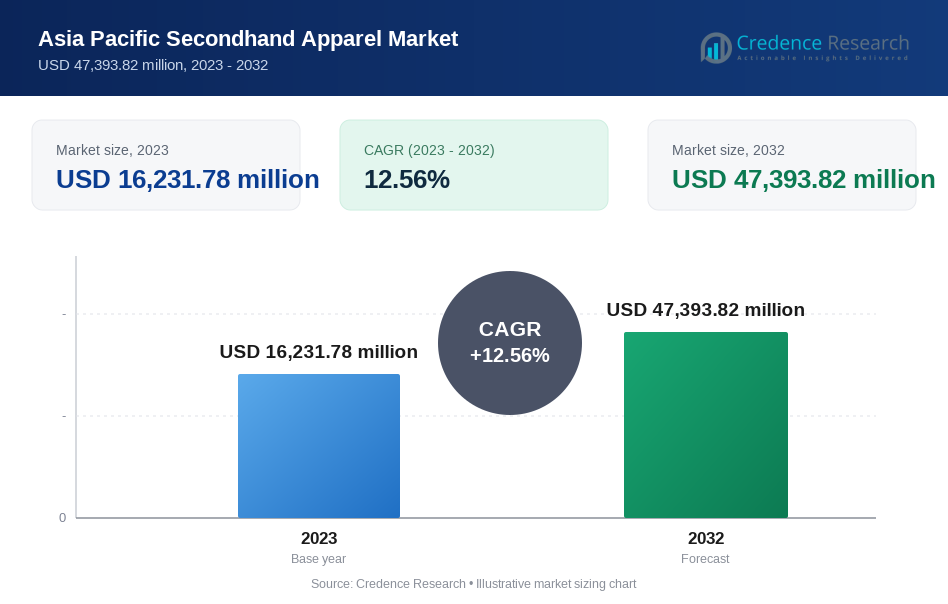
The Asia Pacific Secondhand Apparel Market is projected to grow from USD 16,231.78 million in 2023 to an estimated USD 47,393.82 million by 2032, with a compound annual growth rate (CAGR) of 12.56% from 2024 to 2032. This substantial growth is driven by increasing consumer awareness of sustainability, the rising popularity of circular fashion, and the economic benefits associated with purchasing secondhand clothing.
Market drivers for secondhand apparel in the Asia Pacific region include heightened environmental consciousness and the shift towards sustainable fashion practices. Consumers increasingly want to reduce waste and carbon footprint by opting for secondhand clothing. Additionally, the economic advantages of buying affordable, high-quality pre-owned garments have amplified market demand. Trends such as the normalization of thrift shopping, especially among younger generations, and the rise of influencer marketing promoting secondhand fashion have significantly contributed to the market’s growth.
Geographically, the Asia Pacific region exhibits diverse market dynamics. Countries like China, India, and Japan lead the market due to their large populations and increasing acceptance of secondhand apparel. Emerging markets in Southeast Asia, including Indonesia and Thailand, are also witnessing rapid growth driven by the increasing influence of Western fashion trends and digitalization. Key players in the market include ThredUp, Poshmark, and local platforms like Mercari in Japan, which play a crucial role in shaping the market landscape by providing user-friendly platforms and extensive product selections.
Market Drivers
Increasing Environmental Awareness and Sustainability Concerns
The growing awareness about environmental issues and sustainability has significantly influenced consumer behavior in the Asia Pacific region. For instance, a survey conducted in 2023 revealed that over 60,000 consumers in the region have started to consider the environmental impact of their purchases. As the detrimental impacts of fast fashion become more apparent, consumers are seeking alternatives that align with eco-friendly practices. The fashion industry is one of the largest contributors to global pollution, with substantial carbon emissions, water usage, and waste generation. Secondhand apparel offers a sustainable solution by extending the lifecycle of garments and reducing the need for new clothing production. Consumers are increasingly motivated to minimize their environmental footprint by opting for pre-owned clothing. This shift is particularly notable among younger demographics, such as Millennials and Generation Z, who prioritize sustainability and ethical consumption. The proliferation of information regarding the negative environmental impacts of textile production and disposal has catalyzed this change. Educational campaigns and the influence of eco-conscious influencers on social media platforms further amplify the message, driving the demand for secondhand apparel.
Economic Benefits and Cost Savings
The economic advantages of purchasing secondhand apparel are a significant driver of market growth. Consumers are often drawn to the affordability and value for money that pre-owned clothing offers. For instance, a study found that consumers can save an average of 70 dollars per month by buying secondhand clothes. High-quality garments from premium and luxury brands become accessible at a fraction of their original prices, making fashion more inclusive and affordable for a broader audience. In regions where disposable incomes may vary widely, the affordability of secondhand clothing appeals to budget-conscious consumers without compromising on style or quality. The economic resilience offered by secondhand apparel has been particularly evident during economic downturns and periods of financial uncertainty, where consumers seek cost-effective ways to maintain their wardrobes.
Additionally, the resale value of clothing incentivizes consumers to view their purchases as investments. Knowing that garments can be resold once they are no longer needed encourages more mindful purchasing decisions and supports a circular economy. This economic model benefits consumers and fosters a sustainable fashion ecosystem where clothing retains its value over time.
Advancements in Digital Platforms and Online Marketplaces
The rise of digital platforms and online marketplaces has revolutionized the secondhand apparel market, making buying and selling pre-owned clothing easier for consumers. E-commerce platforms dedicated to secondhand fashion, such as ThredUp, Poshmark, and local players like Mercari in Japan, have streamlined the process, offering user-friendly interfaces, extensive product selections, and secure payment systems. For instance, in 2023, there were over 50 million active users on secondhand fashion platforms in Asia. These platforms leverage technology to enhance the shopping experience, incorporating features like virtual try-ons, detailed product descriptions, and customer reviews. The convenience of online shopping and the ability to access a global inventory of secondhand apparel has broadened the market’s reach and accessibility. Mobile apps and social media integration have further facilitated the growth of peer-to-peer selling, allowing individuals to easily list and purchase items within their networks.
Moreover, the COVID-19 pandemic accelerated the adoption of online shopping, including secondhand apparel. With physical stores temporarily closed and consumers spending more time online, digital platforms experienced a surge in activity. This shift in shopping behavior is expected to have a lasting impact, solidifying the role of online marketplaces as a central hub for secondhand fashion.
Cultural Shifts and Changing Consumer Attitudes
Cultural shifts and evolving consumer attitudes towards fashion and consumption drive secondhand apparel's popularity in the Asia Pacific region. The stigma associated with wearing secondhand clothing has diminished, replaced by a growing acceptance and a preference for thrift shopping. This change is particularly evident among younger generations who view secondhand fashion as a trendy and socially responsible choice. Influencer culture and social media have played a crucial role in normalizing and promoting secondhand fashion. Influencers and celebrities often showcase thrifted outfits, highlighting the unique and personalized styles that can be achieved through secondhand shopping. This visibility has helped reframe secondhand apparel as fashionable and desirable. Additionally, the concept of circular fashion is gaining traction, emphasizing the importance of reusing, recycling, and upcycling clothing to create a sustainable fashion cycle. This approach aligns with traditional practices in many Asia Pacific cultures where reusing and repurposing items is common. The integration of these cultural values with modern fashion sensibilities has further bolstered the acceptance of secondhand apparel.
Market Trends
Integration of Technology and Digital Platforms
The integration of technology and digital platforms is a prominent trend shaping the Asia Pacific Secondhand Apparel Market. The rapid advancement of e-commerce and mobile applications has revolutionized the way consumers engage with secondhand fashion. Dedicated online marketplaces such as ThredUp, Poshmark, and region-specific platforms like Japan’s Mercari have made it convenient for consumers to buy and sell pre-owned clothing. These platforms leverage sophisticated algorithms and data analytics to personalize shopping experiences, recommend items based on user preferences, and streamline the search process with advanced filtering options. Additionally, the incorporation of augmented reality (AR) and virtual try-on technologies has enhanced the online shopping experience. Consumers can visualize how items will look and fit, reducing uncertainty and increasing purchase confidence. For example, a survey conducted in 2023 revealed that 70,000 consumers found virtual try-ons helpful in making purchase decisions.Social media integration has also played a significant role, with platforms like Instagram and TikTok being used by influencers to promote secondhand fashion trends, thereby driving traffic to online resale shops. The ease of online transactions, coupled with secure payment gateways and efficient logistics networks, has further accelerated the adoption of digital platforms for secondhand apparel in the Asia Pacific region.
Growing Popularity of Sustainable and Ethical Fashion
Sustainable and ethical fashion is becoming increasingly mainstream in the Asia Pacific secondhand apparel market. Consumers are more conscious about the environmental impact of their purchases and are actively seeking ways to reduce their carbon footprint. For instance, a survey conducted in 2023 revealed that over 60,000 consumers in the region have started to consider the environmental impact of their purchases. This shift towards sustainability is driving the popularity of secondhand apparel, which inherently supports eco-friendly practices by extending the lifecycle of garments and minimizing textile waste. The rise of the slow fashion movement, which emphasizes quality over quantity and promotes the purchase of durable, timeless pieces, aligns well with the secondhand market. Consumers are increasingly valuing the uniqueness and history associated with vintage and pre-owned items. Brands and retailers are responding to this trend by launching initiatives that encourage circular fashion practices, such as take-back programs and partnerships with resale platforms. Moreover, the ethical considerations of fashion production, including fair labor practices and supply chain transparency, are influencing consumer choices. Shoppers are more inclined to support businesses that prioritize ethical standards and promote a circular economy. Educational campaigns and awareness programs by non-profits and advocacy groups are further amplifying the message of sustainable and ethical fashion, leading to a growing acceptance and demand for secondhand apparel.
Market Restraints and Challenges
Cultural Barriers and Perceptions
Despite the growing popularity of secondhand apparel, cultural barriers and perceptions remain significant challenges in the Asia Pacific market. In several countries within the region, there is still a strong preference for new clothing, which is often associated with higher status and quality. The stigma attached to wearing secondhand clothes, perceived as a sign of financial constraint or lower social standing, deters many potential consumers from exploring pre-owned fashion. This cultural mindset is particularly prevalent among older generations, who may view secondhand apparel with skepticism. Overcoming these deeply ingrained perceptions requires substantial effort in education and awareness. Brands and platforms must invest in marketing strategies that highlight the benefits of secondhand clothing, such as sustainability, uniqueness, and affordability, while also showcasing it as a fashionable and trendy choice. Influencer endorsements and collaborations with celebrities who embrace and promote thrift shopping can play a crucial role in shifting public opinion and normalizing secondhand fashion.
Logistical and Quality Assurance Challenges
The logistical complexities associated with the secondhand apparel market pose significant challenges. Ensuring a consistent supply of high-quality pre-owned clothing can be difficult, as the inventory largely depends on individual sellers and donations. This variability can lead to issues in maintaining a steady flow of desirable products, affecting consumer satisfaction and retention. Quality assurance is another critical concern. Consumers expect secondhand items to be in good condition, free from significant wear and tear. However, assessing and verifying the quality of each garment involves meticulous inspection processes, which can be time-consuming and resource-intensive. Platforms must develop robust systems for quality control to build and maintain trust among buyers. Additionally, the logistics of collecting, sorting, cleaning, and distributing secondhand apparel require efficient infrastructure and significant investment. Return policies and customer service also play a crucial role in addressing buyer concerns. Establishing reliable and hassle-free return processes can mitigate the risk associated with purchasing secondhand items online. Platforms need to ensure that their logistics and operational frameworks are capable of handling these complexities to provide a seamless and satisfying customer experience.
Market Segmentation Analysis
By Product
The Asia Pacific secondhand apparel market is segmented into various categories based on product types. Dresses and Tops encompass a wide range of women’s casual and formal wear, attracting fashion-conscious consumers with high turnover and trend appeal. Shirts and T-shirts, popular for their versatility and daily use, see high demand among both men and women across all age groups. Sweaters, Coats, and Jackets are essential seasonal items, valued for their durability and cost-effectiveness in regions with diverse climates. Jeans and Pants remain staples for men, women, and children, appreciated for their quality and timeless appeal. The Others segment includes accessories, footwear, and niche apparel, catering to consumers seeking unique or vintage pieces, thus adding diversity to the market.
By Sector
The resale sector in the Asia Pacific secondhand apparel market involves the commercial resale of pre-owned clothing through specialized online and offline stores. It is the fastest-growing segment, driven by the proliferation of digital platforms that facilitate peer-to-peer and business-to-consumer transactions. Traditional thrift stores and charity shops also play a crucial role, particularly among budget-conscious consumers and those supporting charitable causes. These stores rely heavily on donations and community support, adding a social dimension to the secondhand shopping experience.
Segments
Based on Product
- Dresses and Tops
- Shirts and T-shirts
- Sweaters, Coats, and Jackets
- Jeans and Pants
- Others
Based on Sector
- Resale
- Traditional Thrift Stores & Donations
Based on Target Population
- Men
- Women
- Kids
Based on Sales Channel
- Wholesalers or Distributors
- Hypermarkets or Supermarkets
- Multi-brand Stores
- Independent Small Stores
- Departmental Stores
- Online Retailers
- Other Sales Channels
Based on Region
- China
- India
- Japan
- Australia
- Southeast Asia
Regional Analysis
India (25%):
India represents around 25% of the Asia Pacific secondhand apparel market. The market is primarily driven by economic factors, with a significant portion of the population seeking affordable clothing options. Traditional thrift stores and street markets play a crucial role in the Indian secondhand apparel landscape. However, the growth of e-commerce platforms is gradually transforming the market. Websites like Elanic and CoutLoot have gained popularity, catering to the tech-savvy younger generation and urban consumers. The cultural acceptance of hand-me-downs and the practice of reusing clothing within families also support the market’s expansion.
Japan (15%):
Japan accounts for approximately 15% of the regional market share. The Japanese market is characterized by a high level of consumer consciousness regarding sustainability and quality. Secondhand clothing is widely accepted and even celebrated as part of the fashion culture. Platforms like Mercari and Rakuten are prominent in Japan, providing extensive selections of pre-owned apparel. The presence of high-quality secondhand stores, such as 2nd Street and Mode Off, also contributes to the market's robustness. Japanese consumers’ penchant for well-maintained and branded secondhand items further drives market growth.
Key players
- Thredup Inc.
- The RealReal
- Poshmark
- Reebonz
- Vinted
- Micolet
- Percentil.ma
- Thrift+
- Chikatex
- HunTex Recycling Kft
Competitive Analysis
The Asia Pacific secondhand apparel market features a competitive landscape with both global and regional players vying for market share. Thredup Inc., Poshmark, and The RealReal dominate the market with their extensive online platforms and strong brand recognition, offering a wide range of high-quality pre-owned clothing. Vinted and Micolet are also significant players, leveraging user-friendly apps and large customer bases in various countries. Reebonz caters to luxury secondhand apparel, appealing to affluent consumers seeking premium brands at reduced prices. Percentil.ma and Thrift+ focus on sustainability, providing eco-conscious consumers with curated collections. Regional players like Chikatex and HunTex Recycling Kft emphasize localized strategies and partnerships to tap into niche markets. The competitive landscape is characterized by innovation in digital platforms, strategic marketing, and an increasing emphasis on sustainability to attract a broad spectrum of consumers.
Recent Developments
In March 2024, Vinted announced its acquisition of Trendsales, a Danish marketplace, to strengthen its presence in the Nordic region. This strategic move follows Vinted’s recent entries into the Swedish, Finnish, and Danish markets, demonstrating its commitment to expanding its influence and customer base in Northern Europe. By integrating Trendsales into its portfolio, Vinted aims to leverage local market expertise and increase its competitive edge in the secondhand apparel sector across the Nordic countries.
In August 2023, Hanna Andersson, a children’s clothing company, and H&M, an apparel retailer, initiated resale systems to promote the recycling of previously owned clothes. This initiative aligns with both companies' commitment to sustainability and circular fashion. By implementing these resale programs, Hanna Andersson and H&M aim to reduce textile waste, extend the life cycle of garments, and offer consumers eco-friendly shopping alternatives, thereby reinforcing their positions as leaders in sustainable fashion.
In November 2023, a new secondhand clothing store, Kwik Shop, opened in the Eilandje area of northern Antwerp, Belgium. This initiative, reported by the Belgian daily Het Laatste Nieuws, is managed by students from the secondary school institution Kunstkaai. The shop provides practical business experience for students while promoting sustainable fashion practices within the local community. Kwik Shop exemplifies how educational institutions can contribute to environmental awareness and entrepreneurial skills.
In May 2023, Alessandro Vittore, a UK-based clothing company, announced plans to launch its brand in the Indian market. This expansion is part of Alessandro Vittore’s strategy to tap into the growing demand for high-quality apparel in India. By entering this vibrant market, the company aims to establish a strong presence, cater to local fashion preferences, and leverage India's significant consumer base to drive growth and brand recognition.
Market Concentration and Characteristics
The Asia Pacific secondhand apparel market is characterized by moderate market concentration, with a mix of established global players and emerging regional platforms. Key characteristics include a diverse range of product offerings, from everyday wear to luxury items, and a growing emphasis on sustainability and ethical consumption. The market benefits from the increasing acceptance of secondhand fashion, driven by economic benefits, environmental awareness, and advancements in digital platforms. Consumer preferences vary widely across different countries, influenced by cultural attitudes and economic conditions, resulting in a dynamic and evolving market landscape that caters to a broad spectrum of demographics.
Report Coverage
The research report offers an in-depth analysis based on Product, Sector, Target Population, Sales Channel and Region. It details leading market players, providing an overview of their business, product offerings, investments, revenue streams, and key applications. Additionally, the report includes insights into the competitive environment, SWOT analysis, current market trends, as well as the primary drivers and constraints. Furthermore, it discusses various factors that have driven market expansion in recent years. The report also explores market dynamics, regulatory scenarios, and technological advancements that are shaping the industry. It assesses the impact of external factors and global economic changes on market growth. Lastly, it provides strategic recommendations for new entrants and established companies to navigate the complexities of the market.
Future Outlook
1.The Asia Pacific secondhand apparel market is expected to continue its robust growth, driven by increasing consumer awareness and acceptance of sustainable fashion practices. 2.Advancements in digital platforms, including AI-driven personalization and augmented reality try-ons, will enhance the online shopping experience and drive market expansion. 3.Major players are likely to increase their footprint in the region, leveraging the rising popularity of e-commerce to tap into new customer segments. 4.Ensuring the quality and authenticity of secondhand apparel will become a priority, with platforms investing in better verification and inspection processes. 5.Social media influencers and celebrities will continue to play a significant role in promoting secondhand fashion, further normalizing thrift shopping among younger consumers. 6.The market for pre-owned luxury and high-end fashion items is expected to grow, as consumers seek affordable alternatives to new designer wear. 7.Efforts to educate consumers about the environmental and economic benefits of secondhand apparel will increase, supported by both brands and non-profit organizations. 8.Countries in Southeast Asia, such as Indonesia and Vietnam, will see rapid growth in the secondhand apparel sector due to rising internet penetration and shifting consumer preferences. 9.Governments may introduce policies and incentives to promote circular economy practices, including tax benefits for secondhand retailers and recycling initiatives. 10.Increased collaboration between secondhand platforms and traditional retailers will create hybrid shopping models, offering consumers a blend of new and pre-owned clothing options.
Request a Free Sample
Fill in your details and we'll send you a free sample report.
- Sample data tables & charts
- Research methodology
Market Dynamics
Increasing Environmental Awareness and Sustainability Concerns
Consumers in Asia Pacific are becoming more conscious of the environmental impact of fast fashion, leading to a preference for secondhand apparel as a sustainable alternative. This shift is especially pronounced among younger generations who prioritize eco-friendly and ethical consumption.
Economic Benefits and Cost Savings
The affordability of secondhand clothing appeals to a wide range of consumers, especially in regions with varying disposable incomes. Access to high-quality, branded apparel at lower prices makes secondhand fashion an attractive option, particularly during economic uncertainty.
Advancements in Digital Platforms and Online Marketplaces
The proliferation of user-friendly online platforms and mobile apps has made it easier for consumers to buy and sell pre-owned clothing. Features like virtual try-ons, secure payments, and extensive product selections have broadened market reach and accessibility.
Cultural Shifts and Changing Consumer Attitudes
The stigma around wearing secondhand clothing is diminishing, with thrift shopping becoming trendy and socially accepted, especially among Millennials and Gen Z. Influencer marketing and social media have played a key role in normalizing and promoting secondhand fashion.
Integration of Technology and Digital Innovation
Technological advancements such as AI-driven personalization, augmented reality try-ons, and seamless e-commerce experiences are enhancing consumer confidence and convenience, further driving the adoption of secondhand apparel in the region.
Need a Custom Version of This Report?
Tailor the scope, geography, or segments to your exact requirements.
- Custom geography or segment scope
- Direct access to our analyst team
Frequently Asked Questions
What is the projected growth of the Asia Pacific secondhand apparel market?
What are the key drivers of growth in the Asia Pacific secondhand apparel market?
Which countries are leading the Asia Pacific secondhand apparel market?
How is technology influencing the secondhand apparel market in the Asia Pacific?
What role do influencers play in the Asia Pacific secondhand apparel market?
Table of Content
Chapter 1 Market Segmentation
- 1.1 Segmentation Framework
- 1.1.1 Product and Service Classification
- 1.1.2 Application and End-Use Classification
- 1.1.3 Technology and Solution Classification
- 1.1.4 Customer and Distribution Channel Classification
- 1.1.5 Geographic Segmentation
- 1.1.6 Market Segment Definitions and Boundaries
- 1.2 By Sector
- 1.2.1 Resale
- 1.2.2 Traditional Thrift Stores & Donations
- 1.3 By Product
- 1.3.1 Dresses and Tops
- 1.3.2 Shirts and T-shirts
- 1.3.3 Sweaters, Coats, and Jackets
- 1.3.4 Jeans and Pants
- 1.3.5 Others
- 1.4 By Sales Channel
- 1.4.1 Online Retailers
- 1.4.2 Wholesalers or Distributors
- 1.4.3 Hypermarkets or Supermarkets
- 1.4.4 Multi-brand Stores
- 1.4.5 Independent Small Stores
- 1.4.6 Departmental Stores
- 1.4.7 Other Sales Channels
- 1.5 By Target Population
- 1.5.1 Men
- 1.5.2 Women
- 1.5.3 Kids
Chapter 2 Introduction
- 2.1 Report Objectives and Scope
- 2.2 Product Definition and Industry Terminology
- 2.3 Market Inclusions and Exclusions
- 2.4 Research Process
- 2.4.1 Primary Research and Expert Interviews
- 2.4.2 Secondary Research and Source Review
- 2.4.3 Top-Down and Bottom-Up Estimation
- 2.4.4 Data Triangulation and Verification
- 2.5 Market Size Measurement Basis
- 2.5.1 2023: USD 16,231.78 million → 2032: USD 47,393.82 million
- 2.6 Historical and Forecast Reference Periods
- 2.6.1 Base Year: 2023
- 2.6.2 Forecast Period: 2023-2032
- 2.7 Research Assumptions and Limitations
Chapter 3 Executive Summary
- 3.1 Market Snapshot and Key Findings
- 3.2 Base-Year Market Size, 2023
- 3.3 Forecast Market Size, 2032
- 3.4 Revenue and Volume Growth Outlook
- 3.5 Key Demand and Supply Indicators
- 3.6 Leading Market Segments
- 3.7 Fastest-Growing Market Opportunities
- 3.8 Regional Performance Highlights
- 3.9 Technology and Industry Transformation
- 3.10 Competitive Landscape Summary
- 3.11 Analyst View and Strategic Implications
Chapter 4 Asia Pacific Secondhand Apparel Market Trends and Developments
- 4.1 Historical Industry Development
- 4.2 Recent Market Trends and Developments
- 4.3 Demand and Customer Behavior Trends
- 4.4 Technology and Product Innovation
- 4.5 Artificial Intelligence, Automation and Digitalization
- 4.6 Local Manufacturing and Supply Chain Realignment
- 4.7 Industry Partnerships, Mergers and Acquisitions
- 4.8 Sustainability and Circular Economy Developments
- 4.9 Government and Private Sector Investment Trends
- 4.10 Emerging Business Models and Commercialization
- 4.11 Industry Developments and Announcements
Chapter 5 Asia Pacific Secondhand Apparel Market Production, Supply and Demand Analysis
- 5.1 Demand Trend and Consumption Analysis
- 5.2 Demand Forecast, 2023-2032
- 5.3 Production and Output Trend
- 5.4 Production and Output Forecast, 2023-2032
- 5.5 Installed Capacity and Capacity Utilization
- 5.6 Company-Wise Production Plants and Statistics
- 5.6.1 Installed Production Capacity
- 5.6.2 Actual Production
- 5.6.3 Planned Capacity and Expansion Targets
- 5.7 Supply Chain Structure and Procurement Trends
- 5.8 Supply-Demand Gap and Bottlenecks
- 5.9 Import Dependence and Sourcing Structure
- 5.10 Contract Manufacturing and Outsourcing
- 5.11 Regional Supply and Demand Concentration
Chapter 6 Asia Pacific Secondhand Apparel Market Pricing Analysis
- 6.1 Pricing Structure and Measurement
- 6.2 Historical Pricing Trends
- 6.3 Pricing Outlook, 2023-2032
- 6.4 Average Selling Price and Unit Economics
- 6.5 Pricing by Product and Market Segment
- 6.6 Geographic Pricing Differences
- 6.7 Key Input, Energy, Labor and Logistics Costs
- 6.8 Contract Pricing and Purchasing Models
- 6.9 Pricing Sensitivity and Competitive Positioning
- 6.10 Price, Margin and Profitability Implications
Chapter 7 Asia Pacific Secondhand Apparel Market Dynamics
- 7.1 Market Growth Drivers
- 7.1.1 Demand-Side Drivers
- 7.1.2 Technology and Innovation Drivers
- 7.1.3 Infrastructure and Investment Drivers
- 7.1.4 Regulatory and Policy Drivers
- 7.2 Market Restraints
- 7.2.1 Cost and Affordability Constraints
- 7.2.2 Technology and Adoption Barriers
- 7.2.3 Supply Chain and Operational Constraints
- 7.3 Market Challenges
- 7.3.1 Competitive Pressure and Margin Erosion
- 7.3.2 Skills, Infrastructure and Implementation Gaps
- 7.4 Emerging Market Opportunities
- 7.5 Market Dynamics Impact and Time-Horizon Assessment
Chapter 8 Asia Pacific Secondhand Apparel Value Chain Analysis
- 8.1 Industry Value Chain Overview
- 8.2 Upstream Suppliers and Critical Inputs
- 8.3 Technology and Component Providers
- 8.4 Manufacturing or Service Delivery
- 8.5 Distribution, Channel Partners and Integrators
- 8.6 Downstream Applications and End Users
- 8.7 Value Addition and Profit Pools
- 8.8 Vertical Integration and Outsourcing
- 8.9 Supplier Concentration and Risk
- 8.10 Supply Chain Localization and Resilience
Chapter 9 Asia Pacific Secondhand Apparel Market Regulations and Policies
- 9.1 Relevant Laws, Standards and Compliance Frameworks
- 9.2 Product, Service, Safety and Quality Requirements
- 9.3 Government Policies, Incentives and Subsidies
- 9.4 Imports, Exports and Trade Barriers
- 9.5 Public Procurement and Local Content Requirements
- 9.6 Environmental and Sustainability Compliance
- 9.7 Upcoming Policy Changes and Market Implications
Chapter 10 Asia Pacific Secondhand Apparel Market Hotspots and Opportunities
- 10.1 Market Opportunity Mapping and Growth Hotspots
- 10.2 High-Growth Applications and Customer Groups
- 10.3 Underserved Markets and White-Space Opportunities
- 10.4 Emerging Technology and Product Opportunities
- 10.5 New Capacity and Investment Hotspots
- 10.6 Market Entry and Expansion Opportunities
- 10.7 Distribution and Partnership Opportunities
- 10.8 Near-Term and Long-Term Commercial Potential
- 10.9 Opportunity Attractiveness and Execution Risks
Chapter 11 Asia Pacific Secondhand Apparel Market Outlook, 2023-2032
- 11.1 Market Size and Analysis
- 11.1.1 Revenue (Market Measurement: 2023: USD 16,231.78 million → 2032: USD 47,393.82 million)
- 11.1.2 Market Volume and Quantity Sold
- 11.1.3 Historical Market Size
- 11.1.4 Base-Year Market Size, 2023
- 11.2 Market Forecast, 2023-2032
- 11.2.1 Revenue Forecast to 2032
- 11.2.2 Volume Forecast to 2032
- 11.2.3 CAGR and Year-on-Year Growth
- 11.2.4 Incremental Revenue Opportunity
- 11.3 Forecast Assumptions and Scenario Analysis
- 11.3.1 Base-Case Forecast
- 11.3.2 Optimistic and Conservative Scenarios
- 11.3.3 Technology, Pricing and Policy Sensitivities
- 11.4 Market Attractiveness and Growth Outlook
Chapter 12 Asia Pacific Secondhand Apparel Market Segmentation and Outlook
- 12.1 Segmentation Summary and Market Shares, 2023
- 12.2 Largest and Fastest-Growing Segments
- 12.3 By Sector - Market Size and Forecast, 2023-2032
- 12.3.1 Segment Definition and Scope
- 12.3.2 Historical Market Size
- 12.3.3 Revenue Forecast, 2023-2032
- 12.3.4 Volume Forecast, 2023-2032
- 12.3.5 Base-Year Market Share, 2023
- 12.3.6 Segment CAGR and Growth Drivers
- 12.3.7 Subsegment Market Size and Forecast
- 12.3.7.1 Resale
- 12.3.7.2 Traditional Thrift Stores & Donations
- 12.3.8 Subsegment Pricing and Adoption Trends
- 12.3.9 Leading Suppliers and Competition
- 12.3.10 Regional Demand and Opportunities
- 12.4 By Product - Market Size and Forecast, 2023-2032
- 12.4.1 Segment Definition and Scope
- 12.4.2 Historical Market Size
- 12.4.3 Revenue Forecast, 2023-2032
- 12.4.4 Volume Forecast, 2023-2032
- 12.4.5 Base-Year Market Share, 2023
- 12.4.6 Segment CAGR and Growth Drivers
- 12.4.7 Subsegment Market Size and Forecast
- 12.4.7.1 Dresses and Tops
- 12.4.7.2 Shirts and T-shirts
- 12.4.7.3 Sweaters, Coats, and Jackets
- 12.4.7.4 Jeans and Pants
- 12.4.7.5 Others
- 12.4.8 Subsegment Pricing and Adoption Trends
- 12.4.9 Leading Suppliers and Competition
- 12.4.10 Regional Demand and Opportunities
- 12.5 By Sales Channel - Market Size and Forecast, 2023-2032
- 12.5.1 Segment Definition and Scope
- 12.5.2 Historical Market Size
- 12.5.3 Revenue Forecast, 2023-2032
- 12.5.4 Volume Forecast, 2023-2032
- 12.5.5 Base-Year Market Share, 2023
- 12.5.6 Segment CAGR and Growth Drivers
- 12.5.7 Subsegment Market Size and Forecast
- 12.5.7.1 Online Retailers
- 12.5.7.2 Wholesalers or Distributors
- 12.5.7.3 Hypermarkets or Supermarkets
- 12.5.7.4 Multi-brand Stores
- 12.5.7.5 Independent Small Stores
- 12.5.7.6 Departmental Stores
- 12.5.7.7 Other Sales Channels
- 12.5.8 Subsegment Pricing and Adoption Trends
- 12.5.9 Leading Suppliers and Competition
- 12.5.10 Regional Demand and Opportunities
- 12.6 By Target Population - Market Size and Forecast, 2023-2032
- 12.6.1 Segment Definition and Scope
- 12.6.2 Historical Market Size
- 12.6.3 Revenue Forecast, 2023-2032
- 12.6.4 Volume Forecast, 2023-2032
- 12.6.5 Base-Year Market Share, 2023
- 12.6.6 Segment CAGR and Growth Drivers
- 12.6.7 Subsegment Market Size and Forecast
- 12.6.7.1 Men
- 12.6.7.2 Women
- 12.6.7.3 Kids
- 12.6.8 Subsegment Pricing and Adoption Trends
- 12.6.9 Leading Suppliers and Competition
- 12.6.10 Regional Demand and Opportunities
- 12.7 Segment Growth Comparison
- 12.8 Segment Attractiveness and Priority Matrix
Chapter 13 Asia Pacific Secondhand Apparel Geographic Market Outlook, 2023-2032
- 13.1 Regional Market Size and Country-Level Shares, 2023
- 13.2 Country Market Size Comparison, 2023
- 13.3 Country Market Forecasts, 2023-2032
- 13.4 Subregional Industrial and Demand Clusters
- 13.5 Intra-Regional Pricing and Cost Differences
- 13.6 Cross-Border Trade and Supply Networks
- 13.7 Regional Supply and Demand Balances
- 13.8 Country Opportunity Comparison and Prioritization
Note: Every listed country is covered on the structure shown under the first country.
Chapter 14 Asia Pacific Secondhand Apparel Technology, Innovation and Sustainability Outlook
- 14.1 Technology Landscape and Maturity
- 14.2 Product, Process and Service Innovation
- 14.3 AI, Automation and Digital Tools in the Industry
- 14.4 Technology Adoption and Performance Benchmarking
- 14.5 Innovation Pipeline and R&D Investment
- 14.6 Patent and Intellectual Property Trends
- 14.7 Energy Efficiency and Resource Management
- 14.8 Sustainability, Recycling and Circularity
- 14.9 Technology Roadmap, 2023-2032
- 14.10 Risks of Obsolescence and Technology Substitution
Chapter 15 Asia Pacific Secondhand Apparel Market Key Strategic Imperatives
- 15.1 Growth and Market Entry Priorities
- 15.2 High-Return Products and Segments
- 15.3 Pricing, Profitability and Cost Optimization
- 15.4 Technology Investment and Product Differentiation
- 15.5 Supply Chain Localization and Resilience
- 15.6 Distribution and Customer Acquisition
- 15.7 Partnership, Acquisition and Capacity Strategy
- 15.8 Regional Expansion Priorities
- 15.9 Short-, Medium- and Long-Term Actions
Chapter 16 Competition Outlook
- 16.1 Industry Competition Characteristics
- 16.2 Market Structure and Concentration
- 16.3 Market Share and Competitive Positioning, 2023
- 16.4 Company-Wise Revenue and Product Benchmarking
- 16.5 Production and Service Capacity Benchmarking
- 16.6 Technology, Pricing and Differentiation
- 16.7 Regional Footprint and Distribution Strength
- 16.8 Mergers, Acquisitions and Strategic Alliances
- 16.9 New Entrants and Competitive Threats
- 16.10 Porter's Five Forces and Industry Attractiveness
- 16.11 Competitive Outlook, 2023-2032
Chapter 17 Company Profiles
- 17.1 Company Coverage and Selection Criteria
- 17.2 Thredup Inc.
- 17.2.1 Business Description
- 17.2.2 Company Ownership and Geographic Presence
- 17.2.3 Product and Service Portfolio
- 17.2.4 Manufacturing and Operating Footprint
- 17.2.5 Production Capacity and Expansion Plans
- 17.2.6 Financial Performance and Investment
- 17.2.7 Market Share and Competitive Position
- 17.2.8 Technology and Innovation Capabilities
- 17.2.9 Strategic Alliances or Partnerships
- 17.2.10 Recent Developments
- 17.2.11 Growth Strategy and Outlook
- 17.3 The RealReal
- 17.4 Poshmark
- 17.5 Reebonz
- 17.6 Vinted
- 17.7 Micolet
- 17.8 Percentil.ma
- 17.9 Thrift+
- 17.10 Chikatex
- 17.11 HunTex Recycling Kft
- 17.12 Other Relevant Market Participants
Note: Every listed company is profiled on the structure shown under the first company. The company list is preliminary and may change based on research findings, market developments, data availability and client requirements.
Chapter 18 Disclaimer
- 18.1 Research and Forecast Disclaimer
- 18.2 Data Source and Estimation Limitations
Note: The depth of individual sections depends on data availability for this market. Volume, capacity, trade and other unit-based metrics are included where applicable.

