
Market Overview:
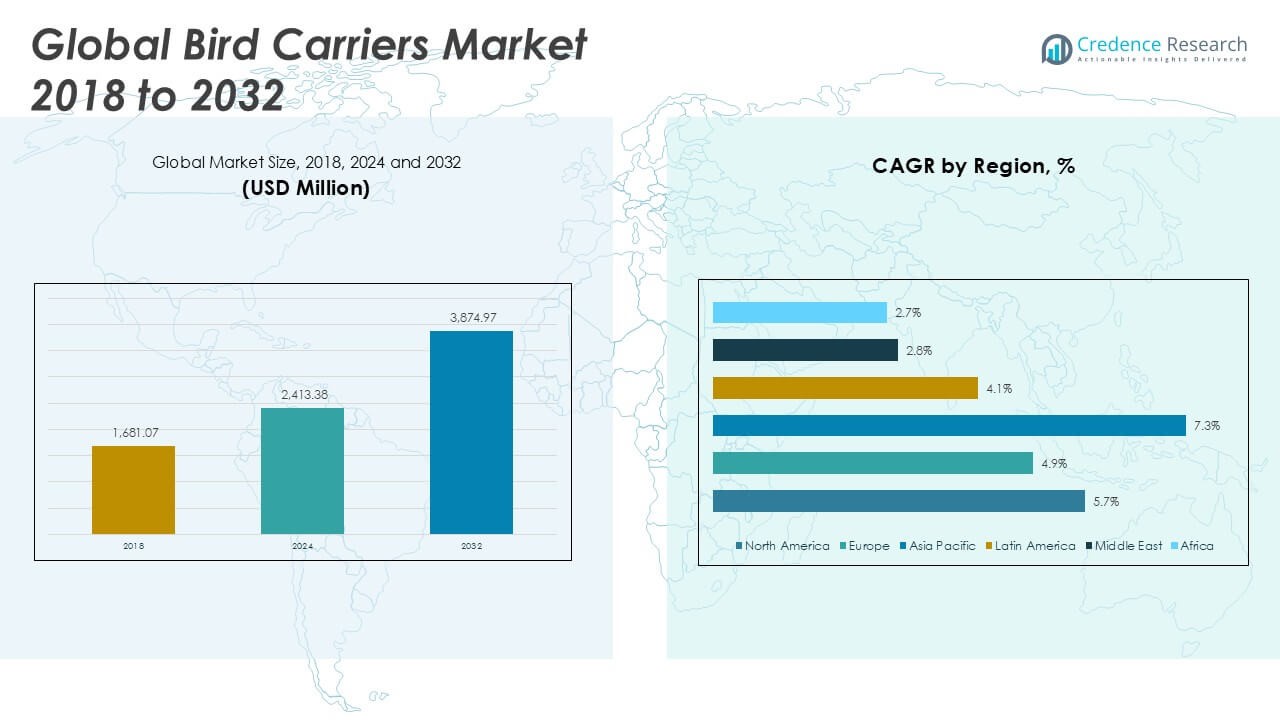
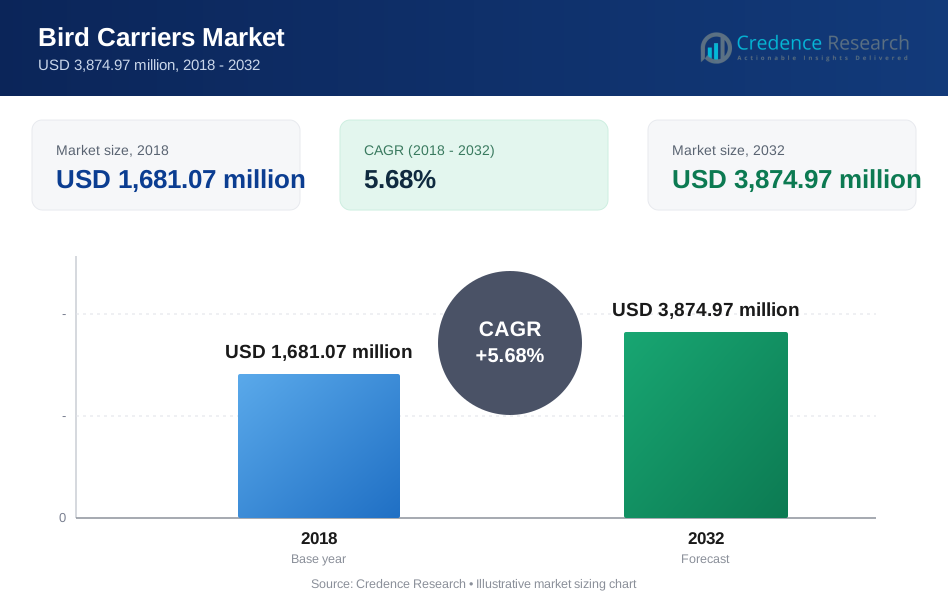
The Global Bird Carriers Market size was valued at USD 1,681.07 million in 2018 to USD 2,413.38 million in 2024 and is anticipated to reach USD 3,874.97 million by 2032, at a CAGR of 5.68% during the forecast period
| REPORT ATTRIBUTE | DETAILS |
|---|---|
| Historical Period | 2020-2024 |
| Base Year | 2024 |
| Forecast Period | 2025-2032 |
| Bird Carriers Market Size 2024 | USD 2,413.38 Million |
| Bird Carriers Market, CAGR | 5.68% |
| Bird Carriers Market Size 2032 | USD 3,874.97 Million |
Key drivers of the market include a surge in the number of pet birds, heightened awareness about animal welfare, and growing trends in travel and tourism involving pets. Innovations in bird carrier designs, such as lightweight, collapsible, and airline-approved options, are also contributing to market expansion. Additionally, the increasing availability of bird carriers in online retail platforms is making these products more accessible to consumers worldwide. The convenience and growing preference for personalized and customizable bird carriers further enhance market demand.
Regionally, North America holds the largest market share, driven by high pet ownership rates and a strong culture of pet care. The growing number of pet-friendly policies in hotels and airlines has further bolstered the market in this region. The Asia-Pacific region, however, is expected to exhibit the highest growth rate during the forecast period, supported by rising disposable incomes, expanding pet ownership, and a growing trend of pet travel in countries like China and India. The increasing penetration of e-commerce platforms in the region is also contributing to the market's rapid growth.
Market Insights:
- The global bird carriers market was valued at USD 1,681.07 million in 2018, is projected to reach USD 2,413.38 million in 2024, and is anticipated to grow to USD 3,874.97 million by 2032, at a CAGR of 5.68% during the forecast period.
- The rise in global pet ownership, particularly among bird owners, is driving demand for specialized bird carriers, ensuring comfort and safety during travel.
- Increased awareness of animal welfare has led to higher demand for high-quality, safe bird carriers, focusing on secure and comfortable transport.
- Innovations in carrier designs, such as lightweight, collapsible, and airline-approved options, are enhancing the convenience and functionality of bird carriers.
- E-commerce platforms have significantly expanded the market by making bird carriers more accessible, offering competitive pricing and a wide range of options.
- The high cost of premium bird carriers remains a challenge, as consumers may find advanced models with additional features less affordable.
- Varying regional regulations for bird carriers complicate manufacturing and market expansion, requiring compliance with different standards for size, ventilation, and safety.
Market Drivers:
Increasing Pet Ownership and Growing Popularity of Birds as Pets
The growing trend of pet ownership worldwide is a significant driver for the global bird carriers market. Pet birds, including parrots, canaries, and finches, are becoming increasingly popular among pet owners. This rise in the number of pet birds correlates with the demand for carriers specifically designed for these animals. Bird owners seek reliable, safe, and comfortable ways to transport their pets, which drives the need for specialized bird carriers. Pet birds' unique needs, such as proper ventilation and safety, further fuel the demand for well-designed carriers tailored to their comfort and security.
Rising Awareness of Animal Welfare and Safety
The growing emphasis on animal welfare has pushed bird owners to prioritize their pets' safety, especially when traveling. Bird carriers provide an essential function in ensuring the secure transportation of pet birds, minimizing stress, and preventing harm during journeys. As more consumers recognize the importance of safe travel options for their pets, the demand for high-quality, durable bird carriers increases. The market is benefiting from an elevated sense of responsibility among pet owners regarding their pets' wellbeing, resulting in a preference for high-end carriers that comply with industry standards for safety.
- For instance, the Prevue Pet Products Travel Carrier 1307 includes welded seat belt collars specifically designed for automotive safety and comes equipped with a 1-foot-long, shapeable rope perch included with every unit for bird comfort during transport.
Innovations in Bird Carrier Design and Functionality
Innovations in bird carrier designs contribute to the expanding market for bird carriers globally. Manufacturers are introducing lightweight, collapsible, and airline-approved carriers, making it easier for pet owners to transport their birds. These advancements make the carriers more convenient for travel while meeting industry standards. The integration of features such as easy-to-clean surfaces, adjustable straps, and breathable materials ensures both comfort and functionality. As pet owners seek products that offer both convenience and security, these innovations further enhance market growth.
- For instance, the Ibiyaya TrackPack Bird Carrier Backpack features 1 integrated wooden perch and 2 secure lockable zippers, alongside 1 breathable steel mesh window for ventilation in every unit.
Expanding E-commerce Channels and Online Shopping Convenience
The rise of e-commerce platforms has made bird carriers more accessible to consumers worldwide. Online retail channels allow bird owners to browse a wide range of carriers with various features and price points, often with the convenience of home delivery. The ease of access to diverse products through digital platforms, combined with competitive pricing, enhances the availability of bird carriers globally. With a growing number of consumers turning to online stores for pet supplies, e-commerce plays a pivotal role in driving the growth of the global bird carriers market.
Market Trends:
Rise in Pet Humanization and Travel with Pets
The global bird carriers market is experiencing significant growth, fueled by the increasing humanization of pets and a rising trend of traveling with them. Pet owners are increasingly viewing their birds as family members, leading to a surge in demand for products that ensure their comfort and safety during travel. This shift in perspective has resulted in a growing willingness to invest in high-quality, specialized carriers designed to meet the unique needs of pet birds. The trend is particularly evident among younger generations, who prioritize the inclusion of their pets in various aspects of their lives, including travel. This cultural shift is driving innovation in carrier designs, with manufacturers focusing on features that enhance the travel experience for both pets and their owners.
- For instance, Delta Air Lines introduced the CarePod, a pet carrier featuring industrial-strength insulated walls, a built-in hydration system holding up to 1 liter of water, and real-time GPS tracking supported by a 24/7 monitoring center.
Expansion of Pet-Friendly Travel Options
The expansion of pet-friendly travel options is another key trend influencing the bird carriers market. Airlines and travel services are increasingly accommodating pets, offering services that cater to the needs of traveling birds. For instance, some airlines have introduced in-cabin pet policies, allowing small birds to travel with their owners under specific conditions. This development has created a demand for carriers that comply with airline regulations and provide a secure and comfortable environment for birds during flights. The availability of such services is encouraging more pet owners to travel with their birds, thereby driving the need for specialized carriers. This trend underscores the growing integration of pets into the travel industry and the corresponding need for products that facilitate safe and comfortable journeys for pet birds.
- For instance, Delta Air Lines allows exactly one household bird per passenger to travel in the cabin on most domestic U.S. flights, provided the bird is at least 8 weeks old and can fit comfortably in an airline-approved carrier placed under the seat in front of the traveler.
Market Challenges Analysis:
High Cost of Premium Bird Carriers
The global bird carriers market faces a challenge with the high cost of premium, specialized carriers. While many pet owners are willing to invest in high-quality carriers, the expense of advanced models with features like airline approval, durable construction, and comfort options can deter a segment of potential buyers. These premium carriers often come at a price point that makes them less accessible to price-sensitive consumers, limiting the market potential in certain regions. The cost of manufacturing such carriers, particularly those with safety certifications, contributes to the overall price. As consumer preferences lean toward affordable options, manufacturers must find ways to balance quality with cost-effectiveness to cater to a broader audience.
Regulatory Compliance and Standardization Issues
The global bird carriers market also faces challenges related to regulatory compliance and standardization. Different regions and countries have varying regulations for transporting pets, including specific carrier requirements for size, ventilation, and safety. Navigating these differences can be complex for manufacturers aiming to sell internationally. Compliance with these regulations often requires additional research and design modifications, increasing both production time and costs. While some global standards exist, the lack of universally accepted guidelines for bird carriers may create barriers for manufacturers looking to streamline their operations and expand into multiple markets efficiently.
Market Opportunities:
Growing Pet Ownership in Emerging Markets
The global bird carriers market presents significant opportunities in emerging markets, where pet ownership is on the rise. Countries in regions such as Asia-Pacific, Latin America, and the Middle East are seeing an increasing number of pet owners, particularly among urban populations. As disposable incomes rise and lifestyles become more pet-centric, these markets are becoming more receptive to pet-related products, including bird carriers. This growth offers manufacturers a chance to tap into a large, untapped consumer base. Introducing affordable, high-quality carriers tailored to the specific needs of emerging markets could fuel growth in these regions.
Innovations in Eco-Friendly Materials and Sustainability
There is a growing market opportunity in the development of eco-friendly and sustainable bird carriers. As environmental consciousness among consumers continues to rise, there is an increasing demand for products that use recyclable or biodegradable materials. Manufacturers can capitalize on this trend by offering bird carriers made from sustainable materials that appeal to environmentally conscious pet owners. This shift toward sustainability not only aligns with global trends but also provides a competitive edge in an increasingly eco-aware market. Emphasizing eco-friendly designs and production processes will cater to consumers' preferences and drive further market growth.
Market Segmentation Analysis:
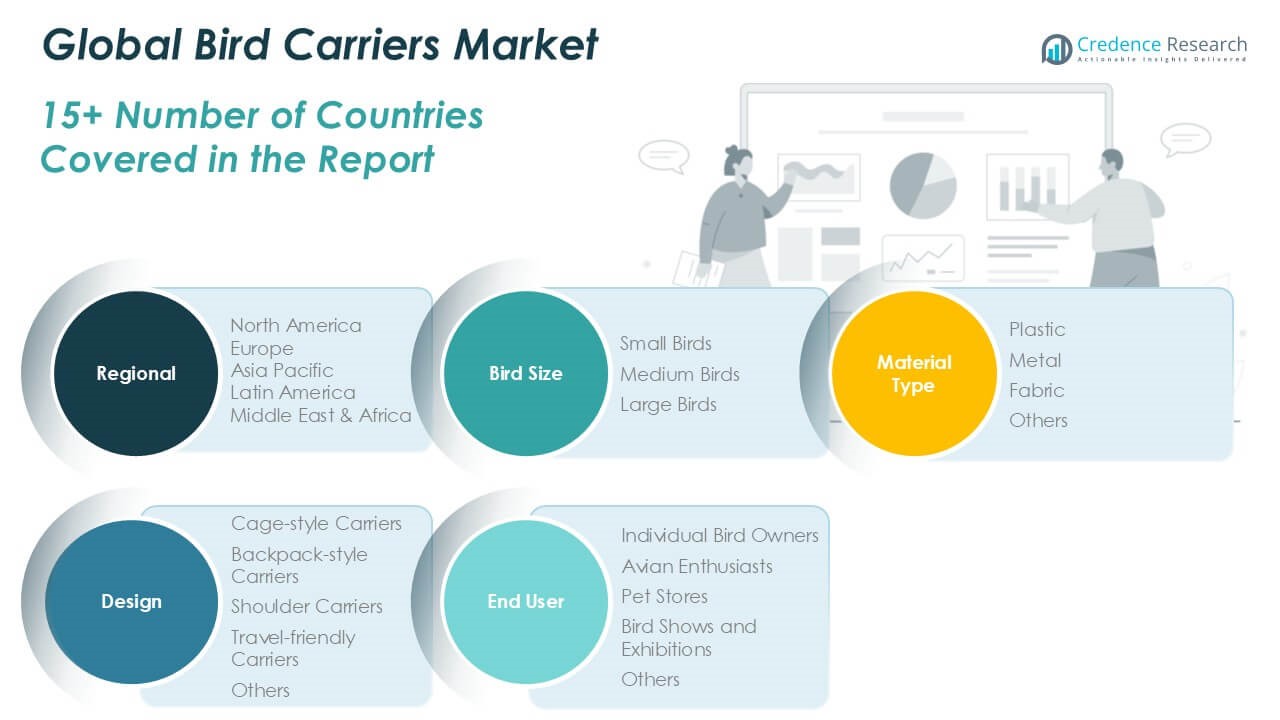
By Bird Size:
The market is divided into small, medium, and large bird carriers. Each size caters to the specific needs of bird owners, offering products that fit various bird species. Small bird carriers are designed for compact pet birds, medium carriers serve average-sized birds, and large carriers accommodate larger bird species. This segmentation ensures that products align with the size and comfort requirements of different bird types.
- For instance, Cornell University researchers developed a solar-powered radio tag—less than 1g in weight—specifically to track small songbirds like tree swallows, successfully tagging 70 birds in a single study, demonstrating the carrier’s suitability for small birds and advanced monitoring capabilities.
By Material Type:
The bird carriers in the market are made from plastic, metal, fabric, and other materials. Plastic carriers are lightweight and durable, ideal for everyday use. Metal carriers, known for their strength, are commonly used for larger birds. Fabric carriers offer flexibility and comfort, making them a preferred choice for short travels. Other materials like wood and hybrid composites also play a role in diversifying the market.
- For instance, Feather Friendly’s Evolution™ material offers over 20 years of durability in bird collision deterrence, effectively lasting through more than 40 bird migration cycles, making it a cutting-edge solution in material performance and longevity.
By Design:
Bird carriers come in various designs including cage-style, backpack-style, shoulder carriers, and travel-friendly carriers. Cage-style carriers are traditional and secure, often chosen for their reliability. Backpack-style and shoulder carriers provide portability and convenience for frequent travelers. Travel-friendly carriers combine ease of use with practicality, catering to owners looking for compact and functional solutions for bird transportation.
Segmentations:
By Bird Size:- Small Birds
- Medium Birds
- Large Birds
- Plastic
- Metal
- Fabric
- Others
- Cage-style Carriers
- Backpack-style Carriers
- Shoulder Carriers
- Travel-friendly Carriers
- Others
- Individual Bird Owners
- Avian Enthusiasts
- Pet Stores
- Bird Shows and Exhibitions
- Others
- North America
- U.S.
- Canada
- Mexico
- Europe
- Germany
- France
- U.K.
- Italy
- Spain
- Rest of Europe
- Asia Pacific
- China
- Japan
- India
- South Korea
- South-east Asia
- Rest of Asia Pacific
- Latin America
- Brazil
- Argentina
- Rest of Latin America
- Middle East & Africa
- GCC Countries
- South Africa
- Rest of the Middle East and Africa
Regional Analysis:
North America
The North America global bird carriers market size was valued at USD 703.27 million in 2018, projected to reach USD 998.68 million in 2024, and is anticipated to grow to USD 1,608.15 million by 2032, at a CAGR of 5.7% during the forecast period. North America holds the largest market share, driven by high pet ownership rates, a well-established pet care culture, and an increasing focus on pet safety. The U.S. is the dominant market within the region, where pet ownership continues to rise. Pet-friendly travel policies, especially among airlines and hotels, have fueled demand for specialized bird carriers. The region’s well-developed e-commerce platforms further contribute to market growth, making bird carriers widely accessible. Retail innovations and the increasing popularity of premium, durable products are expected to drive future demand. North America is also seeing a trend toward personalized and eco-friendly bird carriers, which provides an opportunity for manufacturers to expand their offerings.
Europe
The Europe global bird carriers market size was valued at USD 499.86 million in 2018, projected to reach USD 692.92 million in 2024, and is anticipated to grow to USD 1,050.57 million by 2032, at a CAGR of 4.9% during the forecast period. Europe is one of the prominent markets for bird carriers, driven by high pet ownership and growing awareness of animal welfare. The region has a large base of pet owners who increasingly prioritize comfort and safety during travel. The market benefits from a favorable regulatory environment, which encourages pet travel and the adoption of bird-friendly practices. The U.K. and Germany represent the largest markets within Europe, with France showing increasing demand due to its growing pet culture. Rising disposable incomes in countries such as Germany and the Netherlands are also contributing to market growth. Retail and online shopping platforms play a significant role in reaching European pet owners, increasing the availability of specialized bird carriers.
Asia Pacific
The Asia Pacific global bird carriers market size was valued at USD 333.43 million in 2018, projected to reach USD 517.62 million in 2024, and is anticipated to grow to USD 938.21 million by 2032, at a CAGR of 7.3% during the forecast period. Asia Pacific is expected to exhibit the highest growth rate, driven by increasing pet ownership, particularly in countries like China, India, and Japan. Rising disposable incomes, urbanization, and a growing focus on pet care contribute to the increasing demand for bird carriers. The trend of traveling with pets is gaining popularity in the region, with more airlines adopting pet-friendly policies. In addition, the rise of e-commerce platforms has made bird carriers more accessible, leading to increased sales across the region. As more consumers adopt pets, especially in urban areas, the demand for high-quality and affordable carriers will continue to grow.
Latin America
The Latin America global bird carriers market size was valued at USD 79.58 million in 2018, projected to reach USD 112.83 million in 2024, and is anticipated to grow to USD 160.40 million by 2032, at a CAGR of 4.1% during the forecast period. Latin America is a developing market with increasing pet ownership and an emerging pet care culture. Countries like Brazil and Mexico are seeing a rise in demand for bird carriers, driven by the growing number of pet birds and the desire for more convenient travel options. As the region's middle class continues to expand, pet owners are spending more on pet-related products, including carriers. Urbanization and the increasing trend of traveling with pets further contribute to the market’s growth. While the market is smaller compared to North America or Europe, it presents significant opportunities for manufacturers looking to tap into an evolving pet care sector.
Middle East
The Middle East global bird carriers market size was valued at USD 38.87 million in 2018, projected to reach USD 50.00 million in 2024, and is anticipated to grow to USD 64.78 million by 2032, at a CAGR of 2.8% during the forecast period. The Middle East represents a niche but steadily growing market, where pet ownership, including birds, is becoming more popular, particularly in countries like the UAE and Saudi Arabia. The region’s increasing interest in pet travel, combined with the growing expatriate population, contributes to the demand for specialized bird carriers. While the market growth rate is moderate, a rising focus on luxury pet care products and the expansion of e-commerce are expected to drive the market further. Regional pet care retailers are beginning to offer more bird-specific products, which will enhance market access and drive sales.
Africa
The Africa global bird carriers market size was valued at USD 26.06 million in 2018, projected to reach USD 41.32 million in 2024, and is anticipated to grow to USD 52.87 million by 2032, at a CAGR of 2.7% during the forecast period. The market for bird carriers in Africa remains smaller but is showing steady growth, particularly in countries with expanding middle-class populations such as South Africa and Nigeria. Growing pet ownership, especially in urban areas, is driving demand for bird-related products, including carriers. Limited but increasing availability of specialized pet products through both traditional retail and online platforms is expanding market access. While economic factors may limit growth compared to other regions, an improving standard of living and increasing interest in pet care are expected to drive gradual growth in the bird carriers market.
Key Player Analysis:
- Petmate
- Aspen Pet
- BirdTricks
- Midwest Homes for Pets
- Pioneer Pet
- Prevue Pet Products
- Qiheng Pet Products Manufactory Co Ltd
- A&E
- Mcage
- Entirelypets
- Beruru
- vidaXL
Competitive Analysis:
The Global Bird Carriers Market is highly competitive, with key players striving to capture a larger share through product innovation and brand differentiation. Leading companies such as Petmate, Prevue Pet Products, and Aspen Pet have established strong market presence by offering a wide range of carriers tailored to different bird sizes, materials, and designs. These companies focus on quality, durability, and user convenience to appeal to bird owners. Smaller players are leveraging niche markets by introducing eco-friendly and customizable options, which help them stand out. The competitive landscape is also influenced by price sensitivity, with some players offering affordable solutions without compromising on quality. Innovation in carrier designs, such as travel-friendly and multi-functional carriers, continues to drive competition. Companies are also expanding their distribution channels, particularly online, to meet the growing demand for convenient shopping experiences. The market will likely see continued consolidation and strategic partnerships in the coming years.
Recent Developments:
- In June 2025, MidWest Homes for Pets introduced an updated line of LifeStages and iCrate dog crates featuring eco-friendly materials and redesigned leak-proof replacement pans, addressing durability, sustainability, and safety concerns.
- In March 2025, A+E Global Media announced the commissioning of over 100 hours of original programming for A&E and FYI, including new and returning series as part of ongoing partnerships with Hello Sunshine and Rachael Ray’s Free Food Studios.
Market Concentration & Characteristics:
The Global Bird Carriers Market exhibits moderate concentration, with a few dominant players holding significant market share. Key companies such as Petmate, Prevue Pet Products, and Aspen Pet lead the market, offering a broad range of bird carriers across various sizes, materials, and designs. Smaller, regional players also contribute to market dynamics by catering to niche segments, including eco-friendly and customized solutions. The market is characterized by a high level of innovation, with continuous product developments focused on enhancing convenience, comfort, and safety for both birds and their owners. Consumer preferences are shifting towards carriers that combine functionality and portability, further driving product innovation. Price competition remains strong, as affordability plays a crucial role in consumer decisions. With an expanding online retail presence, the market is becoming more accessible, allowing for increased customer engagement and broader distribution.
Report Coverage:
The research report offers an in-depth analysis based on Bird Size, Material Type, Design, End-User and Region. It details leading market players, providing an overview of their business, product offerings, investments, revenue streams, and key applications. Additionally, the report includes insights into the competitive environment, SWOT analysis, current market trends, as well as the primary drivers and constraints. Furthermore, it discusses various factors that have driven market expansion in recent years. The report also explores market dynamics, regulatory scenarios, and technological advancements that are shaping the industry. It assesses the impact of external factors and global economic changes on market growth. Lastly, it provides strategic recommendations for new entrants and established companies to navigate the complexities of the market.
Future Outlook:
- Increasing adoption of birds as pets globally is driving demand for bird carriers.
- Rising disposable incomes and spending on pet care are contributing to market growth.
- The trend of pet humanization is leading consumers to seek premium and comfortable bird carriers.
- Customization options in bird carriers are gaining popularity among consumers.
- Multi-utility carriers that offer versatility are in high demand.
- Fabric carriers are expected to remain the top-selling category due to their lightweight and cost-effectiveness.
- Medium-sized carriers are anticipated to be the most popular among pet owners.
- The U.S. is forecasted to account for the largest revenue share in the bird carriers market.
- The market is expected to see steady growth in the U.K. and Japan in the coming years.
- Technological advancements, such as improved ventilation and durability features, are expected to influence product design and functionality.
Request a Free Sample
Fill in your details and we'll send you a free sample report.
- Sample data tables & charts
- Research methodology
Need a Custom Version of This Report?
Tailor the scope, geography, or segments to your exact requirements.
- Custom geography or segment scope
- Direct access to our analyst team
Frequently Asked Questions
What is the current size of the Global Bird Carriers Market?
What factors are driving the growth of the Global Bird Carriers Market?
What are the key segments within the Global Bird Carriers Market?
What are some challenges faced by the Global Bird Carriers Market?
Who are the major players in the Global Bird Carriers Market?
Which segment is leading the market share?
Table of Content
Chapter 1. Report Introduction
- 1.1 Report Description & Purpose
- 1.1.1 Report Title & Market Definition
- 1.1.2 Unique Selling Propositions (USP) & Key Differentiators
- 1.1.3 Value Proposition for Stakeholders
- 1.2 Research Objectives
- 1.2.1 Market Sizing Objectives (Volume & Revenue)
- 1.2.2 Segmentation Objectives
- 1.2.3 Competitive Intelligence Objectives
- 1.2.4 Forecast & Scenario Objectives
- 1.3 Report Scope
- 1.3.1 Bird Carriers Scope – Types & Subtypes Covered
- 1.3.2 Geographic Scope – Regions & Countries Covered
- 1.3.3 Historical Period, Base Year & Forecast Period (2018; forecast to 2032)
- 1.3.4 Inclusions & Exclusions
- 1.4 HS Code & Classification Framework
- 1.5 Currency, Units & Pricing Basis
- 1.6 Target Stakeholders
- 1.7 Limitations & Assumptions
Chapter 2. Executive Summary
- 2.1 Global Bird Carriers Market Snapshot
- 2.1.1 Market Size – Historical (2018) & Forecast (2018-2032) (2018: USD 1,681.07 million → 2032: USD 3,874.97 million)
- 2.1.2 Volume & Revenue – Global Totals
- 2.1.3 Key Market Highlights – Top Five Facts
- 2.2 Bird Carriers Market Segmentation Snapshot
- 2.2.1 Market Split by Region – 2018 vs. 2032
- 2.3 Competitive Snapshot
- 2.3.1 Top 10 Players by Revenue Share – 2018
- 2.3.2 Top 10 Players by Volume Share – 2018
- 2.3.3 Recent Strategic Developments (18-Month Summary)
- 2.4 Key Investment Highlights & Strategic Conclusions
Chapter 3. Bird Carriers Market Dynamics & Industry Analysis
- 3.1 Market Overview & Context
- 3.1.1 Bird Carriers Market Position in the Broader Automotive Value Chain
- 3.1.2 OEM vs. Replacement Market Dynamics
- 3.1.3 Market Maturity & Development Stage by Region
- 3.2 Bird Carriers Market Drivers
- 3.3 Bird Carriers Market Restraints & Challenges
- 3.4 Bird Carriers Market Opportunities
- 3.5 Porter's Five Forces Analysis
- 3.5.1 Threat of New Entrants
- 3.5.2 Bargaining Power of Suppliers
- 3.5.3 Bargaining Power of Buyers
- 3.5.4 Threat of Substitutes
- 3.5.5 Competitive Rivalry – Intensity Assessment
- 3.6 Bird Carriers Value Chain Analysis
- 3.6.1 Upstream – Raw Material/Input Suppliers
- 3.6.1.1 Raw Material/Input 1
- 3.6.1.2 Raw Material/Input 2
- 3.6.1.3 Raw Material/Input 3
- 3.6.2 Midstream – Production/Manufacturing/Service Delivery
- 3.6.2.1 Production/Process Overview
- 3.6.2.2 Key Facility Locations & Capacity by Manufacturer
- 3.6.3 Downstream – Distribution & End Consumer
- 3.6.3.1 Primary Channel – B2B/OEM
- 3.6.3.2 Secondary Channels – Dealer, Retail, Online, Direct
- 3.6.4 Value Chain Profitability Analysis
- 3.6.1 Upstream – Raw Material/Input Suppliers
- 3.7 PESTEL Analysis
- 3.7.1 Political Factors
- 3.7.2 Economic Factors
- 3.7.3 Social Factors
- 3.7.4 Technological Factors
- 3.7.5 Environmental Factors
- 3.7.6 Legal Factors
- 3.8 Bird Carriers Supply Chain Analysis
- 3.8.1 Raw Material/Input Supply Risk Assessment
- 3.8.2 Manufacturing Concentration Risk (Geographic Exposure)
- 3.8.3 Trade Disruption Impact Analysis
- 3.9 Regulatory & Policy Landscape
Note: The regulatory and policy landscape section covers regulations based on their applicability to the market, Bird Carriers category, geography, and scope of the study. Only regulatory frameworks with a material impact on operations, compliance, trade, sustainability, or market access are analyzed in detail.
Chapter 4. Key Investment Pockets & Opportunity Analysis
- 4.1 Bird Carriers Market Attractiveness Analysis
- 4.1.1 By Region – Investment Attractiveness Matrix (Volume × CAGR)
- 4.2 Absolute Revenue Growth Opportunity
- 4.2.1 By Region – Absolute USD Growth Through 2032
- 4.3 Incremental Volume Opportunity
- 4.3.1 By Region – Incremental Volume Through 2032
- 4.3.2 Segment – Incremental Volume
- 4.4 Emerging Submarket Opportunity Deep Dive (Subject to Applicability)
- 4.5 Emerging Market Opportunity Scorecards
- 4.5.1 United States
- 4.5.2 Europe
- 4.5.3 Asia
- 4.5.4 Middle East & Africa
Note: Emerging Market Opportunity Scorecards will be included based on relevance and strategic importance. Regions listed are indicative and may vary depending on data availability and market dynamics.
Chapter 5. Bird Carriers Import-Export Analysis & Trade Flows
- 5.1 Global Trade Overview
- 5.1.1 Global Export Value by Country (2018)
- 5.1.2 Global Export Volume by Country (2018)
- 5.1.3 Global Import Value by Country (2018)
- 5.1.4 Global Import Volume by Country (2018)
- 5.1.5 Net Trade Balance by Country (2018)
- 5.2 Export Analysis – Segment
- 5.2.1 Type 1 (HS Code)
- 5.2.2 Type 2 (HS Code)
- 5.2.3 Type 3 (HS Code)
- 5.2.4 Type 4 (HS Code)
- 5.2.5 Type 5 (HS Code)
- 5.3 Import Analysis – Segment
- 5.3.1 Type 1 (HS Code)
- 5.3.2 Type 2 (HS Code)
- 5.3.3 Type 3 (HS Code)
- 5.3.4 Type 4 (HS Code)
- 5.3.5 Type 5 (HS Code)
- 5.4 Average Unit Trade Prices
- 5.4.1 Average Export Price – Segment & Country
- 5.4.2 Average Import Price – Segment & Source Country
- 5.4.3 Price Trends (2018)
- 5.5 Key Trade Route Analysis
- 5.5.1 Trade Route 1
- 5.5.2 Trade Route 2
- 5.5.3 Trade Route 3
- 5.5.4 Trade Route 4
- 5.5.5 Trade Route 5
- 5.6 Trade Policy Impact Assessment
- 5.6.1 US Anti-Dumping & Section 301 Tariffs
- 5.6.2 EU Customs Union Impact
- 5.6.3 Major Free Trade Agreements
- 5.6.4 USMCA Rules of Origin
Note: Trade policy analysis will be included only where relevant to the Bird Carriers market.
Chapter 6. Competitive Landscape & Company Benchmarking
- 6.1 Bird Carriers Market Concentration & Structure
- 6.1.1 Herfindahl-Hirschman Index (HHI) – vs. 2018
- 6.1.2 Tier 1, Tier 2 & Tier 3 Market Structure
- 6.1.3 Global, Regional & Local Player Dynamics
- 6.2 Bird Carriers Market Share Analysis – 2018
- 6.2.1 Global Revenue Share by Company
- 6.2.2 Global Volume Share by Company
- 6.2.3 Regional Revenue Share
- 6.2.4 Market Share Evolution ( vs. 2018)
- 6.2.5 OEM Segment Share by Company
- 6.2.6 Replacement Segment Share by Company
- 6.3 Production/Delivery Capacity & Facility Analysis
- 6.3.1 Global Installed Capacity
- 6.3.2 Capacity Utilization Rates
- 6.3.3 Production/Output Volume
- 6.3.4 Facility Locations & Capacity Map
- 6.3.5 Planned Capacity Additions
- 6.4 Bird Carriers Competitive Benchmarking Matrix
- 6.4.1 Revenue, Volume, CAGR & Profitability Comparison
- 6.4.2 Channel Revenue Mix
- 6.4.3 Geographic Revenue Exposure
- 6.4.4 R&D Intensity
- 6.4.5 Sustainability Maturity
- 6.5 Strategic Developments in Bird Carriers (Last 24 Months)
- 6.5.1 Mergers, Acquisitions & Divestments
- 6.5.2 New Bird Carriers Launches
- 6.5.3 Facility Expansions
- 6.5.4 Strategic Alliances, Joint Ventures & Partnerships
- 6.5.5 Distribution Expansion & Market Entry
- 6.5.6 Sustainability & ESG Initiatives
- 6.6 Competitive Strategy Mapping
- 6.6.1 Leader, Challenger, Follower & Niche Classification
- 6.6.2 Pricing Strategy Comparison
- 6.6.3 Channel Strategy Matrix
Note: Strategic developments are included based on their materiality and the availability of reliable information.
Chapter 7. Global Bird Carriers Market – By Distribution Channel
- 7.1 Segment Overview
- 7.1.1 Volume & Revenue Split by Channel (2018 & 2032)
- 7.1.2 Channel Mix Evolution (2018-2032)
Chapter 8. Regional Market Analysis – Global Overview
- 8.1 Global Regional Overview
- 8.1.1 Regional Volume Share
- 8.1.2 Regional Revenue Share
- 8.1.3 Regional Volume by Region
- 8.1.4 Regional Revenue by Region
- 8.1.5 Regional Forecast Through 2032
- 8.2 Cross-Regional Segment Analysis
- 8.2.1 By Distribution Channel
- 8.2.2 By Brand/Price Tier
Chapter 9. North America Bird Carriers Market
- 9.1 United States
- 9.2 Canada
- 9.3 Mexico
Chapter 10. Europe Bird Carriers Market
- 10.1 Germany
- 10.2 France
- 10.3 Italy
- 10.4 United Kingdom
- 10.5 Spain
- 10.6 Poland
- 10.7 Russia
- 10.8 Netherlands
- 10.9 Belgium
- 10.10 Sweden
- 10.11 Denmark
- 10.12 Norway
- 10.13 Rest of Europe
Chapter 11. Asia Pacific Bird Carriers Market
- 11.1 China
- 11.2 India
- 11.3 Japan
- 11.4 South Korea
- 11.5 Thailand
- 11.6 Indonesia
- 11.7 Vietnam
- 11.8 Malaysia
- 11.9 Australia
- 11.10 Rest of Asia Pacific
Chapter 12. Latin America Bird Carriers Market
- 12.1 Brazil
- 12.2 Argentina
- 12.3 Colombia
- 12.4 Chile
- 12.5 Rest of Latin America
Chapter 13. Middle East Bird Carriers Market
- 13.1 Saudi Arabia
- 13.2 United Arab Emirates
- 13.3 Turkey
- 13.4 Israel
- 13.5 Iran
- 13.6 Rest of the Middle East
Chapter 14. Africa Bird Carriers Market
- 14.1 South Africa
- 14.2 Egypt
- 14.3 Nigeria
- 14.4 Morocco
- 14.5 Rest of Africa
Chapter 15. Bird Carriers Company Profiles
- 15.1 [Company 01]
- 15.1.1 Company Overview
- 15.1.2 Key Management Personnel
- 15.1.3 Products & Services Portfolio
- 15.1.4 Financial Performance
- 15.1.5 Key Market Focus & Geographic Presence
- 15.1.6 Recent Developments & Strategic Initiatives
Note: The company profile list is preliminary and may change based on research findings, market developments, data availability, and client requirements.
Chapter 16. Appendices
- Appendix A – List of Abbreviations & Acronyms
- Appendix B – Industry Classification Code Reference – Full Series
- Appendix C – Production & Capacity Data Tables
- Appendix D – End-Use & Demand Base Tables
- Appendix E – Consumption & Replacement Rate Assumptions
- Appendix F – ASP Reference Tables
- Appendix G – Manufacturing & Facility Database
- Appendix H – Import-Export Data Tables
- Appendix I – Regulatory Summary Tables
- Appendix J – Primary Research Participant List (Anonymized)
- Appendix K – Primary Research Questionnaire Framework
- Appendix L – Data Sources & Bibliography
- Appendix M – Market Size Divergence & Source Comparison
Chapter 17. Research Methodology
- 17.1 Research Framework & Philosophy
- 17.2 Secondary Research – Sources, Hierarchy & Data Extraction
- 17.3 Data Modeling – Bottom-Up & Top-Down Market Sizing
- 17.4 Primary Research – Stakeholder Framework, LOI & Sample Sizes
- 17.5 Forecast Methodology – Regression, Scenario & Sensitivity Analysis
- 17.6 Quality Control – Four-Layer Validation Framework
- 17.7 Limitations & Standard Assumptions
- 17.8 Disclaimer
