
Bronchoscope Market Overview:
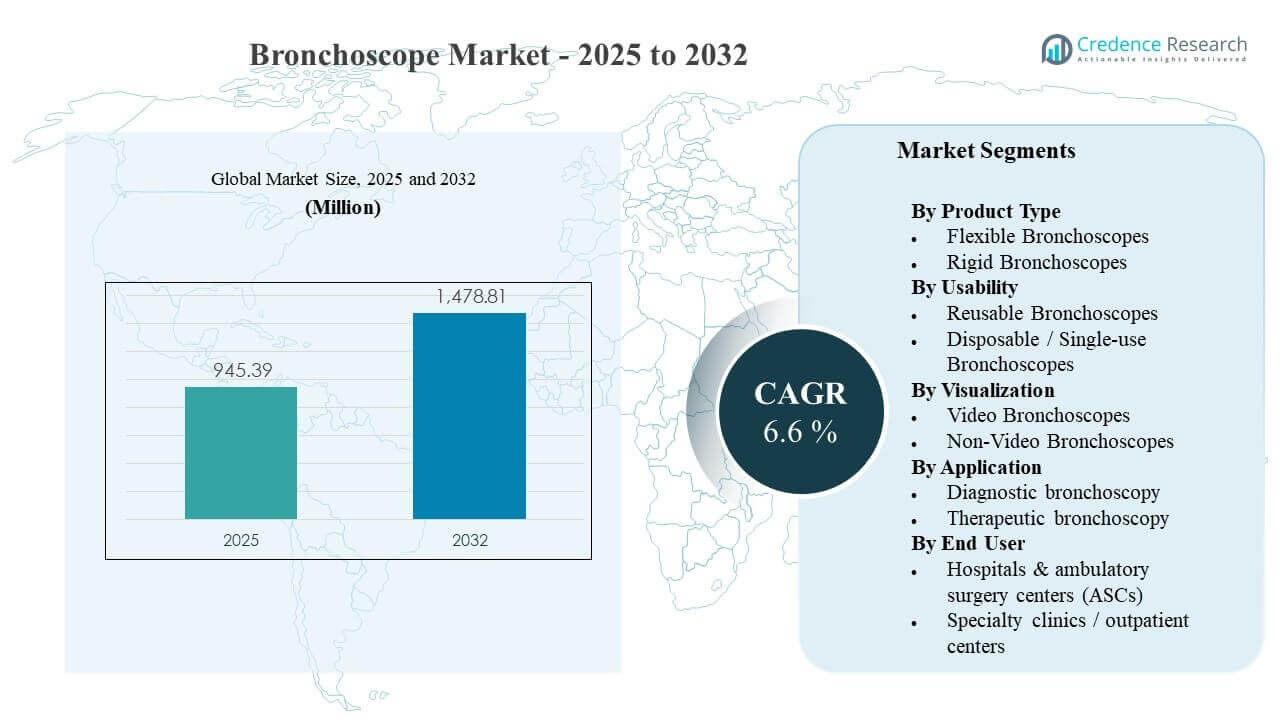
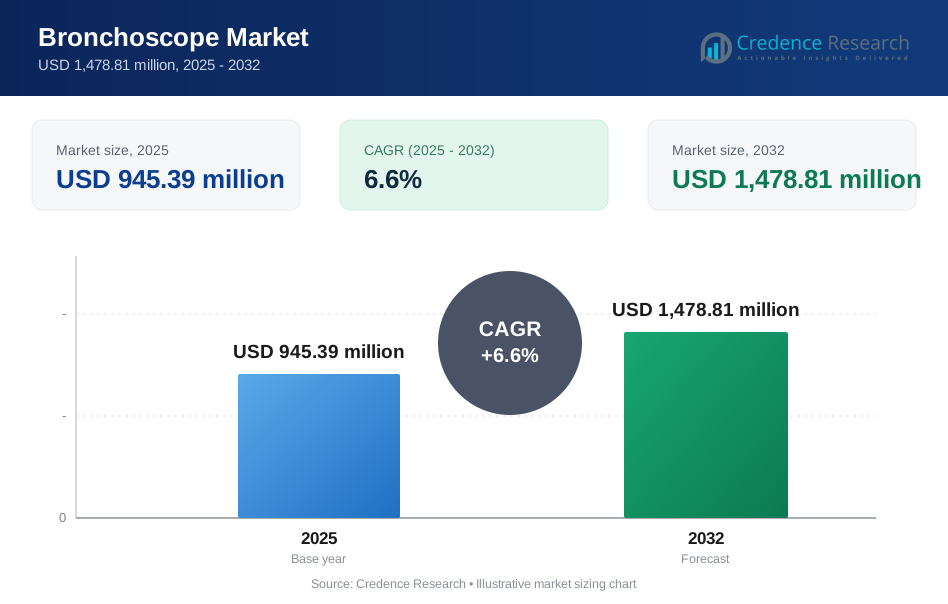
The global Bronchoscope Market size was estimated at USD 945.39 million in 2025 and is expected to reach USD 1,478.81 million by 2032, growing at a CAGR of 6.6% from 2025 to 2032. Demand is primarily supported by the expanding use of bronchoscopy in pulmonary diagnostics and therapeutic interventions, where clinicians increasingly rely on bronchoscopy to improve airway access, tissue sampling, and procedure efficiency. Adoption is further reinforced by hospital upgrades to advanced endoscopy suites and broader availability of bronchoscopy services across large care networks.
| REPORT ATTRIBUTE | DETAILS |
|---|---|
| Historical Period | 2020-2024 |
| Base Year | 2025 |
| Forecast Period | 2026-2032 |
| Bronchoscope Market Size 2025 | USD 945.39 million |
| Bronchoscope Market, CAGR | 6.6% |
| Bronchoscope Market Size 2032 | USD 1,478.81 million |
Key Market Trends & Insights
- Flexible bronchoscopes accounted for the largest share of 61.90% in 2025, supported by broad use across both diagnostic and therapeutic workflows.
- Reusable bronchoscopes held 66.10% share in 2025, reflecting the large installed base and established reprocessing pathways in high-volume facilities.
- Hospitals & ambulatory surgery centers (ASCs) represented 72.60% share in 2025, driven by higher procedure volumes and complex case mix managed in institutional settings.
- Disposable / single-use bronchoscopes are projected to expand at 15.85% CAGR during 2026–2031, reflecting infection-control priorities and simplified logistics for sites lacking reprocessing capacity.
- Asia Pacific is projected to grow at 9.51% CAGR during 2026–2031, underpinned by expanding pulmonary care capacity and rising diagnostic procedure volumes.
Segment Analysis
Purchasing decisions in the bronchoscope market are increasingly shaped by workflow efficiency, infection-control protocols, and imaging performance expectations across endoscopy suites. Providers with high bronchoscopy throughput typically prioritize reliability, serviceability, and total cost of ownership, which supports continued investment in reusable fleets, while also expanding access to single-use options for specific use cases and settings. Clinical teams also value consistent visualization quality and ergonomic handling, particularly as bronchoscopy is integrated into more structured diagnostic pathways for pulmonary disease management.
Technology evolution is reinforcing the role of advanced bronchoscopy capabilities in enabling precise targeting and improved procedural confidence. In many facilities, bronchoscopy is being positioned not only as a diagnostic step, but also as a platform for interventional procedures that can reduce invasiveness compared with alternative surgical approaches. As a result, procurement is increasingly tied to system-level considerations such as interoperability with existing tower systems, accessories compatibility, clinician training requirements, and the ability to standardize protocols across multi-site networks.
By Product Type Insights
Flexible Bronchoscopes accounted for the largest share of 61.90% in 2025. Flexible platforms lead because they support a wider range of clinical indications and can access more distal airway anatomy compared with rigid alternatives. Ongoing improvements in maneuverability, working-channel utility, and visualization performance continue to align with clinician preferences in routine bronchoscopy. Broader procedure volumes in pulmonary diagnostics also reinforce demand for flexible systems across high-throughput settings.
By Usability Insights
Reusable Bronchoscopes accounted for the largest share of 66.10% in 2025. Reusable fleets remain dominant due to established procurement patterns, amortization economics, and standardized reprocessing workflows in large hospitals. Clinical teams often prefer reusable options for consistency, accessory compatibility, and long-term utilization across multiple procedure types. At the same time, infection-control scrutiny and operational simplification are supporting faster adoption of single-use devices, particularly in settings with limited sterilization capacity.
By Visualization Insights
Video bronchoscopes lead qualitative adoption dynamics because they support improved visualization, documentation, and team-based workflows compared with non-video alternatives. Higher expectations for image clarity in diagnostic bronchoscopy, training, and quality assurance encourage providers to modernize visualization capabilities over time. Integration with digital platforms and procedure recording also strengthens the value proposition for video systems in institutional settings. Non-video systems retain relevance mainly in cost-sensitive environments or where infrastructure limitations constrain adoption of advanced visualization platforms.
By Application Insights
Diagnostic bronchoscopy leads qualitative utilization because bronchoscopy remains a standard tool for airway visualization, pulmonary assessment, and sampling pathways used in routine evaluation. Growth in diagnostic demand is reinforced by expanding pulmonary disease burden and broader use of structured work-up pathways that incorporate bronchoscopy. Therapeutic bronchoscopy demand is increasing as minimally invasive interventions become more standardized in hospitals that invest in advanced bronchoscopy suites. Across both applications, procedure volume expansion supports recurring demand for bronchoscopes and compatible accessories.
By End User Insights
Hospitals & ambulatory surgery centers (ASCs) accounted for the largest share of 72.60% in 2025. Hospitals lead due to their ability to manage complex cases, maintain specialized staff, and support advanced bronchoscopy infrastructure for both diagnostics and interventions. ASCs are gaining momentum as payers and providers look to optimize site-of-care economics and improve scheduling throughput for appropriate cases. Specialty clinics and outpatient centers expand where bronchoscopy is increasingly standardized and supported by simplified device workflows and referral network growth.
Bronchoscope Market Drivers
Rising Pulmonary Diagnostic Procedure Volumes
Bronchoscopy demand increases as pulmonary diagnostic pathways expand across major care settings, particularly for evaluation and sampling in complex respiratory cases. Hospitals are investing in bronchoscopy suite capacity to improve procedural throughput and reduce delays in diagnostic work-up. Clinicians also rely on bronchoscopy to support structured decision-making when imaging alone is insufficient. As diagnostic protocols become more standardized, procedure growth translates into recurring replacement and fleet expansion needs. This dynamic supports stable baseline demand across both mature and emerging healthcare markets.
- For instance, in a large cohort of 14,228 patients undergoing bronchoscopy, more than 12,000 procedures were performed with reusable flexible bronchoscopes to obtain endobronchial or transbronchial samples that directly informed downstream management decisions.
Technology Upgrades Improving Visualization and Workflow
Ongoing improvements in imaging, ergonomics, and system compatibility strengthen the clinical and operational value of modern bronchoscopes. Providers increasingly prefer platforms that support consistent visualization, simplified handling, and smoother integration with existing endoscopy infrastructure. Workflow efficiency is becoming a core procurement criterion as facilities seek faster turnaround, improved documentation, and standardized training across multi-site networks. These upgrades also encourage replacement of older platforms that no longer meet performance expectations. Technology-led differentiation remains an important lever for manufacturers competing for institutional contracts.
- For instance, the EVIS X1 CV‑1500 system with BF‑H1200 (4.9 mm, 2.2 mm channel) and BF‑1TH1200 (5.8 mm, 3.0 mm channel) bronchoscopes combines high-definition optics with advanced image enhancement modes such as TXI, RDI, and BAI‑MAC to improve lesion visibility and navigation through peripheral bronchi.
Infection-Control Focus and Reprocessing Burden
Healthcare systems are prioritizing infection prevention and operational consistency across endoscopy workflows, which influences bronchoscope purchasing decisions. Reprocessing complexity, turnaround time, and compliance requirements place pressure on facilities to optimize sterilization and reduce variability. As a result, many providers adopt mixed fleets that combine reusable and single-use options based on setting and case requirements. This approach supports both continued reusable demand and faster uptake of disposable bronchoscopes in targeted environments. Infection-control priorities remain a strong structural driver, especially in high-volume and resource-constrained settings.
Expansion of Interventional and Therapeutic Bronchoscopy
Therapeutic bronchoscopy demand rises as hospitals expand minimally invasive interventions that can improve patient experience and reduce reliance on more invasive alternatives. Facilities that upgrade bronchoscopy suites are better positioned to perform interventions with improved procedural confidence and operational predictability. Growth is also supported by clinician training expansion and greater availability of specialized pulmonary care teams. As therapeutic use becomes more standardized, device utilization per facility can increase through higher case throughput and broader indication coverage. This driver supports sustained investment in platforms that enable both diagnostic and therapeutic workflows.
Bronchoscope Market Challenges
Cost management remains a key challenge because bronchoscopy purchasing decisions must align with capital budgets, service costs, and total cost of ownership targets. Facilities must balance performance expectations with affordability, particularly when upgrades require ecosystem spending across towers, accessories, and maintenance. Reimbursement variability and differing procurement rules across markets can further slow adoption of higher-cost platforms. In many settings, budget constraints drive extended replacement cycles, creating pressure on manufacturers to justify premium pricing. These factors can temper near-term upgrades despite clear clinical benefits.
Operational variability in reprocessing quality and workflow standardization is another constraint for reusable fleets. Facilities face staffing requirements, compliance documentation burdens, and process variability that can increase downtime and cost per procedure. In parallel, single-use adoption introduces its own operational considerations related to inventory management, supply continuity, and waste handling requirements. Providers often require strong evidence of workflow benefit and infection-control value before switching protocols. This creates a complex purchasing environment where adoption can be gradual and highly setting-dependent.
- For instance, an analysis of 14,228 bronchoscopy procedures reported that use of sterile single-use bronchoscopes (Ambu aScope) reduced 30‑day readmission rates from 7.7% with reusable scopes to 3.6%, with patients undergoing procedures with reusable bronchoscopes being 2.3 times more likely to be readmitted, which strengthens the operational and infection‑control case for protocol change in appropriate settings.
Bronchoscope Market Trends and Opportunities
A growing trend is the expansion of hybrid fleet strategies where providers deploy reusable systems for core workloads and single-use bronchoscopes for specific settings or risk profiles. This approach supports standardization across care networks while allowing flexibility in infection-control management and case logistics. Facilities with limited reprocessing capacity, including certain outpatient and ambulatory sites, increasingly adopt single-use devices to streamline turnaround time and staffing needs. Hybrid models also enable procurement teams to optimize cost allocation across departments and procedure types. This trend creates opportunities for manufacturers with broad portfolios and strong clinical support programs.
- For instance, Ambu’s aScope 5 Broncho single-use platform, which offers four scope sizes on a common video processing unit, has been used to complete 95% of advanced bronchoscopy procedures in a clinical series without conversion to reusable scopes, while eliminating the 76 minutes of average hands-on reprocessing time per endoscope reported for conventional flexible endoscopes in Olympus reprocessing studies.
Another opportunity area is the increasing preference for digital integration, documentation, and training enablement within bronchoscopy suites. Providers value systems that support consistent visualization quality, recording, and easier team-based learning to reduce procedural variability. As multi-site healthcare networks expand, standardized bronchoscopy protocols and interoperable equipment become more important for quality and productivity. Manufacturers that offer service models, training pathways, and accessories ecosystems aligned to standardized workflows can gain share in institutional tenders. This environment also encourages product innovation focused on usability, durability, and workflow simplification.
Regional Insights
North America
North America held 41.57% share in 2025, supported by strong procedural capacity and broad availability of advanced bronchoscopy infrastructure. Hospitals and large care networks drive purchasing through structured procurement programs and standardization initiatives. Demand is reinforced by the routine use of bronchoscopy across diagnostic and interventional pathways in pulmonary care. Infection-control priorities and workflow optimization also encourage mixed adoption of reusable and single-use devices. Continued technology upgrades remain a key factor shaping replacement and expansion decisions.
Europe
Europe accounted for 24.35% share in 2025, underpinned by mature hospital infrastructure and established endoscopy practices across major healthcare systems. Procurement is often driven by system-wide standardization goals, service requirements, and lifecycle cost considerations. Demand remains stable across diagnostic bronchoscopy, with growth supported by increasing procedural efficiency initiatives within hospitals. Adoption patterns vary across countries depending on reimbursement structures and capital investment cycles. Providers increasingly prioritize equipment reliability, training enablement, and interoperability with existing endoscopy platforms.
Asia Pacific
Asia Pacific represented 21.28% share in 2025 and is supported by expanding healthcare capacity and rising pulmonary procedure volumes. Hospital investment in respiratory diagnostics and minimally invasive care pathways contributes to growing bronchoscopy utilization. Adoption is influenced by uneven infrastructure maturity, with advanced uptake in large urban hospitals and more gradual penetration in secondary facilities. Cost sensitivity drives careful technology selection, but demand benefits from broader access expansion and clinical modernization initiatives. The region’s growth momentum supports continued investment in both reusable and simplified workflow solutions.
Latin America
Latin America reached 7.10% share in 2025, reflecting moderate adoption of bronchoscopy across key hospital hubs and specialist centers. Demand is concentrated in higher-capacity facilities where pulmonary diagnostics and interventional services are available. Budget constraints and procurement variability can extend equipment replacement cycles and limit rapid upgrades. Single-use adoption can be selective, often focused on operational simplicity in facilities with limited reprocessing infrastructure. Over time, expanding diagnostic access and hospital modernization can support steady demand growth.
Middle East & Africa
Middle East & Africa accounted for 5.70% share in 2025, supported by demand concentrated in tertiary hospitals and better-resourced care hubs. Adoption trends vary widely across markets, with advanced bronchoscopy services more prevalent in select countries and urban centers. Procurement decisions often emphasize durability, service support, and standardized training due to staffing and operational constraints. Growth is supported by increasing investment in hospital infrastructure and respiratory care capacity. Wider penetration depends on continued expansion of specialist services beyond major centers.
Competitive Landscape
Competition in the bronchoscope market is shaped by portfolio breadth across reusable and single-use devices, technology differentiation in visualization and usability, and the ability to support large institutional procurement requirements. Suppliers compete on total cost of ownership, service coverage, training enablement, and ecosystem compatibility with existing endoscopy infrastructure. Product performance and workflow efficiency remain central differentiators as facilities prioritize throughput, standardized protocols, and infection-control compliance. Strategic positioning increasingly depends on the ability to address both high-volume hospital requirements and emerging outpatient and ambulatory demand pockets.
Olympus Corporation remains a leading participant with a strong focus on endoscopy ecosystem integration, clinician training support, and continuous upgrades to imaging and handling performance. The company’s approach typically emphasizes compatibility with platform systems used across broader endoscopy suites, enabling standardized workflows for purchasing organizations. Product portfolio depth supports large-scale tenders and long-term replacement cycles, supported by service and clinical education programs. This positioning is reinforced by sustained investment in product refreshes aligned to institutional needs for performance consistency and operational reliability.
The industry research and growth report includes detailed analyses of the competitive landscape of the market and information about key companies, including:
- Olympus Corporation
- Fujifilm Holdings Corporation
- Ambu A/S
- Medtronic plc
- Karl Storz SE & Co. KG
- Boston Scientific Corporation
- Teleflex Incorporated
- Richard Wolf GmbH
- Smiths Medical
- CONMED Corporation
Qualitative and quantitative analysis of companies has been conducted to help clients understand the wider business environment as well as the strengths and weaknesses of key industry players. Data is qualitatively analyzed to categorize companies as pure play, category-focused, industry-focused, and diversified; it is quantitatively analyzed to categorize companies as dominant, leading, strong, tentative, and weak.
Recent Developments
- In January 2026, FUJIFILM Healthcare Europe announced the European launch of its EB-710US balloonless ultrasonic bronchoscope, a new flexible ultrasound bronchoscope designed to enhance lung cancer detection and staging with improved workflow and imaging performance.
- In February 2026, Olympus Corporation of the Americas reported that the U.S. FDA had cleared pediatric use indications for two H-SteriScope single-use video flexible bronchoscopes in its respiratory portfolio, expanding their application to younger patient populations.
- In September 2025, Olympus Corporation introduced its latest endobronchial ultrasound bronchoscope, the BF-UCP190F, in EMEA and major Asia-Pacific markets, highlighting a thinner outer diameter and stronger upward angulation to extend diagnostic reach, with a launch in Japan planned for the following months.
- In March 2025, Johnson & Johnson MedTech (Auris Health, MONARCH Platform) announced regulatory clearance for MONARCH Quest, a next-generation advancement of its robotically assisted bronchoscopy platform intended to provide enhanced minimally invasive access and visualization of the airways for peripheral lung procedures.
Report Scope
| Report Attribute | Details |
| Market size value in 2025 | USD 945.39 million |
| Revenue forecast in 2032 | USD 1,478.81 million |
| Growth rate (CAGR) | 6.6% (2025–2032) |
| Base year | 2025 |
| Forecast period | 2026-2032 |
| Quantitative units | USD million |
| Segments covered | By Product Type Outlook: Flexible Bronchoscopes, Rigid Bronchoscopes; By Usability Outlook: Reusable Bronchoscopes, Disposable / Single-use Bronchoscopes; By Visualization Outlook: Video Bronchoscopes, Non-Video Bronchoscopes; By Application Outlook: Diagnostic bronchoscopy, Therapeutic bronchoscopy; By End User Outlook: Hospitals & ambulatory surgery centers (ASCs), Specialty clinics / outpatient centers |
| Regional scope | North America, Europe, Asia Pacific, Latin America, Middle East & Africa |
| Key companies profiled | Olympus Corporation; Fujifilm Holdings Corporation; Ambu A/S; Medtronic plc; Karl Storz SE & Co. KG; Boston Scientific Corporation; Teleflex Incorporated; Richard Wolf GmbH; Smiths Medical; CONMED Corporation |
| No.of Pages | 327 |
By Product Type
- Flexible Bronchoscopes
- Rigid Bronchoscopes
By Usability
- Reusable Bronchoscopes
- Disposable / Single-use Bronchoscopes
By Visualization
- Video Bronchoscopes
- Non-Video Bronchoscopes
By Application
- Diagnostic bronchoscopy
- Therapeutic bronchoscopy
By End User
- Hospitals & ambulatory surgery centers (ASCs)
- Specialty clinics / outpatient centers
By Region
- North America
- U.S.
- Canada
- Mexico
- Europe
- Germany
- France
- U.K.
- Italy
- Spain
- Rest of Europe
- Asia Pacific
- China
- Japan
- India
- South Korea
- South-east Asia
- Rest of Asia Pacific
- Latin America
- Brazil
- Argentina
- Rest of Latin America
- Middle East & Africa
- GCC Countries
- South Africa
- Rest of the Middle East and Africa
Request a Free Sample
Fill in your details and we'll send you a free sample report.
- Sample data tables & charts
- Research methodology
Need a Custom Version of This Report?
Tailor the scope, geography, or segments to your exact requirements.
- Custom geography or segment scope
- Direct access to our analyst team
Frequently Asked Questions
What is the market size of the Bronchoscope Market in 2025?
What will be the market size of the Bronchoscope Market by 2032?
What is the CAGR for the Bronchoscope Market during 2025–2032?
Which is the largest segment in the Bronchoscope Market?
What are the key growth factors shaping the Bronchoscope Market?
Which region leads the Bronchoscope Market?
Table of Content
Chapter 1. Report Introduction
- 1.1 Report Description & Purpose
- 1.1.1 Report Title & Market Definition
- 1.1.2 Unique Selling Propositions (USP) & Key Differentiators
- 1.1.3 Value Proposition for Stakeholders
- 1.2 Research Objectives
- 1.2.1 Market Sizing Objectives (Volume & Revenue)
- 1.2.2 Segmentation Objectives
- 1.2.3 Competitive Intelligence Objectives
- 1.2.4 Forecast & Scenario Objectives
- 1.3 Report Scope
- 1.3.1 Bronchoscope Scope – Types & Subtypes Covered
- 1.3.2 Geographic Scope – Regions & Countries Covered
- 1.3.3 Historical Period, Base Year & Forecast Period (2025; forecast to 2032)
- 1.3.4 Inclusions & Exclusions
- 1.4 HS Code & Classification Framework
- 1.5 Currency, Units & Pricing Basis
- 1.6 Target Stakeholders
- 1.7 Limitations & Assumptions
Chapter 2. Executive Summary
- 2.1 Global Bronchoscope Market Snapshot
- 2.1.1 Market Size – Historical (2025) & Forecast (2025-2032) (2025: USD 945.39 million → 2032: USD 1,478.81 million)
- 2.1.2 Volume & Revenue – Global Totals
- 2.1.3 Key Market Highlights – Top Five Facts
- 2.2 Bronchoscope Market Segmentation Snapshot
- 2.2.1 Market Split by Region – 2025 vs. 2032
- 2.3 Competitive Snapshot
- 2.3.1 Top 10 Players by Revenue Share – 2025
- 2.3.2 Top 10 Players by Volume Share – 2025
- 2.3.3 Recent Strategic Developments (18-Month Summary)
- 2.4 Key Investment Highlights & Strategic Conclusions
Chapter 3. Bronchoscope Market Dynamics & Industry Analysis
- 3.1 Market Overview & Context
- 3.1.1 Bronchoscope Market Position in the Broader Automotive Value Chain
- 3.1.2 OEM vs. Replacement Market Dynamics
- 3.1.3 Market Maturity & Development Stage by Region
- 3.2 Bronchoscope Market Drivers
- 3.3 Bronchoscope Market Restraints & Challenges
- 3.4 Bronchoscope Market Opportunities
- 3.5 Porter's Five Forces Analysis
- 3.5.1 Threat of New Entrants
- 3.5.2 Bargaining Power of Suppliers
- 3.5.3 Bargaining Power of Buyers
- 3.5.4 Threat of Substitutes
- 3.5.5 Competitive Rivalry – Intensity Assessment
- 3.6 Bronchoscope Value Chain Analysis
- 3.6.1 Upstream – Raw Material/Input Suppliers
- 3.6.1.1 Raw Material/Input 1
- 3.6.1.2 Raw Material/Input 2
- 3.6.1.3 Raw Material/Input 3
- 3.6.2 Midstream – Production/Manufacturing/Service Delivery
- 3.6.2.1 Production/Process Overview
- 3.6.2.2 Key Facility Locations & Capacity by Manufacturer
- 3.6.3 Downstream – Distribution & End Consumer
- 3.6.3.1 Primary Channel – B2B/OEM
- 3.6.3.2 Secondary Channels – Dealer, Retail, Online, Direct
- 3.6.4 Value Chain Profitability Analysis
- 3.6.1 Upstream – Raw Material/Input Suppliers
- 3.7 PESTEL Analysis
- 3.7.1 Political Factors
- 3.7.2 Economic Factors
- 3.7.3 Social Factors
- 3.7.4 Technological Factors
- 3.7.5 Environmental Factors
- 3.7.6 Legal Factors
- 3.8 Bronchoscope Supply Chain Analysis
- 3.8.1 Raw Material/Input Supply Risk Assessment
- 3.8.2 Manufacturing Concentration Risk (Geographic Exposure)
- 3.8.3 Trade Disruption Impact Analysis
- 3.9 Regulatory & Policy Landscape
Note: The regulatory and policy landscape section covers regulations based on their applicability to the market, Bronchoscope category, geography, and scope of the study. Only regulatory frameworks with a material impact on operations, compliance, trade, sustainability, or market access are analyzed in detail.
Chapter 4. Key Investment Pockets & Opportunity Analysis
- 4.1 Bronchoscope Market Attractiveness Analysis
- 4.1.1 By Region – Investment Attractiveness Matrix (Volume × CAGR)
- 4.2 Absolute Revenue Growth Opportunity
- 4.2.1 By Region – Absolute USD Growth Through 2032
- 4.3 Incremental Volume Opportunity
- 4.3.1 By Region – Incremental Volume Through 2032
- 4.3.2 Segment – Incremental Volume
- 4.4 Emerging Submarket Opportunity Deep Dive (Subject to Applicability)
- 4.5 Emerging Market Opportunity Scorecards
- 4.5.1 United States
- 4.5.2 Europe
- 4.5.3 Asia
- 4.5.4 Middle East & Africa
Note: Emerging Market Opportunity Scorecards will be included based on relevance and strategic importance. Regions listed are indicative and may vary depending on data availability and market dynamics.
Chapter 5. Bronchoscope Import-Export Analysis & Trade Flows
- 5.1 Global Trade Overview
- 5.1.1 Global Export Value by Country (2025)
- 5.1.2 Global Export Volume by Country (2025)
- 5.1.3 Global Import Value by Country (2025)
- 5.1.4 Global Import Volume by Country (2025)
- 5.1.5 Net Trade Balance by Country (2025)
- 5.2 Export Analysis – Segment
- 5.2.1 Type 1 (HS Code)
- 5.2.2 Type 2 (HS Code)
- 5.2.3 Type 3 (HS Code)
- 5.2.4 Type 4 (HS Code)
- 5.2.5 Type 5 (HS Code)
- 5.3 Import Analysis – Segment
- 5.3.1 Type 1 (HS Code)
- 5.3.2 Type 2 (HS Code)
- 5.3.3 Type 3 (HS Code)
- 5.3.4 Type 4 (HS Code)
- 5.3.5 Type 5 (HS Code)
- 5.4 Average Unit Trade Prices
- 5.4.1 Average Export Price – Segment & Country
- 5.4.2 Average Import Price – Segment & Source Country
- 5.4.3 Price Trends (2025)
- 5.5 Key Trade Route Analysis
- 5.5.1 Trade Route 1
- 5.5.2 Trade Route 2
- 5.5.3 Trade Route 3
- 5.5.4 Trade Route 4
- 5.5.5 Trade Route 5
- 5.6 Trade Policy Impact Assessment
- 5.6.1 US Anti-Dumping & Section 301 Tariffs
- 5.6.2 EU Customs Union Impact
- 5.6.3 Major Free Trade Agreements
- 5.6.4 USMCA Rules of Origin
Note: Trade policy analysis will be included only where relevant to the Bronchoscope market.
Chapter 6. Competitive Landscape & Company Benchmarking
- 6.1 Bronchoscope Market Concentration & Structure
- 6.1.1 Herfindahl-Hirschman Index (HHI) – vs. 2025
- 6.1.2 Tier 1, Tier 2 & Tier 3 Market Structure
- 6.1.3 Global, Regional & Local Player Dynamics
- 6.2 Bronchoscope Market Share Analysis – 2025
- 6.2.1 Global Revenue Share by Company
- 6.2.2 Global Volume Share by Company
- 6.2.3 Regional Revenue Share
- 6.2.4 Market Share Evolution ( vs. 2025)
- 6.2.5 OEM Segment Share by Company
- 6.2.6 Replacement Segment Share by Company
- 6.3 Production/Delivery Capacity & Facility Analysis
- 6.3.1 Global Installed Capacity
- 6.3.2 Capacity Utilization Rates
- 6.3.3 Production/Output Volume
- 6.3.4 Facility Locations & Capacity Map
- 6.3.5 Planned Capacity Additions
- 6.4 Bronchoscope Competitive Benchmarking Matrix
- 6.4.1 Revenue, Volume, CAGR & Profitability Comparison
- 6.4.2 Channel Revenue Mix
- 6.4.3 Geographic Revenue Exposure
- 6.4.4 R&D Intensity
- 6.4.5 Sustainability Maturity
- 6.5 Strategic Developments in Bronchoscope (Last 24 Months)
- 6.5.1 Mergers, Acquisitions & Divestments
- 6.5.2 New Bronchoscope Launches
- 6.5.3 Facility Expansions
- 6.5.4 Strategic Alliances, Joint Ventures & Partnerships
- 6.5.5 Distribution Expansion & Market Entry
- 6.5.6 Sustainability & ESG Initiatives
- 6.6 Competitive Strategy Mapping
- 6.6.1 Leader, Challenger, Follower & Niche Classification
- 6.6.2 Pricing Strategy Comparison
- 6.6.3 Channel Strategy Matrix
Note: Strategic developments are included based on their materiality and the availability of reliable information.
Chapter 7. Global Bronchoscope Market – By Distribution Channel
- 7.1 Segment Overview
- 7.1.1 Volume & Revenue Split by Channel (2025 & 2032)
- 7.1.2 Channel Mix Evolution (2025-2032)
Chapter 8. Regional Market Analysis – Global Overview
- 8.1 Global Regional Overview
- 8.1.1 Regional Volume Share
- 8.1.2 Regional Revenue Share
- 8.1.3 Regional Volume by Region
- 8.1.4 Regional Revenue by Region
- 8.1.5 Regional Forecast Through 2032
- 8.2 Cross-Regional Segment Analysis
- 8.2.1 By Distribution Channel
- 8.2.2 By Brand/Price Tier
Chapter 9. North America Bronchoscope Market
- 9.1 United States
- 9.2 Canada
- 9.3 Mexico
Chapter 10. Europe Bronchoscope Market
- 10.1 Germany
- 10.2 France
- 10.3 Italy
- 10.4 United Kingdom
- 10.5 Spain
- 10.6 Poland
- 10.7 Russia
- 10.8 Netherlands
- 10.9 Belgium
- 10.10 Sweden
- 10.11 Denmark
- 10.12 Norway
- 10.13 Rest of Europe
Chapter 11. Asia Pacific Bronchoscope Market
- 11.1 China
- 11.2 India
- 11.3 Japan
- 11.4 South Korea
- 11.5 Thailand
- 11.6 Indonesia
- 11.7 Vietnam
- 11.8 Malaysia
- 11.9 Australia
- 11.10 Rest of Asia Pacific
Chapter 12. Latin America Bronchoscope Market
- 12.1 Brazil
- 12.2 Argentina
- 12.3 Colombia
- 12.4 Chile
- 12.5 Rest of Latin America
Chapter 13. Middle East Bronchoscope Market
- 13.1 Saudi Arabia
- 13.2 United Arab Emirates
- 13.3 Turkey
- 13.4 Israel
- 13.5 Iran
- 13.6 Rest of the Middle East
Chapter 14. Africa Bronchoscope Market
- 14.1 South Africa
- 14.2 Egypt
- 14.3 Nigeria
- 14.4 Morocco
- 14.5 Rest of Africa
Chapter 15. Bronchoscope Company Profiles
- 15.1 [Company 01]
- 15.1.1 Company Overview
- 15.1.2 Key Management Personnel
- 15.1.3 Products & Services Portfolio
- 15.1.4 Financial Performance
- 15.1.5 Key Market Focus & Geographic Presence
- 15.1.6 Recent Developments & Strategic Initiatives
Note: The company profile list is preliminary and may change based on research findings, market developments, data availability, and client requirements.
Chapter 16. Appendices
- Appendix A – List of Abbreviations & Acronyms
- Appendix B – Industry Classification Code Reference – Full Series
- Appendix C – Production & Capacity Data Tables
- Appendix D – End-Use & Demand Base Tables
- Appendix E – Consumption & Replacement Rate Assumptions
- Appendix F – ASP Reference Tables
- Appendix G – Manufacturing & Facility Database
- Appendix H – Import-Export Data Tables
- Appendix I – Regulatory Summary Tables
- Appendix J – Primary Research Participant List (Anonymized)
- Appendix K – Primary Research Questionnaire Framework
- Appendix L – Data Sources & Bibliography
- Appendix M – Market Size Divergence & Source Comparison
Chapter 17. Research Methodology
- 17.1 Research Framework & Philosophy
- 17.2 Secondary Research – Sources, Hierarchy & Data Extraction
- 17.3 Data Modeling – Bottom-Up & Top-Down Market Sizing
- 17.4 Primary Research – Stakeholder Framework, LOI & Sample Sizes
- 17.5 Forecast Methodology – Regression, Scenario & Sensitivity Analysis
- 17.6 Quality Control – Four-Layer Validation Framework
- 17.7 Limitations & Standard Assumptions
- 17.8 Disclaimer
