Busbar Protection Market Overview:
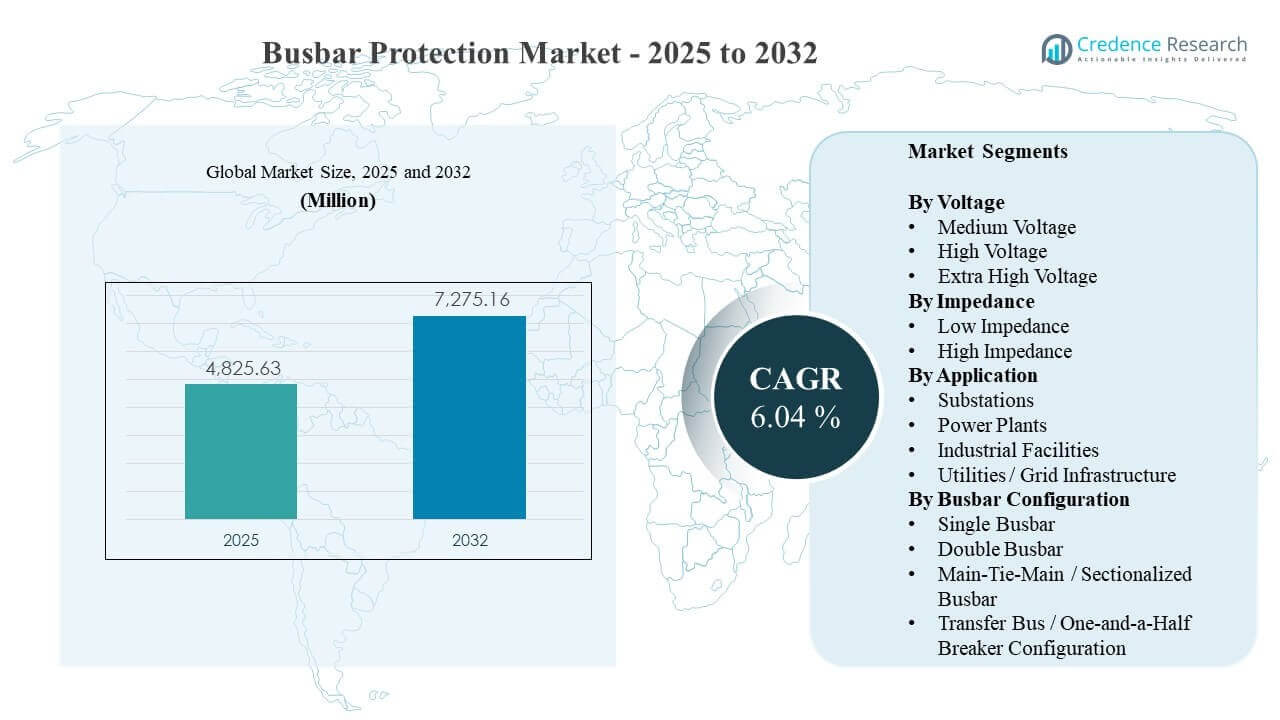
The global Busbar Protection Market size was estimated at USD 4825.63 million in 2025 and is expected to reach USD 7275.16 million by 2032, growing at a CAGR of 6.04% from 2025 to 2032. Busbar Protection Market growth is primarily driven by grid modernization programs that require faster fault isolation, higher substation reliability, and replacement of aging protection schemes with digital relays and advanced differential protection. Asia Pacific expansion of transmission and distribution infrastructure, alongside broader digital substation adoption, continues to reinforce steady demand for busbar protection upgrades across utility and industrial applications.
| REPORT ATTRIBUTE |
DETAILS |
| Historical Period |
2020-2024 |
| Base Year |
2025 |
| Forecast Period |
2026-2032 |
| Busbar Protection Market Size 2025 |
USD 4825.63 million |
| Busbar Protection Market, CAGR |
6.04% |
| Busbar Protection Market Size 2032 |
USD 7275.16 million |
Key Market Trends & Insights
- Low Impedance accounted for the largest share of 59.8% in 2025, supported by strong preference for fast and secure differential protection in modern substations.
- Medium Voltage captured 51.3% share in 2025, reflecting high upgrade volumes across distribution networks and primary substations.
- Substations represented 41.9% share in 2025, remaining the core deployment point for busbar protection due to critical fault isolation needs.
- Asia Pacific held 39.7% share in 2025, underpinned by large-scale grid buildouts and substation automation investments.
- Busbar Protection Market is expanding at 6.04% CAGR (2025–2032), indicating sustained multi-year replacement and expansion cycles in protection infrastructure.
Segment Analysis
Busbar Protection Market demand is shaped by utility-grade reliability requirements and the accelerating refresh of protection and control systems across transmission and distribution networks. Buyers increasingly favor solutions that integrate with digital substation architectures and support standardized communication and engineering workflows, improving commissioning consistency and lifecycle monitoring. Grid modernization activity levels and reliability mandates are also raising the frequency of protection retrofit projects at existing substations, where busbar schemes are upgraded to reduce cascading outage risk and limit equipment damage.
Busbar Protection Market purchasing decisions are also influenced by integration complexity, testing requirements, and the need for dependable post-installation support. Utilities and large industrial facilities tend to evaluate vendors on commissioning capability, diagnostics, cybersecurity readiness, and service responsiveness in addition to core protection performance. These factors collectively reinforce adoption of advanced differential schemes and drive incremental demand for modern relay platforms that can support multiple busbar arrangements and protection zones.
Access crucial information at unmatched prices!
Request your sample report today & start making informed decisions powered by Credence Research Inc.!
Download Sample
By Voltage Insights
Medium Voltage accounted for the largest share of 51.3% in 2025. Medium-voltage substations experience high volumes of modernization activity because distribution networks require frequent protection upgrades to maintain reliability and reduce outage duration. Medium-voltage deployments also benefit from shorter replacement cycles as utilities replace legacy protection with numerical relays and improved monitoring capability. Medium-voltage projects typically scale faster across large installed bases, sustaining the leading share for Busbar Protection Market revenue.
By Impedance Insights
Low Impedance accounted for the largest share of 59.8% in 2025. Low-impedance differential schemes are widely adopted because busbar protection applications demand fast, selective fault clearance and secure operation under complex system conditions. Low-impedance approaches also align well with digital relay platforms that support advanced logic, diagnostics, and communication for substation automation. Utilities prioritize reduced fault clearing time and minimized equipment stress, which reinforces Low Impedance adoption across critical substations.
By Application Insights
Substations accounted for the largest share of 41.9% in 2025. Substations remain the primary node for isolating bus faults and protecting high-value switchgear, making busbar protection a reliability-critical requirement rather than an optional upgrade. Substation automation programs commonly bundle protection refresh with control, monitoring, and communication upgrades, which increases the pace of busbar protection modernization. Substation-focused investments also rise when utilities expand capacity and interconnections, sustaining Substations as the leading application for Busbar Protection Market demand.
By Busbar Configuration Insights
Single Busbar commonly represents a major share of deployments in many networks because Single Busbar designs remain prevalent in cost-sensitive substations and simpler industrial distribution systems. Double Busbar and Main-Tie-Main configurations tend to grow faster where high reliability, maintenance flexibility, and load transfer requirements are prioritized. Transfer Bus and One-and-a-Half Breaker configurations typically appear in high-criticality installations where redundancy and operational continuity justify more complex protection zones. Busbar Protection Market solution selection increasingly depends on the ability to support multi-zone logic and breaker failure integration across these configurations.
Busbar Protection Market Drivers
Grid modernization and reliability-driven protection upgrades
Busbar Protection Market growth is supported by utility programs focused on improving reliability metrics and reducing the probability of cascading outages. Utilities increasingly standardize protection architectures to accelerate commissioning, simplify maintenance, and improve event analysis. Substation modernization projects frequently include relay replacement, bus protection upgrades, and integration with automation and monitoring systems. These initiatives collectively lift demand for advanced busbar differential protection across both transmission and distribution networks.
- For instance, Siemens’ SIPROTEC 7SS85 architecture supports up to 20 three‑phase current transformer measurement points and 26 bays within a single centralized busbar protection scheme, allowing a uniform configuration template to be reused across large substation fleets.
Expansion of transmission and distribution infrastructure
Busbar Protection Market demand rises as new substations and switchyards are commissioned to support load growth, renewable interconnections, and network reinforcement. New builds require modern busbar protection to safeguard high-value switchgear and ensure selective fault isolation. Higher network complexity also drives demand for protection schemes that can manage multiple bus sections and redundant zones. Expansion-led procurement supports steady volumes of protection relays, engineering services, and commissioning activity.
Digital substations and interoperability requirements
Busbar Protection Market adoption benefits from digital substation rollouts that favor numerical relays with strong communication and diagnostic functionality. Interoperable architectures reduce integration risk and support scalable deployment across large fleets of substations. Digital engineering workflows also improve configuration control and enable quicker response to system changes. These factors raise the attractiveness of modern busbar protection solutions that integrate cleanly with substation automation environments.
- For instance, ABB’s digital substation concepts combine REB500 distributed busbar protection with IEC 61850 station and process bus communications, enabling high‑speed trip signaling and extensive self‑supervision within fully digital protection and control systems.
Industrial electrification and critical uptime needs
Busbar Protection Market demand is reinforced by industrial facilities that prioritize uptime, equipment protection, and rapid fault clearance. Electrification of processes and higher power density increase the consequences of bus faults, elevating the value of dependable protection. Industrial buyers also prefer vendors with strong commissioning support and lifecycle service capability to reduce operational risk. These requirements sustain adoption of busbar protection across high-load industrial facilities and critical infrastructure sites.
Busbar Protection Market Challenges
Busbar Protection Market deployments face challenges related to engineering complexity, integration effort, and commissioning time, especially in retrofit projects with legacy switchgear and mixed vendor environments. Protection upgrades often require careful CT validation, scheme coordination, and staged cutovers to maintain continuity of service. These constraints can extend project timelines and increase total cost of implementation. As a result, utilities and industrial buyers often prioritize vendors with proven site support, repeatable engineering workflows, and robust validation tools.
- For instance, ABB’s REB 500 numerical busbar protection platform has been deployed in multi-bay substations with up to 12 busbar sections and 48 bays, where factory pre-testing of the complete scheme and reduced secondary wiring have been shown to substantially shorten project realization and commissioning time compared with conventional hard‑wired busbar protection architectures.
Busbar Protection Market adoption is also constrained by ongoing testing and maintenance requirements that influence lifecycle cost and staffing needs. Protection systems must be periodically tested to ensure secure operation, and utilities often face constraints in specialist protection engineering resources. Cybersecurity and compliance expectations further add complexity to substation digitalization projects. These factors can slow decision cycles, particularly for smaller utilities and budget-constrained industrial operators.
Busbar Protection Market Trends and Opportunities
Busbar Protection Market innovation increasingly emphasizes enhanced diagnostics, event analytics, and condition monitoring embedded within numerical relays. Buyers value solutions that shorten fault investigation time and support predictive maintenance of protection assets. Modern platforms also enable more scalable configuration management, improving consistency across substation fleets. These capabilities create opportunities for vendors to expand software and service value alongside hardware deployments.
Busbar Protection Market opportunity also expands as grids integrate higher shares of inverter-based resources and more dynamic power flows. More complex operating conditions raise the need for secure, selective protection that adapts to changing system topology and fault characteristics. Substation modernization programs can increasingly favor protection architectures that are modular and upgradeable. This shift supports multi-year growth in protection relay refresh, engineering services, and standardized digital substation deployment models.
- For instance, interoperability testing between Schweitzer Engineering Laboratories SEL‑487B and ABB REF615 IEDs in an IEC 61850‑based digital busbar protection scheme, using real‑time digital simulator hardware‑in‑the‑loop, demonstrated reliable multi‑vendor operation under simulated internal busbar faults and validated that the modular architecture can be extended by adding new bays and IEDs without compromising differential protection performance.
Regional Insights
North America (24.6% share in 2025)
Busbar Protection Market activity in North America is supported by aging grid infrastructure replacement cycles and wide-scale utility modernization initiatives. Utilities prioritize reliability, fast fault clearance, and upgraded protection schemes across critical substations. Standardization of substation automation and protection engineering practices also helps utilities scale deployments across large installed bases. These factors collectively sustain steady retrofit demand for advanced busbar protection across both transmission and distribution networks.
Europe (23.1% share in 2025)
Busbar Protection Market demand in Europe is shaped by grid stability requirements, renewable integration, and modernization of substation protection and control infrastructure. Utilities emphasize selective protection and high system availability, which supports upgrades in complex substations and interconnections. Strong engineering standards and structured refurbishment programs accelerate replacement of legacy protection architectures. These dynamics sustain consistent demand for busbar protection upgrades across transmission and distribution substations.
Asia Pacific (39.7% share in 2025)
Busbar Protection Market momentum in Asia Pacific is anchored by the leading regional share of 39.7% in 2025 and ongoing expansion of transmission and distribution infrastructure. New substation construction and large-scale modernization programs create consistent demand for advanced busbar protection in utility applications. Rapid urbanization and industrial growth increase system loading, elevating the need for reliable fault isolation. These conditions support sustained procurement of modern protection relays, schemes, and commissioning services across the region.
Latin America (7.8% share in 2025)
Busbar Protection Market adoption in Latin America is primarily driven by project-based transmission and distribution upgrades and selective modernization programs in larger utility systems. Protection investments often concentrate in expanding urban corridors, industrial hubs, and reliability-improvement zones. Procurement timing can be influenced by budget cycles and phased implementation approaches, shaping near-term demand patterns. Despite smaller scale than leading regions, modernization requirements support stable growth potential over time.
Middle East & Africa (4.8% share in 2025)
Busbar Protection Market demand in Middle East & Africa is supported by infrastructure buildouts, utility reinforcement projects, and expansion of industrial power systems. Project-led investments in high-reliability substations and critical facilities increase demand for robust protection schemes. Buyers typically prioritize dependable commissioning support and lifecycle services due to operational criticality. These factors create steady opportunities tied to new builds and targeted modernization initiatives.
Competitive Landscape
Busbar Protection Market competition is defined by vendors differentiating through protection performance, interoperability with substation automation, cybersecurity readiness, and lifecycle service depth. Leading companies compete on the ability to support multiple busbar configurations, deliver secure differential schemes, and provide strong commissioning and long-term maintenance support. Portfolio breadth across protection relays, digital substation components, and engineering services strengthens positioning with utility and industrial customers. Strategic emphasis is also shifting toward analytics-enabled diagnostics and repeatable engineering workflows that reduce deployment risk.
ABB Ltd. is positioned strongly in Busbar Protection Market solutions through protection and control platforms that support modern substation architectures and scalable engineering. ABB Ltd. typically emphasizes integration with automation environments, diagnostics, and standardized configuration approaches to improve deployment consistency across substation fleets. ABB Ltd. also benefits from a global service footprint that supports commissioning, retrofit execution, and long-term asset lifecycle needs. These capabilities align with buyer priorities for reliability, interoperability, and operational support in protection upgrades.
The industry research and growth report includes detailed analyses of the competitive landscape of the market and information about key companies, including:
- ABB Ltd.
- Siemens AG
- Schneider Electric SE
- General Electric Company (GE Vernova / GE Grid Solutions)
- Mitsubishi Electric Corporation
- Eaton Corporation plc
- Hitachi Energy Ltd.
- Toshiba Energy Systems & Solutions Corporation
- NR Electric Co., Ltd.
- Schweitzer Engineering Laboratories (SEL)
- Basler Electric Company
- ERLPhase Power Technologies Ltd.
- ZIV Aplicaciones y Tecnología, S.A.
- Arcteq Oy
Qualitative and quantitative analysis of companies has been conducted to help clients understand the wider business environment as well as the strengths and weaknesses of key industry players. Data is qualitatively analyzed to categorize companies as pure play, category-focused, industry-focused, and diversified; it is quantitatively analyzed to categorize companies as dominant, leading, strong, tentative, and weak.
Shape Your Report to Specific Countries or Regions & Enjoy 30% Off!
Recent Developments
- In January 2026, GE Vernova highlighted its Multilin B30 distributed busbar protection relay as a cost effective alternative to traditional high impedance schemes, adding enhanced support for IEC 61850-9-2 process bus architectures to protect up to 16 feeders and multiple differential zones in evolving busbar layouts.
- In March 2025, ZIV Aplicaciones y Tecnología, S.A. expanded its distributed busbar protection offering with the DBF system, providing differential protection for up to 24 bays and 4 busbars using IEC 61869-9 sampled values, IEC 61850-8-1 GOOSE and IEC 61850-9-3 PTP, together with supervision logic and dynamic zone functions to improve busbar fault security and dependability.
- In October 2024, Hitachi Energy Ltd. updated its Relion family busbar protection portfolio, emphasizing IEC 61850-based numerical busbar and breaker-failure protection schemes that support both centralized and decentralized architectures for distribution, sub transmission and transmission busbar arrangements.
Report Scope
By Segmentation
By Voltage
- Medium Voltage
- High Voltage
- Extra High Voltage
By Impedance
- Low Impedance
- High Impedance
By Application
- Substations
- Power Plants
- Industrial Facilities
- Utilities / Grid Infrastructure
By Busbar Configuration
- Single Busbar
- Double Busbar
- Main-Tie-Main / Sectionalized Busbar
- Transfer Bus / One-and-a-Half Breaker Configuration
By Region
- North America
- Europe
- Germany
- France
- U.K.
- Italy
- Spain
- Rest of Europe
- Asia Pacific
- China
- Japan
- India
- South Korea
- South-east Asia
- Rest of Asia Pacific
- Latin America
- Brazil
- Argentina
- Rest of Latin America
- Middle East & Africa
- GCC Countries
- South Africa
- Rest of the Middle East and Africa



