Busbar Trunking Market Overview:
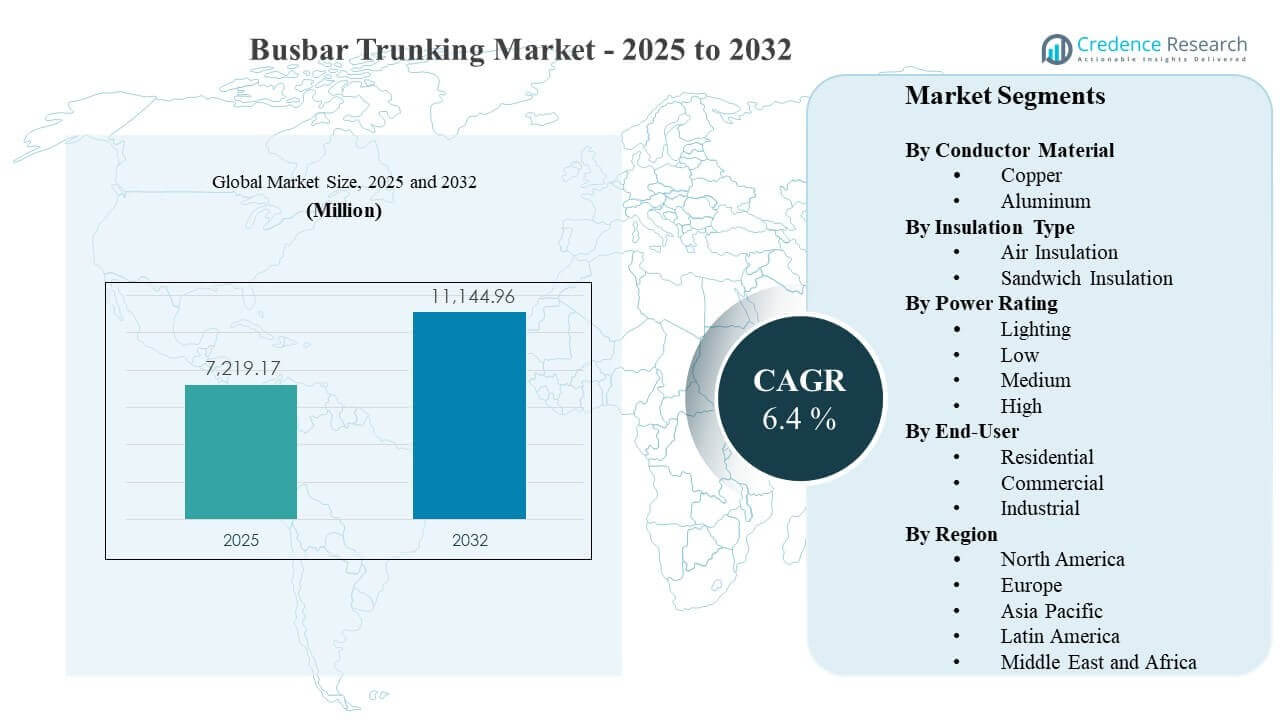
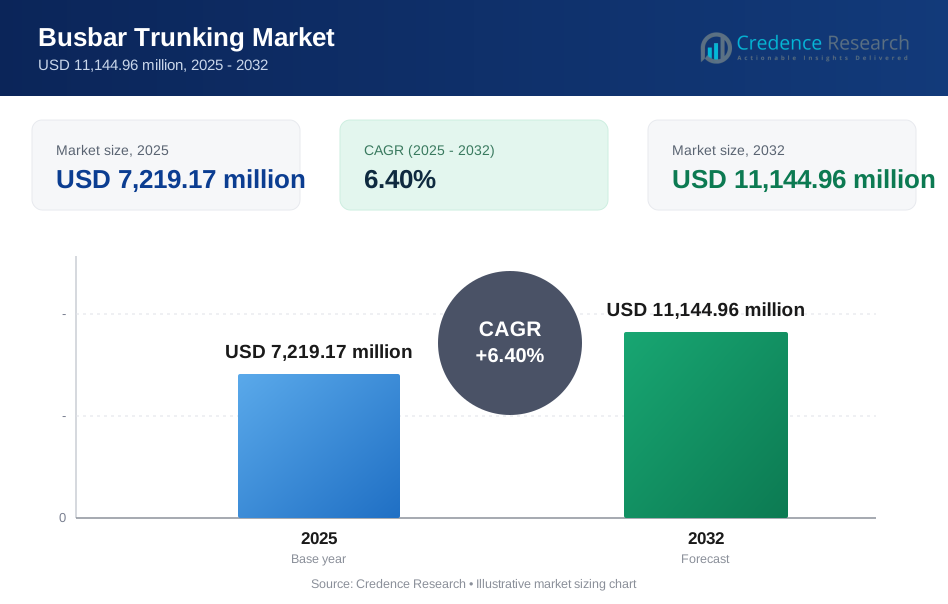
The global Busbar Trunking Market size was estimated at USD 7,219.17 million in 2025 and is expected to reach USD 11,144.96 million by 2032, growing at a CAGR of 6.4% from 2025 to 2032. Rapid electrification of commercial and industrial facilities is strengthening demand for modular, high-current distribution systems that reduce installation complexity and simplify future load expansion. Rising investment in large buildings, industrial modernization, and power-intensive infrastructure is also increasing the need for safer distribution architectures with predictable performance under higher fault and thermal loads.
| REPORT ATTRIBUTE | DETAILS |
|---|---|
| Historical Period | 2020-2024 |
| Base Year | 2025 |
| Forecast Period | 2026-2032 |
| Busbar Trunking Market Size 2025 | USD 7,219.17 million |
| Busbar Trunking Market, CAGR | 6.4% |
| Busbar Trunking Market Size 2032 | USD 11,144.96 million |
Key Market Trends & Insights
- The Busbar Trunking Market is projected to expand at a 6.4% CAGR during 2025–2032, indicating sustained demand across new builds and retrofit projects.
- Asia Pacific held 37.6% share in 2025, supported by ongoing construction activity and expanding industrial power distribution needs.
- Copper accounted for 59.2% share in 2025, reflecting preference for higher conductivity in high-load installations and critical facilities.
- Sandwich insulation represented 66.1% share in 2025, highlighting continued preference for compact, safer routing in space-constrained electrical rooms.
- Industrial end-users contributed 38.9% share in 2025, driven by uptime requirements and higher current-density distribution across factories and process sites.
Segment Analysis
Busbar trunking adoption is closely linked to projects where space, safety, and expandability are critical design requirements. Large commercial facilities such as high-rise buildings, hospitals, malls, and data centers increasingly use busbar trunking to simplify vertical risers and enable structured power distribution that can be modified with minimal disruption. Industrial facilities also value busbar trunking for predictable thermal performance and reduced maintenance compared with conventional cabling in high-current corridors.
Purchasing decisions typically prioritize installation speed, reliability under high loads, and flexibility for future circuit additions. Modular tap-off units and standardized sections help contractors reduce installation time and support staged commissioning. The Busbar Trunking Market also benefits from electrification of new loads such as EV charging areas and expanded building services, where scalable distribution architectures reduce redesign effort during capacity upgrades.
Conductor Material Insights
Copper accounted for the largest share of 59.2% in 2025. Copper leads because higher conductivity supports lower resistive losses and more stable thermal performance in high-current installations. Copper-based systems are also favored in critical facilities where voltage drop control and reliability are higher priority than upfront material cost. Strong performance in dense commercial electrical rooms and industrial corridors reinforces copper preference for feeder and plug-in configurations.
Insulation Type Insights
Sandwich insulation accounted for the largest share of 66.1% in 2025. Sandwich designs lead because compact conductor encapsulation supports higher current density in limited space and improves mechanical protection. Sandwich insulation also aligns with safety and compliance needs in modern buildings where routing paths are congested and fault containment is important. Consistent installation practices and standardized sections strengthen acceptance among contractors and project engineers.
Power Rating Insights
Medium power rating accounted for the largest share of 35.4% in 2025. Medium ratings lead because medium ranges match common building and industrial load bands without overspecifying system cost. Medium segments also fit retrofit upgrades where capacity expansion is required but full high-rating replacement is unnecessary. Balanced economics and broad applicability across commercial services and industrial feeders keep medium power rating systems the most widely deployed choice.
End-User Insights
Industrial end-user accounted for the largest share of 38.9% in 2025. Industrial demand leads because factories and process plants require reliable high-current distribution with low downtime tolerance. Busbar trunking improves maintainability by enabling structured routing and faster modification when production lines change. Industrial buyers also value improved safety and reduced cable clutter in high-load corridors, supporting higher penetration versus traditional cabling.
Busbar Trunking Market Drivers
Accelerating commercial construction and vertical power distribution needs
Commercial building development is expanding demand for compact, modular distribution systems that reduce cable congestion and simplify riser design. Busbar trunking supports structured routing across floors and allows quick circuit additions when tenants change. Contractors benefit from standardized sections that reduce installation time and improve consistency across large projects. Data centers, hospitals, and large campuses also value predictable performance under higher load density and tighter safety requirements.
- For instance, Schneider Electric’s Canalis KS vertical distribution busbar is available in a 2.5 m, 630 A configuration with 4 tap-off outlets, while the wider KSA range is positioned for power distribution from 100 A up to 1000 A, showing how standardized riser sections can support dense multi-floor layouts without extensive recabling.
Industrial modernization and higher current-density requirements
Industrial facilities are upgrading power distribution to support automation, electrified processes, and expanded production capacity. Busbar trunking supports higher current density with simpler routing than conventional cabling in long corridors and service areas. Maintenance teams benefit from accessible, modular layouts that reduce downtime during expansions and reconfigurations. Reliability needs in high-load environments strengthen adoption of busbar trunking for both feeder backbones and distributed tap-offs.
- For instance, Siemens states that its SIVACON 8PS LI system covers 800 A to 6300 A, and its LD-system tap-off units use circuit-breakers designed for up to 1250 A with arc-fault resistance, which aligns well with the uptime and current-density requirements of automated manufacturing lines.
Electrification of new loads and flexible capacity expansion
New electrical loads such as EV charging zones, advanced HVAC, and digital infrastructure require scalable distribution that can be expanded without major redesign. Busbar trunking enables staged capacity upgrades by adding sections and tap-off points rather than replacing full cable runs. Modular architectures also reduce disruption during commissioning and future retrofits. The Busbar Trunking Market benefits when owners prioritize lifecycle flexibility and faster change management.
Safety, compliance, and improved system organization
Electrical safety expectations are increasing across commercial and industrial facilities, raising demand for organized distribution layouts with controlled fault pathways. Busbar trunking reduces cable clutter and supports cleaner segregation of circuits, improving maintainability and inspection outcomes. Insulated systems help protect conductors and reduce accidental contact risks in service areas. Compliance-driven upgrades and standardized engineering practices reinforce adoption in regulated sectors and critical facilities.
Busbar Trunking Market Challenges
Busbar trunking projects can face higher upfront cost sensitivity compared with conventional cabling, especially in price-driven tenders. Specification alignment across designers, contractors, and owners can also delay adoption when familiarity is limited. Project teams must ensure correct rating selection, joint integrity, and protection coordination to avoid performance issues. Supply chain constraints on metals and components can create lead-time variability that affects construction schedules.
Retrofitting existing facilities can be complex when routing paths are constrained and shutdown windows are limited. Interface requirements with legacy switchgear and distribution boards may increase engineering effort and installation risk. Thermal management and fault containment expectations require careful design, testing, and commissioning discipline. Skills gaps among installers can also raise rework probability, especially in high-load industrial corridors and dense commercial electrical rooms.
- For instance, Siemens states that its SIVACON 8PS busbar trunking portfolio covers 40 A to 6300 A, supports load tap-offs up to 1250 A, can use fixing-center distances of up to 4 m in some applications, and reports a fire load of 1.32 kWh/m for the BD2A-250 system versus 5.19 kWh/m for comparable cables, which is why retrofit projects still demand careful routing, installation quality, and protection planning in confined electrical spaces.
Busbar Trunking Market Trends and Opportunities
Data centers are expanding as a high-value opportunity area, supported by higher rack densities and frequent capacity upgrades. Busbar trunking supports structured power distribution and faster change management for expanding white and gray space requirements. Demand is also rising for engineered, modular packages that reduce onsite labor and improve installation repeatability. Standardized product families with configurable tap-offs and monitoring options are gaining preference for lifecycle visibility.
Electrification trends are creating opportunities in EV charging hubs, logistics parks, and mixed-use developments that require scalable outdoor and indoor distribution. Busbar trunking enables staged deployment across multiple charging points and simplifies future additions as utilization increases. Growth is also supported by building modernization programs where owners upgrade distribution to improve safety and reduce downtime. Partnerships with contractors and EPC firms can accelerate specification wins and recurring project pipelines.
- For instance, Schneider Electric says its Canalis for EV solution is compatible with over 20 chargers, and its EV support hardware is specified for 100 A to 400 A applications, giving site operators a measurable pathway for phased charging-point expansion across indoor and outdoor installations.
Regional Insights
North America
North America held 28.7% share in 2025, supported by strong commercial construction activity and steady upgrades across industrial facilities. The region shows consistent adoption in data centers and large commercial buildings where modular distribution reduces downtime during future expansions. Engineering-driven procurement and strict safety expectations also encourage standardized solutions that simplify inspection and maintenance. Retrofit demand remains important where legacy facilities modernize power distribution for higher load density.
Europe
Europe captured 19.6% share in 2025, driven by building standards, safety compliance, and modernization of legacy distribution systems. Commercial retrofits and industrial upgrades support demand for organized, space-efficient routing in constrained service areas. Energy efficiency focus strengthens interest in solutions that reduce losses and improve system organization. Project pipelines remain steady in large public buildings, transport facilities, and manufacturing sites.
Asia Pacific
Asia Pacific accounted for 37.6% share in 2025, reflecting strong construction pipelines and continued industrial expansion across major economies. High-rise development and campus-style commercial projects support demand for compact riser distribution and rapid installation methods. Industrial growth increases procurement for high-current feeders and structured tap-off architectures. The region remains a key growth engine as electrification spreads across infrastructure and digital facilities.
Latin America
Latin America represented 5.2% share in 2025, supported by selective commercial development and industrial modernization programs in major economies. Adoption tends to concentrate in high-value projects where expandability and reduced maintenance justify lifecycle economics. Contractor familiarity and budget constraints can limit penetration in lower-complexity builds. Targeted investments in logistics, manufacturing, and large commercial sites create incremental growth potential.
Middle East & Africa
Middle East & Africa held 8.9% share in 2025, supported by large-scale infrastructure projects and commercial construction in key hubs. High-load facilities such as airports, metros, industrial zones, and large commercial complexes favor structured distribution with safety and reliability advantages. Project-based demand can be cyclical, but specification-led wins often repeat across similar developments. Growth is also supported by expanding power-intensive facilities and modernization initiatives.
Competitive Landscape
The Busbar Trunking Market is characterized by global electrical equipment leaders and strong regional manufacturers competing on product breadth, compliance alignment, installation speed, and application engineering support. Differentiation often centers on safety ratings, current capacity ranges, ingress protection options, and modular tap-off flexibility for changing loads. Suppliers also compete through contractor ecosystems, specification influence, and project services that reduce onsite complexity. Portfolio integration with switchgear, protection devices, and building power architectures strengthens vendor positioning in large projects.
ABB Ltd. competes through broad low-voltage distribution portfolios and engineered busway solutions aligned with commercial and industrial project requirements. ABB Ltd. typically emphasizes modularity, reliability, and application-fit configurations across feeder and plug-in architectures. ABB Ltd. benefits from established channel coverage and project engineering capabilities that support specification in complex builds. ABB Ltd. also leverages integrated protection and distribution product families to simplify coordination and lifecycle maintenance.
The industry research and growth report includes detailed analyses of the competitive landscape of the market and information about key companies, including:
- ABB Ltd.
- Schneider Electric SE
- Siemens AG
- Eaton Corporation plc
- Legrand SA
- General Electric / GE
- Larsen & Toubro (L&T)
- Godrej & Boyce Manufacturing Co. Ltd.
- C&S Electric Limited
- EAE Elektrik A.S.
Qualitative and quantitative analysis of companies has been conducted to help clients understand the wider business environment as well as the strengths and weaknesses of key industry players. Data is qualitatively analyzed to categorize companies as pure play, category-focused, industry-focused, and diversified; it is quantitatively analyzed to categorize companies as dominant, leading, strong, tentative, and weak.
Recent Developments
- In May 2025, Schneider Electric launched Canalis for EV in the UK and Ireland, introducing a scalable busbar solution designed to support electric vehicle charging infrastructure with easier expansion, lower installation time, and reduced maintenance needs.
- In May 2025, Legrand announced the acquisition of Power Bus Way, a North American specialist in Cable Bus power busbars mainly serving data centers, expanding Legrand’s reach in busbar-based power distribution for digital infrastructure.
- In June 2025, Eaton and Siemens Energy entered into a partnership to accelerate new data center capacity, with Eaton set to provide electrical equipment including busways, switchgear, UPS systems, and related power infrastructure for modular deployments.
- In June 2025, Schneider Electric expanded its partner ecosystem through its Canalis Busbar Programme by certifying BMS Services, Metricab Power Engineering, and JA Richardson, a move aimed at improving delivery and installation capability for busbar-based power distribution projects
- In June 2025, Legrand announced the acquisition of Linkk Busway Systems, a Malaysia-based specialist in power busbars for data centers, as part of its strategy to strengthen its position in fast-growing data center power distribution.
Report Scope
| Report Attribute | Details |
| Market size value in 2025 | USD 7,219.17 million |
| Revenue forecast in 2032 | USD 11,144.96 million |
| Growth rate (CAGR) | 6.4% (2025–2032) |
| Base year | 2025 |
| Forecast period | 2026-2032 |
| Quantitative units | USD million |
| Segments covered | By Conductor Material Outlook: Copper, Aluminum; By Insulation Type Outlook: Air Insulation, Sandwich Insulation; By Power Rating Outlook: Lighting, Low, Medium, High; By End-User Outlook: Residential, Commercial, Industrial |
| Regional scope | North America, Europe, Asia Pacific, Latin America, Middle East & Africa |
| Key companies profiled | ABB Ltd., Schneider Electric SE, Siemens AG, Eaton Corporation plc, Legrand SA, General Electric / GE, Larsen & Toubro (L&T), Godrej & Boyce Manufacturing Co. Ltd., C&S Electric Limited, EAE Elektrik A.S. companies |
| No.of Pages | 336 |
Segmentation
By Conductor Material
- Copper
- Aluminum
By Insulation Type
- Air Insulation
- Sandwich Insulation
By Power Rating
- Lighting
- Low
- Medium
- High
By End-User
- Residential
- Commercial
- Industrial
By Region
- North America
- U.S.
- Canada
- Mexico
- Europe
- Germany
- France
- U.K.
- Italy
- Spain
- Rest of Europe
- Asia Pacific
- China
- Japan
- India
- South Korea
- South-east Asia
- Rest of Asia Pacific
- Latin America
- Brazil
- Argentina
- Rest of Latin America
- Middle East & Africa
- GCC Countries
- South Africa
- Rest of the Middle East and Africa
Request a Free Sample
Fill in your details and we'll send you a free sample report.
- Sample data tables & charts
- Research methodology
Need a Custom Version of This Report?
Tailor the scope, geography, or segments to your exact requirements.
- Custom geography or segment scope
- Direct access to our analyst team
Frequently Asked Questions
What is the market size and forecast for the Busbar Trunking Market?
What is the CAGR for the Busbar Trunking Market?
What is the largest segment in the Busbar Trunking Market?
What factors are driving growth in the Busbar Trunking Market?
Who are the leading companies in the Busbar Trunking Market?
Which region leads the Busbar Trunking Market?
Table of Content
Chapter 1 Market Segmentation
- 1.1 Segmentation Framework
- 1.1.1 Product and Service Classification
- 1.1.2 Application and End-Use Classification
- 1.1.3 Technology and Solution Classification
- 1.1.4 Customer and Distribution Channel Classification
- 1.1.5 Geographic Segmentation
- 1.1.6 Market Segment Definitions and Boundaries
Chapter 2 Introduction
- 2.1 Report Objectives and Scope
- 2.2 Product Definition and Industry Terminology
- 2.3 Market Inclusions and Exclusions
- 2.4 Research Process
- 2.4.1 Primary Research and Expert Interviews
- 2.4.2 Secondary Research and Source Review
- 2.4.3 Top-Down and Bottom-Up Estimation
- 2.4.4 Data Triangulation and Verification
- 2.5 Market Size Measurement Basis
- 2.5.1 2025: USD 7,219.17 million → 2032: USD 11,144.96 million
- 2.6 Historical and Forecast Reference Periods
- 2.6.1 Base Year: 2025
- 2.6.2 Forecast Period: 2025-2032
- 2.7 Research Assumptions and Limitations
Chapter 3 Executive Summary
- 3.1 Market Snapshot and Key Findings
- 3.2 Base-Year Market Size, 2025
- 3.3 Forecast Market Size, 2032
- 3.4 Revenue and Volume Growth Outlook
- 3.5 Key Demand and Supply Indicators
- 3.6 Leading Market Segments
- 3.7 Fastest-Growing Market Opportunities
- 3.8 Regional Performance Highlights
- 3.9 Technology and Industry Transformation
- 3.10 Competitive Landscape Summary
- 3.11 Analyst View and Strategic Implications
Chapter 4 Global Busbar Trunking Market Trends and Developments
- 4.1 Historical Industry Development
- 4.2 Recent Market Trends and Developments
- 4.3 Demand and Customer Behavior Trends
- 4.4 Technology and Product Innovation
- 4.5 Artificial Intelligence, Automation and Digitalization
- 4.6 Local Manufacturing and Supply Chain Realignment
- 4.7 Industry Partnerships, Mergers and Acquisitions
- 4.8 Sustainability and Circular Economy Developments
- 4.9 Government and Private Sector Investment Trends
- 4.10 Emerging Business Models and Commercialization
- 4.11 Industry Developments and Announcements
Chapter 5 Global Busbar Trunking Market Production, Supply and Demand Analysis
- 5.1 Demand Trend and Consumption Analysis
- 5.2 Demand Forecast, 2025-2032
- 5.3 Production and Output Trend
- 5.4 Production and Output Forecast, 2025-2032
- 5.5 Installed Capacity and Capacity Utilization
- 5.6 Company-Wise Production Plants and Statistics
- 5.6.1 Installed Production Capacity
- 5.6.2 Actual Production
- 5.6.3 Planned Capacity and Expansion Targets
- 5.7 Supply Chain Structure and Procurement Trends
- 5.8 Supply-Demand Gap and Bottlenecks
- 5.9 Import Dependence and Sourcing Structure
- 5.10 Contract Manufacturing and Outsourcing
- 5.11 Regional Supply and Demand Concentration
Chapter 6 Global Busbar Trunking Market Pricing Analysis
- 6.1 Pricing Structure and Measurement
- 6.2 Historical Pricing Trends
- 6.3 Pricing Outlook, 2025-2032
- 6.4 Average Selling Price and Unit Economics
- 6.5 Pricing by Product and Market Segment
- 6.6 Geographic Pricing Differences
- 6.7 Key Input, Energy, Labor and Logistics Costs
- 6.8 Contract Pricing and Purchasing Models
- 6.9 Pricing Sensitivity and Competitive Positioning
- 6.10 Price, Margin and Profitability Implications
Chapter 7 Global Busbar Trunking Market Dynamics
- 7.1 Market Growth Drivers
- 7.1.1 Demand-Side Drivers
- 7.1.2 Technology and Innovation Drivers
- 7.1.3 Infrastructure and Investment Drivers
- 7.1.4 Regulatory and Policy Drivers
- 7.2 Market Restraints
- 7.2.1 Cost and Affordability Constraints
- 7.2.2 Technology and Adoption Barriers
- 7.2.3 Supply Chain and Operational Constraints
- 7.3 Market Challenges
- 7.3.1 Competitive Pressure and Margin Erosion
- 7.3.2 Skills, Infrastructure and Implementation Gaps
- 7.4 Emerging Market Opportunities
- 7.5 Market Dynamics Impact and Time-Horizon Assessment
Chapter 8 Global Busbar Trunking Value Chain Analysis
- 8.1 Industry Value Chain Overview
- 8.2 Upstream Suppliers and Critical Inputs
- 8.3 Technology and Component Providers
- 8.4 Manufacturing or Service Delivery
- 8.5 Distribution, Channel Partners and Integrators
- 8.6 Downstream Applications and End Users
- 8.7 Value Addition and Profit Pools
- 8.8 Vertical Integration and Outsourcing
- 8.9 Supplier Concentration and Risk
- 8.10 Supply Chain Localization and Resilience
Chapter 9 Global Busbar Trunking Market Regulations and Policies
- 9.1 Relevant Laws, Standards and Compliance Frameworks
- 9.2 Product, Service, Safety and Quality Requirements
- 9.3 Government Policies, Incentives and Subsidies
- 9.4 Imports, Exports and Trade Barriers
- 9.5 Public Procurement and Local Content Requirements
- 9.6 Environmental and Sustainability Compliance
- 9.7 Upcoming Policy Changes and Market Implications
Chapter 10 Global Busbar Trunking Market Hotspots and Opportunities
- 10.1 Market Opportunity Mapping and Growth Hotspots
- 10.2 High-Growth Applications and Customer Groups
- 10.3 Underserved Markets and White-Space Opportunities
- 10.4 Emerging Technology and Product Opportunities
- 10.5 New Capacity and Investment Hotspots
- 10.6 Market Entry and Expansion Opportunities
- 10.7 Distribution and Partnership Opportunities
- 10.8 Near-Term and Long-Term Commercial Potential
- 10.9 Opportunity Attractiveness and Execution Risks
Chapter 11 Global Busbar Trunking Market Outlook, 2025-2032
- 11.1 Market Size and Analysis
- 11.1.1 Revenue (Market Measurement: 2025: USD 7,219.17 million → 2032: USD 11,144.96 million)
- 11.1.2 Market Volume and Quantity Sold
- 11.1.3 Historical Market Size
- 11.1.4 Base-Year Market Size, 2025
- 11.2 Market Forecast, 2025-2032
- 11.2.1 Revenue Forecast to 2032
- 11.2.2 Volume Forecast to 2032
- 11.2.3 CAGR and Year-on-Year Growth
- 11.2.4 Incremental Revenue Opportunity
- 11.3 Forecast Assumptions and Scenario Analysis
- 11.3.1 Base-Case Forecast
- 11.3.2 Optimistic and Conservative Scenarios
- 11.3.3 Technology, Pricing and Policy Sensitivities
- 11.4 Market Attractiveness and Growth Outlook
Chapter 12 Global Busbar Trunking Market Segmentation and Outlook
- 12.1 Segmentation Summary and Market Shares, 2025
- 12.2 Largest and Fastest-Growing Segments
- 12.3 Segment Growth Comparison
- 12.4 Segment Attractiveness and Priority Matrix
Chapter 13 Global Busbar Trunking Geographic Market Outlook, 2025-2032
- 13.1 Regional Market Size and Share, 2025
- 13.2 Regional Market Forecast, 2025-2032
- 13.3 Regional Pricing, Production and Demand Differences
- 13.4 North America
- 13.4.1 United States
- 13.4.2 Canada
- 13.4.3 Mexico
- 13.5 Europe
- 13.5.1 Germany
- 13.5.2 France
- 13.5.3 Italy
- 13.5.4 United Kingdom
- 13.5.5 Spain
- 13.5.6 Poland
- 13.5.7 Russia
- 13.5.8 Netherlands
- 13.5.9 Belgium
- 13.5.10 Sweden
- 13.5.11 Denmark
- 13.5.12 Norway
- 13.5.13 Rest of Europe
- 13.6 Asia Pacific
- 13.6.1 China
- 13.6.2 India
- 13.6.3 Japan
- 13.6.4 South Korea
- 13.6.5 Thailand
- 13.6.6 Indonesia
- 13.6.7 Vietnam
- 13.6.8 Malaysia
- 13.6.9 Australia
- 13.6.10 Rest of Asia Pacific
- 13.7 Latin America
- 13.7.1 Brazil
- 13.7.2 Argentina
- 13.7.3 Colombia
- 13.7.4 Chile
- 13.7.5 Rest of Latin America
- 13.8 Middle East
- 13.8.1 Saudi Arabia
- 13.8.2 United Arab Emirates
- 13.8.3 Turkey
- 13.8.4 Israel
- 13.8.5 Iran
- 13.8.6 Rest of the Middle East
- 13.9 Africa
- 13.9.1 South Africa
- 13.9.2 Egypt
- 13.9.3 Nigeria
- 13.9.4 Morocco
- 13.9.5 Rest of Africa
- 13.10 Regional Investment, Policy and Supply Chain Differences
- 13.11 Regional Competitive Landscape
- 13.12 Geographic Growth Hotspots
Chapter 14 Global Busbar Trunking Technology, Innovation and Sustainability Outlook
- 14.1 Technology Landscape and Maturity
- 14.2 Product, Process and Service Innovation
- 14.3 AI, Automation and Digital Tools in the Industry
- 14.4 Technology Adoption and Performance Benchmarking
- 14.5 Innovation Pipeline and R&D Investment
- 14.6 Patent and Intellectual Property Trends
- 14.7 Energy Efficiency and Resource Management
- 14.8 Sustainability, Recycling and Circularity
- 14.9 Technology Roadmap, 2025-2032
- 14.10 Risks of Obsolescence and Technology Substitution
Chapter 15 Global Busbar Trunking Market Key Strategic Imperatives
- 15.1 Growth and Market Entry Priorities
- 15.2 High-Return Products and Segments
- 15.3 Pricing, Profitability and Cost Optimization
- 15.4 Technology Investment and Product Differentiation
- 15.5 Supply Chain Localization and Resilience
- 15.6 Distribution and Customer Acquisition
- 15.7 Partnership, Acquisition and Capacity Strategy
- 15.8 Regional Expansion Priorities
- 15.9 Short-, Medium- and Long-Term Actions
Chapter 16 Competition Outlook
- 16.1 Industry Competition Characteristics
- 16.2 Market Structure and Concentration
- 16.3 Market Share and Competitive Positioning, 2025
- 16.4 Company-Wise Revenue and Product Benchmarking
- 16.5 Production and Service Capacity Benchmarking
- 16.6 Technology, Pricing and Differentiation
- 16.7 Regional Footprint and Distribution Strength
- 16.8 Mergers, Acquisitions and Strategic Alliances
- 16.9 New Entrants and Competitive Threats
- 16.10 Porter's Five Forces and Industry Attractiveness
- 16.11 Competitive Outlook, 2025-2032
Chapter 17 Company Profiles
- 17.1 Company Coverage and Selection Criteria
- 17.2 Leading Market Participants – Standard Profile Structure
- 17.2.1 Business Description
- 17.2.2 Company Ownership and Geographic Presence
- 17.2.3 Product and Service Portfolio
- 17.2.4 Manufacturing and Operating Footprint
- 17.2.5 Production Capacity and Expansion Plans
- 17.2.6 Financial Performance and Investment
- 17.2.7 Market Share and Competitive Position
- 17.2.8 Technology and Innovation Capabilities
- 17.2.9 Strategic Alliances or Partnerships
- 17.2.10 Recent Developments
- 17.2.11 Growth Strategy and Outlook
- 17.3 Other Relevant Market Participants
Note: Every listed company is profiled on the structure shown under the first company. The company list is preliminary and may change based on research findings, market developments, data availability and client requirements.
Chapter 18 Disclaimer
- 18.1 Research and Forecast Disclaimer
- 18.2 Data Source and Estimation Limitations
Note: The depth of individual sections depends on data availability for this market. Volume, capacity, trade and other unit-based metrics are included where applicable.