
Cardiac Arrhythmia Therapeutics Market Overview:
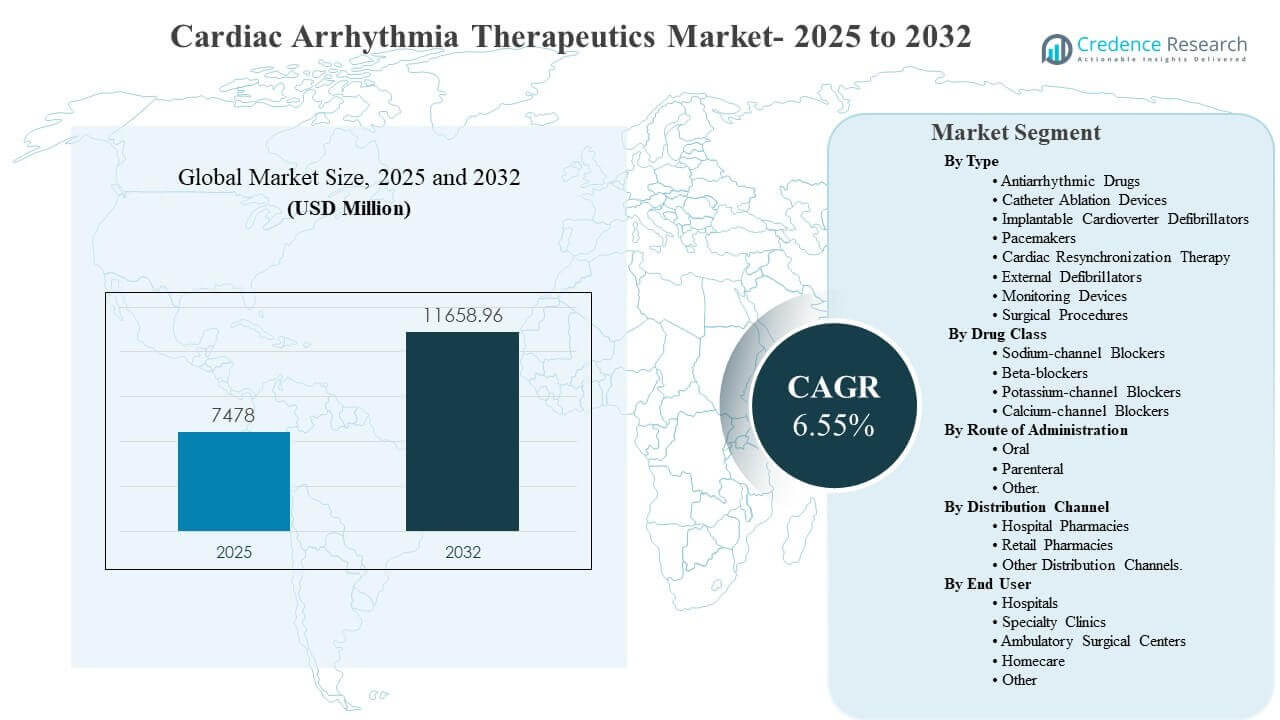
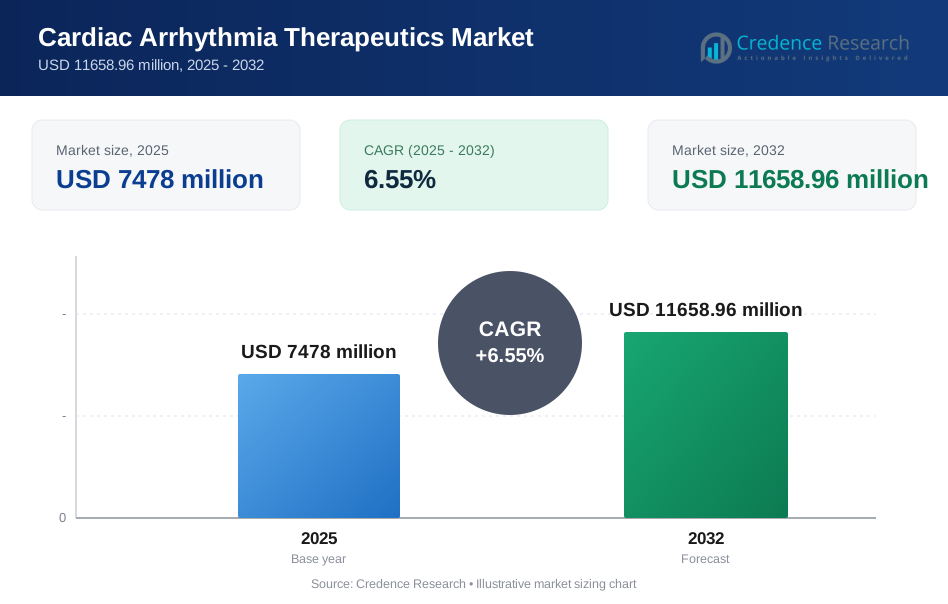
The global Cardiac Arrhythmia Therapeutics Market size was estimated at USD 7478 million in 2025 and is expected to reach USD 11658.96 million by 2032, growing at a CAGR of 6.55% from 2025 to 2032. Growth is primarily driven by the rising burden of atrial fibrillation and other rhythm disorders that require long-term pharmacotherapy, procedural intervention, and device implantation across acute and chronic care pathways. North America and Europe continue to anchor near-term demand, supported by established electrophysiology services and broader access to advanced device therapy.
| REPORT ATTRIBUTE | DETAILS |
|---|---|
| Historical Period | 2020-2024 |
| Base Year | 2025 |
| Forecast Period | 2026-2032 |
| Cardiac Arrhythmia Therapeutics Market Size 2025 | USD 7478 million |
| Cardiac Arrhythmia Therapeutics Market, CAGR | 6.55% |
| Cardiac Arrhythmia Therapeutics Market Size 2032 | USD 11658.96 million |
Key Market Trends & Insights
- The Cardiac Arrhythmia Therapeutics Market expands from USD 7478 million in 2025 to USD 11658.96 million by 2032 at a CAGR of 6.55% (2025–2032).
- North America accounts for 39.6% share in 2025, reflecting high diagnosis rates and strong adoption of device-led rhythm management.
- Europe holds 31.7% share in 2025, supported by structured arrhythmia care models and steady procedural volumes.
- Implantable device therapies represent the largest category at 51.6% share in 2025, reflecting reliance on ICDs, pacemakers, and CRT for high-risk patients.
- Oral administration dominates with 70.4% share in 2025, indicating the importance of chronic outpatient drug regimens in rhythm control.
Segment Analysis
The Cardiac Arrhythmia Therapeutics Market shows a combined reliance on chronic drug therapy and interventional solutions, with patient risk stratification guiding the balance between pharmacological management and device-based therapy. Oral drugs remain foundational for long-term rhythm and rate control, particularly for patients requiring ongoing outpatient management and repeat medication adjustments. At the same time, technology improvements in implantable systems and follow-up workflows reinforce device adoption for patients with elevated sudden cardiac death risk or persistent symptomatic arrhythmias.
Distribution and care delivery are evolving as healthcare systems expand structured pathways across hospital-based electrophysiology services, specialty clinics, and ambulatory procedural environments. Hospital dispensing remains important for initiation, titration, and peri-procedural medication use, but retail and alternative channels support refill continuity for chronic regimens. Monitoring expansion also strengthens the ecosystem by improving diagnosis, treatment optimization, and post-procedure surveillance, which supports repeat clinical engagement and therapy persistence.
By Type Insights
Implantable device therapies (ICDs, pacemakers, and CRT devices) accounted for the largest share of 51.6% in 2025. This leadership reflects clinical reliance on implantable solutions for patients with high-risk ventricular arrhythmias, bradyarrhythmias, and heart-failure-associated conduction abnormalities. Longer device longevity, improved sensing algorithms, and more standardized follow-up workflows help sustain adoption. Procedural experience and established referral patterns further support consistent demand across advanced cardiac centers.
By Drug Class Insights
Beta-blockers accounted for the largest share of 35.2% in 2025. Broad clinical familiarity, long-standing guideline positioning for rate control, and suitability for chronic use across multiple arrhythmia profiles support leadership. Beta-blockers also fit routine outpatient monitoring and dose optimization, which aligns with long-term care models. Ongoing generic availability and established prescribing habits sustain utilization across both hospital and ambulatory settings.
By Route of Administration Insights
Oral administration accounted for the largest share of 70.4% in 2025. Oral regimens enable long-duration therapy in outpatient settings and support continuity for patients needing maintenance treatment to reduce symptoms and recurrence. Strong adherence programs and repeat refill cycles reinforce volume through retail and alternative channels. Parenteral use remains important for acute rhythm stabilization in inpatient environments, but chronic management continues to favor oral dosing.
By Distribution Channel Insights
Hospital pharmacies accounted for the largest share of 61.1% in 2025. Inpatient initiation, protocol-driven therapy, and peri-procedural medication use in electrophysiology and cardiology units support this dominance. Hospital formulary decisions also shape utilization patterns, especially where therapy selection is standardized across care pathways. Retail and alternative channels continue to expand as chronic patients seek convenient refill access and long-term therapy continuity.
By End User Insights
End-user demand concentrates in hospitals because device implantation, acute rhythm stabilization, and complex diagnostic workflows are typically anchored in tertiary cardiac centers. Specialty clinics and electrophysiology-focused practices contribute through structured follow-up, medication optimization, and referral-based procedure volumes. Ambulatory surgical centers increase relevance where reimbursement and infrastructure support select procedural pathways. Homecare expands alongside remote monitoring, adherence support, and post-procedure surveillance programs that reduce avoidable readmissions.
Cardiac Arrhythmia Therapeutics Market Drivers
Rising Prevalence of Atrial Fibrillation and Age-Related Arrhythmias
The patient pool continues to expand as aging populations increase the incidence of atrial fibrillation, bradyarrhythmias, and ventricular rhythm disorders. Longer survival with cardiovascular comorbidities also raises recurrence and chronic management needs. Clinical systems increasingly identify arrhythmias earlier through routine screening and broader diagnostic coverage. This trend supports sustained demand for long-term drug therapy and escalated intervention for complex cases. Care pathways increasingly require integrated management across outpatient and hospital settings.
- For instance, in the Oxford-led AMALFI randomized trial, iRhythm’s home-based Zio long-term continuous monitoring service detected atrial fibrillation in 6.8% of 5,040 high-risk patients versus 5.4% with usual care, and diagnosis occurred 427 days earlier with the monitoring pathway.
Technology Advancement in Implantable and Procedural Therapies
Device innovation improves clinical confidence in ICDs, pacemakers, and CRT systems through enhanced sensing, longevity, and follow-up integration. Procedural ecosystems also improve through better mapping, ablation energy modalities, and workflow standardization. These improvements reduce barriers to physician adoption and increase suitability for broader patient subsets. The result is stronger conversion from medication-only management to combined procedural and device-led strategies. This driver supports durable category leadership for implantable solutions.
Expansion of Electrophysiology Infrastructure and Specialist Access
Hospitals and specialty cardiac centers continue to expand electrophysiology capacity, supported by dedicated labs and trained clinicians. Increased infrastructure improves access to catheter-based interventions and enables standardized follow-up after device implantation. Greater procedural availability also improves patient referral patterns and diagnosis-to-treatment timelines. This infrastructure growth improves outcomes and supports higher therapy utilization. It also creates demand for complementary monitoring and peri-procedural pharmacotherapy.
Growth of Remote Monitoring and Data-Driven Rhythm Management
Monitoring devices and digital follow-up programs enable continuous surveillance, earlier detection, and faster therapy adjustment. Remote monitoring improves adherence by reinforcing care continuity and reducing missed follow-up visits. These systems also help clinicians refine medication titration and identify candidates for escalation to ablation or implantable therapy. The expanding use of rhythm data increases clinical touchpoints and supports ongoing therapy persistence. This driver strengthens both monitoring adoption and downstream therapeutic demand.
- For instance, Medtronic’s CONNECT trial found that CareLink remote monitoring reduced the median time from a clinically actionable event to physician decision from 22 days to 4.6 days, cut cardiovascular-related hospital stay by 18%, and lowered time to clinical decision by 79%.
Cardiac Arrhythmia Therapeutics Market Challenges
Pricing pressure and procurement controls continue to constrain revenue growth, particularly for widely genericized antiarrhythmic drug classes. Hospitals and payers frequently prioritize cost containment through formulary restrictions and procurement tenders, which can limit branded uptake. Device and procedural costs remain a barrier in cost-sensitive markets, creating uneven access across regions. These dynamics can slow adoption of advanced therapies despite clinical need.
- For instance, Boston Scientific’s FARAPULSE pulsed field ablation platform achieved a 99.6% acute pulmonary vein isolation rate and a 73.3% 12-month treatment success rate in the ADVENT trial, while mean procedure time was 105.8 ± 29.4 minutes versus 123.1 ± 42.1 minutes for thermal ablation.
Clinical complexity also remains a persistent challenge because arrhythmia management requires individualized therapy selection, monitoring, and adverse-event management. Drug–drug interactions, tolerability constraints, and comorbidity burden complicate therapy optimization. Procedural risks, variable response to ablation, and the need for ongoing surveillance can discourage rapid escalation in some settings. Workforce constraints in electrophysiology can also limit procedural capacity, elongating wait times and reducing throughput.
Market Trends and Opportunities
A key trend is the shift toward integrated care models that combine monitoring, pharmacotherapy, procedural intervention, and structured follow-up within unified arrhythmia programs. This approach improves patient stratification, reduces recurrence through timely adjustments, and strengthens adherence through coordinated care. Integrated models also enable better utilization of ambulatory settings for selected procedures, supporting throughput improvements. This creates opportunities for solutions that link diagnostics, therapy selection, and follow-up workflows.
- For instance, Abbott’s mapping-integrated Volt PFA system achieved acute pulmonary vein isolation in 99.1% of 578 treated veins, delivered patient-level acute effectiveness in 98.6% of 146 patients, and reported a 2.7% primary adverse event rate, highlighting how integrated electrophysiology platforms can support more efficient and coordinated arrhythmia care pathways.
Another trend is expanding adoption of remote monitoring and consumer-facing detection tools that increase diagnosis rates and trigger earlier clinical intervention. Earlier identification expands the treated population and supports longer therapy duration across chronic disease management. Broader screening also increases demand for specialty consultations, procedural evaluation, and post-implant surveillance. Opportunities emerge for providers and manufacturers that enable scalable monitoring, simplified follow-up, and data-driven therapy optimization.
Regional Insights
North America (39.6% share in 2025)
North America leads the Cardiac Arrhythmia Therapeutics Market with a 39.6% share in 2025 due to advanced electrophysiology infrastructure, strong access to implantable device therapy, and mature reimbursement pathways. Large hospital systems support protocol-driven care that improves diagnosis-to-treatment timelines for complex arrhythmias. High adoption of monitoring and structured follow-up programs also strengthens therapy persistence in chronic patients. The region remains a core revenue base for both device-led management and long-term pharmacotherapy.
Europe (31.7% share in 2025)
Europe holds 31.7% share in 2025, supported by established cardiology networks and standardized arrhythmia treatment pathways across major economies. Hospitals and specialty centers sustain steady procedural volumes, enabling a balanced mix of medication management and interventional therapy. Structured follow-up practices improve adherence and post-procedure monitoring outcomes. Continued modernization of electrophysiology services supports stable demand growth across the forecast period.
Asia Pacific (17.2% share in 2025)
Asia Pacific accounts for 17.2% share in 2025 as urbanization, improving hospital capacity, and rising awareness of arrhythmia risks expand access to diagnosis and treatment. Growth is supported by increasing procedural capability in metropolitan hospitals and gradual reimbursement expansion in selected markets. Adoption remains uneven across countries, but broader screening programs and infrastructure investment are improving utilization. The region continues to add incremental demand as electrophysiology pathways mature.
Latin America (6.8% share in 2025)
Latin America represents 6.8% share in 2025, constrained by affordability challenges, uneven electrophysiology coverage, and variable reimbursement depth. Demand is concentrated in major private hospitals and top-tier urban centers with access to procedures and implantable devices. Pharmacotherapy remains essential where device access is limited, supporting continued reliance on long-term medications. Gradual infrastructure upgrades and private-sector expansion create selective growth pockets.
Middle East & Africa (4.7% share in 2025)
Middle East & Africa contributes 4.7% share in 2025, with demand concentrated in GCC markets and select North African hubs where tertiary care and specialist services are stronger. Access remains constrained in many countries by infrastructure gaps and affordability barriers for advanced devices and procedures. Hospitals anchor most therapy utilization due to limited outpatient pathway maturity. Targeted investment in cardiac centers and monitoring programs can progressively improve access and utilization.
Competitive Landscape
Competition is shaped by a mix of high-volume generic drug supply, differentiated specialty portfolios, and healthcare-system relationships that influence formulary placement and channel access. Companies compete on reliability of supply, breadth of portfolio across cardiac care, and the ability to support provider adoption through clinical education and distribution consistency. Market positioning is also influenced by channel strategies that balance hospital procurement with outpatient refill continuity, especially for chronic therapy segments.
Mylan N.V. focuses on broad-based pharmaceutical access with emphasis on established molecules and scalable supply capabilities that fit cost-sensitive procurement environments. The company’s strength typically lies in portfolio breadth and commercialization reach, enabling continuity of supply for chronic regimens used in rhythm management and adjacent cardiovascular care. Commercial execution across multiple markets supports steady channel presence, particularly in settings where generic adoption is high.
The industry research and growth report includes detailed analyses of the competitive landscape of the market and information about key companies, including:
- Mylan N.V.
- Teva Pharmaceutical Industries Ltd.
- Pfizer Inc.
- Sanofi
- Upsher-Smith Laboratories, LLC
- Covis Pharma
- Novartis AG
- Mayne Pharma Group Limited
- Eli Lilly and Company
Qualitative and quantitative analysis of companies has been conducted to help clients understand the wider business environment as well as the strengths and weaknesses of key industry players. Data is qualitatively analyzed to categorize companies as pure play, category-focused, industry-focused, and diversified; it is quantitatively analyzed to categorize companies as dominant, leading, strong, tentative, and weak.
Recent Developments
- In January 2026, Milestone Pharmaceuticals launched CARDAMYST (etripamil) nasal spray in U.S. pharmacies for adults with paroxysmal supraventricular tachycardia (PSVT), marking the commercial rollout of a new self-administered arrhythmia therapy. The launch followed the product’s FDA approval on December 12, 2025, and Milestone also introduced patient support and affordability programs to improve access.
- In January 2026, Aptar Pharma and Milestone Pharmaceuticals highlighted their partnership supporting the development and launch of CARDAMYST, with Aptar’s Bidose nasal delivery system enabling the product’s self-administered format for PSVT treatment. Milestone described Aptar as an essential partner in bringing this novel therapy to market, showing how drug-device collaboration is contributing to innovation in cardiac arrhythmia treatment.
- In April 2025, Novartis completed the acquisition of Anthos Therapeutics in a deal valued at up to $3.1 billion, with $925 million paid upfront. The acquisition returned abelacimab to Novartis and expanded its cardiovascular pipeline, including therapies relevant to clot prevention in patients affected by rhythm-related conditions such as atrial fibrillation.
Report Scope
| Report Attribute | Details |
| Market size value in 2025 | USD 7478 million |
| Revenue forecast in 2032 | USD 11658.96 million |
| Growth rate (CAGR) | 6.55% (2025–2032) |
| Base year | 2025 |
| Forecast period | 2026-2032 |
| Quantitative units | USD million |
| Segments covered | By Type Outlook: Antiarrhythmic Drugs, Catheter Ablation Devices, Implantable Cardioverter Defibrillators (ICDs), Pacemakers, Cardiac Resynchronization Therapy (CRT) Devices, External Defibrillators, Monitoring Devices, Surgical Procedures, Others; By Drug Class Outlook: Sodium-channel Blockers, Beta-blockers, Potassium-channel Blockers, Calcium-channel Blockers, Others; By Route of Administration Outlook: Oral, Parenteral, Other; By Distribution Channel Outlook: Hospital Pharmacies, Retail Pharmacies, Other Distribution Channels; By End User Outlook: Hospitals, Specialty Clinics, Ambulatory Surgical Centers, Homecare, Other |
| Regional scope | North America, Europe, Asia Pacific, Latin America, Middle East & Africa |
| Key companies profiled | Mylan N.V.; Teva Pharmaceutical Industries Ltd.; Pfizer Inc.; Sanofi; Upsher-Smith Laboratories, LLC; Covis Pharma; Novartis AG; Mayne Pharma Group Limited; Eli Lilly and Company |
| No.of Pages | 330 |
Segmentation
By Type
- Antiarrhythmic Drugs
- Catheter Ablation Devices
- Implantable Cardioverter Defibrillators (ICDs)
- Pacemakers
- Cardiac Resynchronization Therapy (CRT) Devices
- External Defibrillators
- Monitoring Devices
- Surgical Procedures
- Others
By Drug Class
- Sodium-channel Blockers
- Beta-blockers
- Potassium-channel Blockers
- Calcium-channel Blockers
- Others
By Route of Administration
- Oral
- Parenteral
- Other
By Distribution Channel
- Hospital Pharmacies
- Retail Pharmacies
- Other Distribution Channels
By End User
- Hospitals
- Specialty Clinics
- Ambulatory Surgical Centers
- Homecare
- Other
By Region
- North America
- U.S.
- Canada
- Mexico
- Europe
- Germany
- France
- U.K.
- Italy
- Spain
- Rest of Europe
- Asia Pacific
- China
- Japan
- India
- South Korea
- South-east Asia
- Rest of Asia Pacific
- Latin America
- Brazil
- Argentina
- Rest of Latin America
- Middle East & Africa
- GCC Countries
- South Africa
- Rest of the Middle East and Africa
Request a Free Sample
Fill in your details and we'll send you a free sample report.
- Sample data tables & charts
- Research methodology
Need a Custom Version of This Report?
Tailor the scope, geography, or segments to your exact requirements.
- Custom geography or segment scope
- Direct access to our analyst team
Frequently Asked Questions
What is the market size of the Cardiac Arrhythmia Therapeutics Market in 2025 and its forecast for 2032?
What is the CAGR of the Cardiac Arrhythmia Therapeutics Market during 2025–2032?
Which segment is the largest in the market by type?
What are the key factors driving market growth?
Who are the leading companies operating in this market?
Which region leads the Cardiac Arrhythmia Therapeutics Market in 2025?
Table of Content
Chapter 1. Report Introduction
- 1.1 Report Description & Purpose
- 1.1.1 Report Title & Market Definition
- 1.1.2 Unique Selling Propositions (USP) & Key Differentiators
- 1.1.3 Value Proposition for Stakeholders
- 1.2 Research Objectives
- 1.2.1 Market Sizing Objectives (Volume & Revenue)
- 1.2.2 Segmentation Objectives
- 1.2.3 Competitive Intelligence Objectives
- 1.2.4 Forecast & Scenario Objectives
- 1.3 Report Scope
- 1.3.1 Cardiac Arrhythmia Therapeutics Scope – Types & Subtypes Covered
- 1.3.2 Geographic Scope – Regions & Countries Covered
- 1.3.3 Historical Period, Base Year & Forecast Period (2025; forecast to 2032)
- 1.3.4 Inclusions & Exclusions
- 1.4 HS Code & Classification Framework
- 1.5 Currency, Units & Pricing Basis
- 1.6 Target Stakeholders
- 1.7 Limitations & Assumptions
Chapter 2. Executive Summary
- 2.1 Global Cardiac Arrhythmia Therapeutics Market Snapshot
- 2.1.1 Market Size – Historical (2025) & Forecast (2025-2032) (2025: USD 7478 million → 2032: USD 11658.96 million)
- 2.1.2 Volume & Revenue – Global Totals
- 2.1.3 Key Market Highlights – Top Five Facts
- 2.2 Cardiac Arrhythmia Therapeutics Market Segmentation Snapshot
- 2.2.1 Market Split by Region – 2025 vs. 2032
- 2.3 Competitive Snapshot
- 2.3.1 Top 10 Players by Revenue Share – 2025
- 2.3.2 Top 10 Players by Volume Share – 2025
- 2.3.3 Recent Strategic Developments (18-Month Summary)
- 2.4 Key Investment Highlights & Strategic Conclusions
Chapter 3. Cardiac Arrhythmia Therapeutics Market Dynamics & Industry Analysis
- 3.1 Market Overview & Context
- 3.1.1 Cardiac Arrhythmia Therapeutics Market Position in the Broader Automotive Value Chain
- 3.1.2 OEM vs. Replacement Market Dynamics
- 3.1.3 Market Maturity & Development Stage by Region
- 3.2 Cardiac Arrhythmia Therapeutics Market Drivers
- 3.3 Cardiac Arrhythmia Therapeutics Market Restraints & Challenges
- 3.4 Cardiac Arrhythmia Therapeutics Market Opportunities
- 3.5 Porter's Five Forces Analysis
- 3.5.1 Threat of New Entrants
- 3.5.2 Bargaining Power of Suppliers
- 3.5.3 Bargaining Power of Buyers
- 3.5.4 Threat of Substitutes
- 3.5.5 Competitive Rivalry – Intensity Assessment
- 3.6 Cardiac Arrhythmia Therapeutics Value Chain Analysis
- 3.6.1 Upstream – Raw Material/Input Suppliers
- 3.6.1.1 Raw Material/Input 1
- 3.6.1.2 Raw Material/Input 2
- 3.6.1.3 Raw Material/Input 3
- 3.6.2 Midstream – Production/Manufacturing/Service Delivery
- 3.6.2.1 Production/Process Overview
- 3.6.2.2 Key Facility Locations & Capacity by Manufacturer
- 3.6.3 Downstream – Distribution & End Consumer
- 3.6.3.1 Primary Channel – B2B/OEM
- 3.6.3.2 Secondary Channels – Dealer, Retail, Online, Direct
- 3.6.4 Value Chain Profitability Analysis
- 3.6.1 Upstream – Raw Material/Input Suppliers
- 3.7 PESTEL Analysis
- 3.7.1 Political Factors
- 3.7.2 Economic Factors
- 3.7.3 Social Factors
- 3.7.4 Technological Factors
- 3.7.5 Environmental Factors
- 3.7.6 Legal Factors
- 3.8 Cardiac Arrhythmia Therapeutics Supply Chain Analysis
- 3.8.1 Raw Material/Input Supply Risk Assessment
- 3.8.2 Manufacturing Concentration Risk (Geographic Exposure)
- 3.8.3 Trade Disruption Impact Analysis
- 3.9 Regulatory & Policy Landscape
Note: The regulatory and policy landscape section covers regulations based on their applicability to the market, Cardiac Arrhythmia Therapeutics category, geography, and scope of the study. Only regulatory frameworks with a material impact on operations, compliance, trade, sustainability, or market access are analyzed in detail.
Chapter 4. Key Investment Pockets & Opportunity Analysis
- 4.1 Cardiac Arrhythmia Therapeutics Market Attractiveness Analysis
- 4.1.1 By Region – Investment Attractiveness Matrix (Volume × CAGR)
- 4.2 Absolute Revenue Growth Opportunity
- 4.2.1 By Region – Absolute USD Growth Through 2032
- 4.3 Incremental Volume Opportunity
- 4.3.1 By Region – Incremental Volume Through 2032
- 4.3.2 Segment – Incremental Volume
- 4.4 Emerging Submarket Opportunity Deep Dive (Subject to Applicability)
- 4.5 Emerging Market Opportunity Scorecards
- 4.5.1 United States
- 4.5.2 Europe
- 4.5.3 Asia
- 4.5.4 Middle East & Africa
Note: Emerging Market Opportunity Scorecards will be included based on relevance and strategic importance. Regions listed are indicative and may vary depending on data availability and market dynamics.
Chapter 5. Cardiac Arrhythmia Therapeutics Import-Export Analysis & Trade Flows
- 5.1 Global Trade Overview
- 5.1.1 Global Export Value by Country (2025)
- 5.1.2 Global Export Volume by Country (2025)
- 5.1.3 Global Import Value by Country (2025)
- 5.1.4 Global Import Volume by Country (2025)
- 5.1.5 Net Trade Balance by Country (2025)
- 5.2 Export Analysis – Segment
- 5.2.1 Type 1 (HS Code)
- 5.2.2 Type 2 (HS Code)
- 5.2.3 Type 3 (HS Code)
- 5.2.4 Type 4 (HS Code)
- 5.2.5 Type 5 (HS Code)
- 5.3 Import Analysis – Segment
- 5.3.1 Type 1 (HS Code)
- 5.3.2 Type 2 (HS Code)
- 5.3.3 Type 3 (HS Code)
- 5.3.4 Type 4 (HS Code)
- 5.3.5 Type 5 (HS Code)
- 5.4 Average Unit Trade Prices
- 5.4.1 Average Export Price – Segment & Country
- 5.4.2 Average Import Price – Segment & Source Country
- 5.4.3 Price Trends (2025)
- 5.5 Key Trade Route Analysis
- 5.5.1 Trade Route 1
- 5.5.2 Trade Route 2
- 5.5.3 Trade Route 3
- 5.5.4 Trade Route 4
- 5.5.5 Trade Route 5
- 5.6 Trade Policy Impact Assessment
- 5.6.1 US Anti-Dumping & Section 301 Tariffs
- 5.6.2 EU Customs Union Impact
- 5.6.3 Major Free Trade Agreements
- 5.6.4 USMCA Rules of Origin
Note: Trade policy analysis will be included only where relevant to the Cardiac Arrhythmia Therapeutics market.
Chapter 6. Competitive Landscape & Company Benchmarking
- 6.1 Cardiac Arrhythmia Therapeutics Market Concentration & Structure
- 6.1.1 Herfindahl-Hirschman Index (HHI) – vs. 2025
- 6.1.2 Tier 1, Tier 2 & Tier 3 Market Structure
- 6.1.3 Global, Regional & Local Player Dynamics
- 6.2 Cardiac Arrhythmia Therapeutics Market Share Analysis – 2025
- 6.2.1 Global Revenue Share by Company
- 6.2.2 Global Volume Share by Company
- 6.2.3 Regional Revenue Share
- 6.2.4 Market Share Evolution ( vs. 2025)
- 6.2.5 OEM Segment Share by Company
- 6.2.6 Replacement Segment Share by Company
- 6.3 Production/Delivery Capacity & Facility Analysis
- 6.3.1 Global Installed Capacity
- 6.3.2 Capacity Utilization Rates
- 6.3.3 Production/Output Volume
- 6.3.4 Facility Locations & Capacity Map
- 6.3.5 Planned Capacity Additions
- 6.4 Cardiac Arrhythmia Therapeutics Competitive Benchmarking Matrix
- 6.4.1 Revenue, Volume, CAGR & Profitability Comparison
- 6.4.2 Channel Revenue Mix
- 6.4.3 Geographic Revenue Exposure
- 6.4.4 R&D Intensity
- 6.4.5 Sustainability Maturity
- 6.5 Strategic Developments in Cardiac Arrhythmia Therapeutics (Last 24 Months)
- 6.5.1 Mergers, Acquisitions & Divestments
- 6.5.2 New Cardiac Arrhythmia Therapeutics Launches
- 6.5.3 Facility Expansions
- 6.5.4 Strategic Alliances, Joint Ventures & Partnerships
- 6.5.5 Distribution Expansion & Market Entry
- 6.5.6 Sustainability & ESG Initiatives
- 6.6 Competitive Strategy Mapping
- 6.6.1 Leader, Challenger, Follower & Niche Classification
- 6.6.2 Pricing Strategy Comparison
- 6.6.3 Channel Strategy Matrix
Note: Strategic developments are included based on their materiality and the availability of reliable information.
Chapter 7. Global Cardiac Arrhythmia Therapeutics Market – By Distribution Channel
- 7.1 Segment Overview
- 7.1.1 Volume & Revenue Split by Channel (2025 & 2032)
- 7.1.2 Channel Mix Evolution (2025-2032)
Chapter 8. Regional Market Analysis – Global Overview
- 8.1 Global Regional Overview
- 8.1.1 Regional Volume Share
- 8.1.2 Regional Revenue Share
- 8.1.3 Regional Volume by Region
- 8.1.4 Regional Revenue by Region
- 8.1.5 Regional Forecast Through 2032
- 8.2 Cross-Regional Segment Analysis
- 8.2.1 By Distribution Channel
- 8.2.2 By Brand/Price Tier
Chapter 9. North America Cardiac Arrhythmia Therapeutics Market
- 9.1 United States
- 9.2 Canada
- 9.3 Mexico
Chapter 10. Europe Cardiac Arrhythmia Therapeutics Market
- 10.1 Germany
- 10.2 France
- 10.3 Italy
- 10.4 United Kingdom
- 10.5 Spain
- 10.6 Poland
- 10.7 Russia
- 10.8 Netherlands
- 10.9 Belgium
- 10.10 Sweden
- 10.11 Denmark
- 10.12 Norway
- 10.13 Rest of Europe
Chapter 11. Asia Pacific Cardiac Arrhythmia Therapeutics Market
- 11.1 China
- 11.2 India
- 11.3 Japan
- 11.4 South Korea
- 11.5 Thailand
- 11.6 Indonesia
- 11.7 Vietnam
- 11.8 Malaysia
- 11.9 Australia
- 11.10 Rest of Asia Pacific
Chapter 12. Latin America Cardiac Arrhythmia Therapeutics Market
- 12.1 Brazil
- 12.2 Argentina
- 12.3 Colombia
- 12.4 Chile
- 12.5 Rest of Latin America
Chapter 13. Middle East Cardiac Arrhythmia Therapeutics Market
- 13.1 Saudi Arabia
- 13.2 United Arab Emirates
- 13.3 Turkey
- 13.4 Israel
- 13.5 Iran
- 13.6 Rest of the Middle East
Chapter 14. Africa Cardiac Arrhythmia Therapeutics Market
- 14.1 South Africa
- 14.2 Egypt
- 14.3 Nigeria
- 14.4 Morocco
- 14.5 Rest of Africa
Chapter 15. Cardiac Arrhythmia Therapeutics Company Profiles
- 15.1 [Company 01]
- 15.1.1 Company Overview
- 15.1.2 Key Management Personnel
- 15.1.3 Products & Services Portfolio
- 15.1.4 Financial Performance
- 15.1.5 Key Market Focus & Geographic Presence
- 15.1.6 Recent Developments & Strategic Initiatives
Note: The company profile list is preliminary and may change based on research findings, market developments, data availability, and client requirements.
Chapter 16. Appendices
- Appendix A – List of Abbreviations & Acronyms
- Appendix B – Industry Classification Code Reference – Full Series
- Appendix C – Production & Capacity Data Tables
- Appendix D – End-Use & Demand Base Tables
- Appendix E – Consumption & Replacement Rate Assumptions
- Appendix F – ASP Reference Tables
- Appendix G – Manufacturing & Facility Database
- Appendix H – Import-Export Data Tables
- Appendix I – Regulatory Summary Tables
- Appendix J – Primary Research Participant List (Anonymized)
- Appendix K – Primary Research Questionnaire Framework
- Appendix L – Data Sources & Bibliography
- Appendix M – Market Size Divergence & Source Comparison
Chapter 17. Research Methodology
- 17.1 Research Framework & Philosophy
- 17.2 Secondary Research – Sources, Hierarchy & Data Extraction
- 17.3 Data Modeling – Bottom-Up & Top-Down Market Sizing
- 17.4 Primary Research – Stakeholder Framework, LOI & Sample Sizes
- 17.5 Forecast Methodology – Regression, Scenario & Sensitivity Analysis
- 17.6 Quality Control – Four-Layer Validation Framework
- 17.7 Limitations & Standard Assumptions
- 17.8 Disclaimer
