
Market Overview:
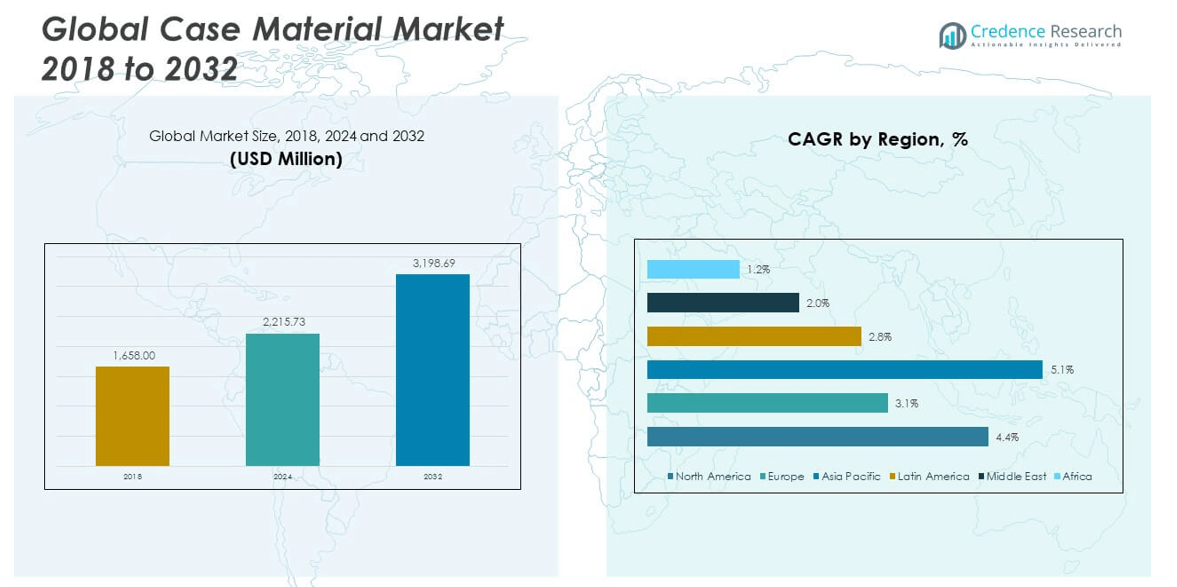
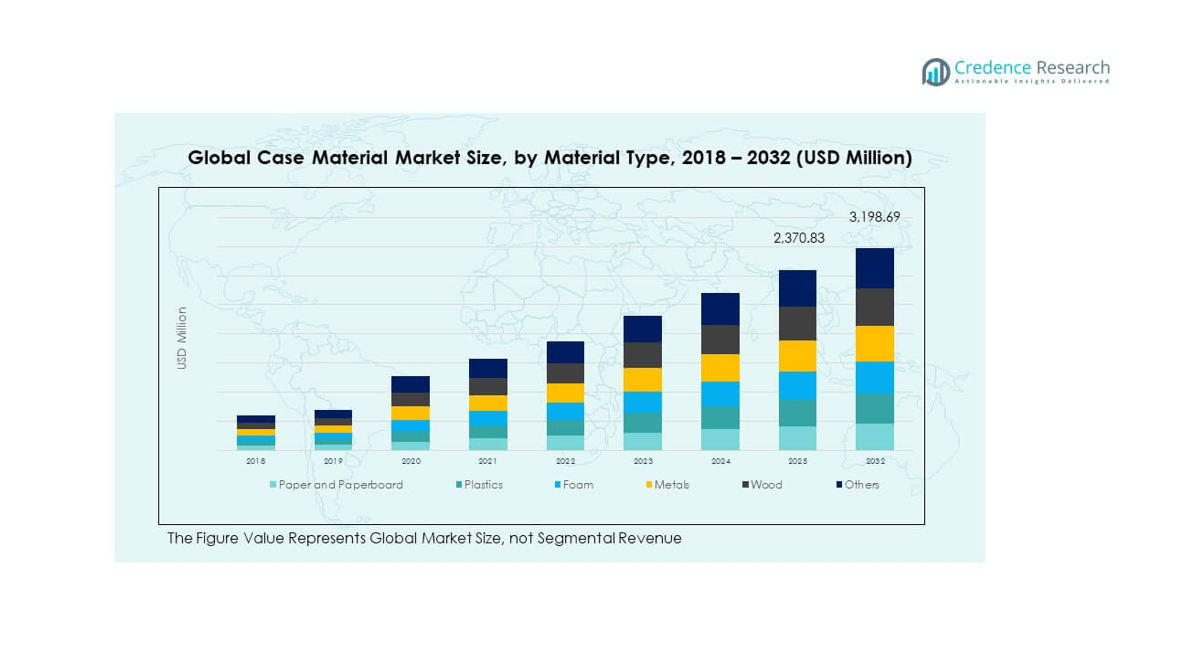
The Global Case Material Market size was valued at USD 1,658.00 million in 2018 to USD 2,215.73 million in 2024 and is anticipated to reach USD 3,198.69 million by 2032, at a CAGR of 4.37% during the forecast period.
| REPORT ATTRIBUTE | DETAILS |
|---|---|
| Historical Period | 2020-2023 |
| Base Year | 2024 |
| Forecast Period | 2025-2032 |
| Case Material Market Size 2024 | USD 2,215.73 million |
| Case Material Market, CAGR | 4.37% |
| Case Material Market Size 2032 | USD 3,198.69 million |
The market is primarily driven by the increasing demand for packaging materials across various sectors such as food and beverage, e-commerce, electronics, and consumer goods. Rising environmental awareness is also pushing manufacturers to adopt recyclable and sustainable paper-based materials like case materials, which are commonly used in corrugated boxes and cartons. The surge in global shipping and logistics activity, particularly with the rise of online retailing, further boosts the need for durable, lightweight, and cost-effective packaging solutions, thereby propelling the market growth.
Geographically, Asia Pacific leads the Global Case Material Market due to strong industrial output and large-scale packaging consumption in countries like China and India. North America and Europe follow with significant demand driven by mature retail infrastructure and growing sustainability regulations. Emerging markets in Latin America and the Middle East are witnessing increased adoption due to expanding manufacturing sectors and the gradual shift towards structured retail, making them important regions for future growth in case material applications.
Market Insights:
- The Global Case Material Market was valued at USD 2,215.73 million in 2024 and is projected to reach USD 3,198.69 million by 2032, growing at a CAGR of 4.37%.
- Rapid growth in e-commerce and logistics sectors is significantly boosting demand for durable and sustainable case materials.
- Increasing preference for paper and paperboard materials is driven by environmental regulations and corporate sustainability goals.
- Price volatility of raw materials like pulp and wood fiber creates cost pressure for manufacturers and limits margin flexibility.
- Asia Pacific leads the Global Case Material Market due to strong industrial activity in China and India and expanding export demand.
- North America shows stable growth, supported by advanced packaging technologies and higher adoption of eco-friendly materials.
- Europe maintains steady demand driven by regulatory compliance and innovation in recyclable packaging solutions.
Market Drivers:
Growing E-commerce and Logistics Demand Driving Packaging Volume
The rapid expansion of e-commerce platforms worldwide significantly contributes to the growth of the Global Case Material Market. Online retailers rely on secure, durable, and cost-efficient packaging to deliver products safely across long distances. Case materials, especially kraft and linerboard, serve this requirement due to their strength and printability. The demand intensifies further during peak shopping seasons and promotional campaigns. Increasing consumer preference for home delivery services compels businesses to invest more in high-quality packaging. Logistics firms also require resilient case materials to minimize transit damage. This evolving consumption pattern boosts the production and utilization of case materials on a global scale. The market benefits from this sustained and scalable demand stream.
Sustainability Mandates Boosting Demand for Recyclable Packaging
The Global Case Material Market gains momentum from rising environmental regulations and consumer awareness surrounding sustainability. Governments across regions are enforcing strict packaging waste directives, leading to a preference for recyclable and biodegradable materials. Case materials offer a lower carbon footprint compared to plastic alternatives and align with circular economy goals. Companies across industries are shifting toward eco-friendly packaging to meet sustainability goals and consumer expectations. This transition drives investments in advanced paper-based case materials with enhanced recyclability and performance. Brands use sustainability-focused packaging to strengthen their image and meet compliance. The shift toward green packaging opens up consistent market potential. It reinforces long-term demand for recyclable case materials across sectors.
- For instance, DHL has rolled out its GoGreen recyclable packaging initiative, offering 100% recyclable boxes certified with the FSC label-ensuring cardboard is sourced from responsibly managed forests.
Expanding Retail and Food Industries Supporting Market Growth
The expansion of the retail and food sectors significantly supports the Global Case Material Market. Supermarkets, hypermarkets, and retail chains use case materials extensively for shelf-ready and transport packaging. Food and beverage companies require high-strength packaging that preserves freshness and ensures safe handling. Case materials fulfill these conditions and allow custom printing for branding. The growing popularity of packaged and processed foods further escalates usage across retail outlets. Rapid urbanization and changing lifestyles contribute to increased consumption of packaged goods. This surge in demand sustains the need for versatile and cost-effective packaging. Manufacturers continue to scale their capacity to serve the growing retail distribution network. It creates a strong foundation for long-term market growth.
- For example, Walmart, in partnership with Denali, introduced the "Zero Depack" technology at more than 1,400 Walmart and Sam’s Club locations across the U.S., automating the separation of expired food from its packaging.
Industrial and Export Sector Expansion Creating Steady Demand
Global industrial output and export volumes continue to fuel the demand for case materials in manufacturing and logistics. The Global Case Material Market benefits from its utility in packaging machinery, electronics, automotive parts, and textiles. Exporters rely on heavy-duty corrugated cases to protect goods during international shipping. Industrial users value case materials for their strength, stackability, and compatibility with automated packing lines. The global push for manufacturing resilience and supply chain localization increases packaging volume requirements. Investments in export infrastructure in developing nations further expand the market scope. These industries view case materials as a reliable solution to reduce product damage and maintain packaging integrity. It positions case material as a preferred medium for secure, scalable packaging.
Market Trends:
Rise of Lightweight and High-Performance Case Materials
The Global Case Material Market is witnessing an increasing trend toward the development and adoption of lightweight case materials. Manufacturers aim to reduce material use while maintaining strength and protective properties. Innovations in fiber processing and coating technologies allow thinner, more resilient case materials. This trend supports cost reduction across transportation and raw material sourcing. High-performance liners with moisture resistance and enhanced load-bearing are gaining traction. The market favors products that balance functionality with sustainability. Lightweight case materials also support automation in packaging lines, improving operational efficiency. This shift shapes procurement strategies across industries.
- For instance, TxV Aero, a U.S.-based startup, engineers bespoke thermoplastic assemblies for aerospace, achieving mass reductions while maintaining strength. Their composites, leveraging advanced ply orientation and near-net shaping, are tailored for high-performance needs in aviation.
Customization and Aesthetic Design Driving Premium Packaging
Brands across industries now emphasize packaging that supports marketing and customer experience, influencing the Global Case Material Market. Custom-printed cases, vibrant branding, and product-specific structural designs are in demand. Case materials that accommodate complex print finishes and die-cut features see increased adoption. This trend is strong in consumer electronics, cosmetics, and food sectors. Companies view packaging as an extension of their brand identity and invest in materials that offer design flexibility. Digital printing technology supports short-run custom designs with high visual impact. Retail-ready packaging also integrates case materials with display functions. The demand for shelf appeal accelerates this trend in urban and retail-centric markets.
Smart Packaging Integration and Traceability Enhancements
Smart packaging technologies are making their way into the Global Case Material Market. Retailers and manufacturers integrate barcodes, QR codes, and RFID tags with printed case materials to enable real-time tracking. This trend enhances inventory management, supply chain visibility, and product authentication. Case materials that can accommodate embedded sensors or conductive inks become essential for tech-enabled logistics. The use of IoT in packaging drives demand for data-compatible substrates. Companies seek packaging that interacts with digital systems for process automation. The trend supports regulatory compliance and customer engagement through digital interfaces. It positions case material as part of a broader intelligent packaging system.
- As an example, Appetite Creative and Tetra Pak collaboratively deployed interactive QR-code-enabled juice packaging in 2024, tracking real-time consumer engagement and integrating personalized digital experiences for shoppers.
Regional Supply Chain Diversification Influencing Design
Geopolitical shifts and global supply chain restructuring impact the Global Case Material Market. Companies reconfigure packaging specifications to suit regional logistics and regulatory norms. This includes adapting case material designs for different weather conditions, transit durations, and handling standards. Demand grows for modular, stackable case designs tailored for intermodal transport. Regional packaging preferences and cost considerations influence fiber composition and coatings. Local sourcing of case materials becomes critical to ensure stability in the face of trade disruptions. The market trend reflects greater emphasis on packaging flexibility, resilience, and cross-border performance. It reshapes how companies select and design their case material solutions.
Market Challenges Analysis:
Raw Material Volatility and Supply Chain Disruptions Impacting Profitability
The Global Case Material Market faces persistent challenges due to volatility in raw material prices and disruptions in the pulp and paper supply chain. The cost of wood pulp, recycled fiber, and energy has shown cyclical spikes, directly affecting input costs. Manufacturers struggle to maintain stable pricing structures amid global inflation and trade restrictions. Supply chain breakdowns caused by geopolitical tensions, pandemics, or logistical bottlenecks create material shortages. These factors hinder consistent production and delivery, affecting customer satisfaction. It impacts small and medium converters more severely due to lower bargaining power. Market players are compelled to diversify suppliers and optimize operations. This instability restrains long-term growth planning for case material producers.
Environmental Compliance Pressure and Waste Management Concerns
Strict global regulations on packaging waste and carbon emissions create operational and compliance challenges in the Global Case Material Market. Producers must meet sustainability benchmarks while maintaining material strength and cost-efficiency. Transitioning to eco-friendly production methods requires capital investment and technical innovation. Managing post-consumer waste and establishing recycling infrastructure across regions remain difficult. The lack of uniform recycling standards complicates reuse and recovery. Regulatory fines and reputational risks increase for non-compliance. Market participants must constantly innovate to align with evolving environmental expectations. It creates financial strain and increases time-to-market for new case material grades.
Market Opportunities:
Expanding Circular Economy Creating Growth Avenues in Recycled Case Material
The growing focus on circular economy principles presents significant opportunities for the Global Case Material Market. Governments and corporations prioritize closed-loop systems that encourage the use of recycled and recyclable packaging. Demand for high-quality recycled kraft and linerboard is growing across industries. It pushes investments in advanced pulping and deinking technologies. Packaging manufacturers view recycled content as a cost-effective and sustainable choice. This trend drives innovation in material recovery, contamination control, and quality enhancement. The availability of certifications for recycled case materials enhances adoption among ESG-conscious companies. It creates a new value chain within the market.
Emerging Markets Opening New Avenues for Industrial Packaging Demand
Developing economies across Asia, Latin America, and Africa offer expanding opportunities for the Global Case Material Market. Industrialization and urbanization in these regions increase demand for protective, scalable packaging. Local manufacturing hubs require reliable packaging solutions for export and regional distribution. The rise of structured retail and e-commerce in emerging markets further supports the adoption of case materials. Investment in logistics infrastructure fuels volume demand from FMCG, electronics, and agriculture sectors. Multinational brands entering these regions prioritize sustainable and compliant packaging. It positions case material as a preferred choice in their localization strategies.
Market Segmentation Analysis:
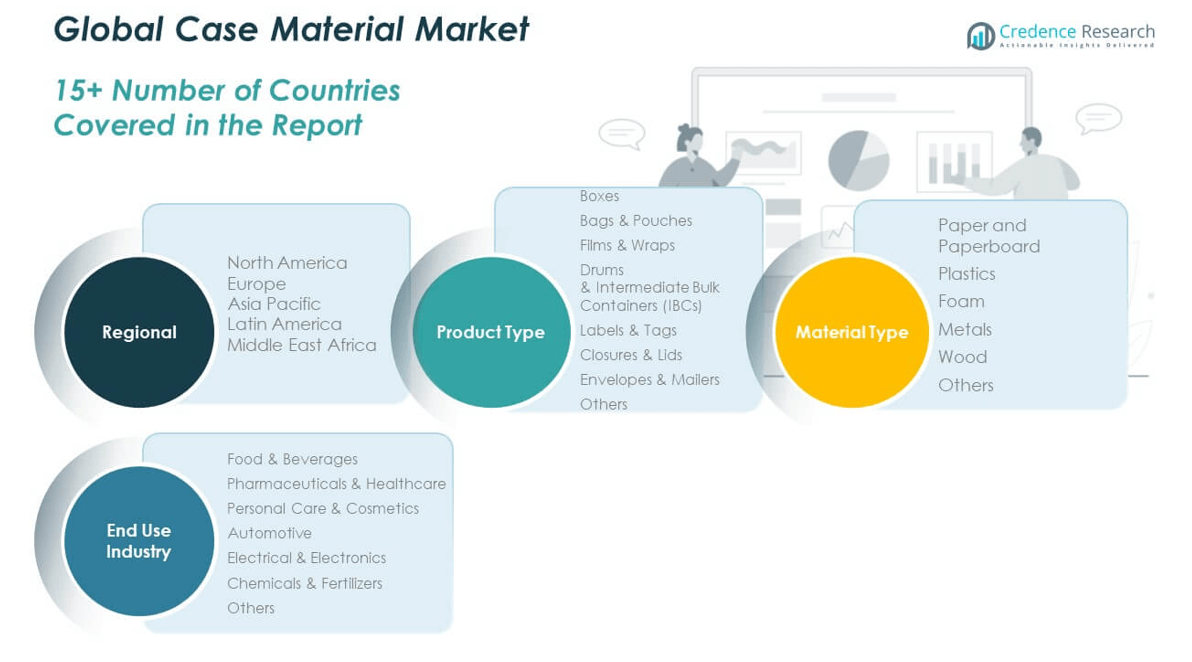
The Global Case Material Market is segmented by product type, material type, end use industry, and region.
By product types, boxes hold a dominant position due to their widespread application in e-commerce, logistics, and retail sectors. Bags & pouches and films & wraps follow, driven by food, cosmetics, and flexible packaging demand. Drums and IBCs cater to industrial applications, while envelopes and mailers gain relevance in the courier and subscription-box industry. Labels, tags, closures, and lids support branding and sealing needs across sectors.
- For example, Avery Dennison, a global labeling leader, demonstrated technological advancement with the launch of its AD LinrSave™ and AD LinrConvert™ linerless decorative label solutions in 2023 at Labelexpo, reducing label waste while maintaining branding and performance.
By material type, paper and paperboard lead the market with growing demand for recyclable and biodegradable options. Plastics remain relevant for durability and moisture resistance, particularly in the food and electronics segments. Foam, metals, and wood serve niche industrial and protective packaging applications.
By end use industries. Food & beverages hold the largest share, followed by pharmaceuticals, personal care, and automotive. Chemicals, electronics, and fertilizers contribute steadily. Regionally, Asia Pacific dominates with high manufacturing output and consumption, while North America and Europe focus on sustainability and innovation. Latin America, the Middle East, and Africa are emerging markets with steady industrialization. The Global Case Material Market adapts to varying regional demands and sector-specific requirements.
- For example, Tetra Pak, a global leader in food and beverage processing and packaging, sold approximately 193 billion packages in 2022 across more than 160 countries, supporting the safety and sustainability of dairy and beverage supply chains worldwide.
Segmentation:
By Product Type:
- Boxes
- Bags & Pouches
- Films & Wraps
- Drums & Intermediate Bulk Containers (IBCs)
- Labels & Tags
- Closures & Lids
- Envelopes & Mailers
- Others
By Material Type:
- Paper and Paperboard
- Plastics
- Foam
- Metals
- Wood
- Others
By End Use Industry:
- Food & Beverages
- Pharmaceuticals & Healthcare
- Personal Care & Cosmetics
- Automotive
- Electrical & Electronics
- Chemicals & Fertilizers
- Others
By Region:
- North America
- U.S.
- Canada
- Mexico
- Europe
- Germany
- France
- U.K.
- Italy
- Spain
- Rest of Europe
- Asia Pacific
- China
- Japan
- India
- South Korea
- South-east Asia
- Rest of Asia Pacific
- Latin America
- Brazil
- Argentina
- Rest of Latin America
- Middle East & Africa
- GCC Countries
- South Africa
- Rest of the Middle East and Africa
Regional Analysis:
North America
The North America Global Case Material Market size was valued at USD 473.10 million in 2018 to USD 622.20 million in 2024 and is anticipated to reach USD 902.06 million by 2032, at a CAGR of 4.4% during the forecast period. North America accounts for 28.08% of the global market in 2024. The region benefits from strong demand across retail, e-commerce, and food packaging sectors. Large-scale distribution networks and advanced packaging technologies support widespread use of high-quality case materials. Regulatory focus on sustainable packaging has accelerated the transition from plastic to paper-based solutions. Manufacturers in the U.S. and Canada invest in lightweight, recyclable materials that align with circular economy goals. Demand for customized and branded packaging continues to grow, influencing product development. Case material suppliers in this region leverage advanced automation and high-capacity mills. It maintains consistent demand through robust industrial and commercial applications.
Europe
The Europe Global Case Material Market size was valued at USD 307.29 million in 2018 to USD 388.00 million in 2024 and is anticipated to reach USD 508.95 million by 2032, at a CAGR of 3.1% during the forecast period. Europe holds 17.51% of the global market share in 2024. Strict environmental regulations and packaging waste directives drive the use of eco-friendly case materials. Countries such as Germany, France, and Italy have mature recycling systems that support recycled kraft and linerboard usage. The European food and beverage industry relies heavily on compliant, traceable packaging formats. Design and print innovations are prioritized to enhance shelf appeal. The market sees growth in e-commerce, particularly in the UK and Western Europe. Paper mills are increasingly shifting to sustainable fiber sourcing. It shows stable demand supported by policy, infrastructure, and advanced material innovation.
Asia Pacific
The Asia Pacific Global Case Material Market size was valued at USD 731.56 million in 2018 to USD 1,013.40 million in 2024 and is anticipated to reach USD 1,551.39 million by 2032, at a CAGR of 5.1% during the forecast period. Asia Pacific dominates with 45.74% market share in 2024, the highest among all regions. China and India lead production and consumption due to rapid industrialization and growth in manufacturing. E-commerce expansion across Southeast Asia drives high-volume packaging requirements. The food, electronics, and textile sectors heavily depend on cost-efficient case materials for transport and retail. Local players and multinational corporations establish capacity expansions to meet growing demand. Government support for sustainable packaging encourages adoption of recycled content. The region benefits from large-scale exports, requiring durable case solutions. It stands as the key growth engine for the global market.
Latin America
The Latin America Global Case Material Market size was valued at USD 78.49 million in 2018 to USD 103.59 million in 2024 and is anticipated to reach USD 132.40 million by 2032, at a CAGR of 2.8% during the forecast period. Latin America holds a 4.67% share of the global market in 2024. Brazil and Mexico are major contributors, driven by growth in processed food, retail, and manufacturing sectors. Packaging companies are increasing capacity to serve domestic and export needs. Rising awareness of eco-friendly packaging is shaping procurement strategies. Infrastructure upgrades in ports and logistics support increased case material use for shipping and storage. Regional manufacturers are exploring fiber optimization to reduce costs. Demand remains stable in urbanized regions with rising consumer product penetration. It continues to show steady growth despite moderate economic conditions.
Middle East
The Middle East Global Case Material Market size was valued at USD 43.49 million in 2018 to USD 52.79 million in 2024 and is anticipated to reach USD 63.41 million by 2032, at a CAGR of 2.0% during the forecast period. The region represents 2.38% of the global market in 2024. The packaging sector is evolving to support growing retail chains and fast-moving consumer goods in the UAE, Saudi Arabia, and Qatar. Investments in logistics and industrial zones support increased use of protective case materials. Awareness of sustainable packaging is growing, though recycling infrastructure is still emerging. Local converters are adopting better-quality kraft paper to meet rising consumer standards. Export-oriented businesses require durable packaging for regional and international shipments. It gradually shifts toward automated and standardized packaging formats. Market growth is moderate but consistent across key economic centers.
Africa
The Africa Global Case Material Market size was valued at USD 24.06 million in 2018 to USD 35.74 million in 2024 and is anticipated to reach USD 40.47 million by 2032, at a CAGR of 1.2% during the forecast period. Africa accounts for 1.61% of the global market in 2024. Economic growth and urbanization are supporting modest demand for packaged goods. South Africa and Egypt lead market adoption due to their relatively developed retail and manufacturing sectors. Case material demand grows with the rise of regional e-commerce and small-scale industrialization. Recycling initiatives are underway but face logistical challenges. Local paper mills are expanding operations to serve domestic demand. Imported packaging materials still meet a portion of consumption in underserved areas. It offers long-term potential as infrastructure and manufacturing capacity improve.
Key Player Analysis:
- Wexxar/BEL Packaging (ProMach)
- Lantech
- Combi Packaging Systems
- Wayne Automation Corporation
- EndFlex
- Pearson Packaging Systems
- Endoline Automation
- Hamrick Manufacturing
- Marq Packaging Systems
- A-B-C Packaging Machine
- AFA Systems
Competitive Analysis:
The Global Case Material Market features a mix of large multinational producers and regional converters competing on quality, capacity, and sustainability credentials. Leading suppliers maintain high operational efficiency through integrated pulp and paper facilities and leverage advanced coating and printing technologies. It offers customized packaging materials tailored to specific industry needs and market trends. Regional players compete by emphasizing local availability, shorter lead times, and lower logistics costs. Several companies invest in research to optimize recycled content and improve fiber performance. Price competition centers on raw material sourcing and manufacturing scale. Quality and compliance with environmental regulations remain critical differentiators. It fosters partnerships with major retail and e-commerce firms seeking consistent supply and performance. Competition intensifies around innovations in lightweight materials and traceable, smart packaging solutions.
Recent Developments:
- In June 2025, Endoline Automation announced a strategic distributor partnership with BBVerpackungsmaschinen, facilitating Endoline's expansion into the German-speaking regions of Germany, Austria, and Switzerland. This partnership will enable BBVerpackungsmaschinen to offer Endoline’s entire range of automated case erecting, packing, and sealing equipment, further boosting Endoline's international presence.
- In January 2025, Lantech was in the news as Lantheus Holdings announced the acquisition of Life Molecular Imaging for $350 million. Although Lantech is not directly mentioned, this highlights ongoing consolidation and growth in adjacent packaging and automation markets.
- In December 2023, Combi Packaging Systems saw a significant corporate event when 3M sold its fifty-percent equity stake in the company to SIAT Group. This transition allows SIAT, an HIG Capital portfolio company, to further expand Combi's capabilities in case taping, wrapping, and strapping automation, strengthening their position in the global market.
Market Concentration & Characteristics:
The Global Case Material Market presents moderate concentration with a few dominant players controlling large production capacities while many regional firms participate at national and local levels. It relies on integrated value chains for pulp, linerboard, and corrugated material, with vertical integration prevailing among market leaders. Demand segmentation across industries such as food, retail, and e-commerce encourages diverse material specifications. It demands consistent quality, regulatory compliance, and sustainable credentials. Product differentiation rests on performance features like moisture resistance, strength, and printability. Companies compete on innovation in eco‑friendly materials and recyclable content. It sustains long-term partnerships with converters, logistics companies, and brand owners focused on supply chain reliability.
Report Coverage:
The research report offers an in-depth analysis based on product type, material type and end use industry. It details leading market players, providing an overview of their business, product offerings, investments, revenue streams, and key applications. Additionally, the report includes insights into the competitive environment, SWOT analysis, current market trends, as well as the primary drivers and constraints. Furthermore, it discusses various factors that have driven market expansion in recent years. The report also explores market dynamics, regulatory scenarios, and technological advancements that are shaping the industry. It assesses the impact of external factors and global economic changes on market growth. Lastly, it provides strategic recommendations for new entrants and established companies to navigate the complexities of the market.
Future Outlook:
- The market will witness rising demand from e-commerce and retail industries driving higher consumption of corrugated packaging.
- Innovation in lightweight, high-strength materials will gain traction to reduce shipping costs and improve efficiency.
- Regulatory shifts toward sustainability will push manufacturers to expand use of recycled fiber and eco-friendly coatings.
- Automation in packaging lines will increase preference for consistent, machine-compatible case materials.
- Growth in Asia Pacific will continue to dominate global expansion due to industrialization and urban consumption trends.
- Premium and customized packaging designs will influence adoption in food, cosmetics, and electronics sectors.
- Manufacturers will invest in smart packaging integration, supporting traceability and inventory optimization.
- Regional sourcing strategies will strengthen to minimize supply chain risks and enhance response times.
- Export-driven industries will require more durable case materials suited for long-haul transit conditions.
- Digital print and short-run packaging needs will create niche opportunities for innovation in case material formats.

Request a Free Sample
Fill in your details and we'll send you a free sample report.
- Sample data tables & charts
- Research methodology
Market Dynamics
E-commerce and Logistics Expansion
The rapid growth of online retail and global logistics networks is driving demand for durable, lightweight, and cost-effective case materials, especially for corrugated boxes and cartons used in shipping and delivery.
Sustainability and Regulatory Mandates
Increasing environmental awareness and stricter regulations on packaging waste are pushing manufacturers and brands to adopt recyclable, biodegradable, and paper-based case materials, accelerating market growth.
Growth in Food, Beverage, and Retail Sectors
The expansion of supermarkets, food processing, and retail chains is fueling demand for high-strength, customizable case materials that ensure product safety, freshness, and branding during transport and display.
Industrialization and Export Growth in Emerging Markets
Rising industrial output and export activities in developing regions, particularly Asia Pacific, are boosting the need for robust case materials to protect goods during manufacturing, storage, and international shipping.
Innovation in Lightweight and High-Performance Materials
Advancements in fiber processing and coating technologies are enabling the production of lighter, stronger, and more efficient case materials, reducing shipping costs and supporting automation in packaging operations.
Need a Custom Version of This Report?
Tailor the scope, geography, or segments to your exact requirements.
- Custom geography or segment scope
- Direct access to our analyst team
Frequently Asked Questions
What is the current market size for the Global Case Material Market, and what is its projected size in 2032?
Which Global Case Material Market segment held the largest share in 2024?
Who are the leading companies in the Global Case Material Market?
Which region commanded the largest share of the Global Case Material Market in 2024?
Table of Content
Chapter 1 Market Segmentation
- 1.1 Segmentation Framework
- 1.1.1 Product and Service Classification
- 1.1.2 Application and End-Use Classification
- 1.1.3 Technology and Solution Classification
- 1.1.4 Customer and Distribution Channel Classification
- 1.1.5 Geographic Segmentation
- 1.1.6 Market Segment Definitions and Boundaries
- 1.2 By Product Type
- 1.2.1 Boxes
- 1.2.2 Bags & Pouches
- 1.2.3 Films & Wraps
- 1.2.4 Drums & Intermediate Bulk Containers (IBCs)
- 1.2.5 Labels & Tags
- 1.2.6 Closures & Lids
- 1.2.7 Envelopes & Mailers
- 1.3 By Material Type
- 1.3.1 Paper and Paperboard
- 1.3.2 Plastics
- 1.3.3 Foam
- 1.3.4 Metals
- 1.3.5 Wood
- 1.4 By End Use Industry
- 1.4.1 Food & Beverages
- 1.4.2 Pharmaceuticals & Healthcare
- 1.4.3 Personal Care & Cosmetics
- 1.4.4 Automotive
- 1.4.5 Electrical & Electronics
- 1.4.6 Chemicals & Fertilizers
Chapter 2 Introduction
- 2.1 Report Objectives and Scope
- 2.2 Product Definition and Industry Terminology
- 2.3 Market Inclusions and Exclusions
- 2.4 Research Process
- 2.4.1 Primary Research and Expert Interviews
- 2.4.2 Secondary Research and Source Review
- 2.4.3 Top-Down and Bottom-Up Estimation
- 2.4.4 Data Triangulation and Verification
- 2.5 Market Size Measurement Basis
- 2.5.1 2024: USD 2,215.73 million → 2032: USD 3,198.69 million
- 2.6 Historical and Forecast Reference Periods
- 2.6.1 Base Year: 2024
- 2.6.2 Forecast Period: 2024-2032
- 2.7 Research Assumptions and Limitations
Chapter 3 Executive Summary
- 3.1 Market Snapshot and Key Findings
- 3.2 Base-Year Market Size, 2024
- 3.3 Forecast Market Size, 2032
- 3.4 Revenue and Volume Growth Outlook
- 3.5 Key Demand and Supply Indicators
- 3.6 Leading Market Segments
- 3.7 Fastest-Growing Market Opportunities
- 3.8 Regional Performance Highlights
- 3.9 Technology and Industry Transformation
- 3.10 Competitive Landscape Summary
- 3.11 Analyst View and Strategic Implications
Chapter 4 Global Case Material Market Trends and Developments
- 4.1 Historical Industry Development
- 4.2 Recent Market Trends and Developments
- 4.3 Demand and Customer Behavior Trends
- 4.4 Technology and Product Innovation
- 4.5 Artificial Intelligence, Automation and Digitalization
- 4.6 Local Manufacturing and Supply Chain Realignment
- 4.7 Industry Partnerships, Mergers and Acquisitions
- 4.8 Sustainability and Circular Economy Developments
- 4.9 Government and Private Sector Investment Trends
- 4.10 Emerging Business Models and Commercialization
- 4.11 Industry Developments and Announcements
Chapter 5 Global Case Material Market Production, Supply and Demand Analysis
- 5.1 Demand Trend and Consumption Analysis
- 5.2 Demand Forecast, 2024-2032
- 5.3 Production and Output Trend
- 5.4 Production and Output Forecast, 2024-2032
- 5.5 Installed Capacity and Capacity Utilization
- 5.6 Company-Wise Production Plants and Statistics
- 5.6.1 Installed Production Capacity
- 5.6.2 Actual Production
- 5.6.3 Planned Capacity and Expansion Targets
- 5.7 Supply Chain Structure and Procurement Trends
- 5.8 Supply-Demand Gap and Bottlenecks
- 5.9 Import Dependence and Sourcing Structure
- 5.10 Contract Manufacturing and Outsourcing
- 5.11 Regional Supply and Demand Concentration
Chapter 6 Global Case Material Market Pricing Analysis
- 6.1 Pricing Structure and Measurement
- 6.2 Historical Pricing Trends
- 6.3 Pricing Outlook, 2024-2032
- 6.4 Average Selling Price and Unit Economics
- 6.5 Pricing by Product and Market Segment
- 6.6 Geographic Pricing Differences
- 6.7 Key Input, Energy, Labor and Logistics Costs
- 6.8 Contract Pricing and Purchasing Models
- 6.9 Pricing Sensitivity and Competitive Positioning
- 6.10 Price, Margin and Profitability Implications
Chapter 7 Global Case Material Market Dynamics
- 7.1 Market Growth Drivers
- 7.1.1 Demand-Side Drivers
- 7.1.2 Technology and Innovation Drivers
- 7.1.3 Infrastructure and Investment Drivers
- 7.1.4 Regulatory and Policy Drivers
- 7.2 Market Restraints
- 7.2.1 Cost and Affordability Constraints
- 7.2.2 Technology and Adoption Barriers
- 7.2.3 Supply Chain and Operational Constraints
- 7.3 Market Challenges
- 7.3.1 Competitive Pressure and Margin Erosion
- 7.3.2 Skills, Infrastructure and Implementation Gaps
- 7.4 Emerging Market Opportunities
- 7.5 Market Dynamics Impact and Time-Horizon Assessment
Chapter 8 Global Case Material Value Chain Analysis
- 8.1 Industry Value Chain Overview
- 8.2 Upstream Suppliers and Critical Inputs
- 8.3 Technology and Component Providers
- 8.4 Manufacturing or Service Delivery
- 8.5 Distribution, Channel Partners and Integrators
- 8.6 Downstream Applications and End Users
- 8.7 Value Addition and Profit Pools
- 8.8 Vertical Integration and Outsourcing
- 8.9 Supplier Concentration and Risk
- 8.10 Supply Chain Localization and Resilience
Chapter 9 Global Case Material Market Regulations and Policies
- 9.1 Relevant Laws, Standards and Compliance Frameworks
- 9.2 Product, Service, Safety and Quality Requirements
- 9.3 Government Policies, Incentives and Subsidies
- 9.4 Imports, Exports and Trade Barriers
- 9.5 Public Procurement and Local Content Requirements
- 9.6 Environmental and Sustainability Compliance
- 9.7 Upcoming Policy Changes and Market Implications
Chapter 10 Global Case Material Market Hotspots and Opportunities
- 10.1 Market Opportunity Mapping and Growth Hotspots
- 10.2 High-Growth Applications and Customer Groups
- 10.3 Underserved Markets and White-Space Opportunities
- 10.4 Emerging Technology and Product Opportunities
- 10.5 New Capacity and Investment Hotspots
- 10.6 Market Entry and Expansion Opportunities
- 10.7 Distribution and Partnership Opportunities
- 10.8 Near-Term and Long-Term Commercial Potential
- 10.9 Opportunity Attractiveness and Execution Risks
Chapter 11 Global Case Material Market Outlook, 2024-2032
- 11.1 Market Size and Analysis
- 11.1.1 Revenue (Market Measurement: 2024: USD 2,215.73 million → 2032: USD 3,198.69 million)
- 11.1.2 Market Volume and Quantity Sold
- 11.1.3 Historical Market Size
- 11.1.4 Base-Year Market Size, 2024
- 11.2 Market Forecast, 2024-2032
- 11.2.1 Revenue Forecast to 2032
- 11.2.2 Volume Forecast to 2032
- 11.2.3 CAGR and Year-on-Year Growth
- 11.2.4 Incremental Revenue Opportunity
- 11.3 Forecast Assumptions and Scenario Analysis
- 11.3.1 Base-Case Forecast
- 11.3.2 Optimistic and Conservative Scenarios
- 11.3.3 Technology, Pricing and Policy Sensitivities
- 11.4 Market Attractiveness and Growth Outlook
Chapter 12 Global Case Material Market Segmentation and Outlook
- 12.1 Segmentation Summary and Market Shares, 2024
- 12.2 Largest and Fastest-Growing Segments
- 12.3 By Product Type - Market Size and Forecast, 2024-2032
- 12.3.1 Segment Definition and Scope
- 12.3.2 Historical Market Size
- 12.3.3 Revenue Forecast, 2024-2032
- 12.3.4 Volume Forecast, 2024-2032
- 12.3.5 Base-Year Market Share, 2024
- 12.3.6 Segment CAGR and Growth Drivers
- 12.3.7 Subsegment Market Size and Forecast
- 12.3.7.1 Boxes
- 12.3.7.2 Bags & Pouches
- 12.3.7.3 Films & Wraps
- 12.3.7.4 Drums & Intermediate Bulk Containers (IBCs)
- 12.3.7.5 Labels & Tags
- 12.3.7.6 Closures & Lids
- 12.3.7.7 Envelopes & Mailers
- 12.3.8 Subsegment Pricing and Adoption Trends
- 12.3.9 Leading Suppliers and Competition
- 12.3.10 Regional Demand and Opportunities
- 12.4 By Material Type - Market Size and Forecast, 2024-2032
- 12.4.1 Segment Definition and Scope
- 12.4.2 Historical Market Size
- 12.4.3 Revenue Forecast, 2024-2032
- 12.4.4 Volume Forecast, 2024-2032
- 12.4.5 Base-Year Market Share, 2024
- 12.4.6 Segment CAGR and Growth Drivers
- 12.4.7 Subsegment Market Size and Forecast
- 12.4.7.1 Paper and Paperboard
- 12.4.7.2 Plastics
- 12.4.7.3 Foam
- 12.4.7.4 Metals
- 12.4.7.5 Wood
- 12.4.8 Subsegment Pricing and Adoption Trends
- 12.4.9 Leading Suppliers and Competition
- 12.4.10 Regional Demand and Opportunities
- 12.5 By End Use Industry - Market Size and Forecast, 2024-2032
- 12.5.1 Segment Definition and Scope
- 12.5.2 Historical Market Size
- 12.5.3 Revenue Forecast, 2024-2032
- 12.5.4 Volume Forecast, 2024-2032
- 12.5.5 Base-Year Market Share, 2024
- 12.5.6 Segment CAGR and Growth Drivers
- 12.5.7 Subsegment Market Size and Forecast
- 12.5.7.1 Food & Beverages
- 12.5.7.2 Pharmaceuticals & Healthcare
- 12.5.7.3 Personal Care & Cosmetics
- 12.5.7.4 Automotive
- 12.5.7.5 Electrical & Electronics
- 12.5.7.6 Chemicals & Fertilizers
- 12.5.8 Subsegment Pricing and Adoption Trends
- 12.5.9 Leading Suppliers and Competition
- 12.5.10 Regional Demand and Opportunities
- 12.6 Segment Growth Comparison
- 12.7 Segment Attractiveness and Priority Matrix
Chapter 13 Global Case Material End-Use and Application Market Outlook
- 13.1 End-Use Industry and Customer Demand Structure
- 13.2 Leading Applications and Customer Groups
- 13.3 End-Use Market Size, Share and Forecast
- 13.4 Major End-Use Industry Deep Dives
- 13.4.1 Customer Requirements and Use Cases
- 13.4.2 Demand and Replacement Cycles
- 13.4.3 Technical and Regulatory Considerations
- 13.4.4 Purchasing and Procurement Models
- 13.4.5 Leading Vendors and Distribution Channels
- 13.4.6 Forecast and Commercial Opportunities
- 13.5 Emerging Applications and Cross-Segment Demand
- 13.6 End-Use Industry Investment Priorities
Chapter 14 Global Case Material Geographic Market Outlook, 2024-2032
- 14.1 Regional Market Size and Share, 2024
- 14.2 Regional Market Forecast, 2024-2032
- 14.3 Regional Pricing, Production and Demand Differences
- 14.4 North America
- 14.4.1 United States
- 14.4.2 Canada
- 14.4.3 Mexico
- 14.5 Europe
- 14.5.1 Germany
- 14.5.2 France
- 14.5.3 Italy
- 14.5.4 United Kingdom
- 14.5.5 Spain
- 14.5.6 Poland
- 14.5.7 Russia
- 14.5.8 Netherlands
- 14.5.9 Belgium
- 14.5.10 Sweden
- 14.5.11 Denmark
- 14.5.12 Norway
- 14.5.13 Rest of Europe
- 14.6 Asia Pacific
- 14.6.1 China
- 14.6.2 India
- 14.6.3 Japan
- 14.6.4 South Korea
- 14.6.5 Thailand
- 14.6.6 Indonesia
- 14.6.7 Vietnam
- 14.6.8 Malaysia
- 14.6.9 Australia
- 14.6.10 Rest of Asia Pacific
- 14.7 Latin America
- 14.7.1 Brazil
- 14.7.2 Argentina
- 14.7.3 Colombia
- 14.7.4 Chile
- 14.7.5 Rest of Latin America
- 14.8 Middle East
- 14.8.1 Saudi Arabia
- 14.8.2 United Arab Emirates
- 14.8.3 Turkey
- 14.8.4 Israel
- 14.8.5 Iran
- 14.8.6 Rest of the Middle East
- 14.9 Africa
- 14.9.1 South Africa
- 14.9.2 Egypt
- 14.9.3 Nigeria
- 14.9.4 Morocco
- 14.9.5 Rest of Africa
- 14.10 Regional Investment, Policy and Supply Chain Differences
- 14.11 Regional Competitive Landscape
- 14.12 Geographic Growth Hotspots
Chapter 15 Global Case Material Technology, Innovation and Sustainability Outlook
- 15.1 Technology Landscape and Maturity
- 15.2 Product, Process and Service Innovation
- 15.3 AI, Automation and Digital Tools in the Industry
- 15.4 Technology Adoption and Performance Benchmarking
- 15.5 Innovation Pipeline and R&D Investment
- 15.6 Patent and Intellectual Property Trends
- 15.7 Energy Efficiency and Resource Management
- 15.8 Sustainability, Recycling and Circularity
- 15.9 Technology Roadmap, 2024-2032
- 15.10 Risks of Obsolescence and Technology Substitution
Chapter 16 Global Case Material Market Key Strategic Imperatives
- 16.1 Growth and Market Entry Priorities
- 16.2 High-Return Products and Segments
- 16.3 Pricing, Profitability and Cost Optimization
- 16.4 Technology Investment and Product Differentiation
- 16.5 Supply Chain Localization and Resilience
- 16.6 Distribution and Customer Acquisition
- 16.7 Partnership, Acquisition and Capacity Strategy
- 16.8 Regional Expansion Priorities
- 16.9 Short-, Medium- and Long-Term Actions
Chapter 17 Competition Outlook
- 17.1 Industry Competition Characteristics
- 17.2 Market Structure and Concentration
- 17.3 Market Share and Competitive Positioning, 2024
- 17.4 Company-Wise Revenue and Product Benchmarking
- 17.5 Production and Service Capacity Benchmarking
- 17.6 Technology, Pricing and Differentiation
- 17.7 Regional Footprint and Distribution Strength
- 17.8 Mergers, Acquisitions and Strategic Alliances
- 17.9 New Entrants and Competitive Threats
- 17.10 Porter's Five Forces and Industry Attractiveness
- 17.11 Competitive Outlook, 2024-2032
Chapter 18 Company Profiles
- 18.1 Company Coverage and Selection Criteria
- 18.2 Wexxar/BEL Packaging (ProMach)
- 18.2.1 Business Description
- 18.2.2 Company Ownership and Geographic Presence
- 18.2.3 Product and Service Portfolio
- 18.2.4 Manufacturing and Operating Footprint
- 18.2.5 Production Capacity and Expansion Plans
- 18.2.6 Financial Performance and Investment
- 18.2.7 Market Share and Competitive Position
- 18.2.8 Technology and Innovation Capabilities
- 18.2.9 Strategic Alliances or Partnerships
- 18.2.10 Recent Developments
- 18.2.11 Growth Strategy and Outlook
- 18.3 Lantech
- 18.4 Combi Packaging Systems
- 18.5 Wayne Automation Corporation
- 18.6 EndFlex
- 18.7 Pearson Packaging Systems
- 18.8 Endoline Automation
- 18.9 Hamrick Manufacturing
- 18.10 Marq Packaging Systems
- 18.11 A-B-C Packaging Machine
- 18.12 Other Relevant Market Participants
Note: Every listed company is profiled on the structure shown under the first company. The company list is preliminary and may change based on research findings, market developments, data availability and client requirements.
Chapter 19 Disclaimer
- 19.1 Research and Forecast Disclaimer
- 19.2 Data Source and Estimation Limitations
Note: The depth of individual sections depends on data availability for this market. Volume, capacity, trade and other unit-based metrics are included where applicable.

