
CDKL5 Deficiency Disorder Market Overview:
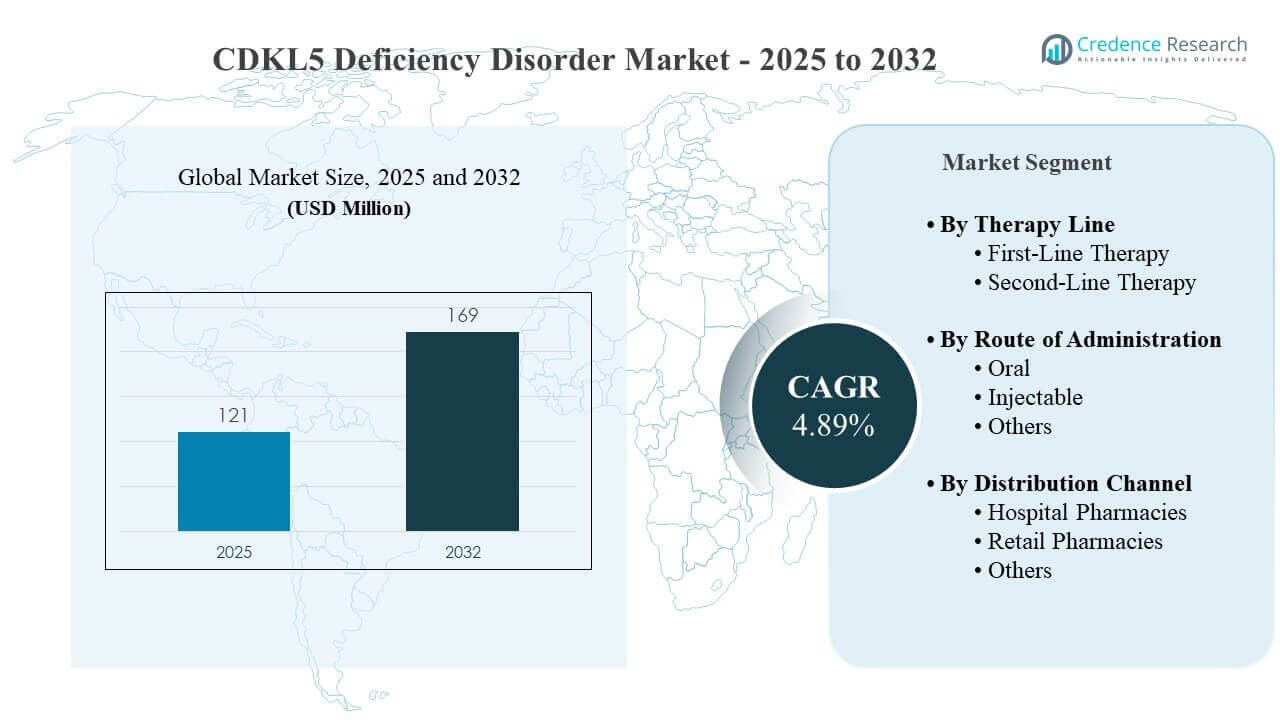
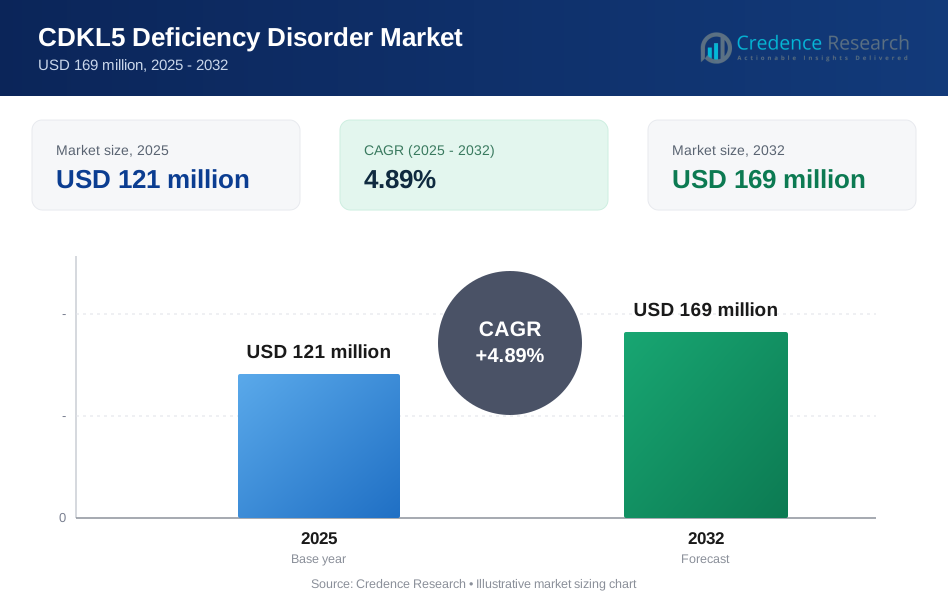
The global CDKL5 Deficiency Disorder Market size was estimated at USD 121 million in 2025 and is expected to reach USD 169 million by 2032, growing at a CAGR of 4.89% from 2025 to 2032. The primary growth driver is the expanding diagnosis and treatment funnel created by faster genetic confirmation, earlier referral into pediatric epilepsy centers, and wider clinical readiness to treat severe developmental and epileptic encephalopathies with targeted or disease-relevant anti-seizure regimens. Market expansion is further supported by increasing caregiver advocacy, specialist-led care pathways, and a pipeline mix that spans optimized anti-seizure approaches and emerging disease-modifying modalities.
| REPORT ATTRIBUTE | DETAILS |
|---|---|
| Historical Period | 2020-2024 |
| Base Year | 2025 |
| Forecast Period | 2026-2032 |
| CDKL5 Deficiency Disorder Market Size 2025 | USD 121 million |
| CDKL5 Deficiency Disorder Market, CAGR | 4.89% |
| CDKL5 Deficiency Disorder Market Size 2032 | USD 169 million |
Key Market Trends & Insights
- The market is projected to expand from USD 121 million (2025) to USD 169 million (2032) at 4.89% CAGR (2025–2032), reflecting steady growth in treated prevalence and therapy persistence.
- North America accounted for 42.8% of global revenue in 2025, reflecting concentration of specialist centers, genetic testing access, and reimbursed rare-disease therapy pathways.
- First-Line Therapy represented 68.4% share in 2025, as most patients begin treatment immediately after diagnosis to control early-onset seizure burden.
- Oral administration held 63.7% share in 2025, supported by caregiver-friendly outpatient dosing and pediatric formulation preferences.
- Hospital Pharmacies captured 56.2% share in 2025, anchored by initiation and titration at tertiary epilepsy and rare disease centers.
Segment Analysis
Treatment demand in CDKL5 Deficiency Disorder is shaped by early and severe seizure onset, substantial developmental impairment, and ongoing caregiver burden, which collectively prioritize reliable seizure reduction and tolerability. Care delivery is concentrated in specialized pediatric neurology and epilepsy centers, which influence prescribing protocols, titration practices, and distribution patterns. As genetic confirmation becomes more routine in infantile-onset epilepsy workups, the diagnosed pool expands, improving therapy initiation rates and continuity of care. Payers and providers increasingly emphasize outcomes evidence, safety in young patients, and practical administration for long-term use.
Commercial dynamics reflect a blend of established anti-seizure management and emerging programs aimed at broader functional benefit beyond seizure control. The market’s growth profile is supported by persistence of treatment needs over time, therapy optimization across lines, and supportive services that reduce access friction in an ultra-rare setting. Patient access programs, specialist education, and caregiver engagement remain decisive in adoption, while pipeline progress can shift clinical practice patterns if new modalities demonstrate meaningful benefit with manageable safety and delivery requirements.
By Therapy Line Insights
First-Line Therapy accounted for the largest share of 68.4% in 2025. CDKL5 Deficiency Disorder typically presents with early-onset, difficult-to-control seizures, which drives rapid initiation of first-line anti-seizure regimens immediately following diagnosis. Specialist-led protocols focus first on stabilizing seizure frequency and severity, since seizure burden materially affects development and quality of life. Earlier diagnosis through genetic testing increases first-line starts, while ongoing regimen optimization sustains first-line volume even as some patients transition to additional therapies.
By Route of Administration Insights
Oral accounted for the largest share of 63.7% in 2025. Caregiver-administered oral dosing aligns with outpatient management needs and reduces dependence on facility-based administration for chronic treatment. Pediatric patients often require flexible dosing and formulations that can be titrated, which supports oral utilization in routine care. As long-term therapy adherence is critical, the lower logistical burden of oral routes supports persistence and refill continuity compared with more resource-intensive administration pathways.
By Distribution Channel Insights
Hospital Pharmacies accounted for the largest share of 56.2% in 2025. Treatment initiation and early titration frequently occur in tertiary epilepsy centers where hospital pharmacies support protocol-driven dispensing, coordination, and patient education. Hospital settings also facilitate navigation of prior authorization, specialty access steps, and monitoring requirements that are common in rare disease therapy pathways. Even when maintenance refills shift outward, hospital-linked networks often remain central to therapy continuity due to ongoing specialist oversight and follow-up care.
CDKL5 Deficiency Disorder Market Drivers
Expansion of genetic testing and earlier confirmed diagnosis
Genetic confirmation is becoming more routine in infantile-onset epilepsy evaluation, increasing the number of patients formally diagnosed and eligible for targeted care. Earlier diagnosis shortens time-to-treatment initiation, which supports growth in treated prevalence. Specialist centers can standardize treatment pathways once diagnosis is confirmed, improving therapy uptake and continuity. Increasing awareness among clinicians and caregivers also strengthens referral patterns into specialized epilepsy clinics. These dynamics collectively widen the addressable treated pool over the forecast period.
Increasing clinical emphasis on seizure reduction in severe DEEs
CDD is associated with severe seizure phenotypes that require sustained pharmacologic management and frequent optimization. Clinicians prioritize therapies with consistent seizure control, manageable safety profiles, and practical dosing in pediatric populations. This emphasis supports persistence of therapy use and structured stepwise escalation when control is insufficient. Care models that integrate neurology, genetics, and supportive services strengthen long-term management. As a result, demand remains resilient even in a small patient population.
- For instance, Marinus’ ZTALMY demonstrated a median 31% reduction in 28-day major motor seizure frequency versus 7% with placebo over 17 weeks in the pivotal study, and the FDA states the approval evidence came from a trial involving 101 patients across 36 sites in 8 countries, giving clinicians a quantified efficacy benchmark in a highly refractory population.
Concentration of care in specialized centers and structured access pathways
Treatment decisions are strongly influenced by specialized pediatric epilepsy centers that guide diagnosis, prescribe protocols, and coordinate follow-up. These centers enable faster initiation, dose adjustments, and monitoring, which improves treatment continuity. Structured access pathways also support adherence through caregiver training and coordinated dispensing. Where reimbursement is established, patients are more likely to maintain therapy for longer durations. This concentration effect supports stable demand and predictable prescribing behavior.
- For instance, the International Foundation for CDKL5 Research has established 10 CDKL5 Centers of Excellence in the United States, while the ZTALMY One program routes therapy through a designated specialty pharmacy and states that eligible commercially insured patients may pay as low as $0 per fill, showing how concentrated expert care and manufacturer-supported access can reduce treatment friction after diagnosis.
Pipeline maturation and broader stakeholder engagement
Ongoing development activity increases clinical attention, strengthens disease education, and expands engagement from patient advocacy groups. As clinical programs progress, prescribers gain confidence in evolving standards of care and adjunctive treatment strategies. Heightened stakeholder engagement can improve diagnosis rates, support earlier intervention, and reduce access friction. Commercial strategies such as patient assistance programs and specialty distribution services further enable uptake. Over time, new options can expand the treated base and improve therapy persistence.
CDKL5 Deficiency Disorder Market Challenges
The CDKL5 Deficiency Disorder Market faces access complexity driven by ultra-rare prevalence, specialist concentration, and payer scrutiny for novel therapies. Diagnostic delays can still occur where genetic testing is limited, and access can be uneven across geographies and care settings. Clinical heterogeneity complicates outcomes assessment, and caregivers may face high coordination burdens across multidisciplinary care. These factors can slow adoption despite strong clinical need.
- For instance, Marinus’ ZTALMY access pathway shows how treatment initiation can involve multiple administrative steps: its ZTALMY One program states that benefits issues are followed up within 2 business days, prior authorization is processed through CoverMyMeds with supporting documentation and appeal support, and eligible commercially insured patients may pay as low as $0 per 30-day fill through the designated specialty pharmacy only.
The market also faces development and commercialization hurdles typical of rare neurodevelopmental disorders. Clinical trials can be constrained by small patient pools, site availability, and endpoint selection, which increases execution risk. Long-term safety expectations are stringent for pediatric populations, and monitoring requirements can increase care burden. In addition, distribution complexity and prior authorization steps can delay treatment starts. Together, these constraints require robust evidence generation and access support.
CDKL5 Deficiency Disorder Market Trends and Opportunities
A key opportunity is the continued shift toward earlier diagnosis and structured care pathways that enable earlier intervention and more consistent longitudinal management. As clinical genetics integrates into routine epilepsy workflows, treatment initiation can become more standardized. This supports improved therapy coverage, better follow-up adherence, and more predictable channel dynamics. Stakeholder education and caregiver support programs can further reduce friction in initiation and refills.
Another trend is expanding modality diversity as programs explore mechanisms beyond traditional seizure management. This can create opportunities for differentiated positioning tied to functional outcomes, caregiver burden reduction, and broader symptom impact. More integrated care models can also support real-world evidence generation, improving payer confidence. As access models mature, specialty pharmacy services and coordinated dispensing may improve adherence and persistence. These shifts can steadily strengthen long-term market expansion.
- For instance, UCB reported that its Phase 3 GEMZ study in CDKL5 Deficiency Disorder enrolled 87 patients aged 1 to 35 years and has continued into a 52-week open-label extension to evaluate long-term safety and tolerability, reflecting continued investment beyond conventional seizure control endpoints.
Regional Insights
North America
North America held 42.8% share in 2025, supported by advanced diagnostic infrastructure, higher penetration of genetic testing in pediatric epilepsy, and strong concentration of specialized treatment centers. The region benefits from structured rare-disease pathways, established reimbursement mechanisms, and active caregiver advocacy networks that accelerate diagnosis and therapy initiation. Specialist-driven protocols support consistent prescribing and longitudinal follow-up, sustaining treatment persistence. Commercial support services and coordinated distribution models further reduce access friction.
Europe
Europe captured 27.3% share in 2025, reflecting established rare-disease frameworks and specialist care networks in major markets. Centralized referral patterns and guideline-based epilepsy care support diagnosis and ongoing therapy management. Market access can vary by country due to reimbursement and HTA processes, but specialist concentration supports continuity once therapy is initiated. Increasing integration of genetic testing within neurology workflows strengthens the treated pool and supports steady demand growth.
Asia Pacific
Asia Pacific accounted for 22.6% share in 2025, with growth supported by expanding genetic testing availability, rising specialist capacity in major urban centers, and improving rare-disease awareness. Large population bases create meaningful diagnosed potential as testing becomes more accessible. Care remains concentrated in tertiary hospitals, which supports hospital-linked dispensing and structured follow-up. Continued improvements in reimbursement pathways and diagnostics can progressively increase treatment initiation and persistence.
Latin America
Latin America represented 4.5% share in 2025, with demand primarily concentrated in leading urban tertiary centers. Diagnostic access and specialist density can constrain early identification, and reimbursement variability can delay therapy starts. Where referral pathways and payer access improve, adoption can rise through specialist-led prescribing and caregiver support networks. Over time, improved genetic testing access and rare-disease policy evolution can expand the treated pool.
Middle East & Africa
Middle East & Africa held 2.8% share in 2025, with treatment demand concentrated in select tertiary hospitals and rare-disease reference centers. Diagnosis can be limited by testing availability and specialist coverage, which reduces initiation rates relative to more mature markets. In settings with expanding genomic medicine programs, earlier identification can improve access and continuity of care. Strengthening reimbursement pathways and specialist training can support gradual market expansion.
Competitive Landscape
Competition is shaped by a small set of companies with rare epilepsy focus and differentiated pipelines, where positioning is driven by clinical evidence, tolerability, dosing practicality, and access support capabilities. Strategies emphasize specialist engagement, caregiver support, and coordination across diagnosis-to-treatment pathways. Differentiation also depends on ability to generate durable outcomes evidence in small patient populations and to navigate reimbursement complexity across regions. Partnerships, acquisitions, and portfolio prioritization influence commercialization scale and pipeline continuity.
Marinus Pharmaceuticals is positioned around rare epilepsy commercialization and therapy continuity in severe developmental and epileptic encephalopathies, leveraging specialist-center engagement and structured patient access support to enable initiation and persistence. The company’s strategy emphasizes disease education, coordination with epilepsy centers for protocol-driven use, and operational readiness for rare-disease dispensing models. A focused approach on clinically meaningful seizure reduction and practical outpatient management supports sustained adoption in an ultra-rare setting. Continued lifecycle planning and access execution remain central to competitiveness as pipeline activity evolves.
The industry research and growth report includes detailed analyses of the competitive landscape of the market and information about key companies, including:
- Marinus Pharmaceuticals
- UCB
- Ultragenyx Pharmaceutical
- Ovid Therapeutics
- Vyant Bio
- Stoke Therapeutics
- Epygenix Therapeutics
- Takeda Pharmaceutical Company
- Eisai Co., Ltd.
- Longboard Pharmaceuticals
- REGENXBIO
- Jazz Pharmaceuticals
Qualitative and quantitative analysis of companies has been conducted to help clients understand the wider business environment as well as the strengths and weaknesses of key industry players. Data is qualitatively analyzed to categorize companies as pure play, category-focused, industry-focused, and diversified; it is quantitatively analyzed to categorize companies as dominant, leading, strong, tentative, and weak.
Recent Developments
- In April 2026, Immedica announced the first marketing authorization approval in the MENA (Middle East and North Africa) region for Ztalmy® (ganaxolone) for the treatment of CDKL5 deficiency disorder, marking a significant geographic expansion for the only FDA-approved therapy for this rare condition.
- In February 2026, Tenacia Biopharmaceuticals (Shanghai) Co., Ltd. and Golden Age Health (Shanghai) Co., Ltd. (GAH) entered into an exclusive commercialization partnership to bring ZTALMY® (ganaxolone) to patients with CDKL5 deficiency disorder in Mainland China. This agreement leverages GAH's patient-centric commercialization platform, which includes disease awareness initiatives, diagnostic support, market access strategies, and patient affordability programs, to accelerate access to the first-ever approved treatment for CDD in China.
- In February 2025, UCB reported that recruitment for its Phase 3 clinical trial investigating fenfluramine (Fintepla®) for the treatment of CDKL5 deficiency disorder was complete, with top-line results expected in the first half of 2025. By December 2025, UCB presented positive efficacy and safety results from this GEMZ Phase III study, which could introduce a second major treatment option for CDD patients if approved.
Report Scope
| Report Attribute | Details |
| Market size value in 2025 | USD 121 million |
| Revenue forecast in 2032 | USD 169 million |
| Growth rate (CAGR) | 4.89% (2025–2032) |
| Base year | 2025 |
| Forecast period | 2026–2032 |
| Quantitative units | USD million |
| Segments covered | By Therapy Line Outlook: First-Line Therapy, Second-Line Therapy; By Route of Administration Outlook: Oral, Injectable, Others; By Distribution Channel Outlook: Hospital Pharmacies, Retail Pharmacies, Others |
| Regional scope | North America, Europe, Asia Pacific, Latin America, Middle East & Africa |
| Key companies profiled | Marinus Pharmaceuticals, UCB, Ultragenyx Pharmaceutical, Ovid Therapeutics, Vyant Bio, Stoke Therapeutics, Epygenix Therapeutics, Takeda Pharmaceutical Company, Eisai Co., Ltd., Longboard Pharmaceuticals, REGENXBIO, Jazz Pharmaceuticals |
| No. of Pages | 327 |
Segmentation
By Therapy line
- First-Line Therapy
- Second-Line Therapy
By Route of administration
- Oral
- Injectable
- Others
By Distribution channel
- Hospital Pharmacies
- Retail Pharmacies
- Others
By Region
- North America
- U.S.
- Canada
- Mexico
- Europe
- Germany
- France
- U.K.
- Italy
- Spain
- Rest of Europe
- Asia Pacific
- China
- Japan
- India
- South Korea
- South-east Asia
- Rest of Asia Pacific
- Latin America
- Brazil
- Argentina
- Rest of Latin America
- Middle East & Africa
- GCC Countries
- South Africa
- Rest of the Middle East and Africa
Request a Free Sample
Fill in your details and we'll send you a free sample report.
- Sample data tables & charts
- Research methodology
Need a Custom Version of This Report?
Tailor the scope, geography, or segments to your exact requirements.
- Custom geography or segment scope
- Direct access to our analyst team
Frequently Asked Questions
What is the market size and forecast for the CDKL5 Deficiency Disorder Market?
What is the CAGR for the CDKL5 Deficiency Disorder Market during 2025–2032?
Which segment is the largest in the CDKL5 Deficiency Disorder Market?
What factors are driving growth in the CDKL5 Deficiency Disorder Market?
Which region leads the CDKL5 Deficiency Disorder Market?
Table of Content
Chapter 1. Report Introduction
- 1.1 Report Description & Purpose
- 1.1.1 Report Title & Market Definition
- 1.1.2 Unique Selling Propositions (USP) & Key Differentiators
- 1.1.3 Value Proposition for Stakeholders
- 1.2 Research Objectives
- 1.2.1 Market Sizing Objectives (Volume & Revenue)
- 1.2.2 Segmentation Objectives
- 1.2.3 Competitive Intelligence Objectives
- 1.2.4 Forecast & Scenario Objectives
- 1.3 Report Scope
- 1.3.1 CDKL5 Deficiency Disorder Scope – Types & Subtypes Covered
- 1.3.2 Geographic Scope – Regions & Countries Covered
- 1.3.3 Historical Period, Base Year & Forecast Period (2025; forecast to 2032)
- 1.3.4 Inclusions & Exclusions
- 1.4 HS Code & Classification Framework
- 1.5 Currency, Units & Pricing Basis
- 1.6 Target Stakeholders
- 1.7 Limitations & Assumptions
Chapter 2. Executive Summary
- 2.1 Global CDKL5 Deficiency Disorder Market Snapshot
- 2.1.1 Market Size – Historical (2025) & Forecast (2025-2032) (2025: USD 121 million → 2032: USD 169 million)
- 2.1.2 Volume & Revenue – Global Totals
- 2.1.3 Key Market Highlights – Top Five Facts
- 2.2 CDKL5 Deficiency Disorder Market Segmentation Snapshot
- 2.2.1 Market Split by Region – 2025 vs. 2032
- 2.3 Competitive Snapshot
- 2.3.1 Top 10 Players by Revenue Share – 2025
- 2.3.2 Top 10 Players by Volume Share – 2025
- 2.3.3 Recent Strategic Developments (18-Month Summary)
- 2.4 Key Investment Highlights & Strategic Conclusions
Chapter 3. CDKL5 Deficiency Disorder Market Dynamics & Industry Analysis
- 3.1 Market Overview & Context
- 3.1.1 CDKL5 Deficiency Disorder Market Position in the Broader Automotive Value Chain
- 3.1.2 OEM vs. Replacement Market Dynamics
- 3.1.3 Market Maturity & Development Stage by Region
- 3.2 CDKL5 Deficiency Disorder Market Drivers
- 3.3 CDKL5 Deficiency Disorder Market Restraints & Challenges
- 3.4 CDKL5 Deficiency Disorder Market Opportunities
- 3.5 Porter's Five Forces Analysis
- 3.5.1 Threat of New Entrants
- 3.5.2 Bargaining Power of Suppliers
- 3.5.3 Bargaining Power of Buyers
- 3.5.4 Threat of Substitutes
- 3.5.5 Competitive Rivalry – Intensity Assessment
- 3.6 CDKL5 Deficiency Disorder Value Chain Analysis
- 3.6.1 Upstream – Raw Material/Input Suppliers
- 3.6.1.1 Raw Material/Input 1
- 3.6.1.2 Raw Material/Input 2
- 3.6.1.3 Raw Material/Input 3
- 3.6.2 Midstream – Production/Manufacturing/Service Delivery
- 3.6.2.1 Production/Process Overview
- 3.6.2.2 Key Facility Locations & Capacity by Manufacturer
- 3.6.3 Downstream – Distribution & End Consumer
- 3.6.3.1 Primary Channel – B2B/OEM
- 3.6.3.2 Secondary Channels – Dealer, Retail, Online, Direct
- 3.6.4 Value Chain Profitability Analysis
- 3.6.1 Upstream – Raw Material/Input Suppliers
- 3.7 PESTEL Analysis
- 3.7.1 Political Factors
- 3.7.2 Economic Factors
- 3.7.3 Social Factors
- 3.7.4 Technological Factors
- 3.7.5 Environmental Factors
- 3.7.6 Legal Factors
- 3.8 CDKL5 Deficiency Disorder Supply Chain Analysis
- 3.8.1 Raw Material/Input Supply Risk Assessment
- 3.8.2 Manufacturing Concentration Risk (Geographic Exposure)
- 3.8.3 Trade Disruption Impact Analysis
- 3.9 Regulatory & Policy Landscape
Note: The regulatory and policy landscape section covers regulations based on their applicability to the market, CDKL5 Deficiency Disorder category, geography, and scope of the study. Only regulatory frameworks with a material impact on operations, compliance, trade, sustainability, or market access are analyzed in detail.
Chapter 4. Key Investment Pockets & Opportunity Analysis
- 4.1 CDKL5 Deficiency Disorder Market Attractiveness Analysis
- 4.1.1 By Region – Investment Attractiveness Matrix (Volume × CAGR)
- 4.2 Absolute Revenue Growth Opportunity
- 4.2.1 By Region – Absolute USD Growth Through 2032
- 4.3 Incremental Volume Opportunity
- 4.3.1 By Region – Incremental Volume Through 2032
- 4.3.2 Segment – Incremental Volume
- 4.4 Emerging Submarket Opportunity Deep Dive (Subject to Applicability)
- 4.5 Emerging Market Opportunity Scorecards
- 4.5.1 United States
- 4.5.2 Europe
- 4.5.3 Asia
- 4.5.4 Middle East & Africa
Note: Emerging Market Opportunity Scorecards will be included based on relevance and strategic importance. Regions listed are indicative and may vary depending on data availability and market dynamics.
Chapter 5. CDKL5 Deficiency Disorder Import-Export Analysis & Trade Flows
- 5.1 Global Trade Overview
- 5.1.1 Global Export Value by Country (2025)
- 5.1.2 Global Export Volume by Country (2025)
- 5.1.3 Global Import Value by Country (2025)
- 5.1.4 Global Import Volume by Country (2025)
- 5.1.5 Net Trade Balance by Country (2025)
- 5.2 Export Analysis – Segment
- 5.2.1 Type 1 (HS Code)
- 5.2.2 Type 2 (HS Code)
- 5.2.3 Type 3 (HS Code)
- 5.2.4 Type 4 (HS Code)
- 5.2.5 Type 5 (HS Code)
- 5.3 Import Analysis – Segment
- 5.3.1 Type 1 (HS Code)
- 5.3.2 Type 2 (HS Code)
- 5.3.3 Type 3 (HS Code)
- 5.3.4 Type 4 (HS Code)
- 5.3.5 Type 5 (HS Code)
- 5.4 Average Unit Trade Prices
- 5.4.1 Average Export Price – Segment & Country
- 5.4.2 Average Import Price – Segment & Source Country
- 5.4.3 Price Trends (2025)
- 5.5 Key Trade Route Analysis
- 5.5.1 Trade Route 1
- 5.5.2 Trade Route 2
- 5.5.3 Trade Route 3
- 5.5.4 Trade Route 4
- 5.5.5 Trade Route 5
- 5.6 Trade Policy Impact Assessment
- 5.6.1 US Anti-Dumping & Section 301 Tariffs
- 5.6.2 EU Customs Union Impact
- 5.6.3 Major Free Trade Agreements
- 5.6.4 USMCA Rules of Origin
Note: Trade policy analysis will be included only where relevant to the CDKL5 Deficiency Disorder market.
Chapter 6. Competitive Landscape & Company Benchmarking
- 6.1 CDKL5 Deficiency Disorder Market Concentration & Structure
- 6.1.1 Herfindahl-Hirschman Index (HHI) – vs. 2025
- 6.1.2 Tier 1, Tier 2 & Tier 3 Market Structure
- 6.1.3 Global, Regional & Local Player Dynamics
- 6.2 CDKL5 Deficiency Disorder Market Share Analysis – 2025
- 6.2.1 Global Revenue Share by Company
- 6.2.2 Global Volume Share by Company
- 6.2.3 Regional Revenue Share
- 6.2.4 Market Share Evolution ( vs. 2025)
- 6.2.5 OEM Segment Share by Company
- 6.2.6 Replacement Segment Share by Company
- 6.3 Production/Delivery Capacity & Facility Analysis
- 6.3.1 Global Installed Capacity
- 6.3.2 Capacity Utilization Rates
- 6.3.3 Production/Output Volume
- 6.3.4 Facility Locations & Capacity Map
- 6.3.5 Planned Capacity Additions
- 6.4 CDKL5 Deficiency Disorder Competitive Benchmarking Matrix
- 6.4.1 Revenue, Volume, CAGR & Profitability Comparison
- 6.4.2 Channel Revenue Mix
- 6.4.3 Geographic Revenue Exposure
- 6.4.4 R&D Intensity
- 6.4.5 Sustainability Maturity
- 6.5 Strategic Developments in CDKL5 Deficiency Disorder (Last 24 Months)
- 6.5.1 Mergers, Acquisitions & Divestments
- 6.5.2 New CDKL5 Deficiency Disorder Launches
- 6.5.3 Facility Expansions
- 6.5.4 Strategic Alliances, Joint Ventures & Partnerships
- 6.5.5 Distribution Expansion & Market Entry
- 6.5.6 Sustainability & ESG Initiatives
- 6.6 Competitive Strategy Mapping
- 6.6.1 Leader, Challenger, Follower & Niche Classification
- 6.6.2 Pricing Strategy Comparison
- 6.6.3 Channel Strategy Matrix
Note: Strategic developments are included based on their materiality and the availability of reliable information.
Chapter 7. Global CDKL5 Deficiency Disorder Market – By Distribution Channel
- 7.1 Segment Overview
- 7.1.1 Volume & Revenue Split by Channel (2025 & 2032)
- 7.1.2 Channel Mix Evolution (2025-2032)
Chapter 8. Regional Market Analysis – Global Overview
- 8.1 Global Regional Overview
- 8.1.1 Regional Volume Share
- 8.1.2 Regional Revenue Share
- 8.1.3 Regional Volume by Region
- 8.1.4 Regional Revenue by Region
- 8.1.5 Regional Forecast Through 2032
- 8.2 Cross-Regional Segment Analysis
- 8.2.1 By Distribution Channel
- 8.2.2 By Brand/Price Tier
Chapter 9. North America CDKL5 Deficiency Disorder Market
- 9.1 United States
- 9.2 Canada
- 9.3 Mexico
Chapter 10. Europe CDKL5 Deficiency Disorder Market
- 10.1 Germany
- 10.2 France
- 10.3 Italy
- 10.4 United Kingdom
- 10.5 Spain
- 10.6 Poland
- 10.7 Russia
- 10.8 Netherlands
- 10.9 Belgium
- 10.10 Sweden
- 10.11 Denmark
- 10.12 Norway
- 10.13 Rest of Europe
Chapter 11. Asia Pacific CDKL5 Deficiency Disorder Market
- 11.1 China
- 11.2 India
- 11.3 Japan
- 11.4 South Korea
- 11.5 Thailand
- 11.6 Indonesia
- 11.7 Vietnam
- 11.8 Malaysia
- 11.9 Australia
- 11.10 Rest of Asia Pacific
Chapter 12. Latin America CDKL5 Deficiency Disorder Market
- 12.1 Brazil
- 12.2 Argentina
- 12.3 Colombia
- 12.4 Chile
- 12.5 Rest of Latin America
Chapter 13. Middle East CDKL5 Deficiency Disorder Market
- 13.1 Saudi Arabia
- 13.2 United Arab Emirates
- 13.3 Turkey
- 13.4 Israel
- 13.5 Iran
- 13.6 Rest of the Middle East
Chapter 14. Africa CDKL5 Deficiency Disorder Market
- 14.1 South Africa
- 14.2 Egypt
- 14.3 Nigeria
- 14.4 Morocco
- 14.5 Rest of Africa
Chapter 15. CDKL5 Deficiency Disorder Company Profiles
- 15.1 [Company 01]
- 15.1.1 Company Overview
- 15.1.2 Key Management Personnel
- 15.1.3 Products & Services Portfolio
- 15.1.4 Financial Performance
- 15.1.5 Key Market Focus & Geographic Presence
- 15.1.6 Recent Developments & Strategic Initiatives
Note: The company profile list is preliminary and may change based on research findings, market developments, data availability, and client requirements.
Chapter 16. Appendices
- Appendix A – List of Abbreviations & Acronyms
- Appendix B – Industry Classification Code Reference – Full Series
- Appendix C – Production & Capacity Data Tables
- Appendix D – End-Use & Demand Base Tables
- Appendix E – Consumption & Replacement Rate Assumptions
- Appendix F – ASP Reference Tables
- Appendix G – Manufacturing & Facility Database
- Appendix H – Import-Export Data Tables
- Appendix I – Regulatory Summary Tables
- Appendix J – Primary Research Participant List (Anonymized)
- Appendix K – Primary Research Questionnaire Framework
- Appendix L – Data Sources & Bibliography
- Appendix M – Market Size Divergence & Source Comparison
Chapter 17. Research Methodology
- 17.1 Research Framework & Philosophy
- 17.2 Secondary Research – Sources, Hierarchy & Data Extraction
- 17.3 Data Modeling – Bottom-Up & Top-Down Market Sizing
- 17.4 Primary Research – Stakeholder Framework, LOI & Sample Sizes
- 17.5 Forecast Methodology – Regression, Scenario & Sensitivity Analysis
- 17.6 Quality Control – Four-Layer Validation Framework
- 17.7 Limitations & Standard Assumptions
- 17.8 Disclaimer
